Bringing Home a New Finch: First Week Guide
By Dr. Zubair Khalid, DVM, MS, PhD ·
Most finches need several days of quiet adjustment and, in many cases, one to two weeks before they behave like settled residents of your home. The first week is about three things only: a warm, draft-free, well-provisioned cage in a low-traffic spot, minimal handling, and close daily observation. If you get those right, everything else about bringing home a finch becomes easier.
This guide walks through the first seven days in order, from the night before pickup to the end of week one. It covers a practical new finch checklist, what normal settling-in behavior looks like, how to monitor your bird's condition with methods used in published research, and the specific signs that mean you should call an avian veterinarian the same day.
This article is educational and is not a substitute for veterinary diagnosis or treatment.
At a Glance: Your First Week Plan
| Day | Goal | Key actions |
|---|---|---|
| , - | , - | , - |
| Before pickup | Prepare the habitat | Cage set up, perches placed, food and water ready, room warmed, drafts eliminated |
| Day 1 | Quiet arrival | Transfer bird gently, cover part of the cage, leave the room, no handling |
| Days 2 to 3 | Observation only | Confirm eating and droppings daily, keep noise low, no cage rearrangement |
| Days 4 to 5 | Gentle routine | Consistent light cycle, begin very short calm room presence, still no handling |
| Days 6 to 7 | Health check and vet planning | Assess feathers and posture, schedule the first vet visit if not already booked |
| End of week 1 | Evaluate settling | Compare behavior and feather condition to Day 1, adjust noise and traffic if needed |
Before You Bring Your Finch Home: The New Finch Checklist
Preparation is the single biggest predictor of a smooth transition. A finch that lands in a fully set up cage on Day 1 avoids a second round of change, and fewer changes mean less stress.
The cage
Choose the largest cage that fits your space, with the emphasis on horizontal flight room rather than height. Finches fly side to side, not upward the way parrots do. Bar spacing must be narrow enough to prevent head entrapment. Place the cage before the bird arrives, never after, because moving a cage while a finch is settling adds unnecessary disruption.
Location matters as much as size. Pick a spot that is:
- Away from windows with direct, unbroken sun, but with access to natural light
- Out of the path of kitchen fumes, aerosol sprays, and strong cooking odors
- Free of drafts from doors, vents, and air conditioners
- At a height where the bird is not at constant eye level with household traffic
- In a room where you can lower activity for several days
Perches, dishes, and furnishings
Install perches at different heights so the bird can choose where to sit, but avoid stacking them directly above food and water dishes. Provide at least two dishes so you can change one while the other stays in place. Add a shallow dish or bath only after the bird is settled if you choose to offer one, because a new arrival may panic in unfamiliar water.
Do not overcrowd the cage on Day 1. A sparse, predictable cage is easier for a stressed bird to understand than a decorated one. You can add enrichment gradually in later weeks, one item at a time.
Supplies checklist
Before pickup day, confirm you have:
- The cage, cleaned and fully assembled
- Perches of varied diameter
- Food and water dishes, plus a spare set
- The same food the bird was already eating, in enough quantity to last well past the first week
- Cage paper or liner
- A cage cover or a plain sheet for partial covering
- A contact for an avian veterinarian in your area, saved in your phone before the bird is home
That last item deserves emphasis. Finding an avian veterinarian after a bird is sick is far harder than finding one in advance, and birds conceal illness until problems are advanced. The Association of Avian Veterinarians maintains resources for locating avian-experienced practitioners, and their guidance is consistent on this point: establish a relationship with an avian veterinarian early rather than in a crisis.
Asking the seller or breeder the right questions
When you pick up the bird, ask what it has been eating, what times it was fed, and whether it was housed with other birds. Keep the answer in writing. The fastest way to keep a new finch eating is to start with its previous diet and change nothing for the first several days. Any diet transition is a conversation to have with your avian veterinarian after the bird has settled, not during the first week of adjustment.
Day 1: Bringing Your Finch Home
Transport the bird in a small, secure travel carrier lined with paper, kept out of direct sun and away from open windows. Drive gently. A finch arriving home chilled or overheated starts the adjustment period at a disadvantage.
At home, complete the transfer in one calm, unhurried movement. Open the carrier inside or immediately beside the cage and let the bird move in on its own if possible. Chasing a finch around a carrier with your hands raises its stress level substantially and risks injury to a small, fragile body.
Once the bird is in the cage:
- Close the cage securely and step back.
- Partially cover the cage so one side stays open for visibility and airflow.
- Leave fresh food and water in place without rearranging anything.
- Leave the room and let the bird decompress.
For the rest of Day 1, keep the room quiet. Children, other pets, visitors, and vacuum cleaners should all stay away. Check visually a few times without approaching the cage closely. A newly arrived finch may freeze on a perch for hours. Stillness is normal on the first day. What matters is what happens over the next two to three days, not what happens in the first afternoon.
Days 2 and 3: Observation Without Interference
The goal on these days is to confirm three functions without disturbing the bird: eating, drinking, and normal droppings.
Watch from a distance at a time of day when the bird is calm. You should see it move to the food dish, handle seed or its usual diet, and drink. Check the paper at the bottom of the cage once daily for droppings. Normal finch droppings are small and consist of a dark central portion with a white urate cap. You are not diagnosing anything at this stage. You are establishing a baseline so you know what your individual bird's normal looks like.
Approach the cage only to change food and water, and do it slowly at the same times each day. Finches are prey animals, and a large shape moving suddenly overhead reads as a predator. Consistent, predictable, slow movements teach the bird within days that you are part of the landscape rather than a threat.
Do not rearrange the cage, add new perches, or change the food brand during this window. Even well-intentioned improvements are disruptions to a bird that is still mapping its new environment.
Days 4 and 5: Building a Gentle Routine
By the middle of the first week, most finches begin moving more freely, vocalizing, and showing interest in their surroundings. This is when you can begin a stable daily routine.
- Feed and water at consistent times.
- Keep a consistent light and dark cycle, covering the cage partially at night if your room stays bright or active.
- Sit near the cage quietly for short periods so the bird learns your presence is uneventful.
- Continue to avoid handling. Finches are, for most owners, watch-and-enjoy birds rather than hands-on pets, and this is especially true during the settling period.
If your finch was sold as part of a pair and arrived with a companion, this is the stage where you should see them perching near each other and beginning to interact. If they arrived separately and you plan to add a companion later, hold that plan until your first bird is fully settled and your avian veterinarian has discussed quarantine and introduction with you.
Days 6 and 7: Assessing Condition and Planning Veterinary Care
Toward the end of the first week, take a deliberate, unhurried health inventory. This is where published research on zebra finch well-being offers a genuinely useful tool for owners.
Researchers studying captive zebra finches developed a plumage scoring system, a simple, non-invasive way to estimate well-being by grading the condition of the feathers. They found that the plumage score showed substantial inter-observer reliability, meaning different people, including people of modest experience, graded the same birds consistently. The same study found that the traditional fat score, a body condition index, required substantially more training before observers agreed reliably [1]. The practical takeaway for a new owner is straightforward. Feather condition is one of the most reliable signs you can assess at home, and you can trust your eyes more than you might expect.
Once a day, from a respectful distance or briefly during routine cage maintenance, look at:
- Feather smoothness. A well bird's feathers lie neatly against the body. Increasingly fluffed, ragged, missing, or disheveled plumage is a signal that the bird is not maintaining itself.
- Posture and position. A healthy finch perches upright or rests with both feet on the perch. A bird that sits low, puffs persistently, or spends time on the cage floor is telling you something is wrong.
- Activity around the cage. Movement between perches, interest in food, and responsiveness to your approach should all be stable or improving compared with Day 1.
If you have not yet booked the first vet visit for a finch in your care, do it now. Many avian veterinarians recommend a new bird examination shortly after acquisition to establish a baseline, screen for underlying problems, and answer diet and housing questions specific to your bird. When you call, say it is a new pet finch and ask whether the practice sees finches and other small passerines, because not all avian practices do. Resources from VCA Animal Hospitals and the Merck Veterinary Manual on pet bird care both stress that birds benefit from an avian-experienced veterinarian rather than a general practice with limited bird caseloads.
How Long for a Finich to Settle In: Realistic Timelines
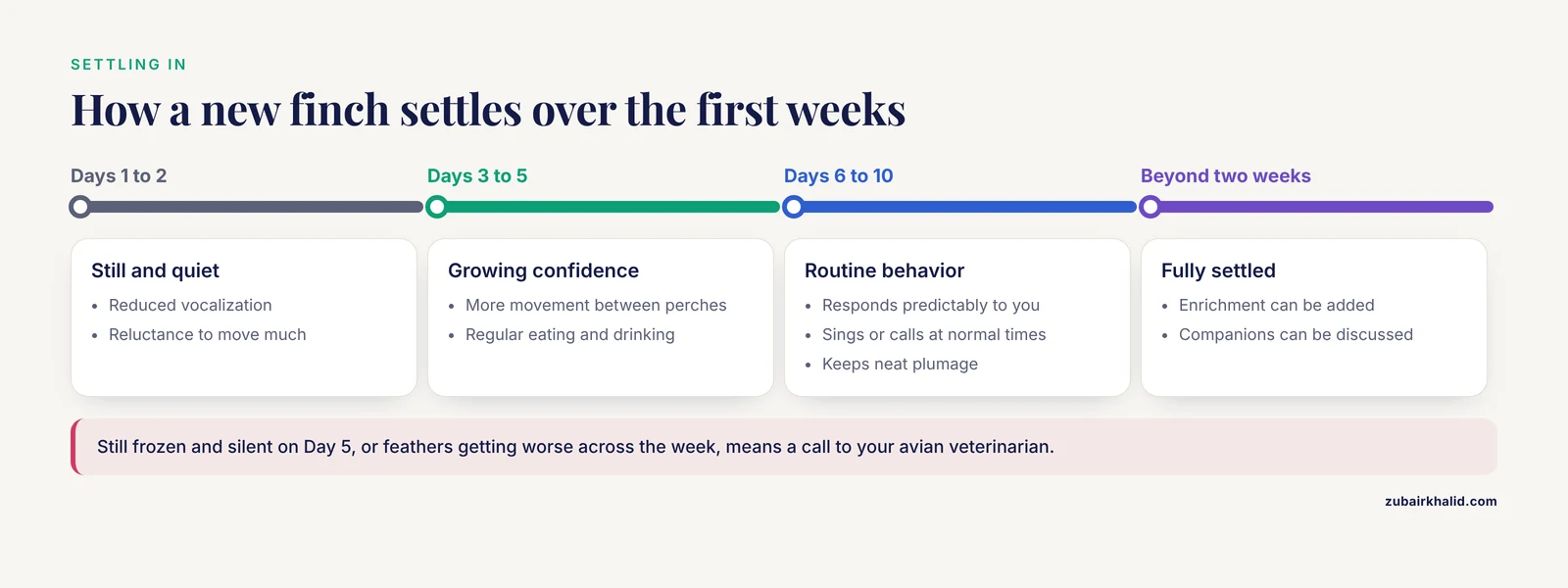
Owners commonly ask how long for a finch to settle in, and the honest answer is that it varies with the individual bird, its age, its history, and how calm the household is. The general pattern looks like this:
- Days 1 to 2. Stillness, reduced vocalization, and reluctance to move much. Normal.
- Days 3 to 5. Growing confidence. More movement, exploratory flights between perches, regular eating and drinking.
- Days 6 to 10. Routine behavior. The bird responds predictably to your movements, sings or calls at normal times, and maintains neat plumage.
- Beyond two weeks. Full settling, at which point enrichment additions, any planned companions, and routine care changes can be discussed with your veterinarian.
A finch that is still frozen and silent on Day 5, or one whose feather condition is deteriorating rather than improving across the first week, falls outside this pattern and warrants a call to your avian veterinarian. Individual birds vary, and the timeline above is a guide, not a guarantee for every animal.
Common Mistakes in the First Week
Handling too soon. Grabbing a new finch, even gently, teaches it that hands are terrifying. Every unnecessary capture in week one sets adjustment back.
Changing the diet immediately. A new home plus a new food is two major stressors at once. Keep the previous diet and plan any transition later with veterinary guidance.
Cage in the wrong spot. Kitchens are the most common bad placement. Fumes from overheated nonstick cookware and other aerosolized chemicals are acutely dangerous to birds, and the Merck Veterinary Manual's pet bird resources list respiratory hazards among the most serious household risks for caged birds. Choose a calmer room.
Misreading silence as contentment. A frozen, fluffed, silent bird is often a bird in trouble, not a bird that is relaxed. Movement, feeding, vocalizing, and clean plumage are the positive signs. Stillness alone is not.
Skipping the veterinary relationship. Owners who wait for a problem before finding an avian veterinarian lose the most valuable thing an early visit provides, which is a baseline of what their individual healthy bird looks like.
Adding a second bird too fast. Enthusiasm for companionship is reasonable, but new birds should be introduced on a schedule set with an avian veterinarian, not on the impulse of the first weekend.
Companionship and Introducing a Second Finch
Finches are highly social, and most owners eventually want more than one. Handle this slowly. Before any introduction, your new bird should be fully settled, and your avian veterinarian should advise on a quarantine period for any new bird entering the household, because apparently healthy birds can carry infections that only show up under examination.
The science of finch pair formation is more subtle than most owners assume. In zebra finches, mate choice research has examined the cues females use when selecting a male, including the colored leg rings used in research settings. One experiment found that female zebra finches preferred males associated with red color cues in the environment over males associated with green cues, though follow-up experiments found that environmental color cues not attached to the male's body did not consistently alter female choice or male behavior [2]. The relevant lesson for owners is not about cage colors. It is that pairing decisions in finches involve individual preferences that are not fully predictable, so introductions should be observed carefully and separated promptly if a pairing goes badly. Discuss introduction plans with your avian veterinarian before purchasing a companion.
Troubleshooting the First Week
My finch is not eating. Compare the dish levels to what you filled, and check the cage paper for seed hulls, which show processing even when the bird is nervous. If you see no evidence of eating by the end of Day 2, contact your avian veterinarian. Small birds have limited reserves, and food refusal is always a same-day call.
My finch stays on the cage floor. Occasionally resting low can happen, but persistent floor-sitting is a classic sign of illness in small birds and warrants an immediate call.
My finch fluffs up constantly. Brief fluffing, especially before sleep, is normal. Continuous fluffing combined with reduced activity is not.
My finch breathes with its mouth open. Open-mouth breathing is recognized in zebra finches as a behavior associated with discomfort and distress in research observation settings [3]. In a pet finch at home, open-mouth breathing at rest, with or without tail bobbing, is an emergency sign. Call an avian veterinarian immediately.
My finch seems terrified of me. That is normal in week one and does not require correction. Reduce your proximity, slow your movements, and let time do the work.
Welfare Monitoring Beyond Week One
The plumage scoring work on zebra finches matters beyond the first week. The researchers concluded that the plumage score is a simple, reliable, and non-invasive way to estimate an important indicator of well-being in captive zebra finches, and that it can be taught reliably to different observers, potentially in combination with the fat score [1]. Translated into owner practice, this means a monthly feather check is one of the best monitoring habits you can build. Run your eyes over the body, neck, and head for neatness, coverage, and wear. Photograph your bird when it is settled so you have a reference point for later comparison.
Adequate housing is described in that same research as a prerequisite for welfare in captive birds [1], which is the formal version of what every experienced finch keeper knows. The cage you set up in week one is not temporary housing to upgrade someday. It is the primary determinant of your bird's day-to-day well-being for its entire life.
Limitations and When to Contact a Veterinarian
Individual cases vary, and only an examination by an avian veterinarian can determine whether a particular bird is healthy. This guide describes patterns and published research, not a diagnosis for your bird.
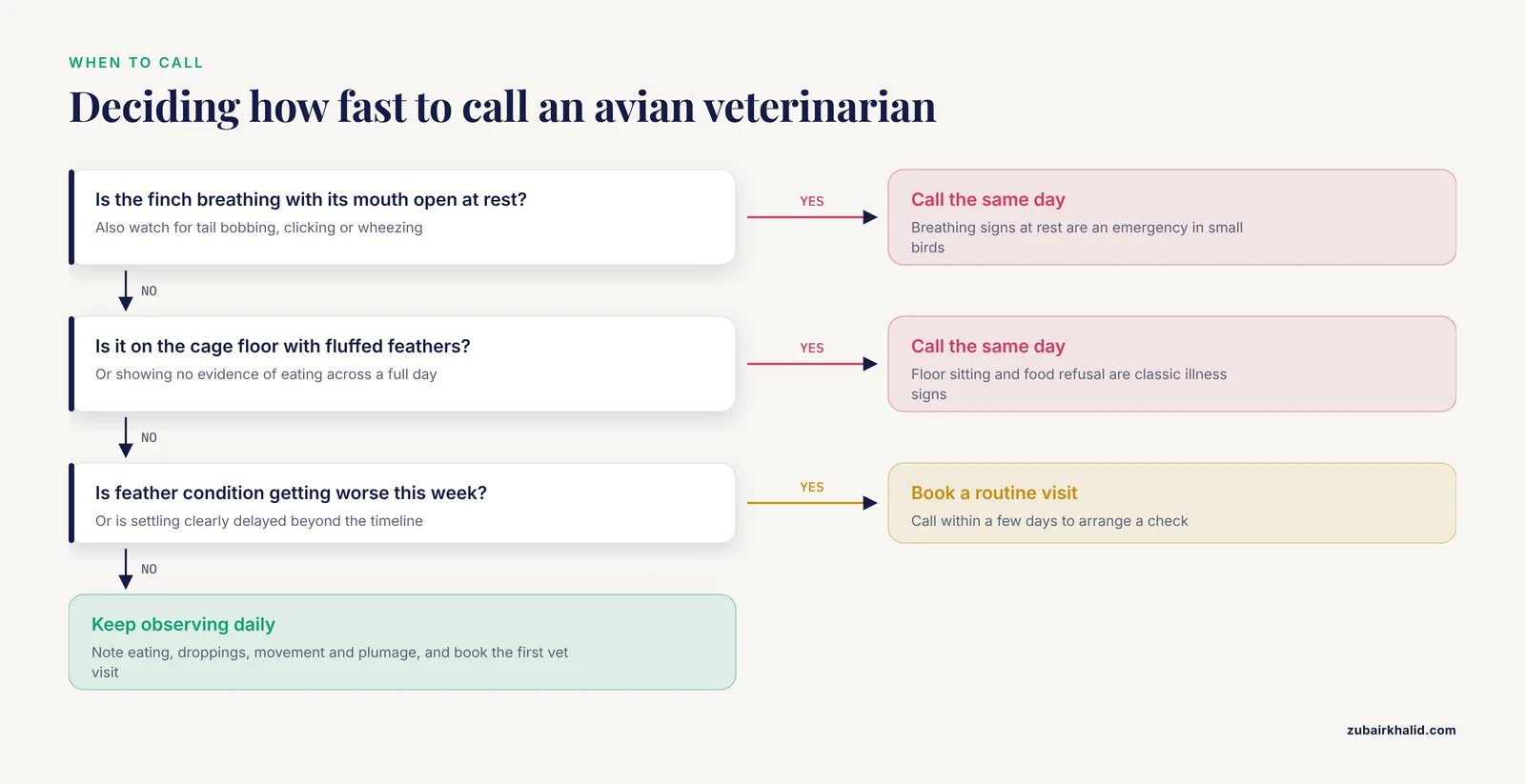
Contact an avian veterinarian on an urgent basis, meaning the same day, if your finch shows any of the following:
- Open-mouth breathing at rest, tail bobbing with respiration, or audible clicking or wheezing
- Sitting on the cage floor, especially with fluffed feathers
- No evidence of eating across a full day
- Persistent closed eyes, sleeping during normal active hours, or unresponsiveness
- Blood, an injured wing or leg, or a bird caught in cage hardware
- Sudden, sustained silence in a previously vocal bird
- Droppings that change abruptly in volume, color, or consistency, particularly with reduced appetite
Contact an avian veterinarian on a routine, within-a-few-days basis if:
- Feather condition is deteriorating across the first week
- Settling-in is significantly delayed beyond the timeline described above
- You want guidance on diet transition, cage enrichment, or introducing a companion bird
- You have not yet scheduled the first vet visit for a finch in your household
Keep the contact information for an emergency or after-hours avian facility before you need it. Small birds deteriorate quickly, and the difference between same-day and next-day care can matter.
Frequently Asked Questions
How long does it take a finch to settle into a new home?
Most finches show meaningful settling within three to five days and behave like fully settled birds within one to two weeks. Quiet households, a pre-set cage, and no handling shorten this timeline, while noise, traffic, and frequent cage changes lengthen it.
Should I bring home one finch or a pair?
Finches are social birds, and most keepers do best with a pair or small group, but add any second bird only after your first is settled and after discussing quarantine and introduction with an avian veterinarian. Pair formation involves individual preference, so introductions should be supervised closely.
When should the first vet visit for a finch happen?
Schedule it before or shortly after the bird comes home. Many avian veterinarians recommend a new bird exam soon after acquisition to establish a baseline and screen for underlying problems. When booking, confirm the practice sees finches and other small passerines.
What should be on a new finch checklist?
The cage, varied perches, food and water dishes with spares, the diet the bird was already eating, cage liner, a partial cage cover, and the phone number of an avian veterinarian, all prepared before pickup day.
Can I handle my finch during the first week?
No. Avoid handling during the first week except when necessary for safety. Finches are prey animals that experience capture as a predator event, and repeated handling during adjustment slows settling and can cause injury.
What does a healthy finch look like at the end of week one?
Neat, smooth plumage, upright perching, regular movement between perches, visible interest in food, normal droppings, and appropriate vocalization. Feather condition is one of the most reliable at-home indicators of well-being in small songbirds.
Should I cover the cage at night?
A partial cover that leaves one side open for airflow is a reasonable way to create a dark, secure sleeping environment in an active household. The priority is a consistent dark and quiet period each night, however you achieve it.
When can I introduce my new finch to my other birds?
Not during the first week. Your new bird needs to settle first, and any introduction should follow a quarantine period and a plan reviewed with your avian veterinarian, because birds that appear healthy can still carry infections.
Sources
- Plumage and Fat Condition Scores as Well-Being Assessment Indicators in a Small Passerine Bird, the Zebra Finch (Taeniopygia guttata).
- Colour Cues That Are Not Directly Attached to the Body of Males Do Not Influence the Mate Choice of Zebra Finches.
- Evaluation of Best Practices for the Euthanasia of Zebra Finches (Taeniopygia guttata).