Bringing Home a New Conure: First Week Guide
By Dr. Zubair Khalid, DVM, MS, PhD ·
Most conures need three to seven days of calm, low-pressure time to stop treating the new cage as a threat, and several more weeks to show their full personality. The job of the first week is narrow and simple. Set up the cage correctly, keep the environment quiet, feed a familiar diet, watch droppings and appetite, and book an avian veterinarian. Handling, training, and out-of-cage play come later.
Bringing home a conure goes wrong most often when owners do too much in the first 48 hours. A conure that is chased around the cage, showered with visitors, or switched to a brand new diet immediately will spend its energy on stress instead of settling. This guide walks through a day-by-day plan, a complete supply checklist, the reasoning behind each step, and what to do when things do not go to plan.
This article is educational and is not a substitute for veterinary diagnosis or treatment.
First Week at a Glance
Use this as your working plan. Adjust the pace to the individual bird. A bold hand-fed conure may be stepping up on day three. A nervous rehomed bird may need the whole week just to relax at the sight of you.
| Day | Goal | What to do |
|---|---|---|
| , - | , - | , - |
| Day 1 | Let the bird settle | Cage set up before the bird arrives. Hands off except for food and water changes. House quiet, no visitors. |
| Day 2 | Establish routine | Feed at fixed times. Sit near the cage and speak softly for a few minutes at a time. Do not force interaction. |
| Day 3 | Book the vet | Call an avian veterinarian and schedule a new bird exam during this week if you have not already. Start offering a favorite treat through the cage bars. |
| Day 4 | Build positive associations | Offer treats from your hand at the cage door if the bird approaches calmly. Keep sessions under five minutes. |
| Day 5 | Voluntary exploration | Open the cage door and let the bird decide whether to come out. Never pull the bird out. |
| Day 6 | Repeat and observe | Same routine. Watch droppings, appetite, weight if you have a scale, and activity level. |
| Day 7 | First vet visit | Attend the new bird exam. Bring notes on diet, housing, and behavior since arrival. |
How Long for a Conure to Settle In
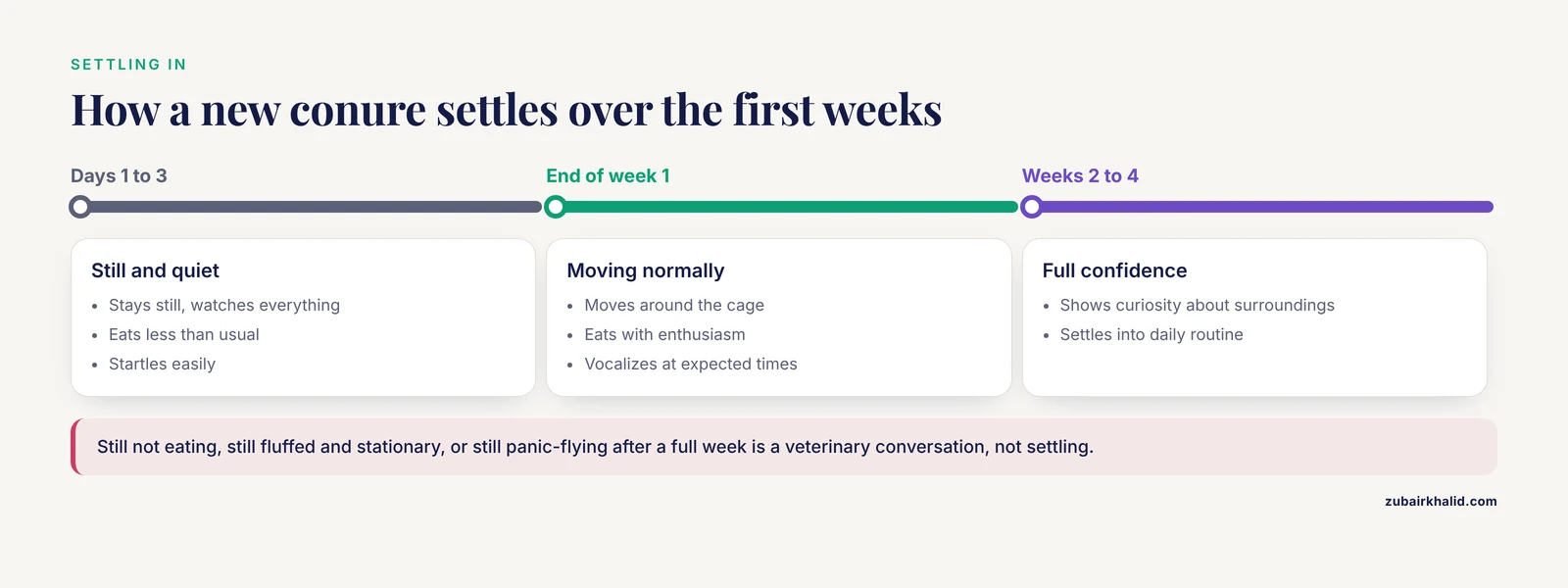
Expect visible relaxation within a few days and full confidence over several weeks. In the first two or three days, a settling conure often stays still, watches everything, eats less than usual, and startles easily. By the end of the first week, most birds move around the cage normally, eat with enthusiasm, vocalize at expected times, and begin showing curiosity about their surroundings.
Two things speed this up. The first is predictability. Conures settle fastest when feeding, lights, and household noise follow the same pattern every day. The second is choice. A bird that can retreat behind a toy, turn its back on you, or stay on a high perch controls its own exposure to new things, and that control is what turns fear into curiosity.
A survey of husbandry practices across professional animal care institutions found wide variation in how different facilities manage even basic routines for the same kinds of animals [1]. That variation is a useful reminder for owners. There is no single correct schedule for settling a conure, and the bird's own behavior is the schedule you should follow.
If your conure is still not eating normally, still fluffed and stationary, or still panic-flying inside the cage after a full week, that is no longer settling behavior. That is a veterinary conversation, and it is covered in the escalation section below.
New Conure Checklist
Buy everything before the bird comes home. A cage that needs rearranging on day three resets your settling clock.
Cage and location
- The widest cage you can reasonably fit and afford. Width matters more than height because birds use horizontal space for flight and exercise.
- Bar spacing narrow enough that the bird cannot push its head between the bars.
- A location in the family's main living area but out of constant traffic, away from direct sun, away from exterior doors and drafty windows, and not in the kitchen.
- A solid wall or corner behind at least one side of the cage. Birds feel safer with a protected back.
Perches and furnishings
- Several perches of different diameters and textures so pressure on the feet varies through the day.
- Natural wood branches sold for birds, placed so they do not sit directly over food or water dishes.
- Perch placement that lets the bird reach food, water, and toys without climbing the cage bars.
Food, water, and cleaning
- Sturdy dishes, positioned away from perches above them.
- Paper-based cage lining, checked and changed daily. Droppings on the liner are one of your best daily health monitors, so plain paper beats anything that hides them.
- A spray bottle or shallow dish for bathing, used only if the bird chooses to engage.
Enrichment
- Two or three toys to start, including something shreddable and something foraging-based. Rotate rather than crowd the cage.
- Enrichment is not decoration. A survey of UK backyard bird keepers found that the large majority, 78.4 percent, provided enrichment for their flocks, reflecting how standard this has become in bird-keeping practice [2].
Practical items
- A secure carrier for the first vet visit and any emergency.
- A cage cover or a predictable dark, quiet sleep location.
- A small digital scale if your veterinarian recommends tracking weight. Sudden weight loss is one of the most reliable early signs of illness in birds, and a bird that is losing weight often looks normal until it is quite sick.
- The contact details and after-hours plan for an avian veterinarian near you.
Feeding During the First Week
Do not change the diet in week one. Ask the breeder, store, or previous owner exactly what the bird was eating, including brand, form, and timing, and start there. A conure coping with a new home does not need the added stress of unfamiliar food.
If you plan to move the bird to a different diet, raise it with your avian veterinarian at the first visit and transition gradually over days to weeks, mixing old and new and watching droppings and body weight the whole time. The Lafeber Company publishes detailed owner-facing guidance on transitioning pet birds between diets, and it is a reasonable reference to work from alongside your vet's advice.
A practical pattern for week one looks like this:
- Fresh formulated diet and water each morning.
- Fresh vegetables or the familiar foods the bird already ate, offered at a consistent midday time.
- Remove perishable food after a few hours so it cannot spoil in a warm room.
- Note in a notebook what was eaten and what the droppings looked like. Three days of notes will make your first vet visit far more useful.
A conure that eats well, produces normal droppings, and holds its weight through the first week is very likely adjusting well physically even if it is still shy.
Quarantine and Health Precautions
If you have other birds at home, do not house or even room the new conure with them during the first weeks. Discuss quarantine length and setup with your avian veterinarian before the bird arrives, because the right duration depends on the bird's origin and history.
Quarantine is standard practice among experienced bird keepers. In a 2024 survey of UK backyard bird keepers, 70.2 percent isolated new additions before introducing them to their existing flock [2]. The habit exists for good reason. Newly transported birds are stressed, stressed birds can shed pathogens they were carrying quietly, and problems often appear days after arrival rather than on day one.
The quarantine period is also your observation window. The same principle guided the rehabilitation of hundreds of oiled seabirds after the MV Rena grounding in New Zealand, where birds were first stabilized in quiet housing before any more demanding procedures, and birds that arrived in poorer body condition fared worse [3]. The lesson transfers directly to a pet bird coming home. Stabilize first. Observe body condition and droppings. Handle the least necessary while the bird recovers from the move.
Practical quarantine points to confirm with your veterinarian:
- House the new bird in a separate room from existing birds, with separate dishes and cleaning tools.
- Care for your established birds first each day, or wash hands and change clothing between the two.
- Treat the new bird's first vet visit as part of the quarantine plan, not separate from it.
The First Vet Visit for a Conure
Schedule the first vet visit for a conure during the first week, ideally within the first few days. If the bird seems to be coping poorly, go sooner. If the bird is eating and active but shy, a visit at the end of week one is a reasonable target. When you call to book, ask the clinic what arrival timing they prefer, since some clinics like a bird to have a day or two of observations behind it before the exam.
Start with a veterinarian who actually sees birds. The Association of Avian Veterinarians maintains a public find-a-vet directory at aav.org, and it is the fastest way to locate an avian practice near you. This matters. In the backyard bird keeper survey cited above, 63.6 percent of keepers used veterinary services, but a minority reported struggling to find a veterinarian willing to treat their birds [2]. Locating the right clinic before you need one urgently is part of first week preparation, not an afterthought.
What to bring:
- Notes on what the bird eats, including the exact products if you know them.
- A description or photo of the cage setup and perch arrangement.
- Your three days of droppings and appetite notes.
- Any paperwork from the breeder, store, or previous owner, including hatch date if recorded.
- The bird in a secure, covered carrier.
What to expect. A new bird exam typically includes a hands-on physical examination, a weight check with the bird weighed on a gram scale, a review of diet and housing, and a discussion of what screening tests make sense given the bird's source and history. Your veterinarian may recommend testing for common infections in newly acquired birds and will discuss vaccination or preventive care decisions specific to your situation. VCA Animal Hospitals publishes owner guides describing the standard well-bird examination, and reading one beforehand helps you ask better questions.
Questions worth writing down before the appointment:
- Is my bird's weight and body condition appropriate?
- What diet transition plan do you recommend, if any?
- How long should this bird be kept apart from my other birds?
- What household hazards should I remove, given the Merck Veterinary Manual identifies fumes from overheated nonstick cookware and other airborne toxins as serious hazards for pet birds?
- What should this bird's normal droppings look like, and when do droppings justify a call?
Building Trust Without Rushing
Trust building in week one is mostly about what you do not do. A conure learns in the first days whether hands mean restraint or good things.
Work in this order:
- Passive presence. Sit near the cage doing something quiet. Read or use your phone. The bird learns your body language without any demand placed on it.
- Soft voice. Talk in a low, even tone as you pass the cage. Conures are loud birds, and they respond to energy in the room.
- Treats through the bars. Offer a small piece of a favorite food. If the bird will not take it, put it in the dish and walk away. Repeating this daily is the core of week one socialization.
- Hand near the door, no grabbing. Rest your hand calmly at the cage door while the bird watches. Never reach in to catch a bird that is not stepping up.
- Voluntary exit. When the bird willingly comes to the open door, that is your green light for the next stage.
Keep sessions short and end them while the bird is still comfortable. A conure that flies to the back of the cage after two minutes has told you the session was one minute too long. respecting that signal builds more trust than any training trick.
For a conure that was hand-fed and seems confident early, you can compress this sequence. For a rehomed adult with an unknown history, stretch it. Age and history change the pace but not the order.
Common First Week Mistakes
These are the errors that create long-term problems, and every one of them is avoidable.
Too much handling too soon. Forcing a step-up on day one teaches a conure that humans are inescapable threats. Biting that develops in week two is usually caused by handling pressure in week one.
Diet change on arrival. A bird that will not eat unfamiliar food can decline quickly. Feed what it knows first, transition later.
Wrong room placement. A cage beside a blasting television, in a drafty hallway, or in a kitchen exposes the bird to stress, temperature swings, or airborne hazards. Choose the location before the bird arrives.
Free access to the whole house. Opening the cage door into an un-bird-proofed room invites accidents. Windows, ceiling fans, open toilets, other pets, and toxic houseplants all belong on the hazard list you review with your vet.
Ignoring the droppings. Owners watch the bird's face and miss the paper liner. Droppings are the fastest daily health signal you have.
Skipping the vet visit because the bird looks fine. Birds mask illness. A bird that looks fine on day five may not be fine, and the new bird exam exists precisely because early problems are subtle.
Hosting a welcome party. Every new person, new sound, and new smell competes for the bird's limited settling capacity. Introduce the household gradually over the first weeks.
A Welfare Framework Worth Knowing
The Five Domains model is a widely used framework for assessing animal welfare, and an expert panel applying it to common interventions found that restrictions on behavior showed the strongest association with negative mental state impacts of any domain [4]. For a new conure, that finding has a direct application. The interventions that stress a settling bird most are the ones that remove its choices, such as forced handling, deprivation of escape routes, and constant disturbance.
The same principle shows up in sheltering research. A large survey of animal shelter organizations found that caregivers consistently provided basic physical resources like food and veterinary access, while psychological needs such as low-stress handling were met far less reliably [5]. Pet owners tend toward the same imbalance. New conure owners buy excellent cages and premium food and then, with the best intentions, overwhelm the bird with interaction.
The fix is to plan for the bird's mental state as deliberately as its physical setup. Choice, predictability, and the ability to opt out are the three levers you control in week one, and they matter as much as anything in the food dish.
Troubleshooting the First Week
The bird is not eating. First, confirm it is actually eating rather than just being watched at the wrong moments. Check that it recognizes the food you provided. If appetite seems reduced for more than a day, or droppings change sharply, call your avian veterinarian. Never wait several days on a bird that is not eating.
Constant screaming. A newly arrived conure often does contact calling, which is loud but normal. Screaming that escalates usually means a need is unmet, such as cover from a frightening sight line, food the bird recognizes, or rest. Address the environment before you address the noise.
Hiding or staying fluffed in a corner. Fluffed posture with reduced movement can be either settling behavior or early illness. Appetite and droppings tell the difference. If either is abnormal, escalate to your vet.
Refusing to come out of the cage. Do not force it. Leave the door open during supervised time, put a treat just outside, and let the bird explore on its own schedule. Some conures take two or three weeks.
Biting at offered hands. Stop hand offers, return to treat delivery through the bars, and rebuild more slowly. Biting is communication, not defiance.
Restless nights. Give the bird a covered or darkened, quiet sleep space at a consistent time. Households underestimate how much light and noise reach a cage at night.
Limitations and When to Contact a Veterinarian
Every conure is an individual, and history, age, and source all change what a normal first week looks like. The guidance here covers general patterns, and individual cases need a veterinarian who has examined the bird.
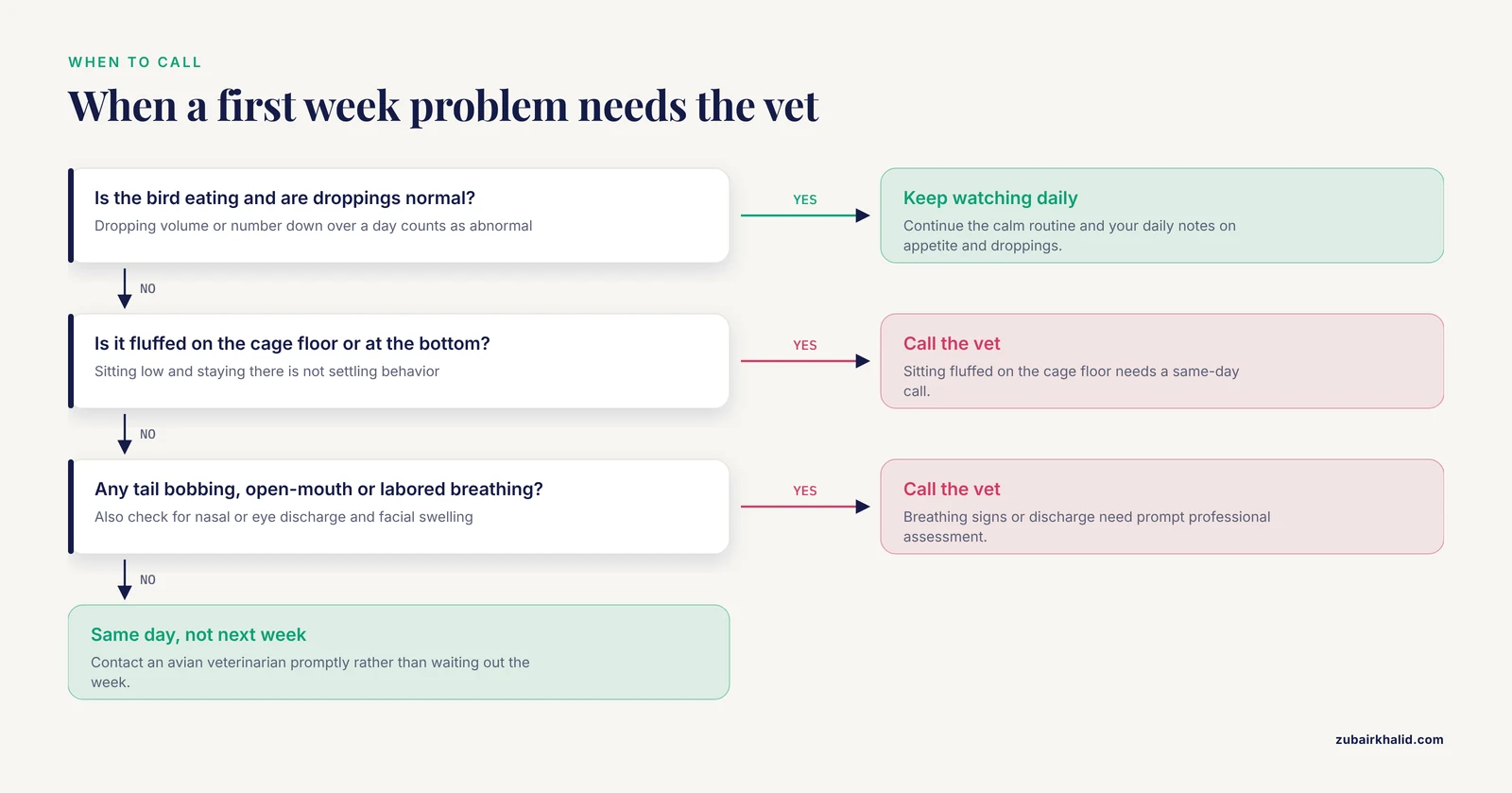
Contact an avian veterinarian promptly, the same day rather than waiting out the week, if you see any of the following:
- Sitting fluffed on the cage floor or remaining at the bottom of the cage.
- Not eating, or a marked drop in dropping volume or number over a day.
- Tail bobbing, open-mouth breathing, or labored breathing.
- Discharge from the nostrils or eyes, or swelling around the face.
- Droppings that are persistently loose, absent, oddly colored, or accompanied by straining.
- Sudden lethargy, loss of balance, or head tilt.
- Any bleeding, broken blood feather, or injury from a fall or another pet.
- Regurgitation that is frequent or accompanied by head stretching and fluid, which differs from normal bonding regurgitation and needs professional assessment.
Book a routine first visit within the first week even if none of these occur, both to establish baseline health and to build the relationship with the clinic you will rely on for this bird's lifetime. If you cannot find an avian veterinarian locally, ask general small animal clinics for a referral, or use the Association of Avian Veterinarians directory to widen the search.
Frequently Asked Questions
How long does it take a new conure to settle in?
Most conures visibly relax within three to seven days and reach full confidence over two to four weeks or longer. Hand-fed young birds often settle faster, while rehomed adults with unknown histories may need more time. Judge progress by appetite, droppings, activity, and willingness to approach you, not by a calendar.
When should my conure have its first vet visit?
During the first week, ideally within a few days of arrival, unless the bird seems unwell in which case go immediately. Call ahead to ask the clinic's preference on timing and bring notes on diet, housing, and behavior.
What should I do the first night my conure is home?
Set up the cage completely before the bird arrives, put it in the chosen room, and keep the evening calm and quiet. Offer familiar food and water, dim the lights at a consistent bedtime, and consider a partial cage cover. Do not handle the bird beyond what is necessary to transfer it into the cage.
What should I feed my conure in the first week?
Feed exactly what the bird was eating before it came home, even if you plan to change it later. Ask the breeder, store, or previous owner for specifics. Discuss any diet transition with your avian veterinarian at the first visit and change foods gradually while monitoring weight and droppings.
When can I start handling my new conure?
Start when the bird voluntarily approaches you, takes treats through the bars calmly, and moves normally around the cage, which for many birds is within a few days to a week. Begin with short, low-pressure sessions and never force a step-up. Pushing handling earlier is the most common cause of biting and lasting fear.
Should I cover my conure's cage at night?
A cover or a darkened quiet room is helpful if it gives the bird a predictable dark, quiet sleep period, and many conures rest better with one. Avoid thick covers that trap humidity and block all airflow, and watch whether your individual bird seems more relaxed covered or uncovered.
Can my new conure be around my other pets?
Not during the first week. Keep the conure in its own room away from cats, dogs, and other birds, both for quarantine reasons and to reduce stress. Introductions to other pets come much later, always with the bird caged and supervised, and your veterinarian can advise on the safest sequence for your household.
Do I need to quarantine my new conure from my other birds?
Yes if you have other birds, and your avian veterinarian should confirm the setup and duration. Isolating new birds is common practice among experienced keepers, and the first weeks are when newly transported birds are most likely to shed or show problems. House the new bird in a separate room with its own dishes and cleaning supplies during this period.
Sources
- Characterization of Current Husbandry and Veterinary Care Practices of the Giant Pacific Octopus (Enteroctopus dofleini) Using an Online Survey
- Survey of the husbandry and biosecurity practices of backyard chicken keepers in the UK.
- Captive husbandry and veterinary care of seabirds during the MV Rena oil spill response
- Using the Five Domains Model to Assess the Adverse Impacts of Husbandry, Veterinary, and Equitation Interventions on Horse Welfare
- Part 1: A Sector-Wide Survey of UK/British Isles Shelter Organisations Caring for Cats: Caregiver-Reported Approaches to Housing, Husbandry and General Care Provision