Bringing Home a New Canary: First Week Guide
By Dr. Zubair Khalid, DVM, MS, PhD ·
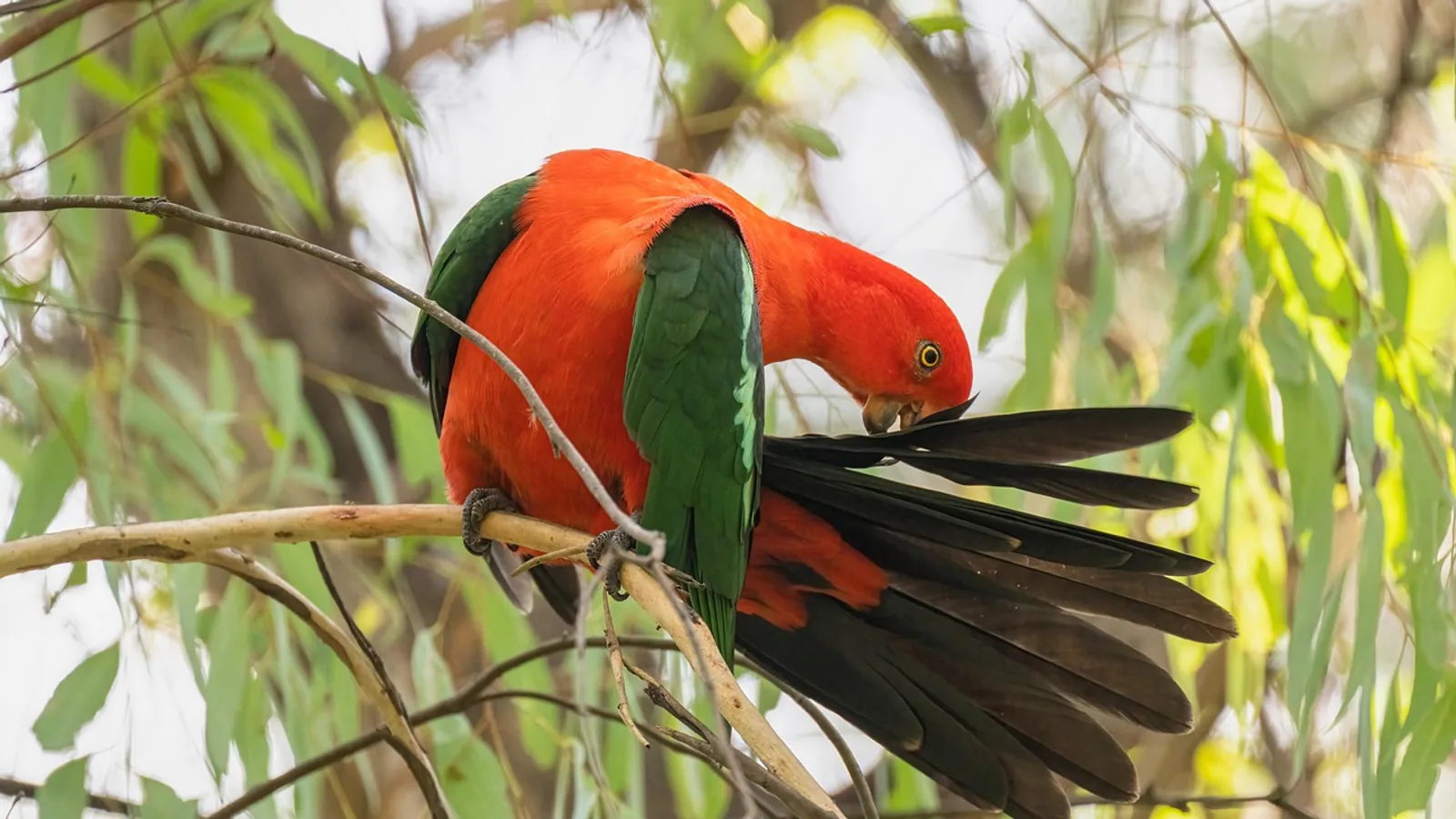
Most canaries need roughly one to two weeks to settle into a new home, and the first seven days set the tone for everything that follows. A canary that spends week one in a calm, warm, draft-free room with predictable food, water, and light usually transitions from a stressed newcomer to a confident, singing bird with very little drama. Your job during the new canary first week is not training or taming. Your job is to keep the environment quiet and stable, watch your bird closely, and let it learn that the cage is a safe place.
This guide walks through what to prepare before your canary arrives, what the first 24 hours should look like, how to read normal settling behavior versus warning signs, what to feed during the transition, and how to plan the first vet visit for a canary. Modern welfare research supports this hands-off, observation-heavy approach. Studies of animals moved into new housing consistently show that careful behavioral observation during the initial period produces better welfare decisions than early intervention [1], and researchers increasingly emphasize that welfare is best judged by combining behavior with physiological stress indicators rather than a single measure [2].
This article is educational and is not a substitute for veterinary diagnosis or treatment.
At a Glance: Your First Week Plan
| Day | Focus | What to Do |
|---|---|---|
| , - | , - | , - |
| Before arrival | Setup | Assemble the full new canary checklist, place the cage, buy the food the bird is already eating |
| Day 1 | Rest | Transport home, place bird in cage, leave the room quiet, no handling |
| Day 2 | Observation | Minimal interaction, confirm the bird is eating and droppings look normal |
| Day 3 | Routine | Establish consistent light and feeding times, sit quietly near the cage |
| Day 4 | Diet check | Confirm seed and water intake, begin slow transition toward the diet your avian veterinarian recommends |
| Day 5 | Enrichment | Add or rotate a safe toy, keep handling off the agenda |
| Day 6 | Monitoring | Weigh if you have a gram scale, record droppings, appetite, and activity |
| Day 7 | Vet planning | Schedule the first vet visit for a canary with an avian veterinarian, bring notes from the week |
| Days 8 to 14 | Consolidation | Keep the routine steady, expect increasing song and activity |
New Canary Checklist: What to Have Ready Before Arrival
Bringing home a canary goes smoothly when the cage is already set up and running before the bird walks through the door. A canary should move directly from the carrier into a prepared cage, not wait in a cardboard box while you assemble equipment. Work through this list in advance.
The Cage
Canaries are flying birds, not climbing birds. Choose a cage that is wider than it is tall, with horizontal space being the priority. A long, low flight-style cage serves a canary far better than a tall, narrow decorative cage. Buy the largest cage your space and budget allow, because a canary that exercises by flying between perches is healthier and more active than one confined to a small footprint.
Bar spacing should be narrow enough that the bird cannot wedge its head between bars. Stainless steel or powder-coated cages with a removable tray are easiest to keep clean.
Perches
Provide several perches of varying diameter so your canary's feet experience different pressures and angles. Natural wood branches of bird-safe species are a good option. Avoid sandpaper perch covers, which are widely discouraged by avian veterinarians because of foot irritation. Position perches so the bird can hop between them without bumping food dishes, and do not place any perch directly over another where droppings would contaminate the lower perch.
Food and Water Dishes
Use two or three dishes that attach securely to the cage bars. Separate dishes for seed, fresh water, and fresh foods work well. Shallow, wide dishes are easier for a small finch-type bird to use. Place them away from perch ends so droppings do not land in food.
Food for Week One
Buy the same food the bird was eating before you brought it home. Ask the breeder, pet store, or rescue exactly what seed mix or pellet brand the canary has been receiving, and continue that diet for the first week without change. A diet switch during the settling period adds an unnecessary stressor and risks the bird simply not recognizing the new food as food. Diet change is a project for weeks two and beyond, done gradually.
Cage Liner and Cleaning Supplies
Line the tray with plain paper or paper towels. Avoid cedar and other aromatic wood shavings, which avian health resources such as the Merck Veterinary Manual flag as respiratory irritants for birds. Keep a dedicated scoop, paper towels, and a bird-safe cleaning solution on hand so daily tray changes take under five minutes.
Location Supplies
Before the bird arrives, decide where the cage goes. The spot should be:
- Free of drafts, including air conditioning vents, open windows, and exterior doors
- Away from the kitchen, because overheated nonstick cookware and cooking fumes are dangerous to birds, a hazard the Association of Avian Veterinarians highlights repeatedly in its owner guidance
- In a room where the household gathers at a moderate level, so the bird hears normal life without being startled constantly
- Out of direct, all-day sun but with access to a normal day and night light cycle
- At a height where the cage is not on the floor, which most birds find threatening
A breathable cage cover or a plain sheet helps signal lights-out at night. Many canary keepers cover the cage for a consistent dark period each evening, which supports a stable sleep rhythm.
Optional but Useful
A small digital gram scale for tracking weight, a notebook or phone note for daily observations, and a carrier for vet visits round out a practical new canary checklist.
Bringing Home a Canary: The First 24 Hours
The first day is about one thing, and that is rest. The drive home, the change of surroundings, new smells, and new sounds represent a significant stress load for a small prey animal.
Transport
Transport your canary in a small, secure carrier or travel cage rather than carrying the full main cage. Cover the carrier loosely with a light cloth to reduce visual stimulation while still allowing airflow. Drive smoothly, keep the car at a comfortable temperature, and avoid loud music. A short trip of under an hour is ideal, and a canary can safely wait in the covered carrier for the time the trip takes without food or water.
Moving Into the Cage
Set up the cage completely before opening the carrier. Food and water dishes filled, perches in place, liner down. Then open the carrier inside the cage or hold it at the open cage door and let the bird walk or fly out on its own. Do not reach in, do not tip the carrier, and do not chase the bird. If it hesitates, give it time. Most canaries will exit within a few minutes once the carrier sits still.
Then, Do Almost Nothing
After the bird is in the cage, cover one side of the cage partially to create a sheltered corner, and leave the room largely alone for the rest of the day. Speak in a normal, calm voice if you pass by. Do not put your hand in the cage. Do not invite friends over to see the new bird. Do not rearrange perches.
Your canary will likely sit still, often fluffed slightly, and may eat little on day one. This is expected. Watch from a distance.
How Long for a Canary to Settle In
This is one of the most common questions new owners ask, and the honest answer is a range. Many canaries show clear improvement within three to five days, and most are settled, eating well, and singing within one to two weeks. Some individuals, especially older birds or birds from stressful previous environments, need longer. There is no fixed deadline, and comparing your bird to someone else's canary rarely helps.
The more useful frame is to watch the trend. Behavioral monitoring during the first days in new housing is exactly how welfare scientists approach acclimation in managed animals. In a welfare study of threatened lizards moved into managed enclosures, systematic observation of daily activity, feeding, and social behavior during the initial stages of housing directly informed management decisions and improved the animals' welfare [1]. The same principle applies to your canary. You are not just watching for entertainment. You are collecting baseline data.
What Normal Settling Looks Like
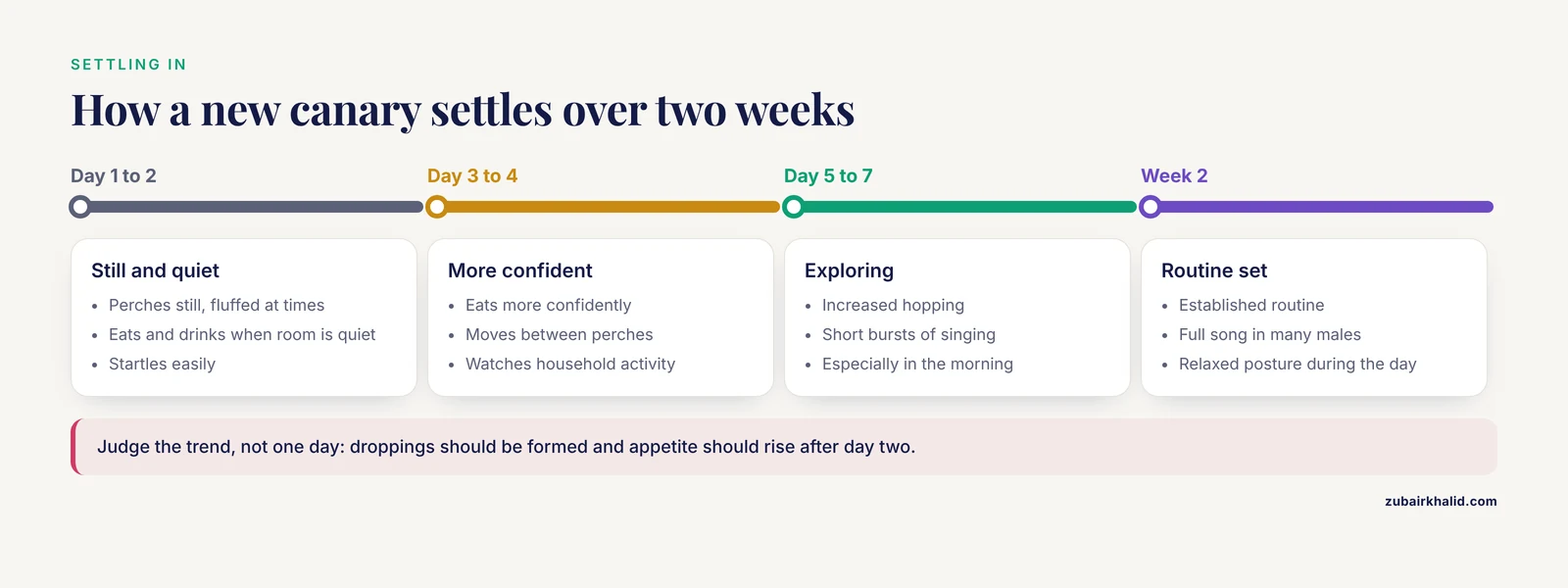
Over the first week, a settling canary typically shows a progression like this:
- Day 1 to 2: Perches still, fluffed at times, eats and drinks when the room is quiet, startles easily
- Day 3 to 4: Eats more confidently, moves between perches, watches household activity with interest
- Day 5 to 7: Increased hopping, exploring the cage, short bursts of singing, especially in the morning
- Week 2: Established routine, full song in many males, relaxed posture during the day
Droppings should be formed, with a dark solid portion and a white urate cap. Appetite should trend upward after day two. These are the two most reliable daily indicators that a canary is settling well.
What Physiological Stress Research Adds
Owners usually judge stress by behavior alone, but welfare science increasingly pairs behavior with physiological measures. Research on managed wildlife has validated non-invasive hormone sampling as a way to track stress and welfare over time, with cortisol-type measures showing meaningful links to negative welfare states when interpreted alongside behavior, body weight, and other indicators [2]. You cannot measure your canary's hormones at home, but the underlying message transfers directly: a single observation is weak evidence, while a pattern across appetite, droppings, weight, posture, and activity is strong evidence. Keep simple daily notes for the first two weeks. If the bird ever sees a veterinarian, those notes are genuinely valuable.
Daily Care Routine for Week One
Predictability is the most powerful calming tool you have. Canaries respond to consistent routines faster than to any taming technique.
Light Cycle
Give your canary a consistent schedule of roughly 10 to 12 hours of light and a correspondingly dark, quiet period at night. Cover the cage at the same time each evening and uncover it at the same time each morning. Irregular light exposure disrupts rest and, over longer periods, can affect molting and breeding cycles, a topic worth discussing with your avian veterinarian for your specific bird.
Feeding Times
Refresh seed and water at roughly the same time each morning. Check water again in the evening. Consistent timing helps the bird learn when to expect resources, which reduces vigilance behavior.
Cleaning
Change the tray liner daily. Wash food and water dishes daily with hot water. Do a full cage clean weekly, but during week one keep cleaning brief and calm, because a large cleaning event with unfamiliar noises can restart the settling clock. Spot clean around the cage rather than dismantling everything in the first days.
Sound and Interaction
Sit near the cage and speak or read softly for a few minutes two or three times a day. This teaches the bird your presence is safe without demanding anything of it. Resist the urge to put your hand in the cage during week one. Canaries are generally observed rather than handled birds, and early forced interaction damages trust that takes weeks to rebuild.
Feeding During the Transition
Week one nutrition has one rule, which is continuity. Feed what the bird already knows.
Seed as the Familiar Base
Most canaries arrive eating a canary seed mix. Keep that mix available in a full dish at all times during week one. A small bird with a fast metabolism cannot safely go long without eating, so an empty seed dish is never acceptable.
Fresh Foods, Carefully
You can offer a small piece of dark leafy green or a slice of apple in a separate dish from day three onward, but do not judge the bird for ignoring it. Novel foods often take repeated exposures before a canary tries them, and some birds will not touch anything new until fully settled. Lafeber Company's avian nutrition resources emphasize gradual diet transition for small birds precisely because abrupt changes lead birds to hold out for the familiar food, which is risky for a small species.
Water
Fresh, clean water daily, in a dish the bird already knows how to use. If your tap water is heavily treated or you have any concern about its quality, ask your avian veterinarian what they recommend for your local supply rather than guessing.
What Not to Do
Do not introduce pellets, egg food, supplements, grit, or treats during week one unless your avian veterinarian instructs you to. Do not assume the bird needs grit. Modern avian veterinary guidance, including materials from the Association of Avian Veterinarians, generally does not recommend grit for canaries, and adding it is a common beginner error worth confirming with your own vet.
Common Mistakes Owners Make in the First Week
Most first-week problems trace back to a handful of avoidable errors.
- Handling too soon. The single most common mistake. Hands in the cage during days 1 to 5 set back settling considerably. Hands-off observation is the correct approach for a canary anyway.
- Changing the diet immediately. New food plus new home is two stressors at once. Keep the familiar diet, transition later.
- Moving the cage around. Pick the location before arrival and keep it fixed for at least two weeks. Repeated relocation tells the bird nothing is stable.
- Loud environments. Television volume, guests, children bursting into the room, and other pets sniffing at the cage all prolong stress. Introduce household members gradually and calmly.
- Judging day one too harshly. A quiet, still, fluffed bird on day one is normal. Panic and repeated cage-side hovering add stimulation, not comfort.
- Housing the new bird next to an existing bird immediately. Keep cages in separate rooms during any quarantine period your avian veterinarian recommends, and watch for territorial responses even across the room. Direct observation of individual compatibility is what allows sound housing decisions with any territorial species, as demonstrated in managed-care studies where behavioral data on aggression and tolerance directly changed which animals were housed where [1].
- Skipping the vet visit because the bird looks fine. Birds are adept at hiding illness. A baseline exam early in ownership is one of the highest-value things you can do.
Troubleshooting: When Things Look Off
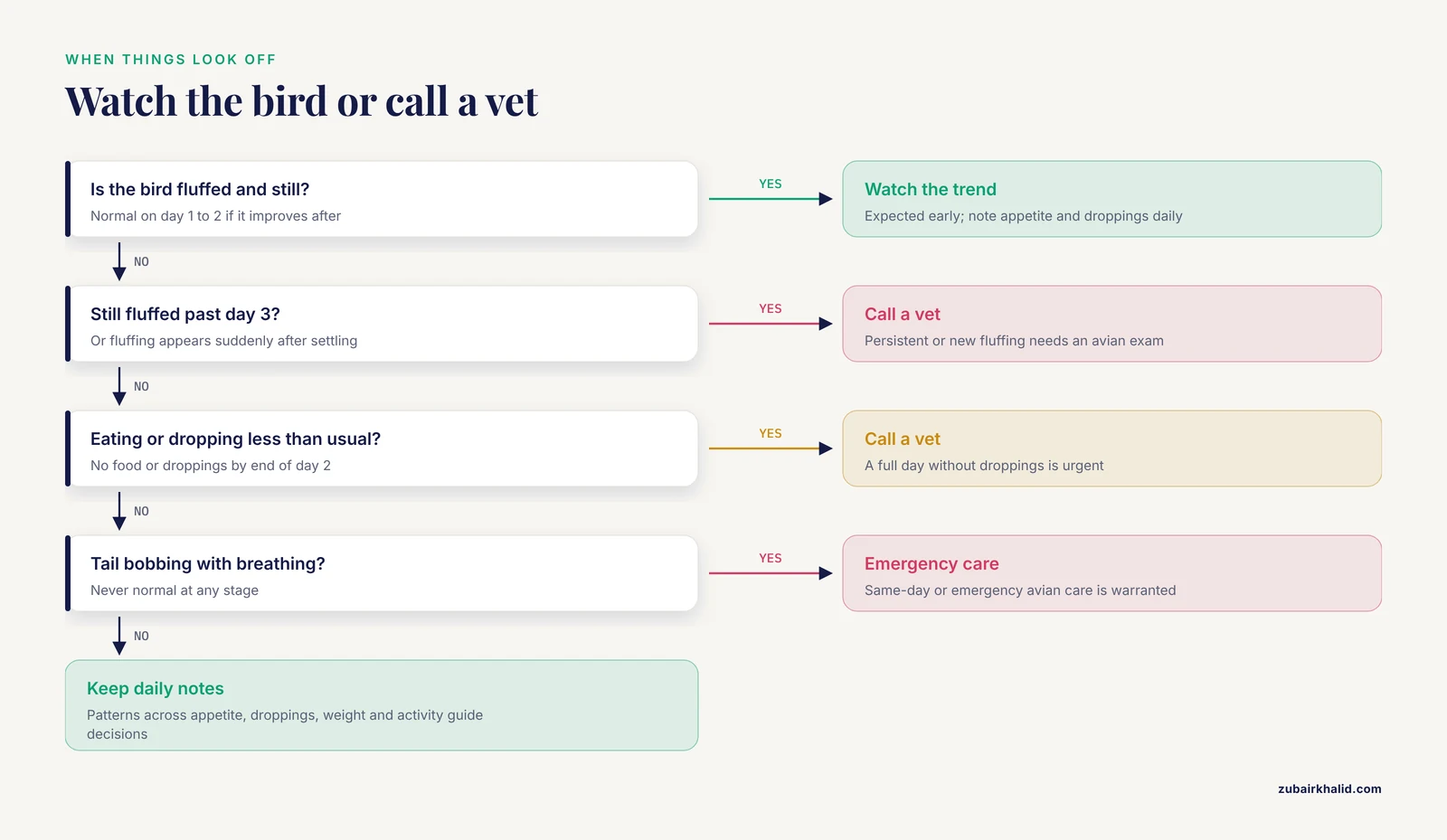
Use this quick guide to interpret what you are seeing. Trend matters more than any single day.
| Observation | Likely Fine If | Contact a Vet If |
|---|---|---|
| , - | , - | , - |
| Sitting fluffed and still | Day 1 to 2, then improving | Persists beyond day 3, or appears suddenly after settling |
| Not eating much | Day 1, with seed interest by day 2 | No eating or drinking by end of day 2, or a full day of no droppings |
| No singing | Entire first week, common | Absent well past two weeks with other changes, or sudden loss of established song |
| Quiet, few droppings | First morning after arrival | Ongoing, combined with fluffing or weight loss |
| Tail bobbing with breathing effort | Never normal | Any time, urgently |
| Sitting on the cage floor | Briefly, adjusting | Repeatedly, especially with fluffing or closed eyes |
Sitting fluffed on the cage floor with labored breathing is an emergency. Small birds decompensate fast, and same-day or emergency avian care is warranted.
The First Vet Visit for a Canary
Schedule the first vet visit for a canary within the first week or two of ownership, ideally after the bird has had a few days to settle but not so long that a hidden problem goes undetected. Many avian veterinarians recommend an initial wellness exam for any new bird, and some also recommend a quarantine period of several weeks between a new bird and existing birds, with the exact approach depending on your household. Ask your veterinarian to lay out a plan specific to your situation.
Finding the Right Veterinarian
Not all small animal clinics treat birds. Look for a veterinarian with avian qualifications or demonstrated avian experience. The Association of Avian Veterinarians maintains a find-a-vet resource, and VCA Animal Hospitals publishes owner-facing avian care guides that can help you understand what an avian exam typically covers. Call ahead and confirm the clinic sees canaries specifically, since finch and canary medicine differs in practical ways from parrot medicine.
What to Expect at the Visit
A typical new-bird exam includes a hands-on physical examination, a weight check to establish a baseline, an oral and cloacal inspection, and often a fecal examination to screen for parasites. Your veterinarian may recommend additional testing based on the bird's history and source. Bring:
- Your daily notes from the first week, including appetite, droppings, and activity
- A fresh droppings sample from the cage paper that morning, collected clean and kept cool
- Information on the bird's source, approximate age if known, and current diet
- Photos or details of your cage setup if you want feedback on it
Questions Worth Asking
Prepare a short list before you go:
- What diet transition plan do you recommend for this bird over the coming months?
- Does this bird need any screening tests based on its source?
- How long should any quarantine from my other birds last?
- What weight range is normal for this bird, and how should I monitor at home?
- What are the most common health problems you see in canaries in your practice?
Welfare and Safety Beyond the Basics
The first week is also when you set welfare standards that will hold for the bird's entire life, which for a healthy canary can mean many years.
Air Quality
A canary's respiratory system is extraordinarily efficient, which is an advantage in the wild and a vulnerability indoors. Aerosolized cooking fumes, especially from overheated nonstick pans, smoke, scented candles, air fresheners, and strong cleaning products can harm birds quickly. Keep the bird's room well ventilated and free of airborne chemicals, guidance echoed across avian veterinary resources including the Merck Veterinary Manual's pet bird materials.
Environmental Stability
Contemporary welfare research emphasizes that welfare is best assessed and managed as a multifactorial picture, combining behavior, physiological indicators, body condition, and environment rather than any single measure [2]. In practical terms, that means your canary's welfare depends on stable light cycles, predictable feeding, appropriate space, freedom from drafts and toxins, and the chance to express natural behaviors like flying, hopping, and singing. A stable routine covering all of these is worth more than any single perfect purchase.
Enrichment Without Overwhelm
After the first week, offer enrichment in small steps. One new item at a time, observed from a distance. Safe options include fresh branches from bird-safe species, simple foraging opportunities built around seed, and varied perch positions. Rotate items rather than piling them in. If the bird startles repeatedly at an addition, remove it and reintroduce later.
Limitations and When to Contact a Veterinarian
Individual canaries vary widely in age, history, and temperament, and no general article can replace an examination of your actual bird. Use this guide for preparation and observation, and involve an avian veterinarian for anything diagnostic or medical.
Contact an avian veterinarian promptly if you observe any of the following:
- Sitting fluffed on the cage floor, especially with labored or open-mouth breathing
- Tail bobbing in rhythm with breathing
- No food intake or no droppings for a full day after the first 48 hours
- Discharge from the eyes or nostrils, or crusted feathers around the face
- A sudden, unexplained change in droppings lasting more than a day
- Significant weight loss if you are tracking weight
- Injury, bleeding, or a suspected fracture
- Sudden loss of song and activity together in a previously settled bird
Emergency signs such as respiratory distress or collapse warrant immediate care, not observation.
Frequently Asked Questions
How long does it take for a canary to settle in?
Most canaries settle into a new home within one to two weeks, with noticeable improvement often visible by day three to five. Individual birds vary, so judge progress by the trend in appetite, droppings, and activity rather than a fixed deadline.
Should I cover my canary's cage at night?
A consistent evening cover that creates a dark, quiet sleep period is a widely used and reasonable practice. Aim for a regular schedule each night, and ask your avian veterinarian what light cycle they recommend for your bird.
When can I start handling my new canary?
Wait until the bird is fully settled, eating well, and relaxed, which is typically at least a week or two. Canaries are generally observe-first pets, and any handling should be gradual and patient.
What should I feed my canary during the first week?
Feed exactly what the bird was eating before arrival for the entire first week. Ask the seller for the specific food in advance, and plan any diet transition gradually after settling is complete, following your veterinarian's guidance.
When should the first vet visit for a canary happen?
Schedule a wellness exam with an avian veterinarian within the first week or two of ownership. Early visits establish a weight baseline, screen for hidden problems, and set up a diet and care plan.
My canary is not singing. Is something wrong?
Silence during the first week is normal and usually reflects settling, not illness. If a bird that has settled and previously sang stops singing alongside other changes such as reduced appetite or fluffing, contact your avian veterinarian.
Can I put my new canary near my other birds?
Keep a new canary in a separate room from existing birds during any quarantine period your avian veterinarian recommends, and monitor all birds for signs of stress or aggression before and after any gradual reintroduction to shared airspace.
How do I know if my canary is stressed?
Look for patterns rather than single moments, including persistent fluffing, reduced appetite, few droppings, repeated startle responses, and prolonged stillness beyond the first few days. If several of these persist past day three or four, consult an avian veterinarian.