The 5-Minute Morning Bird Health Check Routine
By Dr. Zubair Khalid, DVM, MS, PhD ·

The 5-minute morning bird health check is a fixed five-step scan you run at lights-on every day. You read posture and breathing from across the room, interpret the overnight droppings on the cage paper, inspect the head and face up close, survey the body and feet, and finish with a food, water, and cage audit. One line then goes into a log. The order never changes and the timing never moves.
That structure is the whole point. Pet birds are prey animals, and masking sickness is a survival behavior, a fact that every avian care reference from the Merck Veterinary Manual to the VCA Animal Hospitals bird guides hammers home for new owners. By the time a parrot sits fluffed on the cage floor, it has often been unwell for days. A structured morning check exists to catch the quiet deviations that come first: a slightly smaller dropping, a shorter greeting call, a seed dish that looks full but is really just a pile of empty hulls.
Morning is the right time for three practical reasons. Overnight droppings accumulate in one readable place, the bird has fasted so appetite signals are clean, and wake-up behavior is the most consistent baseline you will ever get. Five minutes at lights-on gives you more usable information than an occasional hour of worried staring.
This article is educational and is not a substitute for veterinary diagnosis or treatment.
At a Glance: The Five Stations
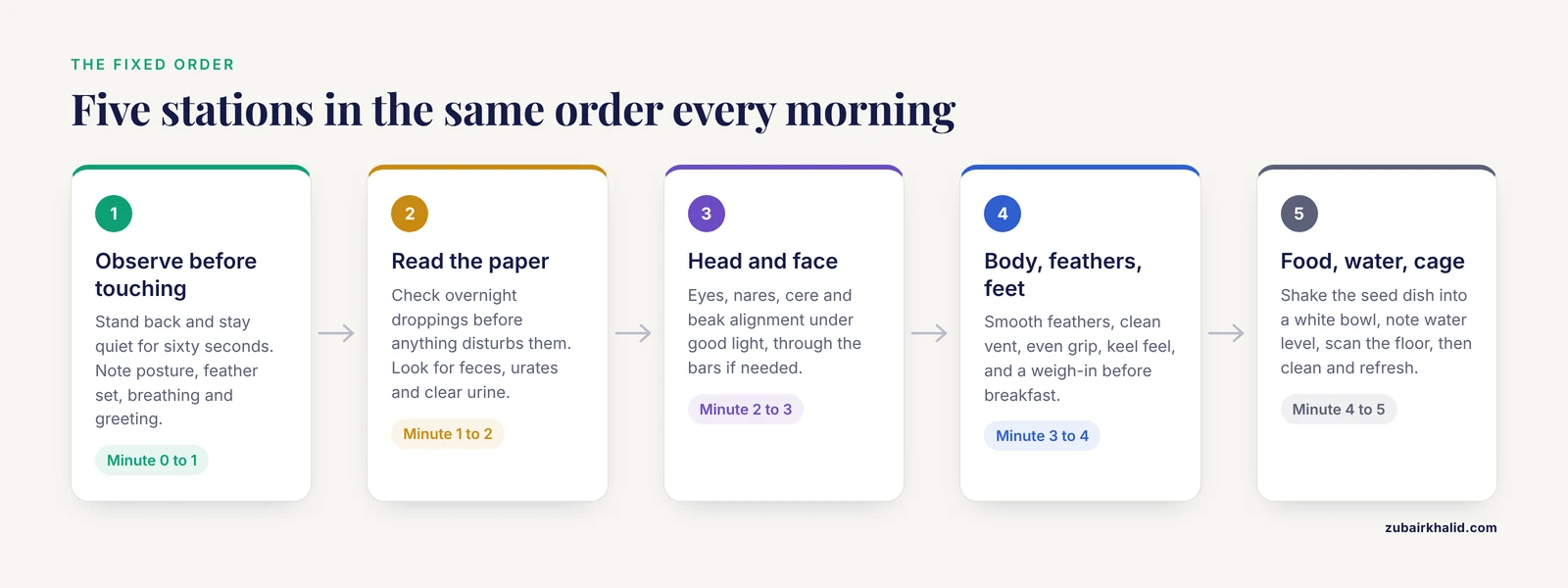
| Minute | Station | Normal | Red flag |
|---|---|---|---|
| 0-1 | Whole-bird scan | Upright, both feet gripping, bright-eyed, greets you | Fluffed and low, tail bobbing at rest, eyes half closed, silent |
| 1-2 | Overnight droppings | Dark feces, white urates, clear urine | No droppings, green or yellow urates, blood, undigested seed |
| 2-3 | Head and face | Clear eyes, dry nostrils, aligned beak | Discharge, swelling, squinting, crusted nares |
| 3-4 | Body and feet | Smooth feathers, clean vent, firm grip | Sharp keel, soiled vent, weak grip, bald patches |
| 4-5 | Food, water, cage | Dish genuinely eaten down, clean water | Full dish of unhulled seed, soiled water, blood on the floor |
Why a Morning Bird Health Check Routine Works
Across hospital wards, cattle feedyards, and poultry houses, structured daily monitoring finds trouble earlier than occasional inspection.
Hospital medicine makes the case clearly. Modified early warning scores are traditionally calculated three to four times a day through spot checks, and research on 905 general-ward patients examined how easily that rhythm misses early deterioration, which is why hospitals are moving toward continuous monitoring paired with automated early warning systems [1]. Your bird lives with an intermittent observer, you. The fix is not more anxiety. The fix is a fixed daily protocol.
Livestock science shows the same effect with harder endpoints. An electronic feeding system that tracked 2,826 group-housed pigs detected 55.7 percent of the illnesses later diagnosed by caretakers, and it flagged them on average 2.8 days earlier [2]. In beef cattle, automated recording of individual drinking behavior during the high-risk adaptation period at the fattening unit provided useful early indicators of respiratory disease, the leading health problem in those herds [3]. Reduced intake is one of the first measurable signs of trouble in warm-blooded animals everywhere, which is why the dish audit and the dropping count anchor this routine.
Poultry operations already run on repeated visual inspection. Commercial houses in Taiwan holding 15,000 to 20,000 chickens are inspected three times daily, and eye condition is a core finding inspectors look for, so much so that researchers built a camera-based early warning system for abnormal eyes that reached a precision of 0.944 and a recall of 0.831 across three production cycles in a working farm [4]. A budgerigar in your living room deserves at least the inspection frequency of a broiler house.
Finally, the routine converts feelings into data. Elite endurance coaches who manage medal-winning athletes consistently rated daily follow-up and systematic diaries as their most important monitoring tools, and they treat a mismatch between expected and observed performance as an early warning sign [5]. Your one-line log does the same job for a canary.
The 5-Minute Morning Bird Health Check, Step by Step
Run the check before you change food or water, before you clean, and before much talking. Interaction resets behavior and destroys the baseline you came to measure.
Minute 0 to 1: Observe Before You Touch
Stand back, stay quiet, and watch for sixty seconds. VCA Animal Hospitals' avian care guides push new owners to learn their individual bird's normal rhythm, and this minute is where that knowledge gets built.
Normal looks like an upright bird on the perch, both feet gripping, feathers smooth or only briefly fluffed after waking, eyes fully open, and a usual greeting call or curious response to your presence.
Not normal looks like sitting low on the perch or on the cage floor, feathers persistently fluffed through the whole minute, one foot not gripping, eyes half closed during active hours, labored breathing with a visible tail bob at rest, open-mouth breathing, or a clicking or wheezing sound with each breath. Silence from a normally loud bird is a finding, not a blessing.
While you watch, count breaths for fifteen seconds and multiply by four. Respiratory rate is one of the most informative vital signs in medicine and one of the most neglected, a gap so consistent that a hospital quality-improvement project in Japan found it recorded in only about 3 percent of routine vital-sign sets before targeted intervention [6]. Simple counts carry real signal. In a pediatric sepsis study in Bangladesh, a small wireless wearable collected heart rate, respiratory rate, and temperature alongside clinician measurements, and the two were formally tested for agreement as core monitoring data [7]. Log your own bird's resting number rather than comparing it to a species chart, because normal rates vary widely with body size and excitement.
Minute 1 to 2: Read the Paper Before You Read the Bird
Lift the tray or lean in and read the overnight droppings before anything disturbs them. A healthy dropping has three visible parts: a coiled feces portion that is green to brown depending on diet, a white to cream urate portion, and a small pool of clear urine.
Red flags on the paper include no droppings at all from a bird that spent the night in the cage, feces that are black, tarry, or streaked with blood, undigested seed visible in the feces, urates that are bright yellow or green, droppings dramatically smaller or fewer than your baseline, and droppings so watery they soak the paper with no fecal component. Green or yellow urates can reflect liver or systemic disease and justify a same-day call to an avian veterinarian. No overnight droppings suggest the bird stopped eating, and in a small bird that is an emergency, not a watch-and-wait situation.
Minute 2 to 3: Head and Face Up Close
Ask for a step-up or simply observe through the bars under good light. Eyes come first. They should be bright, fully open, and symmetrical, with no discharge, redness, or swelling around them. Eye state is such a consistent early illness marker in birds that poultry researchers built an entire automated warning system around detecting abnormal eyes [4].
Then check the nostrils, called nares, for discharge or crusting, look at the cere above the beak for changes in color or texture, and view the beak from the front to confirm the upper and lower halves align. Listen for sneezing, clicking, or a changed voice when the bird vocalizes. Any discharge from eyes or nares, a squinting eye, or an asymmetric face is a same-day veterinary question.
Minute 3 to 4: Body, Feathers, Feet, and Weight
Run a minimal-contact survey. Feathers should lie smooth with normal preening, no bald patches beyond the current molt, and no matting. Photograph anything odd, including horizontal fault lines across growing feathers, called stress bars, and ask your veterinarian about them at the next visit.
Feel the keel, the ridge of the breastbone, with a fingertip. A sharp, prominent keel, or one that feels sharper than last week, points to weight loss, and muscle wasting along the keel is one of the most reliable physical signs of chronic disease in birds. Check the vent under the tail for cleanliness. Look at both feet for even grip, swelling, sores on the undersides of the toes, overgrown nails, and leg bands that sit tight or buried in skin.
If you weigh your bird, do it now, same scale, same time, before breakfast, and record the grams. Weekly weigh-ins catch the slow losses your eye cannot.
Minute 4 to 5: Food, Water, and Cage Audit
Audit what happened overnight before refreshing anything. Pull the seed dish and shake it gently into a white bowl. Empty hulls are normal, but a dish that looks full because the bird hulled seed and ate nothing is one of the most commonly missed early signs of illness. Estimate remaining pellets, note the water level and whether the dish is soiled with food or droppings, and scan the cage floor for blood feathers, regurgitated seed, or ignored food.
Only now do you clean and refresh. Remove perishable fresh foods that sat overnight, since they grow bacteria quickly, swap in clean water, and return the dishes to their exact positions. Consistent placement is what makes tomorrow's audit comparable.
The Morning Bird Health Check Routine Format and Template
The format is deliberately rigid: same order, same time, same five stations, one line of notes. Rigidity is what turns five observations into a trend line. Keep the template simple enough that you will actually fill it in.
| Date | Droppings | Dish audit | Water | Breaths/min | Posture and voice | Weight (g) | Action |
|---|---|---|---|---|---|---|---|
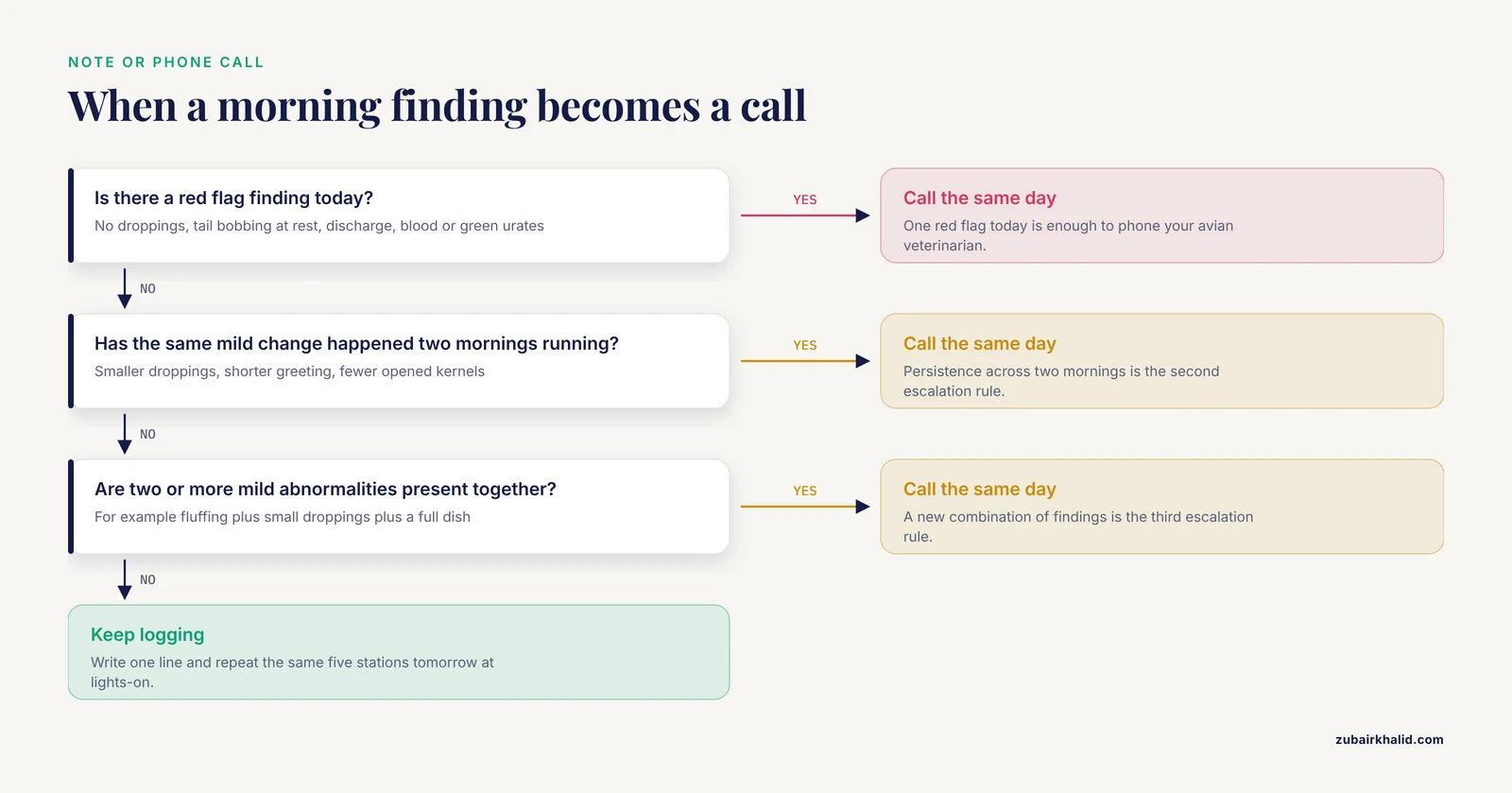
Four escalation rules, adapted from the logic of digital early warning platforms, tell you when a note becomes a phone call. Researchers designing rule-based self-monitoring systems found value in four alert types: an abnormal current status, short-term worsening, a new combination of findings, and persistence across submissions [8]. In bird terms:
- Any single red-flag finding today, such as no droppings or tail bobbing at rest.
- The same mild abnormality two mornings in a row.
- Two or more abnormalities appearing together.
- Any finding that is clearly worse than yesterday.
A structured home log also makes you a better historian for your veterinarian. A randomized controlled trial now underway is testing a home monitoring app for medically complex children in which parents record daily vitals and symptoms, receive automatic alerts, and share summary graphs with the care team [9]. Your notebook is the low-tech version of the same idea, and the one-line-per-day format is what keeps it alive after week three.
A Morning Bird Health Check Routine Example
Here is the format in action for Kiwi, a six-year-old budgerigar.
Monday, 7:10 a.m. Posture upright, greeted loudly. Droppings normal, three on the paper. Dish audit shows plenty of hulls but noticeably fewer opened kernels than usual. Water slightly low. Resting breaths about 68 per minute. Log entry: hulls up, kernels down, otherwise normal.
Tuesday, 7:08 a.m. Greeting is short, one chirp instead of the usual chatter. Sits slightly fluffed for the first minute, then smooths out. Droppings smaller than baseline. Dish audit again shows mostly hulls. Two mild abnormalities now repeat.
Wednesday, 7:05 a.m. Fluffing persists through the full minute of observation. Droppings small and few. Kernels untouched. Three rules fire at once, persistence, worsening, and combination.
That Wednesday entry is a call to the avian veterinarian the same morning, with three days of dated notes to read from. Without the log, the same story usually surfaces on Saturday as "he isn't acting right," with no way to say when it started or what changed first. The example also shows what the routine is not. It is not a diagnosis. It is a dated, specific report that turns a vague worry into something a veterinarian can act on.
Supplies Worth Having
The routine needs almost nothing, but four items make it reliable.
A digital kitchen scale that reads in 1-gram increments with a tare function is the highest-value purchase in bird ownership, because gram weight is the most objective number in the whole system. Choose a platform that fits a travel cage or a small perch stand.
Plain paper liners, unprinted newsprint or butcher paper, make overnight droppings readable in seconds. Avoid loose bedding, corncob, or litter that hides the dropping and holds moisture.
A fixed log, a small notebook taped near the cage or a note on your phone, in the exact column format above.
Good light, from a window position or a small flashlight, because eye, nostril, and vent checks fail in dim rooms. A white bowl for the dish audit lets you separate hulls from whole seed in one shake. No brand matters, only the measurement criteria.
Seven Mistakes That Quiet the Alarm
- Handling first, observing never. The moment you open the cage, posture, feather set, and breathing all change. Observation comes first, always.
- Cleaning before reading. Fresh paper is satisfying and destroys the single best daily sample in your home.
- Trusting a full dish. Seed-eating birds hull seed, so a dish can look untouched while the bird ate almost nothing. Shake and sort before you judge.
- Comparing to memory instead of the log. Memory normalizes slow drift, which is exactly why the one-line record exists.
- Reading tameness as health. A sick pet bird may still step up cheerfully. Friendliness is one data point, not a verdict.
- Skipping weekends and holidays. Intermittent checking recreates the spot-check problem the routine exists to solve. If mornings are impossible some days, anchor the check to lights-on timers or evening lock-in instead.
- Overreacting to normal morning fluff. Birds fluff briefly on waking and after preening. Fluffing that persists through a full minute of observation is the finding, not a two-second puff.
One more caution comes from wearable-device research. A 30-day study of healthcare workers wearing monitoring wristbands during COVID-19 surveillance found no significant pre-infection shift in heart rate or skin temperature despite daily measurement [10]. Single readings and single days mislead. Judge your bird on trends across mornings, never on one glance.
Troubleshooting Common Obstacles
A hand-shy bird. Run the whole check visually. Posture, droppings, dish audit, water, and cage floor require zero contact. For weight, train the bird to step onto a scale platform for a treat in its own time, or weigh the travel cage with and without the bird and subtract. If neither works, ask your avian veterinarian to demonstrate low-stress training at a wellness visit.
A mixed aviary or flight cage. Give each bird a fixed dish station so audits stay individual, identify birds by band color or markings, and log a line per bird. If droppings cannot be matched to individuals, weigh the paper totals as a group and watch posture bird by bird. Persistent ambiguity is a reason to discuss overnight housing options with your veterinarian.
An early work schedule. Anchor the check to lights-on, whatever the clock says, or move the full routine to evening lock-in and keep a two-minute morning glance for droppings and posture. Consistency of sequence matters more than the hour.
Forgetting. Tape the template inside a cabinet door you open every morning, or pair the check with an existing habit such as starting the coffee.
A Parrot Care Checklist Built on the Same Five Minutes
The five-station format scales to any parrot from a parrotlet to a macaw. The parrot care checklist below adds the items that matter most for hookbills.
- Dish audit with weight. Large parrots hull seeds and crack nuts, so shake, sort, and weigh portions where possible. Pellet counts are simpler, count pieces served and pieces left.
- Toy and foraging audit. Parrots destroy things normally, and foraging-based feeding, which avian nutrition resources such as Lafeber promote, gives you a built-in audit. The distinction that matters is reduced interest in food alongside normal toy destruction, or frantic chewing with no eating.
- Voice. Note the morning flock call. A macaw that fails to greet the day, or an Amazon that suddenly screams at dawn, is reporting a change.
- Beak alignment viewed from the front, plus beak growth pattern, which your avian veterinarian should assess at annual visits.
- Foot grip on varied perches, because parrots grip all day and weakness shows early in how they hold a perch.
- Powder and feather condition. Cockatoos, cockatiels, and African greys produce powder-down, and changes in dust, feather quality, or barbering belong in the notes column.
- Weekly gram weigh-ins, which matter enormously for parrots because they hide weight loss until disease is advanced.
Everything else, the posture scan, the dropping reading, the head check, is identical.
Bird Cage Setup That Makes the Check Easier
Your bird cage setup either feeds the routine or fights it.
Line the tray with plain paper so overnight droppings print clearly. A grate is fine, but decide once whether you read droppings on the grate floor or the tray, and always read the same place.
Put food and water dishes in fixed positions, the same heights and corners every day, and keep a dedicated spot for the morning dish audit away from the favored perch so shaking hulls does not startle the bird. Avoid placing the sleeping perch directly beside the water dish, which invites droppings into the water overnight.
Position one perch in your natural morning sightline, at mid-cage height and away from food, so the sixty-second posture scan happens without the bird moving toward you. Keep the cage out of kitchens and away from aerosol sprays and scented products, and ask your avian veterinarian to review your specific room for airborne hazards during a wellness visit, because inhaled toxins hit birds faster than any other pet in the home.
Keep lighting consistent. A predictable dark period at night is what makes lights-on behavior a reliable baseline. If wake-up time shifts constantly, the morning scan loses its reference point.
Welfare and Safety Points
The check should never become a struggle. If a bird resists handling, run the visual version and build handling slowly with treats, because a daily fight erodes trust and stresses the animal you are trying to protect. Watch for stress signals during any contact, beak gaping, wing flipping, or escape attempts, and stop.
Wash your hands before and after the check, especially in households with multiple birds, and keep dishes separate per bird. Keep the routine calm and predictable, same voice, same order, same small reward afterward if you use one. Rewarding cooperation after the check, not before, keeps the bird from performing behavior for food.
If the bird is visibly ill, skip restraint entirely. Capture is real physiological stress for a bird, and a bird that looks sick needs a phone call and a quiet morning more than it needs to be examined at home.
Limitations and When to Contact a Veterinarian
No checklist replaces an examination, and individual cases always need a veterinarian to interpret findings in context. The routine's job is to generate specific, dated observations, not conclusions.
Call your avian veterinarian the same day for any of the following:
- No overnight droppings, or a bird that has not eaten its usual amount by mid-morning.
- Tail bobbing at rest, open-mouth breathing, clicking, or wheezing sounds.
- Sitting fluffed and low, or on the cage floor, during active hours.
- Discharge or swelling around the eyes or nostrils.
- Green or yellow urates, blood in droppings, or undigested seed in feces.
- A measurable drop on the gram scale across two consecutive weigh-ins.
- Regurgitation outside normal bonding behavior, a soiled vent, or lameness.
- A hen straining, sitting low, or fluffed with a distended abdomen, which can indicate egg binding.
Treat as an emergency and go immediately for bleeding, a seizure, collapse, trauma from another pet, or a bird found unresponsive on the cage floor.
Two habits strengthen the whole system. First, establish a baseline with an annual wellness examination from an avian veterinarian, because a veterinarian who knows your bird's normal weight, and has baseline labwork where recommended, can interpret your log far better. The Association of Avian Veterinarians maintains a public directory to help owners find an avian vet. Second, bring the log to every appointment. Three weeks of dated one-line entries tells a veterinarian more than an hour of recalled impressions. If no avian veterinarian is nearby, contact a general exotic-pet practice rather than delaying, and build an emergency plan for your bird before you need one.
Frequently Asked Questions
What is the 5-minute morning bird health check?
It is a fixed five-step scan done at lights-on each day. You observe posture and breathing, read overnight droppings, check the head, survey the body, and audit food and water, then write one log line. The fixed order and timing are what turn daily notes into early warnings.
What time of day should I do the routine?
At lights-on, whenever that falls. Morning is ideal because overnight droppings accumulate in one readable spot and the bird has fasted, which makes the dish audit meaningful. Consistency of sequence matters more than the exact hour.
What should healthy morning droppings look like?
A healthy dropping has three parts, a green to brown feces portion, white to cream urates, and a small amount of clear urine, with colors shifting somewhat by diet. Blood, black or tarry feces, yellow or green urates, undigested seed, or no droppings at all are findings to report to your veterinarian.
How do I check my bird's weight without stressing it?
Train the bird to step onto a gram-scale platform for a treat, or weigh the travel cage with and without the bird and subtract. Weigh at the same time, before breakfast, and record the number at least weekly.
Can I do the check without handling my bird?
Yes. Four of the five stations, posture, droppings, dish audit, and cage floor, require no contact, and the head check can be done through the bars under good light. Handling is optional and should never override the bird's comfort.
How do I adapt the routine for multiple birds?
Give each bird a fixed dish station so food audits stay individual, identify birds by bands or markings, and log a line per bird. If droppings cannot be matched to individuals, weigh the paper totals as a group and discuss housing options with your veterinarian.
What bird cage setup supports a daily health check?
Plain paper liners, dishes in fixed positions, a perch in your natural morning sightline, and consistent day-night lighting all help. The setup should let you read droppings, judge intake, and scan posture without moving or disturbing the bird.
When does a morning finding become an emergency call?
Call the same day for no overnight droppings, tail bobbing or open-mouth breathing at rest, sitting fluffed on the cage floor, eye or nostril discharge, or a measurable weight drop. Go immediately for bleeding, collapse, a seizure, or trauma. Birds deteriorate quickly, so when in doubt, call.
Sources
- Effectiveness of Remote Patient Monitoring Equipped With an Early Warning System in Tertiary Care Hospital Wards: Retrospective Cohort Study.
- Online feeding behavior monitoring of individual group-housed grow-finish pigs using a low-frequency RFID electronic feeding system.
- When beef cattle drink less: Automated water intake monitoring as an early warning for respiratory disease during the adaptation period at the fattening unit.
- A deep-learning-based early warning system for abnormal eye conditions in chickens.
- Warning Signs, Monitoring Tools, and Actions Taken by World-Class Endurance Coaches in Cases of Underperformance.
- Improving respiratory rate monitoring in general wards following implementation of a rapid response system: a quality improvement initiative.
- A novel digital health approach to improving global pediatric sepsis care in Bangladesh using wearable technology and machine learning.
- Preliminary Usability Assessment of a Rule-Based Digital Self-Monitoring Platform for Patients With Brain Tumors Toward Digital Early Warning Systems: Pilot Feasibility Study.
- The Efficacy of a Home Monitoring App for Children With Medical Complexity: Protocol for a Randomized Controlled Trial.
- COVID-19 Early Detection in Doctors and Healthcare Workers (CEDiD) study: a cohort study on the feasibility of wearable devices.