Kitchen Dangers for Birds: 10 Hidden Risks in Your Cooking Space
By Dr. Zubair Khalid, DVM, MS, PhD ·
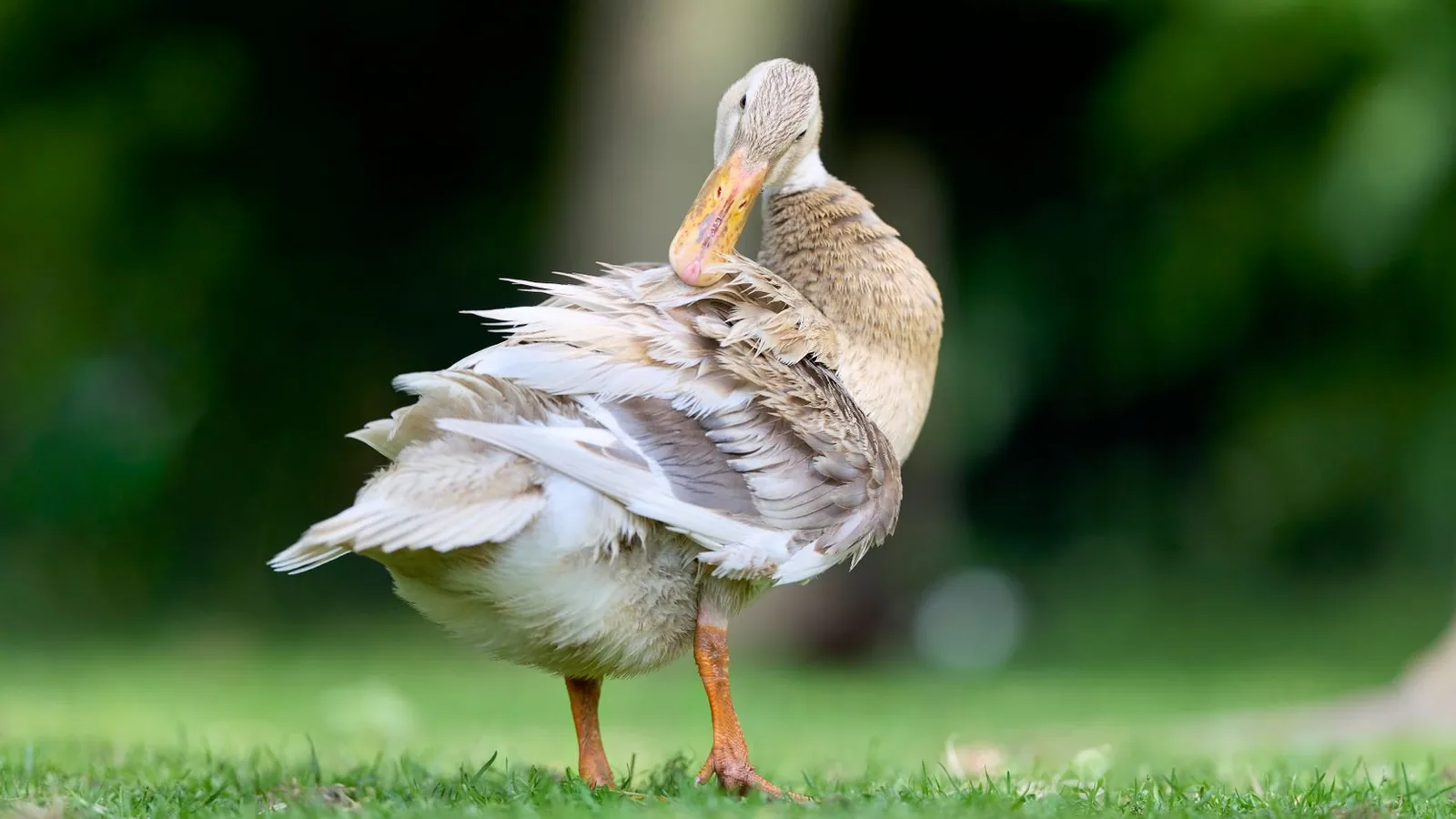
The kitchen is the single most dangerous room in the house for a pet bird. Overheated nonstick cookware can release fumes that kill a bird within minutes, and toxic foods, aerosol grease, cleaning chemicals, open flames, and boiling liquids all add to the risk. The safest and simplest fix is to keep your bird out of the kitchen entirely, especially while cooking, and to audit the room for the ten hidden hazards described below.
This article walks through each of those ten kitchen dangers for pet birds, explains why birds are uniquely vulnerable, and gives you concrete solutions you can apply today. It ends with a kitchen-specific safety checklist, common mistakes to avoid, and clear guidance on when to call an avian veterinarian.
This article is educational and is not a substitute for veterinary diagnosis or treatment.
At a Glance: Kitchen Hazards and Immediate Fixes
| Hidden risk | Why it harms birds | What to do today |
|---|---|---|
| 1. Overheated nonstick (PTFE) cookware | Fumes cause fatal respiratory injury | Keep the bird out of the kitchen when any nonstick pan is heated, replace nonstick where you can |
| 2. Cooking smoke, grease vapor, and aerosol sprays | Birds inhale concentrated particulates | Use the range hood on high, never spray near the bird |
| 3. Self-cleaning oven and broiler cycles | Extreme heat releases fumes from oven liners and residue | Relocate the bird to a distant, ventilated room for the full cycle |
| 4. Small appliances with hidden nonstick parts | Air fryers, toaster ovens, and drip trays also off-gas PTFE | Check manufacturer materials, run them with the bird elsewhere |
| 5. Toxic foods and crumbs | Avocado, chocolate, caffeine, salt, onion, garlic, and certain pits are poisonous | No shared table food, secure trash, clean counters before the bird enters |
| 6. Scented products near food areas | Candles, diffusers, and aerosol fresheners irritate avian lungs | Ban all scented products and plug-in devices from the kitchen |
| 7. Cleaning chemicals | Degreasers, oven cleaner, bleach, and ammonia fumes injure airways | Ventilate, rinse thoroughly, remove the bird before deep cleaning |
| 8. Gas leaks and combustion fumes | Carbon monoxide and gas accumulation are rapidly lethal | Install a detector near the kitchen, service appliances regularly |
| 9. Open pots, boiling water, and hot surfaces | Birds land on rims, dip into liquids, and suffer burns or drowning | Lids on everything, bird caged or out of the room while cooking |
| 10. Escape, falls, and underfoot accidents | Flights toward windows or stoves end in trauma | Cage the bird before meal prep, check the floor before stepping |
Why Kitchens Are Uniquely Dangerous for Birds
Birds process airborne toxins differently from dogs, cats, and people. A bird's respiratory system includes a network of air sacs and a unidirectional airflow pattern that extracts oxygen with remarkable efficiency. That same efficiency means whatever else is in the air, including aerosolized grease, combustion fumes, and polymer smoke, is delivered deeply and effectively into the lungs. Small body size compounds the problem, because a dose of toxin that merely irritates a human can overwhelm a budgie or a cockatiel. The Association of Avian Veterinarians and the Merck Veterinary Manual both identify inhaled toxins and respiratory disease as leading emergencies in pet birds, and avian veterinarians consistently rank the kitchen as a high-risk environment.
The second reason is behavioral. Birds are curious, mobile, and drawn to flock activity. A parrot that rides a shoulder into the kitchen, climbs a counter, or investigates a steaming pot is exposed to burns, poisonings, and escapes within seconds. Because many of these accidents cause irreversible injury before an owner can intervene, prevention through environment control is the core of avian kitchen safety.
The 10 Hidden Kitchen Risks in Detail
1. Overheated Nonstick Cookware and PTFE Fume Toxicosis
Polytetrafluoroethylene, known commercially under several brand names, is the coating on most nonstick pans, some baking sheets, and many small-appliance interiors. When PTFE cookware is overheated, especially a dry or empty pan left on a burner, the coating begins to break down and releases fumes. In humans this can cause flulike symptoms. In birds the same fumes cause hemorrhage and damage within the respiratory tract, a condition often called PTFE toxicosis or Teflon toxicosis, and death can follow rapidly with little warning. Avian veterinarians and the Merck Veterinary Manual have documented these deaths in pet birds kept in homes where nonstick cookware overheated, sometimes in birds in another room.
How to fix it:
- Treat every heated nonstick surface as a hazard, not only visibly damaged or scorched pans.
- Never leave nonstick cookware unattended on a live burner, and never preheat an empty nonstick pan on high heat.
- Prefer stainless steel, cast iron, or other uncoated cookware in a bird household. Ask an avian veterinarian or the Association of Avian Veterinarians resources for current guidance on cookware safety before you buy.
- Keep the bird in a closed room far from the kitchen whenever you cook with any coated product.
2. Cooking Smoke, Grease Vapor, and Aerosol Sprays
Searing meat, burning toast, charring vegetables, and spraying oil from an aerosol can all fill kitchen air with fine particles. A bird breathing that air is filtering the equivalent of a much larger dose than the cook beside the stove, because of the respiratory anatomy described above. Even ordinary cooking, without any nonstick surface, produces vaporized grease that settles on feathers and irritates airways.
Solutions:
- Run the range hood vented to the outside on its highest setting from the moment you turn on a burner until several minutes after you turn it off.
- Move aerosol cooking sprays out of the bird's reach and never spray them with a bird in the room. Grease aerosol travels farther than most owners expect.
- Wipe down surfaces near the cage area regularly so accumulated grease does not become a chronic low-level exposure.
- If a pan begins to smoke, remove the bird from the kitchen immediately, then deal with the pan.
3. Self-Cleaning Ovens and Broiler Cycles
The self-cleaning cycle heats an oven far beyond normal cooking temperatures to incinerate residue. During that cycle, oven liners, spilled grease, and any interior coatings can release fumes. Because pet bird owners frequently report sudden bird deaths associated with self-cleaning cycles, the Association of Avian Veterinarians advises moving birds well away from the kitchen and increasing ventilation whenever this cycle runs. The same caution applies to prolonged broiler use and to burning anything in the oven, such as forgotten foil or baked-on spills that smoke.
How to fix it:
- Run the self-cleaning cycle only when the bird is in another part of the house with the kitchen door closed.
- Open windows and run ventilation during and after the cycle.
- If your bird's primary cage is in or near the kitchen, this alone is reason to relocate the cage. See the bird cage setup section below.
4. Small Appliances With Hidden Nonstick Parts
The most surprising kitchen dangers for birds are the coated parts owners never think about. Air fryer baskets, toaster oven trays, drip pans, waffle irons, rice cooker inner pots, slow cooker liners, and some bakeware all may contain PTFE or similar coatings. When these parts heat up, they can release the same fumes as a nonstick stovetop pan.
Solutions:
- Check the manufacturer's material information for every countertop appliance before using it with a bird in the home.
- Assume a coated surface is present if the interior is dark, slick, or advertised as nonstick until you confirm otherwise.
- Run any appliance with coated components only while the bird is out of the kitchen and preferably out of the room.
- Replace high-use appliances with uncoated alternatives where practical.
5. Toxic Foods, Counter Crumbs, and Unsecured Trash
Food is the other major category of kitchen dangers for birds. Several common kitchen items are poisonous to parrots and other pet birds:
- Avocado, which contains persin, a compound associated with heart and respiratory injury in birds.
- Chocolate and caffeine, which affect the cardiovascular and nervous systems.
- Salty foods, which can cause salt toxicity in a small bird after a surprisingly small quantity.
- Onion and garlic, which have been associated with red blood cell damage in birds.
- Fruit pits and apple seeds, which contain cyanogenic compounds. Remove pits and seeds before offering fruit.
- Alcohol, which is dangerous to birds in very small amounts.
- Raw or undercooked dried beans, which contain naturally occurring lectins.
Lafeber Company's avian nutrition resources list many of these foods among those to avoid, and any avian veterinarian can give you a complete list for your species. Remember that a parrot on a shoulder can reach a plate faster than an owner can react.
How to fix it:
- Never feed table food from your plate. Use a separate, dedicated dish and know the contents.
- Wipe counters and sweep floors before the bird has floor or counter access.
- Keep trash cans lidded or inside a closed cabinet, because a foraging parrot will investigate them.
- Store chocolate, baked goods, alcohol, and cooking supplies behind closed doors, not on open shelves.
6. Scented Products, Candles, and Air Fresheners Near Food Areas
Kitchens often hold plug-in air fresheners, scented candles kept near the stove, essential oil diffusers, and strong-smelling cleaning products. Birds are exceptionally sensitive to inhaled irritants and volatile compounds. VCA Animal Hospitals' avian care guidance and the Association of Avian Veterinarians both caution bird owners against aerosol sprays, scented candles, and diffused essential oils around birds. A diffuser running on the kitchen counter is a continuous exposure, not a one-time event.
Solutions:
- Keep all scented candles, wax melts, plug-ins, and diffusers out of the kitchen.
- Never use essential oils, whether applied to the bird, on surfaces, or in the air, without explicit direction from an avian veterinarian.
- Ventilate instead of masking odors.
7. Kitchen Cleaning Chemicals
Degreasers, oven cleaner, drain opener, bleach, ammonia, and disinfectant sprays are concentrated irritants or corrosives. Fumes from oven cleaner and similar products can injure a bird's airways, and residue on counters or floors can be ingested when a bird forages. Mixing bleach with ammonia or with other cleaners produces chloramine and related gases that are dangerous to every species in the home and especially to birds.
Solutions:
- Remove the bird from the room before any deep cleaning, oven cleaning, or drain treatment, and keep it out until the kitchen is ventilated and rinsed.
- Wipe food-contact surfaces with plain water after any chemical cleaner, even a pet-labeled one.
- Store all chemicals in closed cabinets. A climbing parrot can open many cabinet styles, so latches are worthwhile in a bird household.
- Choose the least volatile product that will do the job, and discuss disinfectant choices for the bird's own area with your avian veterinarian rather than improvising.
8. Gas Leaks, Combustion Fumes, and Carbon Monoxide
Gas stoves, ovens with pilot problems, and poorly vented combustion appliances can release gas or carbon monoxide into kitchen air. A bird's high respiratory efficiency means a bird may show signs of exposure before a human notices anything. Because carbon monoxide is odorless, you cannot rely on your own senses.
How to fix it:
- Install a carbon monoxide detector on the level of the kitchen, following the manufacturer's placement instructions.
- If you use natural gas or propane, have appliances serviced on the schedule the manufacturer recommends.
- If you ever smell gas, leave the house with the bird if you can do so safely, and follow your gas provider's emergency instructions. Do not attempt to diagnose a leak yourself.
9. Open Pots, Boiling Liquids, and Hot Surfaces
Burns and scalds are among the most preventable kitchen injuries in pet birds. A flighted bird can land on a pot rim, dip a foot into a pan of hot oil, or step onto a still-hot burner after the flame is off. Open sinks full of water present a drowning risk for small birds, and a bird that falls into liquid often cannot get out.
Solutions:
- Cage the bird before cooking starts. Cooking with a parrot loose in the kitchen is the single behavior change that prevents the most injuries.
- Turn pot handles inward, use lids, and never leave hot liquid unattended even briefly.
- Treat a recently turned-off burner as hot for longer than you expect, and treat a hot oven door as a burn hazard for a climbing bird.
- Close the toilet lid and cover open water containers elsewhere too, but note that sinks and pots in the kitchen are the most common liquid hazards.
10. Escape, Trauma, and Underfoot Accidents
The kitchen has exterior doors, windows, and heavy traffic. A startled bird can fly through an open door, collide with a window, land on a hot stove, or be stepped on. Trauma from these events, including fractured wings, concussions, and crush injuries, is a frequent presentation in avian practice.
Solutions:
- Cage the bird or move it to a secure room before opening the kitchen's exterior door for deliveries, groceries, or trash runs.
- Screen or cover windows near flight paths if the bird has supervised flight time.
- Check the floor before every step if a bird is loose, and teach every household member to announce the bird's location.
- Trim flight feathers only after discussing the decision and technique with an avian veterinarian, because both flighted and trimmed birds have distinct risks.
A Step-by-Step Kitchen Safety Protocol
If you want a single repeatable routine, use this sequence before and during every cooking session. This is the practical core of how to fix kitchen dangers for pet birds in a working household.
- Cage or relocate. Move the bird to its cage, or better, to a room with a closed door away from the kitchen, before any burner, oven, broiler, air fryer, or self-cleaning cycle is used.
- Ventilate first, cook second. Turn on the external-venting range hood before heating anything and leave it running for several minutes afterward.
- Seal the path. Close the kitchen door if you have one. If the kitchen is open to the living area, use distance as your buffer and keep the bird in a room with a solid door.
- Cook with lids and inward handles. Lids on pots, handles turned inward, no unattended heated pans, no empty preheating of coated pans.
- No sprays, no scents. Skip cooking sprays, candles, and fresheners while the bird is in the house, or reserve them for times when the bird is far away and the kitchen is vented.
- Clean with the bird gone. Do chemical cleaning during the bird's absence, rinse thoroughly, and ventilate before the bird returns.
- Food discipline. Keep human food off shared surfaces, secure the trash, and feed the bird only from a known, bird-safe list. When in doubt about a food, ask an avian veterinarian before offering it.
- Re-entry check. Before the bird returns to the main living space, confirm all burners are off, no pan is still cooling on the stovetop, and the air is clear of smoke or odor.
Bird Cage Setup and Placement: Why the Cage Should Not Live in the Kitchen
Many bird cage setup guides repeat the same mistake. Owners place the cage in the kitchen or on the kitchen's edge so the bird can be part of household activity, and in doing so they put the bird in permanent exposure to every hazard above. The Association of Avian Veterinarians and VCA Animal Hospitals both advise keeping pet birds out of the kitchen, and cage placement is the most important expression of that advice.
A better bird cage setup for kitchen safety:
- Place the primary cage in a family room or living room where the bird has social contact without cooking exposure.
- Keep the cage away from the kitchen doorway so cooking fumes and smoke do not drift directly into it.
- Avoid placing the cage near windows with direct, unrelieved sun or against exterior walls with cold drafts, per general avian husbandry guidance from the Merck Veterinary Manual and avian care guides at VCA Animal Hospitals.
- Provide a separate, smaller travel cage or carrier in another room so you always have a fast way to move the bird during cooking, cleaning, or emergencies.
- Keep food and water dishes on the cage away from the kitchen side of the room.
If your bird's cage currently sits in the kitchen, relocating the cage is the highest-impact change you can make from this entire article.
Kitchen Portion of a Parrot Care Checklist
A full parrot care checklist covers diet, enrichment, veterinary care, and environment. Here is the kitchen-related block you can add to your checklist and review monthly.
- Bird is caged or in another room during all cooking, including toaster, air fryer, and microwave-heavy sessions.
- Range hood vents outdoors and is used every time.
- No self-cleaning cycle runs with the bird in the kitchen or adjacent open space.
- Cookware inventory reviewed, nonstick items identified and either replaced or used only with the bird removed.
- Small appliances checked for coated interiors and drip trays.
- Trash is lidded or in a closed cabinet.
- Counters and floors are cleaned before the bird has access.
- No candles, diffusers, plug-ins, or aerosol fresheners in the kitchen.
- Carbon monoxide detector installed and tested.
- Chemicals stored behind latched cabinets.
- Emergency plan in place, including the phone number and address of an avian veterinarian and a plan for after-hours care.
Common Mistakes Owners Make
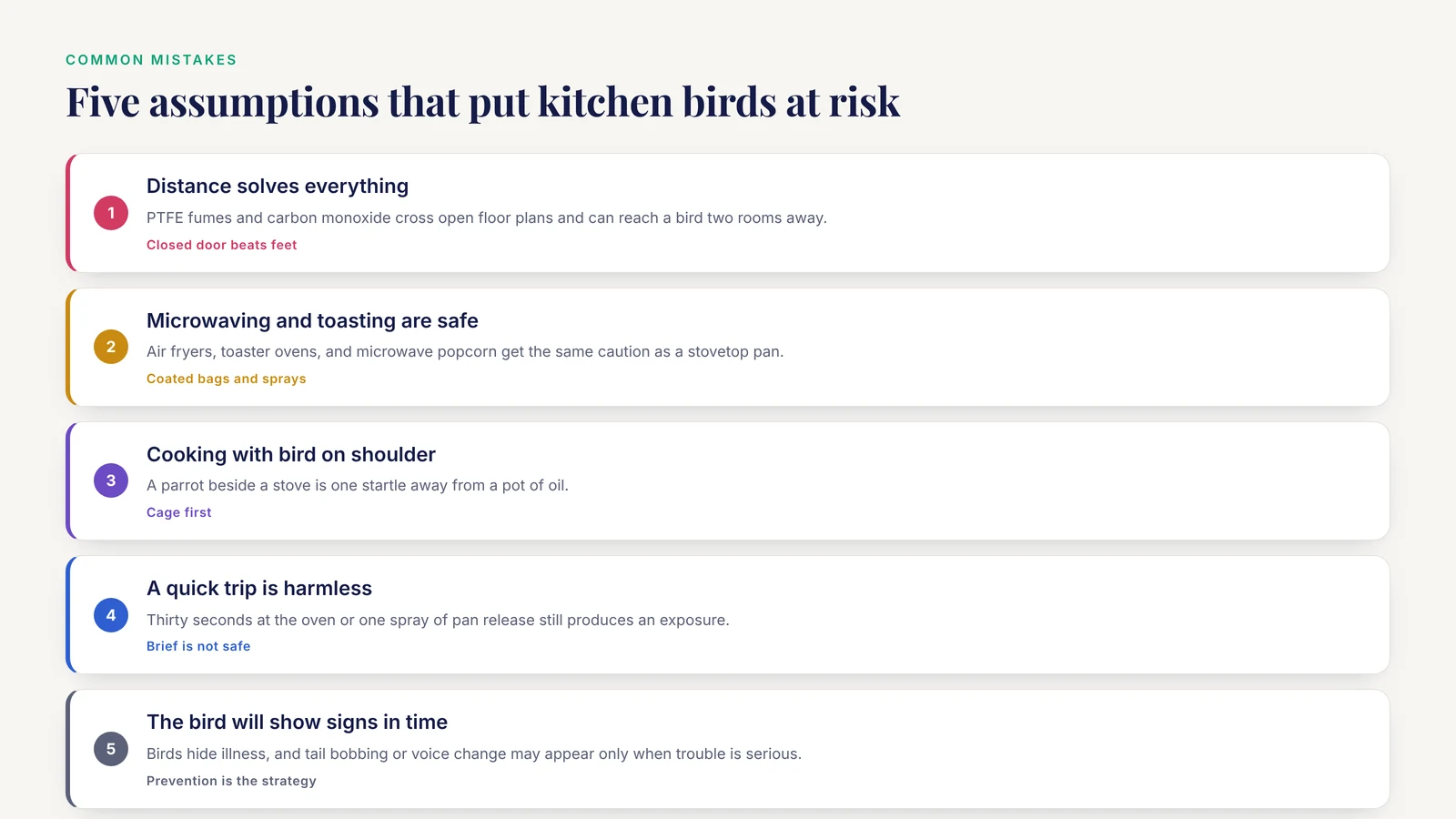
Assuming distance solves everything. PTFE fumes and carbon monoxide travel through open floor plans and can reach a bird two rooms away. Distance helps, but a closed door and ventilation matter more than a few extra feet.
Microwaving and toasting without thinking. Owners who never fry still run air fryers, toaster ovens, and microwave popcorn. Popcorn, in particular, produces hot vapor and often comes with coated bags and butter sprays. Treat every heated appliance with the same caution as a stovetop pan.
Cooking with the bird on the shoulder. A parrot at shoulder height beside a stove is one startle away from a pot of oil. Shoulder trips into the kitchen during cooking cause burns and poisonings that are entirely preventable by caging first.
Believing a quick trip is safe. Opening the oven for thirty seconds, spraying pan release for one second, or wiping the counter with degreaser for a moment all produce exposures. Birds do not tolerate brief exposures the way larger animals do.
Assuming the bird will show warning signs in time. Birds hide illness, and respiratory signs such as tail bobbing, open-mouth breathing, or voice change may appear only when the bird is already in serious trouble. Prevention is the whole strategy.
Troubleshooting: What to Do When Exposure Happens
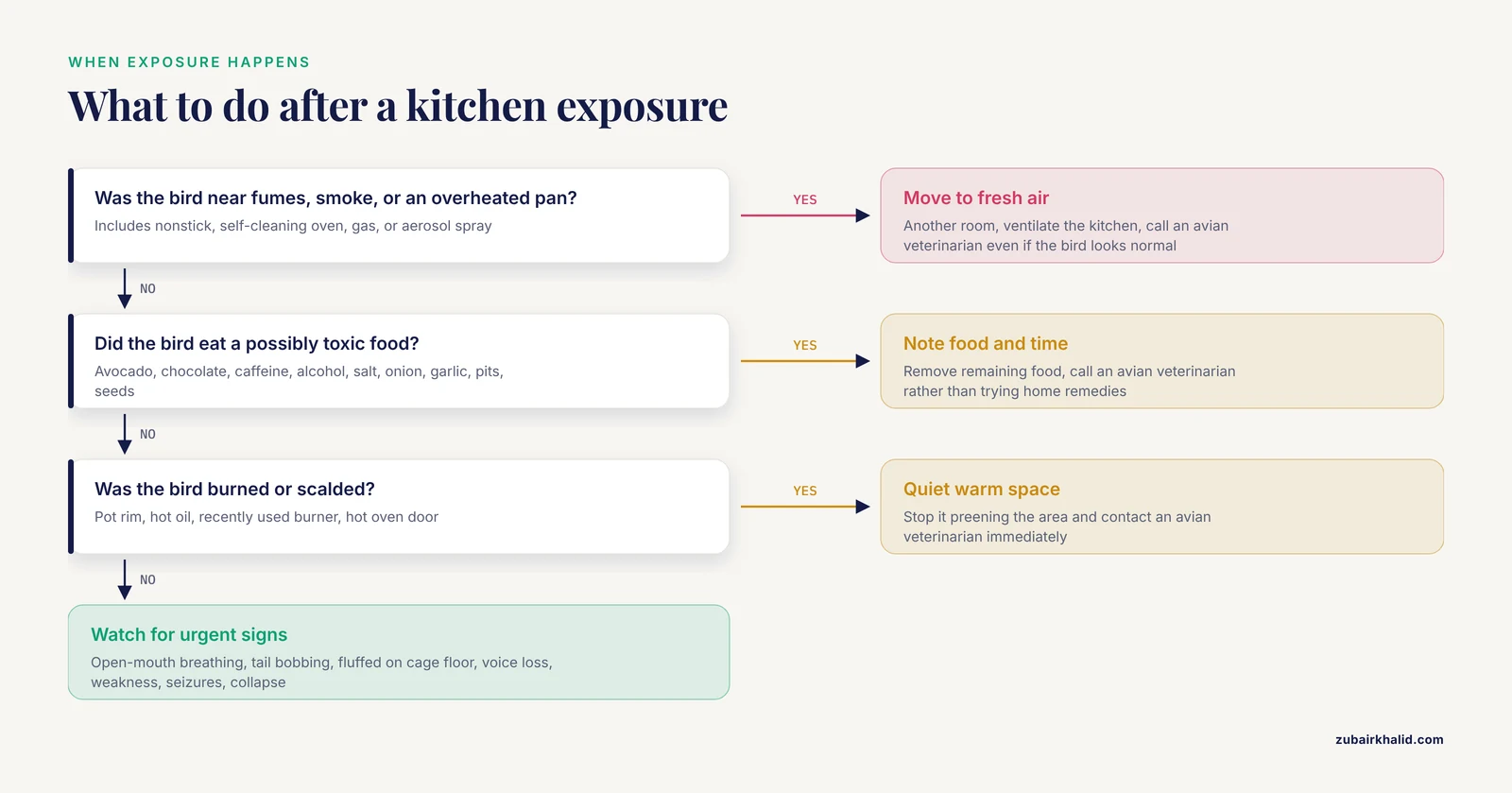
If the bird was in the kitchen when fumes or smoke occurred: Move the bird immediately to fresh air in another room. Increase ventilation in the kitchen. Watch the bird closely for the next several hours and beyond, because respiratory injury can progress. Contact an avian veterinarian even if the bird looks normal, and describe exactly what was heated, for how long, and how close the bird was. Do not wait for obvious symptoms to call.
If the bird ate something potentially toxic: Note the food, the estimated amount, and the time. Remove remaining food from reach. Call an avian veterinarian for guidance rather than trying home remedies.
If the bird was burned: Move the bird to a quiet, warm environment, prevent it from preening the area, and contact an avian veterinarian immediately. Burns in birds can be more serious than they look.
If the bird shows any of the following, seek urgent avian veterinary care: open-mouth breathing, tail bobbing with each breath, sitting fluffed at the cage floor, loss of voice or abnormal sounds, weakness, seizures, or collapse.
Welfare and Safety Points
Restricting a bird's access to the kitchen is not a welfare loss. Parrots are flock animals, and the goal is social contact without exposure. You can preserve companionship by positioning the cage where the bird sees and hears the family, scheduling interaction times outside of cooking, and using a play stand in a safe room rather than loose kitchen access. A bird that spends cooking sessions safely in another room will live longer and healthier than one that shares the kitchen air, and it will still be fully part of the household.
Limitations and When to Contact a Veterinarian
This article gives general prevention guidance based on established avian medicine principles described by organizations such as the Association of Avian Veterinarians, the Merck Veterinary Manual, VCA Animal Hospitals, and Lafeber Company's avian resources. Individual cases vary, and every bird with illness, injury, or suspected exposure needs examination by a veterinarian, ideally one with avian experience.
Contact an avian veterinarian promptly in these situations:
- Any suspected PTFE or smoke exposure, even without symptoms.
- Any known or suspected ingestion of avocado, chocolate, caffeine, alcohol, salt-heavy food, onion, garlic, fruit pits, or unknown substances.
- Any burn, scald, or contact with hot surfaces.
- Any breathing abnormality, including open-mouth breathing, tail bobbing, or increased effort.
- Any behavioral change after a kitchen incident, such as reduced appetite, quietness, or fluffed posture.
- Before making changes to cookware, appliances, or cleaning products, if you want guidance specific to your species and household.
If you do not have an avian veterinarian, the Association of Avian Veterinarians maintains a public directory of member veterinarians, and VCA Animal Hospitals' website locates avian-capable hospitals. Establish this relationship before an emergency, not during one.
Frequently Asked Questions
Are nonstick pans really deadly to pet birds?
Yes. Overheated PTFE-coated cookware releases fumes that can kill birds rapidly, sometimes in birds located in other rooms, and this pattern is well documented in avian medicine. The practical rule is to keep the bird out of the kitchen whenever any nonstick surface is heated and to favor uncoated cookware.
Why are birds so much more sensitive to fumes than dogs or cats?
Birds have a highly efficient respiratory system with air sacs and unidirectional airflow, so inhaled substances are delivered deep into the lungs at high concentration. Their small body size means a given amount of airborne toxin represents a far larger dose per kilogram than in a dog or a person.
Is it safe to keep my bird's cage in the kitchen?
No. A cage in the kitchen exposes the bird continuously to cooking fumes, aerosol grease, cleaning chemicals, temperature changes, and accident risk. Avian veterinarians and the Association of Avian Veterinarians recommend keeping birds out of the kitchen, and cage placement is the single most important decision in a bird cage setup for safety.
What should I do if my bird was in the kitchen when I overheated a pan?
Move the bird to fresh air immediately, ventilate the kitchen, and call an avian veterinarian even if the bird appears fine. Respiratory damage from fume exposure can progress over hours, and early evaluation improves the chance of effective treatment.
Which kitchen foods are the most dangerous for parrots?
Avocado, chocolate, caffeine, alcohol, salty foods, onion, garlic, fruit pits, and apple seeds are among the most dangerous common items. When in doubt about any food, ask an avian veterinarian before offering it.
Do air fryers and toaster ovens pose the same risk as nonstick pans?
They can. Air fryer baskets, toaster oven trays, and drip pans often contain PTFE or similar coatings, and heated coated parts can release the same fumes as a stovetop pan. Check manufacturer material information and run these appliances only with the bird out of the kitchen.
Can I use essential oils or scented candles if I just open a window?
Avoid them in a bird household. Birds are highly sensitive to inhaled volatile compounds, and ventilation does not reliably protect them from candles, plug-ins, diffusers, and aerosol fresheners. Avian care guidance from VCA Animal Hospitals and the Association of Avian Veterinarians advises against these products around birds.
How do I bird-proof the kitchen without renovating?
Cage the bird before every cooking session, run an externally vented range hood, keep lids on pots, store chemicals in latched cabinets, secure the trash, remove scented products, install a carbon monoxide detector, and clean only when the bird is out of the room. These eight habits cover most kitchen dangers for birds without any construction.
Further Reading
- Technology-Assisted Rehabilitation Gym for at-home Training (TARGeT) for stroke survivors: A study protocol for evaluating feasibility, safety, usability, clinical benefit, and costs.
- Dengue@Home: evaluation of a hospital in the home pathway for management of adults with dengue fever.
- Peanut oral immunotherapy updosing via in-office, video, and telephone encounters: Safety and caregiver satisfaction.
- Descriptive Analysis of the First 12-Month Activity of Docadom, a Private Physician-Led Urgent In-Home Consultation Service.
- Home-Based Multimodal Exergame Prototype for Patients With Chronic Stroke: Cross-Sectional Content Validation and Prospective Single-Arm Feasibility Study.
- Home-Based Transcranial Direct Current Stimulation for Depression: From Feasibility to Clinical Implementation.