How to Stop Bird Screaming with Positive Reinforcement
By Dr. Zubair Khalid, DVM, MS, PhD ·

To stop bird screaming with positive reinforcement, you reward quiet, calm behavior the moment it happens, ignore the screaming itself, and change the daily routine so your bird has less reason to scream in the first place. Most companion parrots scream because the behavior has accidentally been rewarded, usually with attention, or because an unmet need such as foraging opportunity, exercise, sleep, or social contact drives the noise. Punishment does not fix either problem. Reward-based training does.
This guide explains why parrots scream, how screaming becomes a learned habit, and how to replace it with calm behavior using positive reinforcement. It also covers cage setup, a daily parrot care checklist, common training mistakes, and the situations that call for an avian veterinarian.
This article is educational and is not a substitute for veterinary diagnosis or treatment.
At a Glance: Your Screaming Reduction Plan
| Step | Action | Timing |
|---|---|---|
| 1 | Rule out medical and environmental triggers with an avian veterinarian exam | Week 1 |
| 2 | Log every screaming episode for 3 to 7 days, noting time, trigger, and your response | Week 1 |
| 3 | Remove accidental rewards. Never respond to screaming with attention, yelling, or leaving the room in reaction | Week 1 onward |
| 4 | Mark and reward quiet moments with a calm voice, a favored treat, or brief attention | Every day, multiple times |
| 5 | Teach a replacement behavior such as a soft contact call, a whistle, or ringing a bell | Weeks 2 to 6 |
| 6 | Add foraging toys, flight or climbing exercise, and structured training sessions | Daily |
| 7 | Review sleep schedule, cage setup, and daily enrichment | Weekly review |
The single biggest shift most owners need to make is this: respond to the quiet, not the noise.
Why Birds Scream: The Main Causes
Loud vocalization is natural parrot behavior. Wild parrots call to keep contact with their flock across long distances, to warn of danger, and to coordinate movement. A pet parrot that screams is not being spiteful or dominant. The bird is communicating in the only loud way it knows. The goal is not to silence the bird but to reduce the frequency, duration, and intensity of screaming to an acceptable level and give the bird better ways to communicate.
The causes of screaming fall into four broad groups.
Learned behavior reinforced by attention
This is the most common cause of chronic screaming in pet parrots. The sequence usually looks like this: the bird makes noise, a person in the home responds, and the bird learns that screaming produces a result. The response does not have to be a reward in your eyes. Yelling "stop that", rushing over, even leaving the room in frustration can all function as attention rewards for a social animal that craves interaction. Over weeks and months, the bird learns that loud screaming is the most reliable way to make things happen.
Unmet behavioral needs
Parrots are long-lived, intelligent, and highly social. When their environment does not provide enough to do, screaming often increases. Survey data from 619 companion parrot guardians found that fewer than half of parrots received cardiovascular exercise through flight (48.9 percent), foraging-based activities (46.2 percent), or positive reinforcement training (34.6 percent), and 65.4 percent of guardians reported at least one behavior concern [1]. Those numbers describe the gap clearly. Most pet parrots do not get enough structured activity, and behavior problems, including vocal excess, are common in that population.
Environmental triggers
Screaming can be triggered by predictable events in the home: dawn and dusk activity, a change in the household routine, a new pet, loud appliances, mirror reflections, or an overcrowded or poorly placed cage. Morning and evening calling bouts are normal in most parrot species and should be expected rather than trained away. The problematic screaming is the persistent, escalating, or attention-seeking kind that continues outside those natural windows.
Medical pain or distress
A bird in pain, especially a bird with an internal problem that has no visible signs, may vocalize more. Hormonal status, reproductive activity, and underlying disease can also change vocal patterns. Any sudden change in screaming behavior, or screaming paired with changes in droppings, appetite, posture, or activity, warrants an avian veterinary exam before you begin training. The Association of Avian Veterinarians recommends annual wellness examinations for pet birds for exactly this reason. Training layered on top of an untreated medical problem fails and prolongs the bird's discomfort.
How Screaming Becomes a Habit
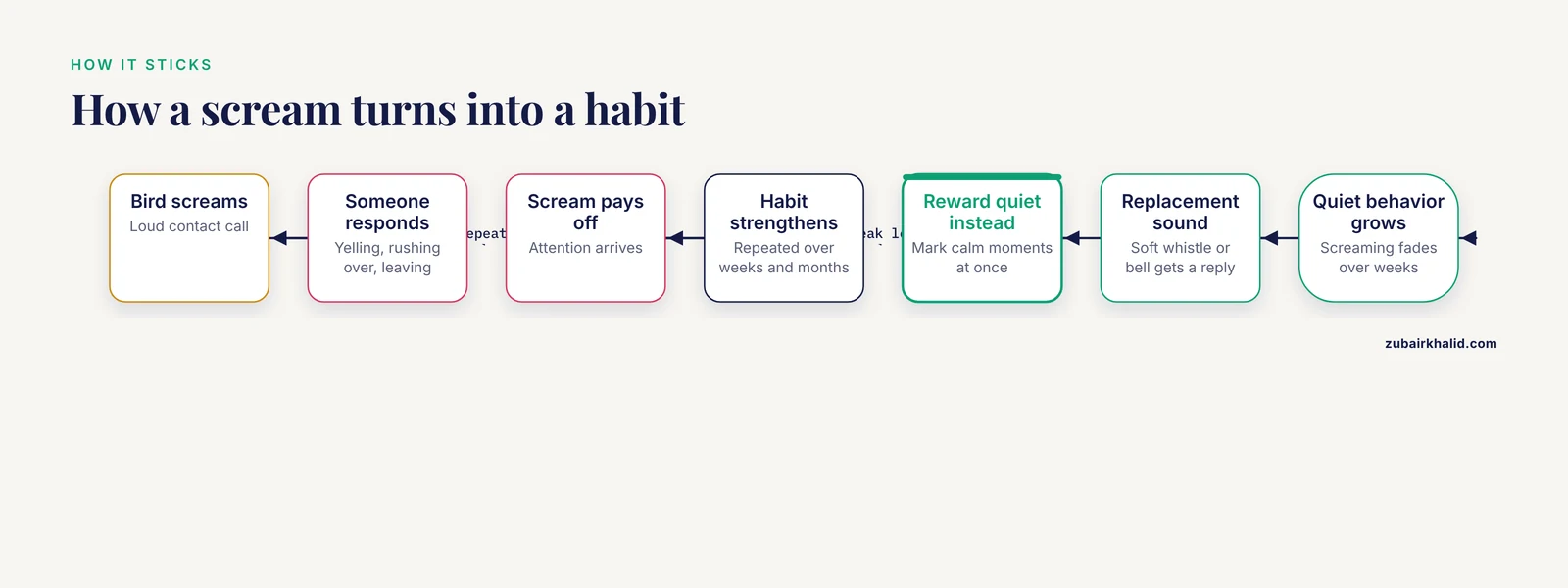
Positive reinforcement works because behavior that is rewarded gets repeated. Unfortunately, this law of learning works on screaming too. Every time a screaming episode produces something the bird wants, the behavior is reinforced and becomes more likely the next time.
The reinforcement history behind a chronic screamer is usually long. An African grey learns that screaming brings the family running. A cockatoo learns that screaming at dusk gets an extra hour out of the cage. A conure learns that screaming when you pick up your phone brings you back. Each of these outcomes is a reward from the bird's perspective.
This is also why the fix works. If you consistently reward calm, quiet behavior and consistently fail to reward screaming, the bird re-learns which behavior pays. The process is called differential reinforcement. You are not just removing a behavior. You are actively building a replacement one. Expect the change to take weeks, not days, because the old habit has months or years of history behind it.
One principle matters more than any other during this phase: consistency among all household members. If one person ignores screaming and another yells at the bird to be quiet, the bird receives intermittent reinforcement, which is the most powerful schedule for maintaining a behavior. Everyone in the home must follow the same plan.
How to Fix Bird Screaming: Step-by-Step Positive Reinforcement Plan
The following plan addresses the three pillars of the problem: causes, reinforcement, and replacement behavior. This is the core of how to stop bird screaming with positive reinforcement solutions that hold up over time.
Step 1: Veterinary rule-out first
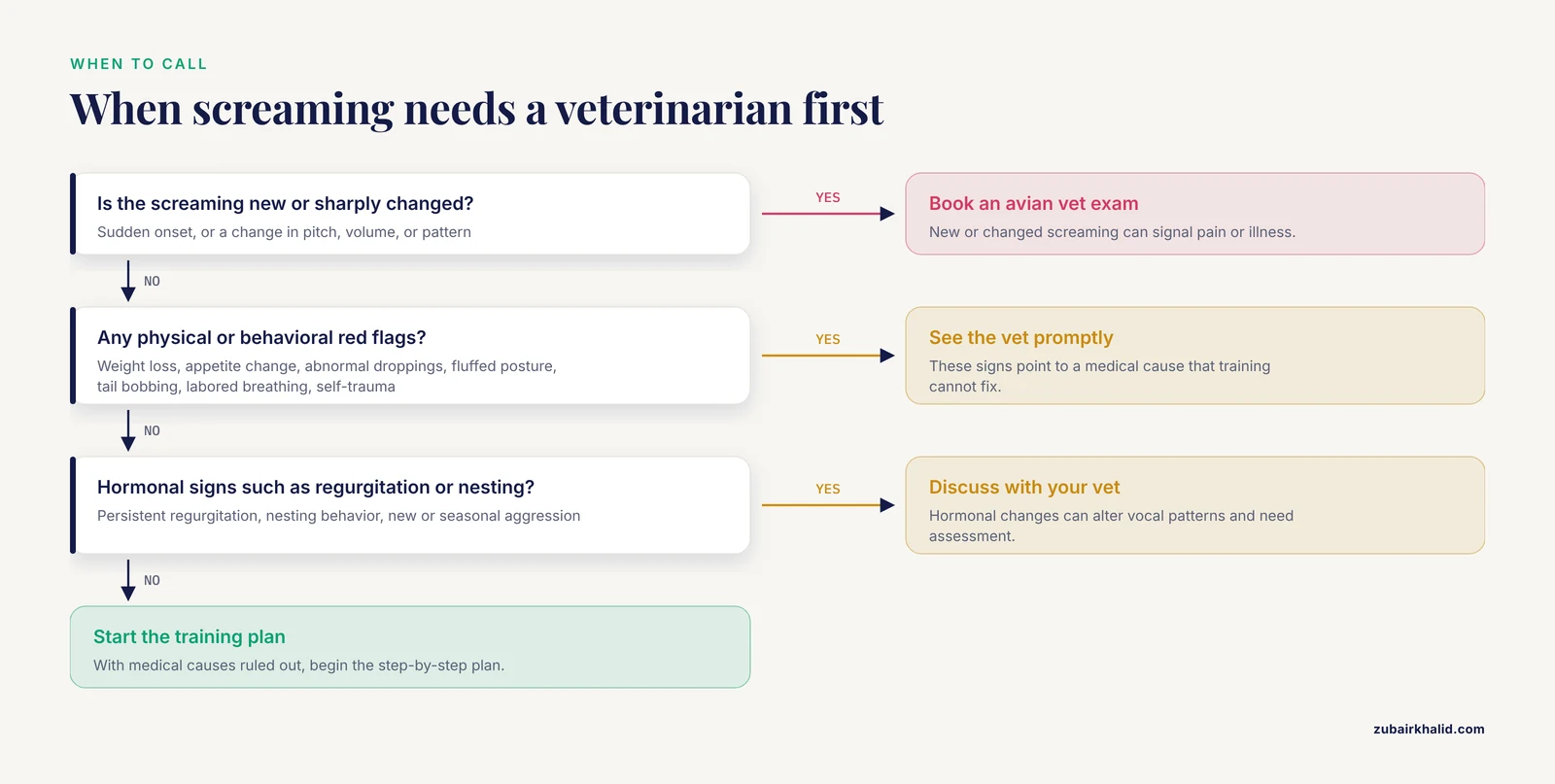
Schedule an exam with an avian veterinarian before starting any behavior plan. Ask the veterinarian to assess pain sources, weight and body condition, nutritional status, and hormonal state. Report the screaming pattern in detail, including when it started, what time of day it occurs, and what seems to trigger it. A bird that screams only at dawn is normal. A bird that screams at all hours and has stopped playing is telling you something else.
Step 2: Keep a screaming log
For 3 to 7 days, write down every screaming episode. Note the time, what happened immediately before, how long it lasted, and how people in the home responded. Most owners discover a pattern within a few days. Common patterns include screaming that starts when the owner leaves the room, screaming that follows the sound of food preparation, and screaming that spikes when the cage cover comes off. The log turns a frustrating noise problem into a specific, solvable one.
Step 3: Remove all accidental rewards
Starting the day you commit to the plan, stop responding to screaming in any way. That means no eye contact, no talking, no touching the cage, no leaving the room, and no scolding. Turn your body away or calmly continue what you were doing. If the screaming happens in another room, do not walk to the bird to check on it, because your arrival is the reward.
Two cautions apply. First, a brief increase in screaming, called an extinction burst, is normal in the first days when a behavior stops paying off. The bird is testing whether louder or longer works. Hold the plan. Second, if screaming is paired with signs of true distress or injury, address the emergency, then return to the plan. Safety always overrides protocol.
Step 4: Reward the quiet, immediately
Catching the bird being quiet is the engine of this plan. Several times a day, when your bird is calm and quiet, calmly approach and deliver a reward. Use a treat the bird values, a soft spoken praise phrase the bird enjoys, a head scratch if your bird enjoys touch, or brief social attention. The reward must arrive within a second or two of the quiet moment, or the bird will not connect the two.
The survey of parrot guardians found that human interaction was the enrichment type most often perceived as preferred by their birds, ahead of food-based and destructible toys [1]. That finding matters for training design. For many parrots, your calm attention is the highest-value reward available, which makes quiet behavior easy to reinforce without food.
Step 5: Teach a replacement sound
Screaming often replaces a natural flock contact call. Give the bird an acceptable version. Choose a soft whistle, a short phrase, or a gentle bell the bird can ring. When the bird makes the replacement sound, respond the way you used to respond to screaming: come over, talk, interact. The bird keeps its communication channel with you. The volume simply drops.
Shape this behavior rather than waiting for it to appear. If the bird does not make the replacement sound on its own, reward approximations. If you want a soft whistle and the bird whistles loudly, reward any whistle at first, then reward only softer versions as the bird offers them.
Step 6: Build structured training sessions
Short, daily positive reinforcement sessions do double duty. They teach specific behaviors and they provide mental exercise that reduces the background motivation to scream. Training sessions of a few minutes, once or twice daily, using a consistent reward and a marker signal such as a clicker or a consistent word, are a practical starting point for any parrot. Target training, in which the bird touches a stick on cue, is a standard first behavior because it builds the training relationship and can later be used to move the bird calmly around the home.
Step 7: Add foraging and exercise
Foraging means making the bird work for food, the way parrots spend much of their day in the wild. Start simple. Hide a favorite treat in a wrapped paper cup or in a shallow tray under safe shreddable material. Progress to commercial foraging toys as the bird's skill grows. Rotate toys weekly, and include destructible items such as untreated wood and paper, because chewing and destruction are normal parrot activities that need an outlet.
For flight and exercise, the safest option depends on your home and your bird. Flighted birds need a bird-safe room with windows marked and hazards removed. Many owners instead build climbing and activity opportunities around the cage and play stands. Discuss wing trim decisions with your avian veterinarian rather than following generic advice, because the right answer varies by species, household, and individual bird.
Step 8: Review sleep and routine
Insufficient sleep is an underrecognized driver of behavior problems in parrots. Most parrots do best with a consistent, long dark and quiet period each night. A separate sleep cage in a quiet room, or a well-fitting cage cover in a low-traffic location, helps many birds. Pair a consistent lights-out routine with a consistent morning routine. Predictability lowers the background arousal that fuels screaming.
Bird Cage Setup and the Daily Parrot Care Checklist
Environment drives behavior. A screaming bird in a barren cage with nothing to do is a predictable outcome, not a mystery. Two frameworks help: the physical setup and the daily checklist.
Bird cage setup criteria
- Size and bar spacing. The cage should allow full wing extension and some horizontal movement without the tail brushing bars. Bar spacing must match the species so the bird cannot wedge its head between bars. Ask your avian veterinarian or an AAV-affiliated resource for species-appropriate spacing before purchase.
- Location. Place the cage in a family living area where the bird can participate in household life, but away from the kitchen, drafty doors, and direct, unfiltered sunlight. One wall-to-wall position with a solid backing side often helps birds feel secure.
- Perches. Provide multiple perches of varied diameter and texture, placed so the bird can move between food, water, and toys without fouling them. Avoid positioning the only perch directly over the food bowls.
- Foraging and destructible enrichment. Dedicate space for at least two interchangeable enrichment items. Survey findings on enrichment practices show that rotating toys and encouraging bathing are among the most common practices guardians use, and nearly all guardians who understood enrichment reported providing it deliberately [1]. Rotation keeps items novel.
- Bathing opportunity. Offer regular bathing, through a shallow dish, a misting bottle, or shower access, depending on what your bird accepts.
- Cleanliness. Change cage liner daily, wash bowls daily, and deep clean perches and toys on a regular schedule. Poor sanitation creates disease risk that no training plan can offset.
Daily parrot care checklist
- Fresh water and fresh food provided at consistent times.
- At least one foraging opportunity instead of, or in addition to, a standard bowl.
- One short positive reinforcement training session.
- Social interaction that the bird initiates or earns through calm behavior.
- Exercise, through supervised flight, climbing, or play on a stand.
- Bathing opportunity several times per week.
- A quiet, consistent, dark sleep period of appropriate length for the species.
- A quick visual health check: droppings, appetite, posture, feather condition, and activity level.
Common Mistakes That Keep Screaming Alive
- Yelling at the bird. To a parrot, loud human voices are flock participation. Yelling often functions as a reward and can even teach the bird to out-scream you.
- Inconsistency between family members. One person sneaking the bird a treat to quiet it down undoes everyone else's work.
- Reacting to the scream, ignoring the silence. Most owners do the exact opposite of what training requires. Flip the pattern.
- Expecting results in days. Screaming with a long reinforcement history typically takes weeks of consistent planning to shift.
- Removing all vocalization. Parrots are supposed to make noise. A plan that tries to eliminate normal species calling, including morning and evening calls, sets an impossible goal and frustrates both bird and owner.
- Skipping the veterinary exam. Pain and illness masquerade as behavior problems. Training cannot fix a medical cause.
- Punishment-based methods. Spraying water, banging the cage, covering the cage as punishment, or dropping the cage in response to screaming suppress behavior temporarily at best and damage the trust the training plan depends on. Aversive methods are contrary to the reward-based approach the evidence supports and are rejected in modern avian practice.
Troubleshooting When Progress Stalls
If screaming has not decreased after two to three weeks of consistent effort, work through this sequence.
Re-check your timing. Rewards delivered late teach nothing. Have a family member watch you train and confirm the reward lands within a second or two of the calm behavior.
Re-check the reward. A bird that ignores praise but works for sunflower seed has told you its currency. Reserve the highest-value treats for training sessions only.
Re-check the log. Compare your new log to the original. If screaming episodes are shorter but still frequent, you are making progress and should continue. If a specific trigger, such as a phone call or a specific family member's arrival, still sets the bird off, design a specific plan for that trigger, using the replacement sound and rewards.
Re-check effort and enrichment. If foraging, exercise, and training have slipped because of a busy week, the behavior often backslides. Restart the daily checklist before changing anything else.
Re-check the health picture. If the screaming has changed in character, intensified despite the plan, or is paired with other changes, return to your avian veterinarian.
Welfare and Safety Points
Positive reinforcement is not only a training method. It is the welfare framework recommended across modern animal care, and it fits parrots particularly well because parrots are cognitive, social animals that learn quickly from consequences. The Association of Avian Veterinarians and the Merck Veterinary Manual both emphasize environmental enrichment and appropriate social contact as core components of companion bird care, and the enrichment survey data confirm that guardians recognize interaction as their birds' strongest preference [1].
Safety within the plan matters. Never use food restriction to motivate training. Rewards should come from the bird's normal daily ration or from healthy extras approved for the species. Keep all training voluntary. A bird that moves away, bites, or freezes is communicating that the session has gone too far, and pushing through that signal teaches avoidance rather than cooperation.
Limitations and When to Contact a Veterinarian
Every individual case is different, and an avian veterinarian who can examine your bird is the right person to tailor this plan. The research summarized here describes population patterns, not guarantees for any single bird.
Contact an avian veterinarian promptly if any of the following apply:
- Screaming begins suddenly in a bird that was previously quiet, or changes sharply in pitch, volume, or pattern.
- Screaming occurs with weight loss, reduced appetite, changes in droppings, fluffed posture, tail bobbing, labored breathing, or reduced activity.
- Screaming is paired with self-trauma, such as feather destructive behavior or skin injury.
- The behavior plan has been followed consistently for three to four weeks with no improvement.
- You are considering any intervention that involves restraint, drugs, or aversive methods. Discuss these with your veterinarian first, and decline any protocol based on punishment.
- The bird shows signs of reproductive or hormonal behavior changes, such as persistent regurgitation, nesting behavior, or aggression that is new or seasonal.
Behavior cases benefit from veterinarians with avian behavior experience, and your avian veterinarian can refer you to a qualified behavior professional when needed.
Frequently Asked Questions
How long does it take to stop bird screaming with positive reinforcement?
Most owners see the first signs of change, such as shorter episodes, within two to three weeks of consistent effort, and substantial improvement over four to eight weeks. Long-established screaming habits take longer because the behavior has a deep reinforcement history.
Why does my bird scream when I leave the room?
Your bird has learned that screaming sometimes brings you back, so the scream is a contact call with a proven payoff. Ignore the scream completely and reward quiet moments, then teach a soft replacement call that always gets a response.
Is it cruel to ignore my bird when it screams?
Ignoring the scream is not neglect when it is paired with generous attention for calm behavior and a full enrichment and social routine. The plan replaces screaming with better communication, rather than leaving the bird ignored.
Should I cover the cage when my bird screams?
Covering the cage as a response to screaming is punishment and can function as a reward or a source of fear, so it is not part of a positive reinforcement plan. A cover used as part of a consistent, calm bedtime routine is a different matter and is fine.
Do all parrots scream, or is mine abnormal?
All parrots vocalize, and daily morning and evening calling is normal for most species. Chronic, persistent, escalating screaming outside those natural windows is a learned or unmet-need problem that responds to training.
What rewards work best for parrot training?
For most parrots, your calm, focused attention is the highest-value reward, followed by favored food treats such as small pieces of species-appropriate foods. Test a few options, reserve the best ones for training, and deliver the reward within one to two seconds of the behavior.
Can an older bird learn to stop screaming?
Yes. Age does not prevent learning in parrots, though habits with years of history take more time and consistency to change. Older birds benefit from the same sequence: veterinary exam, consistent plan, and rich enrichment.
When should I take a screaming bird to the veterinarian?
See an avian veterinarian before starting training if the screaming is new or has changed, and immediately if it appears with weight loss, appetite change, abnormal droppings, fluffed posture, breathing effort, lethargy, or self-injury. Annual wellness exams are recommended for all pet birds.