How to Quarantine a New Conure: Steps and Timeline
By Dr. Zubair Khalid, DVM, MS, PhD ·
Quarantine a new conure for a minimum of 30 days in a room your other birds never enter, using its own cage, bowls, perches, and cleaning tools. Many avian veterinarians prefer 45 to 90 days for a newly acquired bird, because some infections are shed intermittently and incubation periods vary. Knowing how to quarantine a new conure correctly protects three parties at once: the new bird, your existing flock, and everyone in your household.
The discipline matters even for a hand-fed baby from a trusted breeder. Birds instinctively hide the early signs of illness, so a conure can arrive bright, active, and eating while carrying organisms such as Chlamydia psittaci, the bacterium that causes psittacosis. The Association of Avian Veterinarians recommends a physical examination by an avian veterinarian for every newly acquired bird, and quarantine creates the protected window that exam and any follow-up testing need.
This article is educational and is not a substitute for veterinary diagnosis or treatment.
Quarantine a New Conure at a Glance
| Step | Timing | What you do |
|---|---|---|
| Prepare the room | Before homecoming | Pick a room away from other birds, set up the cage, gather dedicated supplies, book an avian vet visit |
| Settle in | Days 1 to 3 | Covered carrier home, quiet room, familiar diet, minimal handling, read the first droppings |
| New bird exam | First week | Physical exam, weight, fecal testing, discussion of screening for psittacosis and viral disease |
| Daily routine | Whole quarantine | Feed and water, change paper, log weight and droppings, care for this bird last |
| Deep clean | Weekly | Full cage disinfection with the bird out of the room until surfaces are dry |
| Recheck and clearance | End of quarantine | Veterinary recheck, review of test results and weight trend, then gradual introductions |
Why Quarantine a New Conure
Birds hide illness, so appearance is not a health certificate
As prey animals, parrots instinctively conceal weakness. VCA Animal Hospitals notes that pet birds often hide disease until it is advanced, which is why a bright, playful conure can still be carrying something serious. Rehoming adds its own risk. The stress of transport, a new cage, new sounds, and new people suppresses immune function and can trigger shedding of organisms the bird already carried. Psittacosis follows this pattern often enough that avian practitioners treat every newly rehomed psittacine as a potential source until testing and time say otherwise.
Diseases spread by new conures
The Merck Veterinary Manual identifies a core group of infectious diseases as the major concerns in pet psittacines, and most of them can travel with a new conure before anyone notices a problem.
| Disease or pathogen | Typical signs in conures | Why quarantine matters |
|---|---|---|
| Psittacosis (Chlamydia psittaci) | Eye or nasal discharge, breathing effort, lime-green droppings, lethargy, or no signs at all | Infects people, treatable with doxycycline, reportable in many US states |
| Proventricular dilatation disease (avian bornavirus) | Undigested seed in droppings, weight loss, regurgitation, weakness | Can incubate for months or longer, care is supportive |
| Psittacine beak and feather disease (circovirus) | Abnormal feathers, beak changes, immune suppression | Young birds are most susceptible |
| Polyomavirus | Regurgitation, diarrhea, feather changes, sudden death in fledglings | Young psittacines are the most vulnerable |
| Pacheco's disease (herpesvirus) | Sudden death, lethargy, green droppings | Stress can trigger shedding and rapid outbreaks |
| Salmonella and other bacteria | Diarrhea, lethargy, ruffled feathers | Some strains infect people |
| Avian mycobacteriosis | Chronic weight loss, poor feathering | Difficult to treat, zoonotic potential |
| Parasites (Giardia, roundworms, mites, lice) | Itching, feather damage, visible pests, dropping changes | Usually treatable once identified |
Young conures, especially fledglings fresh from an aviary, face the highest risk from polyomavirus and circovirus. Psittacosis affects birds of any age and flares under rehoming stress. Proventricular dilatation disease can incubate quietly for months or longer, which is a key reason the conure quarantine period runs longer than a few days.
How these pathogens move between birds
Transmission routes overlap. Infected birds shed organisms in droppings, respiratory secretions, and feather dust. Feather dust is the reason distance alone does not protect your flock, because fine particles stay airborne and drift between rooms, and shared heating and cooling systems can carry them further. Direct contact spreads the rest, including beak-to-beak contact, preening, shared bowls and perches, and your own hands and clothing moving between cages.
The risk to people in your home
Two of these diseases infect humans. Psittacosis causes a flu-like illness in people that can progress to pneumonia, and it responds well to antibiotics when someone thinks to test for it. Salmonella spreads through fecal contamination of hands and surfaces. Households with elderly members, young children, pregnant family members, or anyone with a weakened immune system should be especially strict about handwashing and should keep the quarantined bird away from food preparation areas. In many US states, confirmed avian chlamydiosis is a reportable disease, so your veterinarian may be legally required to notify state animal health officials. If you develop fever, headache, cough, or muscle aches after handling a new bird, tell your physician about the exposure.
How Long Should the Conure Quarantine Period Last
Plan on a minimum of 30 days. Many avian veterinarians recommend 45 to 90 days for a newly acquired bird, and some situations justify longer. The extra time exists for three reasons. Incubation periods differ between pathogens, so an infection caught late in a short quarantine can still surface after the bird joins your flock. Some infected birds shed organisms intermittently, meaning one clean week proves little. Screening tests can also miss early or intermittent infection, so time and repeated observation add information a single test cannot.
The clock starts when the bird enters your home, not when the breeder or store first handled it. If you add a second new bird later, the quarantine period restarts for the whole group. Birds that attend expos, bird fairs, or boarding facilities benefit from a repeat quarantine period afterward, so ask your avian veterinarian how to handle those events. Conures imported into the United States pass through a period of federal quarantine before release, which reduces but does not eliminate risk, so home quarantine still applies.
What extends the quarantine period
- A positive or borderline screening result
- Any illness episode during quarantine, even a mild one
- An unknown or high-risk history, such as a rescue, an aviary closure, or a hoarding situation
- An active treatment course, since doxycycline treatment for psittacosis commonly runs several weeks and quarantine should continue through treatment and follow-up testing
Quarantine Setup for Conures
Choosing the quarantine room
Pick a room your resident birds never enter, with a door that closes. Separate airspace matters more than square footage, because feather dust and aerosolized droppings move through shared air. Keep the room low traffic, out of the kitchen, and away from drafts and direct sun on the cage. Hard flooring beats carpet for cleaning.
The kitchen deserves special mention. Overheated nonstick cookware and some appliances with nonstick coatings release fumes that kill birds quickly, and cooking aerosolizes grease into the air. A quarantine cage never belongs in or near a kitchen.
Bird-proof the space before the bird arrives. Ceiling fans stay off, other pets stay out, toxic plants come out, and scented candles, plug-in fresheners, aerosol sprays, and essential oil diffusers leave the room entirely, since all of them irritate avian airways. Avoid placing the cage directly under a heating or cooling vent.
Cage selection and interior setup
Choose the largest practical cage, wider rather than taller, with room for full wing extension. Bar spacing should be narrow enough that the head cannot slip through, typically about 1/2 inch for green-cheeked and similar small conures, and your avian veterinarian or the manufacturer's size guide can confirm the fit for your species. Stainless steel or intact powder-coated construction cleans best, so skip any cage with rust or chipped coating.
Keep the interior simple. Plain newspaper or paper towel substrate, changed daily, gives you a clean read on droppings and removes the moisture and mold risk of granular beddings such as corn cob. Provide two or three perches of varied diameter, natural wood or smooth wood, with no sandpaper covers and no frayed rope fibers. Use stainless steel or ceramic bowls. One or two simple toys round out the setup, and you will rotate them during quarantine anyway.
Supplies checklist
- Cage with appropriate bar spacing and secure door latches
- Stainless steel or ceramic bowls, one for water and one for food
- Two or three varied-diameter perches, no sandpaper covers
- Plain newspaper or paper towels for substrate
- Digital kitchen scale that reads in grams, with a small perch or container on top
- Disinfectant, either diluted household bleach or an avian-labeled product such as an accelerated hydrogen peroxide cleaner
- Dedicated scrub brush, spray bottle, bucket, and gloves
- Paper towels, trash bags, and hand soap
- A dedicated shirt or smock and dedicated shoes or shoe covers
- The bird's current diet, the target formulated diet, fresh vegetables, and small treats
- A notebook or phone note for the weight and dropping log
The daily biosecurity routine
Order of care is the core habit: resident birds first, quarantined bird last. Before entering the quarantine room, wash your hands and forearms and change into the dedicated shirt or smock with dedicated shoes. Complete all feeding, watering, cleaning, and handling for the new bird in one session. On the way out, remove the smock, wash again, and launder quarantine laundry separately.
Nothing crosses between rooms. Bowls, perches, toys, food bags, sponges, brooms, and vacuums each stay on their own side. If two people share bird care, one person can own the quarantine room entirely while the other handles the resident birds.
Cleaning and disinfection
Daily work is simple: change the paper, wash bowls in hot soapy water, and wipe soiled surfaces. Once a week, do a full disinfection. Move the bird to a carrier inside the quarantine room, remove all accessories, scrub the cage with hot soapy water, and rinse. Organic debris such as dried droppings inactivates many disinfectants, so physical cleaning always comes first.
Then apply your disinfectant, diluted household bleach or an avian-labeled product, following the label's dilution and contact time. Rinse thoroughly, dry, ventilate the room, and return the bird only when every surface is dry and odor-free. Never mix bleach with ammonia, vinegar, or any other cleaner, because the combination releases dangerous gases.
How to Quarantine a New Conure: Step-by-Step Timeline
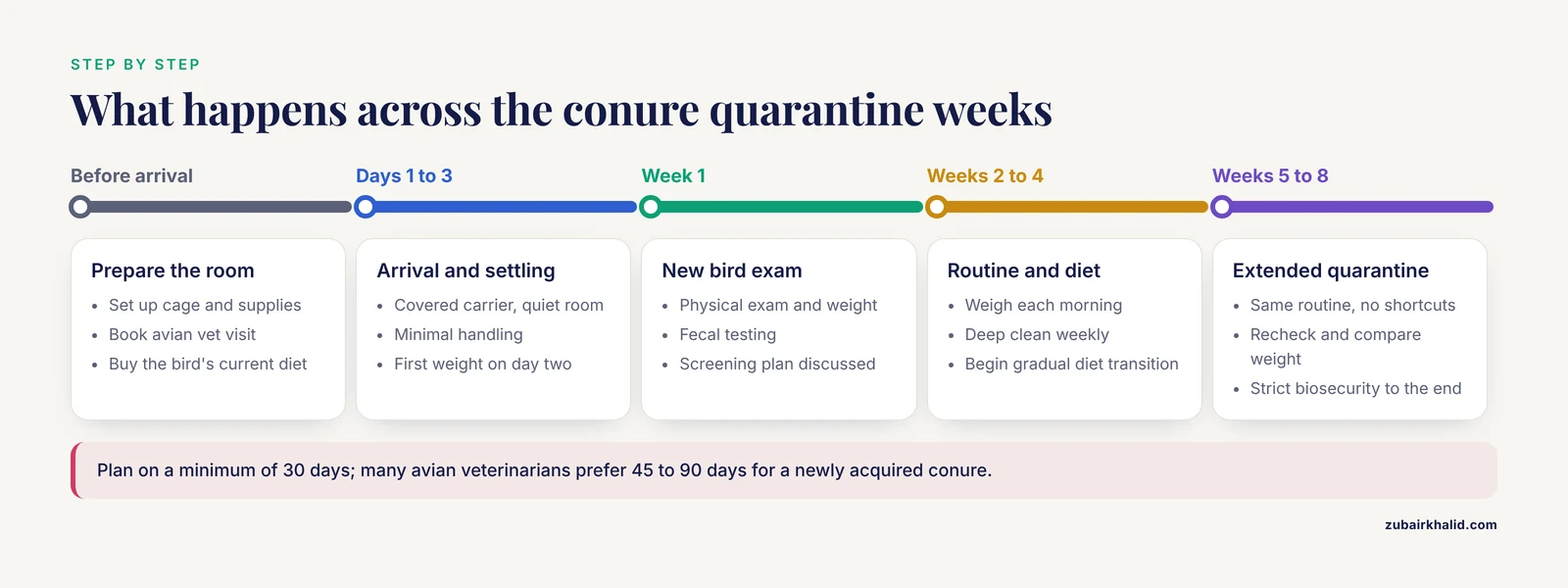
Before homecoming
Set up the room, cage, and supplies a day or two before the bird arrives. Book an appointment with an avian veterinarian for the first few days at home, and the Association of Avian Veterinarians maintains resources for locating an avian practitioner in your area. Ask the seller or breeder exactly what the bird eats and buy the same foods plus extra, because an abrupt diet switch stacks stress on top of transport. Put your log where you will actually use it, next to the scale.
Days 1 to 3: arrival and settling in
Transport the bird home in a covered carrier, secured upright, away from drafts and direct sun. Place it in the prepared cage, offer water and the familiar diet, and then leave it alone. Keep the room dim and quiet and limit household traffic past the door.
Read the first droppings on the paper, because they tell you whether the bird is eating and digesting. On the morning of day two, take the first weight on the gram scale and record it. Keep handling minimal. A calm bird that eats and rests is doing exactly what it should in those first days.
Week 1: the new bird examination
Schedule the wellness exam within the first few days. Expect a full physical examination, a weight check, assessment of feathers, beak, and nails, listening to the heart and lungs, and a crop check for young birds. Baseline testing usually includes a fecal examination, and your veterinarian will discuss screening for Chlamydia psittaci, polyomavirus, circovirus, and avian bornavirus based on the bird's source and risk profile. Bloodwork may be recommended as well. This visit is also where you confirm the quarantine length and the diet plan for your specific bird.
Weeks 2 to 4: routine, monitoring, and diet transition
By now the bird should have a rhythm. Weigh each morning at the same time before feeding, change paper daily, and deep clean weekly. Begin the diet transition if your veterinarian agrees, mixing an increasing proportion of formulated pellets and vegetables into the familiar diet over one to two weeks or longer. Keep handling short and positive, since a few minutes of gentle interaction or target training with a treat beats long forced sessions. Rotate toys to keep the environment interesting.
Weeks 5 to 8: extended quarantine when advised
If your veterinarian set a longer target, continue the same routine without shortcuts. A recheck appointment mid-quarantine or at the end lets your veterinarian compare weight, review test results, and repeat any test that came back inconclusive. Biosecurity stays strict for the full period, and the habits matter most in the final weeks when fatigue tempts shortcuts.
End-of-quarantine checklist
- The quarantine period your veterinarian set has been met in full.
- No signs of illness appeared at any point.
- The veterinary recheck is complete and the results reviewed.
- Weight is stable or climbing.
- Droppings have been normal for several consecutive days.
- You have a written plan for gradual introductions.
Daily Care and Welfare During Quarantine
Feeding and diet transition
Start with the diet the bird already knows, because abrupt switches cause stress and some birds simply refuse unfamiliar food. Once the bird is settled, transition gradually toward a base of formulated pellets with daily vegetables, small amounts of fruit, and seeds or nuts reserved as training treats. Lafeber Company's avian nutrition resources support formulated diets as the foundation of a pet parrot's nutrition, with fresh foods added around them.
Never feed avocado, chocolate, caffeine, or alcohol, and avoid salty or fried human foods, since all of these are toxic to birds. Refresh water daily. A conure that will not eat needs veterinary attention the same day, because birds carry little metabolic reserve.
Sleep and environment
Parrots need a long, uninterrupted dark and quiet sleep period, and Lafeber Company's care resources recommend roughly 10 to 12 hours for most pet parrots. A partial cage cover, a consistent bedtime, and a room free of evening noise do most of the work. Keep the room temperature stable and draft-free, and place the cage out of direct sun.
Enrichment and handling
Quarantine is a medical protocol, not solitary confinement. Rotate two or three simple toys, include shreddable items and simple foraging opportunities, and hiding a small treat inside a wrapped paper cup counts. Lafeber's enrichment resources describe foraging as a core part of parrot welfare, not an optional extra. Keep handling sessions short, let the bird set the pace, and reward calm behavior with a soft voice and a treat. Forced interaction in the first weeks teaches a conure that hands mean restraint, and that lesson takes months to undo.
Monitoring weight and droppings
Weigh the bird every morning or every other morning at the same time, before the first meal. Small day-to-day variation is normal, while a steady downward trend across several days is not. Learn the normal dropping in the first week. A conure passes many small droppings a day, each with a dark green-brown fecal portion, a white urate portion, and clear liquid urine, and first-morning droppings run larger and looser, which is normal. Call your veterinarian about no droppings for several hours, persistent diarrhea, blood, undigested seed, bright green or yellow urates, or a sudden dramatic change in volume.
Troubleshooting common quarantine problems
- Refusing new foods: mix the new diet into the familiar one in small proportions, warm soft foods slightly, and give it days. A bird refusing all food needs a same-day vet call.
- Screaming: check the basics first, food, water, light, sleep, and then add enrichment. Avoid rewarding noise with dramatic reactions.
- Fear of hands: sit near the cage, talk softly, and offer treats through the bars. Progress is measured in weeks, not sessions.
- Escape risk: keep windows and doors closed, ceiling fans off, and other pets out of the room whenever the cage door opens.
Introducing New Conures Safely
Introductions begin only after the full quarantine period and veterinary clearance. Rushing this step undoes everything the quarantine protected.
A gradual introduction plan
- Keep the birds in separate rooms until clearance is complete.
- Move the new bird's cage into the shared room but keep several feet of separation. Watch both birds for a few days, looking for relaxed posture, normal eating, and normal play.
- Reduce the distance gradually over one to two weeks as long as both birds stay calm.
- Offer short supervised visits on a neutral play stand or table, a few minutes at first, always ending before tension appears.
- Keep separate cages for the long term at first. Some pairs eventually share a cage, many never do, and both outcomes are fine.
- Never leave the birds unsupervised together until they have a long track record of peaceful interaction.
Signs to separate the birds
Separate the birds immediately and slow the plan down if you see lunging, biting, chasing, pinned feathers, food guarding, or constant screaming directed at each other. Expect hormonal seasons, especially spring, to raise tension, and increase supervision during those periods. If the two conures never accept each other, keep them as separate caged companions in the same room, because many conures are perfectly content as people-focused pets.
Common Quarantine Mistakes
- Ending quarantine early because the bird looks healthy. Carriers look normal, and the clock protects against what you cannot see.
- Quarantining in the same room or shared airspace. Feather dust travels, and a closed door in a separate room is the standard.
- Sharing equipment between the new bird and the flock. Bowls, perches, toys, food bags, and cleaning tools each need a dedicated set.
- Handling the new conure before the residents. Work in the order of residents first, new bird last, with a clothes change and handwashing between.
- Skipping the new bird exam. Baseline tests change quarantine decisions, and early disease is far easier to manage than late disease.
- Placing the cage in the kitchen. Overheated nonstick coatings release fumes lethal to birds, and cooking aerosolizes grease into the air.
- Using scented products near the bird. Candles, plug-in fresheners, aerosol sprays, and essential oil diffusers all irritate avian airways.
- Treating a single negative test as an all-clear. Tests miss early and intermittent shedding, which is why the timeline and your veterinarian's judgment work together.
- Swinging between total isolation and constant handling. Both create stress, so aim for a predictable routine with short positive interactions.
Limitations and When to Contact a Veterinarian
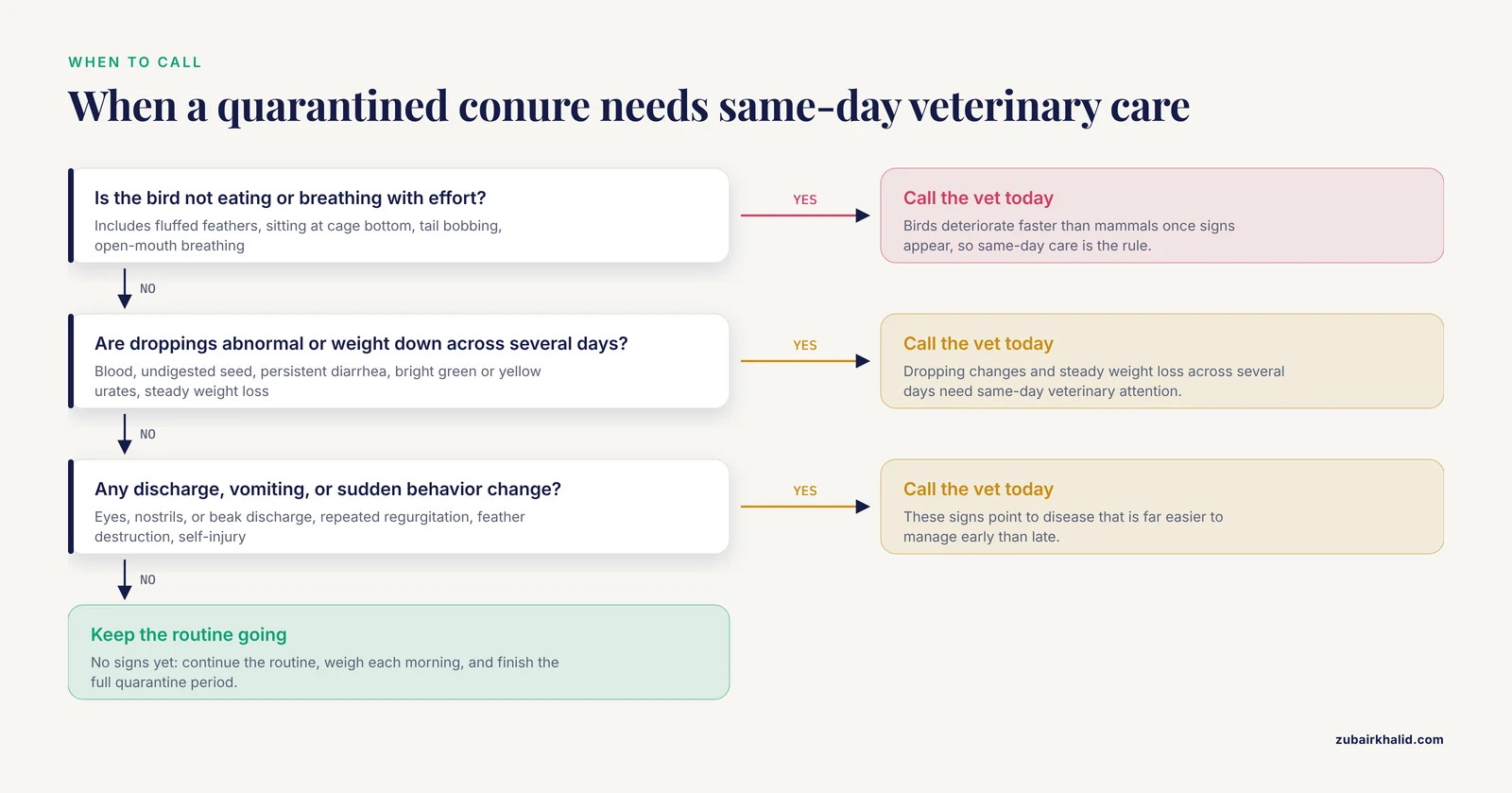
Quarantine plans are tailored, not one-size-fits-all. The right length, testing panel, and introduction schedule depend on the bird's age, source, species, and test results, and an avian veterinarian should set those details for your individual case.
Contact your avian veterinarian the same day for any of the following:
- Not eating or a dramatically reduced appetite
- Fluffed feathers, lethargy, or sitting at the cage bottom
- Tail bobbing, open-mouth breathing, or labored breathing
- Discharge from the eyes, nostrils, or beak
- Vomiting or repeated regurgitation
- Dropping changes, including blood, undigested seed, persistent diarrhea, or bright green or yellow urates
- Steady weight loss across several days
- Feather destruction, self-injury, or a sudden behavior change
- A human household member with fever or flu-like illness after bird exposure, who should also contact a physician and mention the bird exposure
Birds deteriorate faster than mammals once signs appear, so same-day care is the rule for this list. If your regular clinic cannot see birds, the Association of Avian Veterinarians can help you locate an avian practitioner.
Frequently Asked Questions
How long should I quarantine a new conure?
At least 30 days, and many avian veterinarians prefer 45 to 90 days for a newly acquired conure because some infections are shed intermittently and incubation periods vary.
Can I quarantine a new conure in the same room as my other birds?
No. Feather dust and aerosolized droppings move through the air, so the quarantine cage belongs in a separate room with a closed door that your other birds never enter.
What diseases can a new conure spread?
New conures can carry psittacosis, proventricular dilatation disease, psittacine beak and feather disease, polyomavirus, Pacheco's disease, bacterial infections such as salmonellosis, and parasites. Psittacosis and salmonellosis can also infect people.
Does a hand-fed baby conure from a reputable breeder still need quarantine?
Yes. Healthy-looking birds can carry and shed pathogens, and the stress of rehoming can trigger shedding of organisms such as Chlamydia psittaci.
Should I handle my other birds after caring for the new conure?
Care for the quarantined bird last, then wash your hands and change your clothes before touching your resident birds.
What disinfectant is safe to use in a conure quarantine room?
A diluted household bleach solution or an avian-labeled disinfectant, used according to the label with thorough rinsing. Keep the bird out of the room until every surface is dry and odor-free, and never mix chemical cleaners.
When can my new conure meet my current conure?
Only after the full quarantine period and veterinary clearance. Start with cages side by side at a distance, add short supervised visits in neutral space, and keep separate cages until the pair proves compatible over weeks.
Will quarantine stress my conure?
Some adjustment stress is normal in the first days. A consistent routine, enrichment, and short positive handling sessions reduce it, and a conure that stops eating needs veterinary attention the same day.