How to Introduce Finches to Each Other and Other Pets
By Dr. Zubair Khalid, DVM, MS, PhD ·

Introduce finches slowly and in stages: quarantine the new bird first, house the birds side by side in separate cages until they calm down, allow brief supervised contact in a neutral space, then move them in together only after they show relaxed behavior with no chasing or feather plucking. Finches are flock animals, and most zebra finches and society finches accept companions, but every introduction carries a risk of aggression, so supervision and a written plan matter more than speed. When you plan to bring other pets, such as cats and dogs, into the same household, the goal changes. Finches should never share space with predators. Your job is to manage the room, the cage placement, and the other animal's access so the birds stay safe.
This guide walks through the full finch bonding process, from the first day you bring a new bird home to the moment a mixed aviary or multi-pet household runs smoothly. It also explains how to monitor welfare during introductions and when to involve an avian veterinarian.
At a Glance: Your Introduction Checklist
| Step | What You Do | Watch For |
|---|---|---|
| 1. Veterinary check | Book an avian wellness exam for the new finch before any contact | Weight loss, fluffed feathers, nasal discharge, lethargy |
| 2. Quarantine | House the new bird in a separate cage in a separate room | Ask your avian veterinarian how long quarantine should last for your situation |
| 3. Side-by-side cages | Place the cages close enough for the birds to see and hear each other | Relaxed feeding and normal song rather than constant alarm |
| 4. Neutral-space meetings | Allow short, supervised sessions in a neutral enclosure or flight space | Chasing, pinning a bird in a corner, feather damage |
| 5. Move in together | Transfer birds into a clean, redesigned cage at the same time | Repeated fights on day one mean you separate them and slow down |
| 6. Daily monitoring | Score feather condition and body condition every week | Bald patches, ruffled plumage, or a bird sitting fluffed on the floor |
| 7. Other pets | Manage cats and dogs with barriers, distance, and training, never direct contact | Stalking behavior, cage banging, birds panicking at the glass |
Print this table, tape it near the cage, and treat each step as a gate you pass through only when the previous step looks calm.
Why Introductions Matter for Finches
Finches are small passerine birds with fast metabolisms and strong social instincts. In captivity, companionship is often part of good housing, and research on captive zebra finches emphasizes that adequate housing underpins animal well-being [1]. A lone finch in a small cage misses the social stimulation that flock life provides. Adding a companion can improve daily activity, singing, and enrichment.
The same sensitivity cuts the other way. A finch that feels threatened by an aggressive cage mate or a predator staring through the glass experiences chronic stress, and chronic stress shows up in the body. Plumage condition, meaning how neat, complete, and well-groomed the feathers look, is a validated, non-invasive indicator of well-being in captive zebra finches [1]. In practical terms, a finch whose feathers deteriorate during an introduction is telling you something is wrong, even if no one is bleeding yet.
Poor introductions also create physical risk. Small birds can be injured quickly, and a fight that looks minor to you can cause serious wounds, broken feathers, or a bird that stops eating. That is why this article favors slow, staged introductions over the "just put them together and see" approach that circulates in pet-store advice.
Can Finches Live Together?
Yes, most finches can live together, and many thrive in pairs or small groups. The better question is which finches, in what numbers, and in what cage. Answering "can finches live together" honestly requires three decisions.
Same Species or Mixed Species
The safest pairing is two birds of the same species. Zebra finches pair well with other zebra finches, and society finches pair well with other society finches. Mixed-species finch aviaries can work, but they depend on matching temperament, size, and space, and they carry a higher risk of bullying. If you have never kept finches before, start with a same-species pair.
Pair, Trio, or Colony
Zebra finches are strongly pair bonded. A true pair often lives peacefully, while an odd number can leave one bird without a partner and exposed to the pair's combined aggression. If you want a colony, you need a substantially larger flight cage or aviary, more perches and feeding stations than there are birds, and space for a subordinate bird to get out of sight. Never add a third bird to a small cage with an established pair.
How Mate Choice Affects Your Plan
Finch pairing is not random. Female zebra finches assess male quality when they choose mates, and studies of mate choice show that visual details matter to them. In research involving 220 zebra finches, one experiment found that females preferred males when red color cues appeared in the environmental background compared with green cues, although follow-up experiments failed to confirm effects of environmental color cues on female choice or male behavior [2]. The practical takeaway for owners is simpler than the science. Finches notice visual detail, including the colored leg bands that researchers use to mark individuals, and small environmental details can influence how a bird perceives a potential mate [2]. When introducing a new finch as a intended partner, watch whether the two birds actually show interest in each other rather than assuming any male and female will bond.
If birds show no interest, fight constantly, or pick on one individual, the pairing itself may be the problem. Sometimes the fix is a different companion, not a different technique.
Preparing Before You Introduce a New Finch
Preparation is where most successful introductions are won. Rush this phase and the later stages fall apart.
Quarantine and the First Veterinary Visit
Every new finch should be examined by an avian veterinarian before it meets your existing birds. Birds hide illness well, and a new finch that looks healthy can still carry infections or parasites that your established flock has never encountered. The Association of Avian Veterinarians maintains resources and a directory to help owners locate veterinarians experienced with birds, and the Merck Veterinary Manual's pet bird materials stress quarantine and new-bird screening as core biosecurity for home flocks.
During quarantine, keep the new bird in a separate room with its own cage, food and water dishes, and care supplies. Wash your hands and change your shirt after handling the new bird before you touch your established birds. Ask your avian veterinarian how long quarantine should last in your case, because the answer depends on what tests were run and what the bird was exposed to before you brought it home.
Use the quarantine period to learn the new bird's baseline. Record its weight if you have a gram scale, watch how it eats, and note its droppings. This baseline becomes invaluable later if you need to judge whether the bird is coping with the introduction.
Cage and Equipment Setup
Plan the equipment before the birds ever meet. Selection criteria that matter:
- Flight length over height. Finches exercise by flying horizontally. Choose the longest cage your space allows.
- Multiple food and water stations. One dish lets a dominant bird guard the resource. Provide at least one dish per bird, spaced apart.
- Perches at multiple heights and angles. Avoid crowding perches directly over dishes. Include one escape perch where a subordinate bird can sit out of reach.
- Visual barriers inside the cage. A well-placed branch or plant-safe divider lets a harassed bird break line of sight.
- A spare cage. Keep the quarantine cage assembled and ready. Many introductions require separating birds again, sometimes overnight, sometimes permanently.
- A neutral meeting enclosure. For supervised first meetings, a clean cage or flight pen that neither bird has claimed reduces territorial aggression.
For diet, Lafeber Company's avian nutrition resources and VCA Animal Hospitals' finch care guides describe a base diet of formulated finch pellets or a quality finch seed mix supplemented with fresh greens. Confirm the specific diet plan with your avian veterinarian, especially if the new bird came from a breeder feeding something different, because abrupt diet changes add stress during an already stressful period.
How to Introduce Finches Step by Step
Stage 1: Side-by-Side Cages
Place the two cages near each other so the birds can see and hear one another but cannot touch. Keep a few inches of gap between the cages so beaks and toes cannot reach through the bars. Expect some posturing in the first days, including fluffing, calling, and heightened activity. What you want to see within a few days is normalization. Birds should eat, preen, sing, and bathe in the presence of the other cage. If one bird spends the entire day pressed against the bars toward the other or screaming continuously, increase the distance and give them more time.
Side-by-side housing usually lasts one to two weeks, but let the birds set the pace, not the calendar.
Stage 2: Supervised Neutral-Space Meetings
Set up a neutral enclosure, such as a clean flight cage that neither bird has lived in, with fresh perches, multiple food stations, and no pre-existing territory. Introduce both birds at the same time so neither has home advantage. Keep the first sessions short, ten to fifteen minutes, and stay in the room watching the entire time.
Healthy first-meeting behavior looks like this:
- Both birds fly to perches and settle
- They eat near each other, even with a dish between them
- There may be brief wing flicking or a short chase that ends immediately
- No bird is cornered, pinned, or plucked
End every session on a good note, before trouble starts, and return each bird to its own cage. Repeat daily, gradually lengthening the sessions. If a specific bird initiates repeated chases, stop the sessions, go back to side-by-side housing, and give it several more days.
Stage 3: Moving In Together
When neutral-space sessions run long and calm, redesign the permanent cage before the final move. Rearrange perches, rotate dishes to new positions, add new enrichment, and scrub everything. A redesigned cage reads as neutral territory to both birds. Then move both birds in at the same time, ideally in the evening when they are settling toward roost, and leave the lights low.
Plan to stay home and observe for the first full day. Brief squabbling over perches is normal. What is not acceptable:
- One bird relentlessly chasing another
- A bird pinned on the floor or in a corner
- Feathers pulled out, blood, or a bird that cannot reach food or water
- A bird huddled motionless for hours
If you see those signs, separate the birds immediately, return to side-by-side housing, and reassess whether the pairing is workable. Some pairs never click. That outcome is not a failure of your technique. It is a compatibility result, and the humane response is a different companion or a spacious aviary layout that gives each bird real distance.
The Finch Bonding Process After Move-In
True bonding shows in specific behaviors. A bonded pair sits side by side, preens each other's head feathers, shares a roosting spot at night, and coordinates activity. In zebra finches, pair bonds are strong and long lasting, which is why mate choice matters and why breaking an established pair to force a new match is stressful for the birds [2].
The finch bonding process takes time even after birds share a cage. For the first several weeks, keep the environment stable. Do not rearrange the cage, do not add new birds, and keep noise and household traffic predictable. Watch from a distance. Every time you intervene unnecessarily, you reset some of the trust the birds are building with their new surroundings.
Introducing Finches and Other Pets
Finches and other pets are a managed combination, never a friendship. A finch cannot be taught that the cat is safe, and a cat cannot be relied on around a prey animal it can see and hear. The Association of Avian Veterinarians and avian sections of major veterinary texts treat cats, dogs, and other predatory household animals as a constant risk to cage birds, regardless of how gentle the individual animal seems.
Cage Placement and Barriers
Follow these rules from day one:
- Elevate the cage. Place the finch cage on a stand, out of the reach of dogs, and well away from surfaces a cat can leap to.
- Keep distance from glass. A cat sitting inches from the cage, even through bars, frightens the birds and stresses them chronically. Position the cage where a predator cannot press against the wire.
- Use physical barriers where needed. A dedicated bird room with a closed door is the gold standard. In open-plan homes, a mesh or solid barrier between the pet zone and the bird zone works.
- Never allow direct contact. Even a scratched, supervised "introduction" between a cat and a finch is one accident away from a fatality. A cat's mouth bacteria alone can kill a bird from a minor puncture.
Training the Other Pets
Train the dog to settle calmly away from the cage and reward that behavior. Teach a "leave it" cue and use it preemptively. For cats, management beats training. Cat habits, including stalking and pouncing, are hardwired, and the Merck Veterinary Manual's pet bird owner guidance treats environmental management, not predator retraining, as the safety foundation.
Watch the birds' response, not just the other pet's behavior. If your finches stop singing, stop bathing, or perch rigidly whenever the dog walks past, the cage placement is wrong even if no attack has ever happened. Move the cage and see if the behavior resolves. Chronic fear is a welfare problem in its own right, and feather condition gives you an objective way to track it [1].
Other Birds in the Household
Parrots and finches should never share a cage, and many parrots can injure or kill a finch through the bars of adjacent cages. If you keep both, house them in separate rooms or ensure cages are far enough apart that no beak can reach through wire. Supervise any out-of-cage time in shared airspace.
Common Mistakes to Avoid
- Skipping quarantine. The single most expensive mistake in finch keeping. One infected new bird can affect an entire flock.
- Introducing birds into an established cage. The resident bird defends its territory. Always use a neutral, redesigned space for the final move.
- Reading squabbling as bonding. Constant chasing is not courtship. Learn the difference between brief spats that end quickly and sustained harassment.
- Adding a third bird to a bonded pair's small cage. Established pairs defend their bond and their space. Expand the enclosure substantially before expanding the flock.
- Assuming any two birds will pair. Zebra finches exercise mate preference, and details a human barely notices can influence how a bird evaluates a potential partner [2].
- Judging success in hours instead of weeks. Birds can look settled on day two and erupt in conflict during week three, especially as hormones fluctuate.
- Letting cats and dogs "meet" the birds. There is no safe version of this. Barriers only.
- Ignoring feather and body condition changes. These are measurable welfare signals, not cosmetic details.
Monitoring Welfare During and After Introductions
A structured welfare check turns instinct into data. Researchers studying captive zebra finches developed a plumage scoring system that different observers, including relatively inexperienced ones, applied with substantial inter-observer reliability, meaning different people scored the same birds consistently [1]. The same research compared plumage scoring with the traditional fat score used for body condition and found the fat score required more observer training to reach comparable reliability [1]. Both measures are simple, non-invasive tools, and combining a plumage score with a fat score gives a fuller picture of a bird's condition [1].
You do not need the research scoring sheet to benefit from the concept. Once a week, look at each bird systematically:
- Feather coverage. Are there bald patches, broken feathers, or thinning areas, especially around the head and back?
- Feather condition. Does the plumage lie neat and smooth, or does the bird look ruffled and unkempt even when warm and relaxed?
- Keel and body feel. Gently cup the bird and feel the chest. A prominent, sharp keel suggests declining body condition. Ask your avian veterinarian to show you how to assess this during a wellness exam.
- Behavior log. Note singing, bathing, foraging, perching position, and who sits next to whom.
A decline in plumage score or body condition during an introduction is your early warning system. It often appears before open conflict does.
Limitations and When to Contact a Veterinarian
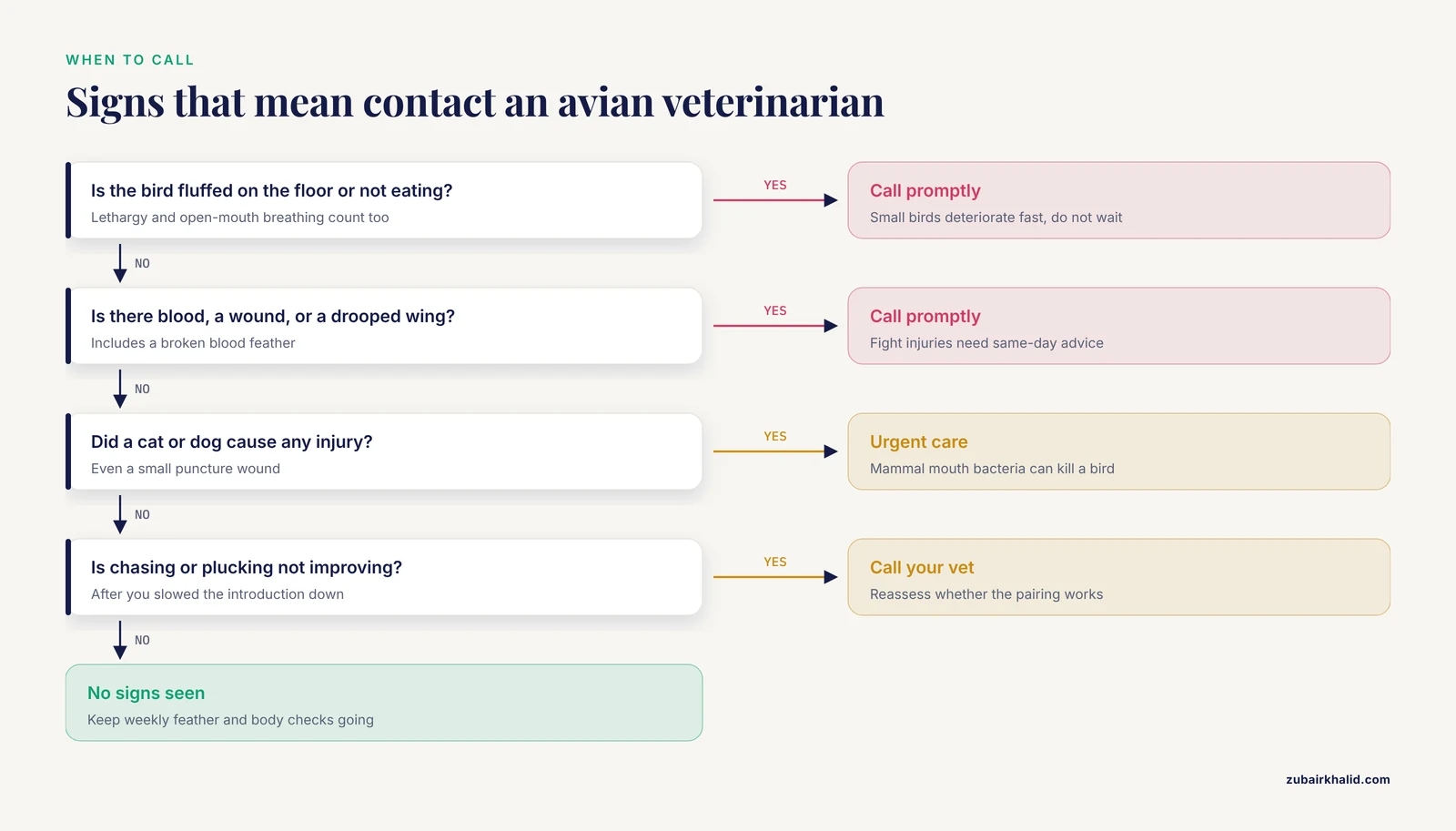
Every finch, household, and introduction is different, and only an examination by an avian veterinarian can assess your individual birds. The stages in this article describe a typical process, not a guarantee, and no article can tell you whether two specific birds will accept each other.
Contact an avian veterinarian promptly if you observe any of the following:
- A bird sitting fluffed on the cage floor, lethargic, or not eating
- Open-mouth breathing, tail bobbing, or discharge from the nostrils or eyes
- Blood, a bleeding broken blood feather, or a wound from a cage mate
- A bird that cannot fly normally or holds a wing drooped after a fight
- Sustained chasing, cornering, or feather plucking that does not improve when you slow the introduction down
- Weight loss or a deteriorating body condition during quarantine or after move-in
- Any injury caused by a cat or dog, no matter how small it looks. Puncture wounds from mammal bites require urgent veterinary care because of bacterial contamination.
- Sudden death of a bird in the flock, which should prompt a conversation about the remaining birds' exposure
If your avian veterinarian is unavailable, ask the Association of Avian Veterinarians directory or an emergency clinic with avian experience rather than waiting. Small birds deteriorate fast.
This article is educational and is not a substitute for veterinary diagnosis or treatment.
Frequently Asked Questions
Can finches live together in the same cage?
Yes, most finches do well in same-species pairs or compatible groups, provided the cage is large enough and you introduce them gradually. Same-species pairs are the easiest combination for beginners, and colonies require generous flight space with extra perches and feeding stations.
How long does the finch bonding process take?
Expect several weeks from the first side-by-side housing until a pair behaves as settled companions, with some pairs taking longer and some never bonding. Bonded finches sit together, preen each other's heads, and roost side by side at night.
Can I keep just one finch?
Finches are flock birds, and a single finch misses the social interaction its species is built for. If you cannot keep more than one, ask an avian veterinarian or experienced keeper about whether your setup can realistically meet a single finch's social and exercise needs, or consider a species better suited to solo life.
How do I introduce a new finch to my existing pair?
Do not add the new bird to the pair's cage. Quarantine it first, then run side-by-side and neutral-space introductions, and only consider moving all three together if you also have the substantially larger enclosure a trio requires. A third bird squeezed into a pair's established territory is the most common setup for serious bullying.
Do finches fight when first introduced?
Some brief squabbling is normal as birds establish perches and roles, but relentless chasing, cornering, or feather plucking is not. Separate birds showing those signs, return to side-by-side housing, and reassess the pairing.
Are finches safe around cats and dogs?
Only with strict physical separation. Cats and dogs are predators, and even a calm, well-fed animal can kill a finch in seconds. Elevate the cage, keep it away from launch points, use a dedicated bird room or barrier when possible, and never allow direct contact.
Can finches share a home with budgies or parrots?
Finches and parrots should not share a cage, and many parrots can injure finches even through adjacent cage bars. House them in separate rooms or keep cages far enough apart that no bird can reach another.
Why did my finches start fighting after months of peace?
Common triggers include breeding hormones, a cage or perch change that disrupted the established order, illness in the subordinate bird, or overcrowding. Do a welfare check on both birds, look for injuries or weight changes, and call your avian veterinarian if the fighting continues or if either bird's plumage or body condition declines.