How to Introduce Conures to Each Other and Other Pets
By Dr. Zubair Khalid, DVM, MS, PhD ·
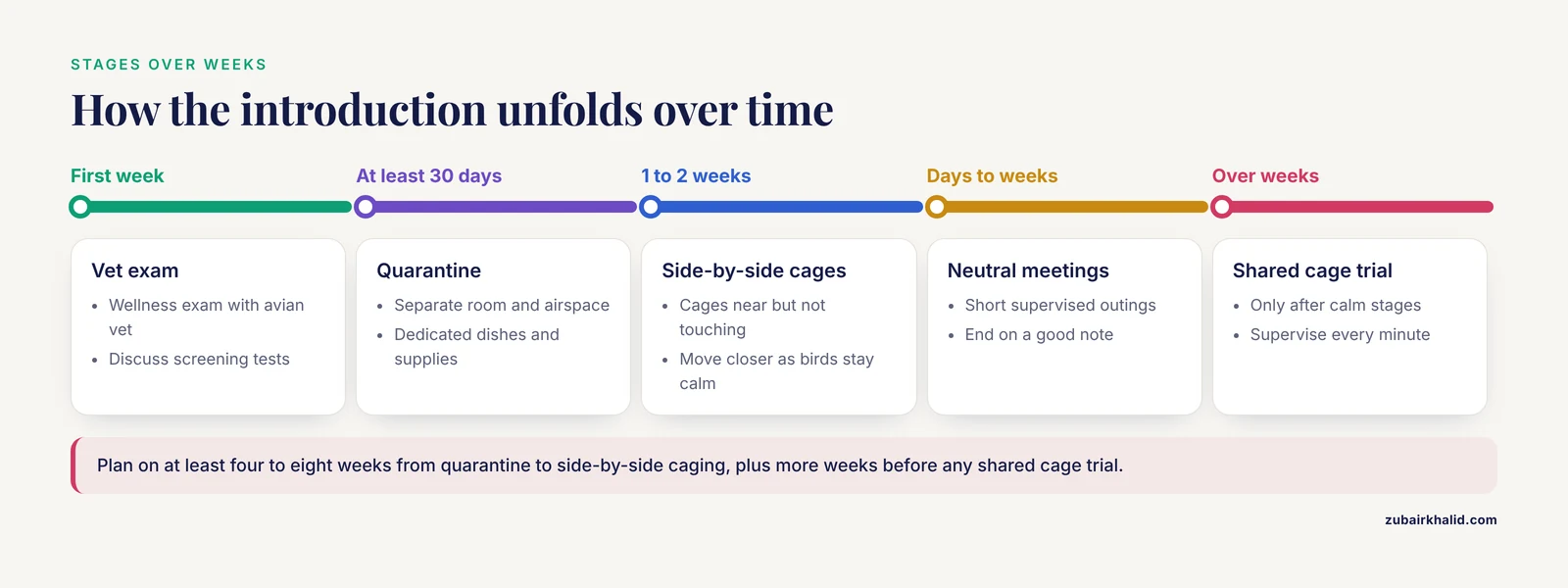
Introduce conures slowly, in separate cages, over several weeks. The safe pattern is quarantine and a veterinary exam first, then side-by-side caging, then neutral-space meetings, then supervised shared time. Full integration, if it happens at all, takes weeks to months and never happens unsupervised until the birds have shown weeks of calm behavior together. Conures and other pets such as cats and dogs should never be expected to "get along." The goal with a cat or dog is strict physical separation, not friendship.
Conures are loud, social, and strong-willed parrots. Some pairs bond and become lifelong companions. Others never tolerate each other and must live apart for life. Both outcomes are normal. Your job is to read the birds, go at their pace, and protect them from injury and disease at every stage.
This guide walks through the whole process, from the first day you bring a new conure home to the day two birds share a cage, or the day you decide they should not.
At a Glance: The Safe Introduction Sequence
| Stage | What Happens | Typical Timeframe |
|---|---|---|
| 1. Veterinary exam | New bird sees an avian veterinarian before meeting anyone | First week home |
| 2. Quarantine | New bird housed in a separate room, separate airspace, dedicated supplies | Commonly at least 30 days, per avian veterinary guidance |
| 3. Side-by-side cages | Cages placed near each other, no physical contact possible | 1 to 2 weeks minimum |
| 4. Neutral-space visits | Short, supervised outings in a neutral room or play gym | Days to weeks |
| 5. Shared cage trial | Only if all prior stages are calm and friendly, always supervised | Gradual, over weeks |
| 6. Cats and dogs | Permanent physical separation, no stage of integration | Ongoing for life |
Print this, tape it near the cages, and treat each stage as a gate the birds must pass through cleanly before you move forward.
Can Conures Live Together?
Yes, many conures can live together, but it depends on the individual birds, their sex, their species, and how they are introduced. Conures are flock animals in the wild and often enjoy the company of another bird. At the same time, they are territorial around their cage and can inflict serious bite wounds on a cagemate they reject. The Merck Veterinary Manual notes that psittacines, including conures, show strong individual variation in compatibility and that aggression between birds can escalate quickly.
Three factors predict success better than anything else:
- Individual temperament. Two easygoing birds have a far better chance than a dominant bird paired with a timid one.
- Space. A cage sized for one conure is not sized for two. Crowding is one of the most common triggers for fighting.
- Introduction speed. Almost every serious injury happens when an owner rushes the process or leaves birds together unsupervised too early.
Same-species pairs are usually easier than mixed-species pairs. Larger and smaller conure species should not share a cage because size differences make injury more likely. If you want two conures to live together, plan on the full staged process below, and accept that some pairs will stop at the side-by-side stage happily for the rest of their lives.
Why Introductions Must Be Slow
Birds hide illness until they are sick, and a new bird can carry infectious disease while looking completely healthy. Avian veterinarians routinely recommend quarantine for any new bird arriving in a home that already has birds, because respiratory and digestive infections can spread through the air, on your hands, and on shared equipment. Skipping quarantine to save two weeks is the single riskiest shortcut in bird keeping.
The behavioral side matters just as much. A conure placed immediately into another bird's cage is defending territory it never agreed to share. Fights that start this way can create lasting grudges, and a badly bitten foot or wing can end in a veterinary emergency. Slow exposure lets each bird accept the other as part of the scenery before contact is ever possible.
Slow introductions also protect the existing bird. Residents often act territorial, scream more, or begin plucking when a newcomer appears. Gradual acclimation gives both birds time to adjust without a spike in stress behavior.
Step 1: Veterinary Exam and Quarantine
Schedule the exam first
Before you think about introductions, book a wellness exam with a veterinarian who sees birds regularly. The Association of Avian Veterinarians maintains resources to help owners locate qualified avian practitioners and recommends a checkup for newly acquired birds. At this visit the veterinarian can perform a physical exam, discuss screening tests for infectious disease, check the bird for parasites, and answer questions about the bird's diet and weight.
Ask the veterinarian directly about quarantine length for your situation. The answer depends on what tests were run, where the bird came from, and what birds already live in your home.
Set up true quarantine
Quarantine means separate airspace, not just a separate cage. House the new bird in a different room with its own air, ideally with a closed door between it and your existing birds. Follow these rules for the whole quarantine period:
- Use dedicated food and water dishes, perches, and cage liners for the new bird only.
- Care for the resident birds first, then the new bird, or shower and change clothes after handling the new bird.
- Do not let the birds' beaks or claws meet through bars. Birds can transmit disease and deliver serious bites through cage wire.
- Wash your hands after every contact with the new bird or its cage.
The VCA Animal Hospitals guidance on new bird care emphasizes that quarantine protects an entire household flock, and that new birds should stay separated until a veterinarian clears them.
Watch the new bird daily during quarantine
Daily observation during quarantine builds the baseline you will rely on later. Note the bird's weight trend, droppings, appetite, activity level, and vocalizations. A bird that fluffs up, sits at the bottom of the cage, stops eating, or produces changed droppings needs a veterinary call, not a wait-and-see approach.
Step 2: Prepare the Environment and Supplies
Cages and placement
Plan for each bird to keep its own cage even if they later share time out together. Every conure needs a retreat it can call its own. Choose cages that give each bird room to flap fully with perches, bowls, and toys installed. If the eventual goal is a shared cage, buy a cage large enough for two birds to be out of each other's reach when they want to be.
During the side-by-side stage, place the cages close enough for the birds to see and hear each other but far enough apart that they cannot touch through the bars. Start several feet apart and move the cages closer over days as both birds stay relaxed.
Supplies checklist
- A full second set of food and water dishes
- Separate perches of varied diameter and texture for each cage
- Foraging toys and shreddables to redirect energy
- A neutral play stand or gym that belongs to neither bird
- A spray bottle of plain water forRedirecting minor squabbles at a distance (never as punishment)
- A towel for emergency restraint, kept out of sight of the birds
- A separate room or travel carrier for time-outs and emergencies
Diet before introductions
Nutrition affects behavior. A bird on a poor diet is more irritable and less resilient to stress. Lafeber's avian care resources highlight that a balanced diet built around formulated pellets, with vegetables and appropriate treats, supports normal behavior and feather condition in conures. Ask your veterinarian to confirm both birds are eating well before you begin face-to-face stages, because a bird that guards food aggressively will guard it even harder with a rival nearby.
Step 3: The Conure-to-Conure Introduction, Stage by Stage
Stage 1: Parallel awareness (days 3 to 10 of side-by-side)
With the cages at a distance, let the birds simply notice each other. Feed them at the same time so eating near the other becomes routine. Watch for calm preening, normal eating, and relaxed posture. Mild curiosity, such as moving to the cage side nearest the other bird, is a good sign. Repeated lunging at the bars, constant screaming at the other bird, or refusal to eat means slow down and increase the distance.
Stage 2: Closing the distance (about 1 to 2 weeks)
Move the cages a few inches closer every day or two as long as both birds remain relaxed. End with the cages side by side or a few inches apart. The Merck Veterinary Manual describes psittacine social behavior as highly individual, and notes that familiarization through gradual exposure is the practical route owners use before attempting housing birds together.
Stage 3: Neutral territory meetings
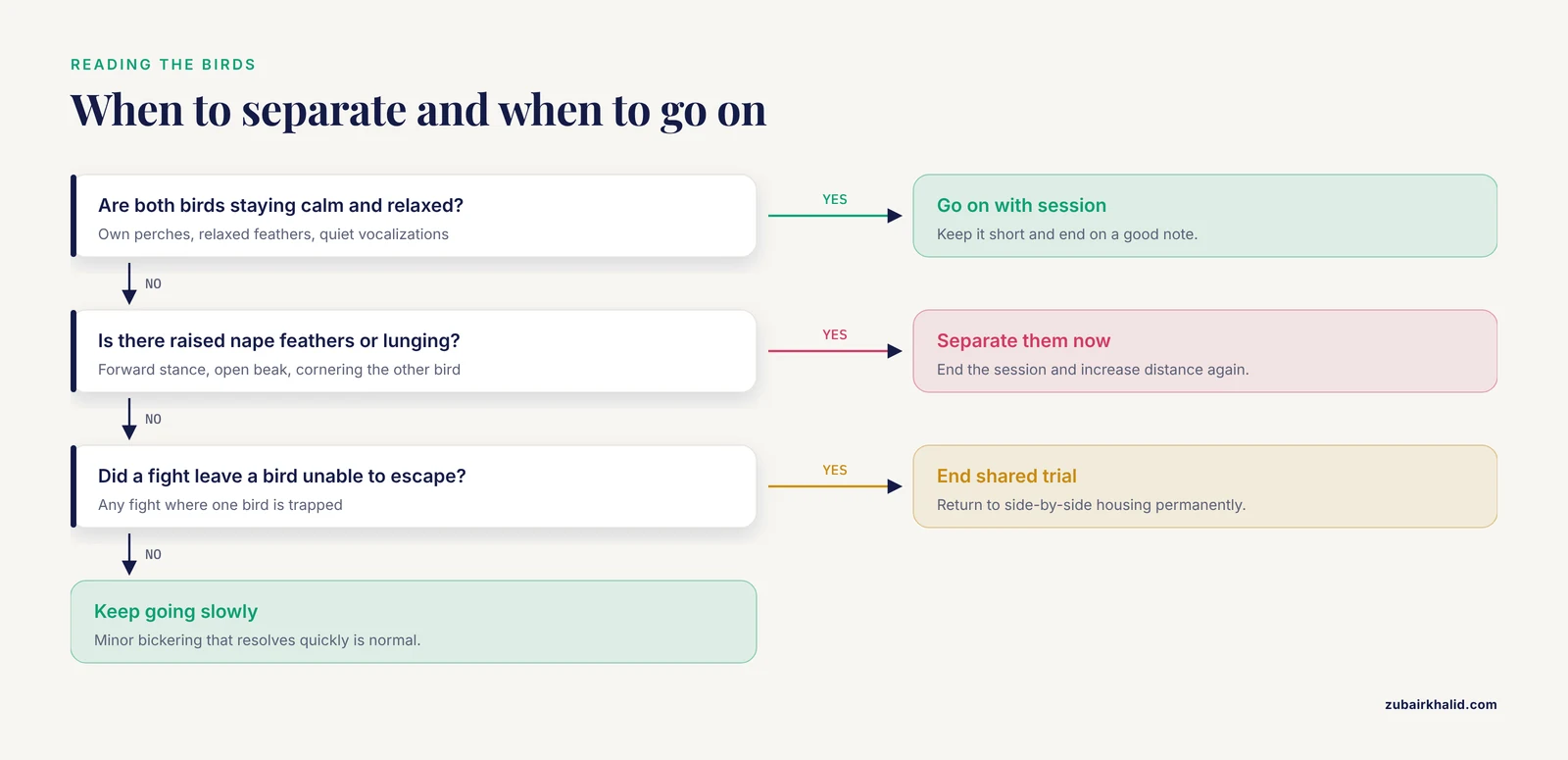
Choose a room neither bird regards as home territory, or use a play stand neither has claimed. Take both birds out at a calm time of day. Keep the first sessions short, five to ten minutes, and end on a good note. Have a second person handle one bird if possible, so you can separate them instantly if tension appears.
Good signs during neutral meetings:
- Both birds stay on their own perches or areas
- Curious approach with relaxed body feathers
- Quiet vocalizations, normal eating if food is present
- One bird grooming near the other without lunging
Warning signs that mean separate them now:
- Raised nape or crown feathers with a forward stance
- Open beak or lunging toward the other bird
- One bird continually pinning the other in a corner or on a single perch
- Rapid escalation after small disputes
Minor bickering happens even between compatible birds. The pattern that matters is whether disputes resolve quickly and both birds recover calmly. The pattern that ends the session is any fight where a bird cannot escape.
Stage 4: Shared cage trial
Only attempt this after weeks of calm side-by-side living and repeated peaceful neutral sessions. Set up the shared cage fresh, with rearranged perches, new bowls in duplicate, and multiple food stations so neither bird controls the resources. Put both birds in at the same time in the morning so neither feels it arrived second into its own space.
Supervise every minute of the first shared-cage days. Have the original cages ready to move back immediately. Watch especially around food, at dusk when birds seek sleeping spots, and during hormonal periods when aggression rises. If a serious fight occurs, end the shared trial permanently and return to side-by-side housing. Some conure pairs will simply never share a cage, and side-by-side companionship is a complete success on its own.
The Conure Bonding Process: What It Looks Like
Conure bonding follows a recognizable arc when it works. The conure bonding process generally moves through these signs in order:
- Tolerance. The birds eat, play, and rest near each other without displaying.
- Proximity. They choose perches near each other and begin synchronizing activities, such as eating or preening at the same time.
- Allopreening. One bird gently preens the other's head and neck feathers. This is the clearest sign of a social bond in parrots and appears once real trust exists.
- Shared resting. The birds sleep near each other or in contact, often within the same cage without conflict.
Reach each milestone on the birds' schedule, not yours. A pair that reaches mutual allopreening has typically been cohabiting peacefully for some time. Do not rush birds toward the milestones. Forcing contact can set the process back weeks.
Also understand what bonding means for your own relationship. Two conures that bond tightly to each other often become less interested in human handling. If your priority is a hands-on pet, that trade-off deserves thought before you start, and it is worth raising with an avian veterinarian or an experienced avian behavior consultant.
Conures and Other Pets: Cats, Dogs, and Small Animals
This is the section where the honest answer differs from what many owners hope to hear. Conures and other pets such as cats and dogs should live in the same household under permanent physical separation. A cat or dog does not need to be aggressive to kill a small parrot. Predators respond to fluttering movement, and a conure on the floor or a low play stand can trigger a chase in an otherwise gentle animal.
Practical rules that avian veterinarians repeat constantly:
- The bird's room is off limits to cats and dogs, with a door that closes and latches.
- Never leave a conure flying or out of its cage in a shared space with a cat or dog present, even a calm, elderly one.
- Cats carry bacteria in their mouths and claws that cause severe, rapidly progressing infections in birds. Any contact, even a scratch through the cage bars, is a same-day veterinary emergency even if the wound looks minor.
- Keep cages high enough and anchored so a dog cannot knock them over.
- Do not allow a dog to "watch" the bird at cage level. Face-to-face proximity at close range builds prey drive, not friendship.
The same logic applies to ferrets, which are persistent predators, and to small pets such as rabbits or guinea pigs that are usually safe from a conure's beak but can be stressed by constant screaming. Housing a conure in a room shared with a rabbit or guinea pig is generally fine when the cage bars prevent contact and both species have retreat space.
Some households do manage calm, supervised coexistence where a dog lies across the room while a conure plays on a stand. If you attempt this, do it only after weeks of controlled exposure at increasing distance, never with the bird on the floor, and never while a dog is excited, playing with toys, or eating. Any single failed moment can be fatal, so most avian veterinarians counsel owners to treat separation as permanent rather than counting on training to hold.
Common Mistakes That Cause Injuries
- Skipping quarantine. The most frequent and most costly error. One infectious bird can expose every bird in the house.
- Putting the new bird in the resident's cage. Territorial defense makes this the fastest route to a severe bite.
- Leaving new birds unsupervised "because they seemed fine." Fights can erupt days or weeks after a calm start, especially around food or sleeping spots.
- Misreading feeding as affection. Beak-to-beak feeding can be courtship behavior. Between birds that are not bonded, or between a bird and its owner, it can trigger hormonal aggression and frustration.
- Assuming size similarity means compatibility. Two conures of different species may differ enough in size and temperament that one can injure the other badly.
- Introducing birds during a hormonal or breeding period. Elevated hormones amplify territorial behavior. If either bird is showing persistent courtship or nesting behavior, ask your veterinarian before proceeding.
- Counting on cats and dogs to learn limits. See the section above. This assumption ends in emergency visits.
Troubleshooting: When Introductions Stall
Constant screaming between cages. Some vocal back-and-forth is normal flock contact calling. Screaming that never settles, combined with lunging at bars, means the birds need more distance. Move the cages apart, let them settle, and progress more slowly.
One bird bullies the other through the bars. Territorial display at the bars is common and often fades. If one bird persistently lunges, hangs on the bars toward the other, or the other bird stops eating, separate them and restart from a greater distance.
Regurgitation between the birds. One bird feeding the other signals pair bonding, which is good news for compatibility but raises a management question. Chronic hormonal behavior has health consequences, so discuss it with your avian veterinarian rather than simply encouraging nesting.
Feather damage on one bird. Missing head feathers or broken feathers on one bird means repeated contact you are not seeing. Separate them immediately and reassess. Do not wait to "catch them in the act."
A regression after progress. Changes such as a move, a new cage arrangement, longer daylight exposure, or a schedule disruption can restart aggression. Step back one stage and rebuild over a week or two.
Welfare and Safety Points
Every stage of this process should leave both birds able to eat well, sleep well, and behave normally. A conure that stops eating, plums its feathers, or grows unusually quiet during introductions is telling you the plan is moving too fast. Birds experiencing chronic stress are more susceptible to illness, and feather-destructive behavior can begin during prolonged social conflict.
Environmental safety matters throughout. Keep the bird room free of nonstick cookware fumes, aerosols, scented candles, and smoke, since airborne toxins affect birds at exposures other pets tolerate. The Merck Veterinary Manual's pet bird resources cover toxic fumes and household hazards in detail and are a useful reference for any conure household.
Finally, respect each bird's individuality. A conure that never accepts a cagemate still deserves daily out-of-cage time, foraging work, and social contact with you.
Limitations and When to Contact a Veterinarian
Every conure is an individual, and the timelines in this article are typical ranges rather than guarantees. Your avian veterinarian should guide quarantine length, disease screening, and any decision about cohabitation based on your actual birds.
Contact your avian veterinarian promptly if you see any of the following:
- Any bite or scratch from a cat or dog, even without visible injury
- A bite wound between birds, puncture, bleeding, or a bird favoring a foot or wing
- Sitting fluffed at the cage bottom, falling off perches, or not perching
- Reduced appetite, weight loss, or noticeably changed droppings lasting more than a day
- Discharge from the eyes or nostrils, difficulty breathing, or tail bobbing
- Sudden severe feather loss or new feather-destructive behavior
- Aggression that appears abruptly in a previously bonded pair, which can reflect pain or illness rather than a behavioral problem
If a bird stops eating entirely, treat it as an emergency and seek veterinary care the same day.
This article is educational and is not a substitute for veterinary diagnosis or treatment.
Frequently Asked Questions
How long does it take to introduce two conures?
Plan on at least four to eight weeks from quarantine to side-by-side caging, and additional weeks before any shared cage trial. Some pairs take months, and some never share a cage.
Can conures live together in the same cage?
Many can, once they have passed quarantine and a staged introduction. Compatibility depends on the individual birds, adequate cage size, and your supervision. Pairs that fight should live side by side in separate cages instead.
Should I quarantine a new conure even if it looks healthy?
Yes. Birds hide illness well, and a healthy-looking new bird can still carry infections that threaten your existing birds. Avian veterinarians commonly recommend at least 30 days of quarantine in separate airspace.
Can a conure and a cat ever be friends?
No. Treat cats and conures as permanently separated pets. Even a playful or calm cat can kill a small parrot in seconds, and cat saliva causes dangerous infections in birds.
What signs show two conures are bonding?
Look for a progression from calm tolerance, to choosing nearby perches, to mutual preening of head and neck feathers, to resting close together. These milestones appear in order over weeks.
Why are my conures fighting after getting along?
Common triggers are food guarding, competition for sleeping spots, a cage that is too small, or rising hormone levels. Separate them, reduce the trigger, and step back one introduction stage before trying again.
Can I introduce conures of different species?
Cautiously, and often only for supervised out-of-cage time rather than shared housing. Size and temperament differences between conure species raise the risk of injury, so discuss your specific species pair with your avian veterinarian before cohabitation.
When should I give up on introducing my conures?
Give up on cohabitation when repeated staged attempts produce lunging, injuries, feather damage, or one bird that will not eat near the other. Side-by-side cages with separate territories are a successful, humane long-term outcome.