How to Introduce Canaries to Each Other and Other Pets
By Dr. Zubair Khalid, DVM, MS, PhD ·

Introduce canaries slowly, in separate cages, and with a plan to keep them permanently separated if aggression appears. Most canaries do best as single birds or as one compatible pair in a large flight cage. Unlike parrots, canaries are not flock birds that bond with cage mates. They are territorial, and two males in one cage will often fight seriously, sometimes causing injury or death. The safest method for introducing a new canary is a staged process: quarantine the new bird, house the birds in side-by-side cages, watch how they respond to each other, and only then allow brief supervised contact in neutral space. If you see sustained aggression, return to side-by-side housing or keep the birds in separate cages for life.
The same cautious, staged approach applies to canaries and other pets. Cats and dogs are predators, and even a friendly paw or a startled lunge can kill a small bird in seconds. This guide walks through the full process, from the first day home to long-term coexistence.
At a Glance: Your Introduction Checklist
| Stage | What You Do | Typical Timeframe | Success Looks Like |
|---|---|---|---|
| 1. Quarantine | New bird housed in a separate room, own equipment, avian vet check | Per your avian veterinarian's recommended period | No signs of illness, clean vet exam |
| 2. Side-by-side cages | Cages a short distance apart, each bird in its own cage | Days to weeks | Calm feeding, normal singing, no constant pacing at the barrier |
| 3. Neutral-space meetings | Short supervised sessions in a neutral play area or open room with both birds confined or flighted under close watch | Minutes at a time | Relaxed posture, curious but calm behavior, no lunging or chasing |
| 4. Shared housing decision | Only if all sessions stay peaceful, consider one large flight cage, ideally one male with one female | Permanent decision | Birds eat, perch, and rest without conflict for weeks |
| 5. Other pets | Always separate. Visual habituation only, with the canary caged and cats or dogs leashed or gated away | Ongoing | Canary sings and behaves normally, other pets ignore the cage |
Print this table, tape it near the cage, and treat each stage as a gate the birds must pass through peacefully before moving to the next one.
Can Canaries Live Together?
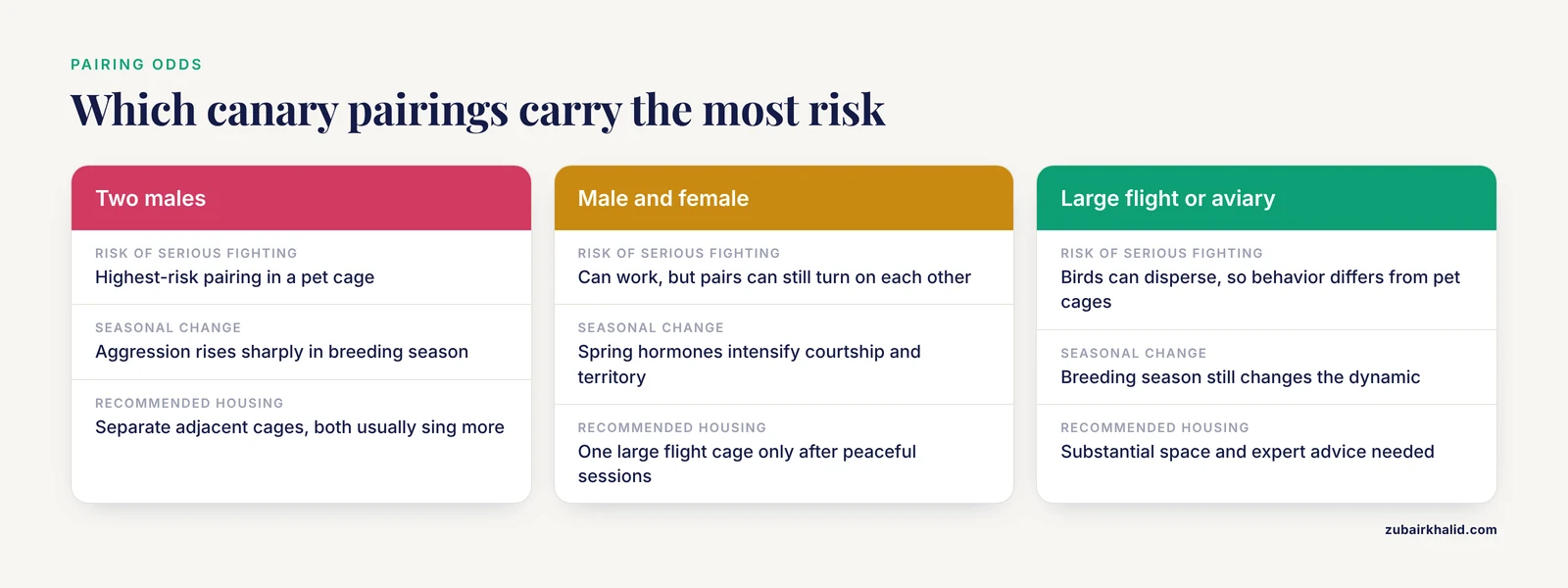
This is the first question most owners ask, and the honest answer is: sometimes, but less often than people hope.
Canaries are territorial, especially males, which are kept for their song and are the birds most likely to fight. During breeding season, male aggression rises sharply. Two adult males in a standard pet cage is the highest-risk combination. A male and female pair can work, particularly outside breeding season, but even pairs can turn on each other. Large flights and aviaries with many birds and plenty of space behave differently from pet cages, because the birds can disperse.
The practical rule is this: any canary-to-canary introduction is a trial, not a promise. You are testing whether these two specific individuals tolerate each other. Some do. Many do not. Your job is to run the trial safely so a failed match costs nobody a feather, and ideally not a drop of blood.
This testing approach mirrors what animal behaviorists do with other species. In studies of endangered lizards in the Canary Islands, researchers filmed individuals in shared enclosures, measured which animals showed high-intensity aggression, and used that data to separate incompatible animals and pair tolerant ones for breeding [1]. The lesson transfers directly to canaries: observe actual behavior, record it, and let the data, not your hopes, decide who lives together.
Why Canaries Fight: Understanding the Behavior First
Before you put two cages near each other, understand what you are working with.
Territory and song. A male canary's song is partly a territorial signal. He is telling other males, in effect, that this space is his. When you place a second canary within earshot and sight, you may be triggering exactly the behavior the song evolved to produce. Some males sing more aggressively near a rival. Others become stressed and stop singing altogether, which is its own welfare problem.
Season. Increasing daylight pushes canaries into breeding condition. Hormonal birds are more reactive. Introductions attempted in deep winter, when daylight is short, often go more smoothly than the same introduction attempted in spring. If your birds are hormonal, delay the trial.
Individual temperament. Two birds of the same sex and age are not interchangeable. One male may be a laid-back neighbor. Another may be a bully who directs intense aggression at one specific individual. The lizard study cited above found exactly this pattern, with most serious aggression aimed at one targeted animal, and recommended isolating that targeted individual for its own welfare [1]. Watch for the same dynamic between canaries. If one bird is repeatedly singled out, that pairing is over, no matter how well it started.
Stress signals matter more than cute moments. A calm bird shows relaxed posture, normal preening, steady eating, and normal song. A stressed bird shows rapid breathing, feather fluffing combined with a crouched posture, pacing, repetitive barrier-hopping, suppressed appetite, and silence. Behavioral observation is one of the most practical tools an owner has for welfare decisions, and structured observation of daily activity and interactions is how professionals make housing decisions across species [1].
Preparing for Introducing a New Canary
Step 1: Quarantine the New Bird
Never skip this. A new canary can carry infections that are invisible in the store or the breeder's aviary but devastating to your existing bird. House the newcomer in a separate room with its own food and water dishes, perches, and cleaning tools. Wash your hands, and ideally change your shirt, after handling the new bird before you touch your resident bird.
The Association of Avian Veterinarians recommends a wellness examination for every new bird, and this is the moment to schedule it. Ask your avian veterinarian to recommend a quarantine length and any screening tests appropriate for your situation. Follow their timeline rather than a generic number from the internet.
Step 2: Set Up the Right Housing
For the trial itself you need:
- Two complete cages, not one cage divided by wire. Divided cages fail because birds reach through bars and injure toes and beaks. Two separate cages with a gap between them is the safe standard.
- A large flight cage if the trial succeeds. Horizontal space matters far more than height for canaries.
- Duplicate equipment. Each cage gets its own dishes, perches, and toys. Sharing dishes across cages spreads disease and creates conflict points.
- A neutral meeting space, such as a small travel cage or a bird-safe closed room, for later supervised sessions.
- A notebook or phone note for logging each session. Write down what you saw, not what you hoped to see.
Placement matters. Start with the cages in the same room but far apart, several feet minimum, so the birds can hear each other without seeing each other. Move them closer over days. The birds should never be close enough to grab each other through the bars at any stage.
Step 3: Let Each Bird Settle
A new canary needs days to decompress before any social work begins. Feed well, keep the routine predictable, and let singing and normal behavior return before you start moving cages closer. Introducing a new canary into a household is a change for the resident bird too. Watch both birds for stress during this period.
The Step-by-Step Canary Introduction Method
Phase 1: Auditory Introduction (Days 1 to 7 after quarantine ends)
Cages in the same room, several feet apart, with a visual barrier such as a shelf or a piece of cardboard between them. The birds hear each other. Feed both at the same time so they associate the other bird's presence with good things. Watch for normal eating and singing. If either bird stops eating or singing, slow down.
Phase 2: Visual Introduction (Days 7 to 14)
Remove the barrier so the birds can see each other, still with a safe gap between cages. This is where you learn the most. Watch for these patterns:
- Tolerable: calm observation, occasional display singing, normal eating and preening.
- Warning signs: constant pacing along the cage side facing the other bird, aggressive wing-flapping aimed at the neighbor, hissing or open-beak threats, refusal to eat, one bird retreating to the far corner permanently.
If you see warning signs for more than a day or two, increase the distance again. Some pairs never get past this phase, and that is a valid outcome.
Phase 3: Neutral-Space Sessions (Week 3 onward, if Phase 2 is calm)
Short sessions, a few minutes at first, in a neutral space neither bird considers home. Options include a clean travel cage with a central divider removed under constant supervision, or a bird-safe closed small room with both birds under your direct watch. Have a towel and a separate net or box ready to separate the birds instantly if needed.
Never leave the room. Never answer the door. Sessions end on purpose, with both birds calm, before anyone gets tired or cranky. Gradually lengthen successful sessions.
Phase 4: The Housing Decision
If weeks of neutral-space sessions are consistently peaceful, you can consider shared housing in a large flight cage with duplicate food stations and multiple perches so neither bird can guard a single resource. The safest pairing is generally one male with one female, and even then, breeding behavior will change the dynamic. Same-sex pairs, especially males, are the least likely combination to succeed in pet-scale housing.
Plan for reversal. Keep both original cages. If conflict appears weeks or months later, which can happen when spring hormones arrive, you move birds back apart the same day. Living permanently in separate adjacent cages is a completely normal, healthy outcome for canaries. Many owners find their birds sing more and appear more content this way than in forced cohabitation.
Reading the Canary Bonding Process Honestly
The canary bonding process is different from what parrot owners expect. Canaries do not typically form the pair-bonded, mutual-preening companionship of lovebirds or budgies. What "success" looks like is usually peaceful tolerance: two birds that eat near each other, ignore each other, and occasionally sit on nearby perches. That is a win. Do not push for cuddling that the species does not naturally offer.
A true pair bond, with courtship feeding and nest-building, emerges only in breeding condition between compatible male and female birds, and it brings its own management challenges, including egg laying and territorial behavior you will need to discuss with your avian veterinarian.
Judge the bonding process by three measures over several weeks:
- Both birds eat full meals at normal times.
- Both birds show normal posture, activity, and vocal behavior.
- No bird shows chronic stress signs, suppressed singing, or repetitive escape attempts.
If all three hold steady, the arrangement is working. If any one fails, separate and reassess.
Canaries and Other Pets: The Non-Negotiable Rules
Canaries and other pets in the same household can coexist, but only with hard physical barriers and permanent supervision rules. The risk profile differs by species.
Cats
Cats are the single greatest danger to a pet canary. Even a well-fed cat with no hunting history retains predatory reflexes, and a single swipe can be fatal. Cornell University College of Veterinary Medicine behavior resources and the Merck Veterinary Manual both note that predatory behavior in cats is instinctive and separate from hunger or malice, which means no amount of trust replaces a closed door or a secure cage. Keep the cage on a high stand away from shelves a cat can jump from, and keep the bird's room closed when you are not present. Never allow a cat in the same room with a canary that is out of its cage.
Dogs
Most dogs can learn that the bird cage is off limits, but a bark, a paw swipe, or a startled body slam can injure a canary even through cage bars. Teach a solid leave-it cue, use baby gates to create distance, and never leave dogs and birds in the same room unsupervised. Terriers, hounds, and breeds with strong prey drives need the strictest barriers.
Other Birds
Larger birds, even gentle ones like a cockatiel or a budgie, can injure a canary quickly with a single bite. Canaries and finches are sometimes housed together in large aviaries, but that is a specialist decision requiring substantial space and expert advice. In a normal home, canaries should not share cage space with any other bird species, and separate cages should be positioned so no bird can reach another.
Small Mammals
Ferrets are obligate carnivores with intense prey drives and should never have access to a canary. Rabbits and guinea pigs are less predatory but can frighten a bird through cage bars, and their caging should not allow nose-to-feather contact.
The framing that applies across all of these pairings is simple: the canary is always the vulnerable party, physical separation is the only reliable protection, and gradual visual habituation, with the canary caged and secure, is the only "introduction" other pets should ever have. A recent study of welfare monitoring in another species emphasized that reliable welfare assessment works best when behavioral signs are interpreted alongside physiological context rather than in isolation [2]. In your home, your version of that multifactorial assessment is watching your canary's song, appetite, posture, and activity as a combined picture, not a single data point.
Common Mistakes That End Badly
- Skipping quarantine. One sick new bird can infect your resident canary before you see a single symptom.
- Using a divided cage. Birds grab toes and beaks through dividers. Two cages with a real gap is the only safe setup.
- Trusting a good first day. Canaries sometimes tolerate a new neighbor for a week and then turn on them, especially when hormones shift. The trial never really ends. Reassess each spring.
- Introducing during breeding season. Spring light makes males territorial. Time the trial for short days if you can.
- Housing two males together in a pet cage. This is the highest-risk pairing, and the odds of serious injury are high.
- Assuming a cat that "ignores" the cage is safe. Cats wait. Supervision is not a substitute for a closed door.
- Leaving the room during neutral-space sessions. Serious injuries happen in seconds. Sessions exist only when you are watching.
- Keeping a bullied bird with its aggressor because they "mostly get along." Chronic stress suppresses immune function and shortens lives. Persistent targeted aggression means permanent separation, as behavioral welfare studies on other species have demonstrated when one individual receives most of the aggression [1].
Troubleshooting
The birds fight through the cage bars even with a gap. Increase the distance. If aggression continues at any distance where they can see each other, go back to the visual barrier and slow the timeline by a week or more.
One bird stopped singing after the introduction began. Suppressed song is a stress signal and, in males, can also reflect physical illness. Rule out illness with your avian veterinarian first. If the bird is healthy, the neighbor is the stressor, and permanent separation is the fix.
The resident bird became aggressive after the new bird arrived. This is common and often reverses with a slower timeline. Give the resident bird priority attention and feeding position for a while, and restart the process at Phase 1.
A pair that coexisted peacefully all winter is fighting in spring. Hormonal season changes everything. Separate them for the season. This is management, not failure, and it is the standard approach experienced canary keepers use every year.
You cannot tell whether the behavior is courtship or fighting. Both can look chaotic. Courtship involves the male singing directly at the female with a lowered head and soft approach. Fighting involves lunging, pecking at feet and eyes, and chasing. If you cannot tell, separate the birds and film a session to show your avian veterinarian or an experienced breeder.
Welfare and Safety Points Every Owner Should Hold Onto
Welfare science gives us a useful principle here. Researchers developing welfare indicators emphasize that no single measure tells the whole story, and that the most reliable picture comes from integrating behavioral observations with broader context over time [2]. For your canary, that integration happens at your breakfast table every morning. The four things worth checking daily are appetite, droppings, activity level, and vocalization. Any change in two or more of these after an introduction is a signal to intervene.
Physical safety is equally concrete. Placement of the cage away from drafts, kitchens, and toxic fumes matters. Nonstick cookware fumes, aerosol sprays, and scented candles are respiratory hazards for all pet birds, a point the Merck Veterinary Manual and VCA Animal Hospitals avian care guides both emphasize for pet bird owners. Keep wings intact and flight areas bird-safe if you allow out-of-cage time during neutral-space sessions, with windows closed, ceiling fans off, and other pets locked out of the room.
Limitations and When to Contact a Veterinarian
Every canary is an individual, and the timelines in this article are guidelines, not guarantees. An avian veterinarian who has examined your specific birds is the right person to tailor quarantine length, screening, and pairing advice. This article is educational and is not a substitute for veterinary diagnosis or treatment.
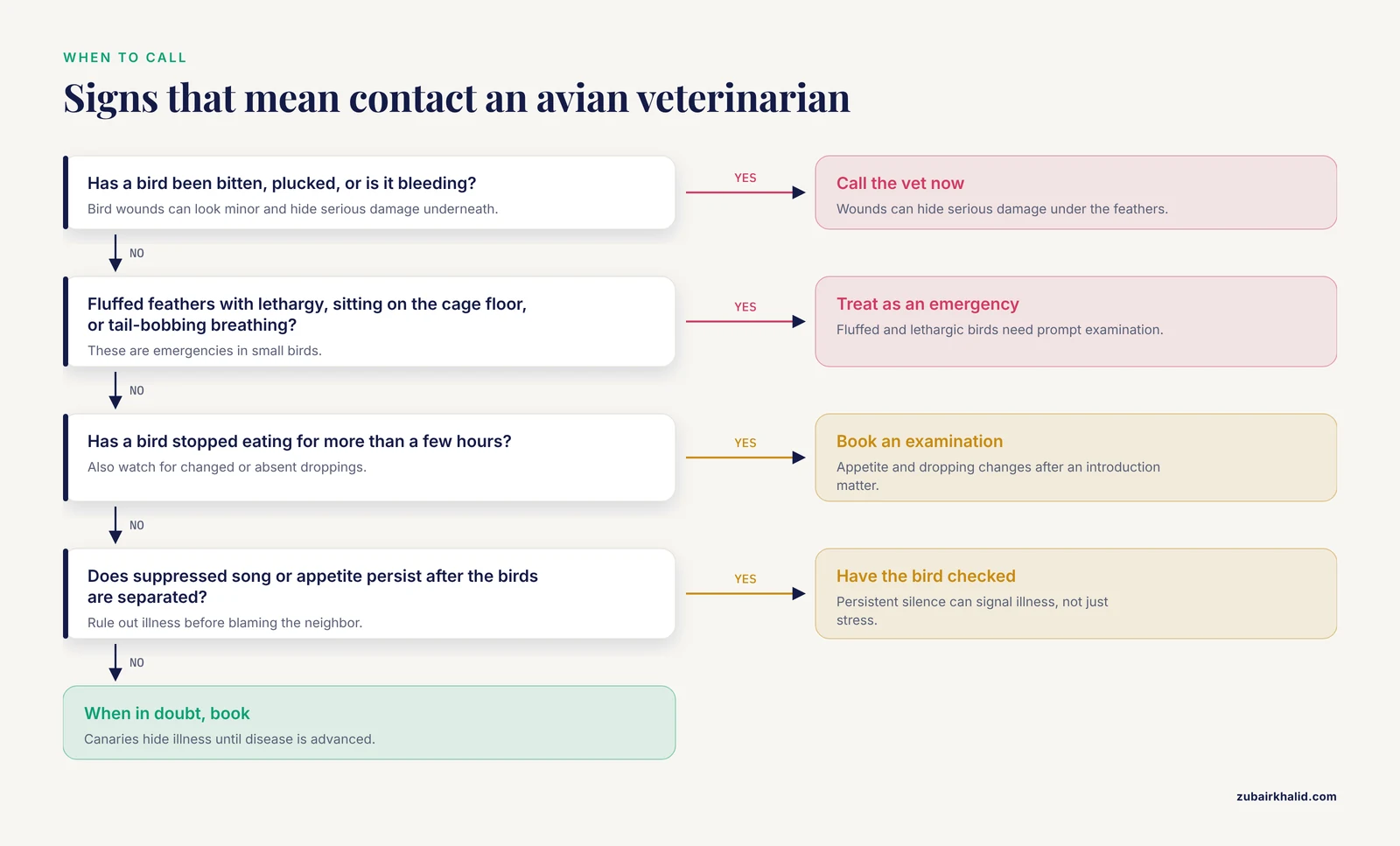
Contact an avian veterinarian promptly if you see any of the following:
- A bird that has been bitten, plucked, or is bleeding. Bird wounds can look minor and hide serious damage underneath.
- Fluffed feathers with lethargy lasting more than a few hours, sitting on the cage floor, or tail-bobbing breathing. These are emergencies in small birds.
- Any bird that stops eating for more than a few hours.
- A change in droppings, including diarrhea or absent droppings, after an introduction or any other change.
- Suppressed song or appetite in one bird that persists after the birds are separated.
- A new bird that sneezes, has discharge from the eyes or nostrils, or shows fluffed, lethargic behavior during quarantine.
Because canaries are small prey animals, they hide illness until disease is advanced. When in doubt, an examination costs far less than the alternative. The Association of Avian Veterinarians maintains a directory of member avian practices, and establishing a relationship with an avian vet before you bring a second canary home is one of the best preparations you can make.
Frequently Asked Questions
Can canaries live together in the same cage?
Sometimes, but often they cannot. Two males in a pet cage usually fight, and even male-female pairs can turn aggressive, especially in spring. House new birds in separate cages and treat any shared housing as an earned privilege after weeks of peaceful supervised sessions.
How long does it take to introduce a new canary?
Plan on several weeks at minimum, from the end of quarantine through side-by-side cages and neutral-space sessions. Some pairs need months, and some pairs never achieve peaceful shared housing, which is a normal outcome.
Can a male and female canary be kept together year round?
They can if they tolerate each other, but expect seasonal changes. Spring hormones intensify courtship and territorial behavior, and many keepers separate pairs during breeding season and reunite them later.
Will two male canaries ever get along?
Occasionally two males coexist in a very large flight with room to disperse, but in normal pet cages, two males are the highest-risk pairing for serious fights. Most owners do better with separate adjacent cages, where both birds typically sing more.
How do I introduce my canary to my cat?
You mostly do not, in the sense of direct contact. Keep the canary caged and secure, position the cage where the cat cannot reach or leap onto it, use closed doors and gates, and never leave them unsupervised in the same room. A cat's predatory instinct remains present regardless of training.
Why did my canary stop singing after I brought home a new bird?
Suppressed song is most often a stress response to a new bird, particularly between two males, but it can also signal illness. Have the bird examined by an avian veterinarian to rule out disease, then reassess the housing arrangement.
Should I quarantine a new canary even if it looks healthy?
Yes. Birds commonly carry infections without visible signs, and quarantine in a separate room with dedicated equipment protects your resident bird. Ask your avian veterinarian to recommend the quarantine length and any screening for your situation.
What does a successful canary introduction look like?
Success is peaceful coexistence, not affection. Both birds eat normally, show relaxed posture, sing or vocalize normally, and ignore each other for weeks without chasing or conflict. Many successful pairs end up living in separate cages side by side, and that counts.