How Often to Clean a Parrot Habitat: Cleaning Schedule
By Dr. Zubair Khalid, DVM, MS, PhD ·
Clean your parrot's habitat on three tiers. Do light tasks daily (change water, wash food dishes, remove fresh food remnants, spot clean droppings, replace soiled liner paper). Do a full clean weekly (scrub bars, tray, perches, and bowl rims). Deep clean and sanitize the entire enclosure, including toys and accessories, about once a month, or every four to eight weeks depending on cage size, number of birds, and how messy your particular parrot is. This tiered parrot cage cleaning schedule takes roughly ten minutes a day and about an hour on deep clean days.
Housing quality sits near the top of every modern parrot welfare checklist. When a panel of parrot welfare experts ranked the priority welfare issues facing captive parrots, housing and the environmental opportunity to express natural behaviors both ranked among the most serious concerns identified [1]. In parallel, an international project called PsittaWel built a 75-question caregiver assessment tool that dedicates entire sections to housing, physical health, and the daily management conditions that shape parrot welfare [2]. Cleanliness is not cosmetic housekeeping. It is a core welfare input, and it is one of the few welfare inputs fully under your daily control.
This guide gives you a workable schedule, the reasoning behind each task, product guidance, deep cleaning steps, and the hygiene red flags that justify a call to your avian veterinarian.
At a Glance: Parrot Cage Cleaning Schedule
| Task | Frequency | Time | Why It Matters |
|---|---|---|---|
| Change drinking water | Daily, sometimes twice | 2 minutes | Stale or soiled water grows bacteria fast |
| Wash food and water dishes | Daily | 3 minutes | Bowl rims harbor the heaviest microbial loads |
| Remove uneaten fresh food | Within a few hours of feeding | 1 minute | Spoiled produce, seeds, and cooked foods seed bacterial growth |
| Spot clean droppings and debris | Daily | 2 to 3 minutes | Prevents accumulation and lets you track droppings |
| Replace cage liner | Daily or every other day | 2 minutes | The liner collects most of the waste in the cage |
| Wipe perches, bars, and toys | Weekly | 15 to 20 minutes | Removes sticky residue, dust, and dried droppings |
| Scrub tray, grate, and bars thoroughly | Weekly | 20 to 30 minutes | Breaks the cycle of gradual buildup |
| Deep clean and sanitize the full enclosure | Every 4 to 8 weeks | 45 to 90 minutes | Resets the habitat baseline, reaches hidden contamination |
| Inspect for rust, mold, chew damage, worn parts | Monthly, alongside deep clean | 5 minutes | Damaged surfaces trap waste and can injure birds |
Why Cleaning Frequency Matters for Parrot Welfare
Parrots are long-lived, cognitively complex animals kept in a confined space where they eat, sleep, defecate, and play in the same square footage. A review of parrot welfare as companion animals noted that many natural behaviors, including flocking, varied foraging, and flight, are restricted in captivity, and that captive parrots show high levels of stereotypy, which suggests poor welfare when their environment falls short [3]. The same review concluded that welfare improves through appropriate environmental enrichment and environmental management, and that this depends on caregivers having sufficient knowledge, resources, and motivation [3]. A clean, well-maintained habitat is the foundation of that management.
Modern welfare science treats husbandry conditions as measurable welfare indicators, not vague ideals. In a Delphi consultation with parrot experts, 73 welfare indicators that owners could realistically monitor were identified from an initial pool of 122, and management conditions that allow parrots to express natural behaviors ranked among the most important indicators of all [4]. The PsittaWel tool follows the same logic, translating housing, physical health, and environmental conditions into concrete questions caregivers answer about their own birds [2]. When researchers design welfare assessment frameworks, they emphasize that tools must be built on clearly defined welfare concepts so that assessments are reliable and comparable over time [5]. Your cleaning schedule is the practical version of that principle. A bird living in a habitat with predictable daily hygiene, fresh water, and a dry substrate floor is living in a habitat you can assess honestly every single day.
There is also a direct disease dimension. Fecal material accumulates quickly in cages, and fecal-oral contamination is a recognized route for parasites and pathogens in captive parrots. During a health assessment of the captive St Vincent parrot population, fecal parasite screening was part of the standard evaluation and detected Capillaria in one of twenty-one samples tested, alongside clinical abnormalities such as poor feathering and skin disease that informed subsequent husbandry recommendations [6]. Routine fecal screening at wellness visits and consistent cage hygiene work toward the same goal from two directions. The vet looks for what hygiene may have missed, and your schedule reduces the chance of exposure in the first place.
The Daily Routine: Five to Ten Minutes
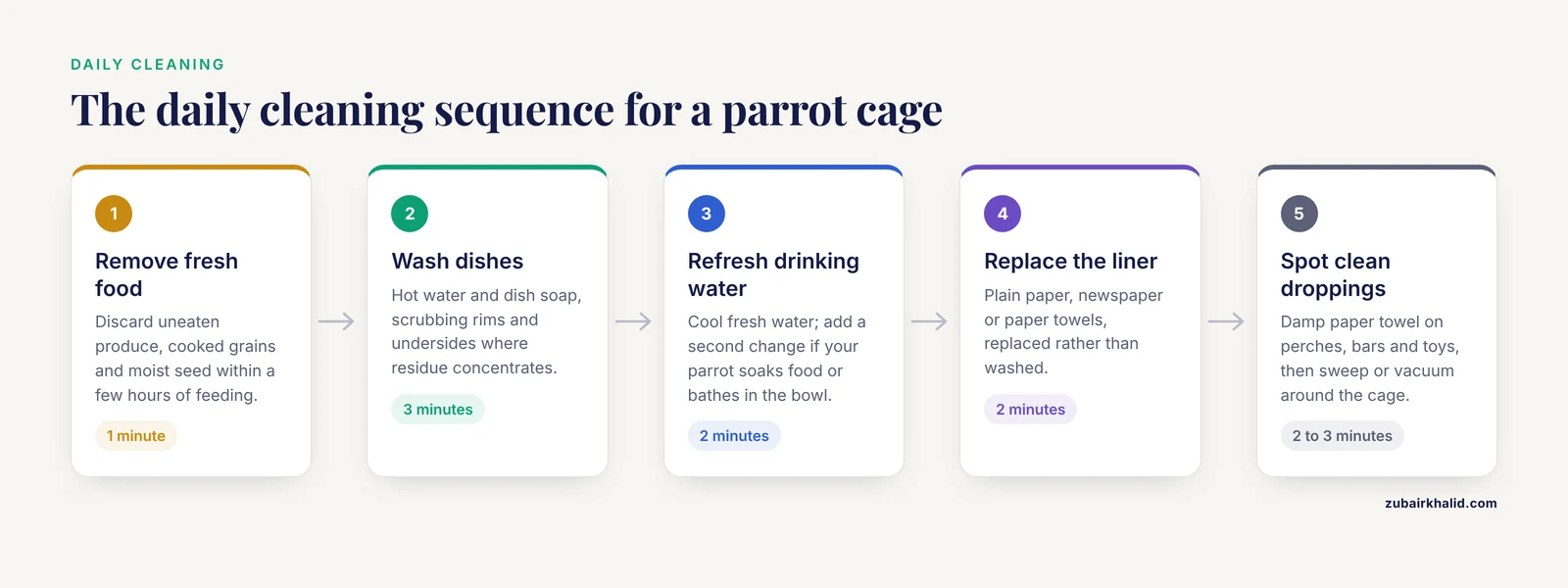
Daily cleaning prevents the small problems that become big ones. Here is the sequence most parrot owners find efficient.
Food and Water
- Remove all dishes and discard uneaten fresh foods. Soft foods, cooked grains, chopped produce, and moist seed mixes begin growing bacteria within hours at room temperature. Remove them within a few hours of feeding rather than leaving them overnight.
- Wash dishes with hot water and dish soap. Scrub the rims and undersides, where biofilm and dried residue concentrate. Rinse thoroughly and dry or air dry before refilling.
- Replace drinking water with fresh, cool water. If your parrot soaks food, dips pellets, or bathes in the water bowl, plan on a second water change midday or by evening. Many parrots contaminate their own water within minutes, so visual inspection at each pass is part of the routine.
Droppings, Liner, and Spot Cleaning
- Pull out the cage liner and replace it. Plain paper, newspaper, or paper towels are practical liner choices because they are replaced rather than washed, which keeps daily cost and effort low.
- Spot clean any droppings that landed on perches, bars, toys, or cage accessories. A damp paper towel or a dedicated spray bottle of water handles most fresh spots in seconds.
- Sweep or vacuum the area around the cage. Seed hulls, feather dust, and food debris on the floor attract pests and contribute to airborne dander and dust in the room.
Daily cleaning has a second function that owners often undervalue. Every liner change and water refresh is a health check. You see droppings more often than anyone else, and changes in droppings, remaining appetite, food tossing behavior, or a sudden drop in activity are the earliest signals you will get. The welfare indicators identified for owner use include exactly these animal-based and management-based observations [4], so treat your ten-minute routine as both cleaning and assessment.
The Weekly Routine: Twenty to Forty Minutes
Once a week, the habitat gets a real scrub rather than a touch-up.
- Move your parrot to a safe temporary location. A travel carrier, a second cage, or a bird-proofed closed room works. This protects the bird from fumes, splashes, and stress, and it lets you clean without obstruction.
- Remove all accessories. Pull out perches, toys, swings, ladders, foraging items, and the grate. Set them aside for washing.
- Scrub the tray and grate. Hot soapy water first, then rinse, then dry completely before reassembly. Trapped moisture under the grate encourages mold and bacterial growth.
- Wipe and scrub the bars. Dried droppings, food paste, and sticky residue come off with hot water, a stiff brush, and patience. A plastic scraper helps with stubborn spots without scratching powder-coated finishes.
- Wash perches and toys. Wooden perches and natural branch perches need scrubbing and thorough drying. Inspect each one for cracks, fraying rope, sharp edges, and chew damage while you clean. Replace anything questionable.
- Clean surrounding surfaces. Wipe the cage stand, walls near the cage, and any play gym surfaces. Feather dust accumulates on horizontal surfaces and contributes to the overall air quality of the room.
Weekly is the right cadence for most single-bird households. Increase to twice weekly if you keep multiple birds, if your parrot eats soft foods that smear easily, if the cage is on the smaller side, or if anyone in the home has allergies or a compromised immune system.
Deep Cleaning a Parrot Enclosure: Monthly Step-by-Step
Deep cleaning a parrot enclosure is the monthly reset that reaches the contamination daily and weekly cleaning cannot. Most households do this every four to eight weeks. Choose the shorter interval for large or messy species, multiple birds, breeding birds, or any bird with a health condition.
Supplies Checklist
- Dedicated cleaning bucket or tub used only for the bird cage
- Dish soap or a mild unscented detergent
- White vinegar, diluted, for mineral deposits and dried droppings
- Stiff-bristled brushes in at least two sizes, one for bars and one for dish grooves and toy hardware
- Plastic scraper
- Spray bottle for water and for diluted rinse
- Clean towels or a drying rack
- Fresh liner paper
- A safe temporary holding area for your parrot
Step 1. Relocate the Bird
Move your parrot out of the room or into a secure carrier before any product is opened. Deep cleaning involves more liquid, more product, and more fume potential than the daily routine, and a bird loose in the room during cleaning is at risk of both chemical exposure and injury.
Step 2. Strip the Cage Completely
Remove everything. Perches, toys, dishes, grate, tray, ladder, swings, foraging devices, and the liner. Nothing stays in the cage during a deep clean. Take a photo before you start if you want an easy reassembly reference.
Step 3. Wash With Hot Soapy Water
Wash the cage itself, inside and out, with hot water and detergent. Work top to bottom so drips do not re-soil cleaned areas. Pay attention to corners, weld points, door latches, feeder doors, and the seam where the tray slides in. These are the locations where dried droppings and food hide.
Step 4. Dislodge Stubborn Deposits
Soak dried droppings and caked residue with warm water or diluted vinegar, wait a few minutes, and scrape gently. Never use metal scouring pads or sharp tools on powder-coated or painted surfaces, because scratches create corrosion points and future contamination traps.
Step 5. Disinfect, Then Rinse Thoroughly
If you use a disinfectant, apply it only after visible organic debris is gone, because debris inactivates most disinfectants on contact. Choose a product labeled as safe for use around animals, follow the label contact time exactly, and rinse with clean water until no product residue remains. Residue on bars and toys ends up in a parrot's mouth, and parrots chew everything in reach. If you prefer to avoid disinfectants entirely, very hot water, detergent, physical scrubbing, and full drying accomplish most of the practical benefit for a home cage, and your avian veterinarian can recommend a product appropriate for any specific disease concern in your bird.
Step 6. Wash and Inspect Accessories
Scrub every perch, toy, and dish the same way. Rope perches and fabric items that cannot be fully cleaned or that show fraying should be replaced rather than returned to service. Inspect toy hardware for rust. Check natural wood perches for cracks that could trap debris or pinch toes. Rotate toys back in selectively rather than all at once. Returning a subset of toys, and adding one or two new or rearranged items, introduces novelty that supports foraging and exploration, both of which expert panels ranked among the welfare conditions that matter most for captive parrots [1] and which the PsittaWel framework treats as a dedicated welfare domain [2].
Step 7. Dry Completely
Air dry or towel dry every component. Moisture left in tray channels, toy knots, and wood perch ends promotes mold and bacterial regrowth between cleanings. Full drying is the cheapest disease prevention step in the entire schedule.
Step 8. Reassemble and Return the Bird
Install a fresh liner, replace dishes with fresh water and food, and return your parrot once the cage is dry and the room is aired out. Most parrots investigate a freshly cleaned cage immediately, which makes post-clean observation a useful behavior check.
Safe Cleaning Products for Parrots
Parrots are unusually vulnerable to airborne irritants because of the structure of the avian respiratory system, and avian veterinarians consistently warn that fumes which seem mild to humans can be dangerous to birds. This shapes every product choice in parrot habitat hygiene.
Follow these selection and use rules.
- Prefer simple products. Hot water, mild unscented dish soap, and diluted white vinegar cover nearly every home cage cleaning need.
- Never clean with the bird in the room. Remove the parrot before opening any product, no matter how gentle the label claims it is.
- Ventilate aggressively. Open windows, run a fan exhausting outward, and keep the room aired out until surfaces are dry and odor free.
- Avoid aerosol sprays, plug-in fresheners, scented cleaners, oven cleaners, drain products, and strong ammonia or chlorine fumes anywhere near the bird's airspace. Residual vapors linger longer than the smell you notice.
- Rinse far more than seems necessary. Any cleaner that touches cage surfaces will contact your parrot's beak, feet, and feathers later.
- Store all products away from the bird room. Parrots are accomplished at opening latches and reaching containers, and access is a poisoning risk.
- If you use any disinfectant, follow the label contact time and rinse directions exactly, and confirm with an avian-savvy veterinarian that the specific product is appropriate for birds. When in doubt about a product, ask before you use it rather than after.
One caution about fragranced products in general. A habitat that smells strongly of cleaner is not a cleaner habitat. It is a habitat with residual chemistry. A properly cleaned parrot cage smells like nothing, or faintly like wood and paper.
Parrot Habitat Hygiene and Health Monitoring
Parrot habitat hygiene and health monitoring belong to the same daily glance. The welfare indicators validated for owner use include both management conditions, such as the cleanliness and suitability of the housing environment, and animal-based observations, such as droppings, posture, feather condition, and behavior [4]. Cleaning is when you collect this information.
Watch for these findings during routine cleaning.
- Dropping changes. Sudden increases in volume, persistent green or black discoloration, undigested food in droppings, chalky white reduction, or a striking change in consistency. One unusual dropping is noise. A consistent pattern over a day is a signal.
- Food waste patterns. A parrot that suddenly stops cracking seeds, or leaves a previously favored food untouched, may be telling you about its mouth, its GI comfort, or its overall state. Qualitative behavioral assessment of orange-winged Amazon parrots demonstrated that structured caregiver observation can detect welfare-relevant responses to husbandry changes, which supports the value of regular owner-side observation rather than occasional glances [7].
- Physical cage condition. Rust, flaking coating, chewed plastic, frayed rope, splintering wood, and loose hardware. Damaged surfaces collect waste, injure feet and beaks, and undermine the rest of your cleaning effort.
- Odor. A clean parrot habitat has little to no odor. A persistent smell from a habitat you clean on schedule is itself a finding. Common sources include damp substrate, hidden spoiled food in tray corners, or soaked wooden perches that never fully dry.
- Pests. Seed moths, ants, or flies indicate food debris accumulation somewhere in the habitat or the surrounding room. Trace it and eliminate the source.
Record anything abnormal with a photo and a date. A short log turns vague worry into specific information your avian veterinarian can act on. Routine wellness examinations with fecal parasite screening are standard practice for captive parrots, as reflected in structured health assessments of parrot populations, which combine physical examination, laboratory screening, and husbandry evaluation to produce actionable recommendations [6]. Bring your cleaning schedule and your observation notes to those appointments. They are part of the medical record.
Common Mistakes
Cleaning only the tray. The tray holds most of the waste, but bars, perches, toy hardware, and dish rims hold the microbial load. A spotless tray over dirty perches is a partially cleaned cage.
Leaving fresh food in overnight. Produce, cooked foods, and moist mixes spoil fast. Overnight residence turns a healthy feeding practice into a bacterial incubator.
Cleaning around the bird with products. Even brief exposure to fumes in the same room is unnecessary risk. Relocate the bird first, every time.
Using strong fragrance to mask odor. Scented products add respiratory irritants and hide the diagnostic information that odor provides.
Washing wooden items and putting them back damp. Damp wood molds from the inside. Dry perches fully, in sunlight or near airflow if needed.
Deep cleaning too rarely, or sanitizing with no scrubbing. Both are common. A cage that only gets spot cleaning accumulates invisible contamination on every surface, while applying a disinfectant over dried droppings does almost nothing, because organic matter neutralizes the active ingredients.
Replacing everything at once after deep cleaning. Stripping all perches and toys and installing an entirely new set simultaneously can unsettle some parrots. Rotate gradually. Environmental predictability matters to a species whose welfare experts rank housing stability and the opportunity to express natural behaviors among the top concerns in captivity [1].
Forgetting the room. Feather dust, seed hulls, and dander on floors and walls are part of the habitat. Weekly room cleaning supports respiratory health, especially for dust-producing species.
Cleaning as a Welfare Check, Not a Chore
Reframe the routine. Each cleaning pass is a scheduled opportunity to assess your parrot against a structured set of welfare indicators, which is precisely the approach validated for companion parrots through tools like the PsittaWel framework and its 145 welfare indicators across domains including physical health, housing, and enrichment [2]. The expert consensus on captive parrot welfare places housing and owner knowledge and support at the top of the priority list [1]. A caregiver who cleans daily, observes during cleaning, and adjusts the environment accordingly is doing the single most valuable thing a parrot owner can do, because sustained appropriate care depends on exactly the knowledge, resources, and motivation that welfare researchers identify as the pathway to improved parrot welfare in captivity [3].
Practical ways to use cleaning time for enrichment and welfare:
- Rearrange one or two perches during the weekly clean, keeping the familiar favorites in place.
- Forage-test during liner changes by scattering a portion of the daily ration in clean substrate or foraging items rather than bowl feeding everything.
- Note perching preferences. Which perch your parrot chooses at which time of day tells you about comfort, foot health, and security.
- Check foot condition weekly while perches are out for washing. Look for smooth weight-bearing, even nails, and no pressure sores or redness.
- End each deep clean with five minutes of quiet observation. A parrot that resumes normal activity, eating, and vocalizing within minutes is telling you the habitat works.
Limitations and When to Contact a Veterinarian
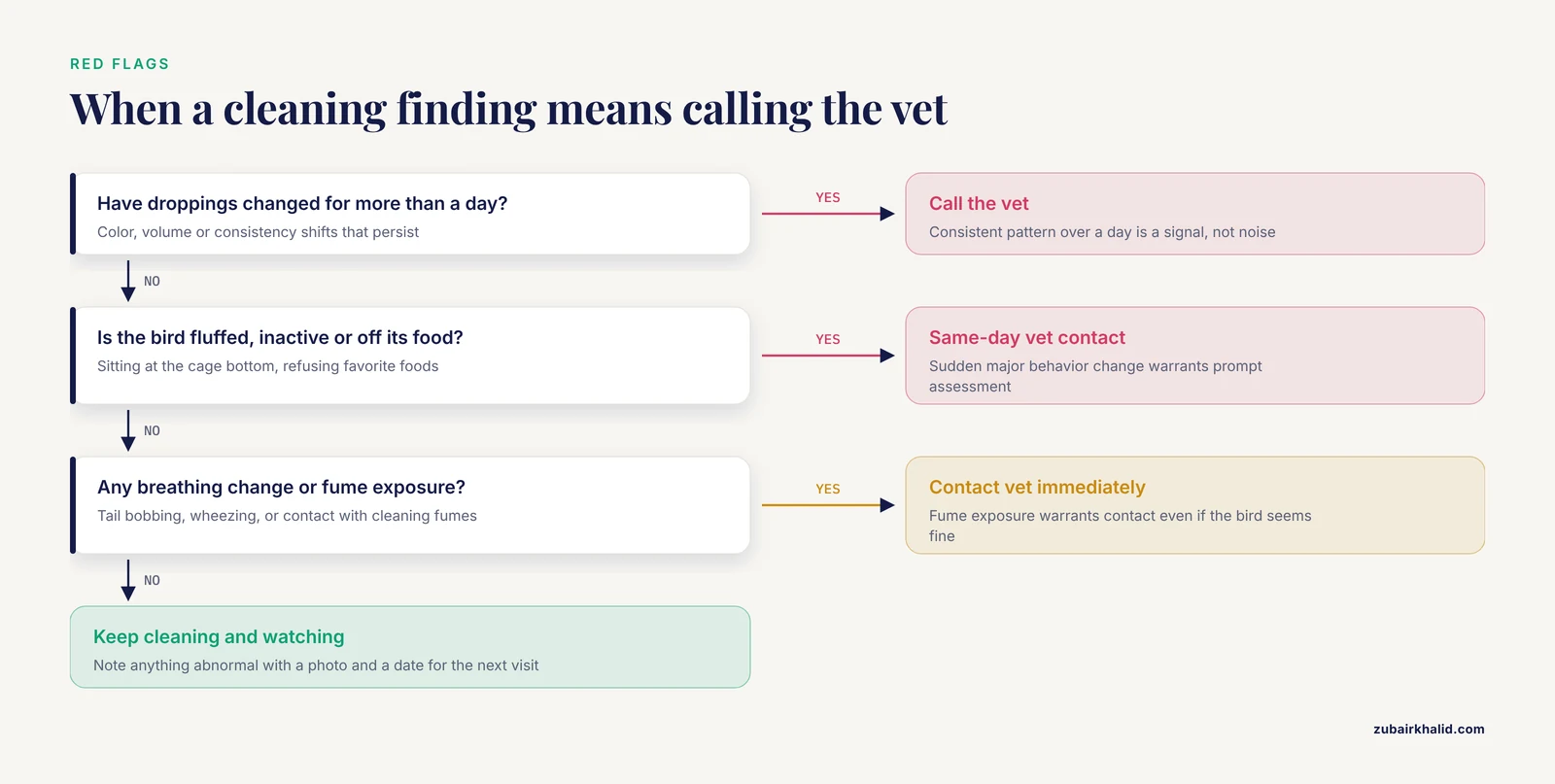
This article is educational and is not a substitute for veterinary diagnosis or treatment. A cleaning schedule supports health, but it does not diagnose disease, and individual birds vary by species, age, health status, and history. Establish the right cadence for your specific bird with an avian veterinarian, especially for very young birds, geriatric birds, birds recovering from illness, or immunocompromised birds, all of whom may need stricter hygiene.
Contact an avian veterinarian promptly, the same day if possible, for any of the following:
- Consistent dropping changes lasting more than a day, including color, volume, or consistency shifts
- A parrot sitting fluffed and inactive at the cage bottom, or any sudden major behavior change
- Reduced appetite or refusal of favorite foods
- Visible vomiting, regurgitation outside of courtship context, or head-bobbing with food expulsion
- Breathing changes, tail bobbing, open-mouth breathing, wheezing, or voice change
- Discharge from the eyes or nostrils
- Any suspected exposure to cleaning fumes, smoke, or aerosol products, which warrants immediate veterinary contact even if the bird seems fine initially
- Weight loss noted on a gram scale, or a felt loss of pectoral muscle condition
- A persistent odor from the cage despite your schedule, which may indicate infection, yeast overgrowth, or spoilage you have not located
Ask your veterinarian about routine wellness examinations, fecal parasite screening, and whether any disinfection protocol is needed after a specific health diagnosis in your bird. Never apply a disinfection or medication protocol to the habitat on your own initiative after a diagnosis without veterinary guidance, because some pathogens require specific agents and specific contact times.
Frequently Asked Questions
How often should I fully clean my parrot's cage?
Do light cleaning daily, a full scrub of bars, tray, and accessories weekly, and a complete deep clean and sanitize every four to eight weeks. Shorten the intervals for multiple birds, large or messy species, small cages, or any bird with a health condition.
Can I clean the cage while my parrot is inside?
For dry spot cleaning with nothing but water and a paper towel, yes, if your parrot tolerates it. For any wet cleaning, scrubbing, or use of any product, relocate the bird first. Fumes, splashes, and stress all argue for moving the bird out of the room.
What cleaning products are safe around parrots?
Hot water, mild unscented dish soap, and diluted white vinegar meet nearly all home needs. Parrots are highly sensitive to airborne fumes, so remove the bird from the room before using any product, ventilate well, and rinse surfaces thoroughly. Avoid aerosols, fragranced cleaners, and strong chemical vapors near the cage, and confirm any disinfectant with an avian veterinarian before use.
How do I deep clean a parrot enclosure?
Relocate the bird, strip the cage completely, wash everything with hot soapy water from top to bottom, soak and scrape stubborn deposits, disinfect if desired after organic debris is removed, rinse thoroughly, wash and inspect all accessories, dry every component completely, reassemble with fresh liner, and air the room out before returning your parrot.
How often should I change the cage liner?
Daily is the standard for a single bird. Every other day is acceptable if droppings are modest and the liner stays dry. Multiple birds, soft food diets, or damp liners push you to daily replacement.
Why does my parrot's cage smell even though I clean it?
Persistent odor means something is being missed or something is growing. Common culprits are damp or inadequately dried wooden perches, spoiled food wedged in tray channels or toy crevices, moisture under the grate, or a cage that needs a full deep clean rather than another spot clean. A persistent smell despite an on-schedule cleaning routine also deserves a veterinary check.
Can a dirty cage make my parrot sick?
Yes. Accumulated droppings and spoiled food support bacterial, fungal, and parasite exposure, and fecal-oral contamination is a recognized disease route in captive parrots, which is why fecal screening appears in formal parrot health assessments. A consistent cleaning schedule reduces that exposure and pairs with routine veterinary wellness visits for full protection.
How do I clean wooden perches and natural branches?
Scrub with hot water and mild soap, rinse well, and dry completely before returning them to the cage. Inspect for cracks, splinters, and chew damage while cleaning and replace perches that cannot be cleaned or that show wear. Replace natural branches periodically rather than keeping any single branch indefinitely.
Sources
- What are the priority welfare issues facing parrots in captivity? A modified Delphi approach to establish expert consensus
- PsittaWel: A welfare assessment tool for companion parrots
- The welfare and suitability of parrots as companion animals: a review
- Evaluation of welfare indicators for companion parrots: a Delphi consultation survey
- Animal welfare definitions, frameworks, and assessment tools: Advancing the measurement and laying the foundation for improved animal welfare through a three-step approach
- Health assessment of the ex situ population of St Vincent parrots (Amazona guildingii) in St Vincent and the Grenadines.
- Using Qualitative Behavioral Assessment with Free Choice Profiling to evaluate the effect of feeding a formulated, over-sized biscuit diet on the welfare of orange-winged Amazon parrots (Amazona amazonica)