How Often to Clean a Canary Habitat: Cleaning Schedule
By Dr. Zubair Khalid, DVM, MS, PhD ·
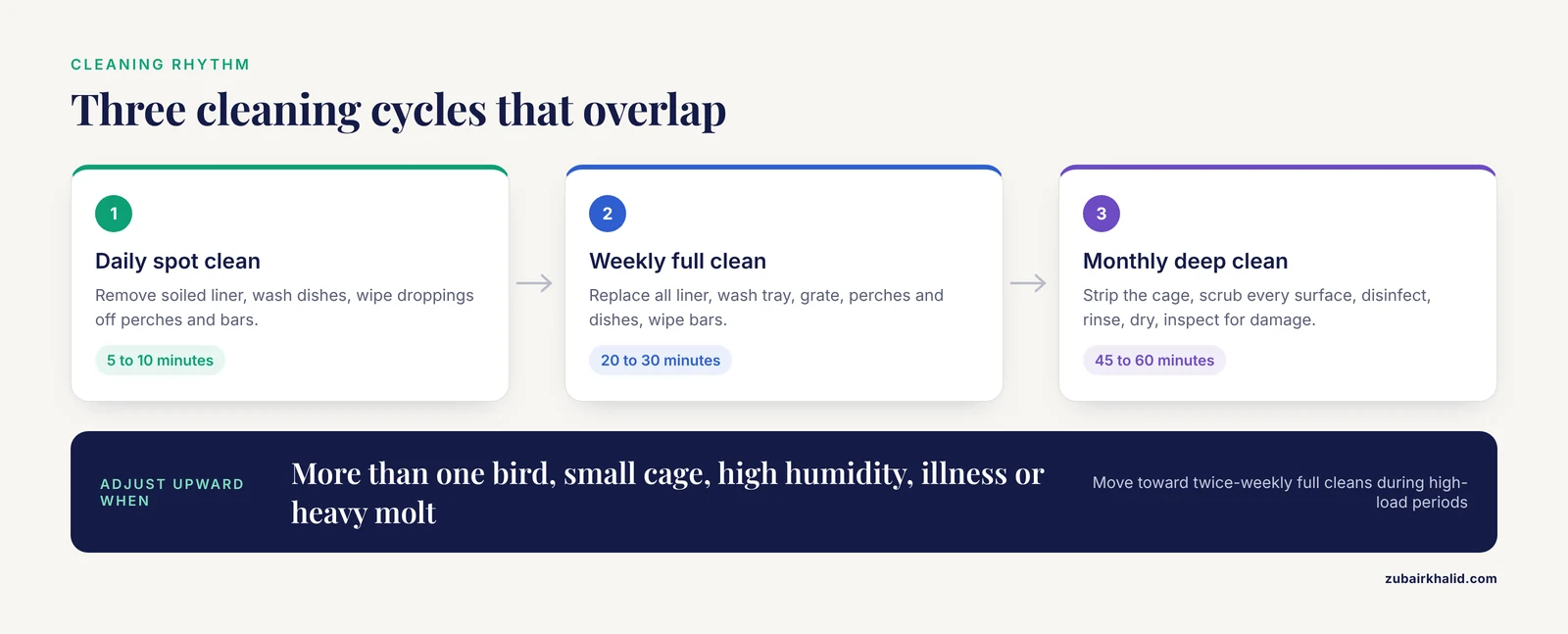
Clean a canary habitat on three overlapping cycles. Spot clean daily, which means removing soiled liner, wiping droppings off perches, and refreshing food and water. Perform a full cage clean once a week, which means replacing all liner, washing trays, perches, and dishes, and wiping bars. Deep clean the entire enclosure once a month, which means everything comes out, every surface gets scrubbed, and accessories are disinfected and dried before they go back.
This three-tier canary cage cleaning schedule matches how contamination actually builds up in a small bird cage. Droppings, seed hulls, molted feathers, and dander accumulate quickly in an enclosure that may hold only a few cubic feet of air. Birds have an efficient but vulnerable respiratory system, and airborne irritants that a mammal would tolerate can harm a canary. Consistent canary habitat hygiene is therefore not cosmetic housekeeping. It is preventive medicine.
Veterinary authors note that husbandry deficiencies are a common contributor to clinical disease in companion animals kept in enclosures, and that owners and clinicians should treat the environment as part of the patient [1]. The same principle drives modern welfare frameworks, which assess animal well-being across nutrition, physical environment, health, behavior, and mental state together [2]. A dirty cage fails the bird on several of those domains at once.
This article is educational and is not a substitute for veterinary diagnosis or treatment.
At a Glance: Your Canary Cleaning Checklist
| Frequency | Task | Typical Time |
|---|---|---|
| Daily | Remove soiled liner or droppings, wash food and water dishes, refresh water | 5 to 10 minutes |
| Daily | Wipe droppings off perches and cage bars | 2 to 3 minutes |
| Weekly | Replace all liner, wash tray and grate, scrub perches and dishes, wipe bars | 20 to 30 minutes |
| Weekly | Rotate or inspect toys and accessories | 5 minutes |
| Monthly | Deep clean a canary enclosure: full strip-down, scrub, disinfect, rinse, dry | 45 to 60 minutes |
| Monthly | Inspect cage for damage, rust, chew marks, and loose parts | 5 minutes |
| Seasonally | Rearrange or replace worn accessories, review the whole habitat setup | Ongoing |
Adjust the frequency upward if you keep more than one canary in the cage, if the cage is small for the bird, if humidity is high, or if a bird is ill or molting heavily.
Why a Cleaning Schedule Matters for Canaries
Hygiene prevents disease before it starts
In enclosed habitats, waste sits close to the animal. Droppings can harbor bacteria and yeasts, damp seed and produce grow mold, and feather dust carries debris into the air your canary breathes all day. A survey of backyard poultry keepers in the UK found that biosecurity awareness varied widely among owners of small bird flocks, and the authors concluded that improved biosecurity and husbandry guidance was a key need for bird-keeping households [3]. The lesson scales down to a single canary on a living room stand. The owners who think in terms of hygiene and biosecurity, not just tidiness, catch problems earlier.
Cleaning also protects the human half of the household. Bird dander, dried droppings, and seed dust become airborne during dry sweeping or aggressive scraping, so the way you clean matters as much as how often.
Cleaning is a welfare intervention, not just a chore
The Five Domains Model, widely used in veterinary welfare assessment, treats the physical environment and the animal's mental state as linked domains, so an impoverished or fouled environment registers as a negative welfare impact even before disease appears [2]. Cleaning schedule decisions should account for the bird's experience of the process as well as the end result. Research on shelter animals found that caretakers met basic physical needs more consistently than psychological ones, and that cleaning and handling approaches were a common point where psychological needs were overlooked [4]. For a canary, that means scheduling cleaning at a consistent time, working calmly, and avoiding unnecessary chasing or removal from the cage.
Behavior tells you whether your routine is working
Behavioral observation is a recognized tool for improving welfare in animals kept in enclosures, and it can reveal whether a management change is helping or harming [5]. Your canary is no exception. A bird that sings, moves between perches, and eats with normal enthusiasm after you clean is telling you the routine works. A bird that flaps frantically every time you approach with a spray bottle, or that stops singing for a day after a disruptive deep clean, is telling you to change the method.
Building Your Canary Cage Cleaning Schedule
The daily routine
Daily attention keeps the cage from ever becoming a health hazard and makes the weekly job short.
- Replace the top layer of liner, or remove the full sheet if droppings are scattered. Most owners find paper liner or unprinted newsprint easiest to change this way.
- Wash food and water dishes with hot water and a dedicated brush. Water dishes grow biofilm, a slippery bacterial layer, faster than they look dirty. Some owners use two sets of dishes and swap them daily, washing the spare set out of the cage.
- Wipe droppings from perches, the grate, and cage bars with a damp paper towel.
- Remove fresh produce or soft foods after a few hours, because spoilage is fast at room temperature.
- Do a 30-second visual check. Is the dropping normal in color and consistency. Is the bird eating. Did the seed get scattered under the grate where it can attract pests.
The weekly routine
Once a week, do the full pass.
- Move the canary to a secure travel cage or a second enclosure, or work with the bird left in place if it stays calm. Most canaries tolerate the owner working around them if you move slowly and talk quietly.
- Remove all liner, tray contents, and loose debris. Roll the liner inward so dust and hulls stay contained.
- Pull trays, grate, perches, and dishes. Wash them in hot water with fragrance-free dish soap, scrub with a dedicated brush, rinse well, and dry completely before reassembly.
- Wipe the bars, corners, and cage base with warm soapy water on a sponge, then wipe again with clean water.
- Vacuum or sweep around the cage stand, since seed hulls and dander accumulate underneath.
- Launder any fabric items near the cage, such as a cage cover, on a regular weekly or biweekly cycle.
Owners who let the schedule slip tend to lose it entirely. A visible reminder, a phone alert, or pairing cage day with another weekly habit keeps the canary cage cleaning schedule intact.
The monthly deep clean
Deep cleaning a canary enclosure means the cage is emptied completely and every surface is cleaned at a level the weekly routine cannot reach.
- Move the bird to a safe holding cage in a warm, draft-free room.
- Remove every accessory, perch, toy, dish, and the grate.
- Take the cage outside or into a bathtub if it is small enough. Scrub the cage with hot water and fragrance-free dish soap, working into corners, welds, door latches, and bar joints where debris collects.
- Disinfect non-porous surfaces with a bird-appropriate disinfectant used strictly according to the label, or with a diluted unscented household bleach solution mixed fresh, then rinse thoroughly with clean water until no chemical odor remains. Any residue or fume is a risk to a bird's respiratory tract, so rinsing is not optional.
- Scrub perches. Natural wood perches can be scrubbed, rinsed, and dried in the sun. Replace perches that are cracked, slick with old residue, or cannot be cleaned.
- Wash or replace toys and accessories. Soft or porous items that cannot be fully cleaned should be replaced rather than reused.
- Dry everything completely. Damp surfaces invite mold.
- Reassemble with fresh liner and clean dishes, then return the bird.
While the cage is empty, inspect it. Look for rust, chipped coating, bent bars, loose welds, and worn latches. A monthly deep clean doubles as a safety inspection, and catching a failing cage before it injures a bird is one of the quiet benefits of the routine.
Safe Cleaning Products for Canaries
Birds are unusually sensitive to airborne irritants because of the structure of their respiratory system, so product selection is a safety decision, not a preference.
Reasonable choices for routine cleaning. Fragrance-free dish soap, plain hot water, unscented white vinegar diluted in water for light mineral and dropping residue, and paper towels or dedicated cloths. None of these should contact the bird, and everything the bird touches must be rinsed and dried afterward.
Use with care. Any disinfectant, including diluted bleach, must be applied to an empty cage, allowed the label-specified contact time, and rinsed until no odor remains. Never mix cleaning chemicals. Bleach combined with ammonia or with some acid cleaners releases dangerous gases, and in a small room those gases can be lethal to a bird before you notice anything yourself.
Avoid entirely around the bird. Aerosol sprays, oven cleaners, strong ammonia products, scented disinfectants, plug-in air fresheners, and spray polish used anywhere near the cage. If a product smells strong to you, assume it is worse for a canary.
Clean in a ventilated room, keep the bird out of the space while products are in use, and allow the air to clear before the bird returns. If you are unsure whether a specific product is safe, ask an avian veterinarian before using it. The Association of Avian Veterinarians and owner resources from hospital groups such as VCA Animal Hospitals both emphasize fume and chemical caution in pet bird households, and an avian vet can advise on products suitable for your specific setup.
Step-by-Step: Making Deep Cleaning Day Low-Stress
The monthly deep clean is the most disruptive event in a canary's week of weeks, and a little planning prevents it from becoming a monthly fright.
- Keep the holding cage familiar. Use the same travel cage each time, with a familiar perch, so the bird has a predictable temporary home.
- Pick a consistent time. Canaries settle faster when the routine is predictable. Late morning, after the bird has finished its main feeding activity, works well for many households.
- Never use force or fog. Do not spray near the bird, do not chase it around the cage with a cloth, and do not grab it for removal unless there is a medical reason. Shelter research shows that cleaning and handling methods affect animal stress even when physical needs are met [4].
- Return the bird to a fully dry cage. Wet bars, damp liner, and humid air after cleaning are uncomfortable and can promote mold.
- Watch the bird afterward. Normal behavior returning within minutes is the goal. Prolonged panting, fluffing, or silence suggests the process was too stressful and should be modified.
Common Mistakes in Canary Habitat Hygiene
Cleaning only when the cage looks dirty. By the time a cage visibly smells or looks soiled, bacterial and fungal growth is well established. The schedule exists precisely because contamination is invisible before it is obvious.
Dry-scraping or sweeping. Brushing dried droppings and seed hulls in an open room launches dust and dander into the air the bird breathes. Moisten before scraping, and vacuum with the bird removed from the room.
Skipping the rinse. Disinfectant residue on bars and perches contacts the bird's feet and beak all day. Rinse as many times as it takes for zero odor.
Cleaning the dishes without the tray. Owners often wash water dishes faithfully while the tray beneath the grate builds up layers of debris. The tray is a major part of the habitat and belongs in the weekly rotation.
Using scented products to fight odor. A cage that needs fragrance is a cage that needs cleaning, not perfume. Odor control comes from frequency, dryness, and ventilation.
Ignoring the environment around the cage. Seed hulls under the stand, dust on the cage cover, and dander on nearby surfaces all feed back into habitat hygiene. Poultry keepers surveyed in the UK showed that biosecurity practices like isolation of new birds and waste management varied greatly with owner awareness, and that better guidance improved practice [3]. Treat the zone within a few feet of the cage as part of the habitat.
Cleaning so infrequently that behavior changes. In a documented wildlife care setting, managers found that housing and husbandry decisions during rehabilitation directly affected outcomes, and detailed management records helped identify what worked [6]. Your equivalent of that record is simple observation. If singing drops off, activity declines, or droppings change after cleaning lapses, the schedule is part of the diagnosis.
How the Schedule Changes With Circumstances
Breeding season and chicks. Increased food mess and chick droppings on the cage rim justify more frequent tray changes and dish washing. Parents feeding chicks generate far more waste than a single bird.
Molting. Heavy molt fills the tray with feathers and increases dander. Daily liner changes during a hard molt keep the environment clear.
Illness or a vet-directed treatment plan. If your canary is being treated for any condition, ask the veterinarian how the cleaning schedule should change. Many infectious and parasitic problems require more aggressive and more frequent disinfection of the enclosure, plus attention to items the bird contacts, so reinfection is prevented. Follow the specific plan your veterinarian gives you rather than the generic schedule in this article.
Multiple birds or a smaller cage. More birds per cubic foot means faster contamination. Move toward twice-weekly full cleans during high-load periods.
Season and climate. Warm, humid rooms accelerate mold on leftover produce and damp liner. In those conditions, remove soft food within an hour or two and check the tray twice daily.
The Health Side of Canary Habitat Hygiene
Husbandry quality and clinical disease are linked across companion species. Veterinary reviews of species as different as green iguanas and guinea pigs reach the same conclusion, that deficiencies in the captive environment are a common contributor to clinical disease, and that correcting the environment is part of the treatment [1] [7]. Small animals kept in enclosures also tend to hide early illness, a trait noted in prey species such as guinea pigs that often present late in a disease process because they conceal signs [7]. Canaries behave similarly. A bird that looks slightly fluffed and quiet for a day may be further along in a problem than it appears.
That is why the daily 30-second check belongs in your routine. You are not just cleaning. You are monitoring.
Behavior-based welfare monitoring gives owners a practical early warning system. Researchers working with a critically endangered lizard used systematic behavioral observation inside enclosures to guide welfare improvements and management decisions [5]. The same logic applies at the pet bird level. Track singing, activity level, appetite, and dropping appearance. Changes that coincide with husbandry lapses often resolve when hygiene is restored, and changes that persist despite good hygiene are a reason to call your veterinarian.
Welfare assessment frameworks such as the Five Domains Model give owners a structured way to think about this, evaluating nutrition, environment, health, behavior, and mental state as one picture rather than as isolated boxes [2]. A cleaning schedule touches all five at once.
Limitations and When to Contact a Veterinarian
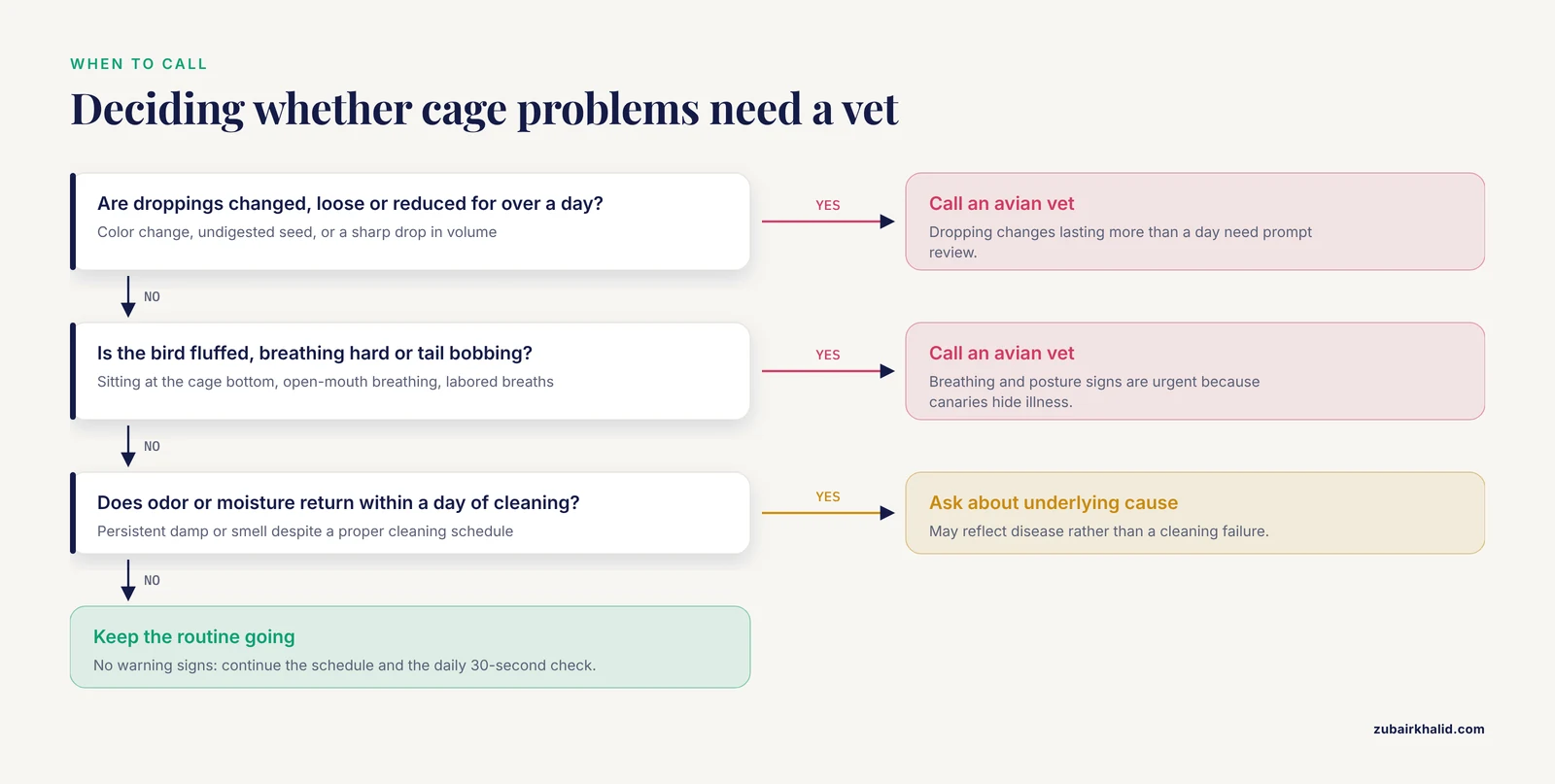
This article provides a general schedule for a healthy adult pet canary in a typical home setup. Individual cases need a veterinarian, especially where birds are ill, breeding, very young, very old, or kept in multi-bird collections.
Contact an avian veterinarian promptly if you notice any of the following:
- Droppings that change color, become loose, contain undigested seed, or drop off sharply in volume for more than a day
- Sitting fluffed at the bottom of the cage, labored breathing, open-mouth breathing, or tail bobbing with each breath
- Discharge from the eyes or nostrils, or a change in voice or reduced singing paired with other signs
- A bird that stops eating or dramatically reduces seed and greens intake
- Any sign of mites, lice, or abnormal feather condition that does not resolve with normal molt
- A sick cagemate in a multi-bird household, since infectious disease spreads quickly in shared air
- Persistent odor or moisture in the cage that returns within a day of cleaning, which may indicate an underlying problem rather than a cleaning failure
Because canaries hide illness, delays matter. Veterinary sources note that small prey species often present late in disease, so early consultation carries real value [7]. If your regular veterinarian does not treat birds, ask for a referral to an avian practitioner. The Association of Avian Veterinarians maintains resources for locating avian-experienced veterinarians in the United States.
Frequently Asked Questions
How often should I fully clean my canary cage?
Perform a full clean once a week, replacing all liner and washing the tray, grate, perches, and dishes. Spot clean daily in between. Deep clean the entire enclosure once a month.
Can I clean the cage while my canary is inside?
Light spot cleaning with the bird in place is fine if you move slowly and avoid startle. Save the weekly wash and the monthly deep clean for when the bird is in a separate holding cage, because spraying, scrubbing, and moving heavy parts around a bird is stressful and can expose it to moisture and residue.
What cleaning products are safe for canaries?
Fragrance-free dish soap, hot water, and diluted unscented white vinegar are reasonable for routine cleaning. For disinfection, use a bird-appropriate product or a fresh diluted bleach solution on an empty cage only, followed by thorough rinsing until no odor remains. Avoid aerosols, ammonia products, oven cleaners, and anything scented near the bird.
How do I deep clean a canary enclosure?
Remove the bird and all accessories, scrub every surface including corners and bar joints with hot soapy water, disinfect non-porous surfaces per the product label, rinse completely, dry everything fully, then reassemble with fresh liner and clean dishes. Inspect the cage for rust, damage, and worn parts while it is empty.
How often should I change the cage liner?
Change the liner daily, or twice daily during heavy mess such as molt or chick rearing. Daily liner changes are the single highest-value task in the whole schedule because they remove the main source of droppings, dust, and odor before it builds up.
Why does my canary cage smell so quickly?
Fast odor usually means one of four things: liner changes are too infrequent, fresh produce is left too long, the tray under the grate is being skipped during weekly cleans, or ventilation in the room is poor. Fix the frequency and airflow rather than masking the smell with scented products, which are unsafe around birds.
How do I clean perches and toys?
Scrub perches weekly with hot soapy water and a dedicated brush, rinse, and dry. Natural wood perches can be sun-dried. Replace items that are cracked, permanently soiled, or made of porous material that cannot be fully cleaned. Rotate toys so each one gets washed and dried between uses.
When should cage problems prompt a vet visit?
Call an avian veterinarian if your canary shows changes in droppings, appetite, breathing, posture, or voice, if a cagemate is sick, or if odor and moisture persist despite a proper cleaning schedule. Persistent environmental problems can reflect disease, and a bird that looks only slightly off may be more unwell than it appears.
Sources
- Veterinary care of green iguanas (Iguana iguana) part 1: husbandry
- Using the Five Domains Model to Assess the Adverse Impacts of Husbandry, Veterinary, and Equitation Interventions on Horse Welfare
- Survey of the husbandry and biosecurity practices of backyard chicken keepers in the UK.
- Part 1: A Sector-Wide Survey of UK/British Isles Shelter Organisations Caring for Cats: Caregiver-Reported Approaches to Housing, Husbandry and General Care Provision
- Behavior as a tool for welfare improvement and conservation management in the endangered lizard (Gallotia bravoana).
- Captive husbandry and veterinary care of seabirds during the MV Rena oil spill response
- Veterinary care of guinea pigs. Part 1: husbandry, stabilisation and diagnostics