Finch Heat and Cold Safety: Safe Temperatures by Season
By Dr. Zubair Khalid, DVM, MS, PhD ·
Pet finches are small birds with fast metabolisms, and they can be harmed by temperatures that humans barely notice. The practical answer for most owners is this: keep your finches in a stable, draft-free indoor environment that feels mildly warm to you, never in direct sun, never near a cold window or an exterior door, and never in a room that swings from hot to cold within a single day. Zebra finches, the most commonly kept pet finch and the species studied most often in thermal research, tolerate warm conditions remarkably well when drinking water is always available, but both prolonged heat above what a pet household would consider normal summer warmth and prolonged cool exposure can produce measurable chronic stress in this species [1]. Because the exact target range for your specific species, cage setup, and local climate is a husbandry decision, confirm a target thermostat range with an avian veterinarian rather than relying on a single universal number.
This article explains what the research on zebra finches actually shows about heat and cold, how to recognize finch heat stroke signs and cold stress, how to keep a finch warm in winter, and what to do differently in each season. It is educational and is not a substitute for veterinary diagnosis or treatment.
At a Glance: Finch Temperature Safety by Season
| Season | Main risk | What to do today |
|---|---|---|
| Summer | Heat buildup, dehydration, heat stroke | Keep the cage out of direct sun, refresh drinking water at least daily, watch for open-mouth breathing and wing drooping |
| Winter | Drafts, cold rooms, chronic cold stress | Move the cage away from windows and exterior doors, cover part of the cage at night, monitor plumage and body condition |
| Spring | Rapid temperature swings, breeding pairs exposed to cooling drafts | Avoid placing breeding cages where temperatures fluctuate, check nests daily |
| Fall | Early cold snaps and indoor heating changes | Recheck cage placement before the first cold night, watch for dull plumage and color changes |
Why Finches Are Uniquely Sensitive to Temperature
Finches are among the smallest birds kept as pets. A small body loses heat quickly in cold air and, in hot air, heats up quickly because there is so little body mass to buffer temperature change. Zebra finches evolved in arid Australia, where they face both scorching heat waves and cold desert nights, and their physiology reflects that history.
Research on wild zebra finches during a real Australian summer showed that the birds coped with hot days, with maximum temperatures averaging about 42.7 degrees Celsius (roughly 109 degrees Fahrenheit), as long as drinking water was available. During heat waves they shifted their thermoneutral zone upward, reduced metabolic heat production, changed how they lost heat, and even allowed their body temperature to rise in a controlled way, a strategy called adaptive hyperthermia [2]. This tells owners two things. First, finches are genuinely heat-adapted birds with real physiological tools for hot weather. Second, those tools depend on water. A finch facing heat without drinking water loses its main defense.
The cold side is different. Zebra finches are desert birds, and cool conditions appear to stress them more than owners often expect. In one laboratory study, male zebra finches kept for 18 weeks at a cool daytime temperature of 23 degrees Celsius (about 73 degrees Fahrenheit) showed higher heterophil to lymphocyte ratios, a standard blood marker of chronic stress, compared with birds kept at a hot 40 degrees Celsius (about 104 degrees Fahrenheit). The cooler group also showed reduced total leukocyte counts, and the authors concluded that prolonged exposure to cool periods may result in chronic stress, especially when body condition is weak [1]. That finding matters for pet owners because 73 degrees Fahrenheit is a normal indoor room temperature. A chronically cold finch will not shiver dramatically or look obviously sick at first. The damage is cumulative and subtle.
Temperature also affects appearance and reproduction, which gives observant owners early warning signs. Cold exposure for four weeks at 6 degrees Celsius (about 43 degrees Fahrenheit) made male zebra finches develop duller bill color and revealed that cold-stressed birds became carotenoid limited, meaning the nutritional building blocks of their coloration were being diverted to survival [3]. Plumage quality itself is a validated well-being indicator in this species, and researchers have shown that a simple, non-invasive plumage scoring system can reliably track captive zebra finch well-being [4]. A finch whose feathers look rough, dull, or poorly preened may be telling you that its environment, including its temperature, is working against it.
Finch Safe Temperature Range: What the Evidence Shows
The honest answer about numbers
Owners searching for the finch safe temperature range usually want a single pair of numbers. Research does not provide one clean pet-owner threshold, and repeating a number without context can be dangerous in both directions. What the zebra finch literature does provide is a picture of how these birds respond across a wide thermal spectrum:
- Around 22 degrees Celsius (about 72 degrees Fahrenheit), zebra finches serve as the control group in most laboratory studies. This is a baseline, unstressed condition.
- At 26 degrees Celsius (about 79 degrees Fahrenheit), birds behaved as a warm but unstressed comparison group in cold-stress research [3].
- At 27 degrees Celsius (about 81 degrees Fahrenheit), captive males showed more heat retention behaviors, tucking and fluffing, than at warmer temperatures, indicating they felt cool [5].
- At 23 degrees Celsius held for months, chronic stress markers rose in a laboratory setting [1].
- At 31.4 degrees Celsius (about 89 degrees Fahrenheit) average daily maximums in the field, wild zebra finches maintained their body mass and showed no blood-marker signs of stress [2].
- At 35 degrees Celsius (about 95 degrees Fahrenheit), birds were described as thermoneutral in a laboratory heat challenge [5].
- At 40 degrees Celsius (about 104 degrees Fahrenheit) sustained for 18 weeks, birds adapted without the chronic stress signature seen in the cool group [1].
- At 42 to 43 degrees Celsius (about 108 to 109 degrees Fahrenheit), even short exposures of hours to days produce clear physiological stress responses, including elevated body temperature, blood glucose, ketones, and corticosterone [3][10][11].
- At 6 degrees Celsius (about 43 degrees Fahrenheit) for four weeks, measurable cold stress appeared, including duller coloration and carotenoid limitation [3].
Reading that spectrum, a reasonable, evidence-informed summary for owners is that healthy adult zebra finches do best in a stable indoor environment roughly in the range of a warm human living space, tolerate genuinely warm weather well when water is plentiful, show stress when kept persistently cool, and are at risk of heat injury when temperatures approach the low 40s Celsius (roughly the mid-100s Fahrenheit), especially without shade, water, or airflow. Other finch species commonly kept as pets, including societies, gouldians, and canaries, have different thermal histories, so the exact target range for your birds is a question to raise with an avian veterinarian. The Association of Avian Veterinarians and avian care resources such as the Merck Veterinary Manual and VCA Animal Hospitals publish husbandry guidance for pet birds that your veterinarian can tailor to your species and setup.
Stability matters as much as the number
One consistent theme across studies is that finches respond to how long a temperature lasts and how quickly it changes, not just to a peak reading. Blood stress markers in adult finches living outdoors rose during short-term weather swings of two, five, and seven days, at both unusually low and unusually high air temperatures [6]. Embryos that experienced periodic cooling during incubation took longer to hatch and grew more slowly after hatching than embryos kept at the optimal incubation temperature of 37.4 degrees Celsius (about 99 degrees Fahrenheit) [7]. For a pet owner, the takeaway is straightforward: a finch whose room is always 74 degrees is better off than a finch whose room bounces between 62 and 84 degrees, even if both rooms have similar averages.
How Hot Is Too Hot for a Finch
What the research shows about dangerous heat
For zebra finches, the danger zone begins well below lethal temperatures. At an acute heat challenge of 43 degrees Celsius (about 109 degrees Fahrenheit) lasting five hours, adult birds showed significantly increased core body temperature, blood glucose, blood ketones, and plasma corticosterone, the primary avian stress hormone. Notably, males and females responded the same way, and the birds mounted this response without detectable DNA damage in their red blood cells [8]. In a related study, males exposed to 43 degrees Celsius showed significantly more heat dissipation behaviors, and this temperature is known in the literature to reduce song production and fertility [5]. Juvenile and adult birds exposed to 42 degrees Celsius (about 108 degrees Fahrenheit) for three consecutive days showed elevated corticosterone responses compared with controls kept at 22 degrees Celsius [3][9][11].
These are research exposures of restrained study birds, not household conditions, but the direction is clear. Multi-hour exposure to temperatures near 108 to 109 degrees Fahrenheit is a physiological emergency for a finch, and temperatures well below that, sustained for hours in a closed room, car, or sunlit enclosure, can still overwhelm a small bird. Wild zebra finches survived days averaging 42.7 degrees Celsius in their native range, but they had shade, freedom to move, and continuous access to water, three things a caged bird may not have [2].
So, how hot is too hot for a finch? A fair evidence-based framing is that sustained ambient heat approaching the high 90s Fahrenheit already demands active cooling, shade, and extra attention to water, and temperatures near 108 to 109 degrees Fahrenheit are dangerous for any finch, whatever the duration. A sunlit room, a closed car, a patio enclosure in afternoon sun, or a cage near a heat-producing appliance can reach those temperatures even when the rest of the house feels comfortable.
Finch heat stroke signs to watch for
Finches show heat stress through behavior before they collapse. Learn these signs and treat any combination of them as an emergency:
- Open-mouth breathing or gaping with the bill held open
- Rapid, labored breathing with visible effort at the chest or abdomen
- Wings held away from the body or drooped outward to shed heat
- Lethargy, fluffed or soggy appearance, reluctance to move
- Sitting on the cage floor instead of perching
- Extreme stillness combined with panting in a bird that is normally active
Heat dissipation behaviors, including wing positions that expose skin, increase sharply at high ambient temperatures in zebra finches [5], and open-mouth breathing is recognized in this species as a behavior associated with distress [9]. During heat waves, wild finches also permitted their body temperature to rise while suppressing evaporative water loss, a water-saving strategy that depends entirely on later access to drinking water [2]. A pet finch that is panting and has no fresh water is losing that race.
What to do if your finch is overheating
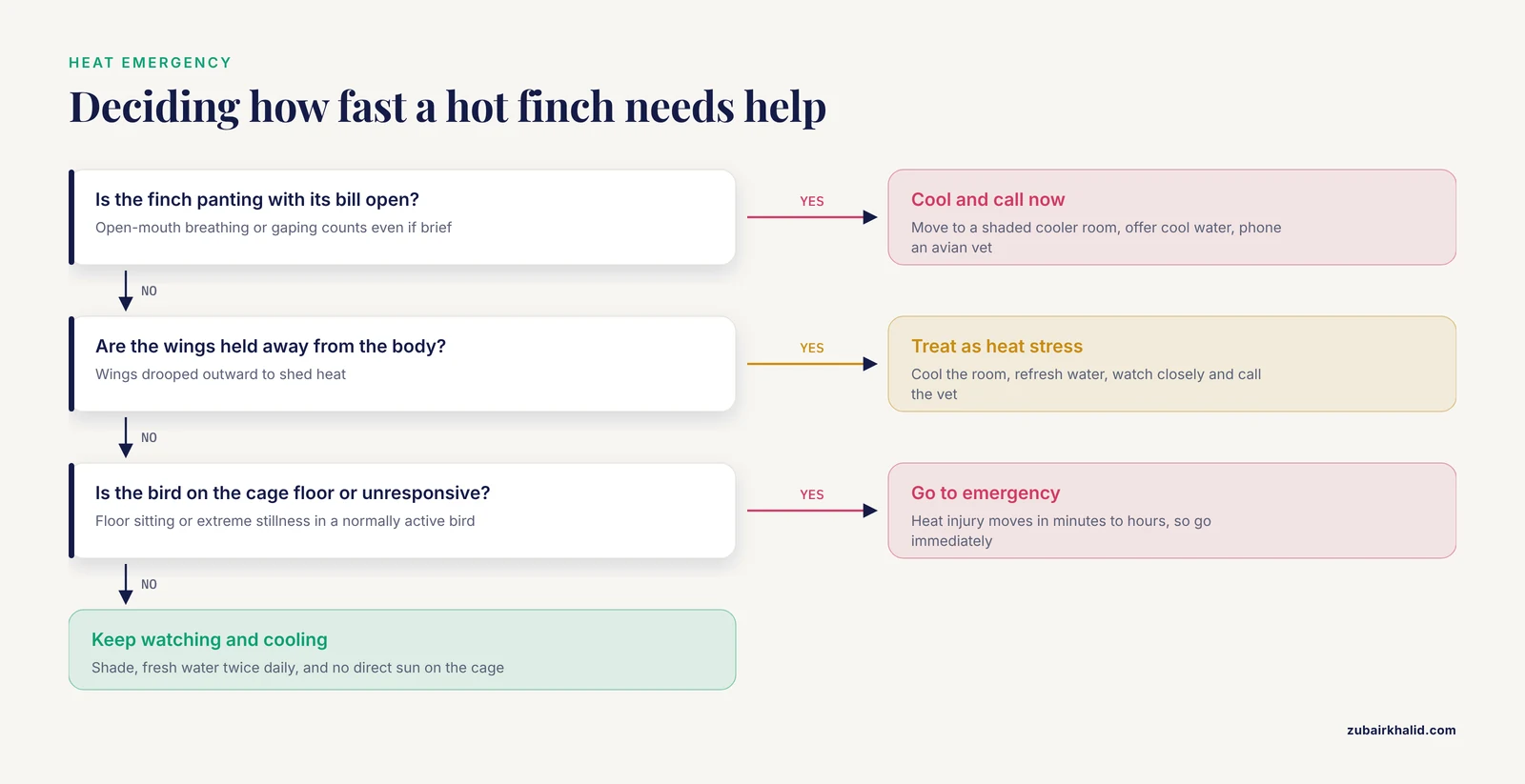
- Move the bird immediately to a cooler, shaded room. Do not wait for the rest of the house to cool.
- Offer fresh, cool drinking water right away. A bird that can drink can use evaporative cooling.
- Do not plunge the bird into cold water or use ice. Rapid extreme cooling is its own shock to a small bird.
- Call an avian veterinarian or an emergency animal hospital while you are cooling the bird. A finch that has reached open-mouth panting and floor-sitting needs professional evaluation, because the same heat exposure that causes visible panting also drives internal changes such as elevated blood glucose and stress hormones that you cannot see at home [8].
How Cold Is Too Cold for a Finch
The cold problem is chronic, not dramatic
Owners often ask how cold is too cold for a finch expecting an answer about shivering and frostbite. In small finches, the more realistic danger is slower and quieter. Zebra finches exposed to 6 degrees Celsius (about 43 degrees Fahrenheit) for four weeks developed signs of thermal stress and became carotenoid limited, producing duller bill color than either warm-fed or cold-supplemented birds [3]. In longer exposures, birds kept at a daytime 23 degrees Celsius, a temperature many homes reach on winter mornings when the heat has been off overnight, developed higher chronic stress markers than birds kept at 104 degrees Fahrenheit, and birds in poorer body condition fared worse [1]. Outdoor monitoring of adult finches found that stress ratios climbed during short windows of extreme low temperatures [6].
The practical translation: a brief chill on the way to the car is not the threat. The threat is a finch that spends night after night in a cool, drafty room, gradually draining the physical reserves it needs to stay healthy.
Warning signs of cold stress at home
- Persistent fluffing, where the bird stays puffed up for most of the day rather than just while resting
- Roosting in the warmest corner of the cage, huddling over feeders or against the cage wall
- Reduced song and activity
- Dull, rough, or poorly maintained plumage, which researchers use as a formal well-being score in captive zebra finches [4]
- Fading or dulling of colored areas, such as the orange bill of a male zebra finch, which measurably dulls under cold stress [3]
- Weight loss or a poorer body condition, which makes cold stress harder to tolerate, as shown in long-term temperature studies [1]
Keeping a finch warm in winter
Keeping a finch warm in winter is mostly about placement and stability rather than gadgets. Work through this checklist before the first cold night of the season:
- Relocate the cage away from windows, exterior doors, and uninsulated walls. A cage that feels fine in October can sit in a cold microclimate by January. Glass windows leak heat, and a finch cage on a sill sits in a downdraft of cold air even when the window is closed.
- Keep the cage out of the direct path of heating vents and fireplaces. Hot, blowing air is its own stressor, and a bird cannot escape a vent that blows onto its perch.
- Partially cover the cage at night with a lightweight breathable cover, leaving ventilation. This traps a layer of warmed air around the bird without sealing the cage.
- Stabilize the room temperature overnight. If you lower the thermostat at night, ask your avian veterinarian how low is safe for your species and whether a gradual schedule change would be better than an abrupt nightly drop.
- Improve body condition before winter with your veterinarian's guidance. Birds in better physical condition showed a greater capacity to face environmental stress in long-term temperature research [1]. Do not change the diet without advice, because sudden diet changes cause their own problems in small birds.
- Watch the plumage and color. A deteriorating plumage score or a dulling bill in a male zebra finch during winter is objective evidence that the environment is taxing the bird, and both are practical, non-invasive monitoring tools validated in research [2][6].
- Provide perches of varying thickness away from the coldest walls so the bird can choose its microclimate. Choice is what wild finches have and caged finches often lack.
If your finches live outdoors in an aviary, winter planning needs a written plan, not improvisation. Ask an avian veterinarian to review your aviary's sheltered zone, wind protection, and cold-night arrangements before the season starts, because retrofitting an aviary during a cold snap is stressful for both birds and owner.
Summer Heat Safety, Step by Step
- Audit the cage location in the afternoon, not the morning. Sun angles change seasonally, and a spot that was shaded in May may be in full sun by July. Sit where the cage sits for ten minutes in mid-afternoon. If you are uncomfortable, the finch has fewer options than you do.
- Confirm shade at all hours. Direct sunlight through glass heats a cage quickly, and a bird cannot move out of the beam.
- Keep drinking water fresh and abundant. The field evidence on heat waves is explicit that hot days were tolerable for wild zebra finches provided drinking water was available [2]. In hot weather, check water at least twice daily, because small drinkers empty and foul quickly.
- Increase observation during heat waves. During multi-day hot periods, expect changes in behavior. Wild finches reduced their activity and metabolic heat production and increased controlled hyperthermia during heat waves [2]. A pet finch that becomes unusually quiet on a hot afternoon may be conserving heat rather than ill, but a finch that is quiet and panting is in trouble.
- Plan for power outages and travel. A finch in a closed car is in a life-threatening situation within minutes on a warm day. Build the rule into your household: the bird never stays in the vehicle.
- Know your emergency plan before summer. Identify the nearest avian or exotic animal veterinarian, their after-hours arrangements, and the drive time from your home.
Seasonal Care Calendar for Finch Owners
Spring
Spring brings temperature volatility and, in many households, breeding season. Both raise the stakes. Periodic cooling during incubation measurably altered development in zebra finch embryos, producing longer incubation periods and slower posthatch growth compared with embryos held at the optimal incubation temperature of about 99 degrees Fahrenheit [7]. If you breed finches, place breeding cages in the most thermally stable room you have, away from doors, windows, and vents. Parents do their best, but a drafty breeding cage forces them to choose between foraging and brooding.
Summer
Apply the heat safety steps above. Watch breeding cages especially closely, because adults reduce brooding behavior during heat waves, which changes the thermal experience of chicks [10]. Provide bath water only in the morning so birds are dry by evening, and never place a cage where afternoon sun reaches it.
Fall
Treat fall as a dress rehearsal for winter. Recheck cage placement before the first cold night, because the draft that did not exist in August appears when the furnace cycles and windows stay shut. Reassess body condition with your veterinarian's help so birds enter winter in good shape, since condition determines how well a finch withstands thermal stress [1].
Winter
Apply the winter warming checklist above. Watch for the quiet signs of chronic cold stress, including plumage deterioration and color dulling [6]. Keep water from freezing if any part of your setup is near a cold zone, and remember that indoor heating dries the air, so check that drinkers have not run low.
Monitoring Your Finches: Two Tools You Can Use This Week
Research on captive zebra finches validated a simple plumage scoring system that any observer can learn, using feather condition as a window into well-being [4]. You do not need the formal scoring sheet to borrow the principle. Once a week, look at your birds in good light and ask three questions. Do the feathers lie smooth and neat, or are they rough, broken, or poorly preened? Is the bird's posture normal, or is it fluffed for most of the day? Does the color look normal for that bird?
For male zebra finches, add a fourth question about the bill. Cold-stressed males developed measurably duller bill color, and the effect was reversed by carotenoid supplementation, showing that color tracks physiological condition [3]. A male whose bill has faded over weeks, not days, is showing you a stress signal worth acting on.
Pair observation with weight when possible. Body condition correlated with hematological stress markers in long-term temperature research, meaning fitter birds handled thermal stress better [1]. A small digital scale used the same way each week, with the bird in a travel carrier or cage weighed as a unit, gives you a trend line that catches problems before they become visible.
Common Mistakes That Put Finches at Risk
- Placing the cage in direct afternoon sun because the bird "seems to enjoy it." A finch cannot escape a sunbeam, and glass intensifies heat.
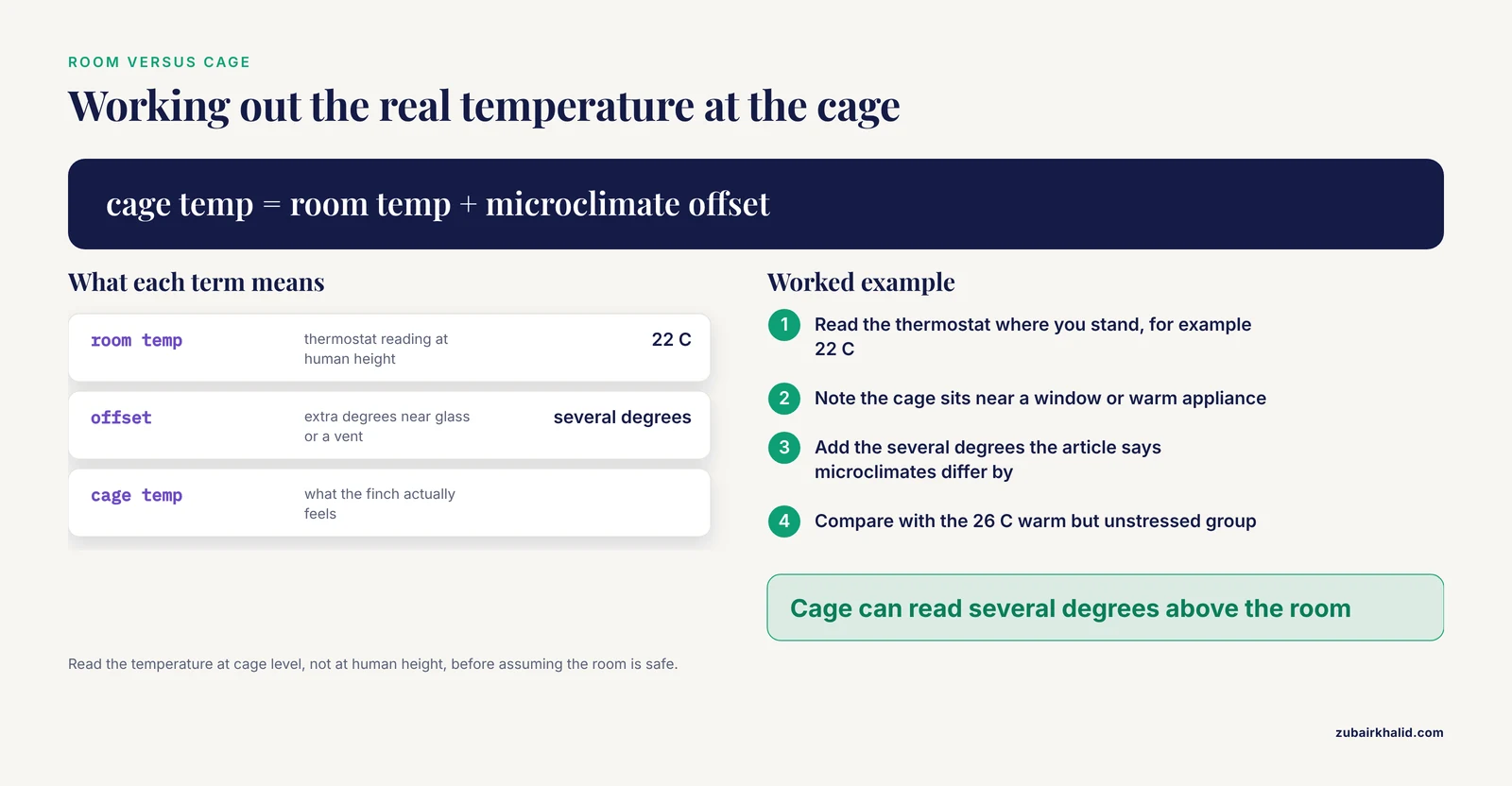
- Assuming indoor room temperature equals cage temperature. Cages near windows, exterior walls, and vents sit in microclimates several degrees different from the room thermostat.
- Reading temperature at human height. Cage-level temperature near the floor of a cool room or the top of a warm room can differ from where you are standing.
- Underestimating cool stress. Owners worry about heat waves and ignore the slow harm of a chronically cool, drafty room, even though prolonged cool exposure produced stronger chronic stress markers than prolonged heat in long-term research [1].
- Letting water run low in hot weather. Every heat adaptation a finch has depends on drinking water [2].
- Ignoring gradual appearance changes. A duller bill [3] or a worsening plumage score [4] develops over weeks and is easy to miss when you see the bird every day.
- Reacting to a heat emergency with ice water or extreme cooling. Move the bird to a cooler space, offer water, and call the veterinarian.
Troubleshooting Specific Situations
My finch pants in the evening only. Check the afternoon sun angle on the cage and any heat source nearby, such as electronics or a refrigerator compressor. Evening panting usually reflects heat accumulated hours earlier. Rearrange the cage and reassess.
My finch stays puffed all winter but eats normally. Persistent fluffing suggests the bird is working to stay warm. Improve cage placement and nighttime cover first, then discuss the room's overnight temperature and the bird's body condition with an avian veterinarian. Remember that prolonged cool conditions, even at normal-feeling indoor temperatures, can raise chronic stress markers in this species [1].
My male zebra finch's color has faded. Rule out seasonal molt first, then look at temperature history and diet with your veterinarian. Cold stress directly dulls carotenoid-based coloration [3], and plumage condition is a recognized well-being indicator [4].
We lost power in winter. Move the cage to the smallest interior room, cover it partially, and keep the birds with you. Contact your avian veterinarian's office for guidance on your specific situation, and never use unvented heating devices in a bird room, because air quality problems develop quickly in small enclosures. Discuss safe emergency heating options with your veterinarian before you need them.
We lost power in summer. Move the birds to the coolest room, offer water frequently, and consider temporary relocation to an air-conditioned space if the outage will be long. A finch in sustained heat near the high 90s Fahrenheit needs active intervention, not observation.
My breeding pair's chicks seem slow to grow. Temperature history in the nest box matters. Periodic cooling during incubation slowed posthatch growth in zebra finches even when embryos survived [7], and heat waves changed parental brooding of nestlings [10]. Review the placement and stability of the breeding cage with an avian veterinarian.
Welfare and Safety Points
Thermal comfort is a welfare issue, not a preference. The tools researchers use to quantify well-being in captive finches, plumage scores and fat scores, exist because subclinical suffering is real and measurable [4]. Chronic stress in this species shows up in blood cells and body condition long before it shows up in behavior [1], and thermal experiences during development leave lasting effects on adult physiology, including stress responsiveness and heat tolerance [3][11]. A finch that has lived for years in a thermally unstable environment carries that history in its body.
There is also good news in the research. Zebra finches are physiologically flexible. Wild birds shifted their entire thermoneutral zone upward during a heat wave and maintained their body mass when water was available [2]. Captive birds that experienced mild heat during development developed more robust responses to severe heat as adults, with altered heat-shock protein expression and lower stress hormone responses [11], and embryos can even upregulate protective heat shock protein genes when exposed to high temperatures mid-incubation [11]. Flexibility, however, has limits, and the research consistently identifies the same two limiting factors for pet finches: water availability in heat and body condition in cold.
Limitations and When to Contact a Veterinarian
Most thermal research on finches has been done in zebra finches under controlled laboratory conditions or in wild Australian populations. Findings from that species inform, but do not exactly predict, the responses of gouldian finches, society finches, canaries, or other pet species, and a research exposure is not a household situation. Individual birds differ by age, health status, and acclimation history. Every owner should confirm a target temperature range and an emergency plan with an avian veterinarian who has examined their birds. Individual cases need a veterinarian, and this article is educational rather than diagnostic.
Contact an avian veterinarian the same day if you observe:
- Open-mouth breathing, wing drooping, or panting at any ambient temperature
- A finch sitting on the cage floor, unresponsive, or unable to perch
- Rapid weight loss or a bird that feels light in the hand
- Plumage deterioration that progresses over weeks despite unchanged care
- A fledgling or chick that is cold to the touch, lethargic, or failing to grow
Go immediately, including to an emergency clinic, if your finch was exposed to a closed hot car, direct sun, or a heated appliance and is now panting, floor-sitting, or unresponsive. Heat injury in a bird this small progresses in minutes to hours, and the internal changes that accompany visible heat stress are best addressed by a professional, not by home care alone [8].
Frequently Asked Questions
What is the finch safe temperature range for a home?
A stable indoor temperature in the range of a warm human living space is a reasonable starting point for healthy adult zebra finches, based on where research birds show no stress markers. Confirm an exact range for your species, cage setup, and local climate with an avian veterinarian, because stability and draft protection matter as much as the number on the thermostat.
How hot is too hot for a finch?
Sustained temperatures approaching the high 90s Fahrenheit call for active cooling, shade, and extra water, and exposures near 108 to 109 degrees Fahrenheit are dangerous even for heat-adapted zebra finches in research settings. Treat any situation where the cage is warmer than the room, such as direct sun or a closed car, as an emergency regardless of the thermostat reading.
How cold is too cold for a finch?
There is no single safe cold threshold, because the harm is cumulative. Research shows measurable chronic stress and physical deterioration in zebra finches exposed to prolonged cool conditions, including temperatures near 43 degrees Fahrenheit over weeks and even normal-feeling cool rooms over months. If your finch stays puffed up during the day, the environment is too cool for that bird.
What are the signs of heat stroke in finches?
Open-mouth breathing, wings held away from the body, rapid labored breathing, lethargy, and sitting on the cage floor are the key signs. Any combination of these means move the bird to a cooler space, offer water, and call an avian veterinarian immediately.
How can I keep a finch warm in winter without special equipment?
Relocate the cage away from windows, exterior doors, and cold walls, partially cover the cage at night while leaving ventilation, stabilize overnight room temperature, and place perches away from the coldest surfaces. Improving the bird's body condition before winter, with veterinary guidance, also builds cold tolerance.
Should I cover my finch's cage at night?
A partial, breathable cover that leaves ventilation is a low-risk way to trap warmed air around a sleeping finch in a cool room. Avoid heavy covers that block airflow entirely, and skip the cover if the room stays warm and stable at night.
Can finches live outdoors year-round?
Outdoor aviaries can work in mild climates with proper shelter, wind protection, and reliable water, but year-round outdoor housing in hot summers or cold winters requires planning that goes beyond what this article covers. Have an avian veterinarian review your specific aviary, species, and regional climate before committing to outdoor housing.
When should I take my finch to an emergency vet for heat or cold?
Go immediately for open-mouth breathing, collapse, floor-sitting, unresponsiveness, or any exposure to a closed car, direct sun, or an overheated enclosure. Go the same day for persistent fluffing, weight loss, dulling color, or a chick that is failing to grow, since these signal problems that worsen without treatment.
Sources
- Temperature and water availability induce chronic stress responses in zebra finches (Taeniopygia guttata).
- Physiological responses of wild zebra finches (Taeniopygia guttata) to heatwaves.
- Environmental stress affects the expression of a carotenoid-based sexual trait in male zebra finches.
- Plumage and Fat Condition Scores as Well-Being Assessment Indicators in a Small Passerine Bird, the Zebra Finch (Taeniopygia guttata).
- How thermal challenges change gene regulation in the songbird brain and gonad: Implications for sexual selection in our changing world.
- A prenatal acoustic signal of heat reduces a biomarker of chronic stress at adulthood across seasons.
- Periodic Cooling during Incubation Alters the Adrenocortical Response and Posthatch Growth in Zebra Finches.
- Acute Heat Exposure Upregulates Zebra Finch Physiology While Avoiding DNA Damage Across Both Sexes.
- Evaluation of Best Practices for the Euthanasia of Zebra Finches (Taeniopygia guttata).
- Effects of heat waves on telomere dynamics and parental brooding effort in nestlings of the zebra finch (Taeniopygia castanotis) transitioning from ectothermy to endothermy.
- Acute exposure to high temperature affects expression of heat shock proteins in altricial avian embryos.