Finch-Proofing Your Home: Hazards and a Safe Setup
By Dr. Zubair Khalid, DVM, MS, PhD ·
Finch proofing your home comes down to four jobs done in order: remove airborne toxins, close every escape gap, eliminate open water and strike hazards in the flight zone, and then build a supervised free roam area where your birds can fly, land, drink, and rest without meeting any of the hazards you just removed. Finches are among the smallest birds commonly kept as pets. Their size, fast flight, and rapid metabolism make them vulnerable to dangers that a parrot or a dog would shrug off, and their well-being depends directly on the quality of the housing and environment you provide [1].
This guide walks through the household dangers for finches, a step-by-step method for finch proofing a room, the equipment you need, and how to confirm afterward that the setup is actually working for your birds. The examples in this article focus on zebra finches, the most commonly kept pet finch, but the same principles apply to society finches and similar small estrildid species.
This article is educational and is not a substitute for veterinary diagnosis or treatment.
At a Glance: Your Finch-Proofing Checklist
| Task | Why it matters | Do it before first free flight? |
|---|---|---|
| Move birds out of the kitchen and ban nonstick cookware use near them | Overheated nonstick (PTFE) fumes can kill birds rapidly | Yes |
| Seal gaps behind appliances, baseboards, and window frames | A finch can disappear into a one-inch gap and become trapped | Yes |
| Cover or screen windows, mirrors, and glass doors | Clear glass is invisible to a flying finch and causes head and neck trauma | Yes |
| Remove or cover all open water deeper than a fingernail | Finches can drown in toilets, sinks, buckets, and pet water bowls | Yes |
| Turn off and block ceiling fans | A single fan strike is usually fatal | Yes |
| Keep cats and dogs out of the flight room, always | Even a swat or a mouth "carry" can cause fatal internal injuries | Yes |
| Ventilate after cooking, cleaning, or painting | Birds have an extremely efficient respiratory system and no tolerance for fumes | Yes |
| Plan a short first session, in daylight, with a return route to the cage | Reduces panic, exhaustion, and night-time injuries | Yes |
| Schedule a well-bird check with an avian veterinarian | Establishes a baseline before you change the bird's environment | Within the first weeks |
Why Finches Need a Different Kind of Proofing Than Parrots
Most finch-proofing advice online is borrowed from parrot care, and much of it does not transfer. Parrots destroy things with their beaks, so parrot proofing centers on chewing hazards. Finches rarely chew household objects. Their dangers are almost entirely about flight, body size, and respiration.
Three differences drive the whole plan.
Size. An adult zebra finch weighs a few grams more than a couple of coins. That means standard window screens will not hold them, mesh gaps that seem tiny to you are wide doors to them, and they can wedge themselves into spaces you would never think to check, such as the gap between a refrigerator and the wall.
Flight style. Finches are burst fliers. They fly fast and erratic, in short straight-line flights, and they panic upward. That makes ceiling fans, the tops of open doorways, and clear glass the three most dangerous surfaces in any room.
Respiration. The avian respiratory system moves air through the lungs in one direction with a network of air sacs, which makes birds far more sensitive to airborne toxins than mammals. Research on zebra finches shows that respiratory distress in this species is visible as open-mouth breathing and postural changes, signs that observers can recognize and score reliably [2]. In a home setting, any finch standing on the floor with its beak open and its neck extended is in an emergency.
There is also a behavioral difference that surprises new owners. Finches are not handle-me birds. A finch that escapes is unlikely to step up onto a finger for rescue, so your proofing has to assume that every escape is recovered by trapping the room, dimming the lights, and waiting, not by chasing.
The Biggest Household Dangers for Finches
Work through this list room by room. The first three items cause the majority of sudden finch deaths in homes.
Airborne toxins: the silent killer
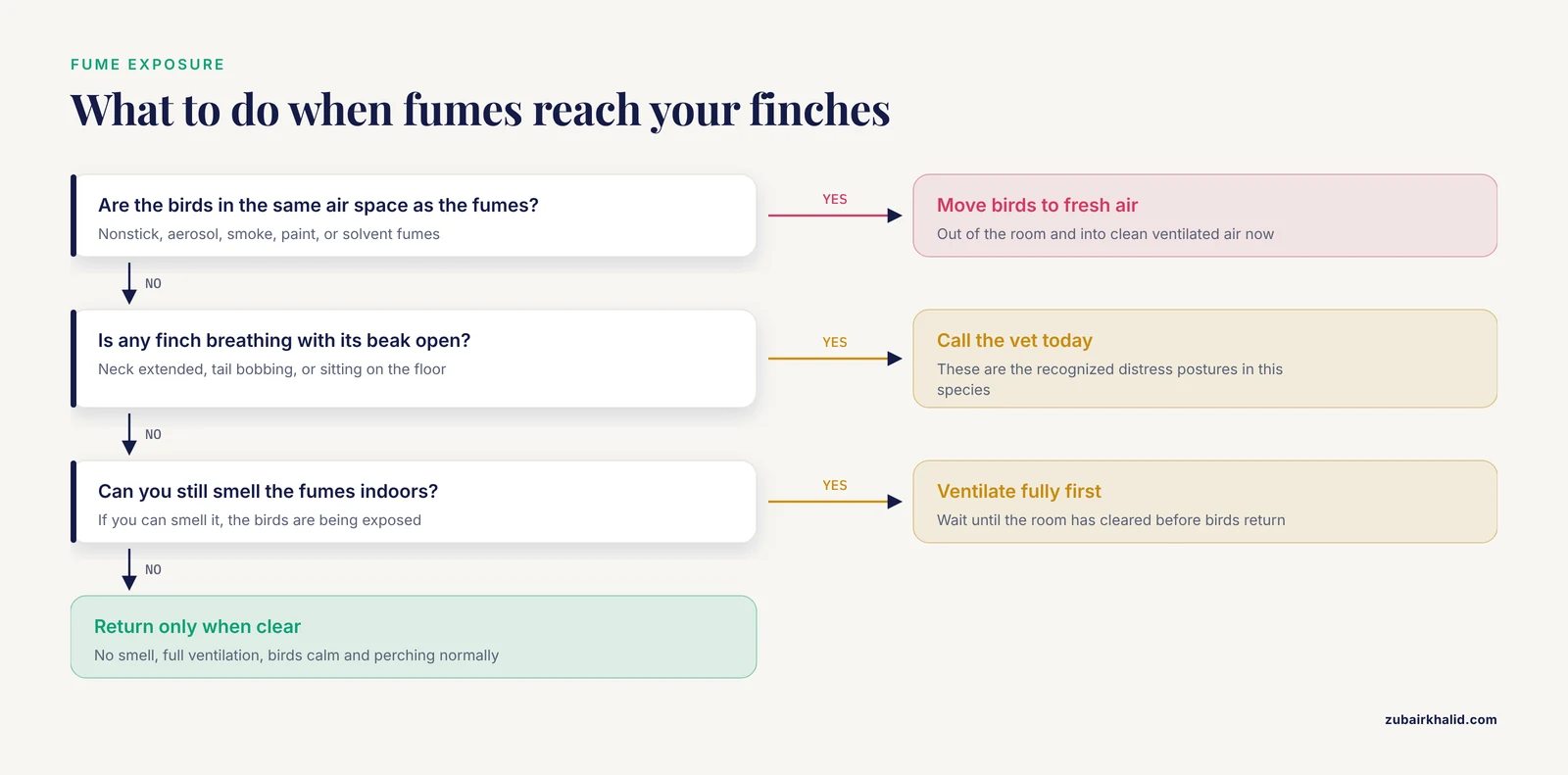
This is the most important section in the article. Birds can die from fume exposures that humans barely notice.
- Overheated nonstick (PTFE) cookware and oven liners. Polymer fume fever in humans is a known hazard, and birds are far more sensitive. Any use of nonstick pans, nonstick bakeware, self-cleaning oven cycles, or nonstick drip pans in a home with finches carries risk, especially when a pan is overheated or left dry on a burner. Avian veterinarians, including those publishing through the Association of Avian Veterinarians and the Merck Veterinary Manual's pet bird resources, treat fume exposure from overheated nonstick coatings as an established avian emergency. The safe approach is to use nonstick cookware only if it is far from the birds, never overheated, and never with the birds in the same air space. Stainless steel, cast iron, and ceramic cookware remove the question entirely.
- Aerosols, sprays, and diffusers. Aerosol deodorants, hairsprays, furniture polish, spray cleaners, perfumes, and essential oil diffusers all put fine droplets into the air. Because a finch's respiratory system is so efficient, what smells mild to you can be a heavy dose to a bird. Move the birds out of the air space, ventilate fully, and wait until the room has cleared before returning them.
- Smoke and combustion fumes. Cigarette and vape aerosol, fireplace smoke, gas leak events, and car exhaust in an attached garage all endanger finches. If you can smell it, the birds are being exposed.
- Paint, varnish, and renovation dust. Fresh paint, polyurethane, adhesives, and construction dust require the birds to be out of the home for the duration of the work and until the odor is fully gone, not just until the room "dries."
The distress signs to know are open-mouth breathing with the neck extended, tail bobbing with each breath, and a bird sitting on the floor of the cage or room instead of perching [2]. Any of these after a fume exposure means fresh air immediately and an avian veterinarian right away.
Open water
A finch that falls into open water can become waterlogged and drown within minutes, and wet finches lose the insulation their tiny bodies depend on. The usual culprits are toilets with the lid up, sinks with standing water, mop buckets, pet dog and cat water bowls, open fish tanks, and drinking glasses. During free flight time, every one of these gets covered, emptied, closed, or removed. A shallow finch bath inside the cage or in the flight space, no deeper than the bird's legs, is the safe way to offer bathing.
Escape routes and gaps
Finches are lost through gaps far more often than they are lost through open doors. Seal or block:
- Gaps behind and beside refrigerators, stoves, washers, dryers, and radiators
- The gap between the bottom of a door and the floor, which a grounded finch will find within minutes
- Openings around pipes under sinks and behind toilets
- Floor heating vents and cold-air returns, which are warm, dark, and fatal
- Gaps in window screens and torn screen panels
- The space behind bookcases and entertainment centers
The standard test is simple. Sit on the floor of the room at finch eye level and look for holes. Anything wider than about the width of your thumb needs covering. A grounded finch walks toward dark gaps instinctively, and many lost finches are found dead behind appliances days later.
Clear glass and mirrors
A flying finch cannot perceive clear glass. Window strikes cause concussion, beak fractures, and death. During flight time, either keep blinds or curtains closed, or apply visible decals, and cover or remove large mirrors. Exterior window strike reduction also matters if your finch cage sits near a window, because indoor birds seeing outdoor reflections can repeatedly crash into the glass.
Other pets
Cats and dogs are incompatible with finch free flight, full stop. A cat does not need to make contact to harm a bird, and a dog that catches a finch gently in its mouth can still crush it. Claw punctures from any species introduce mouth bacteria into a tiny body and can lead to fatal infection even when the wound looks trivial. Every bite or scratch from another pet is an immediate veterinary visit, not a watch-and-wait situation. The safe free roam area for finches is a room that other pets physically cannot enter during flight sessions.
Ceiling fans, hot surfaces, and machinery
Turn ceiling fans off before any bird leaves the cage, and preferably leave them off permanently in the bird room. Hot stovetops, irons, curling wands, space heaters, and open flames all cause severe burns in a fast, low-flying bird. Never run the room during free flight time.
Toxic household items for finches
The category of toxic household items for finches includes more than people expect:
- Cleaning products. Bleach and ammonia fumes, oven cleaners, drain openers, and disinfectant sprays. Use birds'-safe cleaning routines instead: remove the birds, clean, rinse, dry, ventilate, then return them.
- Pesticides and insecticides. Foggers, fly sprays, ant baits, and treated surfaces. If a professional pest treatment is needed, ask the company about bird-safe reentry times and keep the birds out for the full interval.
- Paints, solvents, and glues. Including nail polish and nail polish remover used anywhere in the home.
- Fumes from heated coatings and plastics. Including nonstick oven liners, air fryer interiors with degraded coatings, and heat-damaged nonstick pans.
- Scented products. Candles, plug-in air fresheners, incense, and essential oil diffusers. These do not need to touch the bird to harm it.
For plants, skip the generic internet safe-lists. Plant toxicity information varies by species and by part of the plant, and a finch will sample anything green. Bring the exact plant name to your avian veterinarian and ask before placing any houseplant in or near the flight area.
Temperature, drafts, and night frights
Finches tolerate a comfortable room-temperature household but are stressed by cold drafts from windows and air conditioning vents blowing directly on the cage, and by sudden temperature swings. Position the cage away from drafty windows, exterior doors, and heating or cooling vents. Many finches also experience night frights, sudden panic flights in the dark that cause injuries against cage bars. A very dim night light in the bird room lets a startled finch reorient and land instead of thrashing.
How to Finch Proof a Room Step by Step
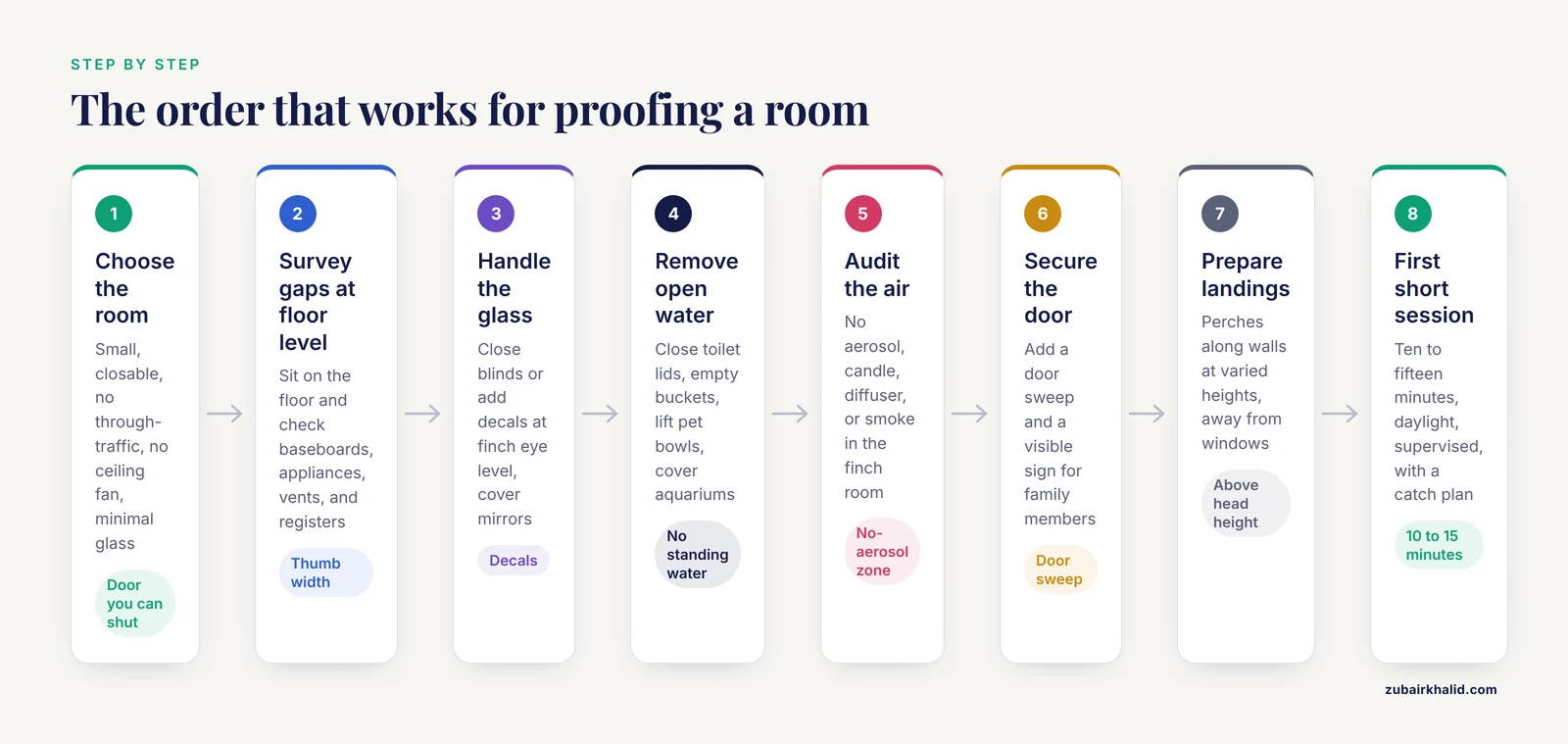
Here is a practical sequence for how to finch proof a room, in the order that works best.
- Choose the room deliberately. The best finch room is small enough to close off, has no through-traffic, no ceiling fan, no fireplace, minimal glass, and a door you can keep shut. A spare bedroom or a home office usually beats an open living room.
- Do the floor-level gap survey. Sit on the floor and inspect every wall junction, baseboard, appliance gap, vent, and floor register. Block what you find with vent covers, foam, door sweeps, or furniture rearrangement.
- Handle the glass. Close blinds or curtains during flight time, or apply window decals at finch eye level. Cover or remove mirrors.
- Remove water. Close toilet lids, empty buckets and mop water, lift pet bowls out of the room, and cover aquariums.
- Audit the air. The finch room should be a no-aerosol, no-candle, no-diffuser, no-smoke zone. If the kitchen shares an open floor plan with the room, nonstick cookware should be retired from the household or used with the birds fully removed and the space ventilated.
- Secure the door. Add a door sweep or draft stopper to block the under-door gap. Consider a visible sign on the door so family members do not open it mid-session.
- Prepare the landing environment. Set up perches, branches, or rope perches at multiple heights around the room edges, away from windows. Finches land on the highest safe point they can see, so give them good options above head height near the walls, not in the middle of the room.
- Run the first session short and supervised. Open the cage in daylight, in the morning, when the birds are calm. Ten to fifteen minutes is plenty for a first flight. Have a catch plan: dim the lights, and a finch in a darkened room will usually settle and can be gathered gently in a cupped hand or a small towel. Never chase a finch around the room, since panic flights cause most injuries.
Repeat the full audit every few months. Homes change, and a new appliance, a new curtain rod, or a visiting pet resets the risk picture.
Building a Safe Free Roam Area for Finches
A safe free roam area for finches is not the whole house. It is one controlled space the birds know, with a defined flight circuit and a predictable return routine.
Define the space. One room, closed during sessions, is the standard. Some owners of multiple finches convert an entire small room into a walk-in flight space with permanent perching, which is the ideal arrangement for this species because zebra finches are active, continuous fliers.
Create a flight circuit. Finches like predictable routes. Position perches so the birds can fly a loop around the room, landing points at the far end, a return path along the other wall, and a clear center. Avoid hanging perches directly in front of windows, where glass strike risk is highest.
Provide perching options at different heights. Natural branches, perches near the ceiling away from lights, and lower perches near the cage give birds choice. Perches should be sanded, cleaned, and free of loose paint.
Keep food and water in the cage. During free flight, the cage door stays open as home base. Finches return to the cage to eat and drink. Offering water only inside the cage during free time eliminates the open-water risk in the room entirely.
Consider the visual environment. Research on zebra finches tested whether environmental color cues, independent of the birds themselves, influenced female mate choice and behavior, and found that while an initial effect appeared, follow-up experiments did not confirm consistent effects of background color cues on choice behavior [3]. The practical takeaway for owners is that you do not need to engineer the colors of the room for your birds' benefit. Put your effort into safety surfaces, perching, and predictability instead of decorating theory.
Establish a return routine. Use the same closing signal and time each day. Finches learn routines quickly, and a predictable end-of-session cue, such as dimming the lights slightly and offering a small portion of a favorite food inside the cage, turns voluntary return into habit rather than a chase.
Equipment and Supplies: What to Buy and What to Skip
You do not need much specialized equipment to finch proof a home, but selection matters.
- Mesh and screening. For building a custom flight space or covering openings, use a mesh with spacing small enough that a finch cannot pass its head through and cannot wedge a foot. Hardware cloth with small apertures, not chicken wire, is the usual choice. If you are unsure about a spacing, measure it against a finger width and confirm with your avian veterinarian before first use.
- Perches. Natural wood branches of varied diameter are better than uniform dowels. Avoid sandpaper perch covers, which abrade feet.
- Window film and decals. Any visible marking at bird eye level breaks up reflections. Cheap and effective.
- Door sweep and vent covers. Inexpensive and solves the two most common escape routes.
- Full-spectrum or gentle room lighting. Not a requirement, but consistent day-night cycles support normal behavior. Avoid placing any heat lamp or bulb where a bird can touch it.
- Skip: sandpaper perch covers, mite protectors, round cages with tight bar patterns, and anything marketed as a "finch scent" or air treatment for birds. The Association of Avian Veterinarians and VCA Animal Hospitals' avian care guides consistently steer owners away from aerosolized products around birds.
The cage itself should be wider than it is tall, since finches use horizontal flight space, with bar spacing narrow enough to prevent head entrapment and with horizontal flight room prioritized over ornamental height. Multiple feeding stations reduce squabbling in a group, because zebra finches live in flocks and competition at a single dish is a real source of stress.
Monitoring Well-Being After the Setup
Finch proofing is not finished when the room is safe. It is finished when you have confirmed the birds are thriving in it. Body condition is the most practical field measure for small birds. Researchers working with zebra finches validated a simple plumage scoring system as a reliable, non-invasive indicator of well-being, with substantial agreement between different observers, and found that plumage condition outperformed fat scoring for consistency, while a combination of the two measures gave the fullest picture [1]. The feather signal is easy for owners to read in plain terms.
- A well finch has smooth, neat plumage lying flat, bright eyes, upright posture, steady weight, and normal daily activity including singing in males.
- A deteriorating finch develops a rough, fluffed, or broken coat of feathers, sits still for long periods, stops singing, and may lose visible body condition over the keel bone.
Check your birds' plumage and body condition at the same time each week, ideally handling each bird gently in a dim room. If the plumage score worsens over several weeks after a change in the environment, the environment, not just the bird, deserves a second look. Bring your observations to your avian veterinarian, who can teach you the scoring approach in a single visit and track it over time.
Common Mistakes in Finch Proofing
- Proofing the room but not the schedule. The safest room in the world is dangerous at aerosol-spray time. Tie flight privileges to a routine: same room, same hours, no exceptions during cooking or cleaning.
- Trusting window screens. Standard house screens hold out cats, not finches. A finch pushes through an ordinary screen seam in a second.
- Assuming a grounded finch is calm. A finch on the floor is frightened, cold, and searching for a gap. Ground it, dim the room, and recover it promptly.
- Letting the dog "just watch." Predatory attention from a dog or cat elevates stress hormones in the birds even without contact. Separate spaces are the only reliable answer.
- Overheating one nonstick pan once. Fatal PTFE exposure does not require a history of unsafe use. One overheated pan in shared air space is enough.
- Chasing during capture. Panic flights into walls cause more injuries than the original escape. Lights low, wait, cup gently.
- Skipping the first veterinary baseline. Well-bird checks establish normal weight and plumage for your individual birds, which makes every later assessment meaningful.
Troubleshooting
The finches fly but will not land. Check your perch placement. If perches are near lights, in the center of the room, or unstable, birds keep circling. Add solid perches along the walls at varied heights.
A finch keeps flying to the window. The bird is seeing either its own reflection or an appealing view. Add decals, shift the cage angle, or close that window's treatment during sessions.
Night panic attacks started after the move. Add a dim night light, reduce abrupt evening noise, and check the cage location for drafts and light spill from hallway traffic.
One bird dominates the flight space. In groups, some zebra finches monopolize the best perches. Add more perch sites at more heights, spaced farther apart, and add a second food station.
A bird seems fluffed and quiet after a session. Rest in the cage, warmth, quiet, and a same-day call to your avian veterinarian. Do not wait out respiratory signs.
Limitations and When to Contact a Veterinarian
Every finch is an individual, and species-level advice cannot predict how your specific bird will react to a new space, a new companion, or a new routine. Use this article as a framework and confirm the specifics with an avian veterinarian who has examined your birds.
Contact an avian veterinarian urgently, the same day, for:
- Open-mouth breathing, tail bobbing, or extended-neck breathing at rest, the recognized distress postures in this species [2]
- Any bite or scratch from a cat, dog, or other pet, regardless of how small the wound appears
- A finch found on the cage floor, unable to fly, or unable to perch
- Known or suspected fume exposure, even if the bird currently looks normal
- Bleeding, a visibly bent wing, head trauma after a window strike, or fluffed immobility lasting more than a few hours
- A missing finch you cannot locate, since trapped birds can deteriorate quietly behind appliances
Schedule a routine well-bird visit when you first acquire finches and at least annually thereafter, and use it to review your housing, plumage and fat condition scoring, and diet with your veterinarian [1].
Frequently Asked Questions
How long should finch free flight sessions last?
Start with ten to fifteen minutes and build up as the birds learn the room. Many owners settle on one to several supervised sessions daily. What matters more than duration is that every session happens in the same proofed room, in daylight, with the return routine intact.
Are nonstick pans really dangerous to pet finches?
Yes. Overheated nonstick (PTFE) coatings release fumes that are a well-recognized cause of sudden death in pet birds, and finches are among the most sensitive species because of their efficient respiratory systems. The safest home with finches uses stainless steel, cast iron, or ceramic cookware, or reserves nonstick cookware for use far from the birds with full ventilation and the birds removed from the air space.
What room temperature range is right for finches?
A comfortable human room temperature, stable and free of drafts, suits indoor finches. Avoid placing the cage where an air conditioning vent, exterior door, or drafty window can blow directly on the birds, and avoid sudden temperature swings. If you keep your home unusually cool or unusually warm, ask your avian veterinarian for guidance at the well-bird check.
Can my finch fly in the same room as my cat or dog?
No. Predatory pets and flying finches do not mix. Even without contact, a cat's or dog's focused attention stresses the birds, and a single swat or mouth grab can be fatal or cause a fatal infection later. The safe free roam area for finches is a room other pets cannot enter during flight sessions.
How do I stop my finch from flying into windows and mirrors?
Finches cannot see clear glass. During flight time, close curtains or blinds, or apply visible window decals at the bird's eye level, and cover or remove mirrors. Position perches away from windows so the flight path does not end at glass.
What household plants are safe to keep near my finches?
Do not rely on generic online lists. Plant toxicity depends on the species, the part of the plant, and how much is eaten, and a finch will sample nearly anything green. Identify your plant by name and confirm it with your avian veterinarian before placing any houseplant in or beside the flight area. The simplest policy is to keep houseplants out of the finch room entirely.
How can I tell whether my finch is happy in the new setup?
Weekly plumage checks are the most practical tool. A thriving finch has smooth, flat, well-groomed feathers, bright eyes, normal activity, and in males regular singing. A rough, fluffed, or broken-feathered coat with reduced activity signals declining well-being and warrants a veterinary visit. Research in zebra finches supports feather condition scoring as a reliable, non-invasive well-being indicator that owners can learn.
What should I do the moment my finch escapes into the house?
Close the room it escaped from, block the under-door gap, and dim the lights rather than chasing. A finch in a dark, quiet room settles within minutes and can be recovered gently by hand or with a small towel. Then re-walk the escape route to find the gap that allowed it and seal it before the next session.
Sources
- Plumage and Fat Condition Scores as Well-Being Assessment Indicators in a Small Passerine Bird, the Zebra Finch (Taeniopygia guttata).
- Evaluation of Best Practices for the Euthanasia of Zebra Finches (Taeniopygia guttata).
- Colour Cues That Are Not Directly Attached to the Body of Males Do Not Influence the Mate Choice of Zebra Finches.