Finch Healthy Weight: Body Condition and Weight Charts
By Dr. Zubair Khalid, DVM, MS, PhD ·
A healthy pet finch is not defined by a single magic number on the scale. It is defined by a stable individual baseline weight, good muscle condition, a smooth feather coat, and a body that feels sleek rather than soft or lumpy in your hand. Most small pet finches, such as zebra finches and society finches, sit somewhere in the range of roughly 10 to 30 grams depending on species, sex, and frame, but the number that matters most is your bird's own consistent trend over time.
This guide explains how much a finch should weigh, how to build and read a weight chart at home, how to perform a simple finch body condition score, how to recognize whether your finch is overweight, and how to help a finch lose weight safely when it needs to. It is written for owners of pet finches in the United States.
This article is educational and is not a substitute for veterinary diagnosis or treatment.
At a Glance: Your Finch Weight Checklist
| Step | What to do | Why it matters |
|---|---|---|
| 1 | Buy a digital gram scale that reads in 0.1 g increments | Finches are so small that 1 gram can be a meaningful change |
| 2 | Weigh your finch at the same time of day, ideally morning before feeding | Food in the crop and gut shifts daily weight |
| 3 | Record every weight on a simple chart with the date | Trends reveal problems sooner than single readings |
| 4 | Learn to feel the keel bone and check the furcular hollow | A finch body condition score catches fat and muscle loss the scale can miss |
| 5 | Compare your bird against a species range and its own baseline, not a neighbor's bird | Frame, sex, and species all change what is normal |
| 6 | Call an avian veterinarian for sudden losses or gains, or for a bird you cannot stabilize at home | Small birds decompensate quickly |
Why Weight Matters So Much in Finches
Finches are among the smallest birds commonly kept as pets. A zebra finch weighs about as much as two sheets of paper and a few coins. Because their total body mass is tiny, changes that would be trivial in a parrot or a dog can represent a large percentage of a finch's body weight. A two-gram drop in a 15-gram finch is more than a 10 percent loss. That is why avian veterinarians treat weight tracking as a core part of preventive care, and it is why the Association of Avian Veterinarians encourages owners to monitor body weight at home as part of routine husbandry.
Weight is also one of the few objective, non-invasive data points an owner can collect without handling stress beyond the weighing itself. Researchers studying captive zebra finch well-being have emphasized exactly this point, that simple, non-invasive, and reliable assessment tools are a prerequisite for good husbandry, and they validated scoring systems designed to be usable by people without advanced training [1].
There are two complementary ways to assess finch condition, and experienced keepers use both:
- Body weight over time, tracked on a chart.
- Physical body condition, assessed by looking at and gently feeling the bird.
Weight alone can mislead. A finch can gain fat while losing flight muscle, keeping the scale steady while body composition worsens. Conversely, an ill finch can retain water or remain within a broad species range while quietly losing muscle. The combination of scale weight and a hands-on condition check gives you the full picture.
How Much Should a Finch Weigh?
The honest answer to "how much should a finch weigh" is that it depends first on species, then on individual frame, sex, age, and hydration status. Small passerine finches vary widely across commonly kept species. The table below gives commonly cited approximate adult ranges for popular pet finches. Treat these as starting reference points, not targets. Your own bird's steady baseline, confirmed by an avian veterinarian during a wellness exam, is the standard that matters.
| Species | Approximate adult weight range | Notes |
|---|---|---|
| Zebra finch | ~12 to 16 g | Males and females are usually similar, males can run slightly heavier |
| Society finch (Bengalese) | ~16 to 25 g | Line-bred for generations, body size varies a great deal between strains |
| Gouldian finch | ~12 to 16 g | Sensitive birds, weight stability is an important health marker |
| Owl finch (double-barred finch) | ~10 to 13 g | Small species, watch losses closely |
| Strawberry finch (red avadavat) | ~10 to 13 g | Males in breeding plumage can carry slightly different condition than females |
| Cut-throat finch | ~13 to 17 g | Robust frame for their length |
| Java rice finch (Java sparrow) | ~25 to 30 g | Technically a munia, one of the heavier "finches" in aviculture |
| Canaries (often kept alongside finches) | ~15 to 30 g | Included because care advice frequently overlaps |
Several practical points about these numbers:
- Species ranges are wide on purpose. A 14-gram zebra finch and a 17-gram zebra finch can both be perfectly healthy. What flags a problem is a change from that bird's own normal.
- Sex differences exist but are modest in most finch species. In zebra finches, body condition scoring systems have been validated across mixed-sex captive groups, and fat condition is treated as an individual-level indicator rather than a sex-specific one [1].
- Age matters. Young finches fresh from weaning may sit at the low end while their flight muscle develops. Older finches can gain fat as activity drops.
- Time of day matters. A finch that has just eaten a full crop of seed weighs measurably more than the same bird the next morning. Weigh at a consistent time, ideally before the morning feed.
Building Your Finch Weight Chart at Home
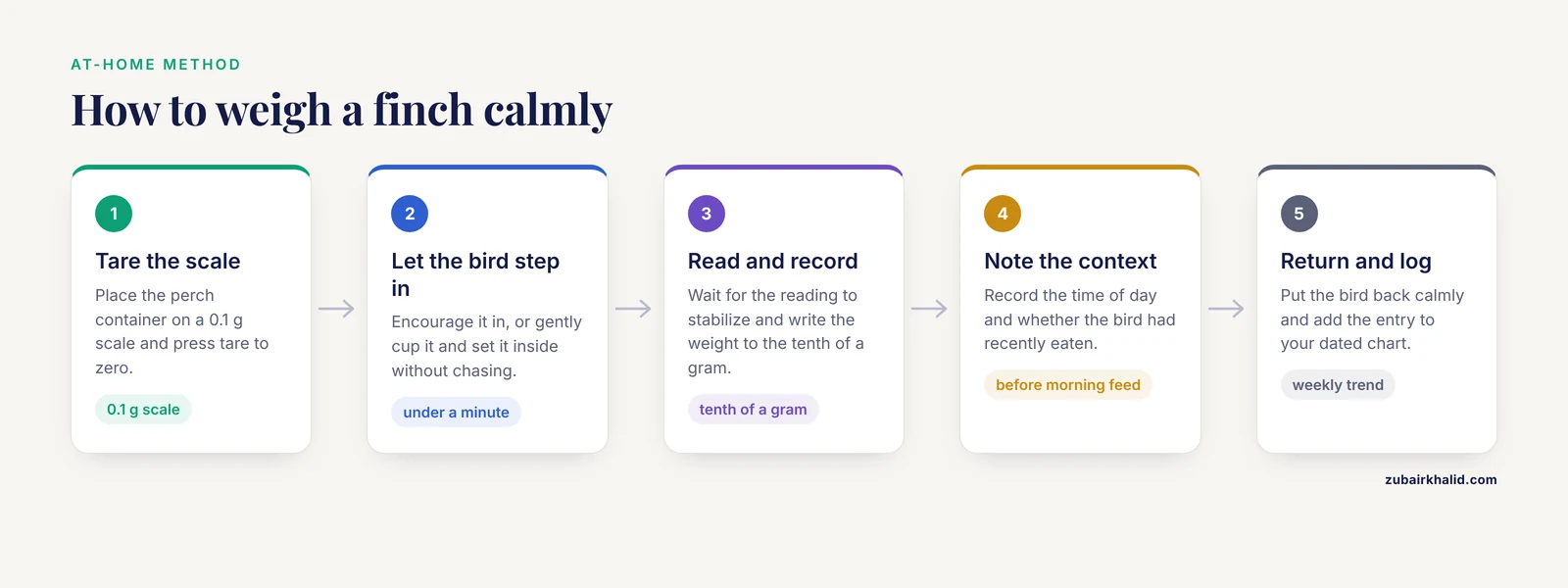
A weight chart is simply a dated log. Any notebook, spreadsheet, or phone note works. The value comes from consistency.
Equipment and selection criteria:
- A digital pocket scale or kitchen scale that reads in 0.1 gram increments. This precision is non-negotiable for finches, whole-gram scales hide meaningful change.
- A small container or perch platform that fits on the scale platform so the bird can stand calmly during the reading. Many owners use a small plastic tub with a perch inside and tare the scale with the tub in place.
- A towel for gently containing a bird that will not voluntarily step onto the scale.
- Your chart or log, with columns for date, time, weight in grams, and any notes such as molt, egg laying, or illness.
Step-by-step weighing method:
- Place the container on the scale and press tare so the reading is zero.
- Encourage the finch to step in, or gently cup the bird in your hand and set it in the container. Keep the session under a minute.
- Wait for the reading to stabilize and record the number to the tenth of a gram.
- Note the time of day and whether the bird had recently eaten.
- Return the bird to its cage calmly. Never chase a finch around the cage to weigh it, the stress of a long pursuit outweighs the data value.
How often to weigh: For a healthy adult finch, weekly weighing is usually enough to establish a trend. Daily weighing is useful when you are actively managing a weight problem, recovering a sick bird under veterinary direction, or monitoring a bird that has recently changed diet. Avoid obsessive daily weighing in a healthy, stable bird, since normal gut fill fluctuations can create false alarms.
Reading the Chart
Three patterns deserve attention:
- Gradual upward drift over weeks, especially without increased exercise, suggests creeping fat gain.
- Gradual downward drift, even if the bird still seems bright, can signal chronic disease, dental-style overgrowth issues of the beak that reduce intake, parasite loads, or malnutrition.
- A sudden drop of several percent of body weight within a day or two is an urgent pattern in a bird this small and warrants a prompt call to an avian veterinarian.
Finch Body Condition Score: The Hands-On Check
A finch body condition score is a structured way to assess fat and muscle by sight and touch. Avian medicine borrowed this approach from the body condition scoring used in mammals, adapted to the anatomy of birds. In zebra finches specifically, researchers have studied two complementary scoring tools, a fat score based on visible fat deposits and a plumage score based on feather coat quality, and found both can serve as reliable, non-invasive well-being indicators in small songbirds [1].
Two findings from that work are directly useful to pet owners. First, the plumage scoring system showed substantial agreement between different observers, including observers of varying experience levels, meaning it is learnable and consistent [1]. Second, the fat score showed lower agreement between observers and appears to require more training to score consistently [1]. Practically, this means you can trust your eye for feather condition relatively early, while your touch for fat deposits will sharpen with practice and improves greatly if a veterinary technician or avian veterinarian shows you the technique once.
What to Feel For: The Keel and the Furcular Hollow
The two anatomical landmarks are:
- The keel (sternal ridge). Hold the finch gently in one hand, wings held against the body, and run a fingertip lightly down the center of the chest. You should feel a defined bony ridge with muscle on either side. The ridge should be palpable but not knife-sharp.
- The furcular hollow (the "clavicle triangle" at the base of the neck, inside the V of the wishbone). In a lean, fit finch this depression feels flat or slightly hollow. Fat fills it from the bottom up, so a bulging or rounded hollow is the classic sign of excess fat in small birds.
A Simple Four-Point Owner Scale
Use this qualitative scale, and ask your avian veterinarian to calibrate your hands during a routine visit:
| Score | Chest and keel feel | Furcular hollow | Overall impression |
|---|---|---|---|
| 1. Underconditioned | Keel ridge feels sharp, little muscle on either side | Hollow and empty | Bird feels light for its size, keel prominent in profile |
| 2. Ideal | Defined ridge with symmetrical muscle | Flat or slightly hollow | Sleek, aerodynamic feel |
| 3. Overconditioned | Muscle still present, soft padding over chest | Rounded or bulging with fat | Body feels soft and full, loss of the visible trim waistline |
| 4. Obese | Fat obscures the ridge feel | Clearly distended | Heavy, fluffed appearance, reduced agility |
If you consistently score your bird at 3 or higher, the next section applies to you. If you score at 1, or the score is dropping alongside falling scale weight, contact your veterinarian promptly rather than simply increasing food, because undercondition in finches frequently has a medical cause.
The Plumage Signal
Feather condition is an underrated window into nutritional state. The validated zebra finch plumage score rates the coat for signs such as damaged, worn, or poorly maintained feathers, and it performed reliably across observers in that research [1]. A finch in good condition typically shows smooth, aligned feathers, an active preening routine, and clean, bright coloration. A dull, tattered, or poorly preened coat in a bird with weight changes is a reason to look closer at diet and health, ideally with professional help.
Is My Finch Overweight?
Owners usually ask "is my finch overweight" after noticing the bird looks round, sits fluffed a lot, or has stopped flying with its old agility. Here is how to answer that question with evidence rather than guesswork.
Signs consistent with excess weight:
- A furcular hollow that feels rounded or bulging instead of flat.
- Soft padding over the chest that muffles the keel ridge.
- A rotund body profile when the bird perches, sometimes described as a "pear" shape.
- Reduced flight stamina, laborious short flights, or a preference for hopping and sitting.
- Labored or faster breathing after mild exertion.
- Fat deposits visible in the ventral abdominal area or around the shoulders in marked cases.
How to confirm:
- Compare your bird's current scale weight against its own logged baseline and against the species range in the table above.
- Perform the four-point condition check described earlier.
- Review the diet history. Seed-only diets, especially free-fed millet spray, are the most common driver of fat gain in pet finches.
- Bring both your chart and your hands-on findings to an avian veterinarian for confirmation.
Why confirmation matters: in birds, excess fat is not merely cosmetic. Obesity in birds is associated with fatty liver change and reduced reproductive and locomotor performance, and the furcular fat deposits that avian professionals score are precisely the deposits studied as condition indicators in research settings [1]. A veterinarian can also rule out other causes of a rounded appearance, such as abdominal masses, fluid, or eggs in a gravid hen, which can mimic a fat body contour and lead owners down the wrong path.
One caution: do not diagnose obesity from weight alone in a broad species range. A large-framed society finch at the top of the range with a trim keel is healthier than a small-framed bird at the middle of the range with a bulging furcular hollow. Body condition and weight trend together are the truth, not the scale number in isolation.
How to Help a Finch Lose Weight
If you and your veterinarian agree your finch is overconditioned, the goal is slow, steady change. Finches have high metabolic rates and small reserves, so crash diets are dangerous. Never withhold food from a finch as a weight-loss method, and never restrict food without a plan a veterinarian has reviewed. In a bird this small, an aggressive calorie cut can tip into life-threatening energy deficit within a short window.
Step 1: Audit the Current Diet
Write down everything your finch eats for a full week, including treats, egg food, greens, millet spray, and what actually gets eaten versus tossed. Most overweight pet finches eat a seed-dominant diet. Seed is palatable and energy-dense, and finches are efficient at sorting out their favorite high-fat items, leaving the balanced portion behind. Avian nutrition resources from manufacturers such as Lafeber consistently identify seed-heavy feeding as the central husbandry problem in small hookbills and finches alike.
Step 2: Shift the Diet Structure With Veterinary Input
Work with your avian veterinarian on a plan that typically includes some combination of the following, tailored to your species and household:
- Transitioning a portion of the diet toward a nutritionally complete pellet or formulated diet appropriate for small granivorous birds.
- Introducing measured amounts of appropriate fresh foods, such as leafy greens and vegetables, in place of some seed volume.
- Converting from free-feeding unlimited seed to measured, portioned feeding so intake is visible and controllable.
- Eliminating or strictly rationing the highest-fat items, with millet spray moved from an unlimited treat to an occasional, portioned reward used for training and handling.
Transition changes gradually over days to weeks, and monitor weight on the chart throughout. A finch that fails to eat a new diet, or whose weight drops quickly during a transition, needs the plan paused and veterinary guidance.
Step 3: Increase Daily Activity Safely
Exercise is the other half of the equation, and it is the half most underused with small birds.
- Flight space. A finch's natural locomotion is short bursts of flight. The longest possible safe flight path, rather than the tallest cage, suits finches best. Many experienced keepers consider flight length more valuable than cage height for finch fitness.
- Multiple perch stations. Arrange perches to encourage hops, short flights, and movement across the enclosure rather than one sedentary corner.
- Foraging opportunities. Scatter small amounts of portioned seed into foraging trays or greens so the bird works to find food instead of eating from one static cup.
- Out-of-cage flight time in a bird-proofed, closed room, if your bird is comfortable with it and your household can make the space escape-proof and hazard-free.
Increase activity gradually. An unfit, heavy finch should not be pushed into exhausting flying sessions on day one.
Step 4: Track, Review, Adjust
Weigh weekly and re-score body condition every two to three weeks. Successful finch weight loss looks like a slow downward trend on the chart with improving furcular hollow feel and unchanged or improving feather quality. If weight stalls for several weeks, revisit the diet audit for hidden calories. If weight drops faster than expected, or the bird seems lethargic, fluffed, or off its food, stop and call your veterinarian.
Step 5: Schedule the Recheck
Ask your avian veterinarian to set a recheck interval. For an actively managed weight-loss plan, a recheck every four to six weeks is a common starting framework, with the schedule adjusted based on the trend line. Bring your chart to every visit. objective home data make veterinary appointments dramatically more productive.
Common Mistakes Owners Make
- Weighing at inconsistent times. A post-meal weight compared to a fasting weight looks like a crisis or a cure. Standardize the time.
- Trusting the species range over the individual. Ranges are population statistics. Your bird's baseline is personal medicine.
- Confusing fluffing with fatness. A cold or resting finch fluffs up and looks fat. Always confirm with your hands, not just your eyes.
- Cutting food abruptly. Food restriction without substitution and monitoring is one of the most dangerous well-intentioned moves in small bird keeping.
- Assuming exercise can outrun diet. A finch cannot fly off a seed-only, free-fed diet. Intake management comes first.
- Ignoring the perch quality of the scale container. A slippery tub floor makes birds panic. A small perch inside the container makes weighing calm and fast.
- Scoring fat deposits without training. Research on zebra finches showed fat scoring has lower reliability between untrained observers than plumage scoring does, so get a hands-on lesson from your clinic rather than self-teaching from photos alone [1].
- Weighing only sick birds. The chart earns its value in health, before anything goes wrong.
Welfare and Safety Points
Every handling session in a bird this small carries stakes. Keep these principles in view.
- Minimize chase and restraint. Gentle containment for under a minute is the goal. Long pursuits flood a finch with stress hormones and teach it to fear the cage opening and your hands.
- Never restrict food or water as punishment or as a do-it-yourself diet. Water restriction in particular is never appropriate.
- Watch the edges of the plan. A finch losing weight should remain bright, active, and eating. Any decline in demeanor stops the program.
- Housing quality is part of weight management. Bar spacing, perch diameter variety, and flight length all determine whether a finch can be naturally active. Small, cluttered cages with a single static food cup produce sedentary birds.
- Handle hens with extra care. Reproductive condition, including a hen carrying an egg, changes body contour and weight. This is one of the clearest cases where hands-on findings need veterinary interpretation.
Limitations and When to Contact a Veterinarian
Every finch is an individual, and the ranges and scales in this article are frameworks, not diagnoses. Individual cases need an avian veterinarian, ideally one experienced with passerine (softbill and finch) species rather than only psittacines.
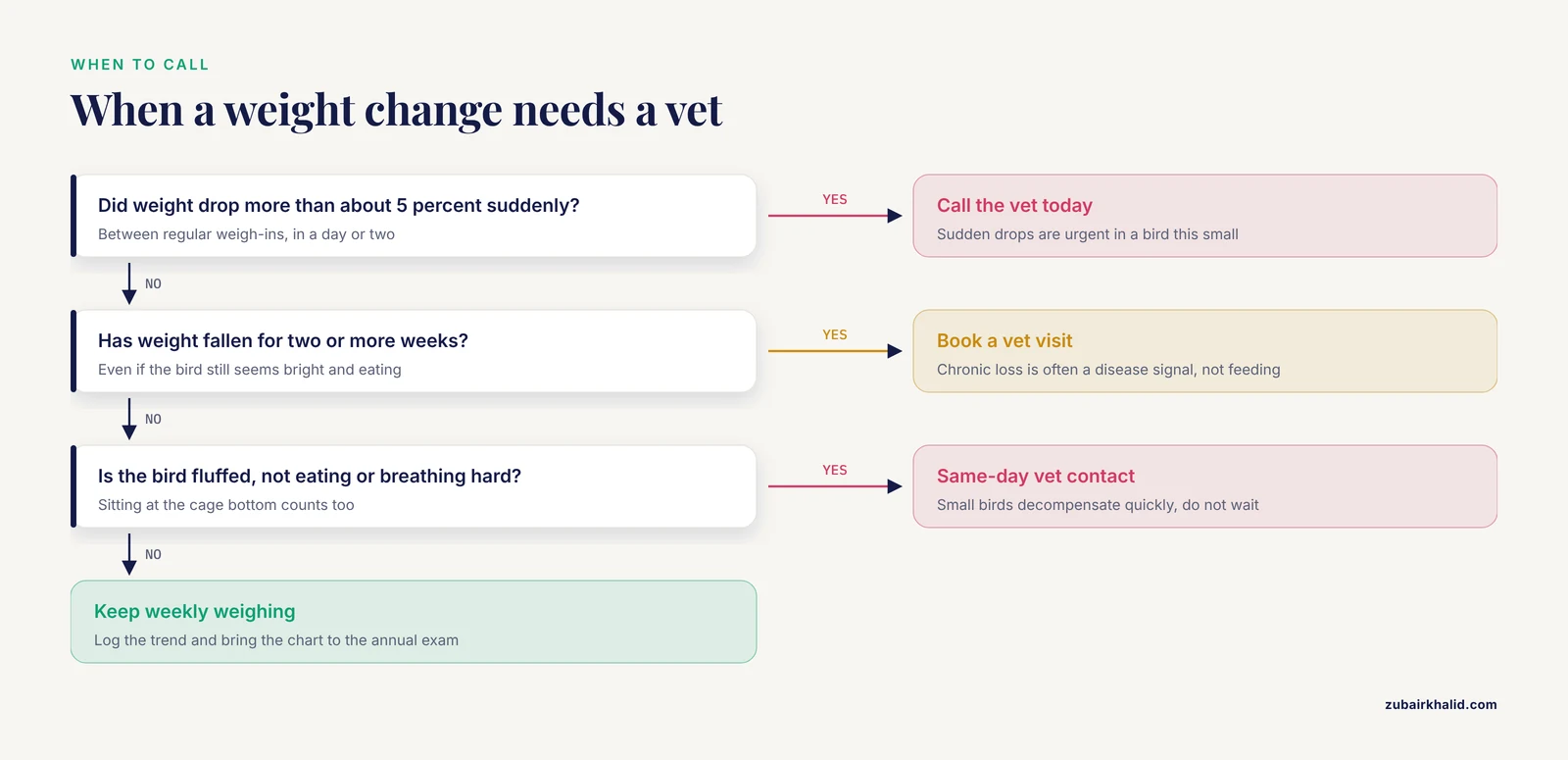
Contact an avian veterinarian promptly, meaning same-day to next-day, if you observe any of the following:
- A sudden weight drop of more than about 5 percent of body weight between regular weigh-ins.
- A confirmed weight loss trend across two or more weeks despite normal eating.
- A finch that stops eating entirely, even for a few hours, or that sits fluffed at the bottom of the cage.
- Labored breathing, tail bobbing at rest, or open-mouth breathing.
- A bulging furcular hollow or distended abdomen in a hen, which may indicate egg-related problems rather than simple fat.
- A weight-loss plan that produces lethargy, reduced droppings, or refusal of the new diet.
- Any bird you score as underconditioned (score 1), because unintentional weight loss in finches is more often a disease signal than a feeding volume problem.
For routine wellness, schedule at least an annual examination with an avian veterinarian, and bring your weight chart and your condition-score notes. The Merck Veterinary Manual's pet bird resources and VCA Animal Hospitals' avian care guides both emphasize routine wellness examinations as the backbone of preventive avian care, and home data make those exams far more useful.
Frequently Asked Questions
How much should a finch weigh?
Most small pet finch species fall in a broad range of roughly 10 to 30 grams as adults, with zebra finches commonly around 12 to 16 grams and society finches commonly around 16 to 25 grams. The number that actually matters is your own bird's stable baseline, so weigh regularly, record the trend, and have an avian veterinarian confirm what normal looks like for your individual bird.
How do I weigh a finch at home?
Use a digital scale that reads in 0.1 gram increments, place a small perch-equipped container on it, tare the scale, and let the bird step in or gently place it inside for less than a minute. Weigh at the same time each session, ideally before the morning feed, and log the date, weight, and notes on a simple chart.
What is a finch body condition score?
A finch body condition score is a hands-on assessment of fat and muscle using the keel ridge on the chest and the furcular hollow at the base of the neck. In a healthy finch the keel is palpable with muscle on either side and the furcular hollow feels flat, while fat fills the hollow and rounds the body contour. Research in zebra finches has validated condition and plumage scoring as reliable, non-invasive well-being tools for small songbirds.
Is my finch overweight?
A finch is likely overweight if the furcular hollow feels bulging rather than flat, the chest feels soft with padding over the keel, the body looks round when perched, and the scale weight has drifted upward from the bird's own baseline. Confirm the finding with an avian veterinarian, because a rounded body in a hen can also reflect reproductive conditions rather than fat.
How can I help my finch lose weight?
Help a finch lose weight by auditing the diet, replacing part of a seed-heavy ration with appropriate formulated diet and fresh foods, moving to measured portions instead of free-feeding, rationing high-fat treats like millet spray, increasing daily flight and foraging activity, and tracking weekly weights with veterinary supervision. Change should be gradual, and food should never simply be withheld.
How often should I weigh my finch?
For a healthy adult finch, weekly weigh-ins are usually sufficient to spot trends. Weigh daily only when actively managing a weight problem, recovering a bird under veterinary care, or monitoring a recent diet change, because normal daily gut-fill changes can otherwise create false alarms.
Can a finch lose weight too fast?
Yes. Finches have small energy reserves and rapid metabolisms, so aggressive food restriction can cause harm quickly. A safe plan produces slow, gradual change with the bird remaining bright, active, and eating throughout, and any rapid drop, lethargy, or reduced droppings is a signal to stop and call an avian veterinarian immediately.
Do male and female finches weigh different amounts?
In most commonly kept finch species the sexes weigh similar amounts, with males sometimes running slightly heavier, so sex does not change the core approach of tracking an individual baseline and scoring body condition. The hands-on furcular and keel assessment applies to both sexes, and in hens any change in body contour should be evaluated with egg-related possibilities in mind.
Further Reading
- Colour Cues That Are Not Directly Attached to the Body of Males Do Not Influence the Mate Choice of Zebra Finches.
- Evaluation of Best Practices for the Euthanasia of Zebra Finches (Taeniopygia guttata).