Finch Enrichment Ideas That Match Natural Behavior
By Dr. Zubair Khalid, DVM, MS, PhD ·
Good finch enrichment does three things at once. It gives your birds something to do with their beaks and feet, it lets them express the behaviors they would perform in the wild, and it changes often enough that the cage stays interesting without becoming stressful. The most effective finch enrichment ideas fall into five categories: foraging opportunities, bathing water, varied perching and flight space, safe nesting and shredding material, and appropriate social contact with other finches. Research on zebra finches, the species most pet finch advice is built around, shows that environmental enrichment improves welfare and that sudden, unfamiliar changes to a finch's environment can be stressful in their own right [1][2]. The goal is predictable novelty, not constant upheaval.
This article walks through what finch enrichment should look like, how to build it with simple materials, which toys suit finches and which do not, how to spot the signs of a bored finch, and when a problem needs a veterinarian rather than a new toy.
At a Glance: A Daily and Weekly Enrichment Checklist
| Task | Frequency | Why it works |
|---|---|---|
| Refresh a shallow bathing dish | Daily or several times weekly | Bathing is a strong natural behavior and a reliable activity |
| Hide seed in foraging items (paper cups, finger traps, millet sprigs tucked in cage mesh) | Daily | Foraging occupies finches the way ground and plant searching occupy wild birds |
| Rotate two or three toys, keeping most of the cage layout familiar | Every 1 to 2 weeks | Novelty without the stress of a wholly unfamiliar cage [2] |
| Provide fresh shreddable material (plain paper, dried grass, coconut fiber outside nesting season) | Weekly | Meets chewing and nest-building motivation safely |
| Offer supervised flight time in a bird-safe room or a large flight cage | Several times weekly | Finches are flight-first animals, not climbing parrots |
| Check perches, toys, and cords for wear | Weekly | Prevents entrapment and ingestion injuries |
| Score your birds' plumage and body condition at home | Monthly | A simple, validated way to track well-being over time [3] |
Why Enrichment Matters for Finches
Finches are small passerines with fast metabolisms and short attention cycles. In captivity, their day is compressed into a cage, a dish of seed, and whatever the household provides. Without structured enrichment, that environment asks almost nothing of them behaviorally.
The research case for enrichment is strongest in zebra finches, which are also among the most commonly kept pet finches. A dedicated study on enhancing the welfare of zebra finches through environmental enrichment established that enriching the captive environment is a legitimate welfare intervention for this species, not a cosmetic one [1]. Work on captive animal care more broadly supports the same principle across species, with one important addition: animals learn from each other. A review of social learning in captive animal management found that socially housed animals explore novel objects and foods more readily because companions reduce neophobia, and that they can pick up new behaviors by watching cage mates [4]. For finches, which are strongly flock oriented, that means an enriched cage plus a compatible companion produces more activity than either alone.
There is also a subtler lesson from the zebra finch literature. Familiarity itself has welfare value. In an analysis of singing rate as an indicator of positive welfare, researchers found that zebra finches isolated in an unfamiliar environment showed a marked drop in singing for several days, an acute stress response, while birds isolated in a familiar cage or separated from a companion in a familiar setting showed no such drop [2]. Singing in a male zebra finch is a good proxy for feeling secure. For a pet owner, this reframes enrichment, the aim is a familiar, well-mapped home territory that contains interesting things, rather than a home that is constantly rearranged.
Finally, environmental variability during development appears to shape behavior in lasting ways. In a large experiment with juvenile male zebra finches, birds raised under variable ambient temperatures were more likely to sing during recordings, and birds that experienced variable prenatal conditions showed higher song-learning accuracy, leading the authors to describe temperature variability as a form of environmental enrichment in its own right [5]. A home version of this idea is gentle, safe variation, perches at different heights, food presented in different places, and normal daily household temperature rhythm, rather than a sterile, unchanging box.
Natural Finch Behavior: The Template for Enrichment
Every enrichment decision should trace back to a behavior finches perform naturally:
- Flocking and social contact. Finches are companions of their own kind first. Adolescent social experience shapes adult behavior in zebra finches, with early social environment influencing later behavioral patterns and social competence [6].
- Foraging. Wild finches spend a large share of their day searching, handling, and husking seed. A dish of hulled seed eliminates nearly all of that work in seconds.
- Bathing. Passerines bathe vigorously and frequently when water is offered.
- Singing and vocal interaction. Male zebra finches sing to establish and maintain social bonds, and song output is used by researchers as an indicator of positive welfare state [2].
- Nest building and shredding. Even pairs not intended for breeding retain the motivation to gather material and work it into structure.
- Short, fast flights. Finches navigate horizontally and vertically in bursts, unlike parrots, which climb and chew more.
Signs of a Bored Finch
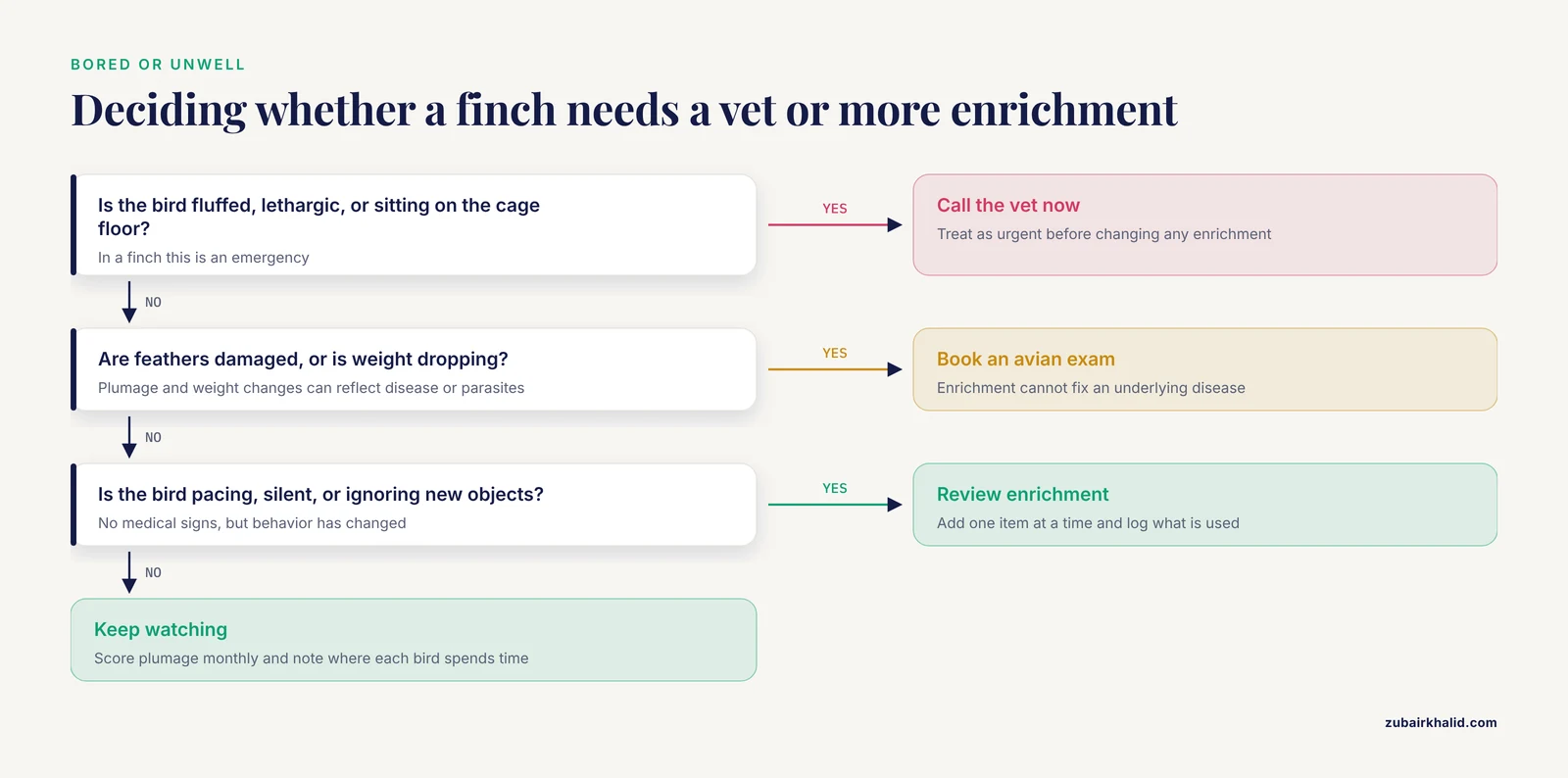
Owners usually ask how to keep a finch entertained after noticing something is off. Watch for these patterns:
- Repetitive pacing or route flying along the same flight path, the same corners, at the same times.
- Feather damage that is not medical. Poor plumage condition is one of the most practical at-home welfare indicators in small songbirds. A validated plumage scoring system for zebra finches showed substantial reliability between different observers, meaning an attentive owner can track plumage changes meaningfully over time [3]. A finch whose feathers become unkempt, dull, or damaged while eating normally deserves both a veterinary check and an enrichment review.
- Loss of interest in the environment. A bird that ignores new objects, never visits the bath, and does not respond to household activity.
- Silence from a normally vocal bird. Song suppression in zebra finches is documented as a response to acute stressors, including unfamiliar environments [2]. A quiet bird that is otherwise healthy may simply have nothing worth singing about.
- Excessive sleeping or fluffed posture during the day. This can also signal illness, so treat it as a reason to call your avian veterinarian, not just a boredom sign.
- Stereotyped behaviors, such as constant head bobbing at one spot or chewing obsessively at a single cage bar.
None of these signs is diagnostic on its own. Feather-destructive behavior, weight loss, and lethargy require a veterinary exam first, because enrichment cannot fix an underlying disease.
The Best Toys for Finches (and Why Parrot Toys Fail Them)
Finches are not small parrots, and the best toys for finches reflect that. They have delicate beaks built for husking small seed, not for cracking hardwood or working stainless steel bolts. When you evaluate a toy, use these criteria:
- Lightweight and movable. Finches interact with things they can push, swing, and flutter past. A toy that reacts to their movement gets more use than one they can demolish.
- Soft or shreddable, not hard chewables. Untreated pine slats, balsa, palm leaf, dried grass, and paper suit finch beaks. Hard acrylic and thick leather knots belong in parrot cages.
- No small entrapment gaps. Open rings, loose bells with clappers, and fraying ropes trap finch legs and toes. A bell with a accessible clapper is a recognized toe-trap hazard in small birds.
- Nothing fibrous that can tangle. Loose thread, fine sisal, and hair-like fibers can wrap around a toe or be swallowed.
- sized for the bird. Anything a finch can fit its head into but not back out of is a hazard.
Good finch toy categories include:
- Swings and bouncing perches that respond to body movement.
- Shreddables, small palm or balsa pieces, paper finger traps, safe dried grass bundles.
- Foraging devices, seed balls, millet holders, and small cups with paper covering the contents.
- Bathing accessories, from a simple dish to enclosed bath houses that contain the splash.
- Visual enrichment, such as safe foliage placed outside the cage at perch height.
Check any commercial toy against these criteria before purchase, and inspect weekly for wear. The Association of Avian Veterinarians and the Merck Veterinary Manual both emphasize safe, appropriately sized cage furniture for pet birds as part of routine preventive care, and a bird-savvy avian veterinarian can help you vet specific items during a wellness visit.
DIY Finch Enrichment: A Step-by-Step Method
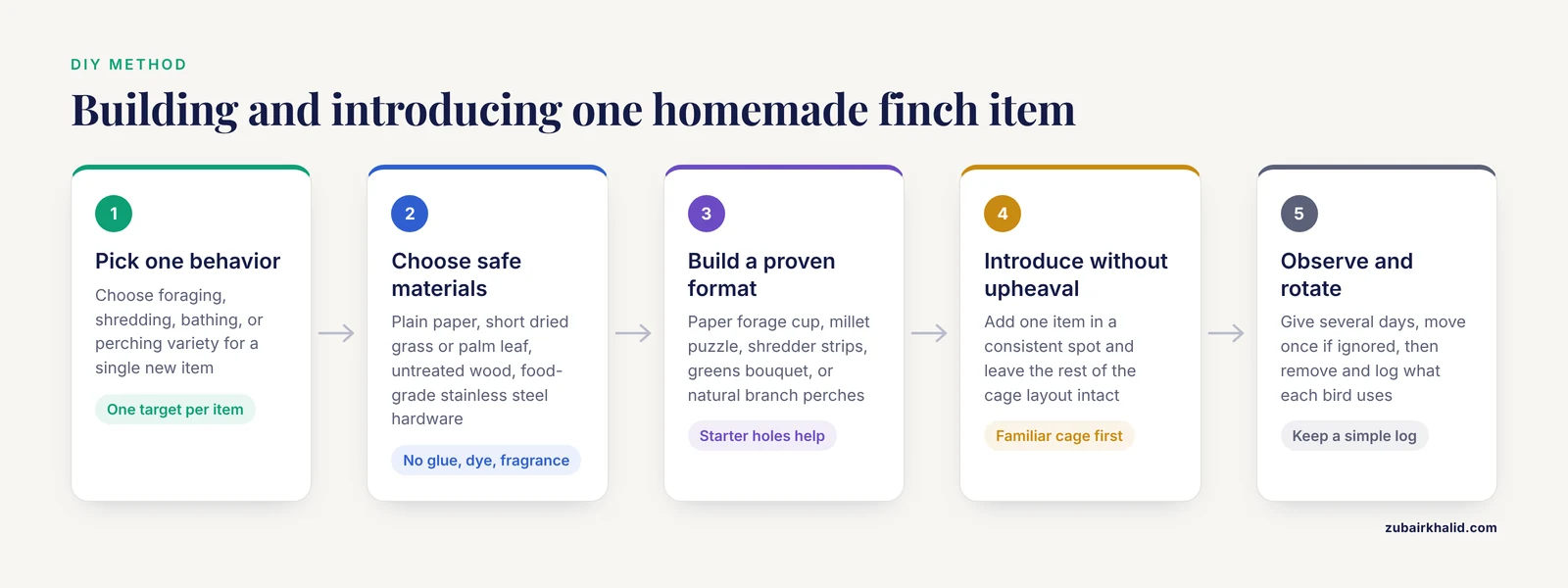
Homemade enrichment is where finch owners get the most value, because finches respond to simple materials. This method covers building, introducing, and retiring a DIY item safely.
Step 1: Pick one natural behavior to target
Choose foraging, shredding, bathing, or perching variety. One target behavior per new item keeps the cage from becoming cluttered and makes it easy to tell whether the bird actually uses the item.
Step 2: Choose safe materials
Use plain, unprinted or soy-ink paper, undyed natural fibers such as dried grass or palm leaf in short lengths, food-grade stainless steel hardware for attachment, and untreated wood. Avoid anything with glue, dye, fragrance, or metal coatings, and avoid long fibrous strands entirely.
Step 3: Build one of these proven formats
- Paper forage cups. Fill a small paper cup with a teaspoon of seed mix, fold the top closed, clip it to the cage mesh, and poke two or three starter holes so the finch discovers the contents.
- Millet puzzles. Push a spray of millet through the bars at an angle so the birds must work at it from an odd position, or wedge it into a stainless steel skewer at perch height.
- Shredder strips. Weave short strips of plain paper through the cage bars near a favorite perch. Finches pull, carry, and rearrange them.
- Herb and greens bouquet. Wet leafy greens clipped to the bars double as food, foraging, and bath material. Introduce any new food gradually and confirm it is safe for your species with your veterinarian or an avian nutrition resource such as Lafeber Company's owner guides.
- Perch variety from natural branches. Cleaned, nontoxic branches of varying diameter, positioned so birds fly between them rather than hop, exercise the feet and the flight muscles at once. Ask your avian veterinarian for a list of safe local wood species, since some common trees are toxic.
Step 4: Introduce items without destabilizing the cage
Remember the finding that unfamiliar environments suppress singing and behavior in zebra finches while familiar settings do not [2]. Add one new item at a time, in a consistent location, and leave the overall layout intact. Many finches will watch a bolder cage mate approach a new object before trying it themselves, a socially facilitated pattern that captive-animal welfare reviews describe as a deliberate tool for enrichment success [4].
Step 5: Observe and rotate
Give each item several days. If it is ignored, change its location once. If it is still ignored, remove it and try a different format. Keep a simple log of what each bird uses. Over a few weeks you will learn each bird's preferences, and that knowledge is itself enrichment, because you can rotate the proven winners.
Social Enrichment: The Category Owners Skip
For finches, the single most powerful enrichment is another finch. Zebra finches are colonial, socially bonded birds, and their welfare framework in research settings assumes compatible social housing. Adolescence is a sensitive window, with social influences during that period shaping adult behavior and social function in zebra finches [6].
Practical implications:
- Keep finches in same-species pairs or small groups unless a veterinarian advises otherwise for medical reasons. Hand-raised imprinting on humans does not replace finch companionship.
- Introduce new birds carefully and watch for persistent aggression. Chasing that prevents feeding or access to perches is not enrichment.
- Do not house finches with hookbills or other species that may injure them, even in a large mixed aviary, without expert guidance.
- Your own interaction counts as social enrichment too. Talking, whistling, and routine-structured time near the cage all matter, and research on captive animal care shows that predictable positive human interaction improves welfare outcomes [4].
Sensory Enrichment: Color, Sound, and Climate
Finches perceive their environment in ways owners often overlook, and some of those channels are documented in the research.
Color. Mate-choice experiments in zebra finches found that female choice could be swayed by red color cues in the environmental background in an initial experiment, although follow-up experiments failed to replicate effects on choice or male behavior [7]. The safe takeaway is modest: environmental color is not meaningless to finches, and offering varied visual backgrounds, such as different natural perching sights, window views, and foliage, adds sensory variety without risk. Do not expect red cage accessories to transform behavior.
Sound. Song is central to zebra finch social life. Consistent household sound, soft radio, conversation, and other birds at appropriate volume, provides auditory texture. Sudden loud noise, by contrast, is a stressor.
Temperature variation, safely bounded. The developmental study showing that variable ambient temperatures promoted song learning and production also makes clear that this was a controlled experimental variable, not a recommendation for household temperature swings [5]. Keep your finches in the stable, draft-free temperature range your avian veterinarian recommends. The enrichment lesson is about predictable daily rhythm and varied microenvironments within the safe range, for example a warmer perch zone and a cooler one, never about letting room temperature fluctuate widely. Chronic cool exposure in zebra finches drives measurable physiological changes, including increased metabolic rate and pectoral muscle mass, showing that temperature is a powerful physiological variable for this species, not a plaything [8].
Nesting and Reproductive Enrichment, With a Caution
Finches retain strong nest-building and egg-laying drives. Providing nesting material can be excellent enrichment, and reproductive behavior in birds is regulated by interactions between hormones and environmental cues, a relationship long recognized in avian endocrine research [9]. That same science is the reason for caution. For pairs you do not intend to breed, sustained nesting cues and long daylight exposure can trigger repeated clutches, which deplete hens and carry real health risk.
A middle path many avian veterinarians recommend for non-breeding pairs:
- Offer shreddable material year round but avoid full nest boxes outside of planned breeding.
- Restrict material quantities so birds can perform gathering and weaving behavior without completing a clutch-ready nest.
- Discuss photoperiod, the number of light hours per day, with your avian veterinarian if your hen lays repeatedly, since day length is one of the environmental cues that drives the reproductive axis [9].
Common Mistakes in Finch Enrichment
- Overcrowding the cage. Enrichment items must never block flight paths. Finches need horizontal flight distance more than they need objects.
- Rotating everything at once. Wholesale rearrangement mimics an unfamiliar environment, the exact condition shown to suppress behavior and singing in zebra finches [2]. Change one thing at a time.
- Using parrot toys. Heavy, hard, or rope-based parrot items injure finches.
- Treating food dishes as the only foraging site. Scatter small amounts of seed across clean foraging surfaces or into multiple cups instead.
- Skipping the bath. Water is one of the highest-value, lowest-cost enrichment items for finches, and its absence is a missed opportunity.
- Assuming a single finch is fine with attention alone. Human interaction cannot substitute for conspecific company in a flock species, and social learning research shows companions actively help animals engage with novelty [4].
- Ignoring gender dynamics. Two males or two females may coexist or may not, depending on species and individuals. Ask your avian veterinarian or an experienced breeder before buying.
- Reading boredom as a toy problem when it is a medical problem. A fluffed, lethargic, or feather-damaging bird needs an exam.
Monitoring Whether Enrichment Is Working
Give your program two measurable indicators.
Plumage condition. The plumage scoring approach validated for zebra finches is simple enough for owners to approximate, smooth, well-preened feathers in good alignment, versus rough, damaged, or poorly maintained plumage [3]. Photograph each bird monthly under the same light and compare. Improving plumage over weeks suggests the environment is working.
Activity distribution. Note where each bird spends time. A well-enriched cage shows birds using multiple perches, the bath, foraging items, and different heights throughout the day. A cage where both birds sit on one perch all day, every day, tells you the enrichment has failed regardless of how much is in there.
Weight trends matter too. Because temperature and diet interact with body mass and metabolism in zebra finches over chronic time frames [8], any unexplained weight change alongside enrichment changes is a reason to call your veterinarian rather than adjust toys.
Limitations and When to Contact a Veterinarian
Most of the controlled research cited here involves zebra finches. Other commonly kept finch species, such as society finches, Gouldian finches, and canary-finches, differ in social structure, dietary needs, and activity patterns, so treat this article as a framework and confirm species specifics with an avian veterinarian. Individual cases always need professional assessment, and no enrichment plan replaces medical care.
Contact an avian veterinarian promptly if you see any of the following:
- Feather loss, over-preening, or feather-destructive behavior, which can reflect disease, parasites, or hormonal problems as easily as boredom.
- A bird sitting fluffed and lethargic on the cage floor. In a finch, this is an emergency.
- Changes in droppings, appetite, or water intake lasting more than a day.
- Any injury from a toy or cage feature, including a toe caught in a ring or bell.
- Repeated egg laying in a hen, which risks calcium depletion and egg binding.
- Sudden stopping of singing or vocalizing combined with any other change.
- Weight loss confirmed on a gram scale, since small birds decompensate quickly.
The Association of Avian Veterinarians maintains a directory of members, and establishing care with an avian vet before problems arise is one of the highest-value preventive steps a finch owner can take. The AVMA's pet owner resources and the Merck Veterinary Manual's pet bird sections provide reliable baseline husbandry guidance that complements your veterinarian's advice.
This article is educational and is not a substitute for veterinary diagnosis or treatment.
Frequently Asked Questions
How do I keep a finch entertained while I am at work?
Set up foraging items, a fresh bath, and shreddables before you leave, and keep a compatible finch companion with your bird. Finches entertain each other, and distributed food-finding tasks fill the daylight hours you are away. Leave the overall cage layout unchanged so the environment stays familiar and secure.
What are the best toys for finches?
The best toys are lightweight, movable, and soft, such as swings, shreddable palm and balsa pieces, paper forage cups, and millet holders. Avoid heavy parrot chew toys, open rings, loose bells, and long fibrous ropes, all of which can injure a small finch. Rotate a few items at a time rather than filling the cage.
What are the signs of a bored finch?
Look for repetitive pacing or route flying, ignoring new objects, unkempt or damaged plumage, reduced vocalizing from a normally vocal bird, and excessive daytime sleeping. Because several of these signs overlap with illness, a veterinary exam should come before a toy shopping trip when plumage, weight, or activity change suddenly.
Do finches need a companion or is human attention enough?
Finches need companions of their own kind. They are flock animals whose social experience, beginning in adolescence, shapes their adult behavior, and socially housed birds engage more readily with novelty and enrichment. Human attention is a valuable supplement but cannot replace conspecific company.
How often should I change my finch's toys?
Introduce or swap one item every one to two weeks and keep the cage layout stable. Finches respond to predictable novelty, and wholesale rearrangement can suppress their activity and vocalizing. Retire items that are ignored after a location change and keep rotating the proven favorites.
Are mirrors good for finches?
Mirrors are a reasonable option for a single finch because they provide visual and social stimulation, but they are not a substitute for a live companion and some birds may direct courtship or aggression at the reflection. Watch your bird's response and remove the mirror if it causes persistent agitation. Ask your avian veterinarian about your specific setup.
What household materials are safe for DIY finch enrichment?
Safe choices include plain unprinted paper, food-grade paper cups, untreated pine or balsa, dried grass and palm leaf in short lengths, and stainless steel attachment hardware. Avoid dyed, glued, scented, or metallic-coated items, and avoid any long fiber that can wrap a toe or be swallowed. Inspect every homemade item weekly.
Do finches need baths?
Yes. Bathing is a core natural behavior for finches and one of the most reliable enrichment activities you can offer. Provide a shallow dish of clean water or an enclosed bath house several times a week or daily, remove it before the water soaks droppings, and expect vigorous splashing, especially on warm days.
Sources
- Enhancing the welfare of zebra finches through the use of environmental enrichment
- Familiarity of an environment prevents song suppression in isolated zebra finches
- Plumage and Fat Condition Scores as Well-Being Assessment Indicators in a Small Passerine Bird, the Zebra Finch (Taeniopygia guttata).
- Leveraging Social Learning to Enhance Captive Animal Care and Welfare
- Variable ambient temperature promotes song learning and production in zebra finches
- Social Influences during Adolescence on Adult Behaviour in Zebra Finches (Taeniopygia guttata) - Underlying Mechanisms and Functional Consequences
- Colour Cues That Are Not Directly Attached to the Body of Males Do Not Influence the Mate Choice of Zebra Finches.
- Interactive Effects of Temperature Acclimation and Dietary Fatty Acids on Metabolic Rate and Body Composition of Zebra Finches (Taeniopygia guttata)
- Symposium: Neurohumoral and Environmental Interactions Determining Avian Reproductive Behavior Introduction