Conure-Proofing Your Home: Hazards and a Safe Setup
By Dr. Zubair Khalid, DVM, MS, PhD ·
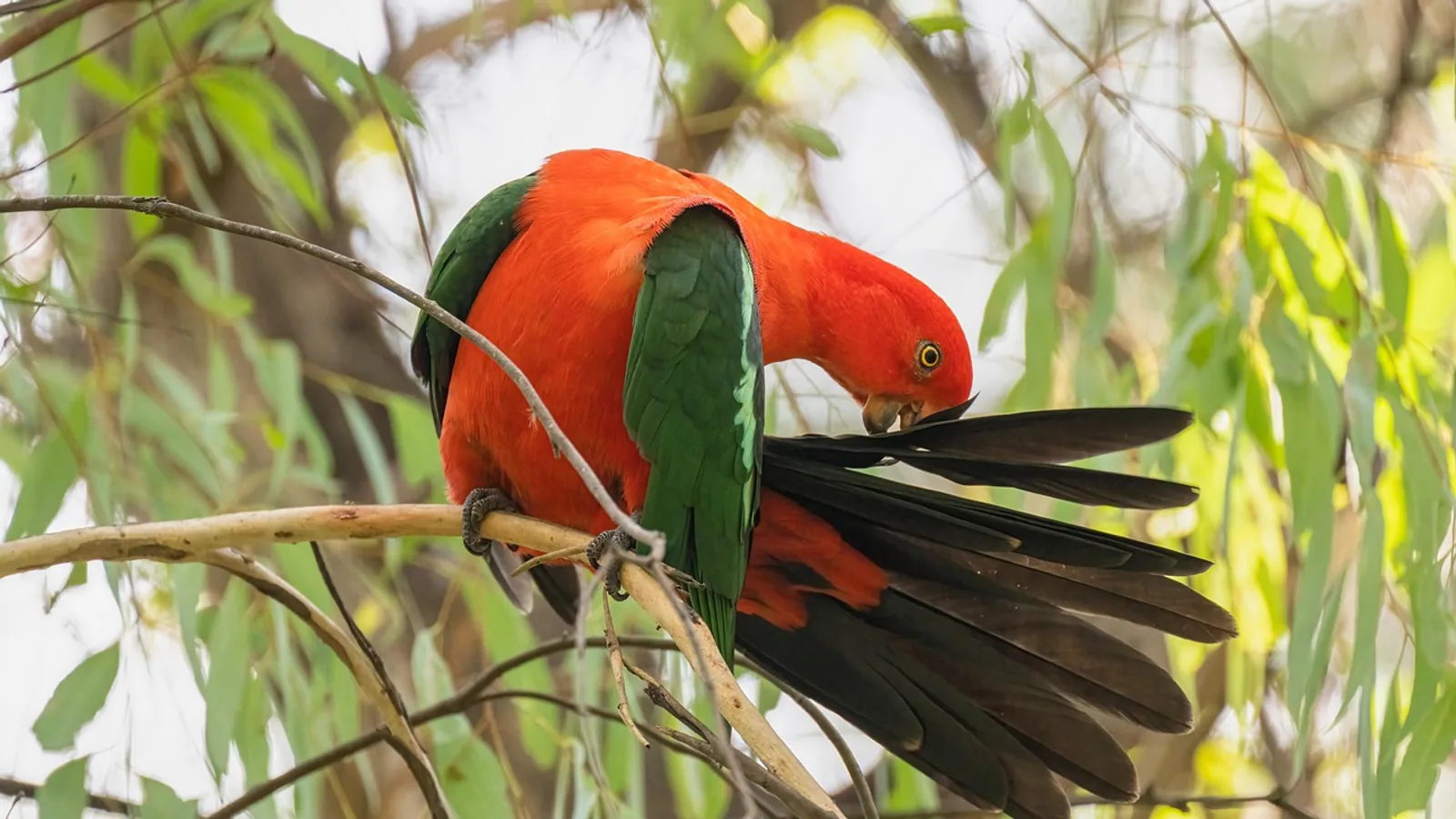
Conure proofing your home means controlling three hazard groups before your bird's first flight: the air it breathes, the objects it can chew, and the traps that can catch it in seconds. Conures explore with their beaks, launch before they look, and carry a respiratory system so efficient that fumes which barely register to people can kill a bird within minutes. The Merck Veterinary Manual lists fumes from overheated nonstick cookware and other common household sources among the most serious poisoning risks for pet birds.
The work is manageable in a weekend. Choose one room, walk it at bird height, remove or lock up the toxic household items for conures, neutralize physical traps, then build a supervised free roam area with perches, foraging toys, and written house rules. This guide covers each hazard in order, a room-by-room method, and the points where an avian veterinarian replaces the hardware store.
This article is educational and is not a substitute for veterinary diagnosis or treatment.
At a Glance: Conure-Proofing Checklist
| Hazard | Why it threatens a conure | Do this today |
|---|---|---|
| Overheated nonstick cookware and appliances | PTFE fumes can cause fatal respiratory damage within minutes | Keep the bird in a distant, closed room whenever the stove, oven, air fryer, or iron heats up |
| Aerosol sprays, scented candles, plug-ins, essential oil diffusers | A bird's lungs concentrate airborne chemicals | Ban all sprays and scented products from the bird's airspace |
| Lead and zinc sources (old paint, galvanized wire, foil, solder, costume jewelry) | Chewing causes heavy metal toxicosis | Remove, cover, or replace anything chewable that contains metal or old paint |
| Avocado, chocolate, caffeine, alcohol, salty food, fruit seeds and pits | Common foods poison birds | Keep plates, mugs, and snack bowls out of beak range |
| Toxic houseplants | Many common species harm birds that chew them | Move plants out of the free roam area and verify every species |
| Ceiling fans, open windows and doors | Impact injuries and escape | Fans stay off and windows stay shut whenever the bird is out |
| Electrical cords | Chewing causes burns and electrocution | Cover, hide, or unplug every reachable cord |
| Open water and heat (toilets, sinks, pots, hot drinks) | Drowning and burns happen silently and fast | Close lids, close the bathroom door, keep drinks up high |
| Cats and dogs | Even a pinprick bite can turn fatal | Never share a space unsupervised |
| Recliners, rocking chairs, blankets, cushions | Birds get crushed where nobody thinks to look | Check before you sit, no under-blanket cuddles |
Five actions you can take today:
- Walk the room where your conure will spend time, at knee height and at eye level, and list every cord, plant, spray can, and metal object you find.
- Move every aerosol and scented product out of that room.
- Close the toilet lid and make the closed bathroom door a household rule.
- Unplug or cover every cord the bird can reach.
- Find an avian veterinarian near you and save the clinic's number in your phone before you need it.
Why Conures Need Stricter Proofing Than Dogs or Cats
A respiratory system built for flight, not for living rooms
Birds move air through their lungs in one direction using a system of air sacs, which makes gas exchange far more efficient than in mammals. The same efficiency pulls airborne toxins deep into lung tissue fast, and a conure's small body means a tiny inhaled dose has outsized effects. VCA Animal Hospitals' avian care guides warn that inhaled fumes are among the fastest-moving emergencies in pet birds, and the Merck Veterinary Manual notes that fumes from overheated nonstick cookware can kill a bird with little warning.
A beak that tests everything
Conures use their beaks the way toddlers use their hands. Lafeber Company's conure care resources describe them as playful, intensely social birds that chew constantly, both to explore and to keep their beaks in working condition. Anything within reach gets gripped, tasted, and dismantled, and young or newly rehomed birds tend to test the most because everything is new. Species personalities vary, sun conures and their Aratinga relatives are famously loud while green-cheeked conures are quieter, but every conure shares the same proofing needs.
A flock member who follows you into danger
Conures bond hard and follow their people, which leads them straight into the two most dangerous rooms in a home, the kitchen and the bathroom. As prey animals they also hide illness until disease is advanced, so prevention and an established veterinary relationship matter more than any treatment. The Association of Avian Veterinarians recommends wellness examinations for pet birds and encourages owners to identify an avian clinic before an emergency happens.
Wings that work even when nobody thinks they do
Treat every conure as capable of sudden, panicked flight. A bird that has not flown in months still launches when startled, and a startled bird picks the fastest exit, not the safest one.
The Main Household Dangers for Conures
Every proofing plan handles three categories: what the bird breathes, what it eats or chews, and what can trap or strike it. Work in that order, because airborne hazards kill fastest.
Airborne Dangers: Fumes Reach Your Bird Before They Reach You
The most notorious hazard is polytetrafluoroethylene (PTFE), the nonstick coating on many pans, air fryers, toaster ovens, irons, hair dryers, space heaters, and stovetop drip pans. Overheated PTFE releases odorless fumes that cause rapid, often fatal respiratory damage in birds. VCA Animal Hospitals warns that overheated nonstick coatings can kill pet birds quickly and places self-cleaning oven cycles on the same list. The Merck Veterinary Manual identifies nonstick cookware fumes as one of the most serious household poisoning risks for pet birds.
Treat every spray and scent as a hazard too. Aerosol hairsprays, deodorants, cleaning sprays, furniture polish, and bug foggers put droplets into air your bird filters constantly. Scented candles, incense, plug-in fresheners, and essential oil diffusers release compounds that a bird's respiratory system concentrates rather than ignores. Natural does not mean bird-safe. Cigarette smoke, vapor, and wood smoke all belong outside the bird's airspace, and burned food on a stovetop counts as a smoke event, not a nuisance.
Add carbon monoxide to the list. A working CO detector protects your bird along with your family, and a gas leak you barely notice can sicken a bird first.
A workable rule: if it sprays, smokes, plugs in to smell, or heats a coated surface, it stays out of the bird's airspace. For any cleaning project, painting, or renovation, move the bird to a distant closed room and ventilate the work area for hours afterward, not minutes.
Toxic Household Items for Conures: Chewables, Foods, and Plants
Heavy metals. Conures chew metal the way they chew wood, and two metals cause most poisonings. Lead hides in paint from older homes, especially on baseboards, window frames, and trim, and in curtain weights, fishing gear, solder, foil seals, stained glass, costume jewelry, and some toy hardware. Zinc comes from galvanized wire and hardware on older or homemade cages, plus some chains, quick links, and bell clappers. The Merck Veterinary Manual describes heavy metal toxicosis in pet birds as a chewing-related poisoning with signs such as vomiting, diarrhea, weakness, and seizures, treated with veterinary chelation therapy. VCA Animal Hospitals gives matching advice, remove the source and get the bird treated fast. Inspect every cage, toy, and play stand for galvanized parts, loose clips, and painted or rusty metal, and replace suspect hardware with stainless steel.
Human foods. Several everyday foods poison birds. Keep avocado, chocolate, caffeine in any form, alcohol, heavily salted foods, and fruit seeds and pits out of beak range. Lafeber Company's nutrition resources group these among the foods that should never be shared with pet birds, and VCA Animal Hospitals' feeding guidance says the same, human plates, coffee mugs, and snack bowls stay away from the bird. A conure on your shoulder at dinner is one head-dip away from trouble.
Houseplants. Verify every plant in the home. Common species such as philodendron, pothos, dieffenbachia, ivy, amaryllis, azalea, and oleander can harm birds that chew leaves, stems, or soil, and fertilizers or pesticides on treated plants add risk. The Association of Avian Veterinarians maintains client education on toxic plants and recommends confirming each plant before the bird arrives. Hanging plants are not automatically safe, a flighted conure reaches them.
Cleaning and chemical products. Store cleaners, pesticides, rodenticides, ant baits, mothballs, oven cleaners, and drain openers behind locked doors, and never use them in the bird's room while the bird is present. VCA Animal Hospitals recommends moving birds out of the area for cleaning projects and letting the air clear completely before they return. Rinse surfaces and ventilate well.
Physical Hazards: Traps That Injure in Seconds
Airborne and swallowed hazards get the headlines, but ordinary objects cause most injuries.
Ceiling fans and windows. The fan stays off, not on low, whenever the conure is out. Windows stay closed unless a secure screen is in place, and curtains or window decals help a flying bird see glass it would otherwise hit. Treat mirrors the same way.
Doors. A closing door breaks wings and toes, and an open exterior door is an escape route. Set a rule that everyone announces themselves and checks the floor before opening anything.
Cords and outlets. Conures strip insulation in seconds. Cover, hide, or unplug every reachable cord, and block access behind entertainment centers and desks.
Water and heat. Closed toilet lids, closed bathroom doors, no open sinks or tubs, covered fish tanks, and no hot drinks or pots at bird level. A conure can drown in a toilet or a water glass, and a stovetop burn happens faster than you can cross the kitchen.
Other pets. Cats and dogs are the most serious physical hazard in many homes. A cat's bite, even a pinprick puncture, can seed a fatal infection, and a dog can crush a conure in a friendly shake. VCA Animal Hospitals' avian guides treat any dog or cat contact as a same-day veterinary event, because birds hide injuries until they are severe.
Furniture traps. Recliner footrests, rocking chairs, sofa cushions, folded blankets, laundry piles, washers and dryers, drawers, and the gap beside the refrigerator all catch birds. Check before you sit, close, or fold.
How to Conure Proof a Room, Step by Step
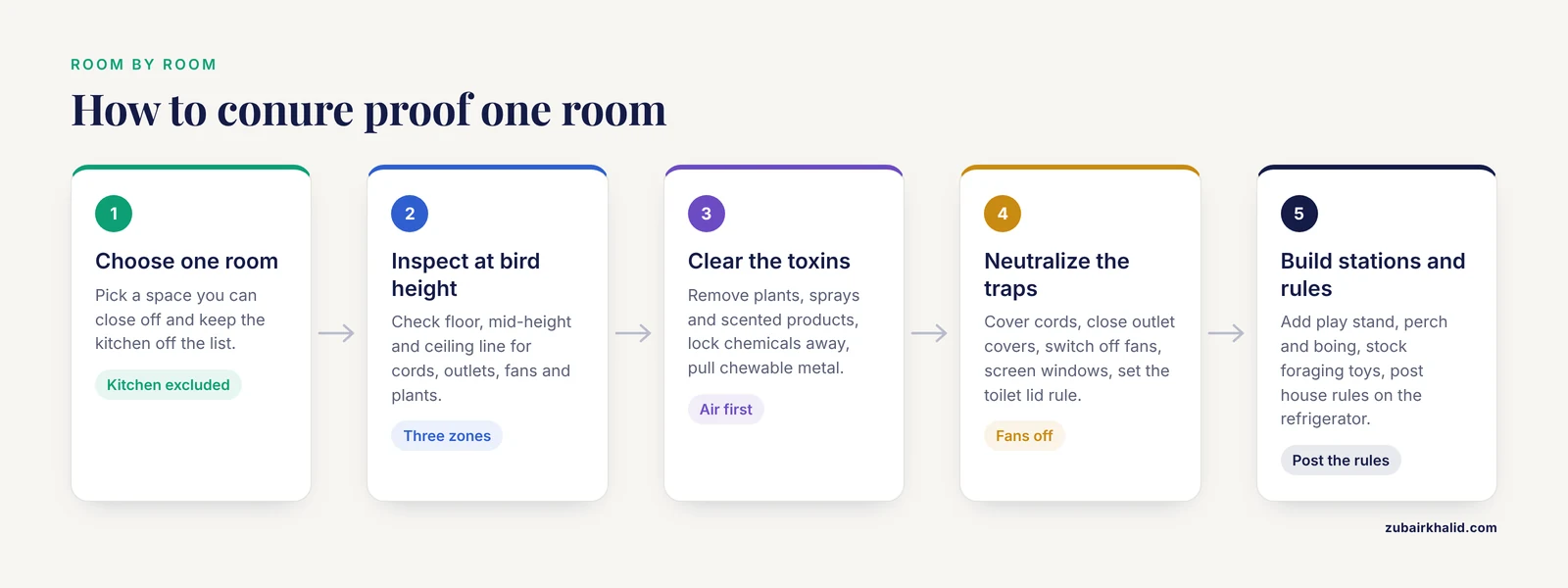
Conure proofing one room well beats proofing the whole house badly. Start with the room where your bird will spend out-of-cage time, then expand.
Step 1: Choose the room. Pick a space you can close off, and keep the kitchen off the list. Kitchens combine fumes, heat, water, and traffic. A family room or dedicated bird room works if you control what enters it. Hard flooring cleans up after foraging messes more easily than deep carpet.
Step 2: Inspect at bird height. Kneel to floor level, then stand and look up. You are checking three zones: the floor (cords, gaps behind furniture, dropped objects), mid-height (outlets, table edges, plant stands), and the ceiling line (fans, curtain rods, cabinet tops, light fixtures). A conure will visit all three.
Step 3: Clear the toxins. Remove plants, move aerosols and scented products out entirely, lock chemicals in another space, and pull any metal objects a beak could dismantle. In an older home, cover or block chewable baseboards and window trim until you have discussed lead paint with your avian veterinarian.
Step 4: Neutralize the traps. Cover or unplug cords, close outlet covers, switch off the ceiling fan, close and screen the windows, set the toilet lid rule, and decide what happens at every door. Every trap you remove now is one you never react to later.
Step 5: Build the stations. Set up a play stand, a table-top perch, and a rope or boing between them. Place stations away from doors, windows, drafts, and the kitchen side of the house. Give the bird better options than the forbidden spots it would otherwise pick.
Step 6: Stock the enrichment. Add foraging toys, shreddable wood and paper items, and chew toys sized for a conure's beak. Lafeber Company's care resources describe foraging and chewing as core daily behaviors for parrots, not optional extras.
Step 7: Write the house rules. Post them on the refrigerator: fans off, doors announced, no sprays or candles, drinks up high, no other pets in the room, check before sitting. Rules fail when they live in one person's head.
Step 8: Re-inspect monthly and after every change. New furniture, holiday decorations, gifts, a new cage, or a guest's handbag all introduce hazards. A five-minute walk-through keeps the room safe as the household changes.
Building a Safe Free Roam Area for Conures
A safe free roam area for conures is a bounded, fully proofed space where your bird spends supervised time outside the cage every day. The key word is bounded. One excellent room beats a whole house full of exceptions, and daily out-of-cage time is what lets a conure exercise, forage, and be part of the flock.
Set Boundaries Before You Expand Them
Start with a single closed room. Baby gates do not contain a flying bird, and half-proofed space is where accidents happen. Once the room holds up to weeks of daily use, expand to a second proofed room or a hallway, one hazard at a time. Keep the kitchen off the map permanently.
Stations, Enrichment, and Daily Routine
Birds seek the highest available perch, so provide one you have chosen. A play stand positioned away from windows and doors becomes the default landing spot instead of the curtain rod. Add a second station near where the family sits, because conures want to be in the middle of the flock.
Fill the space with jobs. Foraging toys, shreddable palm and wood pieces, plain paper, and cardboard turn free time into work time. Rotate toys weekly so the space stays interesting. Structure the routine as out-of-cage time followed by a calm return to the cage. Frequent short sessions work better than rare marathon ones and build the return habit before you need it in an emergency.
The Cage and Sleep Area
The cage anchors the whole setup. Place it in the social heart of the home but out of kitchen fume range, away from drafts, direct sun, heat vents, and anything under a ceiling fan. The Merck Veterinary Manual's housing guidance for pet birds stresses matching the cage to the species, with bar spacing narrow enough that the head cannot wedge between bars. Check used and inherited cages for galvanized wire and old paint, the heavy metal sources described earlier.
Inside the cage, use natural-wood perches of varied diameters, skip sandpaper perch covers, keep easy-to-clean bowls away from perch drop zones, and line the tray with plain paper changed daily.
Sleep matters as much as space. Conures do best with a long, uninterrupted dark and quiet period each night, in a covered cage or a separate sleep cage in a quiet room. VCA Animal Hospitals notes that consistent sleep supports behavior and health in pet birds.
Flight, Recall, and Escape Prevention
Decide deliberately how your conure will move through the space. The Association of Avian Veterinarians treats wing trimming as an individual decision to make with your avian veterinarian, weighing the bird's safety, home environment, and quality of life. A flighted conure needs stricter window discipline, secured screens, visible glass cues, and a trained recall. A trimmed conure still glides, so nearly all the same rules apply.
Teach a recall cue with a high-value treat while the bird is calm, and practice before an emergency makes it urgent. For escape prevention, keep exterior doors announced and closed, fit secure screens, and keep a recent photo of your conure on your phone.
Common Mistakes That Undo Good Proofing
- Proofing only the cage area. The bird flies through the whole room, so the whole room is the hazard zone.
- Trusting a bird that never flies. Startled conures launch, and out-of-practice flyers land badly.
- Cooking with the bird nearby. The stove, oven, self-clean cycle, and air fryer all generate fumes. The bird stays in a distant closed room whenever any of them runs.
- Assuming natural means safe. Essential oils, beeswax candles, and plant-based cleaners can still injure a bird's respiratory system.
- Cuddling in crush zones. Under-blanket snuggles, shoulder rides near doors, and naps on recliners put a conure exactly where crushing happens. Cuddle on a perch or play stand instead.
- Skipping the hardware check. New and secondhand cages and cheap toys can arrive with galvanized parts, loose clips, or frayed rope. Inspect everything before it enters the cage.
- Letting the dog or cat visit. There is no safe version of a predator greeting a prey animal. Separate spaces, always.
- Waiting for symptoms after an exposure. Birds hide illness until disease is advanced. Call the avian veterinarian at the moment of exposure, not after the bird looks sick.
Troubleshooting Stubborn Problems
My conure keeps landing on the curtain rod. Birds pick the highest point in the room. Provide a taller, better station and reward every landing on it, and the curtain rod loses its appeal.
My conure chews the baseboards. Block access first, then redirect to chew toys. In older homes, paint can contain lead, so mention the habit to your avian veterinarian and keep the bird away from chewable trim until you have a plan.
My conure screams when the family leaves the room. Contact calls are normal flock behavior in conures. Reward quiet moments, keep sessions predictable, and end on a calm return to the cage rather than mid-scream.
My conure will not go back in the cage. Make the cage the best place in the room, feed meals and favorite treats there, and never chase or grab the bird as punishment. Station training turns the return route into a game.
New hazards keep appearing. Run the five-minute walk-through monthly, and add a holiday and guest checklist. Candles, ribbon, and visitors' open bags are the classic seasonal offenders.
Limitations and When to Contact a Veterinarian
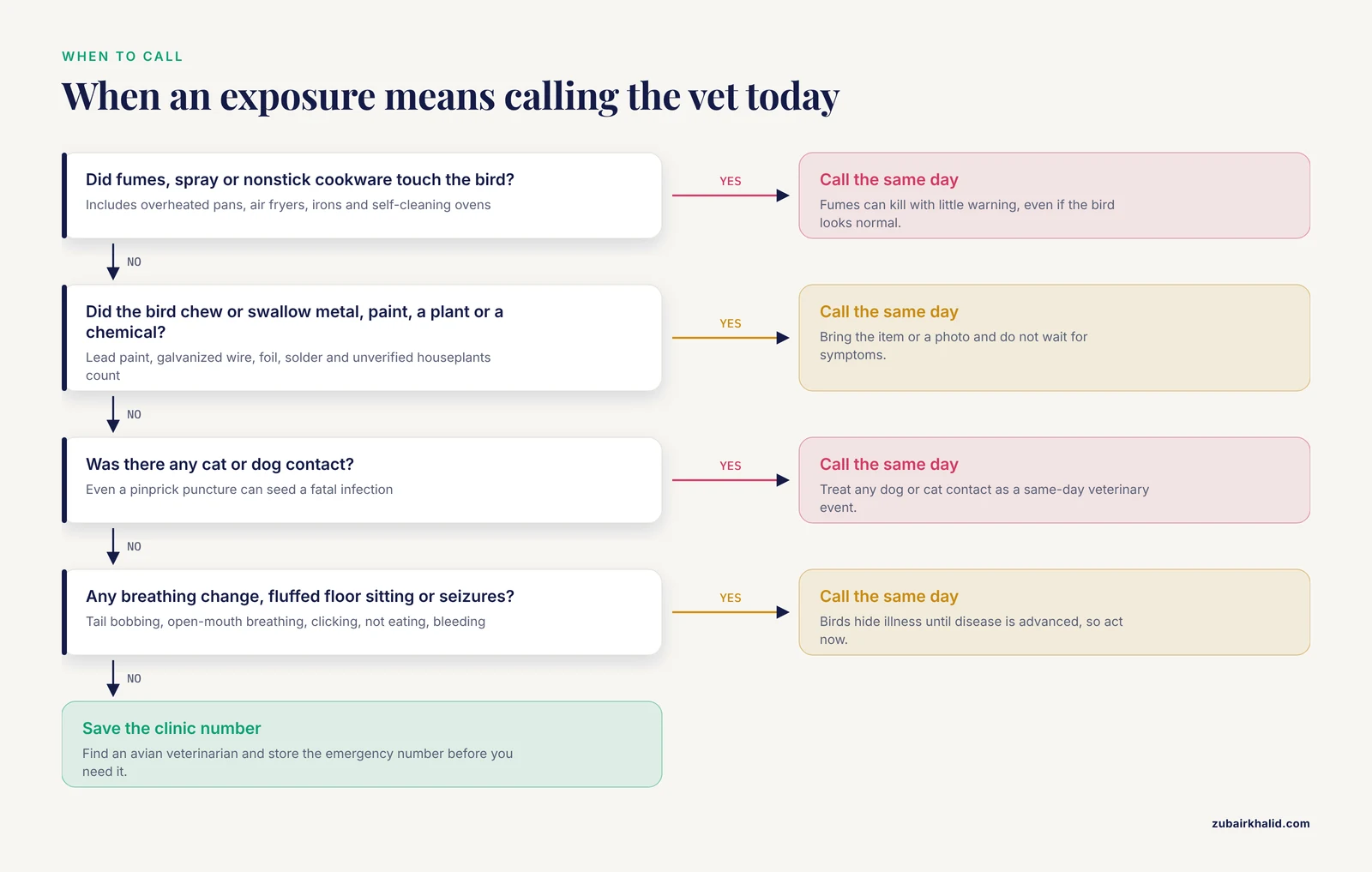
Every home and every conure is different, and individual cases need a veterinarian, ideally one with avian experience, to turn this guide into a plan for your specific bird. Use the rest of this section as the escalation map.
Contact an avian veterinarian the same day for:
- Any known or suspected exposure to toxic fumes, including overheated nonstick cookware, even if the bird seems normal.
- Any chewed or swallowed metal, paint flake, plant, medication, or chemical.
- Any amount of avocado, chocolate, caffeine, or alcohol.
- Any bite or scratch from a cat or dog, however small the wound looks.
- Breathing changes such as tail bobbing, open-mouth breathing, clicking sounds, or a changed voice.
- Sitting fluffed on the cage floor, not eating, repeated regurgitation, abnormal droppings, bleeding, seizures, or sudden weakness.
Plan ahead rather than react. The Association of Avian Veterinarians recommends regular wellness examinations for pet birds and offers a directory for locating an avian veterinarian near you. Save the clinic's emergency number in your phone before you need it, and ask your veterinarian to review your proofing plan and cage setup at the first visit.
Frequently Asked Questions
What does conure proofing your home actually involve?
Conure proofing means controlling three hazard groups before your bird spends time out of the cage: airborne toxins, chewable poisons, and physical traps. In practice, that means a fume-free airspace, locked-away chemicals and metals, safe food boundaries, and a room cleared of fans, cords, open water, and other pets.
Which toxic household items for conures should I remove first?
Start with anything that affects the air: nonstick cookware fumes, aerosol sprays, scented candles, and essential oil diffusers. Then remove heavy metal sources, toxic foods such as avocado and chocolate, and any houseplant you have not verified.
Is nonstick cookware dangerous if my conure is in another room?
Yes. Fumes from overheated nonstick coatings travel through a home, so keep the bird in a distant room with the door closed whenever nonstick cookware, an air fryer, an iron, or a self-cleaning oven heats up. Call your avian veterinarian if an exposure happened.
How do I conure proof a room if I rent or cannot make big changes?
Most proofing is removal and habit, not renovation. Unplug and cover cords, remove plants and sprays, close lids and windows, and set household rules. Nothing requires drilling or permanent changes.
Can my conure have free flight, or should the wings be trimmed?
Both options can work, and the choice is an individual decision to make with your avian veterinarian. Flighted birds need stricter window and fan discipline plus a trained recall, while trimmed birds still glide and need most of the same rules.
Are essential oil diffusers and scented candles safe around conures?
No. A conure's respiratory system concentrates airborne compounds rather than filtering them, so keep diffusers, candles, incense, and plug-in fresheners out of the bird's airspace entirely.
How much out-of-cage time does a conure need?
Plan on daily supervised time in your safe free roam area, as much as your household routine allows, plus a long, dark, quiet sleep period each night. Your avian veterinarian can help you set the right schedule for your bird.
What should I do if my conure chews or swallows something unsafe?
Remove the bird from the area, note what the item was, and call your avian veterinarian right away with the item or a photo in hand. Do not wait for symptoms, because birds hide illness until disease is advanced.