Conure Healthy Weight: Body Condition and Weight Charts
By Dr. Zubair Khalid, DVM, MS, PhD ·
Most conures reach a healthy adult weight somewhere between about 60 and 150 grams, but the exact number depends on the species, and the number alone never tells the whole story. A green-cheeked conure that weighs 80 grams can be perfectly fit, while another green-cheeked conure at the same weight can carry too much fat. That is why avian veterinarians judge a bird's condition by feel and by trend over time, not by a single number on the scale. The most reliable answer to "how much should a conure weigh" comes from three things combined: your bird's species-typical range, a regular home weighing routine that tracks change, and a body condition assessment based on the sharpness of the keel bone and the presence of fat deposits.
This guide walks through typical weight ranges by conure species, a practical body condition scoring method you can use at home, the signs that a conure is overweight or underweight, and a safe, step-by-step plan for helping a conure lose weight.
At a Glance: Your Conure Weight Checklist
| Step | What to do | How often |
|---|---|---|
| 1 | Weigh your conure on a gram-precision digital scale, ideally in the morning before breakfast | Weekly |
| 2 | Record the weight in a log or app so you can see the trend | Every weighing |
| 3 | Feel the keel bone down the center of the chest with the tips of your fingers | Monthly |
| 4 | Look for fat pads near the hips, vent, and the "V" where the neck meets the chest | Monthly |
| 5 | Compare your findings with the species weight range in the chart below | Ongoing |
| 6 | Schedule an annual checkup with an avian veterinarian, who can weigh the bird and score its condition in person | Yearly |
If your bird is stable within the species range, has a keel that feels well-fleshed but not padded, and has no visible fat rolls, that is the profile of a conure at a healthy weight.
Why a Conure Healthy Weight Is a Range, Not a Number
"Conure" covers a large group of small to medium parrots split mainly between two groups. The Pyrrhura group (green-cheeked, maroon-bellied, crimson-bellied) contains the smallest conures. The Aratinga group (sun, jenday, nanday, blue-crowned, cherry-headed) contains larger, louder birds that typically weigh nearly twice as much as a green-cheeked conure. Asking how much a conure should weigh without naming the species is like asking how much a dog should weigh.
Even within a species, healthy weight varies. Sex, frame size, muscle mass, age, and individual genetics all shift the target. Research in other companion species shows how much recorded bodyweight can vary within a single breed by sex and reproductive status [1], and avian practice mirrors this. A large-boned male green-cheeked conure at 82 grams may be lean, while a petite hen at 78 grams may be carrying extra fat. This is exactly why the body condition score was developed as a clinical tool, and why scoring systems are now used across species groups, from companion mammals to exotic pets [2][3].
The scale number matters most as a trend. A stable weight from week to week is reassuring. A steady upward drift of even two or three grams per month, sustained over a year, represents a meaningful change in a bird that weighs under 150 grams total.
Conure Weight Chart: Typical Adult Ranges by Species
The table below lists commonly used reference ranges for adult conures. Treat these as starting points for a conversation with your avian veterinarian, not as strict targets. Individual birds can be healthy slightly outside these ranges.
| Species | Common name | Typical adult weight |
|---|---|---|
| Pyrrhura molinae | Green-cheeked conure | 60-80 g |
| Pyrrhura frontalis | Maroon-bellied conure | 70-85 g |
| Pyrrhura perlata | Crimson-bellied conure | 85-105 g |
| Aratinga weddellii | Dusky-headed conure | 90-105 g |
| Aratinga canicularis | Half-moon conure | 95-110 g |
| Aratinga solstitialis | Sun conure | 100-120 g |
| Aratinga jandaya | Jenday conure | 100-120 g |
| Thectocercus acuticaudatus | Blue-crowned conure | 110-150 g |
| Aratinga nenday | Nanday conure | 125-150 g |
| Psittacara wagleri | Cherry-headed (red-masked) conure | 140-180 g |
Two cautions apply to any weight chart. First, a juvenile bird still growing, a female producing eggs, and a bird recovering from illness all sit outside normal adult patterns, so interpretation changes with life stage. Second, a bird that has lost weight recently may still register inside the species range while trending toward a problem, which is why the weekly log matters more than any single reading.
What Is a Conure Body Condition Score?
A body condition score, usually shortened to BCS, is a standardized assessment of fat and muscle on the animal's frame. In companion animal medicine, the BCS is the accepted first-line tool for evaluating whether a pet is underweight, ideal, or overweight, and it is considered more informative than bodyweight alone because it separates fat from frame and muscle [2]. The same logic applies to birds, adapted to their anatomy.
In mammals, scoring relies heavily on palpating ribs under a layer of skin and fat. In birds, the key landmark is the keel, the prominent ridge of the breastbone (sternum) that runs down the center of the chest. Because a bird's body fat concentrates in specific, predictable locations, the keel plus a few palpation points give a clear picture.
The Five-Point Keel Method for Conures
Use the tips of your fingers, apply gentle pressure, and work when the bird is calm. Birds do not have a diaphragm the way mammals do, so avoid firm compression of the chest.
- Locate the keel. Run a fingertip down the center of the chest from the base of the neck toward the vent. You will feel a bony ridge.
- Assess the keel's prominence. In a lean bird, the keel feels sharp, almost knife-like. In an ideal bird, the ridge is easily felt but the two pectoral muscles on either side round out smoothly so the keel sits slightly recessed in flesh. In a heavy bird, the keel is difficult to find at all because muscle and fat have covered it flush.
- Palpate the pectoral muscles. Sweep your fingertips over the breast on both sides of the keel. Convex, firm muscle with a rounded contour suggests good condition. Concave, wasted muscle suggests the bird is losing condition. Bulging softness suggests fat.
- Check the fat deposit sites. Gently examine the area of the "V" where the neck meets the chest (the interclavicular region), the hips on either side of the tail base, and the area around the vent. Firm, squishy lumps in these locations are fat stores, not normal anatomy.
- Score the overall picture. Assign a simple score of 1 through 5: 1 is emaciated, 2 is thin, 3 is ideal, 4 is overweight, and 5 is obese. Some clinics use a 9-point scale, and the concept transfers directly, with 5 of 9 equivalent to 3 of 5.
The reason a formal score matters is that subjective impressions are unreliable. Studies of pet owners repeatedly show that a large share of owners believe their animals are in ideal condition when objective measurements say otherwise. In one study of dog owners who reported their pets were in "ideal" body condition, calculated body fat measurements revealed that more than half of the dogs were over fat, and the owners had done a poor job of identifying correct condition [4]. A French study found that roughly one quarter of pet owners underestimated their pet's body condition [5]. Your conure's fluffed feathers, small size, and daily Handling can all mask condition changes that your fingers would catch immediately. The score removes guesswork.
Is My Conure Overweight? Signs to Check
Ask "is my conure overweight" and run through this checklist. One sign alone is not a diagnosis, but several together point clearly toward excess condition.
Physical signs you can check at home:
- The keel feels flush with the surrounding chest or is hard to locate by palpation
- A soft, movable fat pad in the interclavicular "V" at the base of the neck
- Fat rolls or thickened pads along the hips on either side of the tail
- A round, bulging abdomen that hangs visibly when the bird perches
- Fat deposits around the vent
Behavioral and postural signs:
- Labored or heavy breathing after mild activity
- Reluctance to fly, or short, low, effortful flights
- Sitting low on the perch with a hunched, broad stance
- Decreased interest in climbing and playing
- In females, a tendency toward reproductive and egg-related problems, which excess condition can aggravate
Scale-based signs:
- A weight above the species range with a keel you cannot feel
- A steady upward trend on the weekly log over several months
Owners are the first line of defense, but owners are also the weakest link in weight monitoring. In an Irish study of horse owners, three quarters used no method at all to monitor their animals' body condition, and even with instructions, agreement between owner and veterinarian scoring was only fair to good [6]. The lesson for conure keepers is direct: do not rely on impressions. Build a routine of weighing and keel checks, and let an avian veterinarian confirm or correct your home assessments at annual visits.
Why Excess Weight Shortens a Conure's Life
Obesity is one of the most prevalent nutritional disorders encountered in veterinary practice, and it is defined by excessive accumulation of adipose tissue [2]. The consequences are not cosmetic. Large-scale clinical data across companion animal species show that as body condition score rises, so does the risk of chronic disease. In a study of more than 1.3 million cats, fourteen of twenty-one examined health conditions, including diabetes mellitus, musculoskeletal problems, respiratory conditions, and dermatological disease, were significantly associated with elevated body condition scores, particularly at scores of 7 and above on a 9-point scale [7]. Obese cats in a separate study showed elevated systolic blood pressure and higher circulating glucose and fructosamine compared with ideal-weight cats [8]. In dogs, higher body condition scores correlate with adverse metabolic markers, including elevated insulin, leptin, triglycerides, and cholesterol [9].
Avian medicine draws the same conclusions from clinical experience: chronic excess condition in parrots is associated with fatty liver disease, reproductive dysfunction, reduced exercise tolerance, and joint strain. While the species differ, the underlying physiology, fat tissue as an active endocrine organ driving metabolic and inflammatory changes, is shared across vertebrates [9].
Prevention is easier than correction, and timing matters. A longitudinal study in dogs found that neonatal growth rate in the first two weeks of life and body condition at seven months predicted which dogs became obese adults [10]. The practical translation for anyone raising or buying a young conure is that early feeding habits and early condition set long-term trajectories. Hand-fed chicks pushed to grow fast on calorie-dense formula, and juveniles raised on unlimited seed, often become adults with entrenched fat metabolism problems.
Finally, prevalence data from companion animal practice should temper any owner's confidence that their pet is fine. Among millions of adult dogs and cats seen at primary practices in the United States between 2020 and 2023, roughly one half of adult dogs and a substantial share of adult cats were recorded as overweight or obese, with prevalence climbing through adulthood [11]. Pet birds living sedentary indoor lives on seed-based diets share the same fundamental risk profile as these species: abundant food, limited activity, and owners who love them enough to overfeed them.
How to Weigh Your Conure at Home
Accurate home weighing is the single most valuable monitoring habit a conure owner can build. Here is the method.
Choosing a Scale
Any digital kitchen scale or jewelry scale that reads in 1-gram increments works. A scale with 0.1-gram precision is better but not required. Selection criteria:
- Capacity of at least 500 grams, so the platform is stable under a bird's weight
- A flat platform the bird can perch on, or a perch attached to a platform
- A hold function that locks the reading after it stabilizes, useful with a bird that will not sit still
- A large, backlit display
The Weighing Routine
- Pick a consistent time. Weigh in the morning, before the first meal. Food in the crop can add several grams and creates false readings.
- Tare the scale. If the bird stands on a towel or small perch on the scale, zero the scale with that item in place first.
- Lure, do not force. Place a favorite treat or the bird's usual morning bowl on or near the scale platform. Many conures will step onto a scale voluntarily for food.
- Record immediately. Memory fails. Write the number down the same minute you read it.
- Graph the trend. A simple note in your phone or a paper log works. Look for direction of travel over weeks, not day-to-day fluctuation.
Daily weighing is unnecessary for a stable bird and can create anxiety around handling. Weekly is the standard rhythm. Increase to twice weekly if the bird is ill, recovering, or on a supervised weight-loss plan directed by your veterinarian.
Interpreting Fluctuations
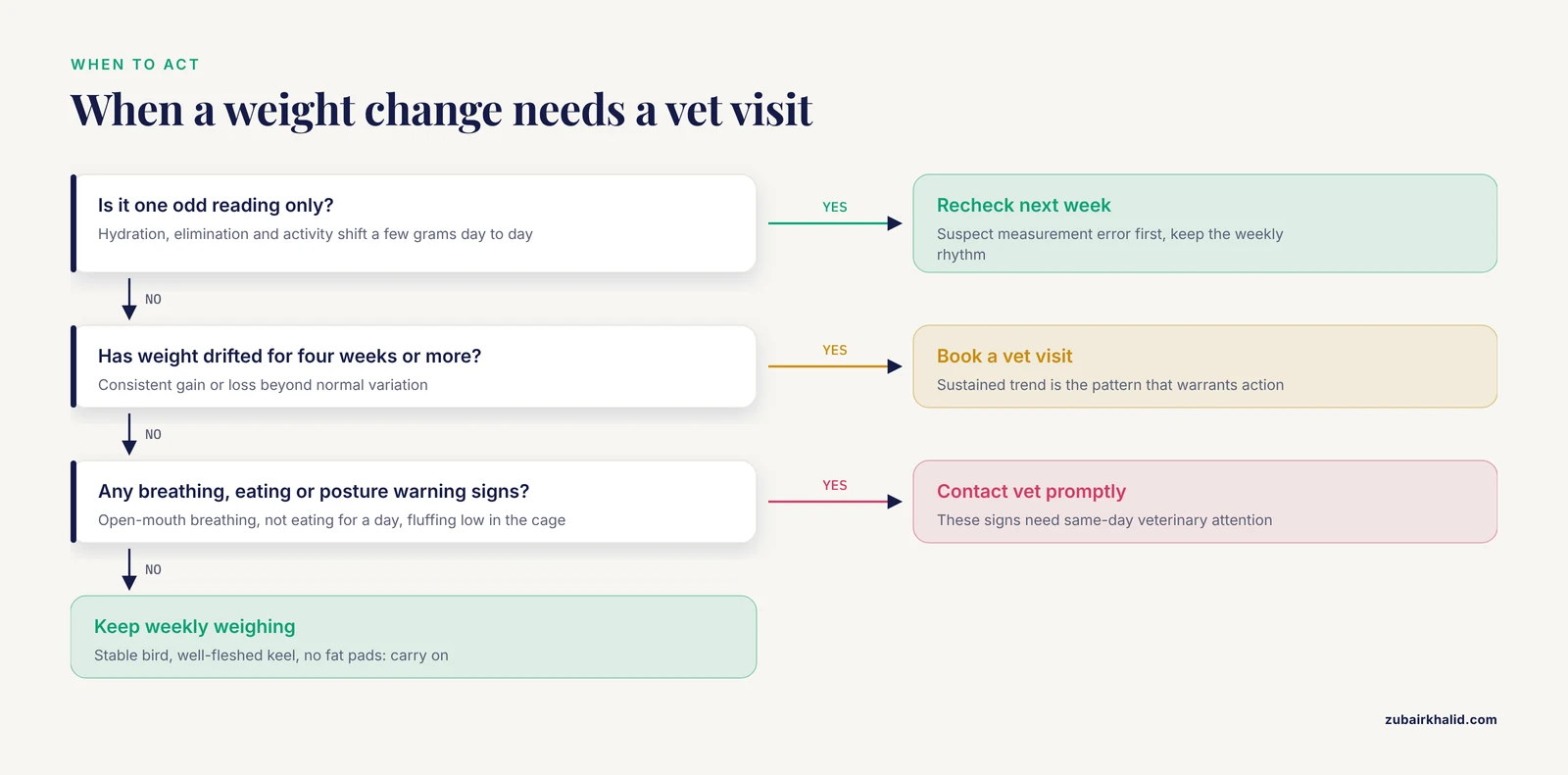
A healthy adult conure's weight varies by a few grams day to day with hydration, elimination, and activity. Treat a single high or low reading with suspicion of measurement error before suspecting a real change. The patterns that warrant action are sustained trends: consistent gain over four or more weeks, or consistent loss beyond normal variation, especially any loss exceeding roughly five percent of body weight over a short period, which always justifies a veterinary appointment.
How to Help a Conure Lose Weight
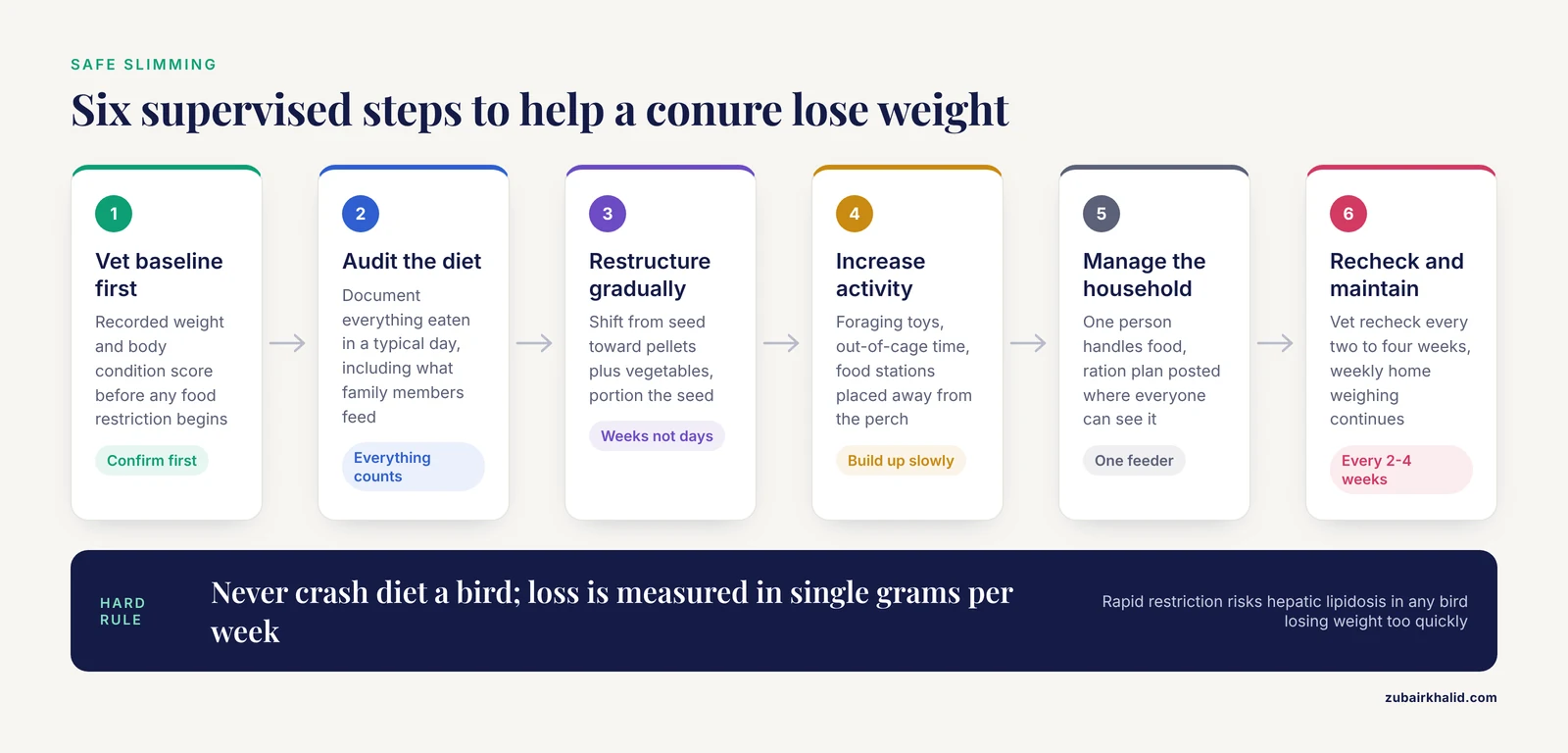
If you have concluded your conure is overweight, the plan that follows is the framework avian veterinarians typically recommend, with two firm rules at the top. First, confirm the assessment with an avian veterinarian before restricting food, because weight gain can occasionally reflect other problems, and because birds tolerate calorie restriction poorly compared with mammals. Second, plan for slow change. A bird weighing 70 grams cannot safely lose weight the way a 20-kilogram dog can. Rapid restriction risks hepatic lipidosis, a serious liver condition, in any bird losing weight too quickly.
Step 1: Get a Baseline Veterinary Assessment
Book a visit with an avian veterinarian before starting any weight-loss plan. The visit should establish a recorded weight and body condition score, evaluate general health, and rule out conditions that complicate dieting. Ask the veterinarian to show you the keel palpation on your specific bird so your home scoring matches theirs. This is also the time to discuss a target rate of loss, which for a small parrot is usually measured in single grams per week and is individualized.
Step 2: Audit the Current Diet
Most overweight conures share the same history: a seed-heavy or all-seed diet with free access to food all day, plus generous table food and treats. Seeds, particularly sunflower and other oilseeds, are calorie-dense and fat-rich, and they are also the item conures most preferentially eat when given a mix. Because food intake and dietary energy density are consistent predictors of weight loss and its maintenance in controlled weight-management programs [12], the audit should document everything the bird eats in a typical day, including what family members feed it.
Step 3: Restructure the Diet Gradually
The general framework, consistent with avian nutrition guidance published by resources such as Lafeber Company and the care guides from VCA Animal Hospitals and the Merck Veterinary Manual, is to shift the diet's center of gravity from high-fat seed toward a balanced pellet base plus fresh vegetables, with seed converted from a staple into a portioned treat or foraging reward. Practical steps:
- Transition pellets gradually. Mix increasing proportions of pellets with the current diet over several weeks rather than switching overnight. Some birds initially ignore unfamiliar foods, and a slow mix prevents both hunger strikes and food refusal.
- Make vegetables a daily course. Leafy greens, chopped vegetables, and small amounts of appropriate fruit add volume and fiber at low calorie cost. Introduce new items repeatedly, since birds often accept a food only after many exposures.
- Portion the seed. Measure seed rather than filling the dish. A measured daily allocation, or seed used only inside foraging toys, cuts intake dramatically without the bird experiencing an empty dish.
- Convert treats. Replace fatty treats such as sunflower seeds and crackers with small pieces of vegetable, a single pellet, or a tiny portion of fruit.
Never implement a crash diet or remove all food. If your conure refuses new foods for more than a day and is not eating its usual diet reliably, contact your avian veterinarian, because anorexia in small birds escalates quickly.
Step 4: Increase Daily Activity
Cage-bound conures gain weight and lose muscle. Build activity into the day:
- Maximize supervised out-of-cage time in a bird-safe room, with flight encouraged where your setup allows, or climbing, ladder, and rope navigation where it does not
- Use foraging toys that require the bird to work for part of its daily ration, which both burns energy and slows eating
- Place food and water stations at some distance from the favorite perching spot so the bird travels for meals
- Reward movement with attention and interaction rather than with food
Do not begin intense enforced exercise with an obese, deconditioned bird. Increase activity gradually, and flag any respiratory distress, sustained open-mouth breathing, or refusal to move to your veterinarian.
Step 5: Manage the Human Side
Owner beliefs and feeding behaviors are among the strongest predictors of a pet's body condition. Research across thousands of pet owners found that perceptions of the pet's vulnerability to obesity, beliefs about feeding norms, and social influences all predicted body condition score alongside demographics [13]. The same dynamics apply to birds. A conure that screams for food and receives it learns that screaming works, and family members who each sneak treats can undermine a plan that looks correct on paper. Practical fixes:
- Designate one person to handle all food and treats
- Post the daily ration plan where everyone in the household can see it
- Replace food rewards with attention, head scratches, or a toy when the bird begs
- Recheck the scale weekly and the keel monthly, and adjust only gradually
Step 6: Recheck and Maintain
Expect slow, steady progress rather than dramatic change. Return for a weight recheck on the schedule your veterinarian sets, commonly every two to four weeks during active weight loss. Once the bird reaches its target condition, shift to maintenance portions and continue the weekly home weighing, because regained weight is the rule rather than the exception when monitoring stops. Sustained maintenance depends on durable habits around food and activity, a finding consistent with weight-management research showing that long-term behavior patterns, not short-term diet changes, determine whether loss is kept off [12].
Common Mistakes to Avoid
- Judging by appearance. Feathers hide everything. Two conures can look identical while one is lean and one is obese.
- Weighing inconsistently. Different times of day, different scales, or weighing right after meals produces noise that hides real trends.
- Trusting the species range alone. A weight within range with a padded keel and hip fat deposits is still an overweight bird.
- Free-feeding seed. Unlimited seed in the dish is the most common driver of excess weight in pet conures.
- Crash dieting. Rapid food restriction in a small bird can trigger serious metabolic illness. Loss must be gradual and supervised.
- Feeding for affection. Treats feel like love, but each sunflower seed is a meaningful calorie load for a 75-gram animal.
- Ignoring the whole household. One secret snack per day defeats a well-designed plan.
- Skipping the annual exam. Home monitoring supplements professional assessment, it does not replace it. An avian veterinarian weighs the bird on a calibrated scale, scores body condition, and can identify changes you cannot detect.
Welfare and Safety Notes
Weight management in birds sits inside a larger welfare picture. Conures are social, intelligent animals, and food is only one of their needs. A weight-loss plan that increases foraging work, enriches the environment, and adds daily interaction improves welfare beyond the scale numbers. Conversely, a plan built on restriction alone, with no enrichment or activity, creates a frustrated bird and usually fails.
Handle the underweight case with equal seriousness. A conure whose keel feels sharp, whose breast muscles feel concave, and whose weight is trending down may be dealing with illness, poor diet, or both, and needs veterinary evaluation rather than simply more seed. Underweight is less common than overweight in pet conures but is more immediately dangerous.
Limitations and When to Contact a Veterinarian
Every conure is an individual, and only an examination by an avian veterinarian can establish what a healthy weight means for your specific bird. The ranges and methods in this article are decision aids, not diagnoses.
Contact an avian veterinarian promptly if any of the following occur:
- Sustained weight loss of more than a few grams across consecutive weekly weighings
- A keel that has become noticeably sharper since your last check
- Your bird stops eating, or eats markedly less, for more than a day
- Open-mouth breathing, tail bobbing, or labored breathing at rest or after mild activity
- Sudden lethargy, fluffing at the bottom of the cage, or a drop in vocalization
- A straining posture, or a female bird showing signs of egg-related distress
- A suspected fat pad that changes quickly, feels hot, or appears discolored
- No progress on a weight-loss plan after four to six weeks despite consistent implementation
Schedule a routine visit, rather than an urgent one, if your conure is overweight with no acute signs and you are preparing to start a diet, or if you simply want a baseline weight and body condition score to anchor your home records.
Frequently Asked Questions
How much should a conure weigh?
It depends on the species. Green-cheeked conures typically weigh about 60 to 80 grams, sun and jenday conures about 100 to 120 grams, nanday conures about 125 to 150 grams, and cherry-headed conures about 140 to 180 grams. Individual variation is real, so pair the species range with a body condition assessment and an avian veterinarian's input rather than treating the chart as a hard target.
How can I tell if my conure is overweight?
Feel the keel bone in the center of the chest. In an overweight conure the keel is difficult to feel because flesh covers it, and you may find soft fat pads in the "V" at the base of the neck, along the hips, or around the vent. Watch also for labored breathing after mild activity, reluctance to fly, and a steadily climbing trend on your weekly weight log.
What is a conure body condition score?
A body condition score is a standardized rating of your bird's fat cover and muscle, assessed mainly by palpating the keel, the pectoral muscles, and known fat deposit sites. A simple five-point scale runs from 1 (emaciated) to 3 (ideal) to 5 (obese). Scoring turns a vague impression into a repeatable number you can track over time and compare with your veterinarian's assessment.
How do I help my conure lose weight?
Start with an avian veterinary checkup to confirm the assessment and set a safe target. Then transition the diet gradually from seed-heavy feeding toward a pellet base with daily vegetables, portion the remaining seed, replace fatty treats, and add foraging toys and more out-of-cage activity. Loss should be slow, measured in grams per week, with regular rechecks. Never crash diet a bird.
How often should I weigh my conure?
Once a week is the standard routine for a stable adult bird, weighed in the morning before the first meal on a gram-precision digital scale. Daily weighing adds noise without value for a healthy bird. Increase to twice weekly during illness, recovery, or a supervised weight-loss plan.
Can a conure be underweight?
Yes. A sharp, prominent keel, concave breast muscles, visible fullness at the crop area, and a downward weight trend all indicate an underweight or declining bird. Underweight demands veterinary attention promptly, because weight loss in small birds can signal illness and deteriorates faster than overweight does.
Does weight change during molting, egg laying, or breeding season?
Yes, temporary fluctuation is normal. A female conure carrying an egg or producing reproductive hormones may weigh more, and increased activity during molt can shift weight slightly. These changes are short-lived, so interpret them against your log rather than reacting to a single reading. Persistent change in either direction still warrants a veterinary look.
Do different conure species need different weight targets?
They do. The difference between a 70-gram green-cheeked conure and a 150-gram nanday conure is enormous relative to their body size, so a single "conure weight" is meaningless. Use the species-typical range as your starting reference, then refine it with keel palpation and your bird's own long-term trend, confirmed by your avian veterinarian.
This article is educational and is not a substitute for veterinary diagnosis or treatment.
Sources
- Bodyweight and body condition scores of Australian British shorthaired cats, 2008-2017
- Canine Obesity: Contributing Factors and Body Condition Evaluation
- Body Condition Scoring and Obesity in Captive African Side-Neck Turtles (Pelomedusidae)
- A comparison of owner perceived and measured body condition, feeding and exercise in sport and pet dogs
- The Perception of the Body Condition of Cats and Dogs by French Pet Owners and the Factors Influencing Underestimation
- Rate of obesity within a mixed-breed group of horses in Ireland and their owners’ perceptions of body condition and useability of an equine body condition scoring scale
- Associations of body condition score with health conditions related to overweight and obesity in cats.
- Body Condition Scores in Cats and Associations with Systolic Blood Pressure, Glucose Homeostasis, and Systemic Inflammation
- Serum spexin concentration, body condition score and markers of obesity in dogs
- Higher neonatal growth rate and body condition score at 7 months are predictive factors of obesity in adult female Beagle dogs
- Overweight and obese body condition in ∼4.9 million dogs and ∼1.3 million cats seen at primary practices across the USA: Prevalences by life stage from early growth to senior.
- Predictors of Body Weight Loss and Body Weight Loss Maintenance in Children and Adolescents following Inpatient Multidisciplinary Obesity Treatment
- Understanding obesity among companion dogs: New measures of owner's beliefs and behaviour and associations with body condition scores.