Canary-Proofing Your Home: Hazards and a Safe Setup
By Dr. Zubair Khalid, DVM, MS, PhD ·
Canary proofing your home comes down to three jobs done in order. First, remove or contain anything that releases fumes, because a canary's respiratory system absorbs airborne toxins faster than almost any other pet. Second, eliminate physical hazards such as open water, ceiling fans, glass, gaps, and other pets. Third, build a safe free roam area, a single bird-proofed room or controlled flight space where your canary can fly under supervision without access to the rest of the house.
A canary can be harmed by something you cannot smell and cannot see. Overheated nonstick cookware, aerosol sprays, and scented products can injure or kill a small bird in minutes. The Association of Avian Veterinarians and the Merck Veterinary Manual both emphasize that birds are exceptionally sensitive to inhaled toxins, and canaries, being among the smallest commonly kept pet birds, sit at the highest end of that sensitivity. This guide walks through every hazard category room by room, then shows you how to set up a flight space that gives your canary real exercise without putting it at risk.
This article is educational and is not a substitute for veterinary diagnosis or treatment.
At a Glance: Canary-Proofing Checklist
Work through this list today. Each row names the hazard and the single most effective immediate action.
| Hazard | Why it threatens canaries | Do this today |
|---|---|---|
| , - | , - | , - |
| Nonstick (PTFE/Teflon) cookware and ovens | Overheated coatings release fumes that cause fatal lung damage in birds | Never use nonstick pans, self-cleaning oven cycles, or nonstick air fryers while the bird is indoors. Move the cage out of the kitchen permanently |
| Aerosols, perfume, hairspray, nail products | Fine droplets and solvent vapors reach a bird's air sacs quickly | Ban all sprays from the bird's room. Apply personal products in a bathroom with the bird caged and the door closed |
| Scented candles, plug-ins, essential oil diffusers | Volatile oils and combustion particles irritate and damage avian lungs | Remove them from the bird's airspace entirely |
| Open water (toilets, sinks, pots, buckets) | Small birds drown quickly and silently | Close toilet lids, cover pots, drain buckets |
| Ceiling fans and hanging fixtures | Panic flights send birds straight up into blades and hot bulbs | Keep fans off whenever the canary is out. Assess every overhead fixture in the flight room |
| Windows, mirrors, sliding glass doors | Birds strike glass at flight speed | Partial window coverings and decals on the flight path |
| Gaps, vents, open doors and windows | A panicking canary escapes through a hole the size of a coin | Walk the room and seal gaps before the first free flight |
| Other pets (cats, dogs, ferrets) | A cat scratch or bite, even a playful one, introduces deadly bacteria | Never allow shared space. A closed door between species at all times |
| Toxic foods and plants | Small doses cause poisoning in a tiny bird | Keep avocado, chocolate, caffeine, alcohol, and salty food away. Remove listed toxic plants from the flight room |
| Smoke of any kind | Tobacco, vape, and cooking smoke damage delicate airways | Keep all smoke out of the home or confine the bird far from it with full ventilation |
Why Canaries Need a Different Kind of Proofing
Canaries are not scaled-down parrots, and they are not proofed the way a parrot is proofed. Three differences drive everything in this article.
Respiratory anatomy. Birds breathe through a system of air sacs with a one-way airflow through the lungs. This design makes flight possible, but it also means inhaled particles and vapors are absorbed with remarkable efficiency and travel further into the respiratory tract than they would in a mammal. The Merck Veterinary Manual describes canaries and other small birds as highly susceptible to inhaled toxins, and overheated polytetrafluoroethylene (PTFE, sold under brand names such as Teflon) fumes are a classic cause of sudden avian death in home settings. A canary does not need to touch a hazard to be harmed by it. Being in the same airspace is enough.
Size and metabolic rate. A canary weighs roughly an ounce. Doses of toxin, drops of water, and degrees of temperature shift that a larger pet shrugs off can overwhelm a bird this small. There is little margin for error.
Flight behavior. Canaries are finches. Unlike a hand-tamed parrot, most canaries will not recall to your hand reliably. When startled, they fly fast, high, and blindly. Household dangers for canaries therefore include anything in the upper third of a room, anything reflective, and any opening a panicking bird can reach in two seconds.
A fourth point shapes the whole project. Birds instinctively mask illness. A canary that feels unwell often looks normal until it does not. The Merck Veterinary Manual notes this pattern across pet bird species, and it means prevention, not treatment, is the real safety net in a home. Proofing is the treatment.
How to Canary Proof a Room, Step by Step
The most reliable approach is to designate one room as the canary's flight room and proof it thoroughly, rather than trying to make the entire house safe. Here is how to canary proof a room from the ground up.
Step 1. Choose the right room
Pick a room that is not the kitchen and not adjacent to it. Kitchen fumes, including PTFE vapor from overheated pans and smoke from everyday cooking, migrate through open floor plans, and distance is your best defense. A bedroom, office, or enclosed sunroom usually works well. Look for a room with a door that closes fully, windows you can cover, and no heavy foot traffic.
Step 2. Walk the room and seal escape routes
Get on your hands and knees with a flashlight. Canaries slip through gaps around pipe penetrations, dryer vents, window frames with broken seals, and the gap between a radiator and the wall. A canary that reaches a wall cavity or a vent duct is often lost. Seal what you find with painter's caulk, foam, or hardware cloth. Check that window screens are intact and secure, because a screen is not a barrier against a bird in full flight, it is only a delay.
Step 3. Handle the airspace above
Canaries panic upward. Sit in the center of the room and look up. Ceiling fans must be switched off at the wall or breaker, not just the pull chain, whenever the bird flies. Light fixtures, hanging plants, exposed bulb sockets, and decorative beams all become strike points. Either remove the flight path under them or accept that the bird will explore them and pad or remove the dangerous ones. Hot halogen and incandescent bulbs cause contact burns.
Step 4. Neutralize glass
A canary flying at full speed into a window can break blood feathers or injure its skull. Break up reflections on the flight path with sheer curtains left partially closed, window film, or multiple decals placed on the glass itself. Mirror-heavy rooms need extra care, because canaries may repeatedly attack or court their own reflection, which is a welfare problem as well as a strike risk.
Step 5. Remove or contain liquids
Close toilet lids at all times, even when the bird is caged, because a loose canary investigates. Never leave a sink full of water, a pot on a stove, a filled bathtub, an open aquarium, or a bucket in the flight room. Provide drinking and bathing water only in shallow dishes designed for birds.
Step 6. Secure cords, outlets, and open flame
Canaries chew far less than parrots, but they do peck, and a pecked power cord is a shock and burn hazard. Route cords behind furniture or inside cord covers. Do not burn candles, incense, or use a fireplace with the bird present, and treat table lamps and hot appliances as off-limits surfaces.
Step 7. Manage other pets and people
A closed door is the only reliable boundary between a canary and a cat, dog, or ferret. Cats carry bacteria in their mouths and under their claws that can cause fatal infection in a bird even from a scratch that looks trivial, so any cat contact is an emergency regardless of how healthy the wound appears. Brief children on the rules, and supervise all interactions between pets and the bird's room without exception.
Step 8. Control temperature, drafts, and light
Canaries tolerate normal household temperatures but not sudden drafts, cold window-adjacent perches in winter, or full sun with no shade. Position perches away from windows that receive direct afternoon sun and away from air conditioning and heating vents. Provide a consistent day-night rhythm, and consider a cage cover at night for darkness and draft reduction.
Step 9. Audit the contents of the room
Empty the flight room of anything you would not want pecked or inhaled. Fresh paint, new pressed-wood furniture, and recently applied finishes off-gas solvents, so complete any renovation and airing-out well before the bird moves in. Remove access to houseplants you have not confirmed as bird-safe, and store all medications, vitamins, and cleaning supplies behind a closed door.
Toxic Household Items for Canaries
This section groups the major toxic household items for canaries by route of exposure. The airborne category deserves the most respect, because it is the one owners underestimate most.
Airborne toxins: the deadliest category
The Merck Veterinary Manual identifies inhaled toxins, especially fumes from overheated nonstick cookware, as a leading and frequently fatal household danger for pet birds. PTFE coatings begin releasing toxic particles when overheated, and birds in the same home can die of lung damage with no warning signs in advance. Self-cleaning oven cycles, nonstick bakeware, nonstick drip pans, and many small appliances with nonstick coatings belong in the same category. The Association of Avian Veterinarians' client education materials consistently place PTFE fume exposure at the top of preventable avian emergencies.
Beyond PTFE, treat the following as banned from your canary's airspace:
- Aerosol sprays of any kind, including deodorant, hairspray, furniture polish, and disinfectant sprays
- Perfume, cologne, and scented lotions applied in the bird's room
- Essential oil diffusers and nebulizers, both active and passive
- Scented candles, wax melts, and incense
- Cleaning products used in the room, especially bleach, ammonia, and oven cleaners, which should only be used with the bird removed and the room aired out completely afterward
- Fresh paint, varnish, wood stain, and adhesive fumes
- Tobacco smoke and vape aerosol, which have no safe level of exposure for a bird
- Carbon monoxide from poorly vented heaters and fireplaces, a reason to maintain a home CO detector
A practical habit solves most of this: if a product has a fragrance warning label or a ventilation warning label, it does not belong near the canary.
Toxic foods
Canaries in flight will investigate plates and crumbs. The following foods are established hazards for birds and are flagged in avian nutrition guidance from sources such as Lafeber Company:
- Avocado, which is toxic to birds
- Chocolate and caffeine in any form
- Alcohol
- Salty, greasy, or heavily processed human snacks
- Fruit seeds and pits, such as apple seeds, which contain cyanogenic compounds
Offer only foods formulated or verified as safe for canaries, and keep human food out of the flight room entirely.
Toxic and risky plants
Household plants are a recurring source of poisoning calls. VCA Animal Hospitals' avian care guides list many common houseplants as toxic to birds, including lilies, philodendron, pothos, dieffenbachia, azalea, and oleander. Do not rely on a plant being "probably fine." Either identify every plant in the flight room with a reputable avian resource, or move unverified plants out of the bird's airspace.
Contact and material hazards
- Lead paint dust and flakes in homes built before modern paint regulations, especially on window frames and old trim
- Zinc and galvanized hardware in cheap cages and toy parts, which birds can ingest by chewing
- Cedar and other aromatic wood shavings, whose volatile oils irritate avian respiratory tracts
- Cat saliva and scratches, a biological rather than chemical hazard but one of the most serious, since even a minor cat-inflicted wound can seed a fatal infection
Building a Safe Free Roam Area for Canaries
A safe free roam area is a defined, fully proofed space, not the whole house. For canaries the space should be built around horizontal flight, because finches fly in loops and arcs rather than climbing and hovering the way parrots do.
Defining the flight space
The best free roam area for a canary is a single closed room, typically a bedroom or office, in which every hazard from the checklist has been addressed. The room should be large enough for the bird to make genuine straight-line or elliptical flights, several wingbeats in a row, without forced turns. A small room can work if obstacles are rearranged to create a clear flight lane.
Alternatively, the canary's flight cage itself can serve as the core of the setup, with supervised out-of-cage time inside the proofed room. The cage is the anchor and the retreat. The room is the exercise floor.
Furnishing the space
Provide multiple perches at varied heights so the bird can choose where to land. Natural branches of bird-safe wood with varied diameter exercise the feet better than uniform dowels. Place perches so they do not sit directly over food and water dishes, since droppings contaminate anything below them. Leave clear vertical and horizontal flight corridors with no hanging obstacles.
Running out-of-cage time safely
Because canaries rarely recall reliably, control the environment instead of the bird.
- Close every door and window in the flight room before opening the cage. Check the seal twice.
- Turn off ceiling fans at the switch.
- Cover or treat the glass on the flight path.
- Keep other pets and small children out of the room entirely during flight sessions.
- Stay in the room and watch. Most escape and injury events happen in the first minutes of a session when the bird surprises you.
- End sessions before feeding time or dusk, when the bird is more motivated to return to the cage voluntarily.
- Have a plan for returning the bird. Dimming the lights and placing the open cage high with food inside often encourages a loose canary to settle.
What makes a cage the right anchor
Selection criteria for the cage matter as much as the room. Look for horizontal space rather than tall ornamental height, since canaries use width for flight. Bar spacing must be narrow enough that the bird cannot wedge its head between bars, which for a canary means the tighter end of small-bird spacing. Avoid galvanized hardware of unclear origin, and rinse a new cage thoroughly before use. Position the cage at partial eye level against a wall rather than in the center of a room, away from the kitchen, away from drafts and direct sun, and with one side partially covered at night for security.
Common Canary-Proofing Mistakes
Owners make a handful of predictable errors. Avoiding them costs nothing.
- Assuming "another room" means safe. Fumes travel through open floor plans, hallways, and HVAC. If the air in your kitchen reaches the bird's room, the pan are not safe to overheat.
- Smell-based judgment. Dangerous PTFE fumes and carbon monoxide often carry no noticeable odor. A hazard you cannot smell is still a hazard.
- Treating a screen as a barrier. Window screens keep insects in and birds out of the glass, not a bird inside a room.
- Free-roaming the whole house. A canary loose in a multi-room home with cats in it is an emergency waiting to happen. One proofed room beats a half-unsafe house.
- Ignoring the vertical third of the room. Fans, fixtures, and high shelves injure more flying birds than floor-level hazards do.
- Cleaning with the bird present. Spraying anything in the flight room, even "natural" cleaners, puts aerosolized chemicals directly into the bird's breathing zone.
- Delaying the escape-route walk. Most first escapes happen through a gap the owner never noticed. Do the flashlight crawl before the first free flight, not after.
Reading Your Canary: Behavior, Stress, and Early Warning Signs
Proofing is prevention, but observation is your ongoing monitor. Welfare science supports this approach across species. In studies of managed animals ranging from endangered lizards to killer whales, researchers found that systematic behavioral observation, activity patterns, social interactions, and posture, provides practical data for improving welfare and making husbandry decisions [1]. Work on non-invasive physiological indicators in killer whales similarly concluded that welfare is best assessed through a multifactorial framework that combines several complementary measures rather than any single metric [2]. Translated to a home canary, this means watch the whole picture rather than one signal.
Practical daily monitoring for a canary includes:
- Song. A male canary that stops singing is often the earliest visible sign that something is wrong, whether illness, stress, molting, or an environmental change.
- Posture. A canary that sits fluffed at the cage floor for extended periods is signaling illness, not resting.
- Breathing. Tail bobbing with each breath, open-beak breathing, or audible clicking warrants urgent veterinary attention.
- Droppings. Persistent changes in droppings that last beyond a day, beyond simple dietary causes, deserve a call to an avian veterinarian.
- Activity and engagement. Reduced movement, lethargy, or withdrawal from normal exploration mirrors the negative welfare indicators documented in formal welfare studies [2] and should prompt a closer look at both health and environment.
Behavior change in a canary has two possible explanations, illness or environment. Sometimes both. When behavior shifts, audit the room for a new fume source, draft, or stressor, and contact your avian veterinarian if the change persists.
Limitations and When to Contact a Veterinarian
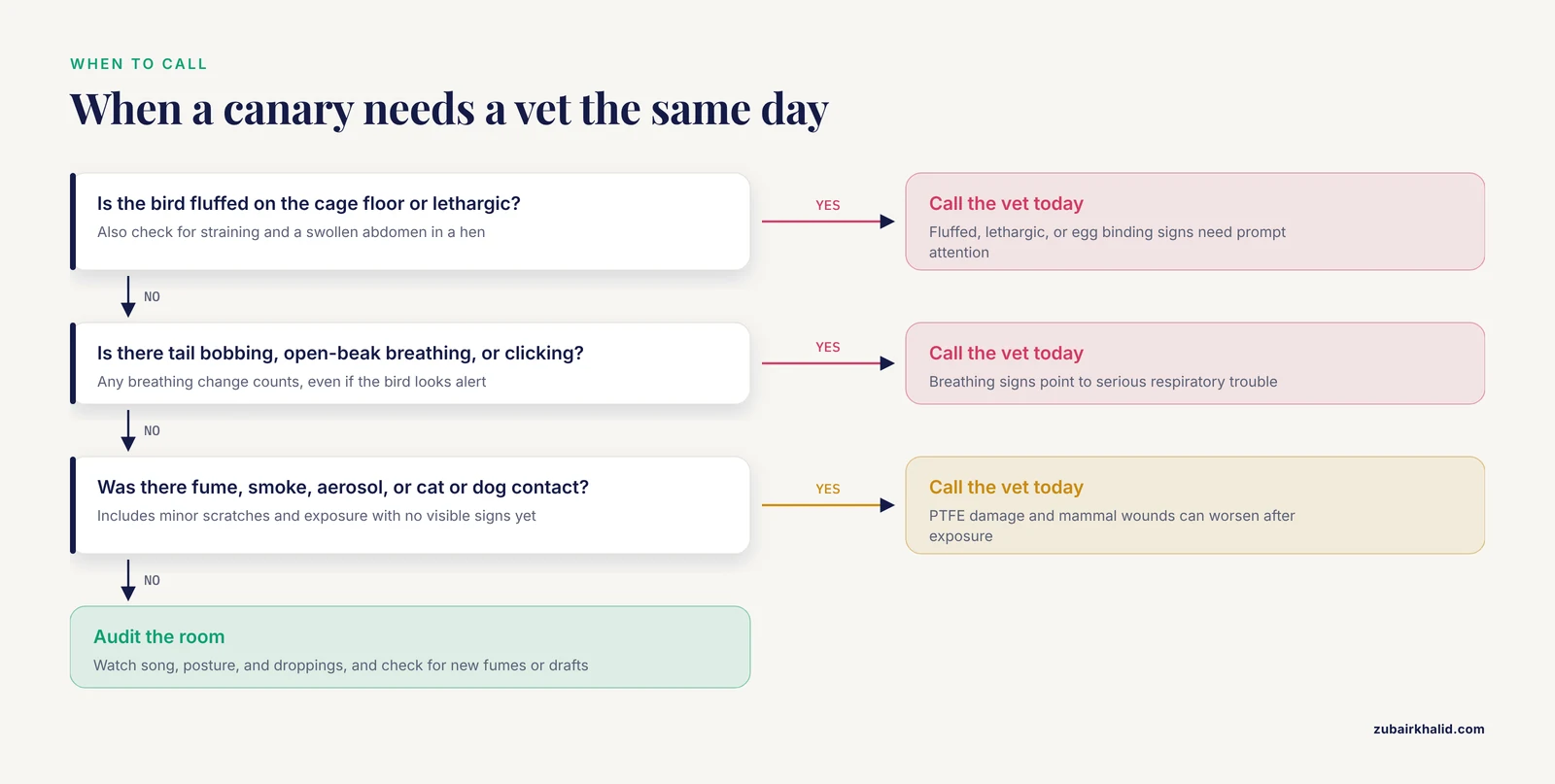
Individual cases vary, and only an avian veterinarian who has physically examined your bird can diagnose illness or confirm that your specific setup is appropriate. This article provides general household safety guidance, not individualized medical or husbandry prescriptions.
Contact an avian veterinarian promptly, the same day, in any of the following situations:
- Your canary sits fluffed on the cage floor, is lethargic, or stops singing along with any other sign of illness
- Tail bobbing, open-mouth breathing, wheezing, or clicking sounds during respiration
- Bleeding from a broken blood feather, beak, or nail that does not stop quickly with gentle pressure
- Any known or suspected exposure to fumes, smoke, or aerosol, even if the bird currently appears normal, because PTFE-type lung damage can progress after exposure
- Any contact with a cat or dog, including scratches or bites that appear minor, since avian wounds from mammals carry high infection risk
- Straining, lethargy, and a swollen abdomen in a hen, which can indicate egg binding, an emergency
- A loose bird that escaped the home, in which case contact your veterinarian and local lost-pet networks immediately
If you do not have an avian veterinarian, the Association of Avian Veterinarians maintains a public directory of member avian practices at aav.org, and the Merck Veterinary Manual's pet bird section can help you prepare useful questions for your first visit.
Frequently Asked Questions
Is canary proofing different from parrot proofing?
Yes, in emphasis. Parrot proofing focuses heavily on chewing, because parrots destroy materials with their beaks. Canary proofing focuses on airborne toxins, escape gaps, glass strikes, and overhead hazards, because canaries fly fast and panic upward but chew far less. Both share the same rule for cats, open water, and nonstick fumes.
Can I cook with nonstick pans if my canary is in another room?
No, not safely. Overheated PTFE fumes can spread through a home, and small birds have died in homes where the cookware was used in a different room. Use stainless steel, cast iron, or ceramic cookware while keeping nonstick items for a home without birds, or reserve their use strictly for times when the bird is out of the house with full ventilation afterward.
What single household danger kills canaries most often?
Overheated nonstick cookware fumes are among the most lethal and most preventable household dangers for canaries, and the Merck Veterinary Manual and avian veterinary organizations consistently rank inhaled toxin exposure at the top of home bird emergencies. The risk is silent, odorless, and fast, which is why prevention rather than reaction is the only defense.
How much out-of-cage flight time does a canary need?
Canaries are active fliers and benefit from regular supervised flight in a fully proofed room, but specific daily durations depend on your bird's age, health, and temperament. Discuss an appropriate flight routine with your avian veterinarian, and in the meantime prioritize that any flight time you provide happens in a room where the full checklist above has been completed.
Does my canary need a companion bird?
No. Canaries are territorial, especially males, and many do best housed individually. Pairing canaries requires careful introduction and observation, since aggression between birds is common. If you want a second bird, discuss housing options, quarantine procedures, and compatibility with an avian veterinarian before acquiring one.
Are essential oil diffusers safe around canaries?
No. Essential oil diffusers and nebulizers release volatile compounds directly into the air your bird breathes, and avian veterinary guidance treats them as a respiratory hazard for pet birds. Remove diffusers from the bird's airspace, and avoid using them anywhere in the home while the bird is present.
How do I canary proof a room on a budget?
Prioritize in this order. First, remove free access to fumes and sprays, which costs nothing. Second, seal gaps and check window screens with caulk and basic hardware. Third, treat glass on the flight path with inexpensive decals or partial curtains. Fourth, reroute cords and switch off fans. The proofed room matters more than expensive equipment, and most high-impact fixes are free or nearly free.
When should I take my canary to the veterinarian?
Same day if the bird sits fluffed and lethargic, shows tail bobbing or open-beak breathing, bleeds, was exposed to fumes or another pet's claws or teeth, or is a hen showing straining and abdominal swelling. Call within a day for persistent dropping changes or a male that has stopped singing along with other subtle signs. Any sudden behavior change with no environmental explanation deserves a call, because birds hide illness until disease is advanced.