Healthy vs Unhealthy Canary Poop: What Droppings Tell You
By Dr. Zubair Khalid, DVM, MS, PhD ·
Healthy canary poop is small, firm, and well formed, with a dark green to gray-brown center, a clean white or cream urate cap, and a modest ring of clear liquid around it. Because a canary's digestive tract, kidneys, and liver all communicate through the same exit, every dropping is a combined report from several organ systems at once. That makes droppings the most useful health data you can gather at home, and changes in color, texture, volume, or frequency are often the first visible sign of illness in a bird that hides sickness by instinct.
This guide explains what normal canary poop looks like, how diet and daily rhythm create harmless variation, how to tell true diarrhea from extra urine, and when to worry about canary poop enough to call an avian veterinarian.
Owner triage summary
- Normal: formed dark green-brown feces, white urates, clear urine, steady volume from day to day.
- Watch closely: loose droppings for a few hours after new foods or a stressful event, wetter first morning droppings, color shifts that match new foods.
- Call your avian veterinarian today: diarrhea lasting more than a day, yellow or lemon-green urates, bubbly or foul-smelling droppings, undigested seeds, or a clear drop in dropping volume.
- Emergency: blood or black tarry material, no droppings at all, a fluffed bird sitting on the cage floor, or open-beak breathing.
This article is educational and is not a substitute for veterinary diagnosis or treatment.
Canary Poop at a Glance
| What you see | What it usually means | What to do |
|---|---|---|
| Formed dark green-brown feces, white urates, clear urine | Normal digestion, kidneys, and hydration | Keep observing daily |
| Larger, wetter first dropping of the morning | Overnight urine pooling, normal | No action |
| Loose droppings for a few hours after new foods or stress | Temporary gut upset | Remove the trigger, watch for 24 hours |
| Loose or unformed feces lasting more than a day | Possible diarrhea from infection, parasites, or diet problems | Call an avian veterinarian |
| Yellow-green or lemon urates | Possible liver involvement | Prompt veterinary visit |
| Black, tarry, or bloody droppings | Bleeding in the digestive tract | Urgent visit |
| Undigested seeds in feces | Poor digestion or absorption | Veterinary visit |
| Bubbly or foul-smelling droppings | Fermentation, yeast or bacterial overgrowth | Veterinary visit |
| Very few or no droppings | The bird is not eating | Emergency |
Why Droppings Carry So Much Information
Birds do not urinate the way mammals do. The kidneys filter nitrogen waste into uric acid, which leaves the body as a semi-solid white paste called urates rather than as liquid urine. This adaptation saves water, an advantage for animals whose eggs develop in a sealed shell with no external water supply. The intestines produce the fecal portion. Both, along with a variable amount of clear urine, empty into the cloaca, a common chamber that also serves reproduction, and leave the body together as one dropping.
That shared exit turns every dropping into a three-part sample. The feces reflect digestion and absorption in the gut. The urates reflect kidney function and hydration. The urine ring reflects water balance. The liver adds a fourth signal, because birds excrete bile pigments such as biliverdin, and liver disease often shows up first as yellow or green staining of the urates. The Merck Veterinary Manual describes this multi-component structure of bird droppings and notes that changes in any component can signal disease in the digestive, urinary, or hepatic systems.
This kind of non-invasive sampling is taken seriously across zoological medicine. Research on welfare physiology in managed wildlife relies on body samples that can be collected without adding handling stress, and it emphasizes that such samples are most informative when collection is standardized and results are read alongside behavior and other indicators rather than alone [1]. Your kitchen-table version of that principle is simple. Collect observations the same way each day, and never judge a single dropping without the rest of the picture.
What Healthy Canary Poop Looks Like
A healthy canary produces many small droppings each day, and each one has three visible parts.
The fecal portion is the dark center. In canaries it is usually dark green to gray-brown, compact, and coiled or tubular, roughly the size of a grain of rice or smaller. It should hold its shape on the cage paper instead of spreading into a smear.
The urate portion is the white or cream cap or streak, often attached to one end of the feces. It should look smooth and chalky, not gritty, yellow, orange, or unusually thick.
The urine portion is the clear liquid ring around the dropping. It should be modest. A wet circle around an otherwise normal fecal core is usually urine, not diarrhea.
Normal variation is wide and harmless in most cases:
- The first dropping of the morning is often larger, darker, and wetter, because the bird produced urine overnight without eating.
- Hens approaching laying pass noticeably larger droppings, sometimes with more urine, because the developing egg presses on the intestinal tract.
- Molting birds, birds that ate greens or fruit the day before, and birds excited by handling can all produce looser or wetter droppings for a short time.
- Colored pellets, dark leafy vegetables, berries, and beetroot can tint the fecal portion for a day or so.
The most valuable habit is learning your own bird's baseline. Studies of managed wildlife have shown that systematic observation of daily patterns provides practical data for welfare and management decisions, and that individuals differ in their rhythms [2]. A canary whose droppings are always a little wet in the evening may be perfectly normal. The same output in a bird that was dry yesterday is a signal. VCA Animal Hospitals recommends that bird owners observe droppings daily as part of routine home health checks, which is easiest when the cage is lined with plain white paper rather than loose substrate.
Canary Poop Color Chart
Use the chart below as a starting point for a conversation with your veterinarian, not as a diagnosis. One odd dropping is rarely urgent. Persistent change is.
| Color or appearance | Component affected | Possible meaning | Urgency |
|---|---|---|---|
| Dark green to gray-brown, formed | Feces | Normal digestion | None |
| Bright green, loose, or slimy | Feces | Not eating, bile-stained feces, intestinal disease | Same-day call |
| Black and tarry | Feces | Digested blood from the upper digestive tract | Urgent |
| Red streaks or frank blood | Feces or urine | Bleeding from the lower gut or cloaca, heavy parasite loads, egg-related trauma in hens | Urgent |
| Yellow or lemon-green | Urates | Liver or bile involvement, some systemic infections | Prompt visit |
| Chalky white, thick, or gritty | Urates | Dehydration or kidney strain | Vet visit |
| Very large clear liquid ring | Urine | Polyuria from watery foods, stress, heat, kidney or hormonal disease | Monitor, call if persistent |
| Bubbly or frothy | Feces | Gas and fermentation, yeast or bacterial overgrowth | Vet visit |
| Whole undigested seeds | Feces | Maldigestion or abnormally fast gut transit | Vet visit |
| Foul or unusually strong odor | Any | Bacterial or yeast overgrowth, spoiled feed | Vet visit |
| Very small, few, or no droppings | All | Reduced or absent food intake | Emergency |
Two habits make the chart work. First, judge trends, not single droppings. Second, rule out diet before assuming disease. Lafeber Company's avian nutrition resources note that diet strongly influences dropping appearance, so a bird that just discovered kale is not the same as a bird with green, slimy diarrhea and a fluffed posture. If the change lasts more than a day, or if your bird acts unwell, stop reading charts and call.
Canary Diarrhea vs Polyuria: Why the Difference Matters
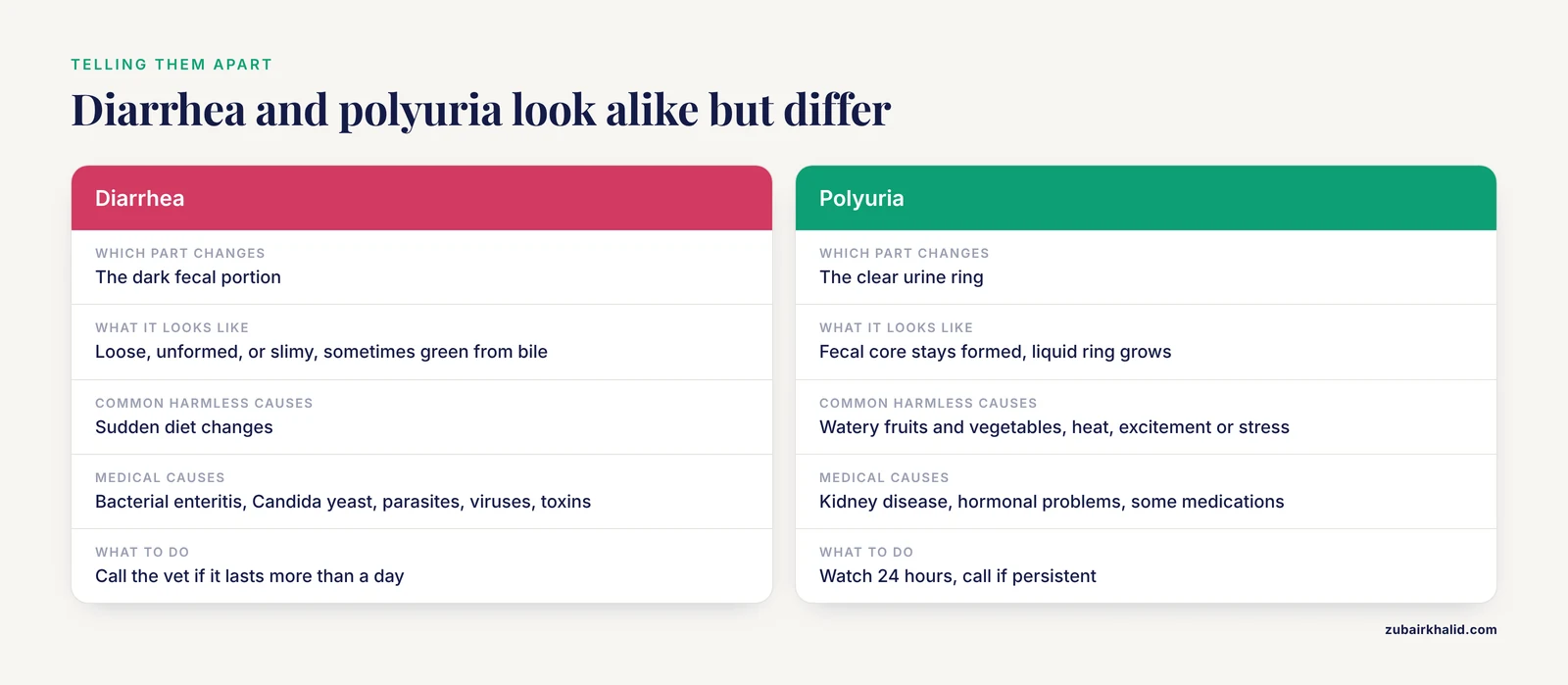
True diarrhea and polyuria look similar on cage paper and mean very different things.
Diarrhea affects the fecal portion. The dark center is loose, unformed, or slimy, sometimes green from bile, and it loses its tubular shape. Causes include bacterial enteritis, yeast overgrowth such as Candida, intestinal parasites, viral infections, sudden diet changes, and toxins. Diarrhea means the gut itself is inflamed or otherwise not working.
Polyuria affects the urine portion. The fecal core stays formed and normal, but the clear liquid ring grows dramatically. Common harmless causes include watery fruits and vegetables, heat, and excitement or stress. Medical causes include kidney disease and hormonal or endocrine problems. Some medications also increase urine output.
The distinction matters because it changes the urgency. A canary eating cucumber and melon in summer may pass wet droppings all day with perfect fecal cores. A canary with green, unformed feces is a different case, even though both leave puddles on the paper.
When you find wet droppings, ask three questions:
- Is the dark fecal core still formed and normal? If yes, think polyuria.
- Did the diet, weather, or environment change in the last day? If yes, watch for 24 hours.
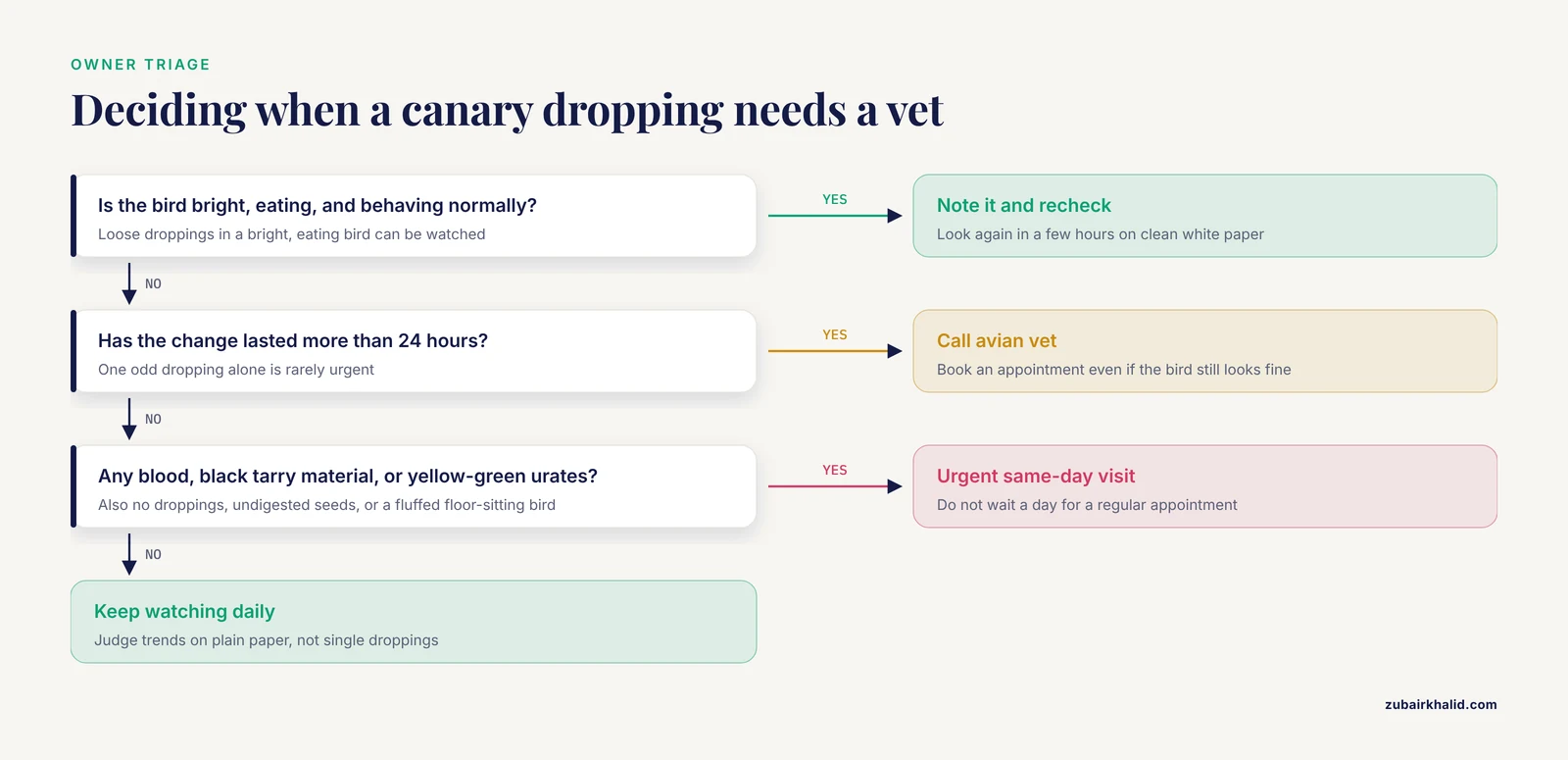
- Is the bird bright, eating well, and behaving normally? Loose droppings in a bright, eating bird can be watched. Loose droppings in a quiet, fluffed, or poor-eating bird need a same-day call.
Only fecal testing at a clinic can confirm the cause when the change persists, so treat persistent wet droppings as a reason to book an appointment rather than a reason to guess.
When to Worry About Canary Poop
Canaries are prey animals, and they mask illness until disease is advanced. Droppings often change before the bird looks sick, which is why dropping watching buys you time. Small birds also have fast metabolisms and limited reserves, so a canary that is not eating deteriorates within hours to days, not weeks.
Use these time rules:
- One odd dropping in a bright, eating bird. Note it and check again in a few hours.
- Abnormal droppings lasting more than 24 hours. Call your avian veterinarian, even if the bird still looks fine.
- Any red-flag finding. Call immediately. Do not wait a day.
Red flags that need urgent or emergency care:
- Blood, red streaks, or black tarry material in or around the droppings
- Yellow or lemon-green urates, especially with a quiet or fluffed bird
- No droppings, or a sudden drop in dropping number, which usually means the bird has stopped eating
- Undigested seeds appearing repeatedly in feces
- Dropping changes paired with systemic signs, including fluffed feathers, sitting on the cage floor, tail bobbing, closed eyes, weight loss, or open-beak breathing
Hen owners should add one more scenario. A hen that strains, passes very large wet droppings, and then stops producing droppings may have an egg stuck in the reproductive tract. Egg-related problems in canaries are time-sensitive and need same-day veterinary attention.
Pair dropping observations with a gram-scale weight check. Many avian veterinarians ask owners to weigh small birds weekly on a digital kitchen scale that reads in grams, because weight loss shows up before a bird visibly stops eating. A bird that is losing weight and passing abnormal droppings should be seen promptly.
Also pair observations with common sense about exposure. If a new bird joined the household recently, or if wild birds or rodents can reach your canary's food and water, infectious causes become more likely and the threshold for calling drops.
What Causes Unhealthy Droppings in Canaries
Infectious causes
Bacteria, yeast, and parasites are the leading infectious reasons for abnormal canary droppings. Bacterial enteritis can follow contamination of food or water by droppings, spoiled feed, or disruption of normal gut flora. Candida yeast can overgrow in young birds, in birds that have received inappropriate or prolonged medication, and in birds whose gut flora is unbalanced, producing loose and sometimes slimy droppings.
Canaries have two well-known protozoal problems. Coccidiosis, caused by Isospora organisms, spreads where droppings contaminate food and water and can cause diarrhea and weight loss, with the heaviest effects in young or stressed birds. Atoxoplasmosis, caused by a single-celled parasite that targets canaries and related finches, is most dangerous in fledglings, in which it can enlarge the liver enough to appear as a dark spot through the abdominal wall. Both are diagnosed through fecal and laboratory testing and treated with medication prescribed by an avian veterinarian.
Viral infections and the organism that causes avian chlamydiosis can also produce abnormal droppings. Avian chlamydiosis is zoonotic, meaning people can develop psittacosis from an infected bird, and confirmed cases are reportable in many US states. Your veterinarian can explain reporting and public health follow-up where your state requires it.
Non-infectious causes
Diet drives many dropping changes. A seed-only diet is nutritionally unbalanced for canaries over the long term, and abrupt food changes can trigger temporary loose droppings. Toxins, including moldy seed, contaminated water, and household fumes, can inflame the gut or sicken the bird more broadly. A hen near laying, a bird recovering from a fright, or a bird in an overheated room can show polyuria without any disease at all.
Risk factors
- A recently acquired bird or new cage mate without quarantine
- Crowded housing and soiled substrate
- Seed-only diets and irregular cleaning of food and water dishes
- Young age, recent weaning, molting, breeding, and egg laying
- Drafts, temperature swings, night disturbance, and other chronic stress
- Access by wild birds or rodents to food, water, or the cage area
What Your Veterinarian Will Do
Expect a history first. Useful details include when the change started, what the droppings look like, any diet or environment changes, new birds in the home, and whether the bird is eating and maintaining weight. Photographs of droppings on plain paper are genuinely helpful.
The physical exam comes next. Your veterinarian will assess body condition, hydration, the cloaca, and overall posture, and will weigh the bird.
Dropping analysis is the core test for gut disease. Common tests include a direct smear to look for organisms, a fecal Gram's stain to sort bacteria and yeast, flotation testing for parasites such as coccidia, and culture with sensitivity testing when bacterial infection is suspected. Bloodwork evaluates liver and kidney function, which matters because yellow urates and polyuria can reflect disease beyond the gut. Radiographs may be used when an egg, a mass, or organ enlargement is suspected.
Sampling quality affects interpretation. Research on non-invasive physiological sampling in managed wildlife has shown that how and where a sample is collected can introduce real variability, which is why a standardized technique matters [1]. At home, collect a fresh dropping within a few hours of the appointment, take it from clean paper, place it in a small sealed container, and refrigerate it. Do not freeze the sample, and do not mix it with litter, seed hulls, or water.
If you cannot bring a sample, line the carrier with clean paper and let the clinic collect fresh droppings there. The Association of Avian Veterinarians maintains resources for locating an avian-experienced veterinarian, which is worth doing for any persistent dropping problem, because birds need practitioners comfortable with their anatomy and fast metabolism.
Treatment and Recovery
Treatment follows the test results, and there is no single remedy for abnormal canary poop. Parasite infections receive specific antiparasitic medication. Bacterial infections receive antibiotics chosen by culture when possible. Yeast overgrowth receives antifungal treatment. Birds with liver involvement, dehydration, or poor appetite receive supportive care, which can include warmth, fluids, easily digested food, and assisted feeding when a bird will not eat enough on its own.
Duration depends on the diagnosis. Your veterinarian will tell you how long the course runs and will usually schedule a recheck with a repeat fecal test to confirm the organism has cleared rather than assuming it has. Finishing the full prescribed course matters, because stopping early invites relapse.
Diet correction is part of most treatment plans. Birds raised on seed-only diets need a gradual transition toward a balanced pellet and vegetable base, staged over weeks rather than days, and your veterinary team or avian nutrition resources from companies such as Lafeber can guide the process. Sudden diet overhauls in a sick bird create more problems than they solve, so changes are made after the acute problem is controlled.
Report honestly at rechecks. If droppings improved on medication and slid back after it ended, if weight is not recovering, or if new signs appeared, your veterinarian needs that information to adjust the plan.
Home Care Mistakes and Unsafe Remedies
The internet is full of dropping remedies, and several are dangerous for a bird that weighs a few dozen grams.
Do not give leftover or over-the-counter antibiotics. The wrong drug, the wrong dose, and incomplete courses can mask signs while disease progresses and can select for resistant bacteria. Prescription medication should come from a veterinarian who has examined the bird.
Do not offer dairy products, including yogurt, as a probiotic. Birds do not digest lactose well, and dairy can worsen diarrhea.
Do not add charcoal products, vinegar, herbal drops, or essential oils to food or water on your own. Birds are exceptionally sensitive to airborne compounds and to changes in their water, and unproven additives can discourage a sick bird from drinking at the worst possible time.
Do not fast a bird to rest its gut. Small birds cannot safely skip meals, and a canary that is not eating needs veterinary attention, not a wait-and-see fast.
Do not abruptly switch diets in a sick bird, and do not bathe or repeatedly handle a bird that is unwell.
The most common mistake is delay. Canaries hide illness, so by the time droppings look clearly wrong, the bird may be further along than it appears. A phone call to an avian clinic costs little and resolves most of these questions.
How to Keep Canary Poop Normal
Prevention is mostly hygiene, diet, and low stress.
Line the cage with plain paper and change it daily. Droppings are easiest to read on white paper, and removing droppings daily breaks the cycle of coccidia and bacterial buildup in the cage environment. Wash food and water dishes daily, and position them where droppings cannot fall into them.
Feed a balanced base diet. Modern avian nutrition guidance, including resources from Lafeber, favors a pellet and vegetable foundation with seed as a supplement rather than the entire diet for canaries. Introduce new foods gradually and watch droppings as you go. Provide fresh water every day.
Quarantine any new bird before it joins your flock. Many avian veterinarians recommend keeping new birds separated in a different room for several weeks, with dedicated care items and hand washing between birds, and ideally a veterinary check with a fecal test during that window. This single habit prevents most infectious dropping problems in home aviaries.
Reduce chronic stress. Keep the cage away from drafts, kitchen fumes, and late-night noise, provide a consistent dark period for sleep, and avoid crowding. Stressed birds shed more organisms and tolerate them less well.
Schedule an annual wellness examination with an avian veterinarian. The Association of Avian Veterinarians recommends regular preventive exams for pet birds, and a yearly visit that includes a weight check and baseline testing catches problems while droppings are still subtly abnormal rather than obviously wrong.
Weigh your canary weekly on a gram scale and record it. Weight trends plus daily dropping checks give you the earliest warning system available for a small bird.
Prognosis
Prognosis depends on the cause and the timing. Diet-related and stress-related dropping changes usually resolve once the trigger is removed. Parasitic and bacterial infections often respond well when treated early with the right medication, and repeat fecal testing confirms clearance. Outcomes are guarded when treatment starts after a bird has stopped eating, lost significant weight, or when the cause is a systemic disease with liver or kidney involvement.
The consistent theme in small birds is that earlier is better. A canary seen on the first day of abnormal droppings generally has more options, a shorter recovery, and a better outcome than the same canary seen a week later. Your veterinarian can give you an individual prognosis after examination and testing, and honest reporting of dropping trends at home is part of that assessment.
Limitations and When to Contact a Veterinarian
Individual cases need a veterinarian. Dropping appearance narrows possibilities but does not confirm a diagnosis, and the same color change can reflect anything from a berry snack to liver disease. Welfare research makes the same point from the research side, showing that physiological markers are most reliable when interpreted within a broader framework that includes behavior, weight, and clinical findings rather than on their own [1].
Contact your avian veterinarian when any of the following apply:
- Abnormal droppings persist more than 24 hours
- You see blood, black tarry material, or yellow-green urates
- Dropping volume drops suddenly or stops
- Undigested seeds appear repeatedly
- Your bird is fluffed, quiet, floor-sitting, not eating, losing weight, or breathing with an open beak
- A new bird recently joined the home without quarantine
- Anyone in the household is pregnant, immunocompromised, elderly, or very young and the bird is ill, because some bird diseases, including psittacosis, can affect people
Go directly to an emergency or avian clinic rather than waiting for a regular appointment when droppings are bloody or absent, or when dropping changes come with collapse, seizures, or severe breathing effort.
This article is educational and is not a substitute for veterinary diagnosis or treatment.
Frequently Asked Questions
What does healthy canary poop look like?
Healthy canary droppings are small and firm, with a dark green to gray-brown fecal core, a white or cream urate cap, and a small ring of clear urine. You should see many of these each day, roughly matching how much your bird eats.
Why is my canary's poop watery?
Most watery droppings are polyuria, meaning extra urine around a normal fecal core, often from juicy foods, heat, or stress. True diarrhea means the fecal portion itself is loose and unformed, and that needs a veterinary call if it lasts more than a day.
Why is my canary's poop green?
Dark green formed feces are normal. Bright green, loose, or slimy droppings can mean the bird is not eating or has intestinal disease, and that combination deserves a same-day call.
What does blood in canary poop mean?
Fresh red blood or black tarry material is never normal and usually points to bleeding in the intestinal or cloacal lining. Treat it as urgent and contact an avian veterinarian the same day.
Can food change the color of canary droppings?
Yes. Dark leafy greens, berries, beetroot, and colored pellets can tint the fecal portion for a day or so. Diet-related color changes fade within a day or two of returning to the usual menu.
How often do canaries poop?
Healthy canaries pass droppings frequently through the day, often dozens of times, because their digestive tract moves food quickly. A clear drop in the number of droppings usually means the bird is eating less.
What should I do if my canary stops producing droppings?
Treat it as an emergency. Few or no droppings usually means the bird has stopped eating, and small birds decline quickly without food.
Should I bring a poop sample to the avian vet?
Yes. Collect a fresh dropping within a few hours of the visit, place it in a clean sealed container, and keep it refrigerated but never frozen.