Canary Healthy Weight: Body Condition and Weight Charts
By Dr. Zubair Khalid, DVM, MS, PhD ·
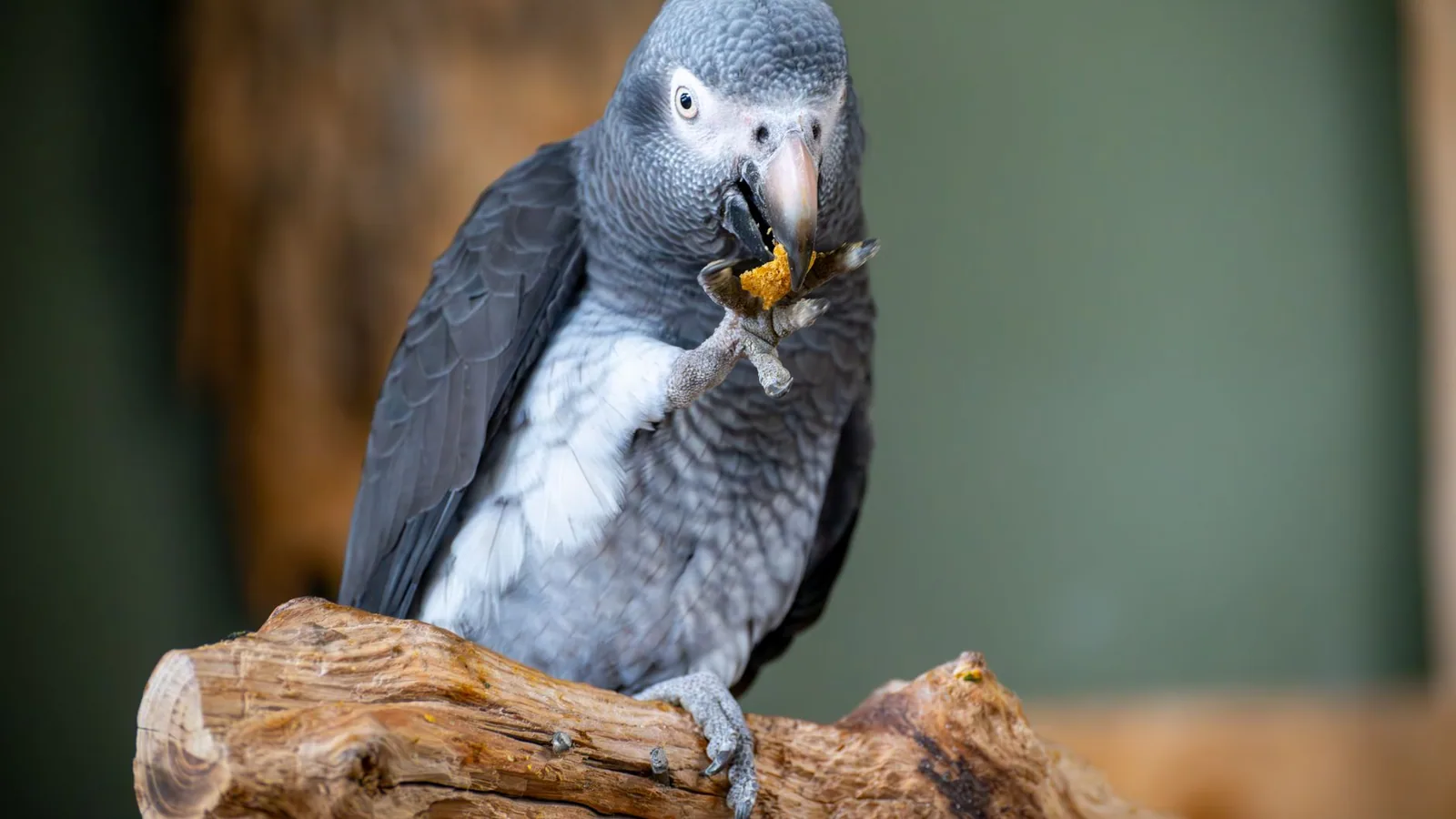
Most healthy adult canaries weigh between about 15 and 30 grams, with the right number for your bird depending on its type, sex, and frame. A canary at a healthy weight has a keel bone you can feel under smooth muscle, flies briskly around the cage, sings and moves normally, and holds a stable weight from week to week. Because feathers hide body shape, the number on the scale plus a simple hands-on check tells you far more than appearance alone.
This guide covers canary healthy weight from both angles, the number on the scale and the feel of the keel bone, then walks through safe, gradual weight loss for birds that need it.
This article is educational and is not a substitute for veterinary diagnosis or treatment.
Canary Healthy Weight at a Glance
| Step | What to do | Why it matters |
|---|---|---|
| Learn the typical range | Adult canaries commonly fall between about 15 and 30 grams, with small song and color-bred types near the low end and large type breeds near the high end | Gives you a starting point before judging your own bird |
| Find your bird's baseline | Weigh your canary at the same time each morning for a week and average the results | A stable personal baseline beats any chart number |
| Run the keel test monthly | Feel along the breastbone for muscle coverage and fat pads | Detects fat or muscle loss that feathers hide |
| Feed for the long haul | Build the diet around pellets and vegetables with seed as a smaller, measured portion | Seed-heavy diets drive weight gain in pet canaries |
| Fly every day | Provide out-of-cage flight in a bird-safe room or the largest flight cage you can manage | Flight is the main calorie burner for a canary |
| Track the trend | Weigh weekly and log the number | Trends catch problems earlier than single readings |
| Know the red flags | Rapid loss of roughly 10 percent of body weight, refusal to eat, fluffed posture, or labored breathing need prompt veterinary care | Small birds deteriorate quickly |
Why a Healthy Weight Matters for Canaries
A canary's body is built for sustained flight, and its metabolism runs fast. Extra weight does more than slow a bird down. In avian practice, obesity in seed-eating pet birds is associated with reduced flight endurance, heat intolerance, reproductive difficulty in hens, and fatty liver disease, a serious condition in which fat infiltrates liver tissue. An overweight hen also faces higher risk of egg binding, a life-threatening emergency in which an egg cannot pass.
Being too thin is equally dangerous. A canary is small and carries almost no reserve. Illness, stress, or a poor diet can strip away body weight in days, and by the time a bird looks thin through its feathers it may already be in real trouble.
Weight is also one of the most sensitive early indicators of disease in pet birds. Birds instinctively hide sickness, so a downward drift on the scale often appears before any other symptom. Avian veterinarians, including members of the Association of Avian Veterinarians, recommend routine wellness examinations for pet birds partly because subtle changes like a weight trend are easy to miss at home.
The encouraging part is that weight is one of the few health markers you can measure yourself. Learning two skills, accurate weighing and keel palpation, takes an afternoon and puts you ahead of most problems.
How Much Should a Canary Weigh?
Adult canaries are small birds, and their healthy weights span a wide range because decades of selective breeding have produced everything from compact song types to large, heavily built show strains.
Typical adult ranges by type:
| Canary type | Typical adult weight |
|---|---|
| Small song types and color-bred canaries (German roller, red-factor, many American singers) | roughly 15 to 20 grams |
| Intermediate breeds (Border fancy, Gloster, Stafford, Lizard) | roughly 18 to 24 grams |
| Large type breeds (Yorkshire, Norwich, and similar big-framed strains) | roughly 24 to 30 grams |
These ranges overlap, and individuals within any breed vary. Treat them as orientation, not as a target you force your bird to hit.
Several factors shift the number:
- Type and frame. Large type canaries are supposed to feel substantial. A Yorkshire at the top of the range can be lean while a roller at the top of its own range can be fat.
- Sex. Cocks and hens are close in size in most strains. A hen in breeding condition carries extra weight from her reproductive tract.
- Age. Young birds fill out during their first year. Some older birds slowly lose muscle mass.
- Time of day. A bird that has just eaten weighs more than one that has not.
- Molt. Feather production raises energy use, and weight can wobble during a heavy molt.
Your bird's own baseline beats the chart
The single most useful number is not on any chart. It is your canary's own stable weight. Weigh your healthy adult bird at the same time every morning for seven days, average the readings, and treat that average as the baseline. A healthy canary typically holds within a few tenths of a gram, and up to about a gram, of its baseline from day to day.
Once you know the baseline, the chart becomes a sanity check. A 17 gram roller that has held steady for a year is almost certainly fine even if a table suggests rollers should weigh more. A 22 gram Border that has crept up from 19 grams over six months needs attention even though 22 grams sits inside a printed range. Ask your avian veterinarian to weigh your bird at its first checkup and confirm where it sits for its type.
Canary Body Condition Score: The Keel Test
A canary body condition score is a hands-on rating of how much muscle and fat covers the frame. Avian veterinarians commonly use a five-point scale for small birds, and you can learn the same technique in a few minutes.
What the scores mean
| Score | What you feel | Interpretation |
|---|---|---|
| 1 | Keel bone razor sharp, breast muscles deeply sunken on both sides | Emaciated, urgent veterinary attention |
| 2 | Keel very prominent, muscles flat or slightly concave | Underweight, investigate diet and health |
| 3 | Keel easy to feel but not sharp, muscles smooth and flush or slightly rounded over it | Ideal for most pet canaries |
| 4 | Keel harder to find, muscles rounded, soft fat pads felt at the shoulders, crop area, or abdomen | Overweight, begin gradual changes |
| 5 | Keel difficult or impossible to feel, obvious fat deposits, bird tires quickly in flight | Obese, veterinary-guided plan needed |
How to palpate the keel
- Work in a quiet room with the door and windows closed.
- Cradle the bird upright in one hand with loose restraint. Never squeeze the chest. Birds breathe by expanding their chest, and tight restraint can suffocate them.
- Run a fingertip lightly down the center of the breast from the neck downward until you feel the ridge of the keel bone.
- Slide the fingertip to one side of the ridge and feel the pectoral muscle. Note whether it is concave, flush, or bulging relative to the keel.
- Repeat on the other side.
- Lightly check the hollow above the breastbone, the shoulders, and the lower abdomen for soft, movable lumps. These are fat deposits.
- Finish within about a minute and return the bird to its cage.
Practice while your bird is healthy so you know what normal feels like. Many tame canaries accept the exam while perched on a finger, which avoids full restraint altogether.
How often to score
Once a month is enough for a stable adult. During a weight-loss program, pair a weekly weigh-in with a quick keel check so you can confirm the bird is losing fat rather than muscle.
Is My Canary Overweight? Signs to Check
Feathers are excellent insulation and excellent camouflage. Two canaries that look identical in a cage can differ by several grams of fat. Rely on touch and performance, not appearance.
Physical signs:
- The keel is hard to feel, or you feel rounded muscle and fat instead of a defined ridge.
- Soft, yellowish lumps under the skin at the shoulders, the hollow above the breastbone, around the vent, or along the abdomen.
- A rounded, persistently bulging lower abdomen outside of breeding condition.
- In markedly obese birds, thickened-looking legs where fat surrounds them.
Behavior and performance signs:
- Labored or open-mouth breathing after short flights.
- Reluctance to fly, shorter flights, or crash landings.
- Reduced singing or general activity.
- A broad, slumped perching posture.
- In hens, fertility problems or past egg binding, which veterinarians associate with excess body fat.
What is not a sign of obesity:
- A fluffed appearance. Fluffing is normal warming behavior and can also signal illness.
- A large frame. Big type breeds are supposed to feel substantial.
- Temporary weight gain during molt or breeding season without other signs.
If the keel test and the scale agree that your bird is heavy, move to the plan below. If the signs conflict, book a checkup. A veterinarian can palpate the same landmarks, weigh the bird on a calibrated scale, and rule out internal causes such as fluid, a growth, or an egg before anyone calls the bird fat.
How to Weigh Your Canary at Home
Choosing a scale
Any digital scale that reads in grams works. Jewelers' scales and small kitchen scales are common choices. Look for:
- Readouts in 1 gram increments at minimum, with 0.1 gram preferred, because meaningful changes on a canary are small.
- A flat, stable platform, or a perch or cup that sits securely on the platform.
- A tare button so you can zero out a container.
- A surface that wipes clean.
Skip analog dial scales. Their needle resolution is too coarse for a 20 gram animal.
Setting up
- Perch method. Secure a natural wood perch or flat platform on the scale so the bird can stand comfortably. Tare the scale first.
- Container method. Place the bird in a small open box or tub on the tared scale for a few seconds.
- Carrier method. For nervous birds, weigh the bird inside a small travel carrier and tare the carrier weight first.
The routine

- Weigh at the same time every session, ideally first thing in the morning before food goes in.
- Tare the scale with the perch or container in place.
- Encourage the bird onto the perch with a bit of greens rather than chasing it around the cage, which spikes stress.
- Wait for the number to settle, read it, and log it with the date and time.
- Keep the session under a minute and reward calm behavior.
Reading the trend
Expect small daily wobble of a few tenths of a gram up to about a gram from gut fill and droppings. A single reading matters far less than the direction over weeks. A simple notebook or phone note with the date, the weight, and a word about diet or behavior is all the record you need.
Why Canaries Gain Weight
Understanding the drivers makes the fix obvious.
- Seed-heavy diets. Straight seed mixes, especially mixes heavy in oil seeds such as sunflower, niger (thistle), and rape, deliver far more fat than a pet canary burns in a cage. Wild canaries fly miles daily and eat seasonally. A living room bird meets the same appetite with a stationary lifestyle.
- Free-choice feeding. A bowl that never empties lets a bird snack all day without moving.
- Treat creep. Millet spray, egg food, and seed bells are calorie-dense and often offered generously during taming and training.
- Limited flight. Small cages and little out-of-cage time remove the main calorie burner.
- Life stage. Hens in breeding condition gain reproductive weight. Birds often receive extra food during molt, and some keep the extra after feathers regrow. Middle-aged birds on seed-heavy rations are the classic candidates for creeping gain.
- Medical causes. Thyroid disease and other metabolic problems can change weight. Unexplained gain deserves a veterinary exam before you cut rations.
Owner resources from the Association of Avian Veterinarians, the Merck Veterinary Manual's pet bird materials, VCA Animal Hospitals, and Lafeber Company all point the same direction on feeding: variety and portion control, with seed as a modest component rather than the base of the diet.
How to Help a Canary Lose Weight Safely
Birds cannot crash diet. A canary processes food continuously, and hours without eating strain a body that runs on quick energy. The goal is slow, steady loss over weeks, ideally under veterinary guidance.
Step 1: Get a baseline exam
Before changing anything, have an avian veterinarian examine your bird. The exam confirms the bird is actually fat rather than carrying fluid, an egg, or a growth, screens for medical causes of gain, sets a target weight, and establishes how often to recheck. Many avian clinics recheck a dieting bird every two to four weeks.
Step 2: Fix the diet gradually
Plan on several weeks for a full transition.
Weeks 1 and 2. Introduce pellets alongside the usual seed mix and add a small daily dish of chopped vegetables. Dark leafy greens, grated carrot, broccoli, bell pepper, and small pieces of apple are common canary favorites. Remove fresh food after a few hours so it does not spoil.
Weeks 3 and 4. Reduce the seed portion and drop high-fat extras such as millet spray and seed bells. Keep a temporary base of seed if the bird is still ignoring pellets.
Week 5 onward. Once the bird eats pellets and vegetables reliably, switch to measured portions. Feed a set amount in the morning and let greens and vegetables make up most top-ups.
Practical tips:
- Change one variable at a time so you can see what works.
- If the bird refuses new foods entirely, back up a step rather than pushing a fast. A canary that will not eat needs veterinary advice quickly.
- Watch the droppings. A sharp change in droppings during a diet transition is a reason to call your veterinarian.
Step 3: Rebuild the exercise
- Provide the largest flight cage or aviary space you can accommodate. Length matters more than height for canaries.
- Allow supervised out-of-cage flight daily in a bird-safe room with windows and mirrors marked or covered, ceiling fans off, other pets locked out, and escape routes closed.
- Place food and water at opposite ends of the cage so the bird travels between them.
- Use foraging. Tuck greens through the cage bars or hide small vegetable portions so the bird works for its food.
Step 4: Monitor and adjust
Weigh two to three times per week at the same time and log the results. Expect gradual change over weeks rather than days. Stop the plan and call your veterinarian if weight drops fast, the bird stops eating, or activity falls off. If nothing changes after several weeks of honest adherence, ask your veterinarian to reassess the target and screen for medical causes.
Common Mistakes Owners Make
- Judging by eye. Feathers hide fat and thin alike. Use the scale and the keel test.
- Crash dieting. Removing all seed overnight or skipping meals to force loss can push a small bird into a crisis. Change rations gradually and never withhold food.
- Chasing a chart number instead of the trend. A bird inside the printed range but drifting upward week after week needs attention. A bird above the range but stable for years with a clean keel test may not.
- Weighing at random times. Morning and evening readings can differ by a gram or more. Consistency makes the data usable.
- Overdoing treats during training. Taming work often turns into a steady stream of millet spray. Swap in greens or a sliver of vegetable.
- Misreading molt and breeding condition. Extra appetite and weight during molt or breeding season is not the same as obesity. Read the calendar along with the keel.
- Assuming a quiet bird is a healthy bird. Reduced singing can accompany weight problems or illness. Changes in voice and activity deserve a checkup.
- Skipping the vet before dieting. What looks like fat can be an egg, fluid, or a tumor. Confirm first.
Welfare and Safety Notes
- Restrain gently and briefly, and never squeeze the chest. A bird's breathing depends on chest movement.
- Keep handling sessions short and predictable so weighing stays routine rather than frightening.
- Watch for stress signals such as rapid panting, wing flicking, and escape attempts. Pause and try again later.
- During out-of-cage flight, remove hazards including other pets, open water, hot cookware, toxic plants, ceiling fans, and uncovered windows.
- Keep day and night cycles regular with a dark, quiet sleeping period.
- Food should remain available throughout any diet change. A canary should never sit with an empty dish as part of a weight plan.
Limitations and When to Contact a Veterinarian
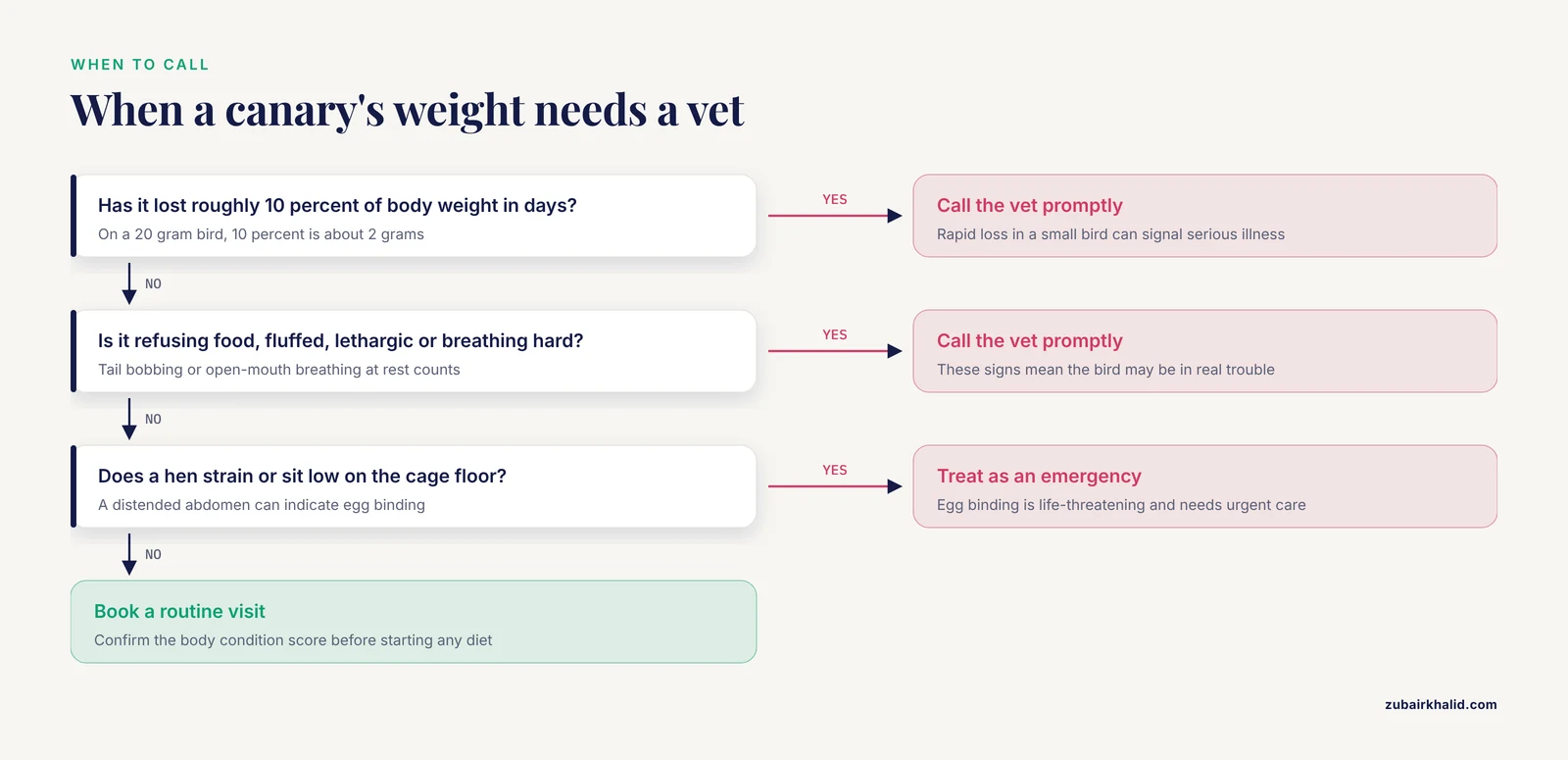
Every canary is an individual, and printed ranges are population guides rather than diagnoses. Scale quality, timing, and handling all add noise to home measurements. Individual cases need a veterinarian, especially whenever the picture is unclear.
Contact an avian veterinarian promptly if:
- Your canary loses roughly 10 percent of its body weight within days, or shows a steady downward trend over a week or more. On a 20 gram bird, 10 percent is about 2 grams.
- The bird stops eating or eats far less than usual.
- It sits fluffed, quiet, and lethargic, or sleeps excessively.
- Breathing looks labored, with tail bobbing or open-mouth breathing at rest.
- Droppings change sharply in volume, color, or consistency.
- A hen strains, sits low on the cage floor, or has a distended abdomen, which can indicate egg binding, an emergency.
- An overweight bird becomes inactive or breathes hard after minimal effort.
- A weight-loss plan produces no change after several weeks, or produces loss that seems too fast.
Book a routine visit, rather than an urgent one, when you first notice a heavy body condition score, before starting any diet, and for annual wellness examinations that include a weighed check-in.
Frequently Asked Questions
How much should a canary weigh?
Most adult canaries weigh between about 15 and 30 grams, with small song-type and color-bred birds near the lower end and large type breeds near the upper end. Your own bird's stable baseline matters more than any chart number.
How can I tell if my canary is overweight without a scale?
Gently feel along the keel bone at the center of the chest. If you cannot find the ridge, or if you feel soft yellowish fat pads at the shoulders, crop area, or abdomen, your canary is likely carrying excess weight.
What is a canary body condition score?
A canary body condition score is a simple one to five rating based on how much muscle and fat covers the keel bone. A score of three means the keel is easy to feel with smooth muscle over it, which is the goal for most pet canaries.
How often should I weigh my canary?
Once a week is enough for a stable adult bird. Weigh two to three times per week during a diet transition, an illness, or a weight-loss plan, always at the same time of day.
How do I help my canary lose weight safely?
Shift gradually over several weeks from free-choice high-fat seed toward measured pellets and vegetables, and add daily flight time. Never restrict food abruptly, and track weight so losses stay slow and steady.
Why has my canary gained weight suddenly?
Sudden gain can reflect diet changes, less exercise, breeding condition in a hen, or a medical problem such as thyroid disease. An unexplained jump deserves an avian veterinary exam before you start cutting rations.
Is it dangerous for a canary to lose weight quickly?
Yes. Small birds burn energy fast and carry almost no reserves, so rapid loss or missed meals can signal or trigger serious illness. Weight loss should be slow, gradual, and supervised by a veterinarian.
When should I take my canary to an avian veterinarian about its weight?
Call promptly for rapid loss of roughly 10 percent of body weight, refusal to eat, fluffed and lethargic behavior, labored breathing, unusual droppings, or a hen that strains or sits on the cage floor. Also book a visit before starting any weight-loss plan.
Further Reading
- [[Lifestyle, socioeconomic status and morbidity in postmenopausal women with grade II and III obesity].](https://pubmed.ncbi.nlm.nih.gov/19627743/)
- Effect of Semaglutide on the Inflammatory Biomarker High-Sensitivity CRP in Patients With Established Cardiovascular Disease and Overweight or Obesity in SELECT: A Prespecified Secondary Analysis.
- Prevalence of obesity in primary care patients: The IBERICAN study.
- Sarcopenic Obesity in People with Alcoholic Use Disorder: Relation with Inflammation, Vascular Risk Factors and Serum Vitamin D Levels.
- Association of the European lactase persistence variant (LCT-13910 C>T polymorphism) with obesity in the Canary Islands.
- Prevalence of general and abdominal obesity in the adult population of Spain, 2008-2010: the ENRICA study.