Canary Grooming Guide: Feathers, Nails, and Skin Checks
By Dr. Zubair Khalid, DVM, MS, PhD ·
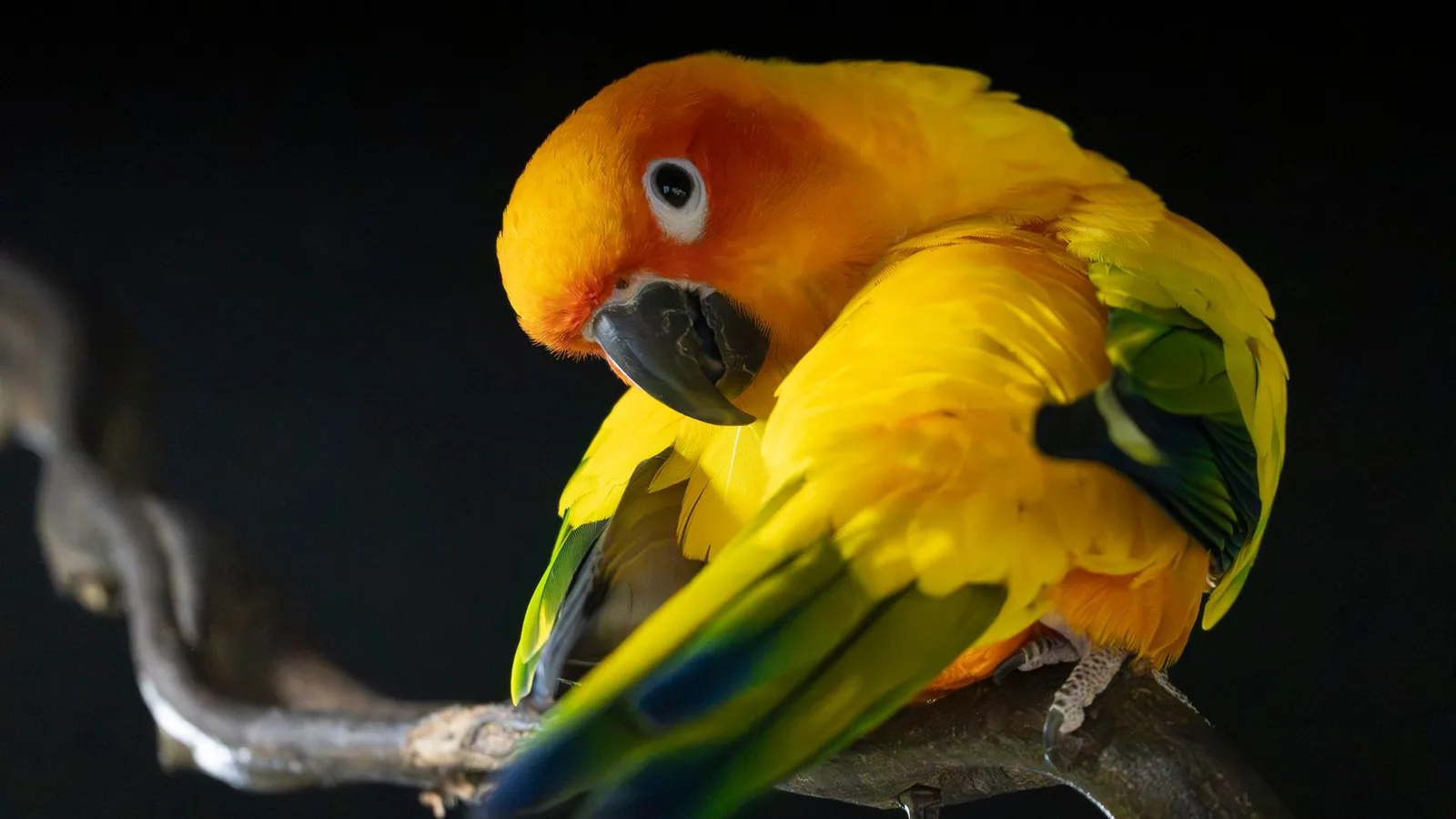
Canary grooming comes down to three routine tasks. Support healthy feather condition with bathing opportunities and a proper diet, trim overgrown nails only when they actually need it, and run a short skin and feather check every week so you catch problems early. Most canaries never need a wing trim, and most grooming happens through daily husbandry rather than hands-on work. A canary is a small bird with a fast metabolism, so restraint and clipping carry more risk than in larger pets and should always be done gently and briefly.
This guide walks through each task step by step, explains the equipment you need, lists the mistakes owners make most often, and gives you clear cut-off points where the job moves from your kitchen table to an avian veterinarian's office.
This article is educational and is not a substitute for veterinary diagnosis or treatment.
At a Glance: Your Canary Grooming Checklist
| Grooming task | How often | What you need | Owner or professional |
|---|---|---|---|
| Bath or misting opportunity | Several times weekly, more during molt | Shallow bath dish or clean spray bottle with room-temperature water | Owner |
| Feather and skin check | Weekly, in good light | Good lamp, your eyes and hands, a notebook for changes | Owner |
| Nail check | Monthly | Small flashlight to see the quick | Owner |
| Nail trim | Only when nails hook or curl | Bird nail clippers or human nail clippers, styptic powder or cornstarch, towel | Owner if confident, otherwise avian vet |
| Full physical exam and nail or beak work | At least yearly, or any time nails are severely overgrown | Avian veterinarian | Professional |
| Cage and perch review for foot and feather health | Weekly | Varied perch diameters, clean cage liner | Owner |
Keep this table on the cage or near your bird care supplies. The single most valuable habit on it is the weekly check, because canaries hide illness well and small changes you notice early are easier to treat.
Why Canary Grooming Is Different From Dog and Cat Grooming
Three facts about canaries shape every recommendation in this article.
Size. A canary weighs roughly 15 to 30 grams. That is less than a handful of coins. The restraint you might use on a cat is dangerous at this scale, because a bird restrained too firmly cannot expand its chest to breathe. Every handling session should be brief, calm, and low pressure.
Feathers are not fur. Feathers are dead keratin structures, like your fingernails, and a canary maintains them through preening and molting rather than through brushing and clipping. Your job is to support that natural maintenance with bathing water, good nutrition, clean conditions, and appropriate light, not to interfere with clippers.
Small birds hide problems. Prey species mask weakness until disease is advanced. This is why the weekly check matters more than any single grooming procedure. Routine handling of the kind described below trains your bird to accept examination and trains your eye to notice what normal looks like for your individual bird.
There is also a growing scientific appreciation for why low-stress, routine handling and careful observation are worth the effort. Welfare researchers have shown that systematic behavioral observation can directly improve husbandry decisions for managed animals, a principle demonstrated even in an endangered lizard species where behavioral assessment guided enclosure management and breeding pair selection [1]. The same logic applies to a small bird in your home. Your notes from grooming sessions become data that help your veterinarian, and calm handling protects your bird from the physiological cost of stress.
How Often to Groom a Canary: Building the Schedule
A common owner question is how often to groom a canary, and the honest answer is that the schedule is mostly built from observation rather than the calendar.
Daily: Provide fresh water, observe posture and activity at a distance, and confirm your bird is eating and producing normal droppings. This five-minute scan is the foundation of canary health monitoring.
Several times per week: Offer a bath or light misting. Bathing frequency can increase during molt when feather maintenance demands rise.
Weekly: Perform the hands-on check described in the skin section below. Look at nails at the same time so you notice growth trends rather than sudden overgrowth.
Monthly: Examine nails specifically against the trimming criteria in the nail section. Most canaries kept with varied natural perches need nail trims only a few times a year or less, while birds with smooth dowel perches may need them more often.
Yearly: Schedule a wellness examination with an avian veterinarian. This is the right time to have nails and beak professionally assessed and to discuss feather condition, diet, and any skin changes you have logged.
Seasonal: During molt, usually once a year in adult canaries, expect heavier feather drop, increased preening, and sometimes a grumpy, less songful bird. Increase bathing opportunities and be patient. A molt that stretches far beyond the normal window, or a bird that loses flight feathers suddenly outside molt, warrants a veterinary visit.
If you are learning how to groom a canary for the first time, start with the weekly check alone for a few weeks before attempting any nail work. Trust builds slowly with small birds.
Feather Care: Bathing, Molt, and Preening Support
Feather condition is the most visible marker of canary health, and most feather care is environmental rather than physical.
Bathing and Misting
Canaries bathe readily when water is offered correctly. Two methods work well, and many owners rotate between them.
- Bath dish. Offer a shallow dish of clean, room-temperature water placed in the cage for a short period, ideally in the morning so feathers dry fully before evening temperatures drop. Remove the dish afterward so your bird does not drink used bath water.
- Misting. Use a clean spray bottle reserved only for the bird, filled with fresh water at room temperature. Mist upward and let the fine spray fall onto the bird like rain rather than squirting the bird directly. Many canaries spread their wings and fluff into the spray.
Let feathers air dry in a warm room free of drafts. Never use a hair dryer on high heat or force a wet bird outdoors, into a breezy area, or near an open window. Birds dry themselves by shaking and preening, and your job is simply to keep the environment safe while they do it.
Feather condition also depends on nutrition. Molt places high demands on protein and nutrient turnover, and avian nutrition resources such as Lafeber Company emphasize that feather growth is one of the most nutritionally demanding processes in a bird's year. Discuss a complete diet appropriate for canaries with your avian veterinarian rather than relying on seed alone, since seed-only diets are a well-recognized problem in pet bird medicine.
What Normal Molt Looks Like
An adult canary typically goes through a full molt once a year, with a gradual, symmetric replacement of feathers over weeks. Expect some increase in scratching, a temporarily duller appearance, loose feathers in the cage, and a bird that may sing less. Symmetry is the key word. Feathers should drop and regrow in an even, balanced pattern.
Abnormal feathering, by contrast, includes sudden patchy loss, feathers that fail to emerge properly, persistent broken or frayed feathers across many molts, or bald areas that persist. These patterns need veterinary evaluation rather than home treatment. The Association of Avian Veterinarians and the Merck Veterinary Manual both identify abnormal molt and poor feather quality as findings that should prompt professional examination, because the underlying causes range from nutritional deficiencies to viral disease and endocrine problems.
When NOT to Clip Wings
Canaries are flight-oriented aviary and cage birds, unlike many parrots kept as companions. Routine wing trimming is generally not part of canary care, and clipping flight feathers removes a canary's primary means of exercise and escape from fright. Ask your avian veterinarian about wing trimming only if a specific safety problem exists in your home, and never trim feathers yourself without professional instruction. Cutting a developing blood feather causes serious bleeding.
How to Trim Canary Nails Safely
Overgrown nails are the most common hands-on grooming task in canary care, and also the one where owners most often get into trouble. The goal of this section is to help you decide whether to trim at home and, if so, how to do it with minimal risk.
Does the Nail Actually Need Trimming?
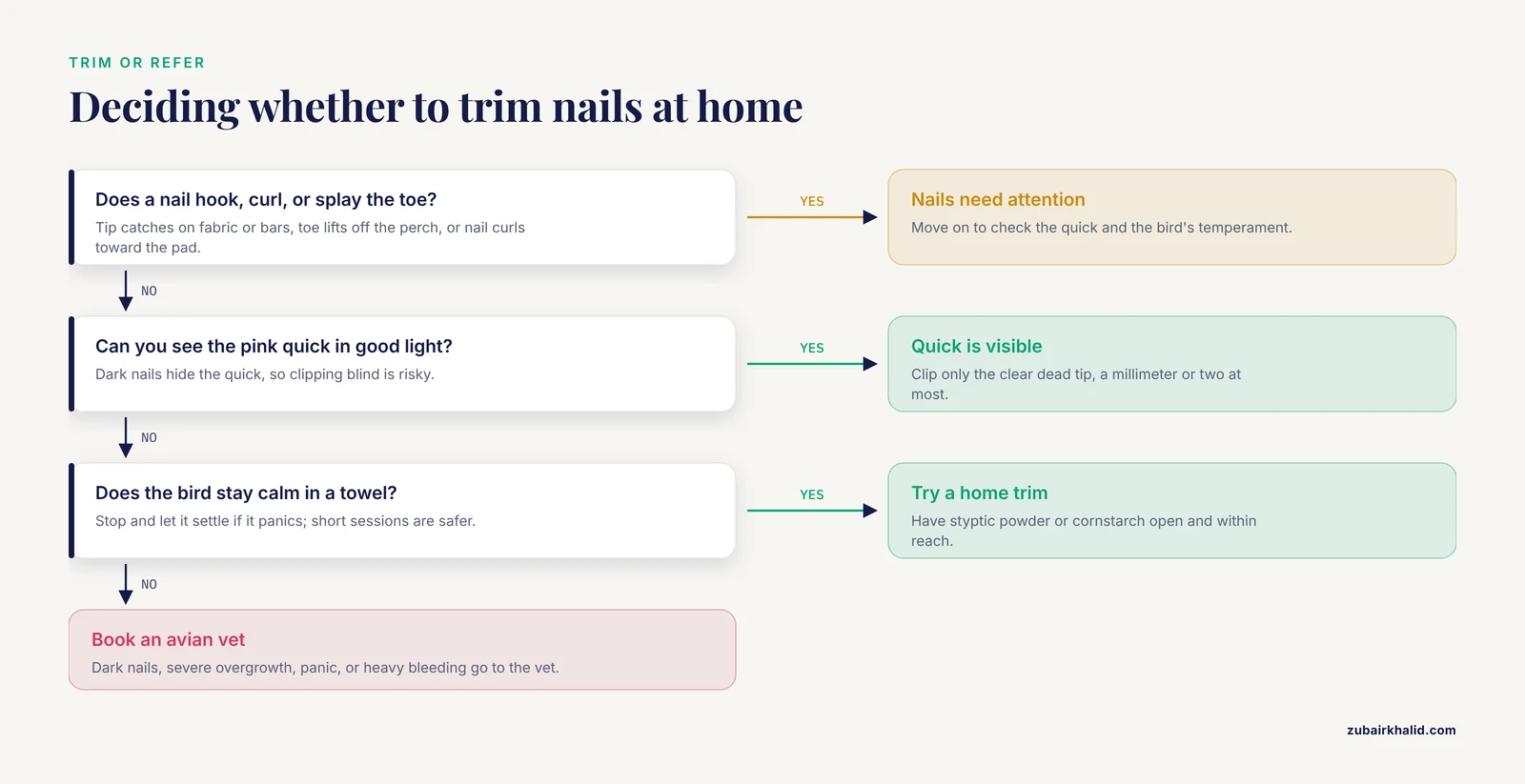
Check monthly against these criteria. Trim only if one or more is present.
- The nail tip curves enough to catch on cage bars, fabric, or your clothing.
- The nail causes the toe to splay upward off the perch when the bird stands.
- The nail begins to curl back toward the foot pad.
If none of these apply, leave the nails alone. Providing natural wood branches, rope perches, and textured perches of varied diameter lets many canaries wear their nails adequately between trims. This perch strategy is cheaper and safer than frequent clipping, and avian veterinarians commonly recommend it as the first line of nail maintenance.
Equipment for Trimming
Gather everything before you catch the bird. A canary should not be held longer than necessary while you hunt for supplies.
- Small bird nail clippers or sharp human nail clippers. Blunt tools crush the nail instead of cutting it cleanly.
- Styptic powder, or plain cornstarch in a pinch, to stop bleeding if you cut too far.
- A small flashlight or a well-lit room. Light lets you see the quick, the pinkish blood vessel inside the nail.
- A soft, clean hand towel for gentle restraint.
- A second person, if possible. One person restrains gently, one trims.
Step-by-Step Nail Trim
- Prepare the space. Close windows and doors, cover mirrors, dim areas outside your work zone, and have the styptic powder open and within reach.
- Restrain gently. Cup the bird in the towel or your hand with the head supported and the body loose enough that the chest can move. A canary should never be squeezed. If the bird panics, stop and let it calm down. Short sessions with a break are far safer than one long struggle.
- Identify the quick. Hold the foot up to the light. In light-colored nails the quick appears as a pink line running down the center. In dark nails you cannot reliably see it, which is a strong reason to let an avian veterinarian handle those birds.
- Trim tiny amounts. Remove only the clear, dead tip beyond the quick, a millimeter or two at most, cutting straight across. Multiple small sessions beat one aggressive trim every time.
- Check each foot. File or clip any sharp edge left by the cut.
- Stop bleeding immediately if it happens. Press styptic powder or cornstarch against the nail tip and apply gentle pressure. Minor quick bleeding usually stops quickly. Bleeding that does not stop within a few minutes, or heavy bleeding, requires immediate veterinary attention.
- Return the bird to a warm, quiet cage and watch it settle, eat, and perch normally over the next hour.
If your canary fights restraint strongly, has dark nails, has ever bled heavily from a trim, or has nails so long they have curled into a circle, make the next trim a veterinary visit. Severely overgrown nails in birds sometimes accompany foot problems, arthritis, or nutritional disease, and those need diagnosis rather than just a clip. Avian veterinarians can also trim nails quickly and safely during a routine visit, and for many owners this is the simplest and safest answer to how to trim canary nails without stress.
The Skin as a Sampling Surface
Your bird's skin is not only something you inspect. It is a biologically active tissue. Research in other managed species has explored epidermal sampling as a non-invasive way to measure physiological markers such as cortisol, and that work has shown both the promise of skin-based monitoring and the importance of standardized technique, because body location and sampling variability can meaningfully change results [2]. For an owner, the practical translation is straightforward. Check the same areas of skin the same way each week, and record what you find. Consistency in your technique turns your observations into information your veterinarian can actually use.
Skin Checks: Catching Canary Skin Problems Early
A weekly skin and feather check takes about five minutes once your bird is used to it, and it is your best early-warning system for canary skin problems.
The Weekly Check Routine
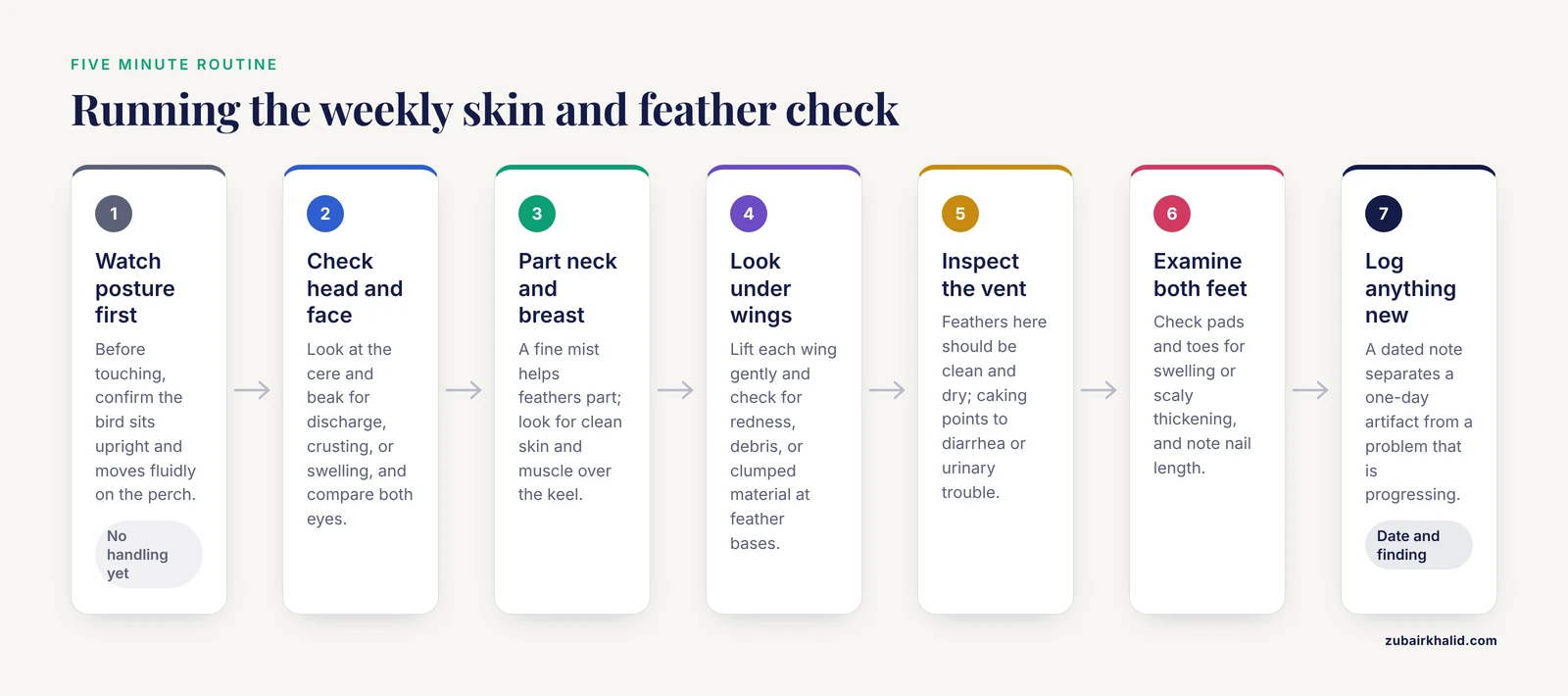
Choose a consistent time, such as before the morning water change, and work in good light.
- Watch posture first. Before touching the bird, watch it on the perch. A healthy canary sits upright, moves fluidly, and alternates resting posture with alert posture.
- Look at the head and face. Check the cere and beak area for discharge, crusting, or swelling. Look at both eyes for clarity and symmetry.
- Part the feathers on the neck and breast. In a healthy canary you should see clean skin, an emerging feather tract, and pectoral muscle without prominent sharp keel bone protrusion. Wetting the feathers slightly with a fine mist helps them part.
- Check under the wings. Lift each wing gently and look at the skin and feather undersides for redness, debris, or clumped material at the feather bases.
- Inspect the vent area. The feathers around the vent should be clean and dry. Caking or matting here signals diarrhea or urinary problems and needs veterinary attention.
- Examine both feet. Look at the foot pads and toes for swelling, scaly thickening, or changes in grip. Check nail length while you are there.
- Log anything new. A simple note of date and finding lets you distinguish a one-day artifact from a progressing problem.
Common Skin and Feather Findings Owners Notice
The list below describes signs to watch for, not diagnoses. Every one of these needs an avian veterinarian to confirm the cause and prescribe treatment.
- Feather cysts. Firm lumps along the wing or body where a growing feather becomes trapped under the skin. Canaries are among the breeds noted for this problem, and some show-color lines are particularly predisposed. Cysts can recur and often need veterinary surgical management.
- Flaky or dry skin. Low humidity, poor diet, or low-grade infection can all produce dull, flaky skin. Environmental and dietary corrections help, but persistent changes deserve an exam.
- Mites and external parasites. Signs include restlessness at night, visible irritation, damaged feathers, and crusty changes on the face or legs. Different mites affect different body areas in birds, and treatment depends entirely on identifying the parasite, so do not apply over-the-counter products before diagnosis.
- Feather destructive behavior and bald patches. Self-inflicted feather loss, symmetrical thinning, or persistent bare areas have many possible causes, from husbandry to disease to behavior. As welfare researchers have documented in other species, changes in activity and behavior pattern can be among the first signals of a welfare problem, and careful behavioral observation is a recognized tool for detecting and correcting those problems [1]. Note when the pulling or over-preening happens and what changed in the bird's environment beforehand.
- Growths and masses. Canaries are known to develop skin and feather follicle tumors, including yellowish xanthoma-like masses, as well as other nodules. Any growing lump needs professional evaluation, and older canaries deserve especially vigilant checks because mass frequency tends to rise with age.
- Poxvirus-type lesions. Crusty or scabby lesions on the face, eyelids, or feet in canaries can reflect poxvirus infection, a significant disease in this species. This is a veterinarian situation, both for the affected bird and for any other birds in the home.
Why Stress Matters for Skin and Feather Health
Chronic stress affects skin, feather quality, immune function, and behavior in birds. The emerging science of physiological welfare monitoring, including work that validated epidermal cortisol measurement as a practical non-invasive biomarker of welfare state in managed animals, reflects a broader shift in veterinary medicine toward treating welfare as something measurable and improvable rather than assumed [2]. At home, the actionable version of that science is simple. Minimize startling events, keep handling brief and predictable, maintain a consistent light and dark cycle, and watch whether grooming-time behavior changes over weeks. A canary that becomes defensive during a previously tolerated weekly check is telling you something, and that change itself is a reason to look closer or call your veterinarian.
Common Canary Grooming Mistakes
- Trimming nails too short to "save time." Cutting into the quick causes pain and bleeding and teaches the bird that handling means hurt, which makes every future grooming session harder.
- Grabbing and restraining for long periods. A small bird held too tightly or too long can overheat and exhaust. Keep any restraint under a couple of minutes and release the bird if it struggles hard.
- Bathing late in the day or in a cold room. Wet feathers plus a chill is a real risk for small birds. Bathe in the morning in a warm, draft-free space.
- Applying mite sprays, oils, or over-the-counter treatments without a diagnosis. Misidentified parasites get mistreated, and small birds are easily harmed by wrong products. Get the diagnosis first.
- Ignoring perch variety. Birds kept on a single uniform dowel perch develop foot and nail problems. Varied natural diameters are passive grooming you get for free.
- Confusing molt with disease, and disease with molt. Symmetric, gradual feather replacement with a bright new coat emerging is molt. Patchy loss, lethargy, fluffed posture, and reduced appetite are illness. When in doubt, call the veterinarian.
- Skipping the yearly exam because the bird "looks fine." Canaries hide disease. The annual avian exam is where early problems get caught, and it is the natural time for professional nail and beak assessment.
Handling, Welfare, and Safety Points
- Wash your hands before and after handling, and never handle the bird with residue of perfumes, smoke, or cleaning chemicals on your skin.
- Keep all grooming sessions in a closed, quiet room. A loose canary in a house with ceiling fans, open windows, other pets, or hot cookware is a genuine emergency waiting to happen.
- Stop any session if the bird opens its mouth, pants, holds its wings away from the body, or stops struggling entirely while looking limp. Those are signs of distress or exhaustion.
- Birds have sensitive respiratory systems. Never groom near aerosol sprays, scented candles, nonstick cookware fumes, or strong cleaners.
- Reward calm behavior. A small food treat or a return to the cage after a calm check teaches the bird that grooming is survivable and predictable.
Limitations and When to Contact a Veterinarian
Individual canaries vary widely in temperament, age, breed type, and health status, and this guide cannot replace an examination by an avian veterinarian. Contact your avian veterinarian promptly, or an emergency avian service after hours, if you observe any of the following.
- Bleeding from a nail or feather that does not stop within a few minutes of pressure and styptic powder.
- Bleeding from a pin feather or anywhere on the body.
- Any growing lump, especially a rapidly enlarging mass.
- Crusty lesions on the face, eyelids, or feet.
- Sudden patchy feather loss, failure of feathers to regrow, or bald areas that persist beyond a normal molt.
- A fluffed, lethargic, tail-bobbing, or floor-sitting bird, or a bird that has stopped eating. In a bird this small, these signs are emergencies and the window for intervention is short.
- Vent area soiling, persistent diarrhea, or a dramatic change in dropping appearance.
- Lameness, a swollen foot, or toes that fail to grip the perch.
- Overgrown nails or beak that you cannot safely manage, or overgrowth that recurs quickly after trims, which can signal underlying disease.
- Any breathing difficulty, open-mouth breathing, or voice change.
An annual wellness visit is the right setting for routine professional grooming help, baseline weight tracking, and discussion of diet and molt. If your regular clinic does not see birds, ask for a referral to an avian or exotics practitioner, and the Association of Avian Veterinarians maintains owner resources for finding avian care.
Frequently Asked Questions
How often should I groom my canary?
Offer bathing opportunities several times a week, run a full skin and feather check weekly, check nails monthly, and schedule a veterinary exam yearly. Actual nail trims are needed only a few times a year for most canaries, and some birds maintained with varied natural perches rarely need trims at all.
How do I trim canary nails without hurting my bird?
Restrain the bird gently in a towel, shine a light from behind the nail to see the pink quick, and clip only the clear dead tip, a millimeter or two at a time. Have styptic powder or cornstarch ready for bleeding, and stop if the bird panics. If the nails are dark, severely overgrown, or your bird will not tolerate handling, have an avian veterinarian do the trim.
What does healthy canary skin look like?
Healthy skin under the feathers is clean, pale to pinkish, smooth, and free of redness, crusts, flakes, and lumps. Feather shafts emerge cleanly without clumped or bloody material at their bases. Compare the same spots weekly so you notice change early.
Do canaries need wing trims?
Generally no. Canaries are flight birds, and wing trims are not routine canary care. Discuss trimming with an avian veterinarian only if a specific household safety problem exists, and never cut flight feathers without training, because cutting a blood feather causes serious bleeding.
Why is my canary losing feathers outside of molt?
Causes range from low humidity and nutritional gaps to parasites, infection, hormonal problems, and feather destructive behavior. Sudden patchy loss, self-plucking, or feathers failing to regrow needs a veterinary exam rather than home treatment. Note the pattern and timing to report to your veterinarian.
Can I give my canary a bath?
Yes. Offer a shallow dish of room-temperature water in the morning, or mist the air above the bird so fine droplets settle like rain. Let the bird air dry in a warm, draft-free room. Remove the bath water afterward and never use hair dryers on high heat.
What are the signs of mites in canaries?
Watch for restlessness at night, intense scratching, damaged or chewed-looking feathers, and crusty thickening on the face or legs. Because different mites affect different areas and need different treatments, get a diagnosis from an avian veterinarian before applying any product.
Should I trim my canary's nails myself or go to a vet?
Trim at home only if your bird tolerates brief handling, the nails are light enough to show the quick, and the overgrowth is mild. Go to a veterinarian for dark nails, severe overgrowth, a bird that panics during restraint, any trim that causes bleeding you cannot stop, or nails that regrow unusually fast, since recurring overgrowth can signal an underlying problem.