Canary Enrichment Ideas That Match Natural Behavior
By Dr. Zubair Khalid, DVM, MS, PhD ·
Good canary enrichment gives your bird daily opportunities to forage, fly, bathe, perch at different heights, sing or respond to song, and observe or interact with a companion on its own terms. A canary that gets all of this in a structured daily routine is far less likely to develop repetitive cage behaviors, feather-damaging habits, or the listless withdrawal that owners often read as "a quiet bird."
This guide explains why enrichment matters for canaries specifically, how to recognize the signs of a bored canary, which toys and setups actually match canary behavior, and how to build a DIY canary enrichment plan you can start today. Every suggestion here is designed for a small, seed-eating, flight-oriented songbird kept as a single pet or pair in a home cage.
Enrichment at a Glance
Use this checklist as your starting point. Each item can be set up in a single afternoon.
| Enrichment Category | What to Provide Today | Frequency |
|---|---|---|
| Foraging | Millet sprig wrapped in unbleached paper, greens clipped between cage bars | Daily |
| Flight space | Longest cage you can accommodate, cleared flight room time | Daily flight time, cage width reviewed once |
| Bathing | Shallow bath dish or wet greens offered in the morning | Several times per week |
| Perch variety | Natural wood branches of differing diameter alongside one standard perch | Rotate monthly |
| Auditory stimulation | Soft conversational radio, or singing in the same room | Daily |
| Visual stimulation | Cage near a window with an escape route from direct sun, safe out-of-cage vantage | Permanent placement |
| Social contact | Daily calm interaction, and consideration of a compatible companion | Daily |
| Novel objects | One new safe item or rearrangement at a time | Weekly or slower for shy birds |
Why Enrichment Matters for Canaries
Animal welfare scientists increasingly use an animal's own decision-making as a window into its emotional state. One tool is the cognitive bias test, which measures whether an animal responds to an ambiguous situation the way it would respond to something good or something bad. Research in domestic canaries demonstrated that this kind of cognitive bias is a workable measure of welfare in the species, meaning that how a canary interprets uncertain situations reflects how it feels about its living conditions [1].
The same research produced a finding with direct consequences for pet owners. Canaries housed in pairs showed a more "optimistic" response to ambiguous situations than canaries housed alone, suggesting that the social context of daily life influences a canary's emotional state [1]. For an owner, this translates into a practical principle. Enrichment is not decoration. It is the sum of the daily conditions that shape whether your bird's world feels predictable and positive or empty and threatening.
Enrichment also matters because individual canaries differ. In the same study, traits such as aggressiveness, neophobia, and obstinacy proved to be stable, repeatable characteristics of individual birds, while boldness and general locomotion varied more with context [1]. In plain terms, some of your canary's reactions to new toys and new situations are personality, not mood. A bird that freezes when you introduce a new swing may be a neophobic individual, not a suffering one. This is why good enrichment plans introduce novelty gradually and watch the individual bird rather than applying one template to every cage.
Signs of a Bored Canary
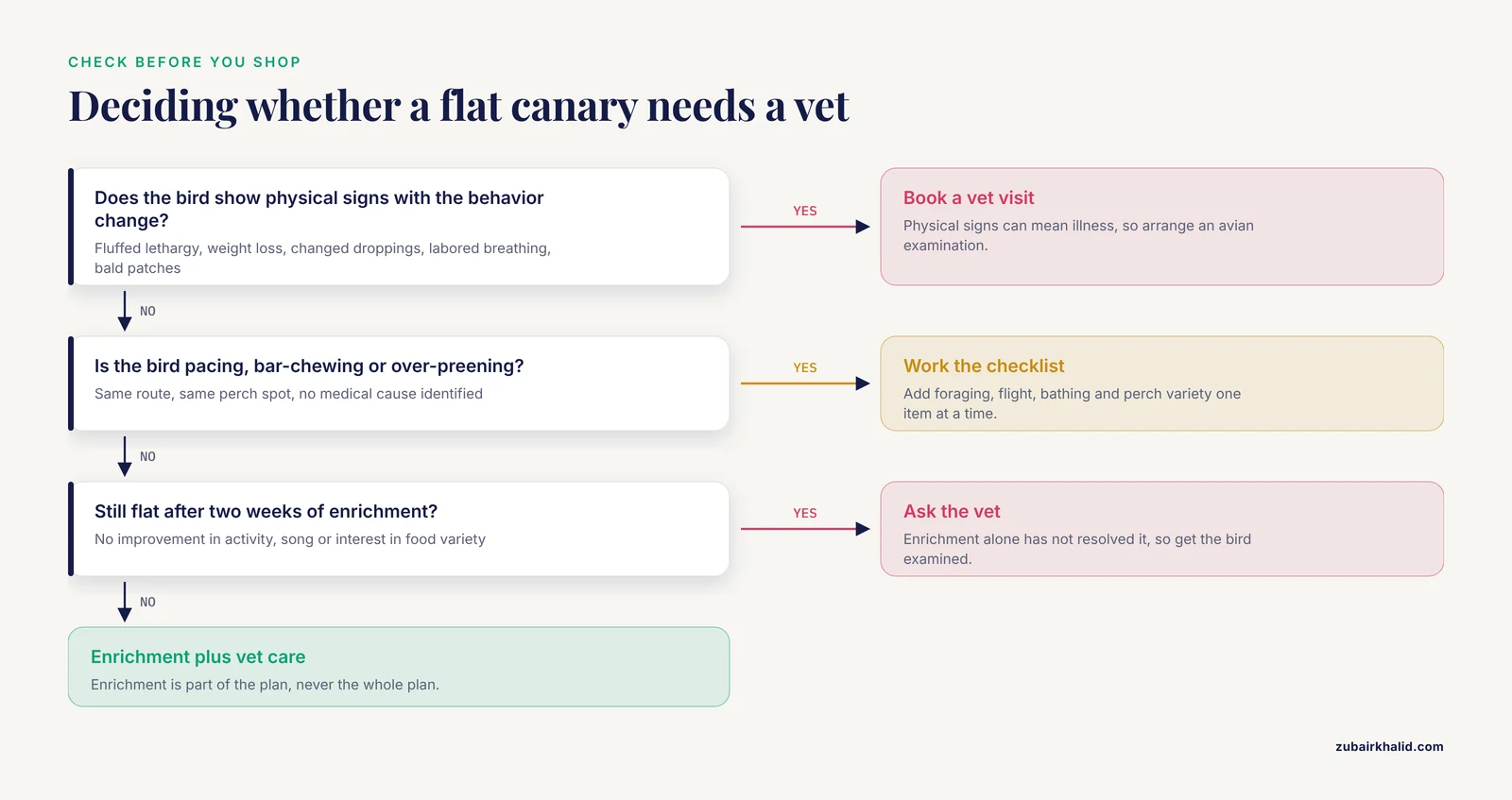
Boredom in canaries rarely announces itself dramatically. Watch for these patterns over several days rather than judging a single afternoon.
- Repetitive pacing or route-walking. The bird travels the same path along the same perches in a fixed sequence, hour after hour.
- Excessive or aimless vocalizing. Song becomes constant, monotonous, or detached from any obvious trigger, or a normally singing male stops singing structured song altogether.
- Feather-directed behavior. Over-preening, plucking, or barbering feathers, particularly on the chest or legs, when no mites, skin disease, or other medical cause has been identified.
- Nibbling at nothing. Chewing at cage bars, food dishes, or the same spot on a perch with no food involved.
- Flat activity profile. The bird shows no burst of activity at dawn, no interest when you enter the room, and moves only to eat and drink.
- Loss of interest in food variety. A canary that ignores fresh greens or new food items it previously sampled.
- Sleeping far more than daylight hours require. Fluffed and dozing through the day when the environment is otherwise quiet and comfortable.
Some of these signs, especially feather damage, lethargy, and appetite change, also occur with illness. If you see them, work through the enrichment checklist and schedule a veterinary examination in parallel. Do not assume boredom explains a sick-looking bird.
Start With Canary Behavior, Not With Products
The best toys for canaries are the ones that answer behaviors the species already performs. A canary is a small granivorous songbird built for short, fast flights between perches, for searching and husking small seeds, for bathing, for singing and listening to song, and for watching its surroundings from an elevated vantage point. Enrichment that asks the bird to do something it has no behavioral machinery for, such as complex puzzle manipulation designed for parrots, usually gets ignored.
Before buying anything, spend one full day simply observing your bird. Note when it is most active, where it prefers to perch, whether it hops or flies between stations, whether it investigates new items immediately or waits, and whether it bathes eagerly or reluctantly. Your observations will tell you which categories of enrichment to prioritize. A neophobic bird, one of the repeatable personality types documented in canaries, needs slow, low-pressure introductions, while a bolder individual may take to a rearranged cage the same day [1].
The Best Toys for Canaries
There is no single best toy for every canary, but there are clear selection criteria. Judge every candidate toy against this list before it goes in the cage.
- Appropriate scale. Canary toys should be small and light. A toy a budgerigar can push around may overwhelm a canary.
- Chewable or manipulable materials. Untreated wood, natural fibers such as sisal or seagrass, palm leaf, paper, and dried grasses give the beak and feet something to do.
- No small swallowing hazards. Avoid toys with tiny bells that can trap toes, loose threads that can tangle feet, glued parts, dyed plastic, or easily shattered acrylic.
- Simple mechanics. Canaries forage and explore, they do not solve multi-step puzzles. Shreddable wraps, clipped greens, and hidden seed dishes work better than latch boxes.
- Placement within reach. Every toy must be reachable from a perch without the bird having to hang or stretch precariously.
- Easy to clean or cheap enough to replace. Foraging items are consumed or soiled. Plan for rotation, not permanence.
Categories worth owning include shreddable palm or seagrass mats, small stainless steel skewers for holding greens, millet spray holders, natural branch perches, a shallow bath house or bath dish, and simple swings or ladders sized for finches and canaries. Avoid mirrors as a default first toy, a point covered in the FAQ below, and avoid anything with a mirror-like surface if your bird begins displaying at it obsessively.
Foraging and Food-Based Enrichment
Food is the most powerful enrichment lever you have, because seed-husking is a core canary activity. In a standard cage, the bird walks to a dish and eats in minutes. Your goal is to stretch that eating time and add searching behavior.
Wrapped millet. Take a millet sprig, wrap it loosely in unbleached paper, and clip it to the bars. The bird must peck through the paper to reach the seed. Increase the wrapping complexity only as fast as your bird succeeds.
Clipped greens. Clip washed leafy greens, such as kale, romaine, or chickweed, between the bars at perch height so the bird must reach, pull, and strip them. This mimics harvesting behavior and adds moisture and micronutrients to the diet.
Scattered seed. Once or twice a week, scatter a portion of the daily seed ration across a clean paper-covered cage floor or into a shallow tray of dried grass or shredded paper. Searching through substrate converts seconds of eating into minutes of natural foraging.
Hidden dishes. Place a small dish of the regular seed mix behind a cage-front plant or under a loosely draped sprig of millet so the bird must move around the cage to find it.
Keep the total daily ration steady. Enrichment changes where and how food is obtained, not how much is eaten. If you use high-fat treats such as spray millet for enrichment, account for them within the overall diet, and discuss the appropriate diet composition for your individual bird with your avian veterinarian. Lafeber Company and other avian nutrition resources consistently emphasize that foraging enrichment should be built on a balanced base diet rather than on treats alone, a framing worth discussing at your bird's next checkup.
DIY Canary Enrichment
Most of the best canary enrichment costs nothing. The DIY projects below use common household materials and follow one rule. If the bird could ingest it, tangle in it, or be injured by it, it does not go in the cage.
Paper forage bundles.
- Take a small handful of the bird's regular seed mix.
- Wrap it in a square of unbleached paper or a coffee filter.
- Twist the ends and tuck them in, then clip or wedge the bundle between cage bars.
- Offer one per day. Expect shredded paper, which is normal and enriching in itself.
Millet kabobs. Thread spray millet, dried chili peppers, or small pieces of dried herbs onto a stainless steel skewer and hang it at perch height. Moving the kabob to a different location each week turns a familiar item into a foraging puzzle.
Fresh-herb bouquet. Tie a bunch of washed, bird-safe fresh herbs, such as basil, cilantro, or dill, and hang it from the cage top. The bird can climb, strip, and bathe in the leaves. Remove wilted material the same day.
Grass tray. Fill a shallow tray with clean, pesticide-free dried grass or coconut fiber and scatter seed through it. Replace the substrate weekly or sooner if soiled.
Branch bundle. Offer well-rinsed, unsprayed branches from bird-safe trees with the bark intact. The bark itself, and the act of stripping it, is enrichment. Replace branches when stripped bare.
Window perch station. Set up a freestanding out-of-cage perch near a window where the bird can watch outdoor activity. Never place the perch in unfiltered direct sun or where a ceiling fan, other pets, or open windows create risk.
Introduce every new item at a distance first. Hang it outside the cage or in the far corner for a day, then move it closer. For a bird with strong neophobia, which is a stable trait in some individuals [1], a two-week introduction curve is normal and not a failure.
Social Enrichment and Companionship
Canaries are not flocking parrots, but they are also not indifferent to company. The experimental finding that pair-housed canaries showed more optimistic responses to ambiguous situations than singly housed birds is the strongest species-specific evidence available that a canary's social living conditions shape its emotional outlook [1]. For owners, this does not mean every single canary must be paired. It means social context deserves deliberate thought.
Practical options, in order of increasing commitment:
- You as the social stimulus. Place the cage in a room where the family spends hours daily. Talk to the bird, move around visibly, and keep a consistent routine. Many single canaries are content in a busy household.
- Visual-only company. A second canary in a separate cage, or even another calm pet bird in the room, provides observation and vocal exchange without physical risk.
- True pair housing. Two compatible birds sharing a cage provides the richest social environment, but compatibility must be established carefully. Same-sex pairs of males may fight outside the breeding season, and forced cohabitation of incompatible birds is a welfare problem, not an enrichment.
If you keep a single canary, compensate deliberately with interaction and auditory enrichment. If you consider adding a companion, discuss quarantine, sexing, and introduction protocols with your avian veterinarian before bringing a new bird home.
Bathing, Flight, and Environmental Variety
Bathing. Most canaries bathe readily and it is a high-value natural behavior. Offer a shallow bath dish with fresh water in the morning, several times per week or daily, and remove it after an hour or two. Some birds prefer wet greens, which they rub against and shake through. Watch what your bird chooses and make that the routine.
Flight. A canary's natural response to disturbance is a fast, short flight. Cage width matters more than height. Choose the longest cage your space allows, with perch spacing that lets the bird fly between stations rather than hop. If you can bird-proof a room, supervised out-of-cage flight in a closed space with covered windows, no ceiling fans, no open water, and no other pets loose in the room gives your canary exercise no cage can replicate. Even a few minutes daily is valuable.
Environmental variety. Rotate perches to change angles and traffic patterns. Move the foraging station. Shift the cage a few feet seasonally so the bird gets a changed view. Rearrangement stimulates exploration, but remember that a repeatable neophobic personality may need slower changes, so introduce one variable at a time [1].
Light and sound. Canaries respond strongly to day length and to ambient sound. Provide a natural daylight cycle with a dark, quiet, covered sleeping period each night. Soft radio, conversation, or even your own whistling during the day provides auditory enrichment. Sudden loud noises are the opposite of enrichment and will startle a bird built for escape flight.
A Daily and Weekly Routine
Knowing how to keep a canary entertained is mostly a scheduling problem. Canaries thrive on predictability, and a routine that alternates activity and rest does more than any single toy.
Every morning
- Serve fresh food and water, and place the foraging item of the day.
- Open or uncover the cage at a consistent time.
- Offer the bath if it is a bath day.
Every day
- Provide at least one active interaction, such as talking, whistling, or a supervised flight session.
- Give several hours of ambient household sound and visual activity.
- Confirm a full dark period for sleep at night.
Every week
- Introduce or relocate one enrichment item.
- Refresh the foraging tray substrate.
- Photograph or note the cage layout so you can rotate setups rather than repeating the same one.
Every month
- Rotate perch types and positions.
- Inspect all toys, perches, and clips for wear, fraying, and rust, and replace as needed.
- Review the overall plan. Is the bird still engaged, or has everything become invisible furniture?
Common Mistakes to Avoid
- Too much too fast. A cage crammed with new items on the same day can overwhelm a neophobic bird and produce fear rather than play.
- Toys that never change. A toy left in place for months stops being enrichment. Rotation is the active ingredient.
- Overfeeding treats as enrichment. Foraging items should come out of the regular ration, not be added on top of it indefinitely.
- Mirrors as a substitute for company. A mirror gives some birds a temporary outlet and others an obsessive one. Watch the individual response and remove mirrors that trigger constant display or aggression.
- Round or tall, narrow cages. A tall narrow cage encourages hopping rather than the short flights a canary is built for.
- Enrichment instead of veterinary care. Feather plucking and lethargy have medical differentials. Enrichment is part of the plan, never the whole plan.
- Unsafe materials. Galvanized hardware, treated wood, frayed rope fibers, and small detachable parts are the usual culprits in toy-related injuries.
Troubleshooting a Bird That Ignores Enrichment
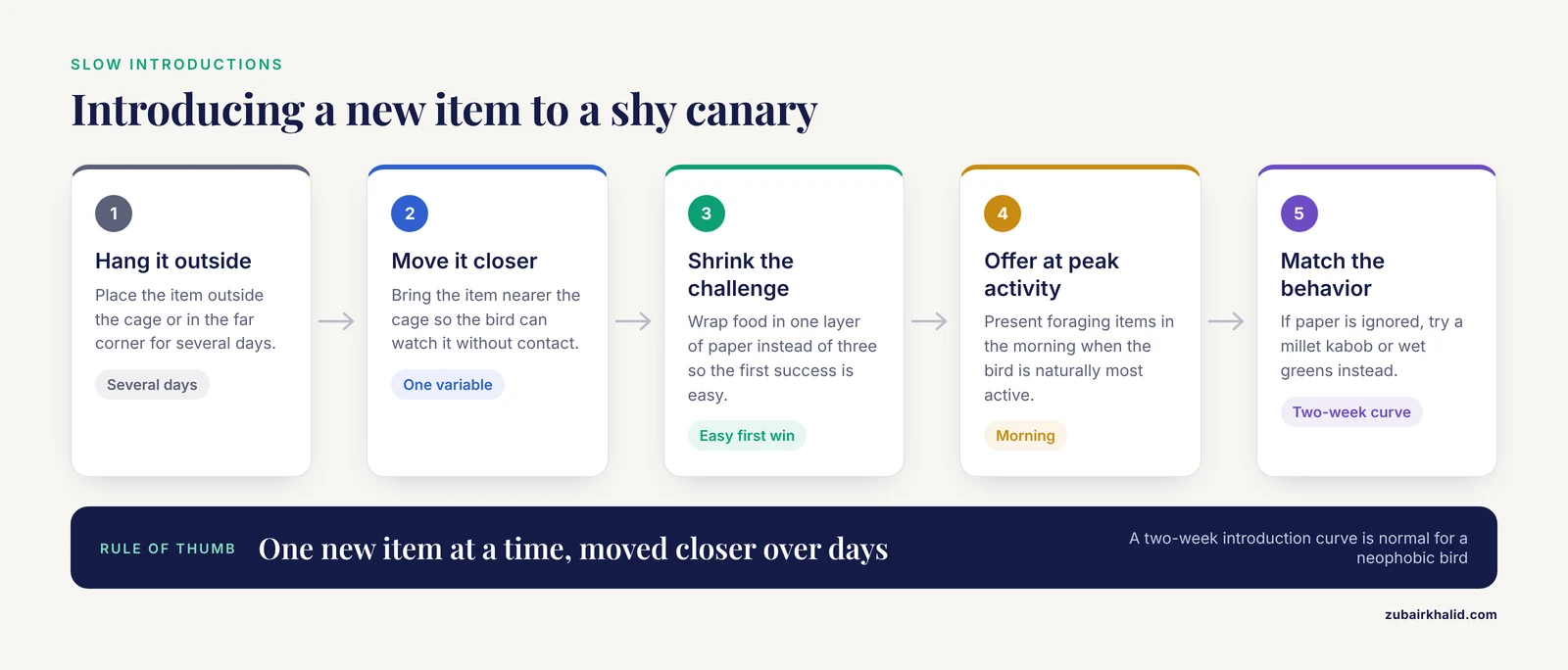
If your canary ignores everything you offer, work through this sequence.
- Slow down. Move the item outside the cage for several days before bringing it in.
- Shrink the challenge. Wrap food in one layer of paper instead of three. Make the first success easy.
- Model the behavior. Handle the greens or the foraging bundle in front of the bird. Interest through observation is common in canaries.
- Change timing. Offer foraging items at the bird's natural peak activity period, usually morning.
- Change the item type. A bird that ignores shredded paper may chase a millet kabob or bathe in wet greens. Match the behavior, not the product.
- Reassess the baseline. A bird that is too ill, too frightened of the room, or too sleep-deprived to explore has a husbandry or medical problem that no toy can fix.
Limitations and When to Contact a Veterinarian
This article is educational and is not a substitute for veterinary diagnosis or treatment. Individual canaries differ in personality and health status, and any enrichment plan for your specific bird should be confirmed with an avian veterinarian, who can examine the bird and account for its full history.
Contact an avian veterinarian promptly if you observe any of the following:
- Feather plucking, bald patches, or self-trauma, which have medical causes that must be ruled out before being attributed to boredom.
- A singing male that stops singing for more than a few days, especially with fluffing, lethargy, or weight change.
- Sitting fluffed on the cage floor, tail bobbing, labored breathing, or open-mouth breathing.
- Discharge from the eyes or nostrils, changes in droppings, or a documented loss of body weight.
- Sudden aggression or behavioral change in a previously steady bird, which can reflect pain or illness.
- Any injury from a toy, perch, or cage component.
For finding a qualified avian practitioner, the Association of Avian Veterinarians maintains a public directory of member veterinarians, and your general practice veterinarian can often refer you to one.
Frequently Asked Questions
How do I know if my canary is bored?
The clearest signs of a bored canary are repetitive route-pacing in the cage, obsessive chewing at bars or the same perch spot, feather over-preening without a medical cause, and a flat activity pattern with no morning burst of energy. Watch across several days, and see a veterinarian if any sign appears alongside lethargy or appetite change.
What are the best toys for canaries?
The best toys for canaries are small, lightweight, chewable items sized for finches and canaries, such as shreddable palm or seagrass pieces, millet spray holders, greens clipped to stainless steel skewers, and natural wood perches of varying diameter. Judge every toy on scale, safe materials, simple mechanics, and easy cleaning rather than on any single product.
Can I make DIY canary enrichment at home?
Yes, most effective DIY canary enrichment uses household materials. Paper forage bundles made with seed and unbleached paper, fresh-herb bouquets hung from the cage top, scattered-seed grass trays, and unsprayed bird-safe branches with bark intact all cost almost nothing. Use only materials the bird cannot ingest, tangle in, or be injured by.
Do canaries need a companion to be happy?
Not every canary needs a cagemate, but social context genuinely influences canary welfare and a carefully introduced compatible companion can improve a bird's outlook. If you keep a single canary, provide daily interaction, ambient household activity, and visual or auditory company instead, and consult your avian veterinarian before acquiring a second bird.
How much out-of-cage time does a canary need?
There is no universal number, but daily supervised flight in a fully bird-proofed closed room, even for a few minutes, gives exercise a cage cannot provide. Balance flight time against the stress some canaries experience being caught and handled, and prioritize a wide cage for flying between perches on days out-of-cage time is not possible.
Are mirrors good for canaries?
Mirrors help some birds and harm others. A mirror may give a single canary a temporary social outlet, but it can also trigger obsessive displaying, courtship behavior, or aggression in an individual. Introduce a mirror briefly, watch the response over a week, and remove it if your bird guards it, displays at it constantly, or becomes irritable.
How often should I change my canary's toys?
Rotate or reposition at least one enrichment item weekly, and do a full perch and toy rotation monthly. Left in place for months, any toy stops stimulating exploration. Introduce changes one at a time, because some canaries have a stable neophobic temperament and need slower introductions than others.
When should I talk to a vet about my canary's behavior?
Contact an avian veterinarian whenever behavioral change appears with physical signs, including feather plucking with bald patches, a singing male going silent, fluffed lethargy, weight loss, or changed droppings. Also consult a vet before pair-housing decisions, diet changes, and any situation where enrichment alone has not resolved a behavioral concern.
Further Reading
- Tracking epidermal cortisol and oxytocin in managed killer whales as potential non-invasive physiological welfare indicators.
- Behavior as a tool for welfare improvement and conservation management in the endangered lizard (Gallotia bravoana).