How to Handle a Bird That Won't Step Up
By Dr. Zubair Khalid, DVM, MS, PhD ·

If your bird won't step up, stop asking for the behavior and rebuild it from scratch. Step-up is a trained, voluntary response, not a reflex, and a bird that refuses is usually telling you one of three things. Either the bird never fully learned the behavior, something about the way the request is being made frightens or hurts the bird, or the bird is physically uncomfortable. The fix depends on which of those three is true. In practice, most refusals improve with a short pause on all handling requests, a review of the bird's environment and daily routine, and a patient return to basics using food rewards and short, calm sessions. A minority of refusals are medical, so any sudden change in willingness to step up, especially in a bird that has done it reliably for years, deserves a conversation with an avian veterinarian.
This guide walks through the common causes of step-up refusal, how to fix the training with a step-by-step plan, the cage setup and daily care foundations that make training possible, the mistakes that stall progress, and the specific signs that mean you should call your veterinarian.
At a Glance: Your First 7 Days
Use this checklist to start today. Each item is expanded in the sections below.
| Step | Action | Time Frame |
|---|---|---|
| 1 | Pause all step-up requests and forced handling | Days 1 to 3 |
| 2 | Watch for signs of illness (fluffed feathers, reduced appetite, less vocalizing, staying at the cage bottom) | Days 1 to 3, ongoing |
| 3 | Book an avian vet exam if the refusal is sudden or paired with other changes | As soon as practical |
| 4 | Review cage setup, perch variety, and cage location | Day 2 to 4 |
| 5 | Begin trust sessions at a distance, no handling required | Days 3 to 7 |
| 6 | Introduce a food reward and a target or hand presentation at a comfortable distance | Days 5 to 10 |
| 7 | Reshape the full step-up only after the bird moves toward your hand willingly | Ongoing |
If your bird bites, lunges, or panics when you approach, do not push through. Fear-based refusal resolves with distance and repetition, not pressure.
Why a Bird Won't Step Up: The Common Causes
Diagnosing the cause is the first half of fixing the problem. A bird that has never learned step-up needs teaching. A bird that used to step up and stopped needs evaluation. These are the causes seen most often in companion parrots, listed roughly from most common to least.
The behavior was never fully trained
Many owners assume a bird that once stepped onto a hand "knows" step-up. In reality, the behavior is context specific. A bird may step up reliably inside the cage but refuse outside it, or vice versa, because the surroundings, the surface you are asking the bird to step onto, and the bird's confidence all change the picture. Birds also discriminate between people. A bird that steps up for one family member and refuses another has learned two different histories with two different hands.
Fear or a negative experience
A single rough capture, a fall caused by a clumsy hand position, a trip to the vet that involved a towel, or a startling event near the hand can all teach a bird that hands predict bad outcomes. Fear shows up as leaning away, raising feathers, lunging, biting, or simply turning the head away when you present your hand. Fear-based refusal is common and is the main reason forced handling makes things worse.
Pain or illness
Birds mask disease well, and reluctance to move or grip is sometimes the first visible sign of a problem. Sore feet, arthritis, wing injuries, abdominal discomfort, and other internal conditions can make stepping onto a hand uncomfortable or simply too effortful. This is why a sudden refusal in an otherwise cooperative bird should trigger a health review before a training review. The Association of Avian Veterinarians recommends annual wellness examinations for pet birds precisely because early signs of illness are subtle and owners often miss them at home.
Territorial or cage-bound behavior
Some birds defend the cage itself. They step up happily when they are on a play stand across the room but become aggressive or frozen when your hand enters the cage. This is a location problem, not a training failure. The solutions differ from those for fear or lack of training, which is why identifying where the refusal happens matters.
Hormonal or seasonal mood
Reproductive hormone surges change how some birds interact with hands, particularly in birds kept on long light cycles or in environments that encourage nesting behavior. A bird that is suddenly cage protective, more vocal, or more reactive each spring may be responding to season rather than to your training.
Never trained at all
Hand-fed baby birds are not born knowing step-up. Many adult birds rehomed from less interactive settings simply have no history with the cue. These birds need the full protocol from the beginning, which takes longer but follows the same path.
The Foundations: Cage Setup and Daily Care That Make Training Possible
Training does not happen in a vacuum. A bird whose basic environment and daily routine are wrong will resist handling no matter how good your technique is. Before you retrain step-up, walk through these foundations.
Bird cage setup review
Walk up to your bird's cage and evaluate it the way a stranger would.
- Perch variety. Offer perches of different diameters and textures so the bird's feet stay healthy. Foot comfort directly affects willingness to step onto any surface, including your hand.
- Perch placement. Perches should not sit directly over food or water dishes. The main perch should allow the bird to stand fully upright without the tail touching cage bars or the head brushing the top.
- Cage location. A cage placed against a wall with a view of the room gives the bird security. A cage in constant foot traffic, next to a blaring television, or in a draft invites chronic stress.
- Access. If the only way out of the cage involves you reaching in and grabbing, the cage itself becomes a trigger. A large door or a top opening that lets the bird exit on its own terms changes the entire dynamic.
- Food and water. Dishes should be easy for the bird to reach and easy for you to change without intrusive handling.
These are the basics an avian veterinarian or a qualified bird behavior consultant will ask about first, and the Merck Veterinary Manual's pet bird resources emphasize that appropriate housing and daily environment are the foundation of companion bird health and behavior.
A working parrot care checklist
Use this list as a monthly self-audit. Any unchecked item can undermine handling progress.
- Fresh food and water daily, dishes cleaned regularly.
- A varied diet appropriate to the species, discussed with your avian veterinarian.
- Daily opportunity for out-of-cage activity in a bird-safe room.
- A consistent sleep area with an established dark, quiet period overnight.
- Regular bathing or misting opportunity.
- Toys rotated and replaced when worn.
- Foraging opportunities, meaning food presented in ways the bird must work to obtain.
- Some form of daily positive interaction, even if it is only calm talking from across the room.
- An annual avian wellness exam on the calendar.
- No exposure to smoke, nonstick cookware fumes, scented sprays, or other known household hazards.
A 2026 global survey of 619 companion parrot guardians found that fewer than half of parrots received cardiovascular exercise through flight (48.9 percent), foraging-based activities (46.2 percent), or positive reinforcement training (34.6 percent), even though nearly all guardians reported intentionally providing environmental enrichment once it was defined for them [1]. In other words, most parrot owners want to do the right things, but structured activities like training are the ones most often missing. Step-up training sits exactly in that gap. It is free, it takes minutes a day, and it doubles as both exercise for the bird and a handling safety tool for you.
The same survey found that most guardians, 65.4 percent, reported at least one behavior concern, with aggression, compulsive behaviors, and fearfulness frequently appearing together [1]. A bird that refuses to step up fits that broader picture. Refusal is often the visible edge of a fear or trust problem, which is why the plan below starts with trust rather than with the hand.
How to Fix Step-Up Training: The Step-by-Step Plan
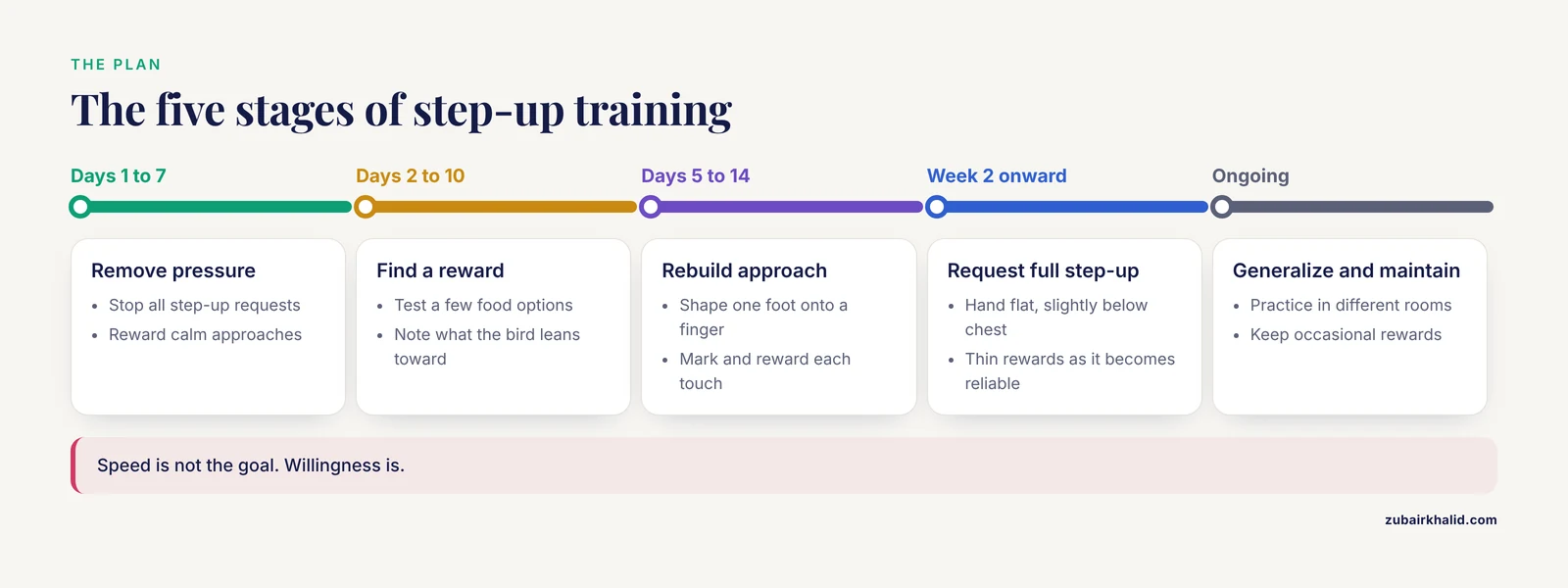
This protocol works for birds that never learned step-up, birds that regressed after a bad experience, and birds that refuse in specific locations. Adjust the pace to your bird. Some birds move through the stages in days. Others need weeks. Speed is not the goal, willingness is.
Stage 1: Remove pressure and reset the relationship (days 1 to 7)
Stop all requests for step-up, all grabbing, all towel handling at home, and any approach that makes the bird lean away. You are teaching the bird that your presence near the cage predicts good things and never predicts being cornered.
- Sit or stand near the cage at a distance where the bird stays relaxed. Relaxed looks like normal posture, normal preening, eating, playing, and soft vocalizing.
- Offer a small food reward through the bars or dropped into a dish whenever you approach, so your approach becomes the signal that something good is coming.
- Keep sessions to a few minutes, several times a day. Short and frequent beats long and intense.
If the bird shows fear at any distance, you have started too close. Increase the distance until the bird is comfortable, then close it in small increments across sessions.
Stage 2: Identify a high-value reward (days 2 to 10)
Every step-up session should be paid for. Experiment to find what your bird works for. For many parrots this is a small piece of a favorite food, such as a sunflower seed or a bit of fruit, held back from the regular diet so it keeps its value. For some birds, a favored toy, a scratch on the head, or verbal praise works as well or better. Test a few options and note which one makes the bird lean toward your hand.
If you use food rewards, keep the overall diet balanced. Lafeber's avian nutrition resources stress that treats for training should come out of the bird's total daily intake rather than being added on top endlessly, so discuss treat allowances and overall diet with your avian veterinarian during a wellness visit.
Stage 3: Rebuild the approach (days 5 to 14)
Once the bird takes rewards calmly near your hand, begin shaping the movement.
- Hold the reward so the bird must reach slightly past your hand's edge to get it. Do not lure the bird onto your fingers yet. You are teaching that hands near the bird mean food, never capture.
- Gradually position the reward so the bird must place one foot on a stationary finger or on a perch you are holding to reach it.
- Mark the moment the foot touches the target surface. A calm, consistent word such as "good" said at the exact moment works, or a clicker if your bird is not sound sensitive. Deliver the reward within a second.
- Repeat in sets of five to ten reps. End the session while the bird is still eager, not after the bird has stalled.
Stage 4: Request the full step-up (week 2 onward, variable)
When the bird reliably places one foot on your stationary finger or a held perch, present your hand the way you ultimately want the step-up to look, with your fingers held flat and the hand slightly below the bird's chest level. Pair the presentation with a short cue word such as "up." Reward every successful step at first, then thin the rewards to every second or third step as the behavior becomes reliable.
Key handling details:
- Present the hand from the front and slightly below, never from above and behind, which mimics an aerial predator approach.
- Keep your hand steady. A wavering hand teaches birds to distrust the perch.
- Practice in multiple locations, first near the cage, then on a neutral perch across the room. A behavior is not trained until it works in more than one spot.
- If the bird hesitates, freeze rather than push. Wait a beat, then re-present. Pushing the hand into the bird's chest to force the step is the single most common mistake and the fastest way to re-create the problem.
Stage 5: Generalize and maintain
Once step-up is reliable, maintain it with occasional rewards rather than expecting it free forever, and practice it in different rooms, with different family members, and at different times of day. Step-up is not a trick you train once. It is a cooperative behavior you keep alive with small, consistent payments.
Common Mistakes That Stall Progress
Most failed step-up training traces back to one of these errors.
- Starting at full difficulty. Asking for the complete behavior from a fearful bird instead of shaping it in small steps.
- Forcing the step. Pressing a hand into the bird's chest until the bird complies. This produces compliance under protest and erodes trust, and in a frightened bird it produces bites.
- Grabbing the bird as a consequence. Any history of the hand ending in capture makes the hand a threat, and the bird will avoid it accordingly.
- Sessions that run too long. Birds lose focus quickly. Three two-minute sessions beat one fifteen-minute grind.
- Inconsistent cues. Different family members using different words, tones, or hand positions fragments the training. Agree on one cue and one hand presentation.
- Punishing refusals. Scolding, squirting water, or shaking the cage after a refusal teaches the bird that training sessions predict unpleasantness. The refusal rate goes up, not down.
- Ignoring the medical possibility. Spending weeks on training with a bird whose refusal is actually caused by a sore foot or an internal problem. This is why a sudden refusal warrants a vet exam before a long training campaign.
- Training only at the cage. If step-up is practiced only inside the cage, territorial birds may never generalize. Practicing on a neutral perch removes the territory factor.
Troubleshooting Specific Situations
The bird steps up but immediately flies off or bites
The bird may be tolerating the step but not wanting the prolonged contact. Shorten the duration. Step the bird up, reward immediately, and step the bird back down within a second or two. Slowly extend the time as the bird chooses to stay. If biting accompanies the step, examine what happens right after the step, since many birds learn to bite as a way to end an interaction they did not want.
The bird only refuses inside the cage
Treat this as cage territoriality. Do all early training on a neutral perch or a play stand away from the cage. Open the cage door and let the bird come out on its own, then train outside the cage. Over weeks, gradually practice approaches near the cage, but never make the cage itself the training battleground.
The bird steps up for one person and not another
Each person builds their own relationship. The refused person should run the full protocol from Stage 1, including feeding favorite treats and running short trust sessions. Do not hand the bird from the favored person to the refused person until the refused person has independently rebuilt the behavior.
The bird froze mid-training and will not move
Frozen posture, wide eyes, and raised feathers mean the session is over. Back up to the last distance or step where the bird was comfortable and resume there next time. Pushing a frozen bird is how bites and lasting fear happen.
Progress stops after initial improvement
Plateaus are normal. Check three things first. Is the reward still valuable, or has the bird tired of it. Are the steps small enough, or did you jump from touching the finger to a full step-up in one leap. Is the bird healthy, because plateaus that coincide with feather changes, appetite changes, or reduced activity belong in a vet exam rather than more training sessions.
Welfare and Safety Points
- Never force a bird onto your hand by pressing into its chest, and never grab a bird that is refusing. Both create the exact fear problem you are trying to solve.
- Watch body language throughout. Leaning away, raised feathers, a fanned tail, lunging, and rapid escape attempts all mean the current step is too hard. Scale back.
- Keep wings intact and flight supervised. Clipping wings to make a bird easier to handle does not build the trust that voluntary step-up requires, and it removes the bird's ability to choose. Discuss wing trimming, if you are considering it at all, with an avian veterinarian who can explain the welfare implications for your specific bird.
- Train with the door closed and windows shut in a bird-safe room. A startled bird that bolts off your hand can be injured long after the training session ends.
- Quit while you are ahead. Ending sessions on a success, with the bird still engaged, keeps training something the bird looks forward to.
The environmental enrichment survey of parrot guardians found that human interaction was the enrichment category birds were most often perceived to prefer, ahead of food-based items and destructible toys [1]. Training sessions are human interaction with a purpose. Done well, step-up training is enrichment for the bird, not just a convenience for you, and reframing it that way changes how patiently most owners run the sessions.
Limitations and When to Contact a Veterinarian
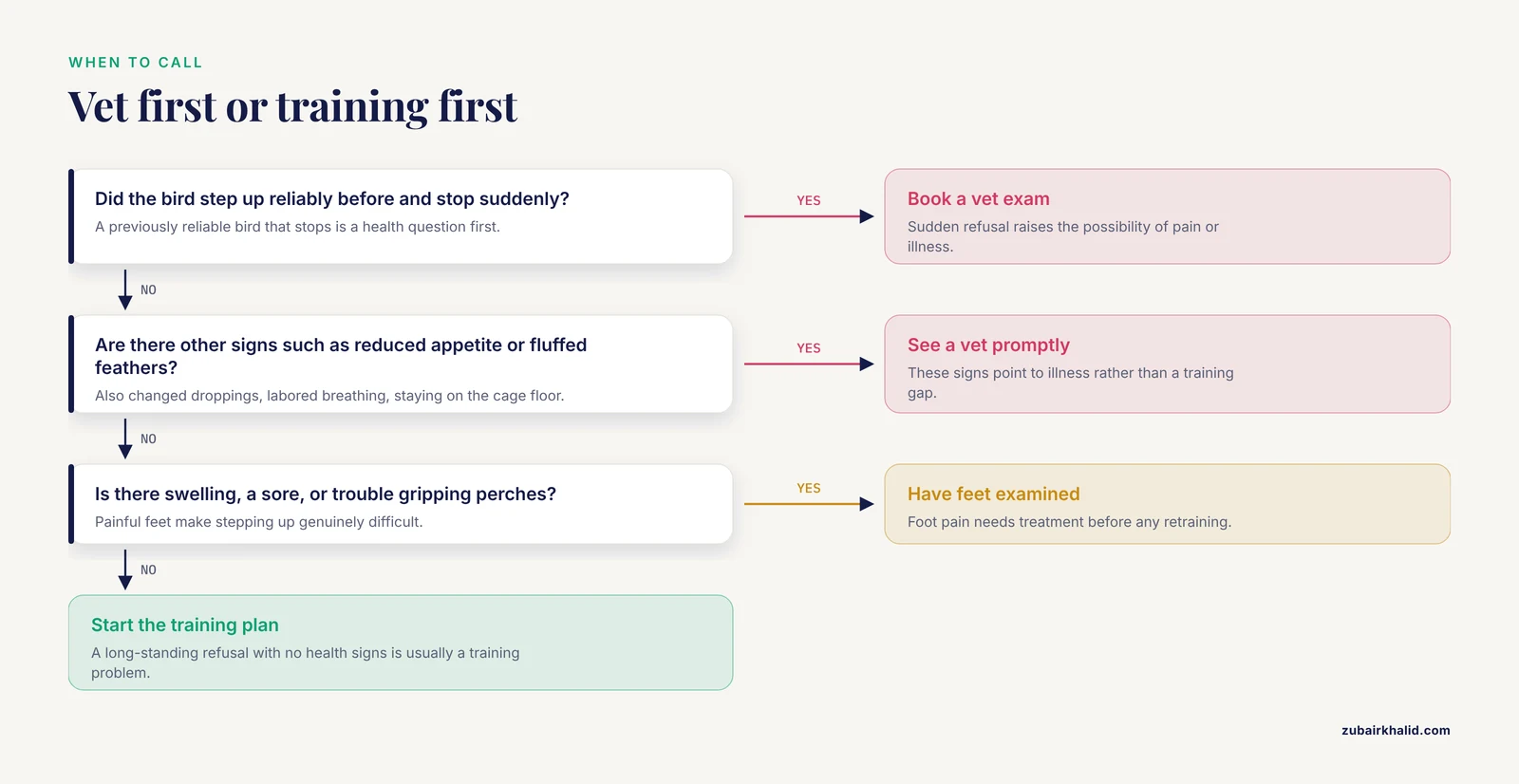
Individual cases vary, and the guidance here cannot replace a hands-on examination by a veterinarian. Contact an avian veterinarian promptly if any of the following apply.
- The refusal is sudden in a bird that previously stepped up reliably. This pattern raises the possibility of pain or illness and should be evaluated before anything else.
- The refusal comes with reduced appetite, weight loss, fluffed feathers for prolonged periods, staying on the cage floor, reduced droppings or changed droppings, labored breathing, discharge from the eyes or nostrils, or a wing held abnormally.
- The bird has visible foot problems, such as swelling, sores, or an inability to grip perches, since painful feet make stepping up genuinely difficult.
- The bird bites hard enough to break skin or draws blood during attempts, particularly if this is a change from its normal behavior, because escalating aggression has medical, hormonal, and behavioral causes that a veterinarian can help sort out.
- You see no meaningful progress after several weeks of consistent, low-pressure work, or the bird's fear is getting worse rather than better. A certified avian behavior professional working alongside your veterinarian is the right next step.
Routine annual wellness exams with an avian veterinarian, which the Association of Avian Veterinarians recommends for all pet birds, are the best time to raise handling problems. Bring a short video of your step-up attempts. Veterinarians can often spot the hand position, cue timing, or body language issue in thirty seconds of video that owners cannot see from inside the interaction.
Frequently Asked Questions
Why is my bird suddenly refusing to step up?
A sudden refusal most often means the bird is experiencing pain, illness, fear from a recent negative event, or a hormonal shift. Check for other changes such as reduced appetite or altered droppings, and contact an avian veterinarian before restarting training, since a previously reliable bird that suddenly stops is a health question first and a training question second.
How long does it take to retrain a bird that won't step up?
There is no fixed timeline. A confident bird with a small gap in training may recover in days to a couple of weeks, while a fearful bird or a bird with years of forced handling history may need several months of patient work. Consistency of short daily sessions matters far more than total elapsed time.
Should I force my bird to step up if it refuses?
No. Forcing the step by pressing into the bird's chest or grabbing the bird teaches it that hands mean capture, which deepens the refusal and often produces biting. Voluntary step-up built with rewards is safer for you, safer for the bird, and far more durable.
Can an older bird learn to step up?
Yes. Age alone does not prevent a bird from learning step-up. Older birds and rehomed birds with no training history can learn the behavior through the same shaping process, though they may need more time at the trust-building stages. Pain from conditions like arthritis is more common in older birds, so a veterinary check is worthwhile before starting.
What rewards work best for step-up training?
The best reward is whatever your individual bird will reliably work for, usually a small piece of a favorite food held back from the regular diet, and for some birds a head scratch or favored toy works too. Test several options, keep treats within a balanced overall diet, and ask your avian veterinarian about appropriate treat allowances for your bird's species and health status.
Why does my bird step up and then bite me?
Birds most often bite after stepping up because they want the interaction to end, they were coerced into the step rather than choosing it, or they are startled by something that happened after the step. Shorten the time on the hand, reward the step immediately, return the bird to a perch within a couple of seconds, and gradually extend the duration only as the bird chooses to stay.
Does cage setup affect step-up training?
Yes, significantly. Poor perch variety, dishes positioned under perches, a cage in a high-stress location, and an exit routine that requires reaching in and grabbing all work against training. A cage that lets the bird exit on its own terms, comfortable perches, and a calm location make the bird far more willing to interact with your hand.
When should I take my bird to a vet about step-up refusal?
Contact an avian veterinarian promptly if the refusal is sudden, if it occurs alongside appetite loss, fluffed posture, changed droppings, labored breathing, or reduced activity, or if you see any sign of foot pain or injury. Any hard bite that is new behavior also warrants an exam, and an annual avian wellness check is the right routine place to discuss handling problems.
This article is educational and is not a substitute for veterinary diagnosis or treatment.