Bird Toy Rotation Schedule: Template and Examples
By Dr. Zubair Khalid, DVM, MS, PhD ·

A bird toy rotation schedule is a repeating plan for swapping a few toys in and out of the cage on fixed days. The goal is steady novelty without sudden upheaval. A starting point that works for most households is a weekly partial swap, a midweek foraging refill, and a bigger monthly change that rearranges the layout.
This guide gives you a copyable template, worked examples for small birds and large parrots, safety and cleaning checks, and the bird cage setup details that make rotation easier. The Association of Avian Veterinarians treats environmental enrichment as part of routine preventive care for pet birds, alongside diet, exercise, and regular wellness examinations. An unchanging cage environment is a recognized contributor to boredom-related problems such as feather damaging behavior and excessive vocalization. A written schedule turns that principle into a habit you can run on autopilot.
This article is educational and is not a substitute for veterinary diagnosis or treatment.
Bird Toy Rotation at a Glance
Here is the whole system in eight actions you can start today.
| Step | What to do | When |
|---|---|---|
| 1 | Pull every toy from the cage, sort by category, discard damaged items | Once, then quarterly |
| 2 | Label storage bins by category (chew, foraging, foot, climb, puzzle) | During setup |
| 3 | Choose a fixed rotation day and add it to your calendar | Once |
| 4 | Swap a few toys for rested items from storage | Weekly |
| 5 | Refill or rewrap foraging devices | Midweek |
| 6 | Inspect every toy for damage, clean, and air dry | Weekly |
| 7 | Change the layout, rest half the toys, audit hardware | Monthly |
| 8 | Note what your bird ignored or loved, adjust the next cycle | Ongoing |
Why a Rotation Schedule Helps Pet Birds
Parrots are long-lived, intelligent animals with strong drives to chew, climb, search, and solve problems. Lafeber's avian care resources emphasize that wild parrots spend a large share of each day locating and processing food, and pet birds keep that drive even when meals arrive in a bowl. Toys, foraging devices, and varied cage furniture give captive birds a safe outlet for those behaviors.
When that outlet is missing, predictable problems appear:
- Feather damaging behavior. Plucking and overpreening have many possible medical and emotional causes, and under-stimulation is one recognized contributor. Any bird that starts picking feathers needs an avian veterinary examination before you treat the problem as purely environmental.
- Excessive screaming and calling. A bird with nothing to do often fills the silence loudly.
- Stereotypic movements. Repetitive pacing, head bobbing, or bar chewing can develop in under-enriched cages, as avian behavior references including the Merck Veterinary Manual describe.
- Frustration behaviors. Chewing trim, nipping cage mates, and irritability during handling often ease once daily occupation improves.
Rotation is the mechanism that keeps enrichment working. Birds habituate to static surroundings, so a toy left in place for months becomes wallpaper. Novelty restores interest, while keeping one or two familiar anchor items prevents the stress of a cage that changes completely overnight. The schedule below aims between those two extremes.
How Often Should You Rotate Bird Toys?
No single interval is mandated, and any schedule, including this one, is a framework to adapt rather than a prescription. Three rhythms layered together cover most birds:
- Weekly partial swap. Replace one to three toys with rested items from storage. This is the backbone of the schedule.
- Midweek foraging refresh. Refill, rewrap, or reposition foraging devices so food-finding stays challenging.
- Monthly deep rotation. Rest half the toys, return earlier retirees, rearrange perches and toy zones, and inspect hardware closely.
Adjust the cadence to the bird in front of you:
- Small birds such as budgerigars and cockatiels often engage quickly with new items and tire of them at a similar pace, so steady weekly changes keep interest high.
- Large parrots, including Amazons, cockatoos, and macaws, can demolish a chewable toy within days. Plan shorter gaps between chew-toy swaps and keep a deeper spare stock.
- Age matters. Young birds usually investigate new objects readily, while adults set in their routines may need gradual introductions.
- Temperament matters as much as species. African greys in particular have a reputation for wariness around novelty, and slower pacing pays off with cautious individuals.
If a swap triggers fear, slow down. If your bird ignores toys for weeks, the fix is usually toy type, texture, or placement rather than rotation speed.
Building the Rotation Schedule Step by Step
Six steps take you from a pile of random toys to a system that runs itself.
Step 1: Inventory and Sort Every Toy
Take every toy out of the cage and sort it into five categories: chew and shred, foraging, foot toys, climb and swing, and puzzle or mechanical. Discard anything with rust, frayed rope, cracked plastic, missing parts, or a history you cannot verify. While sorting, note which toys your bird actually uses, because those become your anchor items. A quick photo of the sorted piles gives you a baseline inventory.
Step 2: Set Up Storage and Staging
Resting toys need a clean, dry home between deployments. A lidded plastic bin per category works well, labeled with masking tape. Wash each toy before it enters storage and again before it returns to service. Keep a second small bin for items awaiting repair or disposal, so damaged goods never drift back into the cage by accident.
Step 3: Choose a Rotation Day and Cadence
Pick a fixed day, such as Sunday morning, and attach it to an existing habit so it sticks. Predictability helps you maintain the system, and gentle regular change suits most birds better than sporadic overhauls. Write the day on a calendar or set a recurring phone reminder. Consistency, not intensity, is what makes the schedule work.
Step 4: Introduce New Toys Gradually
Presentation decides whether a new item gets explored or feared. Hang the toy on the outside of the cage or low in a corner first, let your bird approach at its own pace, and pair first contact with a favored treat. Move the item to its final position after your bird shows relaxed interest. In multi-bird homes, watch for guarding or squabbling and give each bird room to opt in.
Step 5: Inspect, Clean, and Retire
Before any toy goes back into the cage, check knots, links, chains, cords, and seams. Trim frayed strands, tighten loose hardware, and discard chewed-through parts. Wash hard toys with mild soap, rinse well, and let them dry completely before storage. Treat soft wood, paper, cardboard, and natural fiber items as consumables. Once they are substantially destroyed, retire them rather than trying to sanitize them.
Step 6: Track Responses and Adjust
Keep a one-line log for each swap: date, toys in, toys out, and a quick engagement note. Within a few cycles, patterns appear. You will learn which textures earn hours of work, which positions get traffic, and which categories your bird ignores. Use that record to buy smarter, waste less, and keep the mix balanced across categories.
Bird Toy Rotation Schedule Template (Copy the Format)
The format below is deliberately plain so you can copy it into any notes app. Fill in your own details.
- Rotation day (for example, Sunday):
- Toys swapped per week (one to three is a common starting range):
- Anchor items that never move (one or two favorites):
- Foraging refill day (for example, Wednesday):
- Monthly deep rotation day:
- Storage bin location:
- Log location (notebook or phone note):
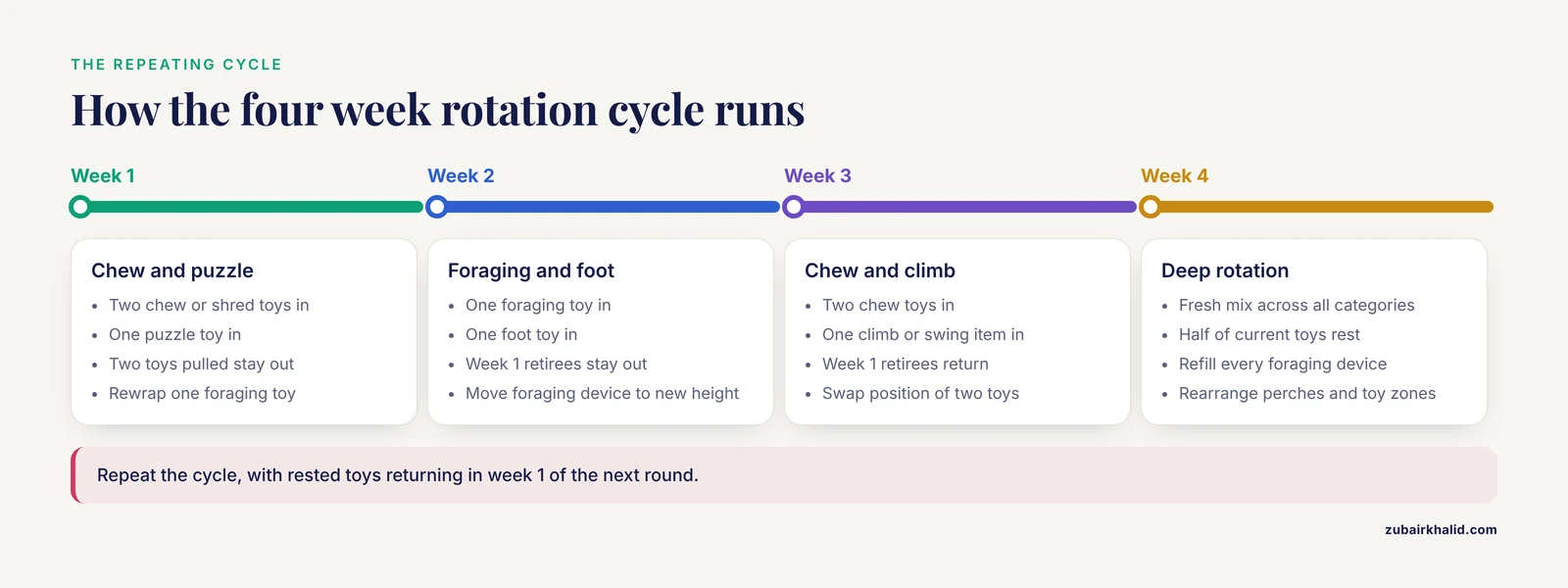
Then run this four-week cycle:
| Week | Entering the cage | Resting in storage | Foraging task | Layout change |
|---|---|---|---|---|
| 1 | Two chew or shred toys, one puzzle | Two toys pulled this week stay out | Rewrap one foraging toy | None |
| 2 | One foraging toy, one foot toy | Week 1 retirees stay out | Move a foraging device to a new height | Rotate one perch position |
| 3 | Two chew toys, one climb or swing item | Week 1 retirees return | Hide food in a different device type | Swap the position of two toys |
| 4 | Fresh mix across all categories | Half of the current toys rest | Refill every foraging device | Rearrange perches and toy zones |
Repeat the cycle, with rested toys returning in week 1 of the next round. Adjust the number of swaps up or down based on destruction speed and interest level.
Bird Toy Rotation Schedule Example Plans
Three worked plans show how the same format flexes across species and situations.
Example 1: Budgerigar or Cockatiel Pair
Small birds do well with light, colorful items they can nip, toss, and sit beside. Keep toys proportionate so a timid bird is not dwarfed by a giant object.
| Day | Task |
|---|---|
| Sunday | Swap two small toys, such as a paper shredder out and a plastic ring and palm leaf in |
| Wednesday | Refresh the treat-stuffed foraging cup, keeping treats modest within a balanced diet |
| Saturday | Inspect every toy, wipe soiled surfaces, and vacuum hulls beneath the cage |
| First Sunday of the month | Deep rotation, perch shuffle, and a full cage clean |
Budgerigars and cockatiels often accept new items within minutes, so you can usually place toys directly rather than staging them outside the cage first. Watch the pair dynamics, since one dominant bird may claim a favored toy.
Example 2: Amazon, African Grey, or Cockatoo
Powerful beaks change the math. Destruction is fast, so swaps come more often and the spare stock needs to run deeper.
| Day | Task |
|---|---|
| Monday | Swap one to two durable chew toys, retiring anything structurally compromised |
| Thursday | Rebuild the cardboard foraging box with fresh wrapping and hidden portions of the daily ration |
| Daily | Hide or scatter a small part of the diet to keep foraging honest |
| First weekend of the month | Rearrange the whole cage, introduce one complex puzzle feeder, and rest half the toy stock |
Keep wooden chunks, thick paper rolls, and hard plastics in rotation, and inspect rope and leather components twice weekly, because wear shows quickly at this scale.
Example 3: Newly Adopted or Cautious Bird
A bird settling into a new home needs stability first and novelty later. Stretch the format over four weeks.
- Week 1: No new items. Observe routines, eating, and droppings, and let your bird map its cage.
- Week 2: Add one toy with a familiar texture, placed away from food and sleep areas.
- Week 3: Hang a second item on the outside of the cage, then move it inside if your bird shows calm interest.
- Week 4: Run your first true swap, keeping the original anchor item untouched.
Progress at the bird's pace. Regression after a move, a new household member, or a schedule change is normal, and stepping back a week costs nothing.
Bird Cage Setup That Supports Rotation
Rotation works best inside a cage designed for it. Four setup details matter most:
- Space and bar spacing. The cage should allow full wing extension and free movement, and bar spacing should suit the species so heads and toes cannot wedge between bars. Your avian veterinarian can confirm appropriate spacing for your bird.
- Perch variety. Offer perches of different diameters and textures, positioned so the tail clears the walls and food bowls sit away from favorite perches to limit droppings contamination.
- Location. Put the cage in the social heart of the home but away from the kitchen. Fumes from overheated nonstick cookware and cooking smoke are dangerous to birds, a hazard emphasized in VCA Animal Hospitals' avian care guidance. Avoid drafts and harsh direct sun.
- Hardware. Use sturdy quick links with no open hooks, check weekly for rust, and discuss metal choices with your veterinarian, since heavy metal exposure from chewed hardware is a recognized avian toxicity concern.
Design the cage in zones, with climbing space up top, toy slots in the middle, and foraging stations lower down, so each swap has a predictable home. A play stand outside the cage doubles your rotation surface and gives retired cage toys a second life.
Common Mistakes and Simple Fixes
- Swapping everything at once. A full overhaul can frighten cautious birds. Fix: partial weekly swaps with one or two anchors left untouched.
- Overcrowding the cage. Too many toys block flight paths and perches. Fix: fewer, better-placed items, and remove anything your bird never touches.
- Rotating a single category. A cage full of chew toys leaves thinking work uncovered. Fix: balance chew, foraging, foot, and puzzle items.
- Leaving destroyed toys in place. Frayed cords and broken parts create entanglement and ingestion risks. Fix: retire items at the first sign of structural failure.
- Skipping cleaning between rotations. Stored toys can carry debris and moisture. Fix: wash, rinse, and dry everything before it enters the bin.
- Treating rotation as a substitute for attention. Toys supplement the flock, they do not replace it. Fix: pair swaps with daily interaction and out-of-cage time.
- Giving up after one rejection. A bird that ignores a toy may reject its position, not the toy itself. Fix: change height, angle, or presentation before retiring a category.
Toy Safety, Cleaning, and Welfare Basics
Materials and construction decide whether a toy is enriching or hazardous. Avian references flag household and cage hazards as a standing risk area for pet birds, so build these checks into every rotation:
- Size matching. Toys must suit the beak. Small parts on a large parrot's toy become swallowing hazards, and oversized items can intimidate small birds.
- Metal safety. Avoid pieces with flaking paint, galvanized finishes, or unknown alloys, since lead and zinc exposure are documented toxicities in birds. Your veterinarian can review specific items with you.
- Ropes and fibers. Trim frayed strands on sight. Loose threads can wrap toes or be swallowed.
- Bells and links. Choose designs without gaps that can catch a toe or beak, and avoid clapper styles that release small parts.
- Inspection ritual. Hands-on check at every swap, plus a full cage audit monthly.
- Cleaning. Mild soap and water, thorough rinse, complete air drying. Discard porous items that cannot be sanitized, and ask your veterinarian which disinfectants are appropriate for your household.
- Supervision. Watch the first hours with any new item and remove it at the first sign of panic or destructive misuse.
Welfare extends beyond the cage. Rotation supplements daily interaction, exercise, training, and appropriate rest. Keep the sleep area quiet and consistent, and avoid adding stimulating items right at the favorite roosting spot.
Where Rotation Fits in a Parrot Care Checklist
Toy rotation is one line on a larger parrot care checklist. Slot it alongside these basics:
Daily
- Fresh food and water
- Interaction, training, or supervised out-of-cage time
- A foraging opportunity
- A quick look at droppings, posture, and appetite
Weekly
- Toy swap and full toy inspection
- Cage spot cleaning and floor vacuuming
- Perch and hardware check
Monthly
- Deep rotation and layout change
- Full cage clean
- Restock the storage bins
Yearly
- Wellness examination with an avian veterinarian, as the Association of Avian Veterinarians recommends for pet birds
Diet sits at the center of the checklist. Avian nutrition guidance favors a formulated diet base with fresh vegetables and modest treats, and known toxins such as avocado, chocolate, caffeine, alcohol, and salty foods should stay out of reach.
Limitations and When to Contact a Veterinarian
This schedule is a husbandry framework, not a medical protocol. Individual birds vary widely in temperament, history, and health, so review your plan with an avian veterinarian, particularly for birds with existing behavior or medical problems.
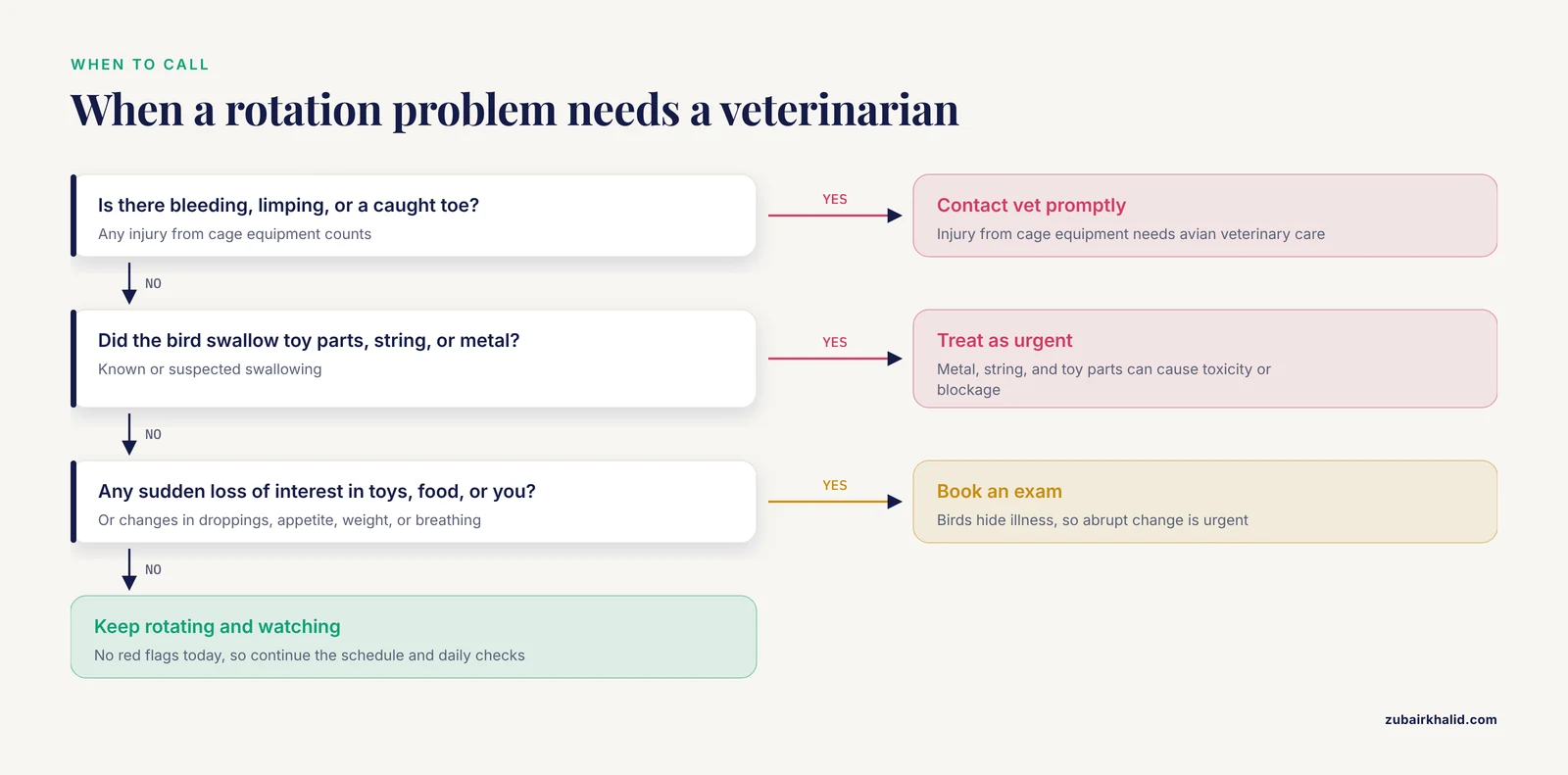
Contact your avian veterinarian promptly if you see any of the following:
- New or worsening feather picking, or any self-injury
- Sudden loss of interest in toys, food, or interaction
- Known or suspected swallowing of toy parts, string, or metal fragments
- Bleeding, limping, a caught toe, or any injury from cage equipment
- Changes in droppings, appetite, weight, posture, or breathing
- Abrupt weakness or collapse after chewing unknown metal, paint, or houseplants
Birds often hide illness until disease is advanced, so treat abrupt behavior change as urgent rather than watching and waiting. The Association of Avian Veterinarians maintains a directory for locating an avian veterinarian near you. Follow the recheck interval your veterinarian sets rather than a generic timeline.
Frequently Asked Questions
How often should I rotate my bird's toys?
Most owners start with a weekly swap of one to three toys plus a monthly deep rotation, then adjust to the bird's response. Large parrots that chew quickly often need midweek additions, while cautious birds may need slower pacing.
How many toys should a bird cage hold?
Enough to offer choice without crowding. If toys block flight paths, perch access, or food bowls, remove some. Keep the items your bird actually uses and let the rest rest.
Do birds really get bored of the same toys?
Yes. Habituation to unchanging surroundings is exactly why enrichment programs build in novelty, and rotating toys is the simplest way to supply it.
What if my bird is afraid of new toys?
Slow down. Hang the item outside the cage for a few days, then place it low in the cage, and pair first approaches with a favorite treat.
Can toy rotation stop feather plucking?
It can help when boredom contributes, but plucking has many medical and behavioral causes, so an avian veterinary examination comes first.
Which toys are unsafe for birds?
Damaged or frayed items, flaking or galvanized metal, small swallowable parts, and gaps that can trap toes or beaks. Inspect weekly and retire anything questionable.
Should perches and foraging spots rotate too?
Yes. Moving a perch or changing where food is hidden adds novelty cheaply, though one or two familiar anchors should stay put.
How do I clean toys between rotations?
Wash with mild soap, rinse well, and dry fully before storage. Retire heavily chewed porous items such as soft wood and paper instead of reusing them.