The Complete Bird-Proofing Checklist: 25 Hidden Hazards
By Dr. Zubair Khalid, DVM, MS, PhD ·

A bird proofing checklist is a room-by-room audit of your home that identifies and removes the 25 hazards most likely to injure or kill a companion bird, including nonstick cookware fumes, toxic fumes from aerosols, open water, ceiling fans, escape routes, and swallowable household objects. Birds explore with their beaks, fly into dangers that ground pets never encounter, and have respiratory systems far more sensitive to airborne chemicals than those of dogs or cats. This makes systematic bird proofing a core part of responsible ownership, not an optional extra.
This guide walks through every hidden hazard, explains why each one matters, and gives you a usable bird proofing checklist format you can apply today. It works for budgies, cockatiels, lovebirds, conures, African greys, Amazons, macaws, and other commonly kept parrots, and it pairs well with any broader parrot care checklist you already follow.
At a Glance: The Ten-Step Bird Proofing Checklist Template
If you do nothing else today, complete these ten actions. They address the hazards responsible for the most serious bird emergencies.
| Step | Action | Where |
|---|---|---|
| 1 | Move the bird out of the kitchen whenever you cook, and never use nonstick cookware or a self-cleaning oven cycle near birds | Kitchen |
| 2 | Eliminate aerosol sprays, plug-in fresheners, scented candles, and perfume use in the bird's room | Whole home |
| 3 | Close windows and doors before the bird leaves its cage, and cover or screen mirrors and large windows | Windows and doors |
| 4 | Turn off and unplug ceiling fans whenever the bird is flighted or out of the cage | Living areas |
| 5 | Secure or hide electrical cords and move small swallowable objects out of reach | Whole home |
| 6 | Separate the bird from cats, dogs, and other pets at all times when out of the cage | Whole home |
| 7 | Close toilet lids and cover fish tanks, sinks, and other open water | Bathroom and kitchen |
| 8 | Remove or relocate toxic houseplants and verify every plant in the home is bird safe | Living areas |
| 9 | Check the cage for bar spacing, zinc or lead hardware, and fraying toys during your regular bird cage setup review | Cage |
| 10 | Post the avian veterinarian's emergency number where every household member can see it | Whole home |
Print this table, adapt it into your own bird proofing checklist template, and walk each room with it in hand. The sections below explain every entry in detail.
Why Birds Need Their Own Proofing Rules
Bird proofing differs from baby proofing or cat proofing in three ways, and understanding them explains the whole checklist.
First, the avian respiratory system is uniquely vulnerable. Birds have air sacs and a flow-through lung design that moves air efficiently through the body, which serves them well in flight but concentrates inhaled toxins. Fumes that merely annoy a human, such as overheated nonstick coating or aerosol propellants, can cause fatal lung damage in a bird within minutes. Avian veterinarians and resources such as the Merck Veterinary Manual consistently identify inhaled fumes as one of the most urgent hazards in the pet bird home. This is why airborne hazards occupy the top of any complete bird-proofing checklist rather than a footnote.
Second, birds are small, light, and fast. A budgie weighs a few dozen grams. A fall, a closing door, or a bite from a friendly dog can be fatal at sizes and forces that would only bruise a larger animal.
Third, parrots investigate with their beaks. They chew, pry, and swallow. Anything small enough to fit in the beak is a potential gastrointestinal foreign body, and anything coated or plated is a potential heavy metal source. Your bird proofing checklist must therefore be completed at bird's-eye level, meaning floor to ceiling in the rooms where the bird spends time.
How to Use This Bird Proofing Checklist Format
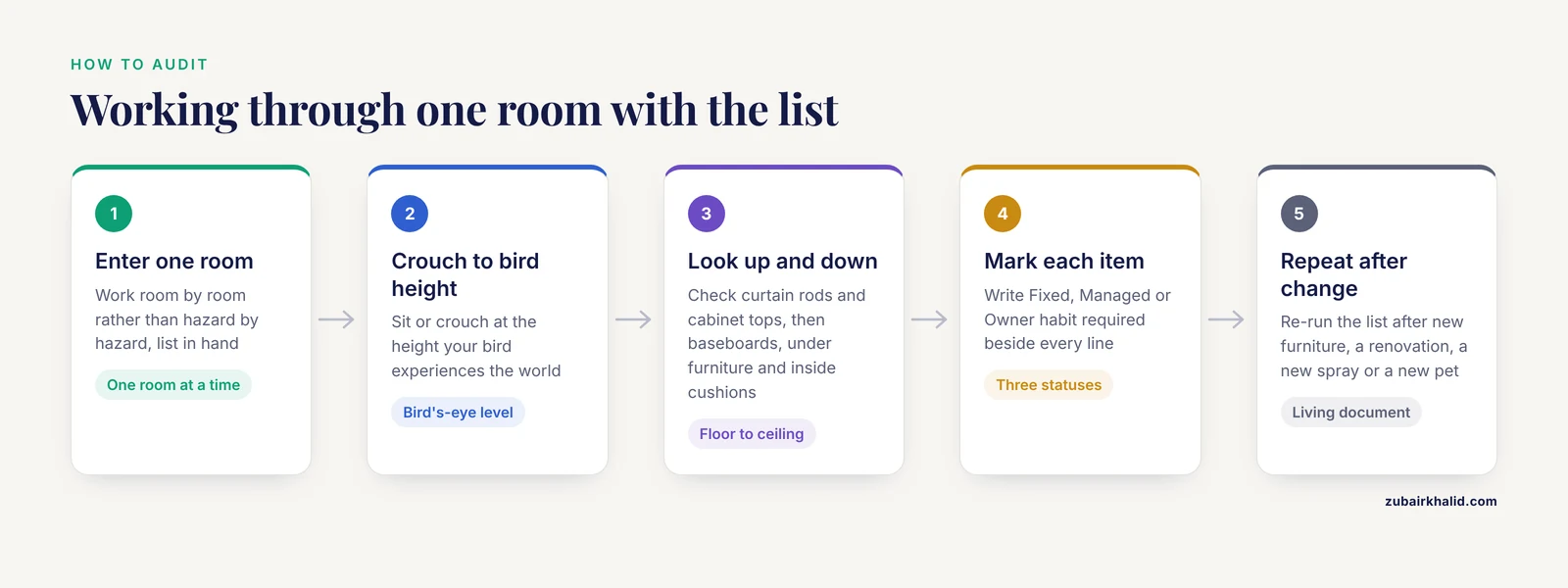
Work room by room rather than hazard by hazard. Walk into each room with the list, sit or crouch at the height your bird experiences the world, and check every item. Birds reach places owners rarely inspect, so look up at curtain rods and the tops of cabinets, and down along baseboards, under furniture, and inside cushions.
Mark three statuses for each item. Use "Fixed" when the hazard is resolved, "Managed" when the hazard remains but access is controlled, and "Owner habit required" when safety depends on daily behavior, such as closing the toilet lid. A bird proofing checklist example filled out this way becomes a living document you revisit after any change in the home, such as new furniture, a renovation, a new room spray, or a new pet.
The 25 Hidden Hazards, Zone by Zone
Kitchen Hazards
1. Overheated nonstick cookware and self-cleaning ovens. Polytetrafluoroethylene (PTFE) coatings, best known under common nonstick brand names, release fumes when overheated. These fumes cause rapid, often fatal respiratory injury in birds, a phenomenon long recognized in avian medicine and repeatedly highlighted by the Association of Avian Veterinarians and the Merck Veterinary Manual. The danger is silent because humans in the same kitchen usually notice nothing. Remove PTFE-coated pans from the home, or enforce a hard rule that the bird is never in or near the kitchen while any nonstick surface is heated, including toaster ovens, air fryers with nonstick interiors, and drip trays. Never run a self-cleaning oven cycle with a bird in the house.
2. Cooking smoke, grease vapor, and burning food. Smoke from burnt toast, scorched oil, or an over-hot wok irritates and damages avian lungs. If anything smokes in the kitchen, ventilate immediately and move the bird to a closed room with fresh air.
3. Open pots, kettles, and hot surfaces. A flying or climbing bird can land in an open pot of boiling water or on a hot burner. Keep lids on pots, turn handles inward, and keep the bird physically out of the kitchen during cooking.
4. Toxic foods left within reach. Avocado, chocolate, caffeine, alcohol, and heavily salted or greasy human foods are recognized bird toxins or health risks in avian practice, and avian nutrition resources such as Lafeber Company advise owners to keep human snack foods away from birds entirely. Counter dining, unattended plates, and accessible trash are the common exposure routes.
5. Open water at sink level. A full sink, a soaking dishpan, or a pot of water is a drowning hazard for a bird that lands in it while no one is watching.
Airborne Hazards Throughout the Home
6. Aerosol products of every kind. Nonstick cooking sprays, hairspray, deodorant, disinfectant sprays, furniture polish, and spray pesticides all release fine droplets that birds inhale far more readily than humans do. Spray nothing in the home while the bird is present, and prefer wipe-on cleaning methods in the bird's living space.
7. Scented products and combustion sources. Scented candles, incense, essential oil diffusers, plug-in air fresheners, and fragrance warmers release volatile compounds into the air. Because fume sensitivity is the core issue for birds, treat all of these as hazards in rooms the bird shares. The safe approach recommended by avian practice resources is simple. If it adds scent to the air, keep it away from the bird and ventilate well.
8. Tobacco and vaping aerosol. Cigarette, cigar, and vape aerosols are harmful to birds in the same room, and nicotine residue on hands and clothing can also be a concern. Keep all smoking and vaping outdoors and away from the bird's cage and play areas.
9. Renovation fumes, paint, adhesives, and new furnishings. Fresh paint, varnish, glue, new carpet, and new pressed-wood furniture release fumes during off-gassing. If you renovate or bring home new furnishings, house the bird in a separate, well-ventilated space for as long as the fumes persist, and discuss an appropriate waiting period with your avian veterinarian before reintroducing the bird.
10. Combustion appliance fumes. Gas stoves, furnaces, fireplaces, and space heaters can release combustion gases, and any malfunction that risks carbon monoxide also threatens your bird, often before human occupants notice symptoms. Maintain combustion appliances, install a carbon monoxide detector, and never use an unvented fuel-burning heater in the bird's space.
Window, Door, and Escape Hazards
11. Open and unscreened windows. A flighted bird can be out the window in under a second, and even a clipped bird can glide farther than most owners expect. Keep windows closed whenever the bird is out, or install secure screens and check them for gaps every season.
12. Exterior doors. Most lost-bird incidents happen during a moment when someone propped a door open. Adopt a household rule that the bird's cage is latched before any exterior door opens, and consider a two-door entry buffer if your layout allows it.
13. Mirrors, large windows, and reflective glass. Birds collide with reflective and transparent surfaces because they do not read them as barriers. Interior mirrors and large window panes should be covered, moved out of the flight path, or broken up visually when the bird is out. Ceiling-height windows and glass doors deserve particular attention.
14. Ceiling fans. A fan spinning at head height is a severe strike hazard for a flying bird. The rule is absolute. Fans stay off whenever the bird is out of the cage, even if the bird appears well supervised.
15. Gaps to the outdoors and to hidden spaces. Gaps around pipes, loose vent covers, fireplace openings, and gaps behind cabinets let a small bird vanish into wall or appliance cavities. Seal or screen any opening wider than the bird's head.
Household Chemical Hazards
16. Cleaning products and their fumes. Bleach, ammonia-based cleaners, oven cleaners, drain openers, and disinfectant wipes release fumes that irritate avian airways, and residue on surfaces the bird later mouths is a second exposure route. Use cleaners in a ventilated space, keep the bird in another room until surfaces are dry and the air is clear, and rinse or wipe down cage-adjacent surfaces with plain water afterward. Ask your avian veterinarian which cleaning agents they consider appropriate around birds.
17. Pesticides, insect sprays, and rodenticides. Bug sprays, ant baits, roach gels, and rodent poisons are all dangerous to birds, both through direct contact and through residues. Bird-safe pest control generally relies on physical exclusion and sanitation. If professional pest treatment is needed, inform the company you have birds and ask your avian veterinarian how long to keep the bird away and how to ventilate afterward.
18. Human medications and personal care products. A dropped pill is an attractive shiny object to many parrots. Store all medications in closed containers in closed cabinets, and treat one dropped tablet or lozenge as an emergency to locate immediately.
19. Heavy metals in the older home. Lead paint dust and flakes in homes built before modern paint rules, lead-containing curtain weights, solder joints, and zinc from galvanized wire or galvanized hardware all pose heavy metal toxicity risks that avian veterinarians diagnose regularly in pet birds. Chewable access is the danger, so inspect anything the bird can mouth, including cage hardware, older paint near the cage, and costume jewelry. If you suspect your older home has lead paint within the bird's reach, discuss testing and safe remediation with professionals and your veterinarian.
20. Toxic houseplants. Many common houseplants are safe for birds, and others cause mouth irritation, gastrointestinal upset, or worse. Before any plant enters the home, verify its safety for birds using a reliable avian resource, and confirm your specific species and plant identification with your avian veterinarian, since plant toxicity varies by species and plant part. The safest habit is to verify first and place second.
Physical and Behavioral Hazards
21. Swallowable objects. Buttons, coins, earrings, puzzle pieces, children's toys, pen caps, foam pieces, rubber bands, and small batteries all present obstruction or poisoning risk to a beak-driven explorer. Sweep surfaces, floors, and low shelves in the bird's rooms, and remember that parrots can and will travel to find novelty.
22. Strings, threads, and fibrous materials. Long strands of thread, yarn, hair, cellophane, and frayed fabric can wrap around a toe or tongue or be swallowed, causing entanglement or gastrointestinal problems. Loose fibers in aging toys and rope perches are a common source, so include toy hardware in every bird cage setup review.
23. Electrical cords. Parrots chew power cords readily, risking burns and electrocution. Route cords behind furniture, inside cord covers, or out of the room entirely, and inspect cords near the cage during every checklist pass.
24. Crushing and entrapment points. Recliner mechanisms, rocking chairs, sofa bed frames, sliding doors, drawers, and the gap between furniture and the wall can trap or crush a bird. The under-foot hazard is the one owners underestimate most, so make a habit of checking your path before you sit or step when the bird is loose.
25. Open water and drowning hazards. Toilets, fish tanks, full bathtubs, pet water bowls deep relative to the bird, and buckets all pose drowning risk. Closed toilet lids, tank covers, and shallow bathing options designed for birds solve this category.
A Bird Proofing Checklist Example, Room by Room
Use this bird proofing checklist example as your starting template. Each line corresponds to one of the hazards above.
Kitchen (ideally a bird-free zone during use)
- Nonstick cookware removed or cooking done only with the bird secured in a distant room
- Self-cleaning oven cycles run only when the bird is out of the house
- Pot lids on, handles turned inward
- Toxic foods and open plates never left unattended
- Sinks emptied or closed before the bird enters
Living room and bedrooms
- Ceiling fans off, no exceptions while the bird is out
- Windows and screens inspected, curtains and cords secured
- Mirrors and glass doors covered or buffered
- Houseplants verified bird safe
- Cords routed and secured
- Small objects and string cleared from reach
- Recliners and rockers checked before use
Bathroom
- Toilet lids closed
- Aerosols, perfumes, and hair sprays used elsewhere
- Medications in closed cabinets
Whole-home systems
- No smoking or vaping indoors
- Scented products removed from shared air
- Carbon monoxide detector installed and tested
- Pest control plan reviewed for bird safety
- Renovation and off-gassing plan established
Cage and play areas
- Cage located away from the kitchen, drafts, direct sun, and fume sources
- Bar spacing and hardware checked for chew damage and metal concerns
- Toys inspected for frayed fibers, loose bells, and rusted parts
- Play stands and perches positioned away from hazards above
- Emergency contact card posted with the avian veterinarian's number
Bird Cage Setup as Part of Bird Proofing
Bird cage setup is the first line of defense, and a poorly set cage can introduce hazards that no room audit will catch. The Association of Avian Veterinarians and hospital resources such as VCA Animal Hospitals emphasize that cage placement and hardware both matter for safety.
Place the cage in a room where the household spends time, away from the kitchen, away from drafty doors and windows, out of direct, unshaded sun, and away from any source of scent or fume. Perch placement matters. Position perches away from food and water dishes so droppings do not contaminate them, and provide varied perch diameters for foot health.
Inspect the cage itself as hardware ages. Galvanized or plated wire and hardware can be a zinc exposure risk if a bird chews it, and older or damaged coatings, soldered seams, and rusted parts warrant replacement. Check toys for fraying rope, small bells that can trap toes, loose chains, and closed rings that can catch a beak or foot. Because toy condition changes week to week, add a short hardware and toy inspection to your regular parrot care checklist rather than waiting for the annual bird proofing review.
Bar spacing is worth confirming for your species with your avian veterinarian or a reputable avian resource. Spacing that is too wide can entrap a head, and spacing that is too narrow can trap toes or beaks in certain designs. Your veterinarian can assess your specific cage and bird.
Common Mistakes Owners Make
The most frequent errors follow a pattern, and knowing them helps you audit your own habits.
Assuming supervision is enough. A fume exposure takes seconds and requires no beak contact with anything. Supervision cannot protect a bird from air. This is why airborne hazards are controlled by removing the product, not by watching the bird.
Proofing once and never again. Homes change. A new candle, a new couch, a visitor's handbag on the floor, or a holiday decoration can reintroduce a hazard overnight. Re-run the checklist after any household change and at least a couple of times per year.
Trusting memory over a written template. The value of a written bird proofing checklist template is that it externalizes your attention. Owners who work from the paper list consistently find items they had forgotten, such as a scented diffuser or a loose vent cover.
Underestimating other pets. Even a gentle, bonded dog or cat is a predator by nature, and bite injuries that appear minor on the outside often involve serious deep tissue damage in birds. Avian veterinarians consistently advise that birds and other pets never share unsupervised space, no matter how trustworthy the other animal seems.
Forgetting visitors. Guests open doors, spray perfume, drop pills, and leave snacks. Give visitors a short verbal briefing whenever the bird will be out or the cage door will be open.
Troubleshooting: When Something Goes Wrong
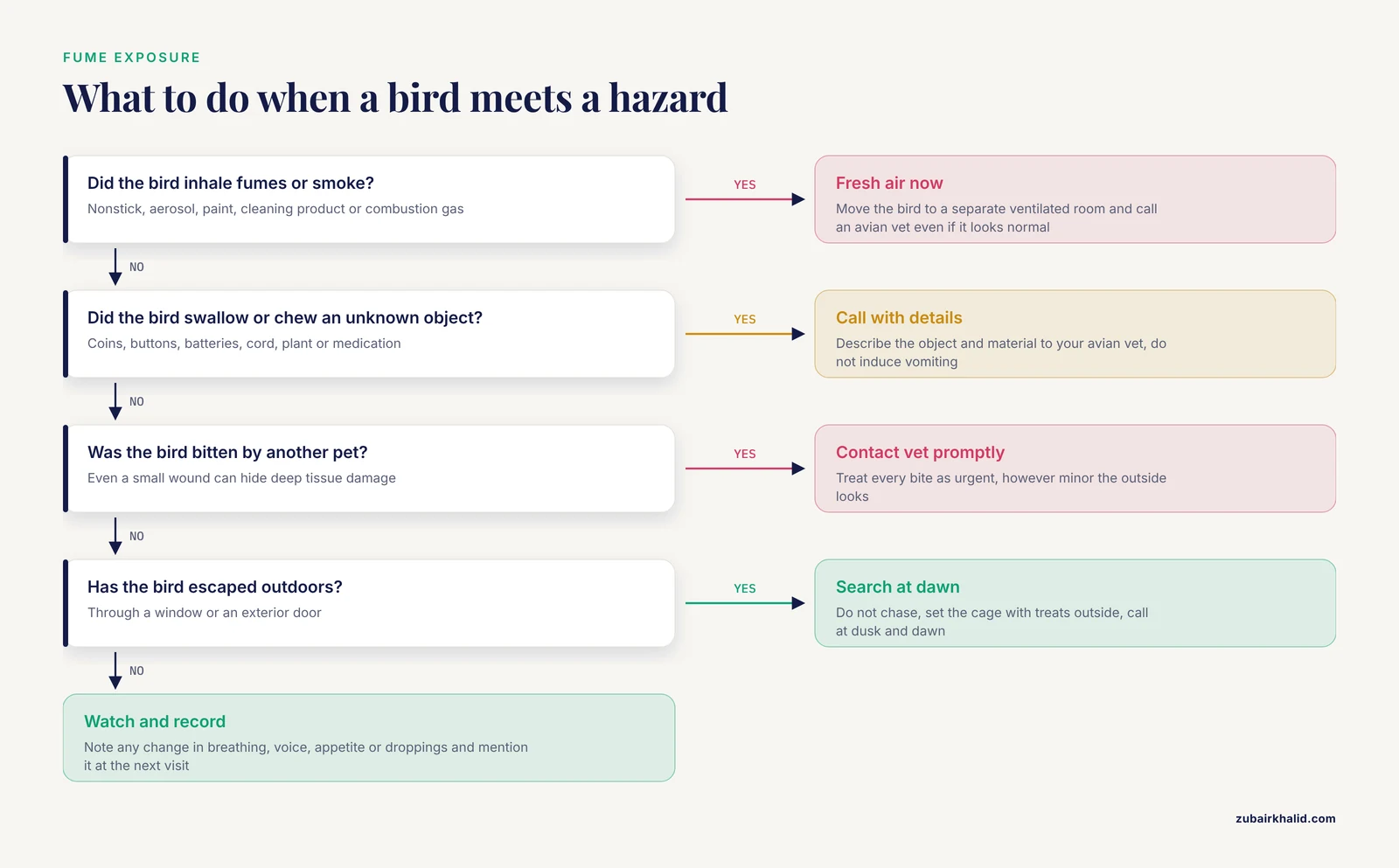
If your bird inhales a suspicious fume, move the bird immediately to fresh air in a separate room and contact an avian veterinarian, even if the bird looks normal. Respiratory injury in birds can progress before obvious symptoms appear.
If your bird swallows or chews an unknown object, contact your avian veterinarian promptly with a description of the object and the material. Do not induce vomiting and do not attempt home remedies.
If your bird escapes outdoors, keep the bird in sight, do not chase it, place the cage with food and the bird's favorite treats outside near the escape point, and call to it calmly at dusk and dawn when birds are most vocal. Contact local avian veterinarians, shelters, and lost bird networks promptly. A recovered escape is far more likely when the search begins within hours, which is another reason prevention through door and window discipline is the highest-value item on any bird proofing checklist.
If your bird behaves normally after a near miss, mention the event at your next wellness visit so your veterinarian can advise whether any follow-up is warranted.
Limitations and When to Contact a Veterinarian
This article is educational and is not a substitute for veterinary diagnosis or treatment. Every home, bird species, and individual bird is different, and an avian veterinarian who knows your bird should confirm that your bird proofing plan fits your specific situation.
Contact an avian veterinarian promptly, the same day, for any known or suspected exposure to fumes, toxic foods, chemicals, heavy metals, medications, or plants, any bite from another animal even if the wound looks small, any object swallowed or missing, and any change in breathing, voice, appetite, droppings, posture, or activity. Birds often hide illness until disease is advanced, so subtle changes are meaningful. Seek emergency care immediately for open-mouth or labored breathing, collapse, bleeding, a witnessed injury, or severe lethargy. If you do not already have an avian veterinarian, the Association of Avian Veterinarians maintains a public directory to help you find one.
Frequently Asked Questions
What is a bird proofing checklist?
A bird proofing checklist is a written, room-by-room audit of your home that identifies hazards to pet birds and tracks which ones you have fixed, managed, or assigned as daily habits. It covers airborne fumes, escape routes, swallowable objects, toxic foods, water hazards, and cage hardware, and it works best when you re-run it after any change in the household.
Which room is the most dangerous for a pet bird?
The kitchen is the most dangerous room because it concentrates several high-risk hazards, including overheated nonstick cookware fumes, cooking smoke, hot liquids, toxic human foods, and open water. Many owners make the kitchen a bird-free zone during cooking and move the bird to a distant, ventilated room whenever heat or spray is involved.
Are nonstick pans really dangerous to birds?
Yes. Overheated polytetrafluoroethylene (PTFE) nonstick coatings release fumes that can cause fatal respiratory injury in birds, and avian veterinary resources such as the Merck Veterinary Manual and the Association of Avian Veterinarians identify this as a major household hazard. The exposure is dangerous even when humans in the same room notice no odor, so either remove nonstick cookware or guarantee the bird is far from the kitchen whenever it is heated.
What foods should never be offered to my bird?
Avocado, chocolate, caffeine, alcohol, and salty or greasy human foods should never be offered, and avian nutrition resources such as Lafeber Company advise keeping all casual human snacks away from birds. Discuss your bird's exact diet plan, including safe vegetables, formulated diet, and treats, with your avian veterinarian, since needs vary by species.
How often should I repeat the bird proofing checklist?
Complete a full walkthrough at least twice a year and after any household change, such as new furniture, a renovation, a new room fragrance, a new pet, or a visitor's stay. Hardware and toy inspections on the cage belong on your regular weekly parrot care checklist because wear and fraying develop continuously.
Can I keep a bird safely in a home with cats or dogs?
Yes, but only with strict separation. Never allow direct interaction between your bird and cats, dogs, ferrets, or other pets, even under close supervision, because bite injuries that appear superficial often cause serious internal damage in birds. Secure the bird in a closed room away from other animals whenever it is out of its cage, and treat latched cage doors as non-negotiable.
How do I bird-proof on a budget?
Prioritize the free and low-cost actions first, which happen to cover the deadliest hazards. Close the toilet lid, turn off ceiling fans, latch doors before opening exterior doors, store medications in closed cabinets, remove aerosols and scented products from shared air, and stop using nonstick cookware near the bird. Physical items like cord covers, screens, and a carbon monoxide detector can follow over time.
What should I do if my bird escapes through a window or door?
Keep the bird in sight without chasing it, place its cage with food and favorite treats near the escape point, and call to it calmly at dawn and dusk when birds vocalize most. Notify local avian veterinarians, animal shelters, and lost bird networks right away, because a search that begins within hours has a better chance of success than one that begins days later.
Further Reading
- Technology-Assisted Rehabilitation Gym for at-home Training (TARGeT) for stroke survivors: A study protocol for evaluating feasibility, safety, usability, clinical benefit, and costs.
- Dengue@Home: evaluation of a hospital in the home pathway for management of adults with dengue fever.
- Peanut oral immunotherapy updosing via in-office, video, and telephone encounters: Safety and caregiver satisfaction.
- Descriptive Analysis of the First 12-Month Activity of Docadom, a Private Physician-Led Urgent In-Home Consultation Service.
- Home-Based Multimodal Exergame Prototype for Patients With Chronic Stroke: Cross-Sectional Content Validation and Prospective Single-Arm Feasibility Study.
- A climate adaptation strategy for Mai Po Inner Deep Bay Ramsar site: Steppingstone to climate proofing the East Asian-Australasian Flyway.