Bird-Proofing for Renters: Temporary Solutions
By Dr. Zubair Khalid, DVM, MS, PhD ·

Permanent bird-proofing alters the apartment, while temporary bird-proofing protects your bird with solutions you can remove on move-out day without a trace. The rule of thumb is simple: if a modification comes off cleanly, leaves no holes or residue, and would not appear on a move-out inspection, it belongs in a renter's plan. Everything else either needs written landlord approval or should be replaced with a removable alternative.
This article is educational and is not a substitute for veterinary diagnosis or treatment.
Why Bird-Proofing Matters More in an Apartment
Pet birds face a hazard profile that is unusually well suited to the home environment. The Association of Avian Veterinarians emphasizes that most serious household injuries to pet birds are preventable, and that a room-by-room safety review is a standard part of avian wellness guidance. In an apartment, several of those hazards are amplified. You share walls with neighbors who cook, burn candles, and use aerosol products. Your kitchen is often in the same open-plan space as your living area. Your windows may have screens that look secure but tear easily under a beak. Your lease limits what you can drill, mount, or replace.
Birds also have a respiratory system that is remarkably efficient at absorbing whatever is in the air. The Merck Veterinary Manual notes that this efficiency makes birds exceptionally sensitive to airborne fumes, smoke, and aerosolized chemicals, which is why air-quality control is not optional in a small shared building. Overheated nonstick cookware fumes, cleaning product vapors, and smoke that drifts in from a neighbor's unit can all harm a bird in a space where the owner cannot simply open windows for cross-ventilation or install new ventilation.
Rental constraints change the solution set, not the goal. A homeowner can screw in a ceiling hook, replace a screen, and install a dedicated return-air filter. A renter works with tension, pressure, adhesion that removes cleanly, and furniture arrangement. That constraint is the reason the field of bird-proofing for renters exists as its own practice, and it is why every option below is judged first on reversibility.
Bird Proofing Apartment for Renters Options at a Glance
The table below is the core of this guide. It compares the main bird proofing apartment for renters options on the criteria that decide real choices: how well each option addresses its hazard, how much risk it poses to your security deposit, how reversible it is, and how much daily vigilance it demands from you.
| Option | Hazard it addresses | Deposit risk | Reversibility | Daily vigilance required |
|---|---|---|---|---|
| Tension-mounted window and door barriers | Escape through open windows, falls, drafts | Very low | Full removal, no hardware | Low, once installed |
| Cord covers, spiral wraps, and cable clips | Chewing electrical cords | Very low | Full removal | Low |
| Cordless, closed-cable device setup | Chewing and entanglement | None | Nothing to remove | Low |
| A dedicated bird-safe room with a staged entry | Flight accidents, escape, access to off-limits rooms | None to very low | Furniture and tension items only | Medium |
| Washable floor mats and peel-and-stick wall panels | Droppings, food scatter, chewing damage | Low, if truly removable | Full removal with care | Low |
| Portable HEPA air purifier | Fumes, smoke, dust, dander | None | Plug-in and move out | Low, filter checks |
| Strategic bird cage setup (placement, anchor-free stability) | Drafts, kitchen fumes, falls, tip-overs | None | Rearrangement only | Medium |
| Removable screen-door mesh panels on tension rods | Entry and exit doors left open | Very low | Full removal | Medium |
| Relocating the bird during high-risk activities | Cooking, cleaning, guests, repairs | None | Behavioral routine | High |
| Written landlord agreement for any exception you want | Lease compliance itself | Determined by lease | Documented | One-time negotiation |
Notice what is absent from this list: screwed-in hooks, bolted ceiling mounts, replaced window screens, permanent room dividers, and anything adhesive that is not explicitly rated as residue-free. Those belong to homeowner bird-proofing. A renter who wants the same outcome accepts a slightly less convenient solution in exchange for a fully refundable deposit.
Window and Door Barriers: The First Priority
Open windows and doors are the most acute escape and injury risk in any apartment. VCA Animal Hospitals' avian care guidance lists open windows and doors among the leading causes of pet bird escape and injury, and recommends that wings be managed and the environment secured before a bird leaves its cage. In a rental, you usually cannot replace a flimsy screen or install a permanent window guard, so the renter solution is a barrier system that stands on its own hardware.
Tension-mounted window barriers. Spring-loaded or tension-pole window guards press between the window frame and the sill. They hold a mesh or grill in place without screws. For bird-proofing, the useful version is a fine mesh, not a bar-style child guard, because a small bird can slip between widely spaced bars. Measure the window opening before ordering, since tension products have limited adjustment ranges.
Secure, checkable latches. Many apartment windows have locks that fail to fully close over years of building settlement. A removable wedge or a secondary sliding-window lock (a small clamp that grips the track, installed and removed by hand) keeps a window from being slid open more than a crack. None of these damage the frame.
Door discipline hardware. For entry doors and balcony doors, a removable screen panel hung on a tension rod inside the doorframe creates a second barrier. When someone opens the main door, the bird is still stopped at the mesh. Cheap, tool-free, and gone in five seconds during a move-out inspection.
The screen caveat. Existing apartment window screens are not bird barriers. Birds chew through standard fiberglass screening easily, and a determined beak can open a corner seam in minutes. Treat the factory screen as a first layer that slows a bird down, not as a safety device. If a window will be open for ventilation while the bird is out, a tension-mounted metal or heavy-duty mesh panel in front of the screen is the renter-appropriate fix.
The pros of this category are high effectiveness against the most sudden hazard, near-zero deposit risk, and low cost. The cons are that tension barriers look temporary, can rattle loose over weeks, and must be rechecked periodically. They also do nothing for a bird that is out of the cage in a room with an open window, so they work best paired with the habit of closing windows before flight time.
Cord and Cable Management: The Quiet Killer
Electrical cords are the most underestimated hazard in apartment bird-proofing. Birds explore with their beaks, lamp cords, charger cables, power strips, and appliance cords are all at beak height when a bird is on the floor, on a playstand, or on low furniture. A bite through an energized cord can cause burns to the beak and mouth and, in some cases, fatal injury. The Association of Avian Veterinarians includes exposed electrical cords on its standard list of household dangers to keep away from pet birds.
Renter-safe cord control has three tiers.
- Conceal what you can. Route cords behind furniture, bundle them with removable velcro ties, and run them along the floor edge rather than across open space. A power strip mounted under a desk with removable adhesive strips (chosen specifically because they are labeled damage-free) keeps the outlet cluster out of reach.
- Cover what you cannot hide. Split-loom tubing, flexible cord covers, and spiral wrap slip over cords and can be cut to length. They slide off just as easily when you move out. A bird that cannot get its beak around a bare cord cannot bite through the insulation in a moment of curiosity.
- Remove what you do not need. The best cord is an absent cord. Battery-operated lighting, cordless lamps, and devices charged in a closed room remove entire hazard zones. Many renters find that half the cords in a living room can simply leave.
The pros of cord management are that it is cheap, invisible to a landlord, and addresses a hazard that causes serious injuries. The cons are that covers must be maintained (birds will test them), and no cover is a substitute for supervision while the bird is out.
A Dedicated Bird-Safe Room: The Highest-Impact Option
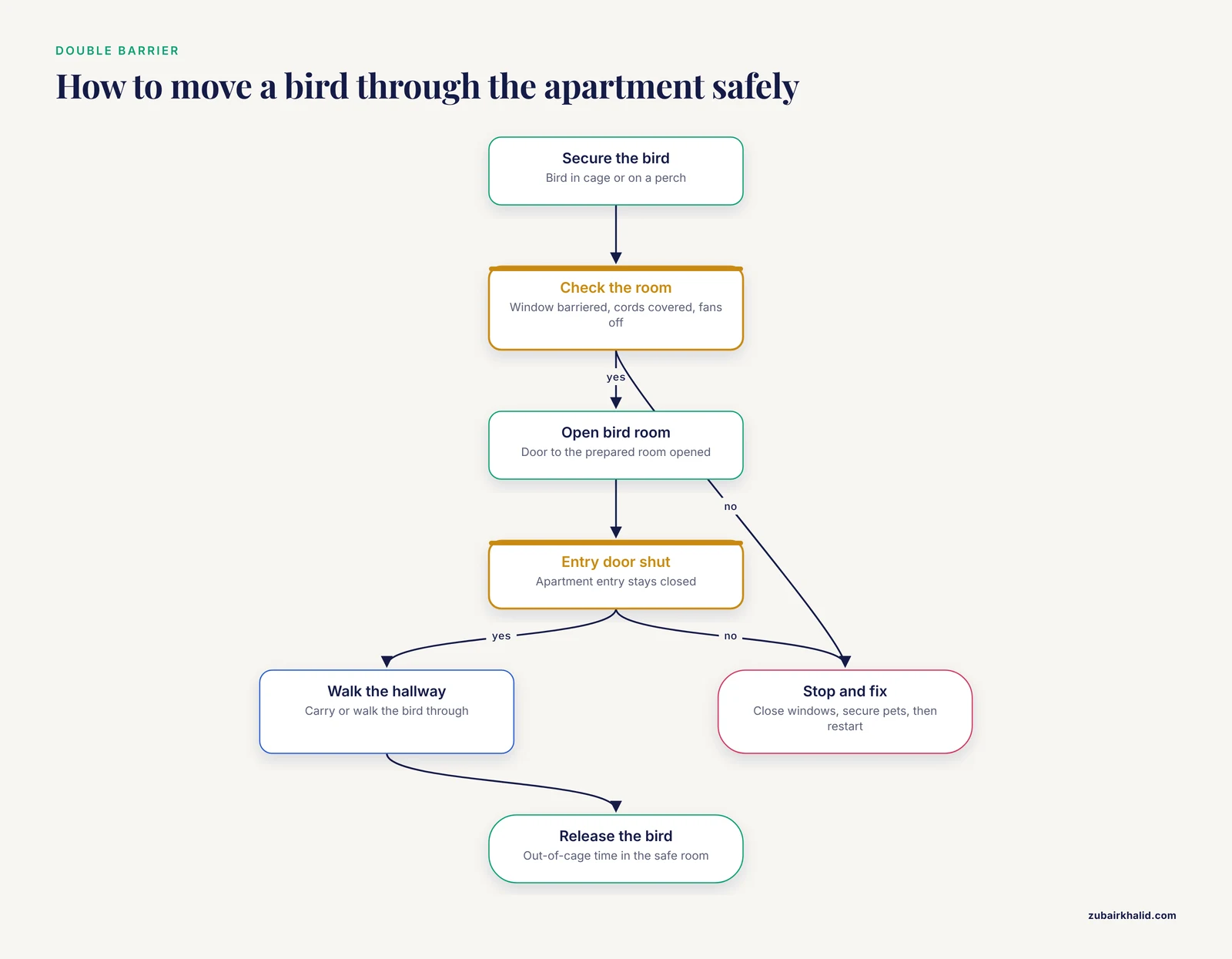
If your apartment layout allows it, designating one room as the bird's out-of-cage space is the single most effective structural choice a renter can make, and it requires zero modification. The logic is that you cannot bird-proof every room to the same standard, so you concentrate the standard in one room and manage access everywhere else.
A bird-safe room is built from furniture arrangement and removable items:
- Windows in that room are covered by tension barriers or kept closed during flight time.
- Cords are routed or covered as described above.
- Other pets are excluded by a closed door, because interactions between birds and cats or dogs are a leading cause of emergency injury even when the dog or cat is "just watching."
- Toilets, if the room is a bathroom, are kept closed, since open water is a documented drowning hazard for birds.
- Ceiling fans are either absent or never run while the bird is out. VCA Animal Hospitals lists ceiling fan contact among the common serious household injuries for flighted birds.
- Houseplants in the room are verified bird-safe or removed, because many common ornamental plants are toxic if chewed, a point the Merck Veterinary Manual makes in its coverage of household poisoning hazards for pet birds.
The staged entry matters as much as the room itself. The safest protocol is: bird secured in cage or on a perch, door to the bird room opened, bird brought through the hallway with the entry door to the apartment closed, then released in the prepared room. This "double barrier" habit is the apartment equivalent of the aviary airlock and costs nothing but routine.
The pros are maximum safety for the daily out-of-cage time that parrots need, no deposit exposure at all, and a consistent environment the bird can learn. The cons are that studios and one-bedroom apartments may not offer a spare room, and household members must follow the protocol every single time, which is where most systems fail.
Floor and Wall Protection: Guarding the Deposit and the Bird
Birds make a mess by design. Droppings, seed hulls, pellet dust, and flung wet food travel further than new owners expect, and a landlord's inspection at lease end is where uncontrolled mess becomes lost deposit money. Wall and floor protection for renters focuses on washable, removable layers.
Under the cage and play areas. Large washable mats, vinyl sheeting cut to size, or purpose-made splatter guards catch debris. They sit loose on the floor, so there is nothing to install and nothing to remove. Sweep under them weekly and mop the underlying floor on your normal schedule.
On the walls. Peel-and-stick products vary enormously in residue behavior. If you use removable wall panels or damage-free adhesive strips to mount a splash guard behind the cage, test a small patch first, keep the packaging so you can show the product's removal claim, and photograph the wall condition at move-in for your records. In practice, a tension-mounted or freestanding screen behind the cage avoids the adhesive question entirely.
Around perches and playstands. A playstand positioned on the mat, away from curtains, upholstered furniture, and drapery, concentrates the mess where it can be cleaned and keeps fabric, which holds dust and dander and offers tempting chew material, out of easy reach.
The pros of this category are financial: it protects the deposit, keeps odors down, and makes daily cleaning faster, which matters because accumulated droppings and food debris support bacterial growth that avian veterinarians flag as a disease risk in the cage environment. The cons are that cheap adhesive products can leave residue that costs more to remediate than the protection saved, so product selection matters.
Air Quality Controls: The Renter's Version of Ventilation
Apartment birds breathe whatever the building breathes. You cannot replace the ventilation system in a rental, so your air-quality plan rests on removal, avoidance, and filtration.
Avoidance comes first. Never cook with the bird in the kitchen airspace. Overheated nonstick (PTFE-coated) cookware and certain self-cleaning oven cycles release fumes that the Merck Veterinary Manual identifies as acutely dangerous to birds, and an open-plan apartment gives you no physical barrier against them. Move the bird to the farthest room, close the door, and run a purifier before, during, and after any high-heat cooking. The same habit applies to cleaning days, strong aerosol products, scented candles, incense, plug-in deodorizers, and any repair or renovation work in the building, since paint fumes and construction dust travel through shared hallways and ventilation.
Filtration is your one tool. A portable HEPA air purifier is a plug-in appliance, which means it is fully renter-compatible. Size it for the room the bird lives in, run it continuously, and change filters on the schedule the manufacturer recommends. In a multiunit building, a purifier also buffers smoke and cooking odors that drift in from neighboring units.
Ventilation windows. When outdoor air quality allows, crack a window with a tension barrier in place for short periods. This is the one ventilation lever a renter controls directly.
The pros are that this category addresses hazards that no barrier can touch, and a purifier is useful for human residents as well. The cons are avoidance is behavioral and depends on every household member and guest following it, and filters are a recurring item you must actually replace.
Bird Cage Setup for a Renter Apartment
A correct bird cage setup does more hazard control than any accessory, and it costs a renter nothing but thought. Placement decisions interact directly with apartment-specific risks.
Distance from the kitchen. Place the cage in a room with a door that closes between it and the kitchen. In a studio, place the cage as far from the cooking area as the layout allows and never at the same air level as an open cooking zone, because heat and fumes rise and spread.
Away from drafts and windows. Direct drafts from leaky apartment windows and strong direct sun through glass both stress birds. A position against an interior wall, out of the direct line of a window, is the standard recommendation in VCA Animal Hospitals' cage guidance.
Stable, tip-resistant footing. The cage must stand level on its own base. No wall straps, no screws into studs, no ceiling suspension. On smooth apartment floors, a low, flat mat under the cage prevents sliding without any attachment to the building.
Height and sightlines. The cage benefits from a height where the bird can perch at or near human chest level, which supports wellbeing, while remaining easy to service. Keep the top of the cage well clear of any ceiling fixture.
Interior setup. Perches of varied diameter, food and water dishes positioned away from perch lines so droppings do not contaminate them, and safe toys rotated for enrichment follow the standard principles described by the Association of Avian Veterinarians and in Lafeber Company's avian care resources. None of these require modification to the apartment.
The cage door habit. In an apartment, the moment the cage opens is the moment the barrier system is tested. Open the cage only with windows closed, doors closed, ceiling fans off, and other pets secured. That sequence, repeated identically every time, becomes the backbone of your parrot care checklist.
Comparing Your Options: Pros and Cons on Real Criteria
Reading each option on its own terms is not enough. Bird proofing apartment for renters pros and cons only become clear when the options compete for the same dollars, hours, and wall space. Here is how they compare on the four criteria that decide real choices.
Effectiveness against the most likely harm. The dedicated bird-safe room wins, because it bundles window control, cord control, pet separation, and surface protection into one space. Cord management and window barriers each address a single acute hazard but do it well. Air quality controls address the only hazard category (fumes) that barriers cannot.
Deposit risk. Furniture-based solutions, tension hardware, cord covers, and plug-in devices carry essentially no risk. Anything adhesive carries a small but real risk of residue or paint lift, which is why adhesive should be your last resort, tested in a hidden spot first.
Ongoing effort. Relocation routines (moving the bird during cooking or cleaning) cost the most daily attention. The bird-safe room and cage placement cost the least once established. Tension hardware needs a recheck every few weeks because tension relaxes.
Landlord relations. Everything on the renter-safe list is either invisible or trivially removable, which means you generally do not need permission at all. That is a genuine advantage of doing bird-proofing the renter way. If you want anything permanent, get the agreement in writing before installing it, because verbal permission does not survive a property manager change.
One more criterion deserves honest mention: cost. No published source in the veterinary literature prices these products, and prices vary widely by retailer and region, so any specific dollar figure here would be unreliable. Categorically, cord covers and tension rods sit at the low end of spend, playstands and purifiers at the higher end. Shop by measurement and product specification rather than by price alone.
Three Worked Scenarios
Scenario 1: A cockatiel in a studio apartment. There is no spare room, so the entire studio is the bird space. Priority order: route or cover every cord within reach, place the cage on an interior wall away from the kitchenette, install a tension mesh barrier on the single window, adopt a strict relocate-during-cooking routine, and run a small purifier continuously. Out-of-cage time happens with the entry door closed and the window barrier verified. The deposit risk of this full plan is near zero because nothing touches the walls permanently.
Scenario 2: A flighted Amazon parrot in a one-bedroom with a cat. The bedroom becomes the bird room. The cat is excluded by a closed door as a standing rule, never by assumption. Cords in the bedroom are removed or covered. A tension-mounted mesh panel on the entry door of the bedroom acts as the second barrier when the bird is out. The window stays closed during flight time. Cooking always happens with the bird locked in the bedroom and the purifier running in the living area. This scenario shows why the room-based strategy suits larger parrots, whose beak strength defeats flimsy covers and whose flight covers real distances in seconds.
Scenario 3: Two budgies in a unit with a strict no-wall-modification lease. Every solution must be freestanding. Cage placement carries the main load, positioned away from windows, kitchen, and drafts. A freestanding screen behind the cage protects the wall. A playstand sits on a washable mat. Cords are hidden behind furniture and wrapped. No adhesive touches the walls at all. This scenario demonstrates that even the strictest lease leaves a complete, effective bird-proofing plan available.
Common Mix-Ups That Undo a Good Setup
Renters make a recognizable set of mistakes with bird-proofing. Each one is avoidable with a small habit change.
- Trusting the factory window screen. Screens tear. A bird can go through one in seconds or chew through one over an afternoon. Always add a real barrier or keep the window shut while the bird is out.
- Assuming a closed ceiling fan counts as safe. If anyone in the household can flip that switch by habit, a fan running while the bird flies is a foreseeable tragedy. Disable the circuit when practical or enforce a spoken checklist before every flight session.
- Cooking with the bird in the same open airspace. The risk is not just a bite from a hot pan. Nonstick fumes and aerosol vapors injure birds before you smell anything.
- Using duct tape, packing tape, or mounting tape on walls. These leave residue or pull paint, which converts a bird-safety project into a deposit dispute.
- Hanging the cage or perches from ceiling mounts without approval. This is structural modification. It requires written permission and proper anchoring, which is exactly what most renter situations cannot support.
- Placing the cage in the kitchen "so the bird is included." This puts the bird in the highest fume, heat, and traffic-risk zone of the apartment.
- Forgetting guests. Visitors open doors, set bags down, and light candles. Brief every guest in one sentence before the bird comes out.
- Setting the system up once and never checking it. Tension hardware loosens, cord covers shift, and velcro adhesives age. A monthly five-minute inspection keeps the system real.
- Assuming small birds need less proofing. A budgie reaches the same lamp cord, the same open window, and the same fume-filled air. Size changes the flight radius, not the hazard list.
A Parrot Care Checklist for the Renter Apartment
Tie your bird-proofing to a short weekly routine and it stays effective. This parrot care checklist covers the renter-specific items that fit alongside the normal daily care every parrot needs.
- Verify all tension window barriers are tight and seated.
- Walk the bird zone and confirm no new cord is exposed.
- Confirm the cage remains level, stable, and clear of drafts, direct sun, and the kitchen airflow.
- Check floor mats and splash guards, clean under them, and confirm walls behind them show no damage.
- Run and inspect the air purifier, and note the filter condition.
- Rehearse the pre-flight checklist aloud: windows closed or barriered, doors closed, fans off, other pets secured, stove off.
- Photograph the apartment once a quarter and at any move-out prep, so wall condition is documented.
A checklist like this takes minutes and converts a one-time project into a durable system, which is the actual goal of bird-proofing for renters.
Limitations and When to Contact a Veterinarian
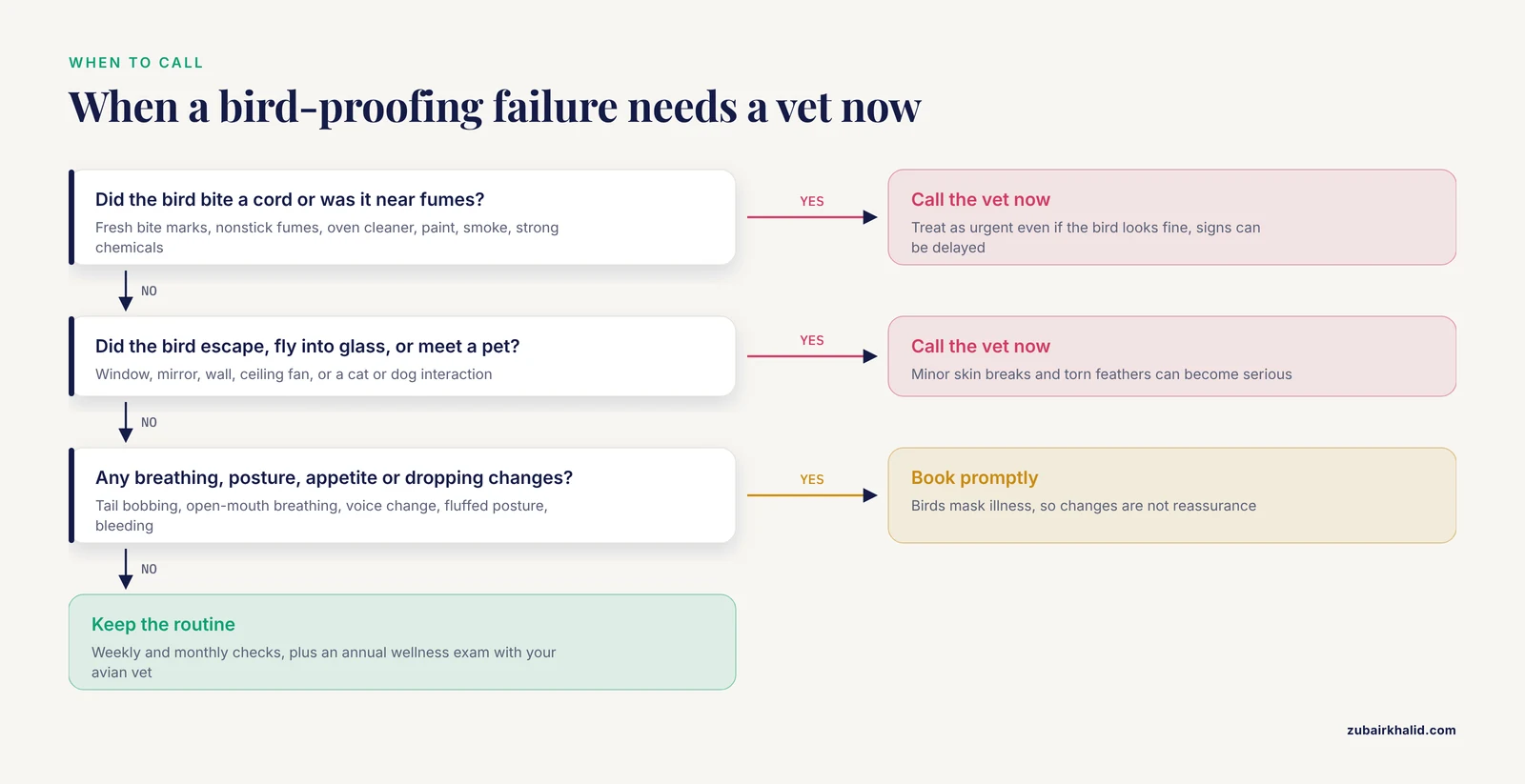
Every apartment and every bird is different, and individual cases need evaluation by an avian veterinarian, who can tailor advice to your species, your bird's flight status, and your specific layout. The Association of Avian Veterinarians maintains a directory of member avian vets, and an annual wellness examination is a reasonable time to walk your vet through your bird-proofing photos and ask for species-specific feedback.
Contact a veterinarian promptly, and treat it as urgent rather than routine, in these situations:
- Your bird has bitten an electrical cord, or you find a cord with fresh bite marks and are unsure whether your bird did it.
- Your bird was exposed to fumes from overheated nonstick cookware, oven cleaner, paint, smoke, or any strong chemical, even if it currently looks fine, because respiratory signs can be delayed.
- Your bird escaped outdoors, or flew into a window, mirror, wall, or ceiling fan.
- You notice changes in breathing, tail bobbing, open-mouth breathing, voice change, fluffed posture lasting more than a few hours, reduced appetite, droppings that change dramatically, or bleeding of any kind.
- Your bird interacts with a cat or dog, even briefly, or you find a puncture or a torn feather after such an interaction, since apparently minor skin breaks can become serious.
- You are unsure whether a plant, product, or material in your apartment is safe, and your bird has already chewed or ingested it.
Delay is the most common reason a survivable avian emergency becomes fatal. Birds instinctively mask illness, so the absence of dramatic symptoms is not reassurance.
Frequently Asked Questions
What is the first thing I should do when bird proofing my apartment?
Secure the windows and doors first, because escape and flight injury are the most sudden hazards. Close and lock operable windows, add tension-mounted mesh barriers to any window you ventilate through, and establish a closed-door habit at the apartment entry before the bird ever comes out of the cage.
Can I bird-proof an apartment without damaging walls or losing my deposit?
Yes, a complete plan exists using only tension hardware, cord covers, freestanding screens, washable mats, and plug-in devices. Avoid all adhesive unless it is specifically rated as damage-free and tested in a hidden spot first, and photograph wall condition when you move in.
Are window screens enough to keep my bird safe?
No. Standard fiberglass screens tear easily under a beak and their corners can be chewed open, so they slow a bird down rather than stop it. Treat a factory screen as decoration and add a tension-mounted metal or heavy-duty mesh barrier whenever a window is open.
Do I need my landlord's permission to bird-proof my rental?
Not for any of the standard renter-safe solutions, since tension rods, cord covers, mats, and plug-in purifiers involve no modification to the property. You only need written permission for anything that attaches permanently, such as wall anchors, ceiling mounts, or replaced fixtures.
How do I handle the kitchen in a bird-proofing plan?
Keep the bird out of the kitchen airspace entirely, which in a studio means relocating the bird to the farthest room with the door closed before any high-heat cooking. Never use nonstick cookware, self-cleaning cycles, aerosol cleaners, or scented products with the bird in the same open space, and run a portable purifier to buffer fumes from neighboring units.
How often should I recheck my bird-proofing setup?
Run a short inspection weekly and a fuller walk-through monthly. Tension hardware loosens, cord covers shift out of position, and velcro and mats age, so a system that was safe at setup can quietly develop gaps within weeks.
Further Reading
- Technology-Assisted Rehabilitation Gym for at-home Training (TARGeT) for stroke survivors: A study protocol for evaluating feasibility, safety, usability, clinical benefit, and costs.
- Dengue@Home: evaluation of a hospital in the home pathway for management of adults with dengue fever.
- Peanut oral immunotherapy updosing via in-office, video, and telephone encounters: Safety and caregiver satisfaction.
- Descriptive Analysis of the First 12-Month Activity of Docadom, a Private Physician-Led Urgent In-Home Consultation Service.
- Home-Based Multimodal Exergame Prototype for Patients With Chronic Stroke: Cross-Sectional Content Validation and Prospective Single-Arm Feasibility Study.
- Home-Based Transcranial Direct Current Stimulation for Depression: From Feasibility to Clinical Implementation.