How to Read a Bird Food Label: A Checklist
By Dr. Zubair Khalid, DVM, MS, PhD ·
To read a bird food label, work through it in this order: the product name and species claim, the ingredient list, the guaranteed analysis, the feeding directions, and the manufacturer's contact and lot information. The single most useful habit is to treat the ingredient list as a ranked list by weight, because the first few ingredients make up most of what your bird actually eats. Labels cannot tell you everything, since studies of pet foods have repeatedly found ingredients present in the product that never appear on the label, so the checklist below covers both what to read and what to verify afterward.
This checklist exists because diet-driven disease is one of the most common preventable problems in pet birds. A review of nutrition-related problems in avian medicine documented hypovitaminosis A in parrots fed seed-based diets, hypocalcemia in African grey parrots, goitre in budgerigars on millet-based mixtures, and iron storage disease in mynahs and toucans, all traced back to unbalanced feeding [1]. Every one of those conditions starts at the food bowl, and the food bowl starts with the label.
At a Glance: Your Bird Food Label Checklist
Use this table in the store aisle or in front of your current bag at home. Any "no" answer is a reason to pause, and several are reasons to call the manufacturer.
| Step | What to check | What a good answer looks like |
|---|---|---|
| 1 | Species and life-stage claim | The label names your bird's group (for example, parrot, cockatiel, finch, canary) and life stage, or states it is complete for that species |
| 2 | First five ingredients | Whole, named foods you recognize, not a pile of grain fragments and vague byproducts |
| 3 | Named protein or species-appropriate base | Ingredients state what they are (millet, sunflower seed, pea, egg product) rather than hiding behind generic terms |
| 4 | Guaranteed analysis | Crude protein, crude fat, crude fiber, and moisture are listed, and the numbers fit your species and life stage |
| 5 | Additives and coloring | Artificial dyes and unexplained additive blends are minimal or absent |
| 6 | Feeding directions | Directions exist, are species specific, and mention transition if you are switching foods |
| 7 | Manufacturer identity | A real company name, address, or phone number appears on the bag |
| 8 | Lot code and date | A lot number and a best-by or manufactured date are printed and legible |
| 9 | Claim language | Words like "premium" or "natural" are treated as marketing, not as proof of nutrition |
| 10 | Post-purchase check | Your bird eats it, droppings look normal, and you keep the bag and lot code in case of a recall |
Why the Label Matters More for Birds Than for Most Pets
Birds hide illness well, and nutritional disease in parrots develops slowly over months to years before an owner notices anything wrong. The conditions listed in the avian nutrition review are directly tied to what fills the bowl. Hypovitaminosis A from seed-based diets causes metaplasia of mucous membranes, which can progress to chronic rhinitis and respiratory fungal infections. Seed mixtures are often deficient in calcium, and nutritional secondary hyperparathyroidism develops unless an additional calcium source such as ground shell is provided [1]. A seed-heavy diet that looks colorful and "natural" on the front of the bag can be the direct cause of chronic disease.
The reverse problem is also real. Over-supplementation of vitamin D causes poisoning, with polyuria and polydipsia as common early signs [1]. That means a well-meaning owner who reads a label, sees added vitamins, and then layers a supplement on top can harm a bird that was already adequately fed. Reading the label is how you avoid both deficiency and excess.
The Association of Avian Veterinarians, the Merck Veterinary Manual, and VCA Animal Hospitals all emphasize formulated pellets as the dietary base for most pet parrots, and Lafeber Company publishes similar guidance for owners. The label is where you confirm whether a product actually fits that model or is simply a seed mix dressed up with a pellet-looking coating.
How to Read a Bird Food Label, Step by Step
This is the core of the checklist, worked through one panel at a time.
Step 1: Read the Product Name and Species Claim First
The front panel should tell you which bird the food is designed for. "Parrot food," "cockatiel mix," "finch seed," and "small bird formula" are not interchangeable categories. The diseases in the avian nutrition review are species specific: hypocalcemia with tetanic symptoms was documented only in African grey parrots and timneh parrots, and goitre in budgerigars arose from iodine-deficient water paired with a millet-based seed mixture [1]. A food that is merely tolerable for one species can be actively harmful for another.
Also check the life-stage claim. A growth formula, an adult maintenance formula, and a breeding or molting formula differ in energy and nutrient density. If the bag says nothing about species or life stage, that silence is itself information.
Step 2: Read the Ingredient List as a Ranked List by Weight
Ingredients are listed in descending order by weight before processing. This is where "bird food label ingredients step by step" reading pays off. The first three to five ingredients describe the bulk of the diet.
Practical reading rules:
- Whole, named foods at the top are a positive sign. Milo, canary grass seed, millet, oat groats, sunflower seed, pea, corn, and ground corn are all identifiable.
- Repeated fragments of the same grain spread across the list (for example, ground corn, corn gluten meal, corn bran) can add up to a corn-dominated diet even when no single corn entry ranks first.
- The word "meal" is not automatically bad, but a vague "animal byproduct meal" or "grain products" tells you nothing. Named sources tell you more.
- For a seed mix, the visible composition is the ingredient list. If sunflower seeds dominate the mix by volume, sunflower dominates the nutrition, regardless of the small print.
Step 3: Match the Ingredient List to Your Bird's Biology
This step is the one most owners skip, and it is where species knowledge changes the verdict.
- Parrots and cockatiels. A predominantly seed-based ingredient list is the pattern associated with hypovitaminosis A and calcium deficiency in psittacine birds [1]. Formulated pellets or a pellet-first blend align better with veterinary recommendations from groups such as the Association of Avian Veterinarians.
- African grey and timneh parrots. Because hypocalcemia is a documented clinical problem in these species, calcium adequacy on the label deserves extra attention, and any calcium supplementation plan should be discussed with an avian veterinarian [1].
- Budgerigars. Millet-based mixtures combined with iodine-poor water have been associated with goitre, so an iodine-adequate formulation or a formulated diet is worth considering for this species [1].
- Mynahs, toucans, and related softbills. Iron storage disease is a known concern in these species, and a diet low in iron has been advised as part of therapy [1]. For these birds, avoid generic "fruit and seed" products and look for species-specific formulas.
- Amazons and other medium parrots. Research in adult amazons measured the protein required just to maintain nitrogen balance, and the authors specifically cautioned against unnecessary protein overconsumption in older pet birds because of declining liver and kidney efficiency [2]. A label boasting very high crude protein is not automatically better, particularly for a mature bird.
Step 4: Read the Guaranteed Analysis
The guaranteed analysis lists minimum crude protein and crude fat, and maximum crude fiber and moisture. Four practical tips:
- Compare protein to your bird's life stage. Adult maintenance needs are modest, and the amazon study above shows that feeding well beyond maintenance protein offers no obvious benefit and may burden older excretory organs [2].
- Compare fat to your bird's activity and species. High-fat seed ingredients such as sunflower and safflower near the top of the list usually predict a high-fat guaranteed analysis.
- Do not compare numbers across wet and dry foods without correcting for moisture. A food with higher moisture will show lower concentrations of everything else.
- Treat the guaranteed analysis as a screening tool, not a verdict. Two foods with identical numbers can differ enormously in ingredient quality and digestibility.
One caution applies here. A pulse ingredient such as pea or lentil on a label is not a red flag by itself. In dogs, a controlled 20-week trial feeding up to 45 percent whole pulse ingredients in a complete and balanced diet found no differences in echocardiographic measures, cardiac biomarkers, or general health measures across increasing pulse inclusion [3]. The lesson that transfers to label reading is that the presence of a single trendy ingredient matters less than whether the whole diet is formulated to be complete and balanced.
Step 5: Scrutinize Additives, Dyes, and Vague Blends
Colored pellets owe their color to dye, not to nutrition. The bird does not care about color, and a long list of color additives is a signal that the manufacturer is marketing to you rather than to your parrot. Similarly, a proprietary "vitamin and mineral premix" listed as one line is common and acceptable, but it prevents you from verifying specific nutrients. If a disease risk relevant to your species depends on a specific nutrient, such as iodine for budgerigars [1], ask the manufacturer whether that nutrient is included and at what level rather than guessing.
The vitamin D warning from the avian literature deserves repeating here in label terms. If the label lists added vitamin D and you also give a supplement, multivitamin, or fortified treat, the total can exceed what the bird needs, and excess vitamin D produces polyuria and polydipsia as early signs of poisoning [1]. Read every product you use, including treats, as part of the same total diet.
Step 6: Read the Feeding Directions and Transition Guidance
Feeding directions should state an amount, a method, and, ideally, a transition period. A sudden diet change is a stressor for birds, and gradual transition is standard advice across avian veterinary resources including VCA Animal Hospitals and Lafeber Company. If a label gives no feeding directions at all, or gives directions so vague they could apply to any species, treat that as a quality signal about the manufacturer.
Step 7: Verify the Manufacturer and Traceability
Look for a company name, a physical address or country of origin, and a phone number or website. A lot code and a best-by date should be printed, not stickered over illegibly. These details matter because food fraud and ingredient authenticity are active concerns in the wider food supply, and authentication work exists precisely to verify that a product matches the claims on its label [4]. Molecular tools such as real-time PCR and digital PCR are now used as label compliance controls to quantify mammalian and avian species content in foods, which reflects how seriously regulators and manufacturers take the gap between label and contents [5]. A manufacturer that answers traceability questions openly is easier to trust than one that does not.
What the Label Cannot Tell You
Honest label reading includes knowing the limits of the document in your hand.
The list may be incomplete. In a survey of foods of animal origin in an Italian region, testing of 723 samples found undeclared milk and egg allergens in samples ranging from 1.8 to 6.8 percent positive across three years, arising from cross-contamination through shared transport and processing equipment [6]. The same phenomenon appears in pet food. ELISA testing of four over-the-counter venison dry dog foods found three positive for soy despite no soy products named in the ingredient list, and one positive for beef with no beef listed at all, which made none of the four suitable for a diagnostic elimination trial [7]. Sensitive immunochemical methods have repeatedly detected allergenic egg residues in foods whose labels listed no egg ingredients [8]. Birds can have adverse food reactions too, so if your avian veterinarian prescribes a limited-ingredient trial, a label that says "no soy" is not laboratory proof.
The stated main ingredient may not match the actual main ingredient. Stable isotope analysis of commercial wet and dry cat foods in Brazil found that chicken and pork dominated most samples, and that even foods labeled with beef as the main ingredient contained a low proportion of bovine material. Roughly 21 percent of the foods derived more than 30 percent of ingredients from plant sources, raising the authors' question of whether this should appear on the package [9]. Pet food labeling is imperfect across species, and bird food is no exception.
Translation and naming errors exist in real markets. A survey of 75 food products in Chinese community markets in Prato, Italy, found non-conformities in every market visited, with 72 percent showing incomplete or mistaken translation of the commercial name, 12 percent incorrect place of production, and 6 percent lacking translation altogether. Missing ingredients or altered commercial names can pose health threats, including allergen exposure [10]. If you buy bird food imported from an unfamiliar market or an informal seller, a garbled or partial label is a legitimate reason to be cautious, not a cosmetic quirk.
None of this means labels are useless. It means the label is the start of due diligence, and the manufacturer contact information on the bag is the tool for finishing it.
Bird Food Label Ingredients: Practical Tips
These bird food label ingredients tips condense the above into habits you can keep.
- Photograph the label before you throw the bag away. You want the ingredient list, guaranteed analysis, lot code, and date on hand for your vet and for recall checks.
- Read treats and foraging items with the same rigor. Owners who select a careful staple diet then hand out dye-loaded seed sticks undo the work. Treats are part of the total diet that produced the diseases in the avian nutrition review [1].
- Call the manufacturer with specific questions. Ask where the food is made, whether diets are formulated to complete-and-balanced standards, and whether nutrient levels are available on request. Reputable companies answer.
- Match the format to the species, then judge the label within that format. A seed mix and a pellet both deserve reading, but a seed mix label promising "complete nutrition" for a parrot deserves extra skepticism given the documented deficiencies of seed-based feeding [1].
- Store the food correctly after opening. The label's best-by date assumes proper storage. Keep food sealed, cool, and dry, and discard stale or insect-damaged product regardless of the date.
Bird Food Label Ingredients: Common Mistakes
These are the bird food label ingredients mistakes seen most often in practice.
- Trusting the front panel. Words like "premium," "gourmet," and "natural" are marketing terms, not verified nutritional claims. The scientific literature on food authentication exists because claims and contents do not always match [4].
- Assuming the first named ingredient is the majority of the diet. Split grain fractions and ingredient splitting can push a single grain to the top of the composition without a single line admitting it [9].
- Feeding one food to all species in the house. The species-specific diseases documented in avian practice, from African grey hypocalcemia to budgerigar goitre to iron storage in mynahs and toucans, exist precisely because nutritional needs differ [1].
- Chasing protein numbers upward. The maintenance protein work in amazons supports adequacy, not excess, especially in older birds [2].
- Ignoring added vitamin D across multiple products. Staple food plus supplement plus fortified treat can stack into toxicity, and the early signs are easy to miss until they are not [1].
- Believing the absence of an ingredient on the label proves its absence in the bag. Cross-contamination and undeclared ingredients are documented findings across food types and testing methods [6][7][8].
- Discarding the bag. Without the lot code, a recall notice or a diet-related illness investigation loses its most useful clue.
- Reading the label once and never again. Formulas change. Re-read the label whenever the packaging or formulation changes, which is why manufacturers print reformulation notices.
Troubleshooting: When Your Bird Rejects the New Food
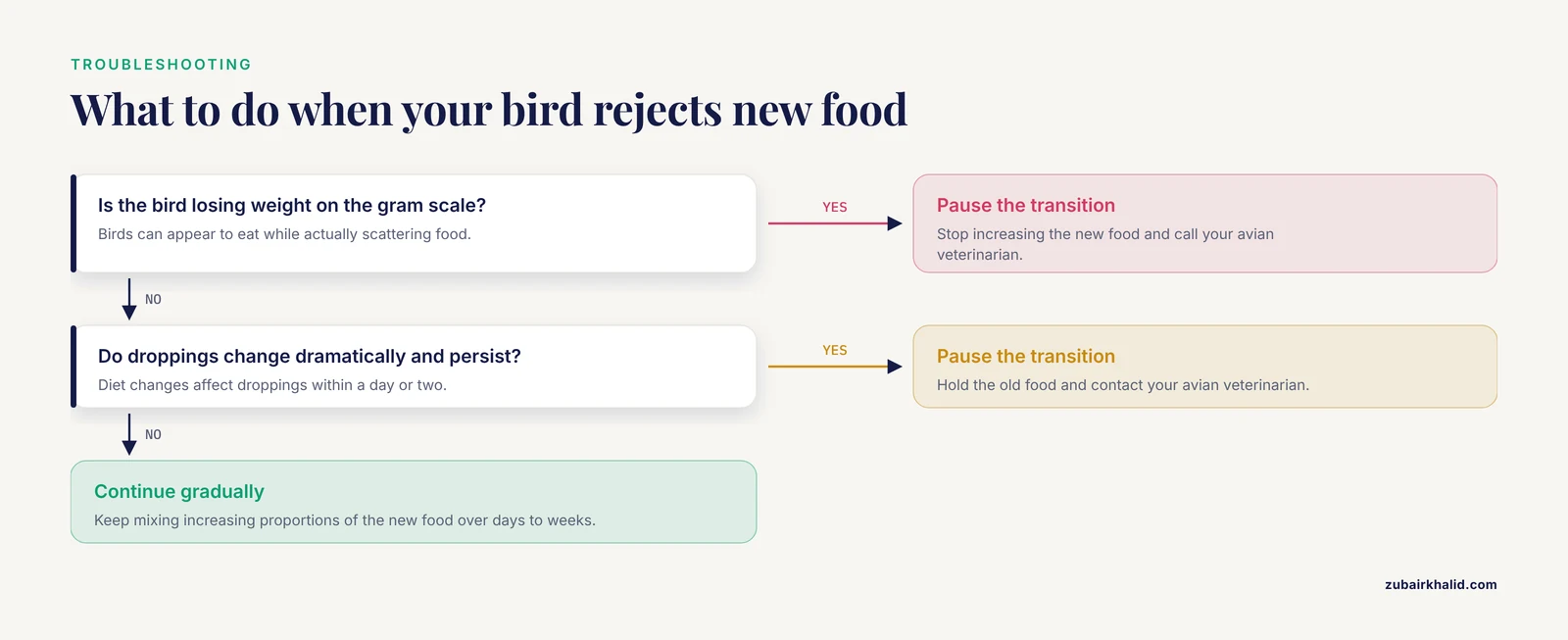
A well-chosen food fails its purpose if the bird will not eat it. Standard avian practice, reflected in guidance from the Association of Avian Veterinarians, VCA Animal Hospitals, and Lafeber Company, is to transition gradually over days to weeks, mixing increasing proportions of the new food with the old. Weight should be monitored with a gram scale during any transition, because birds can appear to eat while actually scattering food. If your bird drops weight, or if droppings change dramatically and persist, pause the transition and call your avian veterinarian.
Also consider placement and hygiene, which connect feeding to bird cage setup. Food and water bowls belong away from perches that sit directly above them, so droppings cannot contaminate the food. Bowls should be reachable without the bird climbing into them, washed daily, and positioned where spilled seed and husks can be cleaned easily. A feeding station downwind of nothing, in cage terms, simply means not under the highest perch. These setup details do not appear on any food label, but they determine whether the carefully chosen food stays safe from bowl to beak.
Welfare and Safety Points
- Diet changes affect droppings within a day or two, so use droppings as an early feedback system during any switch.
- A bird on an all-seed diet that has been fed that way for years should not be converted overnight. Chronic nutritional disease and chronic stress both argue for a graded transition under veterinary guidance [1].
- Keep the total diet in view. The label you read matters, but so does the sum of the staple, treats, table food, and supplements. Vitamin D excess from stacked products is a documented poisoning route in birds [1].
- Any bird showing polyuria, polydipsia, fluffed posture, weight loss, changes in droppings, or respiratory signs needs an avian veterinarian, regardless of what the label promised.
Limitations and When to Contact a Veterinarian
Every individual case needs a veterinarian. Labels, ingredient lists, and published studies describe populations and products, and your bird is an individual with its own history, species, age, and health status. The escalation points below are concrete.
Contact an avian veterinarian promptly if your bird shows any of the following:
- Polyuria or polydipsia, which are described as common early signs of vitamin D over-supplementation and warrant a full diet review including every labeled product you use [1].
- Sudden weakness, tremors, or collapse, which in African grey and timneh parrots should raise the question of hypocalcemia [1].
- Chronic nasal discharge, voice change, or recurrent respiratory infections, which can follow mucous membrane changes from hypovitaminosis A in seed-fed parrots [1].
- Weight loss, persistent changes in droppings, feather abnormalities, or reduced fertility, all of which the avian nutrition review links to unbalanced or multideficient diets [1].
- A suspected adverse food reaction, where your veterinarian may consider a diagnostic elimination diet, with the caveat that label claims alone are not reliable proof of a limited-ingredient food [7].
Ask your veterinarian to review the label and the actual diet together at a routine visit, not only during illness. Bring the photographs of every label in use, including treats.
This article is educational and is not a substitute for veterinary diagnosis or treatment.
Frequently Asked Questions
What should the first ingredient in bird food be?
There is no single correct first ingredient, but it should be a whole, named food matched to your bird's species. For most parrots, veterinary guidance from groups such as the Association of Avian Veterinarians favors a formulated pellet base rather than a seed-dominated list, because seed-based feeding is documented to cause deficiencies such as hypovitaminosis A and poor calcium status [1].
Are seed mixes bad for parrots?
Predominantly seed mixtures are associated with documented deficiencies in psittacine birds, including vitamin A deficiency and calcium inadequacy that can lead to nutritional secondary hyperparathyroidism [1]. Seed can be part of a diet, but it should not be the structural base of one for most parrots.
What does the guaranteed analysis on bird food mean?
It lists minimum crude protein and crude fat and maximum crude fiber and moisture. Use it to screen for wildly inappropriate protein or fat levels for your species and life stage, and remember that higher protein is not automatically better, since research in adult amazons cautions against unnecessary protein overconsumption in older pet birds [2].
How do I switch my bird from seeds to pellets?
Gradually, over days to weeks, mixing increasing proportions of the new food into the old and monitoring weight with a gram scale. If weight drops or droppings change persistently, pause and consult your avian veterinarian. Slow transition is standard guidance across avian veterinary resources.
Are colored pellets harmful to my bird?
The dyes in colored pellets serve owner perception, not bird nutrition, and a long additive list is a signal to read the rest of the label more carefully. The more concrete additive risk documented in avian medicine involves stacked vitamin supplementation, particularly excess vitamin D, which can cause polyuria and polydipsia as early signs of poisoning [1].
Can a label guarantee that a food contains only what is listed?
No. Testing has found undeclared allergens such as milk, egg, soy, and beef proteins in foods whose labels omitted them, arising from shared equipment and processing cross-contamination [6][7][8]. Labels are the starting point for verification, not proof in themselves.
How much protein does my parrot need?
Exact maintenance protein for pet parrots has been estimated in research on adult amazons by measuring inevitable nitrogen losses, and the practical takeaway is that adult maintenance needs are modest [2]. Feed a diet formulated for adult maintenance unless your avian veterinarian advises otherwise for breeding, molting, or medical reasons.
Is bird food labeled for parrots safe for finches or other species?
Not necessarily. Nutritional diseases in birds are species specific, with hypocalcemic tetany documented in African grey and timneh parrots and iodine-related goitre documented in budgerigars on millet-based diets [1]. Buy food labeled for your bird's species group, and ask an avian veterinarian before feeding any product across species lines.
Sources
- [[Nutrition-related problems in pet birds].](https://pubmed.ncbi.nlm.nih.gov/9929897/)
- Estimation of protein requirement for maintenance in adult parrots (Amazona spp.) by determining inevitable N losses in excreta.
- The Pulse of It: Dietary Inclusion of Up to 45% Whole Pulse Ingredients with Chicken Meal and Pea Starch in a Complete and Balanced Diet Does Not Affect Cardiac Function, Fasted Sulfur Amino Acid Status, or Other Gross Measures of Health in Adult Dogs.
- Authenticity and quality of animal origin food investigated by stable-isotope ratio analysis.
- Mammalian and avian species quantification in homogenized foods: real time PCR and digital PCR as tools for label compliance controls.
- Undeclared allergenic ingredients in foods from animal origin: survey of an Italian region's food market, 2007-2009.
- ELISA testing for common food antigens in four dry dog foods used in dietary elimination trials.
- Determination of allergenic egg proteins in food by protein-, mass spectrometry-, and DNA-based methods.
- Identifying the composition of commercial Brazilian cat food with stable isotopes of carbon and nitrogen.
- Labeling of ethnic food in the Prato Chinese community.