Bird Cage Toy Rotation: Step-by-Step Guide
By Dr. Zubair Khalid, DVM, MS, PhD ·
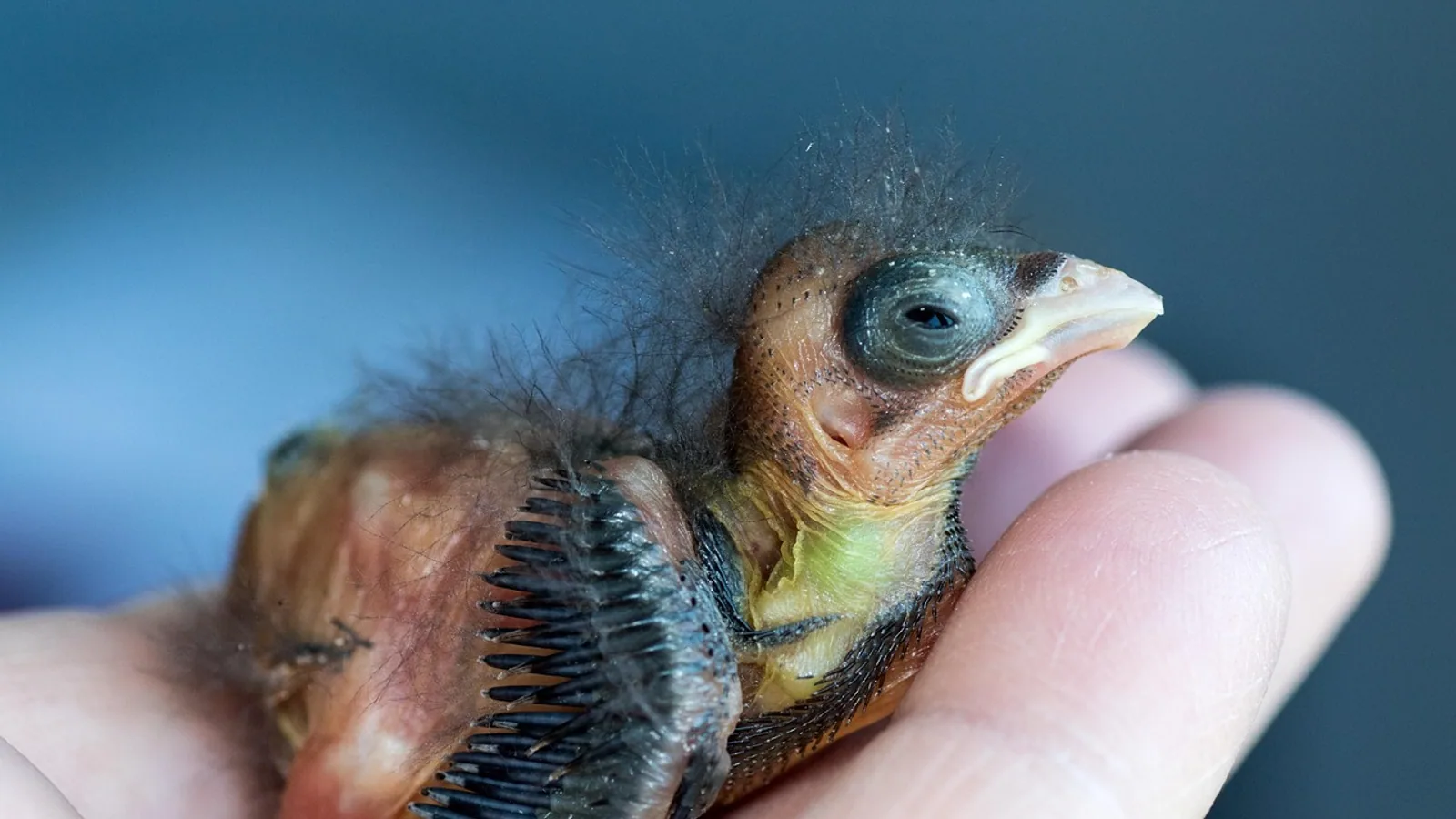
Bird cage toy rotation means swapping the toys in your bird's cage on a regular schedule instead of leaving the same setup in place permanently. A practical starting point for most pet birds is a small change once or twice a week, with a full rearrangement of the cage interior every two to four weeks. The goal is simple. A caged bird spends its whole life in one small space, and toys are the main source of foraging, chewing, and problem-solving activity in that space. Regular rotation keeps those activities fresh, helps prevent boredom-related behaviors such as screaming and feather destructive behavior, and gives you a built-in weekly inspection routine for broken or unsafe items.
Avian veterinarians consistently identify environmental enrichment and foraging opportunities as core parts of responsible parrot care, alongside diet, cage size, and regular health examinations. This guide walks through the process step by step, from your first cage audit to a rotation schedule you can maintain long term.
Bird Cage Toy Rotation at a Glance
Use this checklist to start rotating toys today. Each step is explained in detail in the sections that follow.
| Step | What to do | How often |
|---|---|---|
| 1 | Audit the current cage setup and remove damaged or unsafe items | Once, then during every rotation |
| 2 | Build a toy inventory and group toys by type | Once, then expand over time |
| 3 | Set the rotation schedule that fits your bird | Weekly or every two weeks |
| 4 | Swap a subset of toys rather than everything at once | Every rotation |
| 5 | Introduce truly new toys outside the cage first | As needed |
| 6 | Inspect, clean, and retire toys | Every rotation |
| 7 | Watch behavior and adjust the plan | Continuously |
Why Toy Rotation Matters for Caged Birds
Parrots are intelligent, active animals with strong instincts to chew, shred, and search for food. In the wild, much of a parrot's day is spent foraging. In a cage, that work disappears unless you replace it with something. Toys are the most practical way to do this, and avian care resources from the Merck Veterinary Manual describe enrichment as a standard part of keeping pet birds behaviorally healthy in captivity.
The problem with a static cage setup is habituation. A toy that stays in the same spot for months becomes furniture. The bird stops interacting with it, the cage offers less to do, and unused time gets filled with repetitive behaviors instead. Routine rotation counters this by restoring novelty. When a toy reappears after a few weeks out of the cage, many birds treat it as new again and re-engage with it.
Rotation also serves a medical purpose. Every swap is a hands-on inspection. Frayed ropes, rusted hardware, splintered wood, and ingested fragments are real hazards, and catching them early is far easier than treating an injury or a gastrointestinal obstruction later. Veterinary teaching hospitals emphasize regular inspection of cage contents as part of general bird safety.
Step-by-Step Guide to Rotating Cage Toys
Step 1: Audit the Current Cage Setup
Before your first rotation, look at the cage the way your bird experiences it. Sit at bird height. Check every toy, perch, and accessory against three questions.
- Is it intact? Pull gently on every knot, chain link, clip, and rope strand. Anything loose, frayed, rusted, or cracked comes out now.
- Is it appropriately sized for your bird? Toys sold for small birds can shatter under a macaw's beak, and large chain links or key rings can trap small toes and beaks.
- Where is it placed? Toys should not hang directly over food or water dishes, and there should be room for the bird to move between perches without brushing against a toy.
This audit also doubles as a review of your overall bird cage setup. While you are in the cage, confirm that perches vary in diameter and placement, that food and water dishes are accessible, and that the cage is not overcrowded. Enrichment should add interest without removing usable flight and climbing space.
Step 2: Build a Toy Inventory
Take everything out of the cage and sort it into groups. A simple four-group system works well for most owners.
- Chew and shred toys. Wood blocks, balsa, palm shredders, paper-based items, and natural fiber pieces. These get destroyed, so they are your consumables.
- Foraging toys. Puzzles, wraps, and hides that make the bird work to access food. Foraging toys are widely recommended because they turn feeding time into activity time.
- Manipulative and mechanical toys. Bells, latches, acrylic puzzles, and moving parts that the bird operates rather than destroys.
- Comfort and conditioning items. Perch-mounted grooming textures and other items that stay relatively constant in the cage.
Count what you have. Most owners discover they need to buy or make a few more chew toys, because those are the ones that get destroyed and disappear from the inventory. A workable target is enough toys to fill the cage plus several spares in reserve. You do not need a huge collection. You need enough variety that something is always available to swap in.
Step 3: Set Your Rotation Schedule
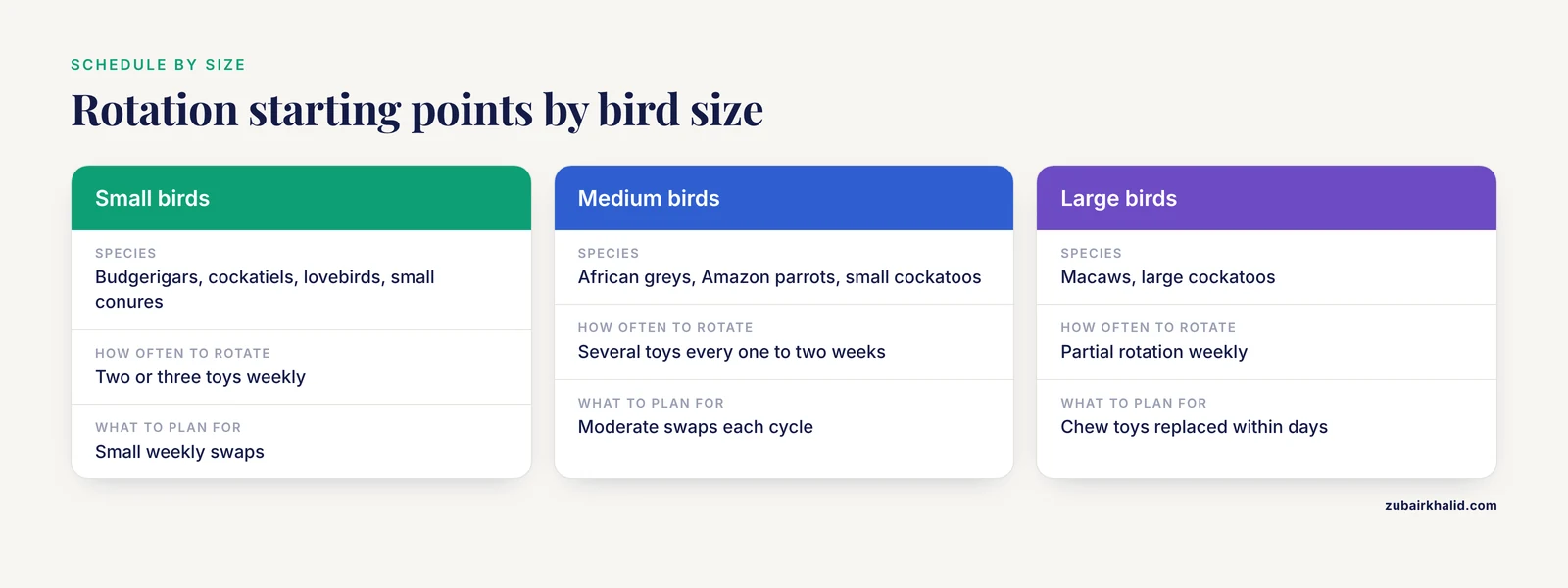
There is no single correct interval, because the right schedule depends on the species, the individual bird, and how quickly toys get destroyed. Use these starting points and adjust based on what you observe.
- Small birds (budgerigars, cockatiels, lovebirds, small conures). Rotate two or three toys weekly.
- Medium birds (African greys, Amazon parrots, small cockatoos). Rotate several toys every one to two weeks.
- Large birds (macaws, large cockatoos). Chew toys often need replacement within days once they start getting destroyed. Plan a partial rotation weekly.
One rule applies across all sizes. Never remove every toy at once and replace them all with brand-new items. A wholesale change can be destabilizing, especially for cautious birds. Partial swaps are the default. Put the calendar reminder in your phone now. Rotations that depend on memory do not happen.
Step 4: Swap a Subset of Toys
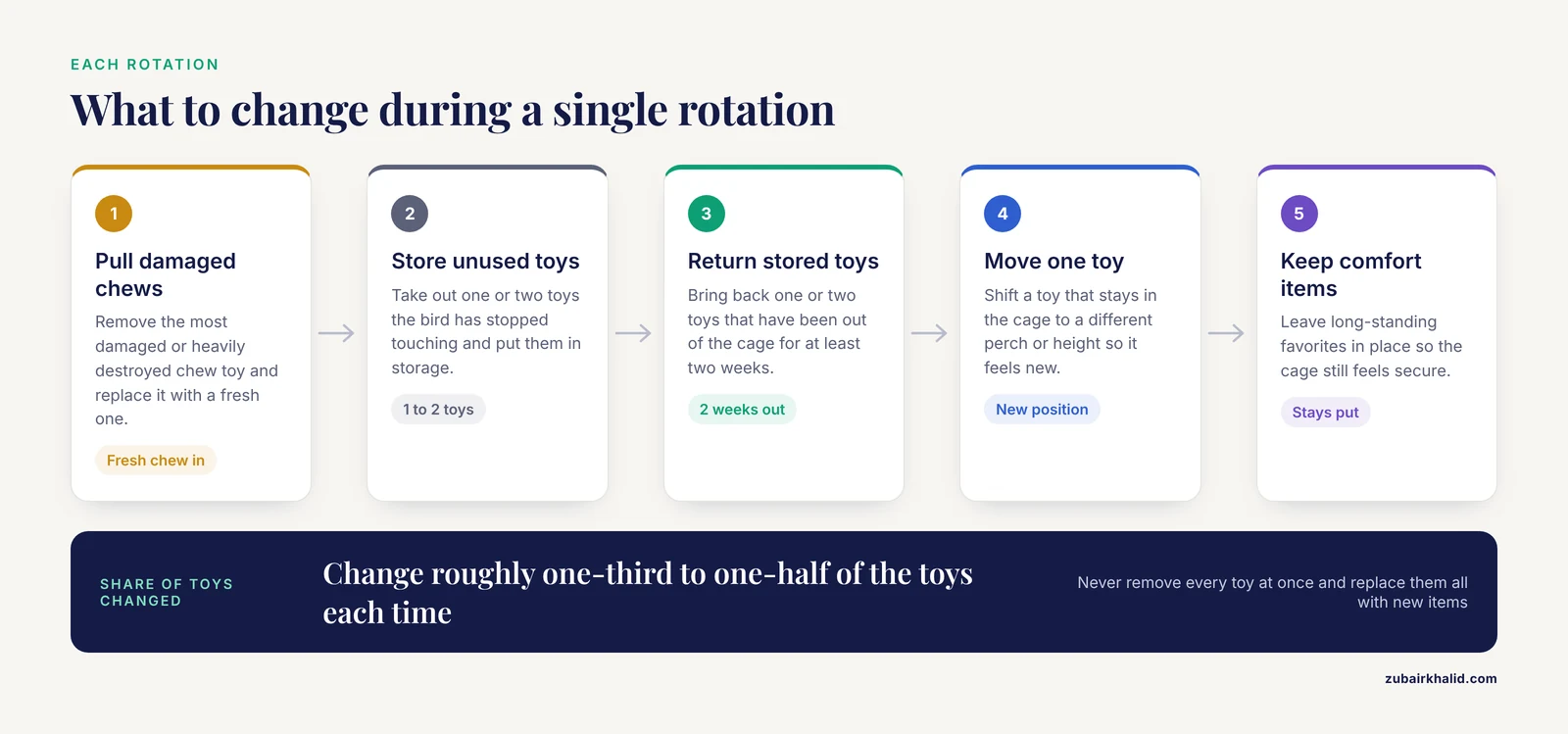
During each rotation, change roughly one-third to one-half of the toys. A simple pattern that works well:
- Remove the most damaged or heavily destroyed chew toy and replace it with a fresh one.
- Remove one or two toys that the bird has stopped touching and put them in storage.
- Return one or two previously stored toys from at least two weeks ago.
- Move the position of at least one toy that stays in the cage. Relocating a familiar toy to a different perch or height changes how the bird encounters it.
Keep the comfort items, such as a long-standing favorite, in place. Birds vary in how they respond to change. Some race over to inspect anything new. Others retreat and need time. Respecting that individual difference is part of good rotation practice.
Step 5: Introduce New Toys Gradually
A toy that has never been in the cage goes through a two-stage introduction.
- Place the new toy outside the cage, within sight but not within reach, for a few days.
- Once the bird ignores it calmly or approaches it willingly, hang it in the cage in a familiar location, not in the bird's favorite sleeping or eating zone.
If the bird shows strong fear responses, such as rushing away, holding feathers tight, or refusing to approach a corner of the cage, remove the toy and reintroduce it more slowly later. Persistent fearfulness or self-injury during introduction is a conversation for an avian veterinarian, because extreme neophobia and anxiety are behavioral problems that can be addressed, not permanent personality traits.
Step 6: Inspect, Clean, and Retire Toys
Every toy that comes out of the cage gets a decision: clean and store, repair and reuse, or throw away.
- Clean. Wash hard toys with warm water and bird-safe soap, rinse thoroughly, and dry completely before storage. Droppings and food residue on toys are a hygiene issue in an enclosed cage environment.
- Retire. Discard any toy that is cracked, splintered, has exposed fasteners, has rusted hardware, or has rope strands that fray faster than they can be trimmed. Do not keep an unsafe toy in the inventory just because the bird likes it.
- Store. Keep clean, intact toys in a closed bin away from the cage so returning toys feel genuinely fresh.
Consumed chew toys that are simply worn down are still safe as long as no hardware is exposed. Many owners keep a small reserve of shredded-but-safe pieces for rehanging during the week between rotations.
Step 7: Observe and Adjust
The last step is the one that never ends. After each rotation, spend a few minutes over the next day or two watching what your bird does.
Signs your rotation plan is working:
- The bird investigates changed items within a short time.
- Chew and foraging toys show fresh interaction marks within days.
- Overall activity level looks normal.
Signs to adjust:
- The bird ignores most toys. Increase foraging content, since food-based toys hold interest better than passive ones for many parrots.
- The bird destroys everything within a day. Increase the number of chew items in the inventory so rotation can keep pace.
- The bird seems stressed after swaps. Make smaller changes per rotation and keep more constant items in place.
Toy Selection Criteria and Safety
Rotation only works if everything in the inventory is safe for your specific bird. Use these criteria when buying or making toys.
- Size match. Toy size, chain strength, and hardware gauge must suit the species. A toy safe for a budgerigar can be a foot entrapment hazard for nothing and a trivial snack for a macaw, so buy for the beak and foot size you actually have.
- Materials. Natural wood, paper, palm, sisal, and stainless steel hardware are standard choices. Avoid toys with loose small parts, long cord or rope strands that can tangle around a leg or neck, and any coating that flakes.
- Destructibility by design. For chewers, the toy is supposed to be destroyed. Budget for consumables rather than expecting indestructible toys to do the same job.
- No favorites-only policy. Birds that fixate on a single toy or mirror can develop pair-bonding behavior toward that object. A varied, rotating inventory reduces the chance of fixation, and veterinarians advise removing objects that trigger persistent hormonal or obsessive behavior.
When in doubt about a specific toy material or design, ask your avian veterinarian at the next visit. Bring the toy or a photo of it.
Bird Cage Toy Rotation Tips
These are the small habits that separate a plan that lasts two weeks from one that lasts years.
- Tie rotation to something you already do. Attach the weekly swap to cage paper changing or to a fixed day of the week. Habit stacking beats willpower.
- Keep a simple log. A note on your phone listing what went in, what came out, and the date is enough. It prevents the common problem of rotating the same three toys in a circle while six sit unused in a drawer.
- Buy or make in batches. Chew toys are consumables. Having spares on hand means a destroyed toy gets replaced immediately instead of leaving a gap for a week.
- Use foraging as the anchor. If you only change one category regularly, make it the foraging toys. Hiding portions of the regular diet in wraps and puzzles converts feeding time into enrichment and is one of the most practical enrichment tools available to owners.
- Change placement, not just items. Height, angle, and distance from perches all change how a toy is experienced. Repositioning costs nothing.
- Match intensity to the bird. A shy rescue bird may need one small change per rotation for months. A bold young conure may thrive on bigger swaps. There is no prize for moving fast.
- Photograph the cage. A quick photo after each successful rotation gives you a record of layouts that worked, which is useful after a vet visit or a cage cleaning.
Common Mistakes in Bird Cage Toy Rotation
Most rotation problems fall into a handful of predictable patterns.
Rotating too infrequently. Toys that stay in place for months stop functioning as enrichment. If you cannot remember the last time a toy moved, it has been too long.
Rotating too much at once. Emptying the cage and refilling it with unfamiliar items can frighten a bird and undo the sense of security the cage provides. Partial swaps are safer and just as effective.
Leaving damaged toys in place. The most serious mistake. A frayed rope or a bent clip is not enrichment, it is a hazard. Rotation exists partly to force inspection, so skipping the inspection defeats the purpose.
Ignoring the bird's response. Rotation is a tool, not a quota. If a particular swap reliably upsets your bird, the plan needs adjusting, not the bird.
Filling the cage instead of enriching it. More toys is not automatically better. An overcrowded cage restricts movement and makes inspection harder. Rotation refreshes interest, so you do not need permanent maximum density.
Using toys as a substitute for interaction. Toys supplement out-of-cage time, training, and social contact. They do not replace them. Behavior resources for pet birds consistently frame enrichment as one component of care alongside daily interaction and exercise.
Buying only visually appealing toys. Bright colors attract owners. Birds respond to texture, destructibility, and food. A plain palm shred often outperforms a plastic rainbow contraption.
Forgetting hygiene between rotations. A toy that sits in a drawer covered in old food residue carries that residue back into the cage. Clean everything before it goes into storage or back into the cage.
Troubleshooting Rotation Problems
| Problem | Likely cause | What to try |
|---|---|---|
| Bird ignores every toy | Passive toys with no payoff | Shift inventory toward foraging and chew items with food rewards |
| Bird fears new toys | Change happens too fast | Longer outside-cage introduction, one new item per rotation |
| Toys destroyed within hours | High chewing drive, thin inventory | Larger stock of consumable chews and more frequent swaps |
| Bird fixates on one toy or mirror | Pair-bonding toward an object | Remove the item, diversify the rotation, discuss with an avian vet |
| Bird screams more after rotation | Schedule change is stressful | Keep food, water, and sleep areas untouched, swap fewer items |
| Motivation fades after a few weeks | Rotation is not on a schedule | Calendar reminder tied to cage cleaning day |
If feather destructive behavior, repetitive pacing, or persistent screaming appears or worsens regardless of enrichment, schedule an examination with an avian veterinarian. These behaviors can have medical contributors as well as environmental ones, and enrichment alone is not a treatment.
How Toy Rotation Fits a Full Parrot Care Checklist
Toy rotation is one line on a longer list. Use this parrot care checklist to place it in context.
- Fresh food and water daily, with a diet appropriate to the species
- Cage cleaned regularly, paper changed frequently, dishes washed daily
- Cage sized appropriately for the species, with varied perches and safe placement away from drafts and kitchen fumes
- Toys rotated and inspected on schedule
- Daily out-of-cage time and interaction where the species and household allow
- Annual wellness examination with an avian veterinarian, or more often if problems arise
- Observation for changes in droppings, appetite, weight, posture, or vocalization
Rotation slots into the weekly or biweekly rows of that list. It touches everything else because each rotation is also a cleaning checkpoint, a safety inspection, and a behavior observation session.
Welfare and Safety Points
Enrichment is not optional decoration. Companion animal welfare frameworks, including guidance followed by organizations such as the AVMA for pet owner education, treat the ability to express natural behaviors as a core component of animal welfare. For parrots, chewing and foraging are among the most important natural behaviors to support in captivity, and toys are the standard tool for that support.
Three safety rules override everything else in this guide.
- An unsafe toy never goes back in the cage, no matter how much the bird liked it.
- Toe, leg, and neck entrapment hazards, including open key rings, gaps in chain, and loose rope loops, get removed immediately.
- Any toy that causes injury, bleeding, or a stuck bird gets removed, the bird gets checked, and your avian veterinarian gets called.
Household aerosols, nonstick cookware fumes, scented products, and smoke remain more dangerous to birds than any toy-related hazard, and cage placement should reflect that. This sits outside toy rotation but belongs in every bird cage setup review.
Limitations and When to Contact a Veterinarian
Every bird is an individual, and the schedules in this article are starting points, not prescriptions. Species, age, history, and health status all change what an appropriate rotation looks like, and individual cases need a veterinarian, ideally one with avian experience.
Contact an avian veterinarian promptly if any of the following occur:
- Your bird ingests part of a toy, string, or foreign material, or you suspect it has
- There is bleeding, a trapped toe or foot, or any injury related to cage equipment
- Feather destructive behavior, self-mutilation, or severe repetitive behavior appears or worsens
- Your bird stops eating, shows fluffed posture, sits at the bottom of the cage, produces abnormal droppings, or shows any sudden behavior change, since birds often hide illness until disease is advanced
- Fear, aggression, or anxiety around the cage or new objects persists despite gradual introduction
- You are unsure whether a toy, material, or cage accessory is safe for your specific species
Annual wellness examinations are the baseline for pet birds, and AAV owner resources recommend establishing care with an avian veterinarian before emergencies happen. Bring your rotation log and questions about toy safety to those visits.
This article is educational and is not a substitute for veterinary diagnosis or treatment.
Frequently Asked Questions
How often should I rotate my bird's cage toys?
A practical starting point is swapping a few toys weekly and doing a larger rearrangement every two to four weeks. Adjust the interval based on how quickly your bird destroys toys and how it responds to change.
How many toys should be in a bird cage at once?
Enough to offer variety without crowding the cage, typically several toys that leave clear space for movement and perching. Quality and variety matter more than quantity, and rotation lets a smaller collection do more work.
Will my bird miss toys that I remove?
Many birds re-engage with a familiar toy when it returns after a few weeks away, which is exactly why rotation works. Removing a toy temporarily is normal practice, not a loss for the bird.
What should I do if my bird is scared of a new toy?
Introduce it outside the cage first, within sight for a few days, then hang it in a familiar spot inside the cage. If fear persists, remove it and try again later with slower steps.
Can I rotate the same toys back in, or do I need new ones?
You can absolutely reuse toys. Clean, inspect, and store them out of sight for at least a couple of weeks, and many birds will treat the returning toy as novel again. New purchases mainly refill your consumable chew supply.
What kinds of toys are unsafe for pet birds?
Avoid toys with loose small parts, long rope or cord strands that can entangle a bird, open key rings, rusted or sharp hardware, flaking coatings, and any toy sized for a much smaller species. Inspect every toy before and after each rotation.
Does toy rotation replace out-of-cage time and training?
No. Toys enrich the cage environment, but they do not replace daily interaction, exercise, and training with you. They work together as parts of the same care plan.
How do I clean bird toys between rotations?
Wash hard toys with warm water and bird-safe soap, rinse thoroughly, and dry completely before storage or reuse. Discard any toy that cannot be cleaned properly or that shows damage such as cracks, splinters, or frayed rope.