Bird Cage Food and Water Dish Placement Guide
By Dr. Zubair Khalid, DVM, MS, PhD ·
Place your bird's food and water dishes on the wall of the cage opposite the perch your bird uses most, at roughly the height of that perch or slightly below, and never directly underneath any perch. This single decision prevents the most common hygiene problem in pet bird keeping: droppings, seed hulls, and shed feathers falling into the dishes. The Association of Avian Veterinarians emphasizes daily access to clean food and fresh water as a core element of routine bird care, and placement is what makes that access actually clean.
Correct placement takes about ten minutes. You mount dishes on the cage wall using the built-in holders or brackets, position them away from droppings and drafts, and leave room for your bird to eat without a toy, door, or swing hitting the dish. This guide walks through the reasoning, the exact steps, the equipment worth choosing, the mistakes owners make most often, and how to troubleshoot a bird that ignores, guards, or soaks in its dishes.
At a Glance: Placement Checklist You Can Apply Today
| Step | Action | Key detail |
|---|---|---|
| 1 | Identify the main perch | Find where your bird actually sleeps and spends most of the day |
| 2 | Pick the opposite wall | Mount dishes on the far side of the cage, out of the droppings line |
| 3 | Set the height | Perch height or slightly lower, within easy reach from a perch |
| 4 | Check reach | Your bird should reach food without stretching or climbing down |
| 5 | Secure the dishes | Dishes must lock into brackets or holders and not wobble or tip |
| 6 | Separate water from food | A few inches apart so seed hulls and moist food do not foul the water |
| 7 | Clear the swing zone | No toys, ladders, or doors that can knock into or cover the dishes |
| 8 | Confirm outside access | You should refill both dishes through feeder doors without opening the main cage door |
| 9 | Test for one day | Watch for droppings in dishes, spilled seed, and wet litter below |
| 10 | Wash daily | Remove, scrub, and refill both dishes every day, per avian veterinary guidance |
Why Placement Matters More Than Most Owners Expect
Bird droppings fall straight down. Seed hulls fly outward. Powder-down feathers, dust, and moist food get flung with surprising force by a bird that eats with its whole head. If a dish sits under a favored perch or beside a busy play area, it collects all of it.
Contaminated dishes are not a cosmetic problem. Avian veterinarians identify unsanitary food and water as a direct contributor to gastrointestinal and bacterial disease in pet birds, and the Merck Veterinary Manual lists contaminated food and water among the routine hygiene hazards owners must control in the home aviary. A dish that looks full can still be fouled. A bird that appears to eat normally can be ingesting droppings-soaked seed every morning.
Placement also drives behavior. Birds are prey animals, and the Association of Avian Veterinarians notes that environmental design affects how confidently a bird eats and drinks. A dish wedged into a corner where the bird cannot see around it, or a dish mounted next to a loud swinging toy, can cause a nervous bird to eat less. On the other hand, dishes placed too close to the sleeping perch can leave droppings on the bird's own food overnight.
Finally, placement affects you. Dishes reachable only by opening the main cage door turn every refill into an escape risk, especially with a bird already trained to fly to an open door. Well-positioned dishes with outside-access doors make the daily routine fast, calm, and safe.
Choosing the Right Dishes Before You Place Them
Placement only works if the dishes themselves are suitable. Match the equipment to the species, the cage, and your cleaning routine.
Material
Stainless steel is the standard recommendation in avian care resources. It does not chip, it resists scratching where bacteria can hide, and it survives dishwashing. Lafeber Company's nutrition and feeding resources for parrots describe sturdy, easily cleaned dishes as the practical baseline for daily feeding. Plastic cups are acceptable for some households but scratch over time, and scratches hold film that scrubbing cannot fully remove. Cracked or deeply scratched plastic should be replaced.
Ceramic works for larger parrots if the glaze is intact, but heavy ceramic dishes in small cages can injure a bird if they topple from a high mount. Avoid anything with lead-glaze uncertainty or decorative paint on the interior.
Shape and depth
For seed and pellet eaters, a relatively shallow dish with moderate depth works well. Very deep cups invite a bird to burrow and fling food. Very shallow saucers invite flinging entirely. For soft foods such as chop, cooked grains, or fruit, a deeper cup reduces spilling.
Attachment style
The best dishes for placement purposes are the ones designed for your cage: bracket-mounted cups that slide into welded holders on the cage wall, or screw-on dishes that clamp to the bars. Loose crocks set on the cage floor are the weakest option because they move, tip, and end up under perches.
Water dishes versus water bottles
Many birds drink happily from a clean dish. Water bottles solve one problem (birds bathing, soaking, or dropping food into the water) and create another: a stuck ball valve can silently cut off water, so a bottle must be checked by tapping it and watching the flow every single time you refill it. VCA Animal Hospitals' avian care guides cover both options and stress daily verification that the water source is actually dispensing. Whatever you choose, the placement principles below are identical.
Bird Cage Food Dish Placement Step by Step
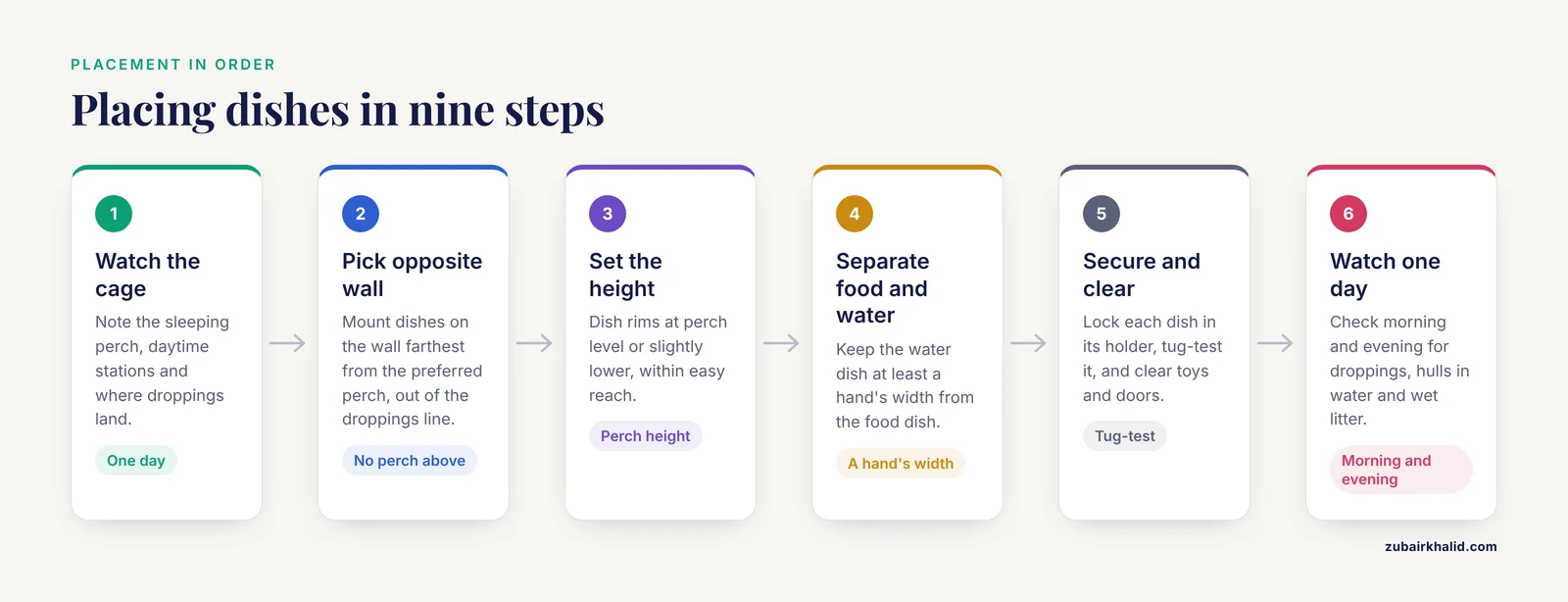
Follow these steps in order. The whole process takes ten to fifteen minutes.
Step 1: Watch where your bird actually lives in the cage
Before moving anything, observe for a day if you can. Which perch holds the sleeping spot? Where does the bird sit while eating now? Where do the droppings accumulate? Most birds have one preferred high perch and one or two daytime stations. The Merck Veterinary Manual's guidance on housing pet birds stresses observing the bird's actual use of the cage rather than assuming from the layout.
Step 2: Choose the opposite wall for the dishes
Mount food and water on the cage wall farthest from the preferred perch, so nothing falls into them from above. If your cage has a corner with no perch directly above it, that corner is often ideal. The droppings test is simple: look straight down from every perch. Any spot that lies in that vertical path is disqualified.
Step 3: Set the height at perch level or slightly below
Food and water dish placement works best when the dish rims sit at the height of an adjacent perch or a little lower. Your bird should be able to hop to a perch next to the dish and reach the contents comfortably. Dishes placed at the very top of the cage get fouled by perches above them. Dishes at the very bottom force the bird to eat off the cage floor zone, where debris and droppings concentrate and where smaller birds may feel exposed.
Step 4: Separate food from water by a few inches
Mount the water dish at least a hand's width away from the food dish. Seed hulls, pellet dust, and bits of moist food flung during eating will otherwise land in the water. This is one of the highest-value bird cage food dish placement tips because it directly reduces how quickly water fouls. If you use a water bottle, mount it away from the food dish for the same reason.
Step 5: Secure each dish in its holder
Lock every dish into its bracket and tug-test it. A dish that a bird can lift, slide, or tip will be lifted, slid, or tipped, usually within the first hour. Larger parrots such as conures, Amazons, and macaws are strong enough to remove poorly seated cups and drop them onto the cage floor.
Step 6: Clear the swing zone
Look around each dish. Does a nearby toy swing into it? Does the cage door bang against it when opened? Can a ladder or bridge slide and cover the rim? Move the interfering object or the dish. A toy that regularly knocks into a water dish will dump water into the cage bedding, and wet bedding is itself a hygiene hazard.
Step 7: Confirm outside access
Every dish should be reachable through a feeder door or hatch without opening the main door. If your cage lacks feeder doors, position the dishes where you can slide a cup out through the bars or use dishes with their own locking covers. This matters most for birds that are not yet comfortable with hands in the cage.
Step 8: Watch one full day
After the move, check the dishes morning and evening. Look for droppings on rims, seed hulls in the water, wet litter under the dishes, and whether your bird eats and drinks normally. A brief period of hesitation at new dish locations is normal. Refusal to eat for more than a day, in any bird, is a reason to call your avian veterinarian, because birds hide illness and can deteriorate quickly when they stop eating.
Step 9: Lock in the daily routine
Wash and refill both dishes daily. The Association of Avian Veterinarians names daily food and water hygiene as part of the standard of care for pet birds. Remove perishable moist foods after a few hours, as guidance from Lafeber Company on feeding fresh foods emphasizes, because spoiling food left in a warm cage poses a real risk.
Water Dish Placement Details
Water deserves its own attention because it fouls fastest.
Keep water out of the droppings path. Droppings in water are a serious contamination event. Replace the water immediately if you see it happen, and move the dish if it recurs.
Keep water away from the bathing zone. Many birds bathe in their drinking water. If your bird does this, either accept it and change the water more often, or mount the drinking dish higher and provide a separate, larger bathing dish lower in the cage. VCA Animal Hospitals' bird care guides note that providing a separate bathing opportunity is a recognized part of routine avian husbandry.
Keep water out of direct sun and away from heat sources. A dish near a sunny window warms quickly and supports faster bacterial growth. The Merck Veterinary Manual's pet bird housing guidance covers the need to keep the cage environment stable and away from drafts and heat extremes.
Check flow daily if you use a bottle. Tap the spout and watch for beads of water. Replace a bottle that leaks or sticks, and keep the water level visible from outside the cage so a glance tells you the status.
Food Dish Placement Details
Food placement has its own set of considerations.
Match the dish to the diet. Pellets do best in a covered or deeper dish that resists flinging. Lafeber Company's feeding resources discuss presenting pellets and supplemental foods in a way that keeps them clean and appealing. Fresh vegetables and chop belong in a dish you can pull out and wash several times a day if needed.
Foraging placement can supplement, not replace, main dishes. Many parrots benefit from foraging opportunities scattered around the cage, and the Association of Avian Veterinarians supports environmental enrichment that encourages natural foraging behavior. Treats and foraging items can go elsewhere in the cage. The main nutrition dishes should stay clean, consistent, and easy to monitor so you can see exactly how much your bird eats each day.
Do not place the food dish where you cannot see it. Monitoring intake is one of the most valuable early-warning tools in bird keeping. A bird that eats less is often the first sign of illness. The Merck Veterinary Manual lists reduced appetite among the signs that warrant prompt veterinary attention in pet birds. Position dishes where a quick glance from across the room tells you the food level.
Common Bird Cage Food Dish Placement Mistakes
These are the errors seen most often, and every one of them has a straightforward fix.
1. Dishes directly under the sleeping perch. The single most common mistake. Droppings fall into food and water all night. Fix: move the dishes to the opposite wall.
2. Dishes on the cage floor. Floor placement mixes food with bedding, dropped droppings, and debris. It also makes intake hard to monitor. Fix: mount at perch height on the wall.
3. Food and water side by side with no gap. Hulls and moist food bits contaminate the water within hours. Fix: separate them by several inches or mount the water bottle on a different wall.
4. Dishes next to the cage door. Opening the main door knocks a dish, dumps water, or pinches a bird. Fix: shift dishes away from the door arc.
5. Unsecured cups that tip or lift. Large parrots treat loose cups as toys. A tipped water dish soaks bedding, and wet bedding left overnight is a recognized hygiene hazard. Fix: bracket-mount every dish and tug-test.
6. Dishes inside the bathing zone. A bird that bathes in its drinking dish leaves standing water fouled with feathers and debris. Fix: separate bathing water from drinking water, or change drinking water twice daily.
7. Dishes wedged behind toys or swinging perches. The bird cannot approach comfortably, or the toy fouls the dish. Nervous birds may under-eat. Fix: give the dish its own clear approach path with a perch beside it.
8. Dishes reachable only by opening the main cage door. Every refill becomes an escape or bite risk. Fix: use feeder doors, outside-access cups, or reposition the dishes.
9. Refilling on top of old food. Topping up seed or pellets over hulls hides how much the bird actually eats and lets debris accumulate. Fix: empty, wash, dry, and refill daily.
10. One dish set for two or more birds. Cage mates can guard a single dish. Resource guarding is a recognized behavior concern in multi-bird households, and avian behavior guidance from the Association of Avian Veterinarians addresses competition around resources. Fix: provide at least one food station and one water station per bird, separated so a dominant bird cannot block both.
Troubleshooting Placement Problems
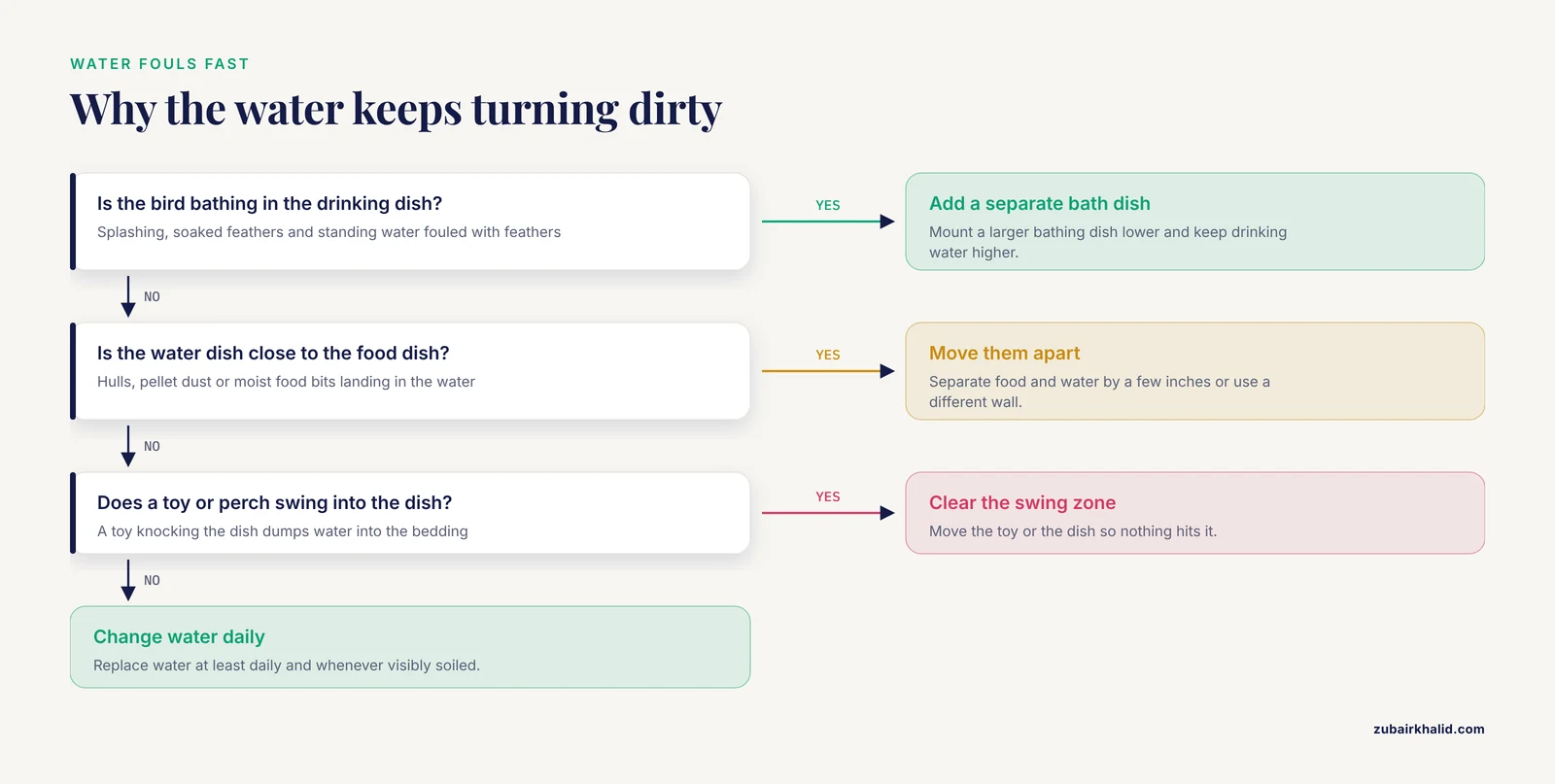
The water is dirty again within hours. Your bird is bathing in it, dunking food, or a toy is dripping into it. Provide a separate bath dish, move the water away from the food, and secure nearby toys.
The bird will not use the new dish location. Give the bird a perch adjacent to the new dish so it can approach with secure footing. Temporarily place a small favorite treat in the new dish. Most birds adjust within a day or two.
Seed everywhere under the dish. Some flinging is normal foraging behavior. A deeper dish, a covered dish, or a dish with a hood reduces the mess. Place the messiest dish over a spot where cleanup is easy.
Droppings still appear in a dish after moving it. Recheck every perch above. Birds sometimes favor a perch you overlooked, or roost in unexpected spots at night. Move the dish one more wall section over.
The bird guards both dishes from its cage mate. Add a second food station and a second water station on a different wall. If guarding persists or a bird is being kept from food, discuss the pair's dynamics with an avian veterinarian, because chronic stress and food restriction carry health consequences.
A bird stops eating after a placement change. Restore the old location temporarily and confirm the bird is eating. A bird that refuses food for more than about a day, or shows fluffed posture, lethargy, or changes in droppings, needs prompt veterinary attention.
How Dish Placement Fits the Wider Cage Setup
Food and water dish placement is one part of a complete bird cage setup. The other elements interact with it.
Perch layout. Perches should span the cage at varied heights with clear flight and hop paths between them, and none should sit over the dishes. VCA Animal Hospitals' avian care guidance covers perch variety and spacing as core husbandry.
Toys and enrichment. Foraging toys and shreddables belong on walls away from the dishes so food and water stay clean, per Association of Avian Veterinarians enrichment guidance.
Grate and tray. A cage grate that lifts droppings and debris away from the floor zone, with a removable tray below, keeps the whole hygiene cycle manageable.
Location of the cage itself. The cage belongs in a draft-free, well-lit family area away from the kitchen. Nonstick cookware fumes and other airborne household toxins are a recognized hazard for birds, as outlined in the Merck Veterinary Manual's pet bird husbandry guidance. Kitchen proximity also adds grease and cooking smoke to dishes you just washed.
A simple weekly parrot care checklist that ties it together:
- Wash and refill food and water dishes daily, and deep-wash holders weekly.
- Inspect dish rims for droppings and biofilm each morning.
- Confirm water flow (bottles) or clarity (dishes) every day.
- Remove perishable fresh food after a few hours.
- Check that no perch, toy, or door fouls the dishes.
- Record approximately how much the bird eats so changes are noticeable early.
- Replace scratched or cracked dishes promptly.
Welfare and Safety Notes
Good placement is a welfare measure, not just housekeeping. Birds that can eat and drink confidently, from clean dishes, without competition or disturbance, show better daily activity and more normal behavior. The Association of Avian Veterinarians frames clean food and water access, environmental enrichment, and observation of eating habits as pillars of preventive avian care.
Two safety points deserve emphasis. First, never let a dish placement trap a bird. Avoid mounts that create a gap a foot, head, or leg could wedge into, especially for small species. Second, avoid placing dishes at heights where a startled bird could crash into them at full speed. Birds startle vertically and quickly, and a dish rim at eye level along a flight path is a collision hazard.
Limitations and When to Contact a Veterinarian
This article covers general placement principles that apply across common pet bird species. Individual cases need a veterinarian, particularly birds with disabilities, chronic conditions, or unusual cage configurations, and an avian veterinarian can advise on placement for a specific bird's needs.
Contact an avian veterinarian promptly if any of the following occur:
- Your bird refuses food for more than a day, or you observe a clear drop in intake.
- Droppings change color, volume, or consistency, which can reflect diet but also illness.
- The bird sits fluffed, lethargic, or at the cage bottom.
- Repeated contamination of dishes persists despite correct placement, since abnormal droppings frequency or volume may be the underlying issue.
- A bird in a multi-bird cage is being prevented from eating by a cage mate.
- You suspect the water supply is contaminated or your bird drank from a fouled dish.
Birds mask illness until disease is advanced, so avian veterinarians consistently recommend treating appetite and droppings changes as urgent rather than watch-and-wait problems. When you call, describe the dish placement changes you made and when, because that timeline helps the veterinarian interpret what you are seeing.
Frequently Asked Questions
How far should food and water dishes be from my bird's perch?
Far enough that nothing falls into them from above. The practical rule is to place dishes on the wall opposite the main perch, out of the direct vertical line of any perch, and a few inches of separation between the food and water dishes keeps hulls out of the water.
Should the water dish be next to the food dish?
No. Keep them a few inches apart or on different walls. Seed hulls, pellet dust, and moist food bits flung during eating foul adjacent water quickly, and separated dishes stay clean longer.
What height should food and water dishes be in a bird cage?
Perch height or slightly below. The bird should reach food from an adjacent perch without stretching or climbing down to the cage floor. Very high placements risk fouling from perches above, and floor placements collect debris.
Can I put food dishes on the bottom of the cage?
It is better not to. Floor-level dishes mix with droppings, bedding, and debris, are harder to monitor, and expose small birds while they eat. Mount dishes on the cage wall at perch height instead.
Why does my bird's water get dirty so fast?
Bathing in the dish, dunking food, flung seed hulls, and nearby swinging toys are the usual causes. Provide a separate bathing dish, increase separation between food and water, and secure nearby toys. Change the water at least daily and whenever visibly soiled.
Can I use a water bottle instead of an open dish?
Yes, and bottles stay cleaner in cages where birds bathe in their water. The tradeoff is that you must confirm the valve dispenses water every time you check, because a stuck valve can go unnoticed. VCA Animal Hospitals' avian guidance emphasizes daily verification of the water source.
How many food and water dishes do two birds need?
Plan on one food station and one water station per bird, placed apart so a dominant bird cannot guard both. Resource guarding around dishes is a known concern in multi-bird cages, and avian behavior guidance addresses separating resources.
How often should I wash and move my bird's dishes?
Wash both dishes daily and deep-clean the holders and surrounding bars weekly. Move dishes only when a placement problem exists, such as droppings falling in or fouling, because birds eat most confidently from consistent, familiar locations.
This article is educational and is not a substitute for veterinary diagnosis or treatment.