Bird Cage Draft Protection: Common Problems and Fixes
By Dr. Zubair Khalid, DVM, MS, PhD ·
Draft protection for a bird cage means placing and shielding the cage so your bird never sits in a path of moving air, such as air from an open window, a heating or cooling vent, a doorway, or a ceiling fan. The fix is usually simple: relocate the cage to a calm corner of a room your family uses daily, keep it away from vents, doors, and windows, and cover part or all of the cage at night. Birds are sensitive to sudden temperature changes and airborne irritants, so thoughtful cage placement is one of the most valuable things you can do for their health.
This article explains why drafts are a problem for pet birds, the most common placement mistakes owners make, how to fix each one, and how to build a complete bird cage setup that supports long-term health. You will also find a parrot care checklist and clear guidance on when to call an avian veterinarian.
At a Glance: Draft Protection Checklist You Can Act On Today
| Step | Action | Why It Matters |
|---|---|---|
| 1 | Hold the back of your hand near the cage for a full minute | You will feel moving air that a quick glance misses |
| 2 | Move the cage away from windows, exterior doors, and vents | Constant moving air forces a bird to burn energy staying warm |
| 3 | Keep the cage off the floor and out of the kitchen | Floor-level air is cooler and kitchens carry fume risks |
| 4 | Cover the cage at night with a breathable cover | Reduces nighttime air movement and light disturbance |
| 5 | Check the cage location in every season | A spot safe in summer can be drafty in winter |
| 6 | Watch for fluffed feathers, lethargy, or tail bobbing | These can signal illness and need an avian vet exam |
Why Drafts Are a Problem for Pet Birds
Birds have a respiratory system that is far more efficient than the human respiratory system, with air sacs that move air through the lungs in one direction. That efficiency is an advantage in flight, but it also means airborne irritants and temperature swings affect birds quickly. A draft does not usually cause disease by itself, but it forces a bird to constantly regulate body heat. Over hours and days, that chronic effort can weaken a bird that is already young, old, molting, ill, or underweight.
Pet birds also hide illness well. In the wild, a visibly sick bird attracts predators, so captive birds instinctively mask weakness until disease is advanced. This is why environmental problems such as a cold, drafty cage location matter even when your bird seems fine. By the time a bird shows obvious signs of sickness, the problem has often been developing for days or weeks.
The Association of Avian Veterinarians recommends that every pet bird have an avian veterinarian and an initial wellness exam, with regular checkups thereafter. Those visits are also the right time to ask whether your specific cage placement suits your species, because a canary, a budgerigar, and a macaw have different tolerances and different needs.
Bird Cage Draft Protection Causes: Where Drafts Come From
Most draft problems trace back to a handful of placement errors. Walk through this list in your own home and identify which apply to your setup.
Windows and Exterior Doors
A cage near a window may look cheerful, and some filtered light is good for birds. The problem is the air layer close to glass. In winter, the glass itself is cold and cools the air beside it. In summer, direct sun through glass can overheat a cage rapidly. A window that opens for ventilation, or an exterior door that swings open frequently, creates direct moving air across the cage several times a day.
Heating and Cooling Vents
Forced-air heating and air conditioning registers blow concentrated streams of air. A cage placed above or beside a floor register, or under a wall vent, sits in that stream for hours. The same applies to portable fans, tower fans, and evaporative coolers. Ceiling fans deserve special mention because they combine moving air with a serious injury risk if the bird is out of the cage.
Hallways and Entry Zones
High-traffic walkways, foyers, and mudrooms experience repeated temperature changes every time a door opens. They are also noisy and stressful. Birds need predictable, calm surroundings, and VCA Animal Hospitals notes that cage placement should balance social contact with a sense of security.
The Kitchen
Kitchens combine several hazards at once. Drafts from doorways and ventilation hoods are the least of them. Overheated nonstick cookware and some other household appliances can release fumes that are rapidly fatal to birds because of their efficient respiratory system. Birds should never be housed in or near a kitchen.
Floor-Level Locations
Cold air settles. A cage on the floor or on a very low stand sits in the coolest layer of the room and is more exposed to foot traffic, other pets, and drafts that travel along the ground. Low placement also increases stress because the bird cannot see its surroundings well.
Overnight Temperature Drops
Many homes cool significantly overnight, especially bedrooms with windows cracked or thermostats programmed to drop at night. A bird sleeping in the path of that cooler air may never show a single dramatic symptom, just a slow decline in condition.
Signs Your Bird Is Struggling With Its Environment
Because birds mask illness, watch for small changes rather than dramatic ones:
- Fluffed feathers held for long periods during the day when the bird is not sleeping
- Lethargy, reduced activity, or spending most of the time hunched on the perch
- Reduced appetite or reduced droppings
- Tail bobbing in time with breathing, which suggests respiratory effort
- Sitting low on the perch or at the bottom of the cage
- A bird that always relocates to one far corner of the cage, away from a particular side
That last sign is easy to miss. Birds often position themselves away from whatever bothers them. A bird that consistently crowds the far side of the cage is telling you something about that location.
Any of these signs justifies a call to an avian veterinarian. Because birds deteriorate quickly once symptoms appear, early examination matters.
How to Fix Bird Cage Draft Problems Step by Step
These solutions work for nearly every cage and living situation. Work through them in order.
Step 1: Find the Draft
Hold the back of your hand, which is more sensitive than your palm, near each side of the cage for a full minute. Do this at different times of day, with the heating or cooling system running, and with doors and windows in their normal positions. Note which side of the cage feels moving air. Also run the test after dark, because nighttime patterns often differ from daytime ones.
Step 2: Relocate the Cage if Needed
The best fix is almost always relocation rather than shielding. Choose a spot that meets these criteria:
- Against an interior wall, ideally in a corner, so two sides of the cage are protected
- Away from windows, exterior doors, registers, radiators, and fans
- Off the floor, at a height where the bird can interact with the family
- In a room the family uses regularly, so the bird gets social contact, but not in the middle of chaos
- Out of the kitchen entirely
One wall of the cage against a solid wall, with a second side near but not touching another wall or piece of furniture, creates a naturally sheltered position without blocking light or air exchange entirely. A cage still needs ventilation. The goal is gentle, stable air, not sealed air.
Step 3: Rearrange the Cage Interior
Perch placement helps the bird protect itself. Provide perches at more than one height and on more than one side of the cage so the bird can choose where to sit. Place a natural wood perch away from food and water dishes. Do not place perches directly beside the cage door or beside food dishes where droppings will contaminate them. VCA Animal Hospitals guidance on avian husbandry emphasizes appropriate perches of varied diameter as a foundation of cage setup.
Step 4: Use a Cage Cover at Night
A breathable, purpose-made cage cover reduces air movement and blocks early morning light, which helps many birds sleep a full night. Cover the cage at a consistent bedtime each evening and uncover it at a consistent time each morning. Consistency matters as much as the cover itself, because predictable light and dark cycles support normal behavior. Leave a small gap at the bottom edge in warm weather so air can move, and never use a cover made of loose-weave fabric, fringe, or fibers a bird could chew and ingest.
Step 5: Manage the Room, Not Just the Cage
- Keep the room temperature stable through the day. Avoid dramatic thermostat setbacks overnight during cold months, particularly for young, elderly, sick, or molting birds.
- Eliminate fans and ceiling fans in the bird's room, or keep the bird out of that room while they run.
- Close windows in the bird's room during cold weather, and never park the cage in the direct path of an opened window in summer either.
- Keep the bird away from fumes of any kind. In addition to kitchen fumes, aerosol sprays, scented candles, plug-in deodorizers, cleaning vapors, paint, and new carpet off-gassing all pose real risks to birds. If you can smell it, the bird is inhaling far more of it than you are.
Step 6: Recheck Every Season
A placement that works in April may fail in November. Reassess the cage location at each seasonal change. Radiators switch on in fall, air conditioners run in summer, and holiday traffic changes room routines in winter. A two-minute hand test each season keeps the setup safe year-round.
Common Mistakes Owners Make With Draft Protection
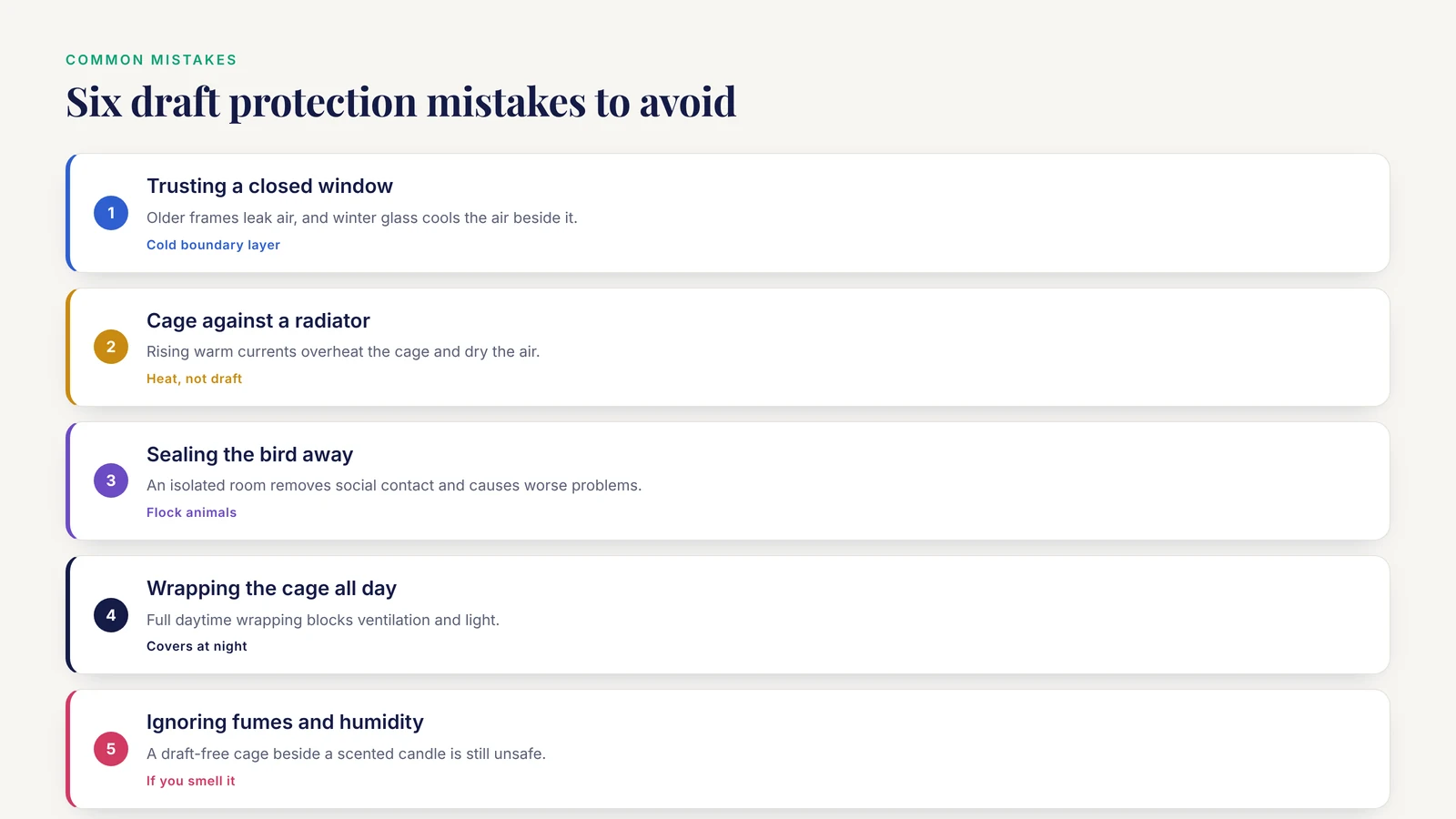
Mistake 1: Assuming a closed window means no draft. Older window frames leak air even when latched. The cold layer of air beside winter glass affects a cage even without an open sash.
Mistake 2: Placing the cage against a working radiator or heater. Heat source proximity is a different problem from draft exposure but just as harmful. It can overheat the cage, dry the air, and place a bird directly in rising warm currents.
Mistake 3: Sealing the cage in a quiet, isolated room. Birds are social flock animals. Solving the draft problem by isolating the bird in a rarely used room creates a worse problem, because lack of social contact and mental stimulation harms pet birds. Choose an actively used room and fix the draft within it.
Mistake 4: Using plastic sheeting or blankets wrapped tight around the cage all day. Full daytime wrapping blocks ventilation and light. Covers belong at night, or briefly during a specific event such as moving the cage, not as permanent wallpaper.
Mistake 5: Fixing the draft but ignoring fumes and humidity. Draft protection is one part of environmental health. A draft-free cage beside a scented candle is not a safe cage.
Mistake 6: Assuming a bird that looks fine is fine. Birds hide illness until it is advanced. Environmental corrections should be made based on the setup itself, not only on whether the bird currently looks sick.
Bird Cage Setup: Building the Full Picture
Draft protection works best as part of a complete, well-planned bird cage setup. The elements below cover the core of a healthy cage environment.
Cage Size and Bar Spacing
Choose the largest cage your space and budget allow, with bar spacing appropriate for your species. A bird should be able to stretch both wings fully and hop between several perches. Small birds need narrow bar spacing to prevent head entrapment, while large parrots need strong bars they cannot bend. Lafeber Company's avian care resources provide species-specific guidance on cage dimensions and setup for common pet parrots.
Perches
Provide several perches of varied diameter and texture to exercise the feet and prevent pressure sores. Natural wood branches, rope perches, and textured perches each serve a purpose. Avoid a cage furnished with only a single uniform dowel perch. Do not place any perch directly over food or water dishes.
Food and Water
Position food and water dishes away from perches that would let droppings fall into them. Refresh water daily and remove perishable fresh foods after a few hours. Lafeber Company provides detailed species-appropriate nutrition guidance, including the role of formulated diets supplemented with vegetables and appropriate fresh foods. Discuss the ideal diet for your specific species with your avian veterinarian.
Lighting and Day-Night Cycles
Birds benefit from consistent, predictable light and dark periods. A dark, quiet, covered cage overnight supports normal sleep. During the day, indirect natural light is welcome, but never allow direct sun through glass to heat the cage.
Enrichment and Social Contact
Rotate toys, provide foraging opportunities, and ensure daily out-of-cage interaction appropriate to your species. Environmental enrichment is a recognized component of responsible avian husbandry. A bird in a perfectly placed but barren cage will develop behavioral problems.
Location Within the Room
Combine everything above: interior wall, corner placement, family traffic but not chaos, no kitchen, no vents, off the floor, cover at night. This single decision, cage location, prevents more problems than any accessory you can buy.
Parrot Care Checklist
Use this checklist as a weekly and monthly review of your parrot's environment and care. It integrates draft protection with the broader daily care that avian veterinarians recommend.
Daily
- Refresh water and check food dishes
- Observe droppings, appetite, activity, and posture
- Confirm the cage cover goes on at a consistent bedtime
- Provide social interaction and supervised out-of-cage time
Weekly
- Run the hand test around the cage to catch new drafts
- Clean the cage, perches, and dishes thoroughly
- Rotate or inspect toys for wear, fraying, or damage
- Weigh your bird if you have a gram scale, and note trends
Monthly and Seasonally
- Reassess cage location for seasonal drafts, sun exposure, and heat sources
- Inspect the cage for bent bars, loose parts, or rust
- Review diet with species-specific resources and your veterinarian
Ongoing
- Maintain a relationship with an avian veterinarian and schedule regular wellness exams
- Know your nearest emergency avian vet before you need one
Troubleshooting Specific Draft Problems
"My bird's cage has to go near a window because that is the only good light."
Filtered daylight is beneficial, but the cage does not need to sit against the glass. Move the cage several feet away from the window so the bird receives light without the cold boundary layer or direct sun. If the window is the only source of daylight in the room, reposition within the room rather than giving up the room.
"My apartment only has wall outlets and vents where a cage could fit."
Measure the throw of air from the vent with your hand. If the vent cannot be redirected, place the cage on the opposite wall, or use a vent deflector to direct airflow away from the cage. Never block a vent completely, because that strains the system and can create moisture problems.
"My bird lives in a room everyone passes through."
Passing traffic is fine. The draft risk in hallways comes from doors, not from people walking by. If the hallway door cannot stay closed, angle the cage so no door swing path or door-adjacent airflow reaches it, and use a night cover.
"I move my bird to a porch or sunroom in summer."
Outdoor time can be enriching, but a porch is the highest draft-risk location in most homes. If your bird spends time outdoors, do so under direct supervision, in a sheltered spot, never in direct sun, and bring the bird inside well before evening temperatures drop. Never leave a bird outdoors unattended, where predators, wild birds, and weather create risks.
"My bird fluffs up every evening and I cannot tell if it is the cold or sleepiness."
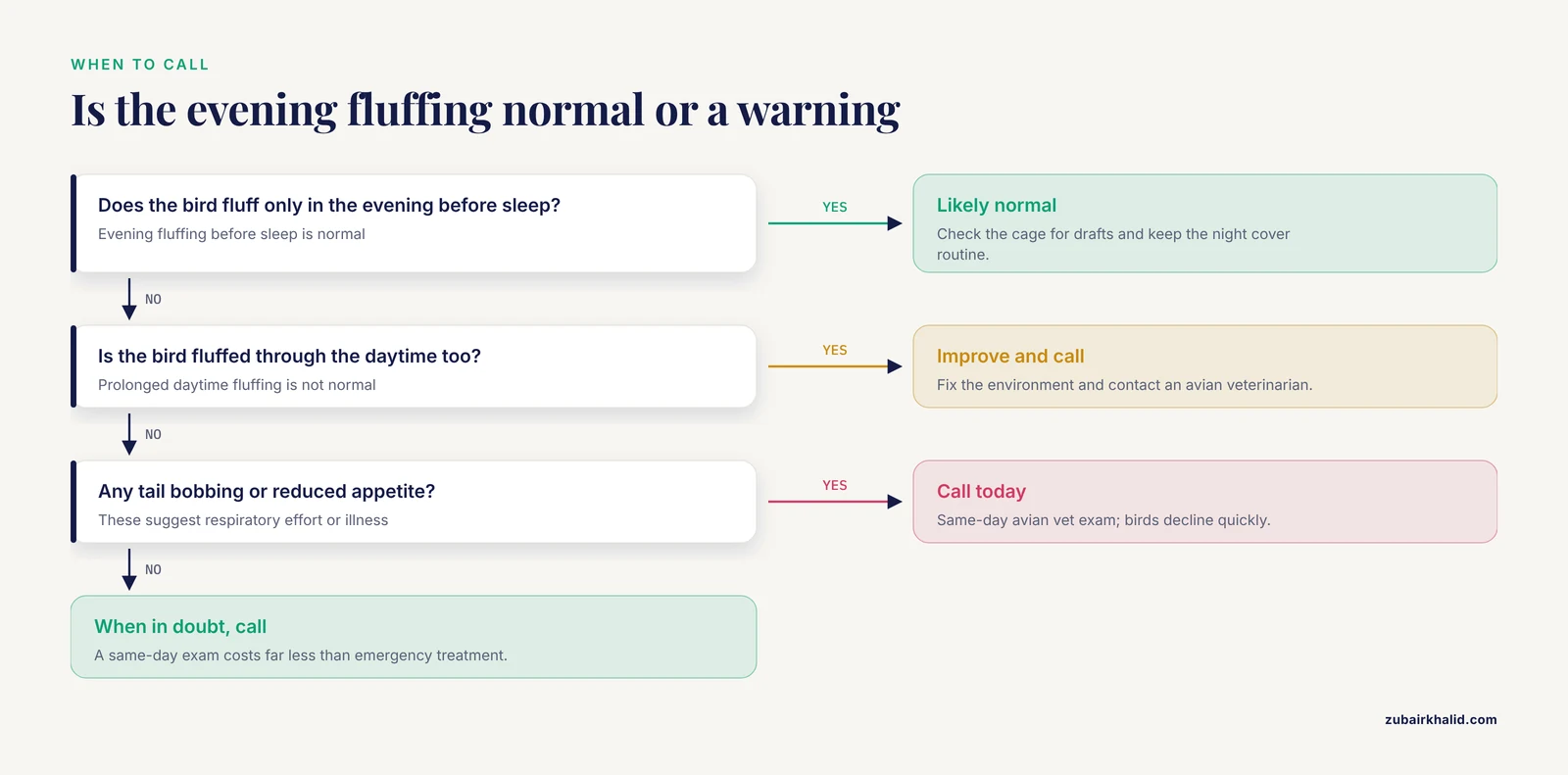
Evening fluffing before sleep is normal. Fluffing combined with lethargy, fluffing through the day, or fluffing with tail bobbing or reduced appetite is not. When in doubt, call an avian veterinarian. Birds decline quickly, and a same-day examination is inexpensive compared to emergency treatment.
Welfare and Safety Points
Draft protection is ultimately a welfare issue. The AVMA's pet owner resources emphasize that responsible pet ownership includes providing an appropriate environment, and for birds, that environment is dominated by the cage and its location. A bird cannot choose its room, so the owner's placement decision defines the bird's climate.
Beyond drafts, remember the respiratory vulnerabilities that make placement decisions so consequential. Fumes from overheated nonstick cookware, aerosols, and strong scents can kill a bird within minutes. Secure windows and doors whenever the bird is out of the cage. Remove ceiling fans from the bird's flight area. Keep other pets separated unless supervision is constant and proven safe.
Finally, treat cage location as a living decision, not a one-time setup. Families change, furniture moves, heating systems get replaced, and rooms get repurposed. The best bird owners reassess the environment whenever life changes around the cage.
Limitations and When to Contact a Veterinarian
Every bird is an individual, and this article provides general guidance rather than a diagnosis. Species, age, health status, and feather condition all change how a particular bird tolerates its environment, and only an examination by an avian veterinarian can account for those factors.
Contact an avian veterinarian promptly if your bird shows any of the following:
- Tail bobbing, open-mouth breathing, or any increased breathing effort
- Sitting fluffed and hunched at the bottom of the cage
- Reduced appetite, reduced droppings, or no droppings
- Discharge from the nostrils or eyes, or a change in voice
- Sudden lethargy or loss of balance
- Any known or suspected exposure to fumes, smoke, or aerosol sprays, which is an emergency regardless of current appearance
Because birds mask illness, do not adopt a wait-and-see approach beyond a few hours when symptoms are present. The Association of Avian Veterinarians maintains resources for locating a qualified avian vet in your area, and establishing that relationship before an emergency arrives is one of the best investments you can make in your bird's health.
This article is educational and is not a substitute for veterinary diagnosis or treatment.
Frequently Asked Questions
Do drafts actually make birds sick?
Drafts do not cause disease on their own, but they force a bird to spend energy staying warm and can contribute to stress and chilling, especially in young, old, molting, or unwell birds. Because birds hide illness well, removing drafts is a sensible preventive step rather than a response to symptoms.
Where should a bird cage be placed in a house?
Place the cage against an interior wall, ideally in a corner, off the floor, away from windows, exterior doors, vents, radiators, and fans, and in a room the family uses regularly. Never place a cage in or near a kitchen because cooking fumes can be fatal to birds.
How do I tell if my bird's cage is in a draft?
Hold the back of your hand near each side of the cage for a full minute at different times of day, with heating and cooling running and doors in their normal positions. Moving air you can feel on your skin is air your bird is living in. Also watch whether your bird consistently avoids one side of the cage.
Should I cover my bird's cage at night?
A breathable cage cover at a consistent bedtime reduces nighttime air movement and light disturbance, which supports better sleep. Cover the cage at night only, not during the day, and ensure some airflow so the cage never becomes sealed or overheated.
What temperature is too cold for pet birds?
There is no single number that applies to every species, and a healthy adult bird tolerates a broader range than a sick, young, or molting one. The practical goal is a stable room temperature without sudden changes, moving air, or proximity to cold glass or heat sources. Ask your avian veterinarian for guidance specific to your species.
Can I put my bird's cage near an air conditioner or heater vent?
No. Vents deliver concentrated streams of moving air, and heaters and radiators create hot, dry zones. Keep the cage far enough away that no direct airflow or radiant heat reaches it, and use a vent deflector if redirection is needed.
What are the signs my bird is too cold?
Look for prolonged daytime fluffing, hunching, lethargy, reduced appetite, staying in one sheltered corner of the cage, or sitting low on the perch. These signs overlap with illness, so if you see them, improve the environment and contact an avian veterinarian promptly.
How often should I check my bird's cage placement?
Recheck the location with a hand test at every seasonal change and whenever furniture, appliances, or heating and cooling routines change. A placement that is safe in spring can be drafty in winter or overheated in summer.