Bird Cage Bar Spacing: Why It Matters for Safety
By Dr. Zubair Khalid, DVM, MS, PhD ·
Bird cage bar spacing is the distance between the wires of a cage, and it is the single most safety-critical measurement on any enclosure you will buy. If the gap is too wide for your species, a bird can push its head through the bars, panic, and strangle or seriously injure itself, or it can slip out entirely. If the gap is too narrow, toes, beaks, and wing feathers catch on the wires, climbing becomes difficult, and the bird loses the visibility that keeps a caged parrot mentally healthy. The correct spacing depends on the species, the individual bird's size, and its behavior, and it should be confirmed with an avian veterinarian or species-specific resources from the Association of Avian Veterinarians, VCA Animal Hospitals, or the Merck Veterinary Manual before purchase.
This guide is a complete bar spacing 101. It explains why spacing matters from a veterinary standpoint, walks through bird cage bar spacing step by step, lists practical tips, and covers the common mistakes that lead to emergency visits.
At a Glance: Bar Spacing Safety Checklist
| Step | What to do | Why it matters |
|---|---|---|
| 1 | Identify your bird's species and adult size, not its current juvenile size | Juvenile birds grow, and a cage bought for a chick may be unsafe for the adult |
| 2 | Find the manufacturer's stated bar spacing and wire gauge | Labels vary in how they measure, so verify the actual clear gap |
| 3 | Perform the head test: no part of the head should fit between bars | Prevents head entrapment, the most dangerous spacing failure |
| 4 | Perform the toe and beak test: toes and beak should move freely between bars | Prevents toe and beak entrapment in overly narrow spacing |
| 5 | Inspect every panel, door, feeder door, and latch for irregular gaps | A cage with safe wall spacing can still have a dangerous door gap |
| 6 | Match wire gauge to beak strength | Strong parrots can bend thin wires and widen gaps over time |
| 7 | Recheck spacing after any move, cleaning, or repair | Transport and chewing can subtly change gaps |
| 8 | Confirm the full bird cage setup with an avian veterinarian | Individual birds vary more than charts suggest |
Bar Spacing 101: The Terms You Need
Bar spacing refers to the clear gap between adjacent vertical or horizontal bars. Wire gauge refers to the thickness of the wire itself. These two measurements are often confused, and manufacturers do not always report them the same way. Some brands list the distance from the center of one bar to the center of the next, which produces a clear gap smaller than the stated number by the thickness of one wire. Others list the true clear opening. A cage described as having a certain spacing on the label may actually present a slightly different physical gap, which is why measuring the cage yourself matters more than trusting the box.
Two independent properties determine safety. Spacing determines what can pass between the bars. Gauge determines whether the bars resist bending. A small budgerigar can be safe behind fairly thin wire, while a large macaw can rapidly widen a thin wire's spacing by chewing and pulling, effectively converting a safe cage into an unsafe one without any change in the original gap.
The functional definition of correct spacing is simple and applies across species. The bird's head cannot fit through, the bird's toes and beak can move freely through, and the bars are strong enough that the bird cannot enlarge the gap.
Why Incorrect Spacing Causes Real Injuries
Head entrapment and escape
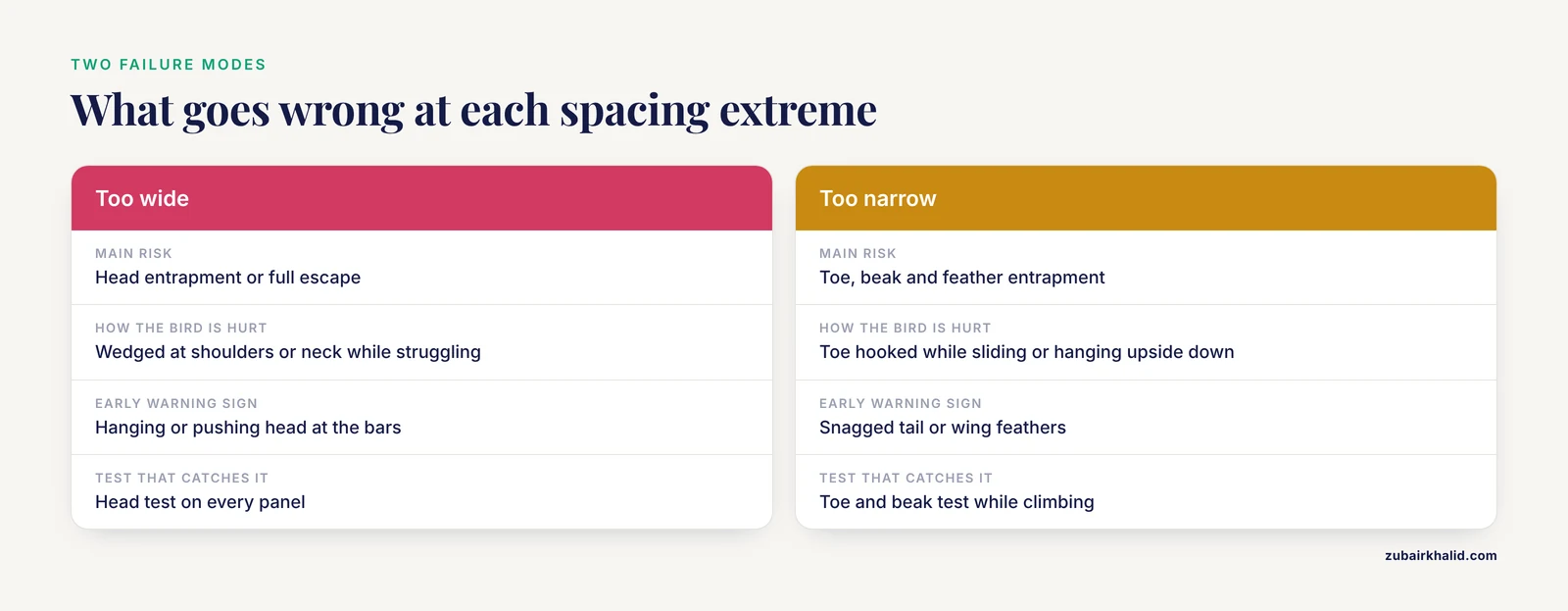
A bird that pushes its head through bars that are slightly too wide can become wedged at the shoulders or neck. Birds react to entrapment with violent struggling, which turns a momentary problem into lacerations, wing trauma, feather loss, or fatal constriction. Escape carries its own risks in a typical home, including ceiling fans, windows, other pets, and starvation in an inaccessible hiding spot.
Entrapment in overly tight spacing
Spacing that is too narrow creates a different injury pattern. Toes can hook on closely spaced wires, especially when a bird slides down the cage wall or hangs upside down, and a dangling bird with a caught toe can suffer a fractured or degloved digit. Tightly spaced bars also prevent natural climbing, reduce visual access to the room, and can trap the tips of long tail and wing feathers, leading to chronic feather damage.
What the poultry welfare literature shows
Research on caged poultry demonstrates how strongly cage configuration affects bird welfare, and the same principles extend to companion birds. A welfare assessment of village chickens transported to live bird markets in Maiduguri, Nigeria documented overcrowding, overstocking in cramped cages with little room to move, aggressive behavior, stress, injuries, and unsanitary conditions, and concluded that improved housing practices were needed to protect well-being [1]. That study involved commercial transport rather than a home pet cage, but the mechanism is identical. A cage that physically constrains a bird beyond what its body was designed for produces measurable harm.
Vertical configuration matters as well. A study of Isa-Brown laying hens in a humid tropical climate found that cage tier height significantly influenced egg mass, hen day production, and daily feed intake, with birds in upper tiers performing better than birds in lower tiers, even though cloaca temperature did not differ significantly between tiers [2]. Work on perch provision in small cage laying hens showed that dominant hens used perches more than subordinate birds, that perching increased lying, preening, and comfort behaviors, and that providing perches reduced crowding on the cage floor and helped groups stabilize socially [3]. For a pet owner, the translation is direct. The physical architecture of the cage, including bar spacing, perches, and usable vertical zones, changes how a bird moves, rests, and interacts with cage mates.
How Bar Spacing Fits Into a Complete Bird Cage Setup
Bar spacing cannot be evaluated in isolation. It interacts with every other component of the cage.
Wire gauge must match beak power. A cockatiel and an African grey can share similar spacing needs at very different beak strengths, so the same gap may be permanent in one cage and self-widening in another. Cages designed for large parrots use heavier wire specifically because these birds test and work every weld and joint.
Door and feeder-door openings deserve their own check. A cage can have correct wall spacing and still present a head-sized gap at a hinged feeding door that has sprung open, or at a latch that no longer seats flush. Inspect these access points with the same head test you apply to the walls.
Interior furniture affects spacing risk. Poorly placed perches can encourage a bird to hang or wedge itself in a corner where a marginal gap becomes a trapping hazard. The laying hen research cited above showed that perch placement changes how birds distribute themselves within a cage and reduces floor crowding and conflict [3]. In a pet cage, arranging perches so birds travel naturally through the middle of the enclosure, away from wall gaps and corners, reduces entrapment behavior.
Housing standards exist at a formal level. In one laboratory context, a recharge cage for freely moving primates was developed in accordance with guidelines for the accommodation of animals under Council of Europe standard ETS 123, illustrating that cage design for captive animals is treated as a standards-driven engineering problem, not a matter of personal preference [4]. Avian veterinary organizations publish similar species-focused housing guidance for pet birds, and those resources should drive your final decision.
The home environment completes the picture. Owners planning dedicated bird housing, down to a purpose-built apartment bird room, have long treated the cage as one element within a larger managed space [5]. If your bird spends hours outside the cage, the cage becomes a nighttime and unsupervised-time refuge, which raises the safety bar for spacing because you will not always be watching when a bird tests a weak point.
Bird Cage Bar Spacing Step by Step
Follow this sequence before you buy or continue using any cage.
- Confirm adult species size. Identify what your bird will measure as an adult, including head width and beak depth. A hand-fed juvenile conure and an adult conure of the same species can differ substantially in head size.
- Ask for two numbers. Request the bar spacing and the wire gauge from the manufacturer. Ask whether the spacing figure describes center-to-center distance or the clear gap.
- Measure the cage yourself. Use a ruler to measure the clear gap between adjacent bars at several points on every panel, including near corners where manufacturing tolerance and shipping damage are most likely to appear.
- Run the head test. The bird's head, including the beak, must not be able to pass between the bars. If the bird can insert its head even partially, the spacing is unsafe regardless of what the label claims.
- Run the toe and beak test. Watch the bird climb and explore. Toes should grip bars comfortably, the beak should open and close through the wire without catching, and long tail feathers should pass freely.
- Evaluate behavior. Escape artists, persistent chewers, and birds that hang upside down by one toe stress a cage differently than calm birds. A strong-beaked or destructive bird needs heavier wire even at the same spacing.
- Inspect all openings. Test every door, feeder hatch, and latch. Push on each. A gap that admits the head at a feeder door is as dangerous as an oversized wall gap.
- Verify with an avian professional. Bring the cage specifications, or photographs with a ruler in frame, to your avian veterinarian, and cross-check against species housing guidance published by the Association of Avian Veterinarians, VCA Animal Hospitals, and the Merck Veterinary Manual.
Bird Cage Bar Spacing Tips From Practice
Buy narrower rather than wider when you are between sizes. If a bird falls near the boundary between two spacing categories, the slightly tighter cage is safer, provided the bird can still climb, grip, and see out without snagging feathers.
Measure a used cage before it houses a bird. Secondhand cages often carry bent bars, repaired panels, or aftermarket modifications. A cage that was safe in a previous home may no longer be safe after years of chewing and transport.
Check spacing after every move. Cages are frequently disassembled, shipped, or knocked during cleaning. Panels can shift in their tracks and corner joints can loosen, creating a new gap that did not exist when the cage arrived.
Match the quarantine and travel cage to the same standard. Owners setting up multiple housing stations, as described in the apartment bird room model, sometimes relax spacing standards for secondary cages [5]. Every cage your bird occupies must meet the same spacing and gauge requirements, including travel carriers and hospital cages you keep on hand.
Prioritize horizontal travel space alongside spacing. Wing-flapping and climbing require room between obstacles. Bars of correct spacing in a cage too small for full wing extension still restrict normal movement, and restricted movement is itself a welfare problem documented in overstocked and cramped caging [1].
Design the interior to reduce risky behavior. Provide enough perches, varied in diameter and placement, so the bird does not develop habits like hanging on walls or wedging into corners. The perch research in caged hens supports the general principle that well-designed interior structure reduces crowding and conflict [3].
Common Bird Cage Bar Spacing Mistakes
Buying for the baby, not the adult. The most frequent error is sizing a cage to a juvenile bird that will later grow into a head too large for the gaps. This mistake surfaces months after purchase, once the bird is bonded to a cage that must be replaced.
Trusting hardware cloth or welded utility wire. Chicken wire and hardware mesh from farm stores are not bird cages. The mesh gauge is soft, galvanized finishes may not be bird-safe, and the grid pattern catches toes and beaks in ways vertical bars do not.
Reading the label instead of the cage. Manufacturers differ in how they report spacing, and assembly error can change real-world gaps. Measure the physical object.
Ignoring wire gauge for strong beaks. Two cages can share identical spacing while one survives a amazon's beak and the other does not. Thin wire bends, and each bend widens the effective gap.
Overlooking door and feeder gaps. Owners apply the head test to the walls and never to the food doors. A sprung feeder hatch is a classic entrapment point.
Modifying cages at home. Adding extra wire, cutting panels, or zip-tying mesh to widen or narrow openings creates sharp edges, new gap patterns, and weak points. Cages are engineered structures, and field experience with purpose-built cages shows that deliberate, tested design produces calmer, safer bird interactions than improvised hardware.
Assuming one spacing fits a mixed-species aviary. In a multi-bird household, the smallest bird sets the spacing requirement for any shared or adjacent caging, not the largest.
Treating cage setup as finished. Spacing, perches, and placement should be reviewed at each annual veterinary visit and whenever the bird's behavior changes. The evidence from cage-tier research in laying hens shows that vertical arrangement alone can shift production and behavior measures, which underscores how sensitive birds are to their physical housing [2].
Troubleshooting Spacing Problems
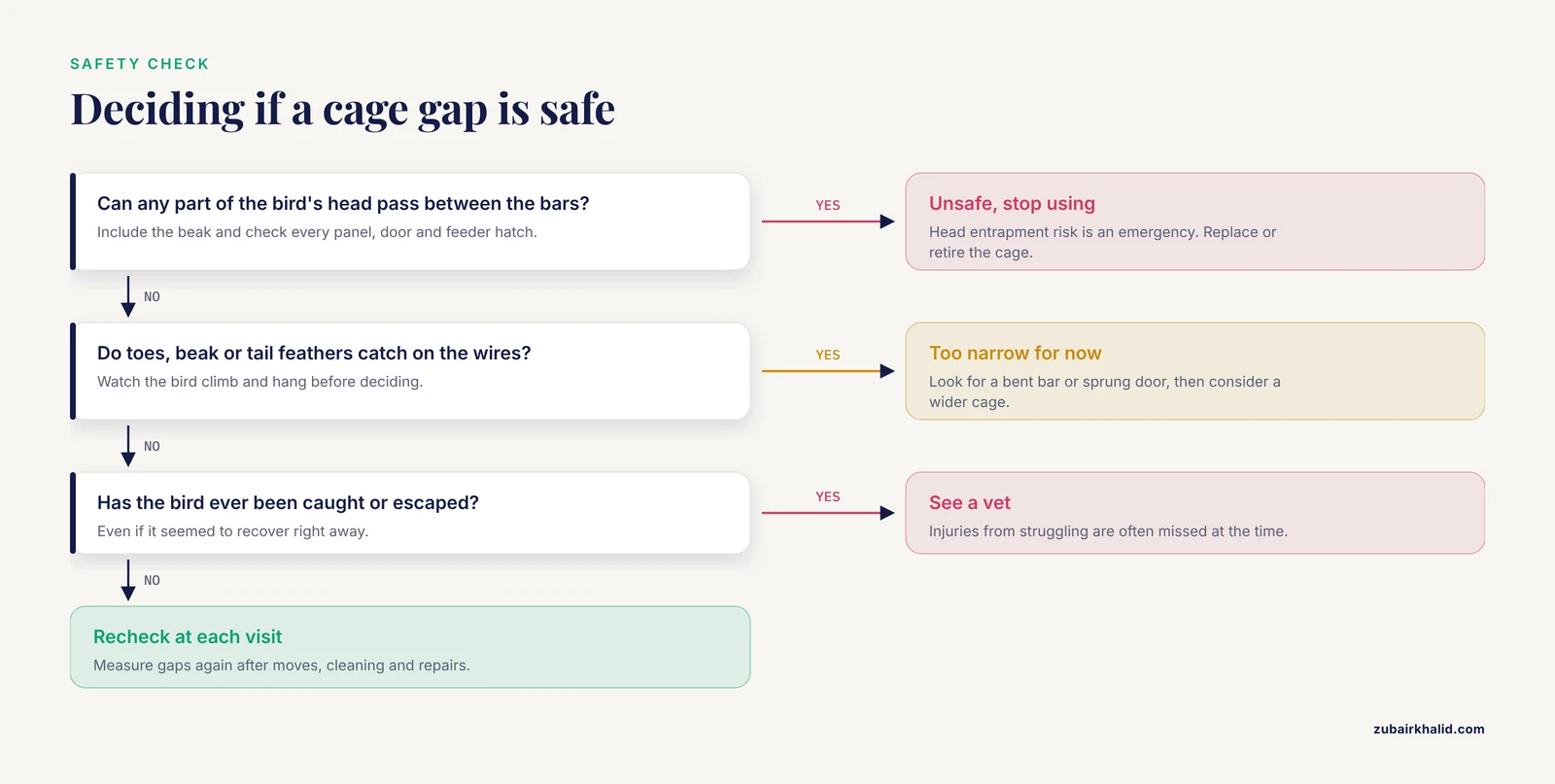
A bird that repeatedly gets a toe caught. Recheck the actual gaps on the panels the bird favors, look for a bent bar or a sprung feeder door, and evaluate whether the bird is hanging from the cage side during play. If the pattern continues in an apparently correct cage, discuss cage design and foot health with your avian veterinarian, since repetitive entrapment can also reflect a foot or joint problem.
A bent or widened panel. Stop using that cage for unsupervised time immediately. Bent bars rarely return to original tolerance, and repeated chewing at the same spot predicts further widening. Replace the panel or the cage.
An escape from a correctly spaced cage. Inspect latches and door alignment before blaming the bars. Many escapes happen through doors that were never fully latched, and cage design work on live capture has shown how much performance depends on closure mechanisms rather than mesh dimensions [6].
Rust, chipped coating, or exposed metal. Damaged finishes change the effective bar surface and can create ingestion risks if the bird chews flaking coating. Have the cage evaluated and discuss any observed powder or flakes with your veterinarian.
New cage, new behavior. Some birds test new enclosures intensively for the first weeks. Supervise closely during that window and re-measure gaps at the end of it.
Limitations and When to Contact a Veterinarian
This article is educational and is not a substitute for veterinary diagnosis or treatment.
Bar spacing guidance is species-specific and individual-specific, and the published evidence base for pet bird housing draws heavily on poultry and laboratory animal research rather than controlled trials in companion parrots. Individual cases need a veterinarian, particularly an avian veterinarian, to confirm that a chosen cage is appropriate for your specific bird.
Contact an avian veterinarian promptly in the following situations:
- Your bird was ever caught by the head, toe, wing, or beak in the bars, even if it seemed to recover immediately.
- You see bleeding, a swollen or non-weight-bearing foot, a drooping wing, or feather damage concentrated on one body area after a cage interaction.
- Your bird escaped the cage, because escape attempts and the struggle to escape commonly cause injuries owners miss.
- Your bird shows repeated escape or entrapment behavior, which may signal anxiety, boredom, or an unmet need for foraging and enrichment that a veterinarian or certified behavior professional can help address.
- You notice flaking coating, rust, or debris in the cage, since ingested foreign material is a gastrointestinal emergency risk.
- You are integrating a new bird into an existing cage and need guidance on spacing, territory, and disease screening before mixing birds, a situation where mixing of ages and health statuses is a documented welfare and disease risk [1].
The Association of Avian Veterinarians maintains a directory of avian vets, and the Merck Veterinary Manual and VCA Animal Hospitals publish species-level husbandry guidance that your veterinarian may reference directly.
Frequently Asked Questions
What happens if my bird's cage bar spacing is too wide?
The bird can push its head through the bars and become wedged, which can cause strangulation, lacerations, or wing injury during panic, or the bird can escape entirely. Both outcomes are emergencies, so spacing that admits any part of the head is unsafe.
What problems does spacing that is too narrow cause?
Toes and beaks catch on closely spaced wires, tail feathers snag and break, and climbing becomes awkward. Overly tight spacing also reduces the bird's visual access to the room, which affects mental well-being.
How do I measure bar spacing correctly?
Measure the clear gap between adjacent bars with a ruler at several points on every panel, and separately confirm the wire gauge. Ask the manufacturer whether their stated figure is center-to-center distance or the clear opening, because the two differ.
Can I rely on the spacing printed on the cage label?
Use the label as a starting point only. Manufacturers report spacing inconsistently, assembly and shipping can alter real gaps, and chewing can widen them over time, so measure the physical cage and recheck it periodically.
Is it safe to modify a cage to change the bar spacing?
Home modifications are not recommended. Added mesh, cut panels, and zip ties create sharp edges, irregular gaps, and weak points, and a purpose-built cage tested for its intended species is safer than any improvised alteration.
Does horizontal or vertical bar orientation matter?
Both orientations appear in commercial cages, and birds climb using both. What matters most is that the clear gap passes the head and toe tests in every direction and that the gauge resists your bird's beak strength.
How does bar spacing fit into a parrot care checklist?
It belongs near the top of the physical environment section, alongside cage size, perch variety, enrichment, and diet, because an unsafe cage undermines every other element of care. Review spacing at every annual avian veterinary visit.
When should a veterinarian be involved in cage selection?
Involve an avian veterinarian whenever your bird is between size categories, has a foot or feather condition, shows escape or entrapment behavior, or when you are setting up caging for a new or mixed-species household. Individual variation is real, and professional confirmation is the safest final step.
Sources
- Evaluation of Village Chicken Welfare during Transport and Stocking at Live Bird Markets: A Case Study From Maiduguri, Borno State, North-eastern Nigeria
- Influence of cage tiers height on cloaca temperature, performance, and egg quality of Isa-Brown laying hens reared in a humid tropical climate
- PSX-A-26 Late-Breaking: The perch competition index of small cage laying hens
- A Fully Integrated Wireless System for Intracranial Direct Cortical Stimulation, Real-Time Electrocorticography Data Transmission, and Smart Cage for Wireless Battery Recharge
- Setting Up an Apartment Bird Room
- Bespoke design of cage trap and patagial wing tag for the capture and study of Black Grouse Lyrurus tetrix at lek sites: assessment of effectiveness for future studies