How to Avoid Impulse Bird Purchases: A Pre-Buying Checklist
By Dr. Zubair Khalid, DVM, MS, PhD ·
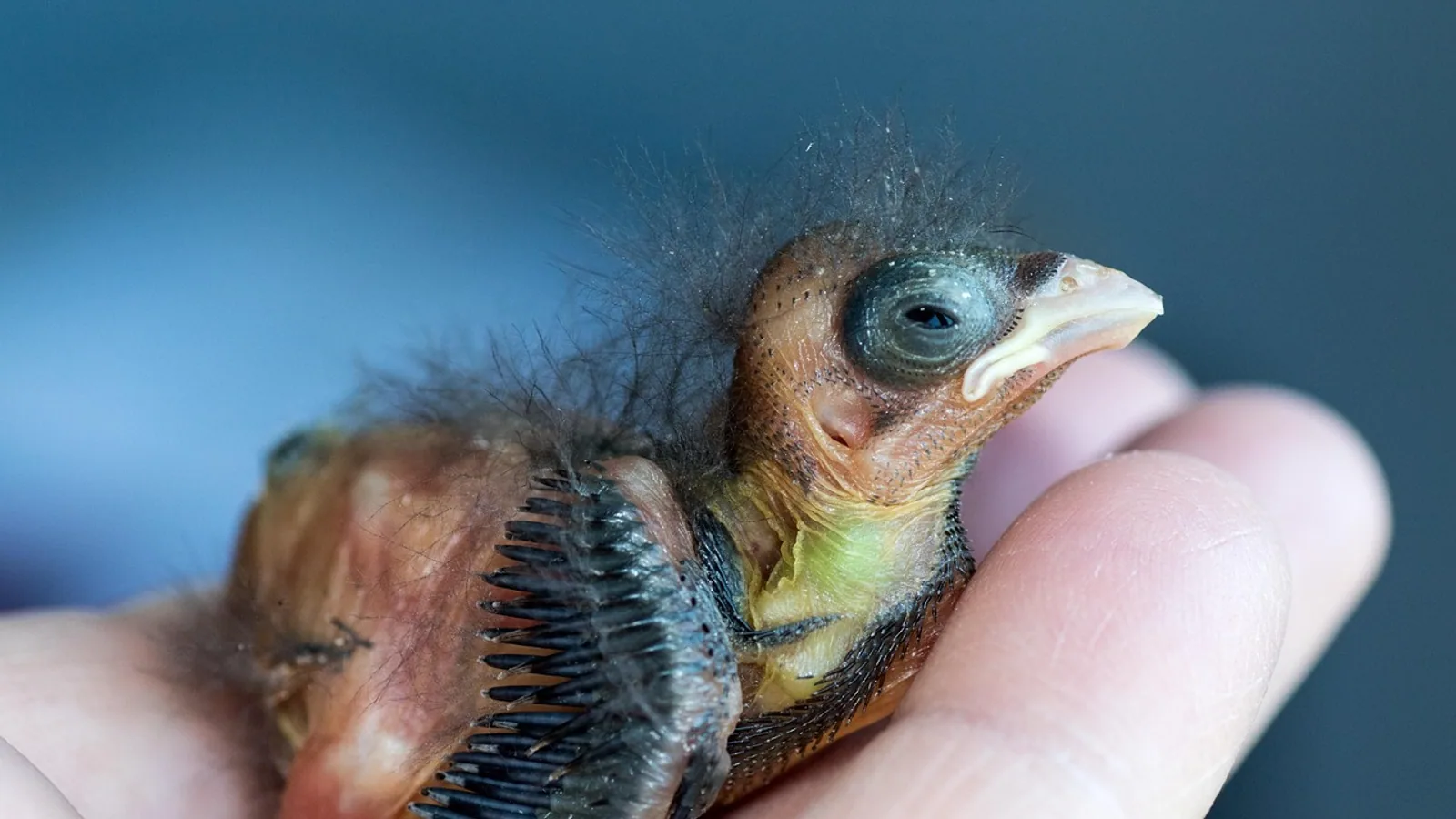
The most reliable way to avoid an impulse bird purchase is to complete a written bird buying checklist before you ever see the bird, and to walk away from any seller who will not let you work through it. A bird that is bought on the spot, in the moment, with no prepared cage, no named avian veterinarian, and no answers about its origin is the bird most likely to be rehomed, neglected, or returned within a year. This article gives you a working bird buying checklist example, explains the reasoning behind each step, and walks through the questions, equipment, and bird cage setup decisions you should finish before money changes hands.
Birds are not starter pets. Many parrots live for decades, form intense social bonds, vocalize loudly, and need daily interaction and specialized care, a reality emphasized across avian care resources from the Association of Avian Veterinarians (AAV), the Merck Veterinary Manual, and VCA Animal Hospitals. A checklist cannot make that commitment disappear. What it can do is force the decision out of the emotional moment and onto paper, where it can be reviewed calmly, ideally with everyone in the household and with your veterinarian.
At a Glance: The Ten-Point Pre-Buying Checklist
Use this as your bird buying checklist template. Print it, fill it out, and do not buy until every line is complete.
| # | Checklist Item | Done? |
|---|---|---|
| 1 | Every adult in the household has agreed, out loud, to the commitment | ☐ |
| 2 | You have researched the species' adult size, noise level, lifespan, diet, and social needs, and confirmed them with an avian veterinarian or AAV-affiliated resource | ☐ |
| 3 | You have identified an avian or bird-experienced veterinarian within reasonable travel distance | ☐ |
| 4 | The cage, perches, food and water dishes, and safe room location are chosen and purchased | ☐ |
| 5 | The cage is assembled and the room is bird-proofed before the bird arrives | ☐ |
| 6 | You can name the bird's origin: breeder, rescue, or store, with contact details and the bird's history | ☐ |
| 7 | You have asked about the bird's age, health history, diet it is currently eating, and any prior medical care | ☐ |
| 8 | You have a plan for a quarantine period and an initial veterinary examination after arrival | ☐ |
| 9 | You have a written budget for ongoing food, enrichment, and veterinary care, not just the purchase price | ☐ |
| 10 | You have slept on the decision for at least one week and still want the bird | ☐ |
If you cannot check item 10 honestly, you are not ready. That single waiting period prevents more impulse bird purchases than any other step in the checklist format.
Why Impulse Bird Purchases Happen, and Why They End Badly
Impulse buying is not a character flaw. It is a predictable gap between what people say they value and what they actually do, and researchers have documented it in animal purchasing contexts. A survey of Flemish consumers found that although general interest and concern for bird welfare was widespread, pro-welfare buying behavior was unevenly distributed across consumer segments, and a consistent preference for standard, non-premium products was tied to strong perceptions about price and personal effectiveness [1]. In plain language, people who cared about animal welfare still bought the cheapest, most convenient option when the moment of purchase arrived.
The same mechanism operates at the pet store cage and the fairground stall. The bird is colorful, vocal, active, and right in front of you. The seller is friendly. The price feels small compared with the emotional pull. Nothing in that moment asks you the questions that matter: Can you keep this animal healthy for the next thirty years, and do you know what that actually costs and requires?
There is also a disease dimension that impulse buyers rarely consider. Birds acquired on the spot from crowded, mixed-species environments carry a real risk of bringing infectious disease home. Live bird markets are recognized hotspots for the maintenance and spread of avian influenza viruses, and a large surveillance study across Bangladesh found influenza A viral RNA in 49 percent of sampled market stalls, with highly pathogenic H5 and H9 subtypes common among positives [2]. The same research showed that the risk factors are practical and fixable, including cleaning frequency, availability of running water, and whether different poultry types are mixed in the same cages [2]. The lesson for a pet buyer is direct: the conditions in which a bird was kept before you bought it matter as much as the bird itself.
The Bird Buying Checklist Format: How to Use This Template
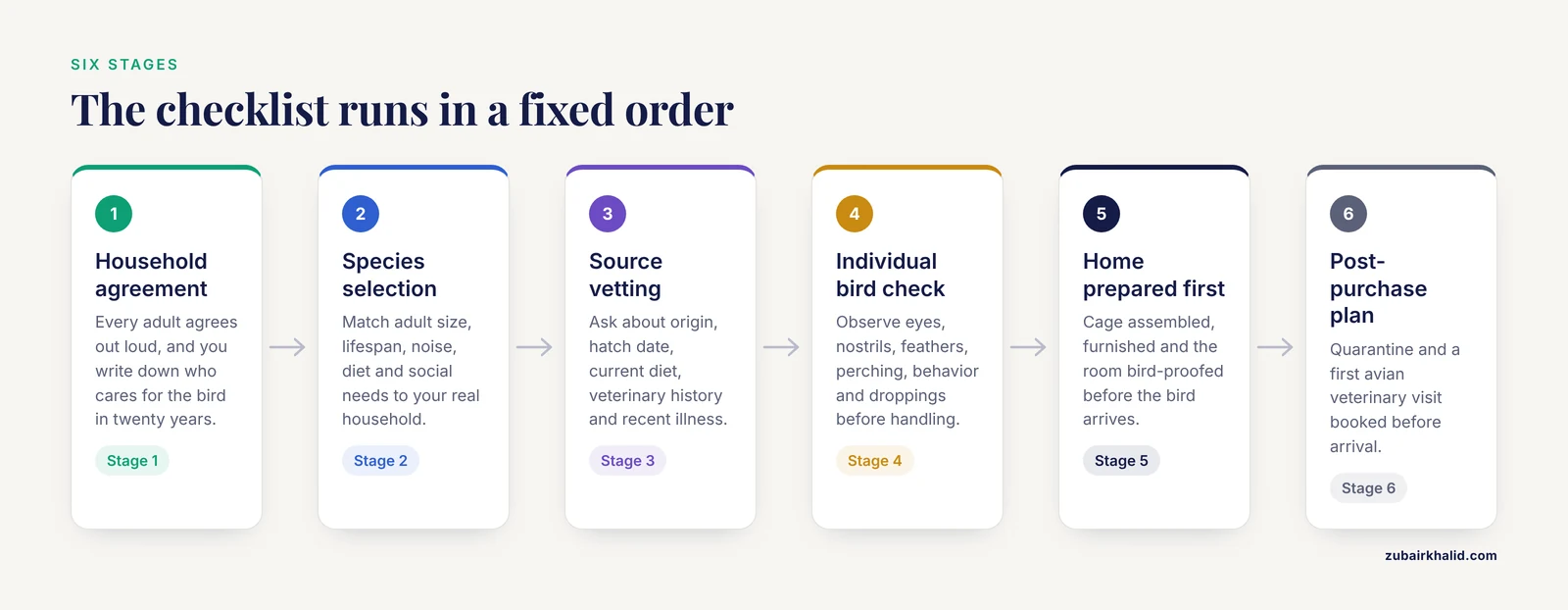
A good bird buying checklist format has three qualities. It is written down, not held in your head. It is completed in order, with earlier steps acting as gates for later ones. And it produces a paper trail, meaning names, dates, and answers you can refer back to.
Here is how the full checklist is organized as a sequence:
- Household agreement and self-assessment
- Species selection matched to your real life, not your imagined one
- Source vetting, including the seller's history and practices
- Individual bird evaluation and health questions
- Home preparation, including full bird cage setup
- Post-purchase plan, including quarantine and a first veterinary visit
Each stage is covered in detail below. You can treat this as your bird buying checklist example and adapt it to your situation, but resist the temptation to skip stages. Buyers who skip straight to stage 4, falling for a specific bird before confirming they can house and care for it, are the buyers most likely to make the impulse mistake this checklist exists to prevent.
Step 1: Honest Self-Assessment Before You Look at a Single Bird
Before any discussion of species, cages, or sellers, answer these questions in writing.
- Who lives in the household, and does everyone agree? A bird that one person wants and another resents is a bird with an uncertain future. Get explicit agreement from every adult, and consider allergies, asthma, noise tolerance, and sleep schedules.
- How long is the commitment? Many parrot species live for decades, with larger species such as macaws and cockatoos commonly reaching very advanced ages, a point highlighted in avian care guidance from VCA Animal Hospitals and the Merck Veterinary Manual. Ask yourself who will care for this bird in twenty years, and write the answer down.
- How much daily time can you actually give? Parrots are social flock animals that need daily interaction, foraging opportunities, and out-of-cage time. Estimate your realistic weekday availability, not your weekend availability.
- What is your noise tolerance, and your neighbors'? Vocalizing is normal bird behavior, not a defect to be trained away. If a dawn chorus would break your lease or your marriage, choose accordingly.
- What is your ongoing budget? The purchase price is the smallest number in this decision. Food, enrichment replacement, and avian veterinary care recur for the bird's entire life. Write a monthly figure and test whether your budget absorbs it.
- What happens if your life changes? Moves, new babies, job changes, and illness all strain pet commitments. Decide now, in writing, what your plan would be.
If any answer is a shrug, stop here. The checklist has done its job.
Step 2: Choose the Right Species for Your Household
Species selection is where research discipline matters most, because birds differ from one another far more than most new owners expect. Species differ in body size, diet, activity pattern, flight style, and underlying physiology. Comparative research on seabirds has shown that even closely related species of similar body size, feeding on the same prey, show significantly different oxidative stress profiles tied to their habitats, flight styles, and physiological functions [3]. Anatomical work tells the same story from another direction. A comparative study of five Accipitriformes species found that the architecture of grasping-related leg muscles differed sharply between a carrion-feeding vulture and four predatory hawks and buzzards, reflecting fundamentally different lifestyles [4]. Pet birds span an even wider range, from finches kept in pairs for observation to cockatoos that expect a place in the family.
For each species on your short list, confirm the following with an avian veterinarian or a resource from the AAV, Lafeber Company, VCA Animal Hospitals, or the Merck Veterinary Manual:
- Adult size and appropriate enclosure scale
- Expected lifespan
- Typical noise level and vocalization pattern
- Dietary requirements, including whether the species needs fresh foods in addition to a formulated diet
- Social needs, including whether the species should live in a pair or group
- Common behavioral tendencies, including biting potential, screaming, and destructive chewing
- Known species-specific health concerns to discuss with your veterinarian
Resist choosing on appearance alone. The most beautiful bird on the shelf is frequently the species with the most demanding social and vocal needs.
Step 3: Vetting the Source Before You Buy
Where a bird comes from determines much of what happens next, both for the bird's health and for yours.
Breeders and reputable rescues
A responsible breeder or avian rescue will welcome your questions and answer them specifically. Ask for the bird's origin, hatch date or approximate age, how long it has been in their care, what it is currently eating, whether it has had any veterinary examination or testing, and whether any birds in their collection have been ill in the past year. A seller who bristles at basic questions is telling you something.
Movement of birds between sources is a recognized disease risk. An epidemiological study of Newcastle disease virus in Switzerland found that buying eggs or poultry abroad and exchanging poultry within the country were more important factors explaining infection in pure-bred flocks than contact with wild birds [5]. The principle applies to pet birds: each additional movement and mixing event in a bird's history increases its exposure opportunities. Prefer sources with stable, documented histories over sources that move animals frequently and mix them freely.
Stores, fairs, and live animal markets
Treat any setting where many birds are held together, displayed publicly, and handled by passing customers as a higher-risk environment. The live bird market research is instructive here. Surveillance across 113 live bird markets detected avian influenza viral RNA in nearly half of sampled stalls, and identified hygiene measures, including cleaning and disinfection frequency and access to running water, as factors with large effects on viral presence [2]. In Guangzhou during the 2013 H7N9 outbreak, a population survey found that 22 percent of respondents were still buying live birds from wet markets at least weekly even after the outbreak was officially declared, and 32.3 percent of buyers reported touching birds during purchase [6]. Handling birds at the point of sale is a direct exposure route, and one that many buyers do not think about.
None of this means every market bird is sick. It means the buyer should ask where the bird was housed, how long it has been at that location, whether new arrivals are mixed with established stock, and whether the seller can document any veterinary care. If you do handle a bird while shopping, wash your hands afterward and before touching your own animals or your face.
Red flags at any source
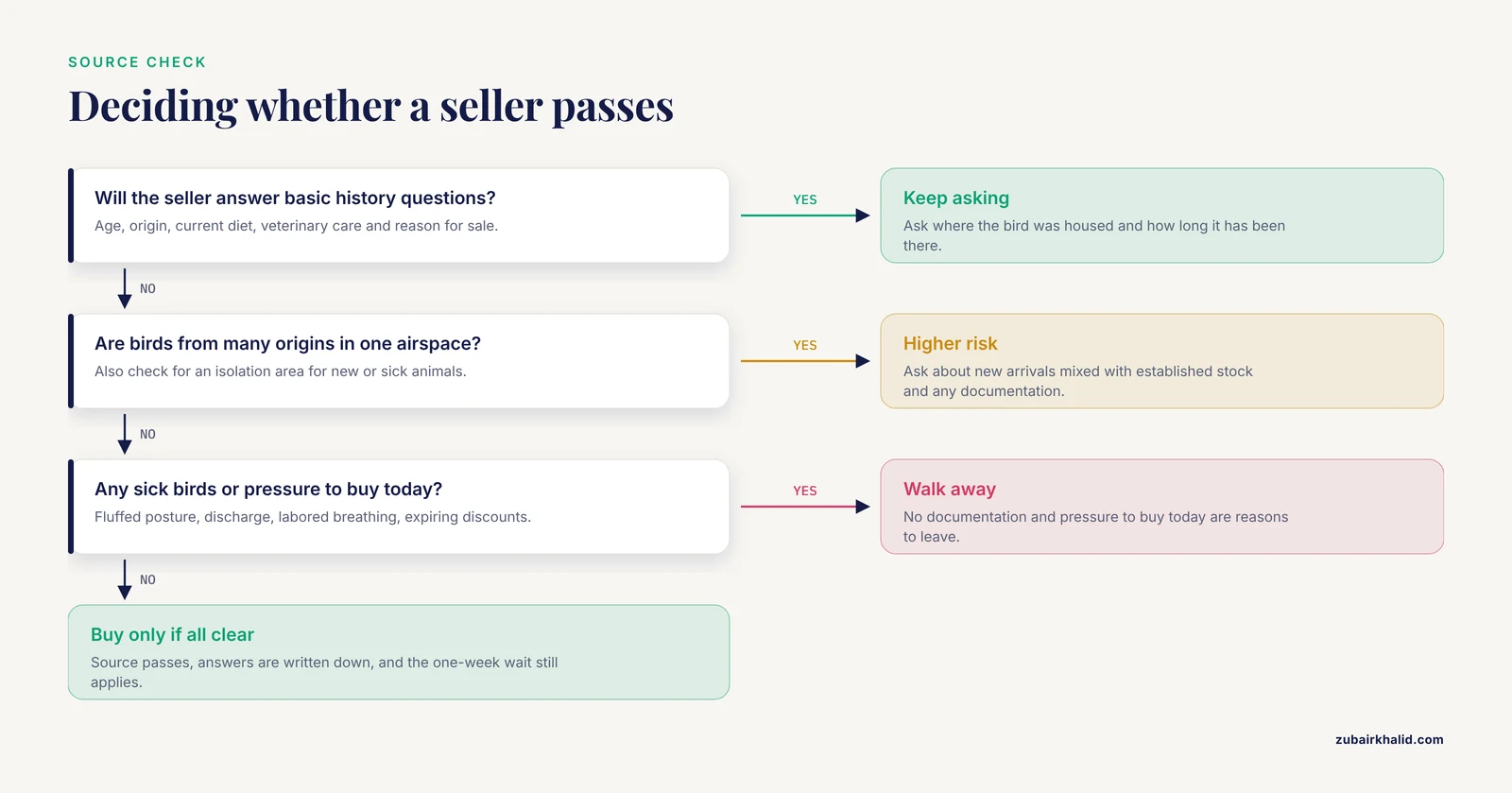
- Refusal to answer basic questions about the bird's history
- Birds from many different origins housed in the same airspace
- No isolation area for new or sick animals
- Sick-looking birds on the premises, including fluffed posture, discharge, or labored breathing
- Pressure to buy today, including discounts that expire at closing time
- No documentation of any kind
Step 4: Evaluating the Individual Bird
Once the source passes, evaluate the individual animal. This is not a substitute for a veterinary examination, but it filters out the most obvious problems before you are emotionally attached.
Observe the bird before it is taken out of its enclosure. Look for:
- Bright, clear eyes with no discharge
- Clean nostrils and an even, quiet respiratory pattern
- Smooth, complete feathers without bald patches or heavy fraying, unless the bird is documented as a feather-plucking rescue with a management plan
- Upright, balanced perching on both feet
- Alert, curious behavior rather than fluffed, lethargic, or tail-bobbing posture
- Droppings that look consistent, neither runny nor starkly discolored, which you should show to your veterinarian for interpretation
Then ask the questions your checklist requires:
- What is this bird's exact age, and can it be documented?
- What diet is it eating right now, and has it been eating it consistently?
- Has it had any veterinary examination, testing, or treatment?
- Has it been exposed to other birds recently, including at fairs, markets, or boarding?
- Why is this bird being sold or rehomed?
- Can I have the seller's contact information in writing?
Write the answers down. Memory softens in direct proportion to cuteness.
Step 5: Prepare the Home First, Including Full Bird Cage Setup
Everything the bird needs should be in place and functioning before it crosses your threshold. This is the stage impulse buyers skip, and it shows in the first week of the bird's life with them.
Choosing the cage
Bird cage setup starts with the enclosure itself. Select a cage that allows the bird to fully extend both wings and flap without touching the bars, with enough height for natural vertical movement. Bar spacing must be narrow enough that the bird cannot wedge its head through, a risk your avian veterinarian can help you size for the specific species. Prefer a cage with a straightforward design that cleans easily, because daily sanitation is part of disease prevention. Position the cage away from kitchen fumes, drafts, direct sunlight, and isolation, and place it at a height where the bird can interact with the household without being the center of constant traffic.
Furnishing the cage
- Perches of varied diameter and texture to promote foot health, positioned so they do not sit over food or water dishes
- Food and water dishes that are easy to remove, clean, and refill daily
- Foraging and enrichment items rotated regularly, because a bored parrot is a bird that develops behavioral problems
- A designated sleeping area or cover, consistent with the species' needs for a dark, quiet rest period
Bird-proofing the room
Birds explore with their beaks, and household environments contain real hazards. Lead is a documented and devastating one. In European wetlands, an estimated 700,000 waterbirds of 16 species die annually in the European Union from acute lead poisoning caused by ingesting spent lead gunshot, with three times as many suffering sub-lethal effects [7]. For pet birds, lead exposure is a recognized toxicological emergency discussed in avian resources from the Merck Veterinary Manual and VCA Animal Hospitals, and it underscores a broader point: older paint, stained-glass materials, and lead-containing household objects have no place within a bird's reach. Ask your veterinarian to walk you through the toxic hazards specific to your home during your first visit.
The broader environmental lesson from recent research is that human-made materials penetrate bird environments in ways owners rarely anticipate. A study of three swift species across 25 European colonies found anthropogenic debris, mainly plastic, in 36.5 percent of examined nests, rising to 85 percent in pallid swift nests, with the probability of plastic presence increasing substantially with the human footprint of the landscape [8]. Your home is a high-footprint environment. Strings, thin plastics, silicone beads, and small detachable parts belong outside the cage and out of flight paths.
A Parrot Care Checklist for the First 30 Days
Purchase is the finish line for the buying checklist and the starting line for the parrot care checklist. The first month sets the pattern for the relationship.
- Book the veterinary appointment before arrival. Schedule a new-bird examination with an AAV-affiliated or bird-experienced veterinarian within the first days of ownership, and ask whether they recommend baseline testing for your species.
- Quarantine as directed. Keep the new bird separated from any existing pet birds, in a different airspace where possible, for the interval your avian veterinarian recommends. New birds can carry infectious agents without showing signs, and the movement-related disease risks documented in flocks [5] apply to the home as much as to the breeder.
- Feed what the bird is already eating first. Abrupt diet changes cause refusal to eat, which is dangerous in birds. Transition to your target diet gradually under veterinary guidance, using resources such as Lafeber Company's avian nutrition materials.
- Let the bird settle. Limit handling for the first days, keep the environment calm, and let the bird learn its cage is a safe place.
- Establish the daily routine. Consistent wake, feed, interact, and sleep times reduce stress and prevent behavior problems before they start.
- Weigh and observe. Learn what normal droppings, posture, appetite, and activity look like for your individual bird, so that changes are detectable early. Birds conceal illness, and subtle change is often the only early sign.
- Document everything. Keep a simple log of weight, diet, droppings, and behavior for the first month. Your veterinarian will use it.
Common Mistakes Buyers Make
- Buying the bird before buying the equipment. The cage arrives days after the bird, the bird waits in a travel carrier, and stress accumulates from day one.
- Trusting the seller's assessment instead of a veterinarian's. A seller is not a diagnostician. Even a healthy-looking bird needs an examination.
- Skipping the waiting period. The one-week cooling-off rule in the checklist exists because desire peaks in the store and declines at home. If the desire survives a week, it is more likely real.
- Underestimating noise and mess. Birds are loud and scatter food and dust. Owners who accepted this intellectually but not practically are the ones who rehome.
- Mixing new birds with existing birds immediately. The disease risks that accumulate through bird movement [2][5] apply doubly in a home with a collection.
- Handling birds at markets and then touching their own animals. Hand hygiene between animal contacts is basic prevention [6].
- Choosing on price. The attitude-behavior research on welfare purchasing shows that convenience and price dominate at the moment of sale even among people who genuinely care about animal welfare [1]. Naming that pattern in advance is the best defense against it.
Welfare and Safety Points That Belong in Every Purchase Decision
Bird welfare begins before ownership. When you buy from a source, you are financially supporting that source's husbandry standards, whether you thought about them or not. The consumer research on higher welfare poultry products found that buyers of welfare-rated products differed from non-buyers in perceived consumer effectiveness, meaning the belief that their own choices mattered [1]. Applied to pet birds, that belief is accurate. Every purchase rewards a set of practices. Rewarding sources that quarantine, test, document, and answer questions shifts the market in the same direction that the fixed hygiene practices, running water, and separated housing shifted disease risk in live bird markets [2].
Safety planning also belongs in the pre-purchase phase, not after. Know your nearest avian veterinarian's hours and emergency options before you bring a bird home, because not every emergency clinic sees birds. Keep your veterinarian's number, and a backup, posted where any household member can find it.
Limitations and When to Contact a Veterinarian
This checklist is educational and cannot replace individualized veterinary advice. Species, and individual birds within species, differ in ways that only an in-person examination can assess. Every bird you bring home, whether purchased from a breeder, rescue, store, or private rehoming, should be seen by an avian or bird-experienced veterinarian shortly after arrival, and that veterinarian should guide your quarantine plan, diet transition, and baseline health screening.
Contact a veterinarian promptly, and treat the following as urgent rather than optional:
- Any bird sitting fluffed on the cage floor, or significantly less active than usual
- Open-mouth breathing, tail bobbing, wheezing, or audible respiratory noise
- Discharge from the eyes or nostrils
- A sudden change in droppings lasting more than a few hours, or no droppings at all
- Refusal to eat, or a sudden drop in food consumption
- Regurgitation outside of normal courtship behavior, vomiting, or diarrhea
- Any known or suspected exposure to toxins, including lead-containing objects, aerosols, nonstick cookware fumes, or household chemicals
- Feather destruction or self-mutilation, which needs both medical and behavioral assessment
- Any bite wound, bleeding, or trauma, however minor it appears
Birds deteriorate quickly and hide illness well. When in doubt, call. A phone call that turns out to be unnecessary costs nothing. A delay in an avian emergency often costs the bird.
This article is educational and is not a substitute for veterinary diagnosis or treatment.
Frequently Asked Questions
What should be on a bird buying checklist?
A complete bird buying checklist covers household agreement, species research, a named avian veterinarian, full cage and equipment purchase, bird-proofing, seller vetting, individual bird evaluation, a quarantine plan, an ongoing budget, and a mandatory one-week waiting period before purchase. Every item should be completed in writing before money changes hands.
How do I avoid buying a bird on impulse?
Decide in advance that you will never buy a bird on the same day you first see it. Complete the written checklist, sleep on the decision for at least a week, and bring a household member who has agreed to talk you out of a purchase you cannot justify. Impulse purchases happen when the decision is made in the seller's presence, so move the decision out of that room.
What questions should I ask a breeder or seller?
Ask for the bird's age and origin, what it is currently eating, its health and veterinary history, whether it has been exposed to other birds recently, why it is being rehomed or sold, and the seller's contact details in writing. A seller who answers these questions readily is a good sign. A seller who resists them is a reason to walk away.
Is it safe to buy a bird from a live animal market or swap meet?
These settings carry higher disease risk because birds from multiple origins are housed together, handled by the public, and often held in conditions where hygiene is difficult to maintain. Research on live bird markets has found avian influenza viral RNA in nearly half of sampled stalls, and hand contact with birds at purchase is a recognized exposure route. If you do buy in such a setting, ask detailed questions, wash your hands afterward, and see an avian veterinarian promptly.
Should I quarantine a new bird?
Yes. Quarantine any new bird away from existing pet birds, in a separate airspace where possible, for the interval your avian veterinarian recommends. New birds can carry infectious disease without showing signs, and moving between locations is a recognized factor in disease spread. Your veterinarian should tailor the quarantine plan to your household.
What cage setup does a new parrot need?
A new parrot needs a cage large enough for full wing extension and flapping, bar spacing appropriate to the species, perches of varied diameter kept clear of food and water dishes, easily cleaned dishes, rotating foraging enrichment, and a quiet sleeping area. Position the cage away from kitchen fumes, drafts, and direct sun, and have your avian veterinarian review the setup during the first visit.
How long do pet parrots live?
Many parrot species live for decades, and larger species such as macaws and cockatoos can live very long lives, sometimes exceeding fifty years. Confirm the expected lifespan for the specific species you are considering with an avian veterinarian or an authoritative avian care resource, and plan for the bird's care beyond your own ability to provide it.
When should a new bird see an avian veterinarian?
Within the first few days of bringing the bird home, ideally at an appointment booked before the bird arrived. An initial examination establishes a baseline, screens for problems, and sets the quarantine, diet, and follow-up plan. After that, follow your veterinarian's recommended schedule, and seek care immediately for any sign of illness.
Sources
- Buying higher welfare poultry products? Profiling Flemish consumers who do and do not.
- Determinants for the presence of avian influenza virus in live bird markets in Bangladesh: Towards an easy fix of a looming one health issue.
- Species-specific physiological status in seabirds: insights from integrating oxidative stress measurements and biologging.
- A comparative study on grasping-related muscles in five Accipitriformes species.
- Epidemiological study of Newcastle disease in backyard poultry and wild bird populations in Switzerland.
- Live Bird Exposure among the General Public, Guangzhou, China, May 2013.
- Economic assessment of wild bird mortality induced by the use of lead gunshot in European wetlands.
- Anthropogenic debris as nest material in three swift species: New insights into the interactions of atmospheric pollution with wildlife.