How to Choose the Best Bird Carrier for Travel
By Dr. Zubair Khalid, DVM, MS, PhD ·
The best bird carrier for travel is the one that keeps your bird physically secure, protects it from drafts and sudden temperature swings, and lets you observe it without opening the door. A good rule of thumb: match the carrier to the trip first, then to the bird, then to your budget. A quick vet visit, a cross-country drive, and a flight in an airplane cabin put completely different demands on the same bird, so a single container rarely does all three jobs well.
This guide walks through the main carrier types on their own terms, compares them on the criteria that actually decide a purchase, works through common travel scenarios, and finishes with a packing and setup checklist you can use before every trip.
Why a Dedicated Carrier Beats a Repurposed Cage
Many owners reach for the bird's home cage when travel day arrives. That almost always creates more problems than it solves. A full cage is heavy, awkward through doorways, hard to secure in a car, and full of loose accessories that become projectiles under braking. Wire cage bars also expose a bird to drafts and give it no visual cover, which raises stress in an already stressful situation.
Avian veterinarians, including those affiliated with the Association of Avian Veterinarians, generally advise owners to transport birds in a dedicated, covered, escape-proof container rather than a home cage. The Merck Veterinary Manual's pet bird resources likewise emphasize minimizing stress and environmental exposure during handling and transport. A purpose-built carrier addresses all of these points at once. It is smaller, easier to secure, easier to cover, and designed to be moved safely.
There is a second reason to separate the two containers. Your home cage and your travel carrier serve different biological purposes. The cage supports perching variety, foraging, exercise, and sleep. The carrier supports containment and protection. Owners who blur the two end up with a carrier that is too big to be safe in a car or a cage that is too heavy to get through a clinic door. If you are starting from scratch, it helps to think of your bird cage setup and your travel kit as two separate projects on the same parrot care checklist.
Bird Carrier Options at a Glance
The table below summarizes the main carrier options most owners choose between. Each option is explained in detail in the sections that follow.
| Carrier type | Best for | Key strengths | Key drawbacks |
|---|---|---|---|
| Hard-sided plastic carrier | Vet visits, short car trips, most small to medium birds | Rigid protection, easy cleaning, secure latches, often airline-friendly | Limited perching, can heat up in sun, less visibility |
| Soft-sided fabric carrier | Calm, quiet birds on short, familiar trips | Lightweight, padded, easy to store, cozy and dark | Birds can chew out, harder to sanitize, offers little crush protection |
| Acrylic or clear-panel carrier | Nervous birds that benefit from seeing the owner, longer car rides | Full visibility, smooth wipe-clean walls, strong doors | Heavier and costlier, less airflow in some designs, can trap heat |
| Wire travel cage | Medium to large parrots, overnight and hotel stays | Room for perches and bowls, familiar feel, good airflow | Heavy, needs covering, loose items can shift in transit |
| Backpack carrier | Hands-free urban trips, hikes, short outings | Portable, perch built in, good for close supervision | Small interior, heat buildup risk, chew risk, no crash protection |
| Car-specific travel cage or restraint setup | Regular road trips and long drives | Can be belted or anchored, roomy, stable water and food | Bulky, needs vehicle space, usually not portable by hand |
Pros and Cons of Each Carrier Option
Hard-Sided Plastic Carriers
These are the molded plastic containers sold for cats and small dogs, often adapted for birds by adding a perch and removing or modifying door hardware. For most small to medium birds on a vet run or a short drive, this is the default answer to "what is the best bird carrier for travel?" because it fails gracefully. If the carrier is dropped, bumped, or stepped on, the shell protects the bird in a way no fabric bag can.
The pros are real: rigid walls, latches that a beak cannot defeat, smooth surfaces that wipe clean after a poop accident, and a shape most airlines already recognize for in-cabin pet travel. The cons matter too. A plastic carrier with no perch forces a bird to grip the wire door or sit on the floor, which is stressful for species that prefer to perch. Solid walls limit airflow in hot cars, and many designs give the bird little to see, which some birds find more frightening than reassuring.
Practical upgrades solve most of these problems. Install a natural wood or stainless perch at a height that keeps tail feathers off the floor. Drill or punch additional small ventilation holes only if the manufacturer's design allows it safely. Choose a door your bird cannot pop open, and add a secondary clip or carabiner as a backup latch for strong-beaked birds such as conures, Amazons, and macaws.
Soft-Sided Fabric Carriers
Fabric carriers are the lightest and most comfortable option for the human at the expense of containment for the bird. They work best for calm, quiet, non-chewing species on short, familiar trips. A budgie or cockatiel that rides quietly to a well-known clinic can do fine in a padded soft carrier with a mesh window, especially if you drape a light cover over part of it.
The pros: they are inexpensive, they fold flat for storage, they cushion bumps, and their semi-enclosed design gives nervous birds the darkness and cover that reduces fear responses. The cons are serious enough to rule them out for many parrots. Parrots chew. A bird with time, motivation, and a strong beak can work through mesh, zippers, and seams, sometimes faster than an owner expects. Fabric also absorbs urates and moisture, which makes sanitation difficult and odor persistent. Fabric offers essentially no protection in a car accident or if the bag is set down carelessly.
If you choose a soft carrier, inspect it before every single trip. Look for started seams, chewed mesh, and zipper pulls a beak can reach from inside. Reserve soft carriers for birds you already know ride calmly, and never use one for a bird left unattended in any situation.
Acrylic and Clear-Panel Carriers
Clear acrylic carriers have become popular with parrot owners because they solve the visibility problem. A bird that can see its person often stays calmer than one staring at opaque walls. The smooth panels wipe clean in seconds, the doors typically lock with metal hardware, and many designs include built-in perches, feeder ports, and generous ventilation grilles.
The pros are durability, hygiene, and the behavioral benefit of visual contact. For long car rides with a cockatoo or African grey, an acrylic carrier with a perch and a partial cover you can drop over half the carrier gives the bird a choice: look out or hide. That choice itself reduces stress.
The cons are weight, cost, and heat. Acrylic carriers are heavier than plastic or fabric of similar size, they are among the more expensive options, and clear panels let sunlight in, which can turn the interior warm quickly in direct sun or a parked car. If you buy one, check that the ventilation area is generous and positioned to create cross-flow, and always keep a cover available to shade the panels.
Wire Travel Cages
A wire travel cage is essentially a smaller, sturdier version of a home cage, built to be moved. This is the right category for medium to large parrots on trips longer than a few hours, and it is nearly essential for overnight stays. A travel cage can hold a proper perch, food and water dishes, and enough space for the bird to move between two perches.
The pros: airflow is excellent, the bird can adopt a more normal posture and routine, and if you buy a folding model it can be reasonably portable. Many experienced parrot owners keep a fully equipped duplicate travel cage permanently set up so the bird sees it as a familiar space.
The cons: weight, bulk, and the need for covering. Wire cages must be draped or covered in transit to block drafts and give visual security, and any toys, bowls, or swings inside must be removed or secured for the drive because loose hardware shifts under braking. A wire cage also provides no insulation, so ambient temperature management falls entirely on you.
Backpack Carriers
Backpack carriers with built-in perches suit owners who take birds on walks, errands, and outings on foot. The hands-free design lets you manage doors, keys, and payments while keeping the bird close and supervised. For a well-socialized bird that enjoys going out, a backpack can genuinely enrich its life.
The pros are portability, a built-in perch, and close human contact, which many parrots find reassuring. The cons deserve equal weight. Interior volume is small, so the bird has little room to brace or reposition. Ventilation is often modest, and dark-colored backpacks sitting in the sun heat up fast. Mesh panels give determined chewers something to work on. And like all soft carriers, backpacks provide no crash protection in a vehicle.
A backpack should be one tool in the kit, not the only one. Treat it as an outing accessory for supervised, human-powered travel, and use a hard carrier or travel cage for anything involving a car seatbelt, an airplane, or an overnight stay.
Car-Specific Travel Cages and Restraint Setups
For owners who travel by car frequently, a dedicated vehicle setup beats improvising every time. This usually means a sturdier wire or acrylic travel cage that is anchored with a seatbelt or cargo strap, positioned where airflow is good and direct sun does not hit the carrier, and sized so the bird can perch naturally.
The pros are stability and comfort on longer drives. An anchored cage does not slide in a hard stop, food and water dishes can be secured, and a bird in a familiar cage with a familiar perch experiences far less travel stress. The cons are the loss of trunk or seat space and the fact that most of these setups are not practical to carry by hand once you arrive.
How to Choose the Right Bird Carrier: The Criteria That Decide
Once you know the options, choosing between them comes down to eight practical criteria. Work through them in order and the right answer usually becomes obvious.
1. Size and posture. The bird should be able to stand on a perch at full height without its tail or head feathers touching the walls, and it should be able to turn around. Bigger is not better. A carrier that is too large lets a bird launch itself during a sudden stop and injure itself against the wall. Aim for the smallest space that allows full upright perching and a comfortable turn.
2. Security. Every latch gets tested against your bird's beak. Parrots are problem solvers, and a latch they can defeat once will be defeated again. Look for metal hardware, spring-loaded or screw-locked doors, and plan on a backup clip for any species known for escape artistry.
3. Ventilation and temperature. Birds are far more vulnerable to heat than to cold on short trips, and overheating inside a closed carrier is one of the most underappreciated travel risks. Choose designs with ventilation on more than one side, which allows cross-flow, and never leave a bird in a parked car, even briefly, even in mild weather.
4. Perching. A proper perch is not optional. Standing on a flat floor for a long trip is exhausting and unnatural for a bird. The perch should be the right diameter for the species' foot, textured rather than smooth, and positioned so the tail clears the back wall and the head clears the top.
5. Cleanability. Accidents happen, usually within the first ten minutes. Smooth plastic and acrylic wipe clean. Fabric does not. If your bird poops frequently under stress, which is normal, prioritize surfaces you can sanitize between trips.
6. Visibility and cover, in that balance. Some birds settle when they can see their owner. Others settle when they cannot see anything at all. The best carriers let you adjust this with a removable partial cover rather than locking you into one mode.
7. Material versus beak strength. Match containment to beak. Finches, canaries, and budgies are usually well served by fabric or plastic. Cockatiels and green-cheeked conures need metal latches. Amazons, greys, cockatoos, and macaws need thick-gauge materials, reinforced seams, and hardware you would trust on a home cage.
8. The trip itself. A carrier that is perfect for a fifteen-minute drive can be wrong for a six-hour flight. Check the specific rules of your airline directly, because carrier dimensions, ventilation, and construction requirements vary by carrier and change over time. Never book travel around assumptions about pet policy.
Worked Scenarios: Matching the Carrier to the Trip
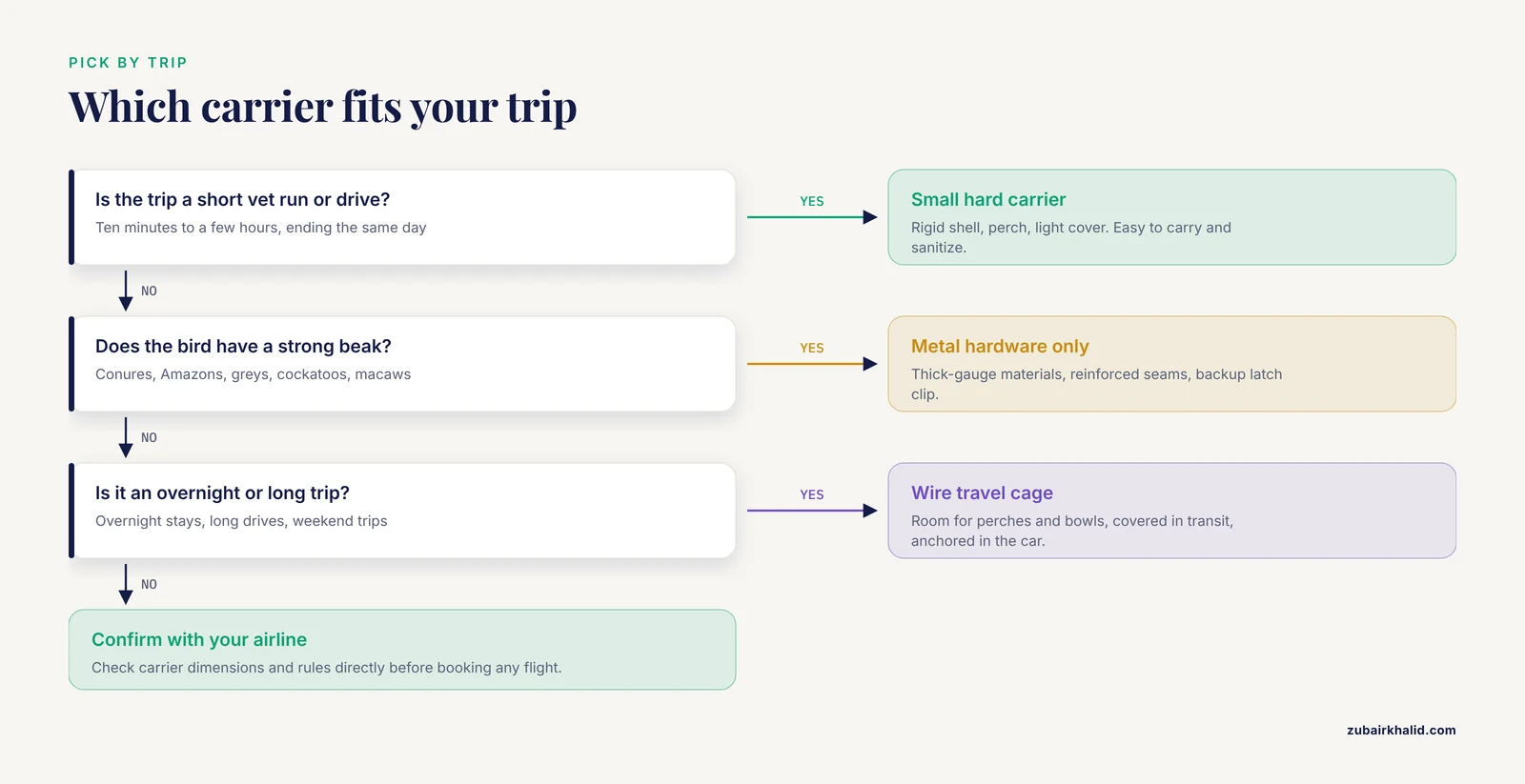
Abstract criteria become easier to apply with concrete situations. Here are four common ones.
Scenario one: the routine vet visit. A budgie needs an annual exam ten minutes from home. The best choice is a small hard-sided plastic carrier with a perch and a light cover. It is easy to carry, easy to sanitize, secure in the car, and familiar if you leave it out between visits so the bird treats it as normal furniture.
Scenario two: the four-hour drive to a family gathering. A green-cheeked conure travels with you for a weekend. A clear-panel acrylic carrier or a small anchored wire travel cage works well. Install the usual perch, secure a small dish of water or plan to offer water at rest stops, drape a partial cover over the back half for privacy, and position the carrier where air circulates but direct sun does not reach.
Scenario three: a flight in an airplane cabin. An airline-approved soft-sided or hard-sided carrier that meets the airline's published dimensions is required, and you must confirm those dimensions and rules directly with the airline before booking. Acclimate the bird to the exact carrier weeks in advance, confirm the health documentation the airline and your destination require, and schedule a pre-travel examination with your avian veterinarian. Birds traveling between states or countries may need health certificates, and your veterinarian is the right person to confirm what applies to your route and timing.
Scenario four: emergency evacuation. Wildfire and storm seasons make a grab-and-go carrier a piece of safety equipment rather than a convenience. A hard-sided carrier with a pre-installed perch, stored where you can reach it in seconds, is the most reliable choice. Prey animals under panic stress need immediate, fail-safe containment, and fumbling with a zipper while smoke alarms sound is not the moment to discover a design flaw. Keep a printed copy of your parrot care checklist in the same bag as the carrier.
Acclimating Your Bird Before the Trip
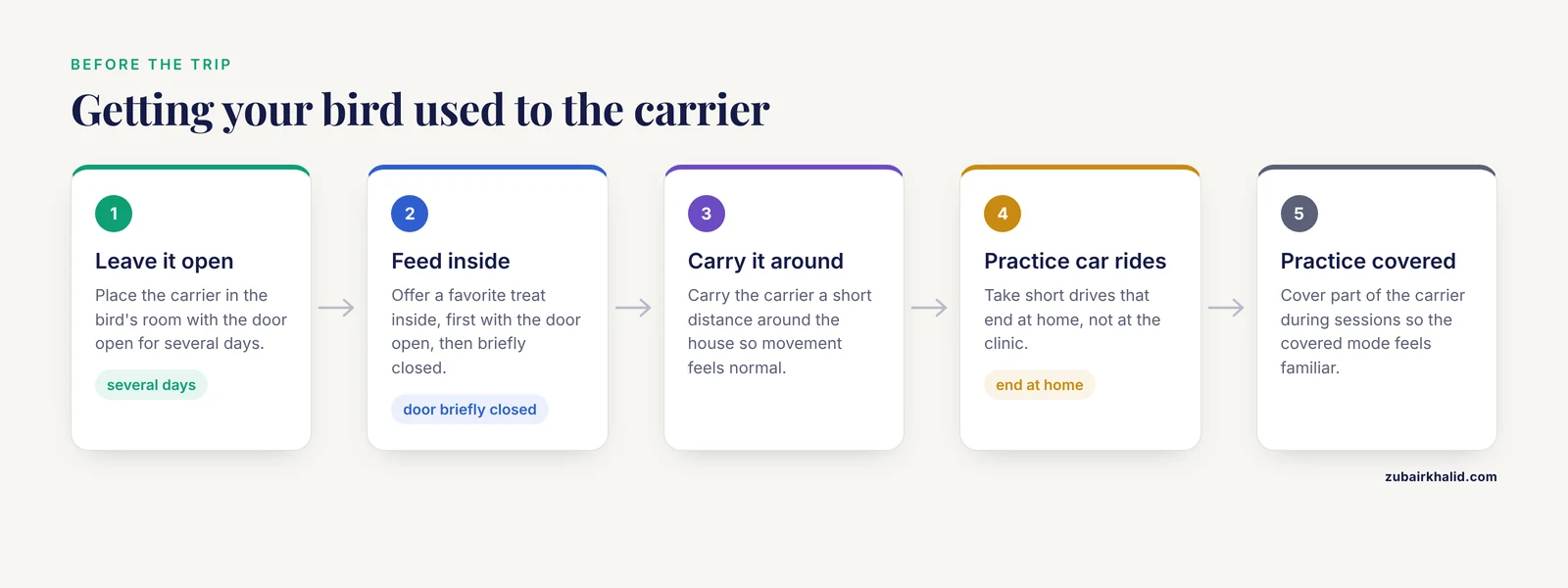
Whichever carrier you choose, the carrier itself becomes the biggest stressor if the bird only ever sees it on vet days. The fix is gradual, unhurried exposure.
Start by placing the carrier in the bird's room with the door open for several days. Let the bird investigate at its own pace. Next, feed a favorite treat inside with the door open, then with the door briefly closed, then with the carrier carried a short distance around the house. Add short car rides that end at home rather than at the clinic, so the car does not predict a stressful destination. Cover part of the carrier during practice sessions so the covered mode feels familiar too.
This training matters as much as the purchase. A bird that steps into its carrier calmly on cue is safer in an emergency and easier to examine at the clinic, and avian vets consistently see the difference in birds whose owners practiced at home.
Travel-Day Checklist
Run this short list before every trip, whether it is a clinic appointment or a vacation.
- Inspect the carrier for damage, chew marks, and latch function.
- Install a clean perch and confirm tail and head clearance.
- Line the floor with paper towel for easy cleanup.
- Secure or remove loose dishes, toys, and accessories.
- Attach a partial cover for shade and privacy.
- Offer water appropriate to the trip length, since open dishes spill in transit and many owners hydrate birds at rest stops instead.
- Pack a small travel kit: paper towel, a spare cover, backup latch clip, seed or pellet portions, and any medication your bird takes.
- Secure the carrier in the vehicle, ideally belted or anchored and out of direct sun.
- Check the cabin temperature before the bird leaves the house.
At your destination, set the bird up promptly rather than leaving it in the carrier all day. A folding travel cage with a fresh liner, food, and water restores normal routine faster and gives the carrier back its job as a transport tool. This is where the bird cage setup and the travel kit meet. Owners who replicate key elements of the home cage at the destination, especially the familiar perch types and dish locations, often report faster settling. For nutrition on the road, keeping the bird on its usual pellet and fresh-food routine matters more than any novelty treat, a point Lafeber's avian nutrition resources and most avian veterinarians emphasize for travel and boarding alike.
Common Mix-Ups to Avoid
Using the home cage for a car ride. Too big, too heavy, too loose, and too exposed. Use a dedicated carrier.
Skipping the perch. A bird bracing on a bare plastic floor for an hour arrives exhausted and sore-footed. Install a perch from day one.
Trusting a zipper against a parrot. Zippers are an escape route for determined beaks. Metal hardware wins.
Leaving the carrier in the sun or in a parked car. Carrier interiors warm quickly even on days that feel mild. Treat the car as never-safe for a bird, full stop.
Buying the carrier the day before the trip. Birds need time to accept new objects. Purchase weeks ahead and use the acclimation steps above.
Overlooking the pre-travel health check. Any trip involving an airplane, a state line, or an overnight boarding facility deserves a conversation with your avian veterinarian first. VCA Animal Hospitals' avian care guides and the Association of Avian Veterinarians both encourage owners to discuss travel plans, including diet, stress, and any needed paperwork, as part of routine avian wellness visits.
Limitations and When to Contact a Veterinarian
This article is educational and is not a substitute for veterinary diagnosis or treatment. Individual birds vary widely in temperament, health status, and tolerance for travel, and your avian veterinarian is the right person to tailor carrier and travel advice to your specific bird.
Contact your avian veterinarian before travel if your bird has any chronic condition, is currently ill, is a very young chick or an elderly bird, has never traveled before and you are planning a long trip, or will cross state or national borders where health documentation may be required. Airlines, destinations, and boarding facilities set their own documentation rules, and these change over time, so verify requirements directly rather than relying on general guidance.
Contact your veterinarian promptly, or an emergency avian clinic after hours, if during or after travel your bird shows open-mouth breathing, tail bobbing, sitting fluffed on the cage floor, refusing food for more than a few hours, regurgitation outside of normal courtship behavior, quiet behavior or voice change, bleeding, or any injury from a fall or a cage escape inside the vehicle. Travel stress can unmask or worsen underlying disease, and birds are famous for hiding illness until it is advanced. When in doubt, call. A short phone call to a clinic that knows your bird is never wasted.
Frequently Asked Questions
What size carrier does my bird need?
Choose the smallest carrier that lets your bird perch at full height without touching the walls with its head or tail, and turn around comfortably. Oversized carriers allow dangerous movement during sudden stops, so bigger is not safer.
Can I use my bird's regular cage for travel?
Only for short, gentle moves at home, and even then it is usually a poor fit. Regular cages are heavy, hard to secure in a vehicle, full of loose accessories, and open to drafts. A dedicated carrier is safer, lighter, and easier to clean.
Are soft-sided carriers safe for parrots?
For calm, non-chewing birds on short trips, sometimes. For most parrots, no. A determined beak can defeat zippers and mesh, fabric is difficult to sanitize, and soft carriers provide no protection in a vehicle incident. Reserve them for quiet, supervised, short-duration use.
How do I get my bird used to a new carrier?
Leave the carrier in the bird's room with the door open, reward the bird for exploring and entering, then progress to brief closed-door sessions and short practice car rides that end at home. Start weeks before any real trip so the carrier becomes familiar rather than frightening.
Should I feed and water my bird in the carrier during travel?
For short trips, many owners skip open water dishes because they spill, and offer water during rest stops instead. For longer trips, use secured dishes or travel-friendly dispensers and plan regular breaks. Discuss the right plan for your bird's species, age, and health with your avian veterinarian before a long journey.
Do I need paperwork to travel with my bird?
It depends on where you are going and how. Airlines set their own carrier and documentation requirements, and some interstate and international moves require health certificates issued by a veterinarian. Confirm the rules with your airline and destination directly, and schedule a pre-travel exam so any required paperwork can be completed on time.
Further Reading
- Technology-Assisted Rehabilitation Gym for at-home Training (TARGeT) for stroke survivors: A study protocol for evaluating feasibility, safety, usability, clinical benefit, and costs.
- Dengue@Home: evaluation of a hospital in the home pathway for management of adults with dengue fever.
- Peanut oral immunotherapy updosing via in-office, video, and telephone encounters: Safety and caregiver satisfaction.
- Descriptive Analysis of the First 12-Month Activity of Docadom, a Private Physician-Led Urgent In-Home Consultation Service.
- Home-Based Multimodal Exergame Prototype for Patients With Chronic Stroke: Cross-Sectional Content Validation and Prospective Single-Arm Feasibility Study.
- Heterogeneous Salmonella typhi transmission within a household: genomic insights from a chronic carrier