How to Get Rid of Fleas in the House and Yard
By Dr. Zubair Khalid, DVM, MS, PhD ·

Fleas in a house are an environmental infestation as much as a skin problem on the pet. The adult fleas you see on the animal are only the visible portion of the problem. Eggs, larvae, and pupae sit in carpet, rugs, bedding, and upholstery, and they keep emerging for weeks after the pet is treated.
The reliable way to clear a home is to do three jobs at the same time. Treat every cat and dog with a flea product that kills adults and stops reproduction. Remove immature stages from the indoor environment with thorough cleaning. Keep both going long enough to break the life cycle. The evidence for this approach comes from controlled studies in simulated homes and from real households with established infestations.
In a six-month simulated home study, cats housed in carpeted pens received monthly topical imidacloprid or fipronil. Both products gave virtually complete flea control for the whole period. Untreated control cats had to be combed on 18 occasions to remove excessive flea burdens, and two of them developed allergic reactions [1]. In 21 real households in West Central Florida, three monthly treatments with a topical selamectin-sarolaner product reduced fleas on cats by 96.3% within 7 days and by 100% from week 6 through the end of the 12-week study [2].
Those two results share a pattern. The product went on every animal, it went on schedule, and it was continued for months rather than days.
This article is educational and is not a substitute for veterinary diagnosis or treatment.
At a Glance: The Clearing Plan
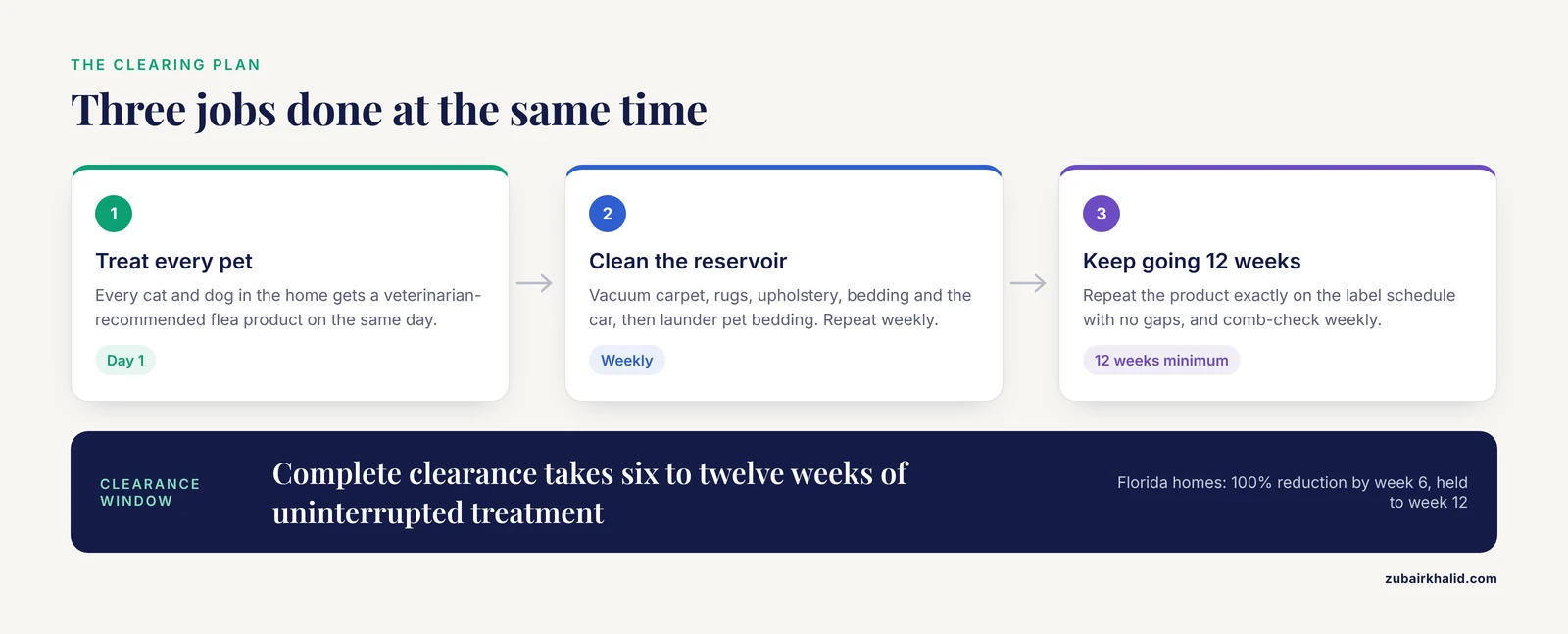
| Step | What to do | Timing |
|---|---|---|
| 1 | Treat every cat and dog in the home with a veterinarian-recommended flea product, all on the same day | Day 1 |
| 2 | Choose a product with proven residual killing power and, where possible, added reproduction control | Day 1 |
| 3 | Vacuum all carpet, rugs, upholstery, pet bedding, and the car. Launder pet bedding | Day 1 and weekly |
| 4 | Set intermittent-light flea traps in rooms where pets rest to track progress | Day 1 onward |
| 5 | Repeat the flea product exactly on the label schedule, without gaps | Monthly or as labeled |
| 6 | Keep every pet protected for at least 12 weeks, and continue year-round in most US regions | 12 weeks minimum |
| 7 | Manage the yard: mow, clear debris from pet resting areas, and keep pets on continuous prevention | Ongoing |
| 8 | Comb-check pets weekly and recheck with your veterinarian at 4 and 8 weeks | Weekly |
Why Fleas Keep Coming Back After Treatment
Carpet is a nursery. The simulated home studies used carpeted pens and carpeted cages specifically because carpet supports the complete flea life cycle away from the host [1][3]. In one study, floor mat samples taken from the environments of treated dogs were incubated for 32 days, and the number of emerging adult fleas was counted [4]. That design exists because the environment holds viable flea stages long after the animal itself has been treated.
Investigators reinforce this deliberately. In a spinosad study, cats were kept in cages with solid carpeted floors, and larval flea growth media was sprinkled onto the carpet every week to keep the environmental challenge going [5]. The carpet is not background scenery. It is part of the infestation.
This explains the pattern most owners see. You treat the pet, the adult fleas die, and then two to three weeks later new fleas appear. Those are not treatment failures. They are adults emerging from pupae that were already in the room before you started.
Reproduction is the second reason infestations persist. Some products kill adult fleas but still allow surviving fleas to lay eggs. Others shut reproduction down almost completely. Fluralaner stopped egg laying entirely at low blood concentrations and prevented flea reproduction in a simulated home environment [6]. Lotilaner reduced egg production by 98.5% within 24 hours of treatment [7]. In cats treated with selamectin plus sarolaner, adult flea efficacy was 100% up to day 36, and only four flea eggs were collected after treatment, compared with individual counts of 110 to 1,256 eggs from placebo-treated cats [8].
Products that stop egg production do more than kill the fleas you can see. They cut off the supply of new immature stages going into the carpet.
Step-by-Step: How to Get Rid of Fleas in the House
Step 1: Treat every pet on the same day
The foundation of household flea control is treating all animals on the premises with a highly effective product [2]. Every cat and every dog, including the indoor cat that never goes outside and the older dog that mostly sleeps. An untreated pet is a reservoir that keeps feeding the cycle, and partial treatment is the single most common reason a household stays infested.
In the Florida household study, 37 cats across 21 homes received the topical product, and dogs in both treatment groups received oral sarolaner at the same time [2]. The entire animal population of each home was covered.
Use species-appropriate products. Never apply a dog product to a cat, and never split a large-dog dose between small pets.
Step 2: Pick a product with residual killing power and reproduction control
Speed of kill on day one is not the main criterion. What matters for a household infestation is how long the product keeps working between doses and whether it interferes with the flea life cycle. A product that kills adult fleas for a month and blocks egg hatch does far more for the house than a fast-acting spray that wears off in a day.
Options with published evidence in household-type settings include topical imidacloprid or fipronil [1], imidacloprid combined with pyriproxyfen [4], selamectin [3], selamectin plus sarolaner [2][8], oral fluralaner [6], oral sarolaner alone or in combination [9][10], oral lotilaner [7], oral afoxolaner [11], oral spinosad [4][5], and topical metaflumizone [12]. Your veterinarian can match one of these to your pet's age, weight, health status, and household.
Step 3: Stay on schedule for at least 12 weeks
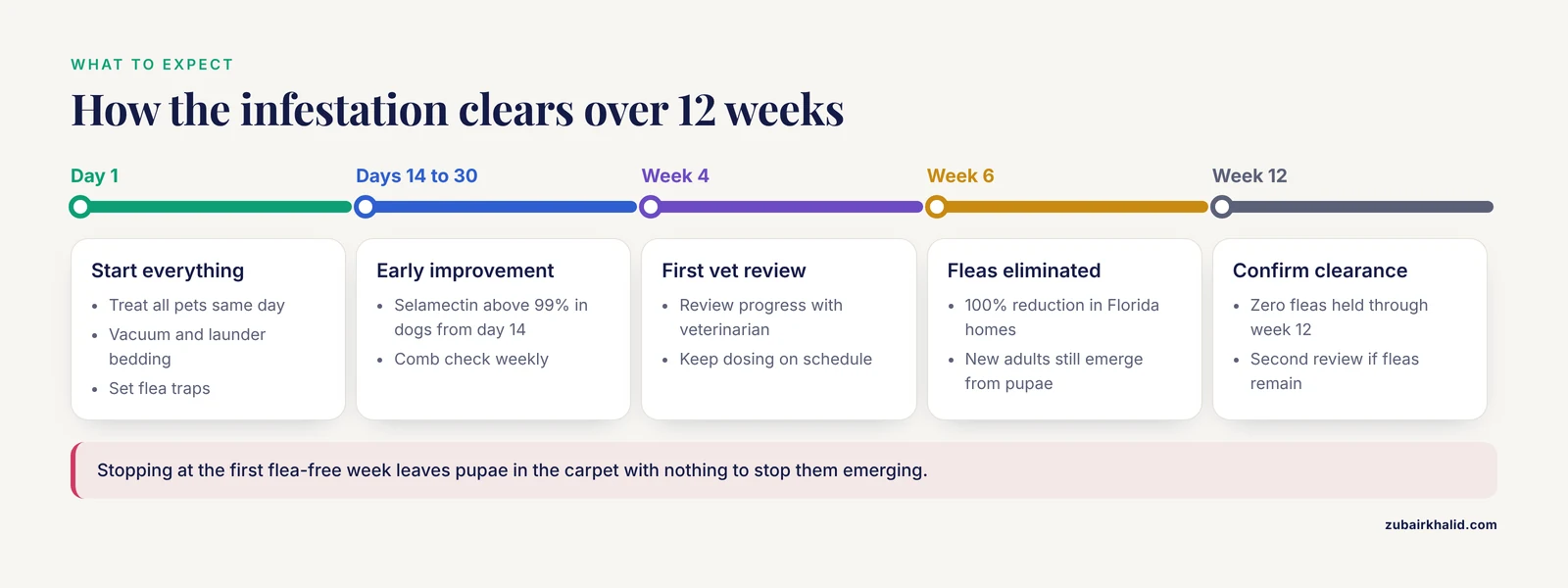
The life cycle in a home takes weeks to run out. In the Florida households, fleas on cats were eliminated by week 6 and stayed at zero through week 12 with continued monthly treatment [2]. In the six-month simulated home work, imidacloprid and fipronil maintained near-complete control across the entire study period [1]. Selamectin produced reductions above 99% in dogs from day 14 onward, and in cats above 92% at day 29 and above 99% on days 44, 59, 74, and 90 [3].
Those timelines tell you what to expect. Early improvement is normal. Complete clearance takes six to twelve weeks of uninterrupted treatment. Stopping at the first flea-free week leaves pupae in the carpet with nothing to stop them emerging.
There is a second reason to stay on schedule. New fleas keep arriving from outside. In the simulated home studies, investigators added adult fleas at intervals specifically to mimic the acquisition of extraneous fleas from outside the home [1]. Reinfestation pressure is normal, and continuous prevention is what handles it.
Outdoor-housed dogs treated monthly with fipronil and (S)-methoprene maintained above 90% flea efficacy at every assessment, and no flea eggs were laid in the treated groups until infestation was carried out more than 60 days after the last treatment [13]. Consistent dosing interrupts the cycle even under heavy exposure.
Step 4: Remove the indoor reservoir
Treating the pets does not remove what is already in the carpet. Mechanical cleaning does.
Vacuum thoroughly on day one and at least weekly afterward. Cover all carpet, area rugs, upholstery, under furniture, along baseboards, pet bedding, and the inside of the car. Seal or discard the vacuum bag or empty the canister outside after each session. Vacuuming pulls eggs, larvae, and debris out of the fibers that the simulated home studies identified as the reservoir [1][4].
Remove and launder pet bedding, blankets, and washable covers. Bedding sits in direct contact with the animal and collects flea eggs and larvae continuously.
Set intermittent-light flea traps in the rooms where pets sleep and rest. These traps were used to assess indoor flea populations in the Florida household study [2]. They are monitoring tools, not treatment. A trap that stops catching fleas is useful confirmation that the indoor population is falling.
Environmental insecticidal sprays are an adjunct, not the foundation. In the lufenuron arm of the simulated home study, cats still needed two insecticidal spray treatments in the first month, and small flea burdens were present continuously afterward [1]. Products applied to the animals did the heavy lifting. Treat the pets first, then ask your veterinarian whether an environmental spray adds anything to your specific situation.
Step 5: Handle the yard and outdoor resting areas
Outdoor exposure is how fleas return to a cleared home. In a survey of 550 dog and cat owners, 90.3% identified the environment outdoors as the most common source of infestation, and 54.4% mentioned contact with other animals [14]. Yard management is covered in detail below.
Step 6: Monitor with a flea comb and recheck
Comb your pet weekly over a white surface. Flea comb counts were the standard measure of response in the treatment studies, including the work on flea allergy dermatitis where treated animals stayed at 11 fleas or fewer while untreated animals exceeded 100 [15]. A comb is the most practical home test you have.
Clinical trials typically reassess at days 14, 30, 60, and 90 [10]. A reasonable home schedule is a weekly comb check, a review with your veterinarian at 4 weeks, and a second review at 8 to 12 weeks if fleas are still being found.
Choosing a Flea Product: What the Evidence Shows
| Active ingredient | Typical form | Key finding in household-type studies |
|---|---|---|
| Imidacloprid | Topical | Virtually complete control across six months in carpeted pens [1] |
| Fipronil | Topical | No fleas recovered at any point after the first treatment [1] |
| Imidacloprid plus pyriproxyfen | Topical | Reduced flea life stages in the environment, measured by incubating floor mats [4] |
| Selamectin | Topical | Above 99% reduction in dogs from day 14, above 99% in cats from day 44 [3] |
| Selamectin plus sarolaner | Topical | 96.3% reduction at 7 days and 100% from week 6 in real homes [2], 100% adult efficacy to day 36 with near-zero egg production [8] |
| Fluralaner | Oral | Stopped egg laying completely and prevented reproduction in a simulated home [6] |
| Sarolaner | Oral | 99.3% reduction at day 14 in naturally infested dogs [10], combination product at 99.7% within 24 hours [9] |
| Lotilaner | Oral | 100% adult efficacy and 98.5% reduction in egg production [7] |
| Afoxolaner | Oral | 100% efficacy at day 2 in cats, above 98% through day 42 [11] |
| Spinosad | Oral | Controlled fleas in simulated home environments [4][5], 94.6% reduction at day 14 [10] |
| Metaflumizone | Topical | Above 90% control for up to 7 weeks after a single treatment in cats [12] |
| Lufenuron | Injectable | Needed added insecticidal sprays and allowed small persistent burdens [1] |
Flea products differ in more than speed. Lotilaner delivered 100% efficacy against adult fleas at every assessment point in treated dogs, and egg production dropped by 98.5% within 24 hours [7]. A combination of sarolaner, moxidectin, and pyrantel reached 99.7% efficacy against cat fleas and 100% against dog fleas within 24 hours of treatment and after subsequent infestations [9]. Sarolaner outperformed spinosad at the first recheck in naturally infested dogs, 99.3% versus 94.6% at day 14, though both groups exceeded 98.8% by days 60 and 90 [10].
Bathing is not a substitute for a flea product. In a simulated environment study, dogs bathed weekly with a physiological hygiene shampoo did not control fleas adequately when compared with a long-acting topical fipronil and (S)-methoprene formulation [16]. Shampoo removes dirt and debris. It does not leave residual insecticide on the skin.
Plant-based supplements are not equivalent to conventional products. In a double-blind randomized study, a supplement containing thyme, rosemary, melissa, fenugreek, absinthe, and lemongrass extracts reduced flea counts by 33% at one month and 82% at five months in treated dogs, while untreated dogs rose to an average of 21.5 fleas per dog by four months [17]. That is measurable activity, but it is not the level of control seen with the veterinary products above, and it works too slowly to clear an established household infestation on its own.
Entomopathogenic fungi are an active research area, not a home remedy. Conidia of Beauveria bassiana caused 100% mortality of adult cat fleas after 36 hours in laboratory test tubes, with the strongest results from cultures grown under red LED light [18]. Those are in vitro results against fleas in a tube, not field results in a house.
Flea Prevention for the Yard and Grass Flea Treatment That Works
Owners overwhelmingly point to the outdoors as the source of their flea problems [14]. That makes yard management essential, even for households with indoor-only cats, because fleas arrive on shoes, clothing, visiting pets, and animals that pass through the property.
The single most effective yard strategy is a continuously protected pet. In a five-month study, dogs housed outdoors for seven months were treated monthly with fipronil and (S)-methoprene. The product maintained above 90% efficacy against fleas at every assessment, and no flea eggs were laid in the treated groups until infestation was carried out more than 60 days after the last treatment [13]. Even under outdoor housing and repeated challenge, keeping the animal protected stopped the yard from being seeded with eggs.
That result reframes grass flea treatment. The goal is not to sterilize a lawn. The goal is to stop flea eggs from reaching the soil in the first place, and the pet is where those eggs come from.
Practical yard work supports the medical plan:
- Mow regularly and keep grass short in the areas where pets play and rest.
- Clear leaf litter, clippings, and debris from under decks, along foundations, and around favorite resting spots. Immature fleas develop in damp, shaded organic material.
- Let sun and air reach damp shaded spots by trimming low branches and thinning dense ground cover.
- Manage wildlife access. Keep garbage secured and avoid leaving pet food outdoors, since other animals can carry fleas onto the property [14].
- Wash outdoor pet bedding on the same schedule as indoor bedding.
- Keep every pet on continuous flea prevention, including in winter if your veterinarian recommends year-round coverage.
If you are considering an outdoor insecticide for the yard, discuss it with your veterinarian or a licensed pest professional first. The household studies that cleared established infestations did so by treating the animals, and the environmental flea population followed [1][2]. Outdoor chemicals have a place in some situations, but they cannot compensate for unprotected pets.
Expect reinfestation pressure to continue. Investigators built extraneous flea introduction into their study designs because it reflects real life [1]. Flea prevention for the yard is a maintenance program, not a one-time cleanup.
Common Mistakes That Keep the Infestation Going
Treating only the itchy pet. Fleas on one animal mean fleas in the shared environment. Every pet in the home needs treatment on the same day [2].
Stopping treatment as soon as fleas disappear. The life cycle needs weeks to run out. In the Florida homes, clearance was reached at week 6 and treatment continued to week 12 [2].
Relying on bathing. Weekly hygiene shampoo did not control fleas adequately in a simulated home environment, while a long-acting topical product did [16].
Using a product that only kills adults. Reproduction control matters. Fluralaner stopped oviposition completely [6], and lotilaner reduced egg production by 98.5% [7].
Assuming the yard is the only source. Home infestations persist indoors in carpet and bedding even when pets go outside only briefly [1][4].
Using a plant-based supplement as the only strategy. A tested supplement reached 82% efficacy after five months [17], which is far too slow and too incomplete for an established household infestation.
Skipping doses. The trial designs that produced near-complete control used strict monthly or label-schedule dosing [1][2][13]. Gaps reopen the window for egg laying.
Cleaning once. Weekly vacuuming and laundering keep pulling immature stages out of the environment while the product works on the survivors.
Safety and Welfare Points
Flea control is not only about comfort. Flea allergy dermatitis causes real suffering, and untreated infestations can produce it quickly. In the simulated home study, two untreated control cats developed allergic reactions while being managed for heavy flea burdens [1]. In the flea allergy dermatitis trial, selamectin-treated cats showed significant improvement in miliary lesions, scaling, and crusting, and treated dogs improved in all clinical signs, while control animals did not improve [15]. Clearing fleas fast is a welfare intervention.
Fleas also carry pathogens. In a controlled cohousing study, cats treated with fipronil and (S)-methoprene did not become infected with Bartonella clarridgeiae despite exposure to infected fleas, while untreated cats in an adjacent enclosure did [19]. Household flea control has a public health dimension, particularly in homes with immunocompromised people.
Use products exactly as labeled. Do not apply a dog product to a cat, do not combine multiple adulticides without veterinary advice, and check with your veterinarian before treating puppies, kittens, pregnant or nursing animals, or pets with chronic illness.
Watch for application-site reactions and contact your veterinarian if you see swelling, redness, vomiting, lethargy, or neurological signs after a treatment. The products in the studies above were well tolerated in the tested populations, but individual reactions happen and should be reported.
Limitations and When to Contact a Veterinarian
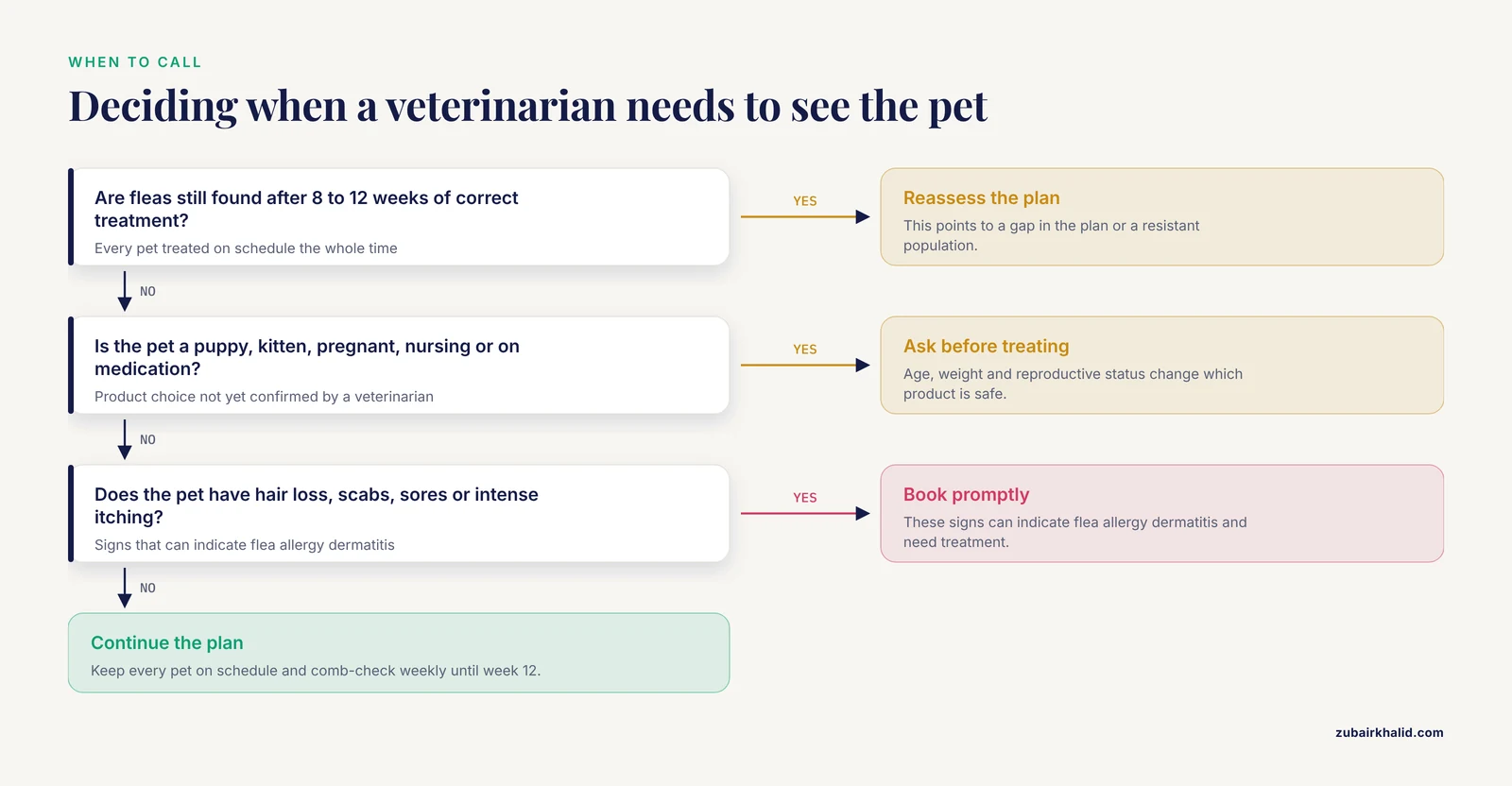
Contact your veterinarian promptly if:
- Your pet has hair loss, scabs, open sores, thickened skin, or intense itching, which can indicate flea allergy dermatitis [15].
- Your pet is a puppy or kitten, pregnant, nursing, or on medication, and you have not yet confirmed which product is appropriate.
- Your cat shows any sign of illness after a flea product is applied.
- Fleas are still being found after 8 to 12 weeks of correct, on-schedule treatment of every pet in the home, since this points to a gap in the plan or a resistant population that needs reassessment.
- You cannot treat every animal in the household, which is common in multi-cat homes with fractious cats. Your veterinarian can help with an approach that works for all of them.
- Someone in the household is immunocompromised, given the role fleas play in transmitting Bartonella species [19].
- You are considering an outdoor insecticide and want to know whether it is necessary alongside pet treatment.
Individual situations vary, and a veterinarian who can examine your pet and your household setup should guide the final plan.
Fleas on Puppies, Kittens, and Pregnant or Nursing Pets
Age, weight, and reproductive status change which flea product is safe. Puppies and kittens have minimum age and weight requirements for each product, and pregnancy and nursing add further restrictions. Do not guess a dose by splitting an adult product, and never use a dog product on a cat; some dog flea products are toxic to cats.
Start with a veterinary visit. The veterinarian will weigh the pet and select a product labeled for that age and status. Until treatment begins, remove fleas physically with a fine-toothed flea comb over soapy water, several times daily if needed. Treat the environment at the same time by vacuuming and laundering bedding, since immature fleas in the house will keep reinfesting the young animal.
Seek urgent care if a puppy or kitten is pale, lethargic, weak, or breathing rapidly, because heavy flea feeding can cause life-threatening anemia in small animals.
Multi-Pet Homes and Indoor-Only Cats: Making Treatment Actually Happen
Treat every cat and dog in the home on the same day and repeat on the same schedule [2]. An untreated pet keeps supplying eggs to the shared environment, and one missed dose reopens that window. Put reminders on a calendar, refill before the last dose is used, and record which pet received what.
After a topical product, separate pets briefly so they cannot groom it off each other. Keep them apart until the application sites are dry or as the label directs. For fractious cats, plan before treatment day: ask your veterinarian about an oral product, use two people, and have a towel ready. Do not skip the cat because handling is difficult.
An indoor-only cat can still seed an infestation. Fleas arrive on clothing, shoes, and visiting animals [14], then the cat's eggs drop into carpet and bedding.
Hard Floors, Furniture, and Laundry: Cleaning Beyond the Carpet
Carpet gets the attention, but flea eggs and larvae settle wherever pets rest.
Washable items
Wash pet bedding, blankets, throw rugs, and slipcovers in hot water, then dry on the hottest setting the fabric allows. Repeat weekly while fleas are active.
Upholstery and crevices
Vacuum cushions, under furniture, along baseboards, and inside closets with a crevice tool. Empty the canister outside afterward.
Hard floors
Vacuum first, then mop with soap and water, reaching corners and under toe kicks.
Carriers and cars
Wipe hard carriers, launder their pads, and vacuum car seats and floor mats.
Cleaning removes immature stages from fibers and cracks [1][4], but it does not treat fleas on the animal. Keep every pet on its schedule. If fleas persist after 8 to 12 weeks of correct treatment, or the infestation is severe, have your veterinarian reassess the plan.
Related Guides
- How Often Should Cats Get Flea and Tick Treatment? Timing Guide: Timing guidance for cat flea and tick preventive treatment
- Sand Flea Bites: What They Look Like, Treatment and Prevention: Outdoor sand flea bites, symptoms, and prevention advice
- Canine Heartworm Disease and Flea Prevention: Integrated Parasite Control: Integrated heartworm and flea prevention options for dogs
- Bed Bugs on Dogs: Signs, Bites, and How to Get Rid of Them
- How to Get Rid of Ringworm in Cats: Home Remedies
- Dog Lice: How to Treat and Get Rid of Them
Frequently Asked Questions
How long does it take to get rid of fleas in the house?
Most homes need six to twelve weeks of consistent treatment. Fleas on pets in a real household study reached 100% reduction by week 6 and stayed at zero through week 12 with continued monthly treatment [2].
Do I need to treat my yard if my cat never goes outside?
Yes, yard management still matters. Fleas come indoors on shoes, clothing, and other animals, and most owners in a large survey identified the outdoor environment as the most common source of infestation [14].
Can I just bathe my dog instead of using a flea product?
No. Weekly bathing with a hygiene shampoo did not control fleas adequately in a simulated home environment, while a long-acting topical product did [16].
Will one flea treatment be enough?
No. A single dose leaves pupae in the carpet to emerge later. Studies that achieved near-complete control used repeated monthly dosing over months [1][2].
Do flea traps clear an infestation?
No. Intermittent-light flea traps are monitoring tools that show whether the indoor population is falling [2]. They do not replace treating the pets and cleaning the environment.
Are plant-based flea products strong enough?
They are generally much weaker than veterinary products. A tested supplement reached 82% efficacy only after five months, while untreated dogs worsened over the same period [17]. That is too slow for an established home infestation.
Can I use my dog's flea product on my cat?
Never. Species-specific products are formulated and dosed differently, and some dog products are toxic to cats. Ask your veterinarian for a cat-safe option.
Why are fleas still appearing after I treated my pet?
New adults are emerging from pupae that were already in the carpet before treatment, and new fleas may be arriving from outside [1][4]. Continue on schedule for the full 12 weeks and keep cleaning.
Sources
- Control of flea populations in a simulated home environment model using lufenuron, imidacloprid or fipronil.
- Evaluation of a topical sarolaner-selamectin combination to control flea populations on naturally infested cats in private residences in West Central Florida.
- Efficacy of selamectin in the treatment and prevention of flea (Ctenocephalides felis felis) infestations on dogs and cats housed in simulated home environments.
- Evaluation of the efficacy of topically administered imidacloprid + pyriproxyfen and orally administered spinosad against cat fleas (Ctenocephalides felis): Impact of treated dogs on flea life stages in a simulated home environment.
- Speed of kill efficacy and efficacy of flavored spinosad tablets administered orally to cats in a simulated home environment for the treatment and prevention of cat flea (Ctenocephalides felis) infestations.
- Fluralaner, a novel isoxazoline, prevents flea (Ctenocephalides felis) reproduction in vitro and in a simulated home environment.
- Efficacy of lotilaner (Credelio™) against the adult cat flea, Ctenocephalides felis and flea eggs following oral administration to dogs.
- Efficacy of a new spot-on formulation of selamectin plus sarolaner for cats against adult Ctenocephalides felis, flea egg production and adult flea emergence.
- Laboratory studies evaluating the efficacy of a novel orally administered combination product containing sarolaner, moxidectin and pyrantel (Simparica Trio™) for the treatment and control of flea infestations on dogs.
- Efficacy and safety of sarolaner (Simparica(®)) in the treatment and control of naturally occurring flea infestations in dogs presented as veterinary patients in Australia.
- Efficacy of afoxolaner in the flea control in experimentally infested cats.
- Efficacy of a novel formulation of metaflumizone for the control of fleas (Ctenocephalides felis) on cats.
- Five-month comparative efficacy evaluation of three ectoparasiticides against adult cat fleas (Ctenocephalides felis), flea egg hatch and emergence, and adult brown dog ticks (Rhipicephalus sanguineus sensu lato) on dogs housed outdoors.
- Knowledge and practices of dog and cat owners in Mainland Portugal regarding fleas, flea-borne pathogens, and their management.
- Efficacy of selamectin in the treatment and control of clinical signs of flea allergy dermatitis in dogs and cats experimentally infested with fleas.
- Comparative efficacy on dogs of a single topical treatment with fipronil/(S)-methoprene or weekly physiological hygiene shampoos against Ctenocephalides felis in a simulated flea-infested environment.
- Evaluation of a plant-based food supplement to control flea populations in dogs: A prospective double-blind randomized study.
- Virulence of Aerial Conidia of Beauveria bassiana Produced under LED Light to Ctenocephalides felis (Cat Flea).
- Fipronil and (S)-methoprene can lessen the risk of transmission of Bartonella clarridgeiae among cats with exposure to Ctenocephalides felis.