Winter Pasture Management: Protecting Grass and Preventing Mud
By Dr. Zubair Khalid, DVM, MS, PhD ·
Winter pasture management for horses comes down to three moves you can make before the first hard frost. Move horses off wet, frozen, or grazed-down grass onto a dedicated sacrifice paddock with sacrifice-area footing, provide forage in every paddock horses occupy, and pick up manure on a fixed schedule instead of harrowing it into the ground. Do those three things and you protect the grass crown, keep soil structure intact, and stop the mud cycle before it starts, because mud is almost always the result of hooves churning saturated soil around hay feeding areas and gateways in late fall and winter.
This guide walks through the whole system: how horses actually use pasture in winter, a step-by-step grazing plan, footing and drainage fixes, manure and parasite management backed by recent research, feeding decisions as grass disappears, a horse care checklist, and a simple horse health record template you can copy.
This article is educational and is not a substitute for veterinary diagnosis or treatment.
At a Glance: Winter Pasture Actions You Can Take Today
| Action | Timing | Why it matters |
|---|---|---|
| Walk every paddock and score grass cover | Early fall, then monthly | Grass below about 2 inches cannot recover, and bare ground becomes mud |
| Designate one sacrifice paddock with footing | Before ground saturates | Concentrates hoof traffic on a surface built for it instead of your best grass |
| Pull water troughs away from gates and high-traffic lanes | Before first freeze | Trough traffic zones are the first place mud starts |
| Pick up manure at least twice weekly in occupied paddocks | Ongoing all winter | Research shows twice-weekly removal sharply cuts parasite larvae on herbage |
| Stop harrowing until dry, warm weather returns | Fall through winter | Harrowing spreads larvae rather than killing them in cool, wet conditions |
| Order forage before grass runs out | Late summer or early fall | Horses turned onto short winter grass with no hay face a much higher risk of gastric disease |
| Rest worn paddocks for the full grazing season | Rotate out in fall | One year of rest greatly lowers parasite levels on pasture |
Why Winter Pasture Management Matters for Horse Health
Most horse owners underestimate how quickly winter conditions change a pasture. Growth slows or stops in cold weather, rainfall and snowmelt saturate the soil, and a few weeks of hooves on wet ground can destroy the root structure that took all spring and summer to build. Once the sod tears, you get mud, and mud brings a cascade of problems: lost footing, thrush and scratches, buried fences, contaminated water, and a paddock that stays ugly well into summer.
The health consequences are measurable. In a large survey of horse owners in Great Britain, only 4 percent of horses were stabled around the clock, and pasture access was nearly universal, with a median of 91 hours per week, but the proportion of horses fully stabled rose significantly in winter [1]. That tells you two things. First, most horses in temperate climates live outside through winter, so pasture condition directly shapes their daily welfare. Second, many horses do move onto restricted turnout in winter, which concentrates wear on small paddocks and makes management decisions more consequential, not less.
Winter pasture condition also affects what is happening inside the horse. A yearlong study in New Zealand followed mature horses on pasture and tracked their fecal microbiota monthly. When horses had access to pasture only, bacterial diversity in the feces was significantly higher than during the months when hay supplemented the grass, and the microbial communities clustered separately during the late autumn to winter period compared to other seasons [2]. Grass is not just calories. It is a substrate that shapes the hindgut ecosystem, and abrupt shifts from living grass to conserved forage are a real dietary transition even when total forage intake looks similar on paper.
Gastric health adds another layer. In a prospective study of 80 extensively managed Icelandic horses gastroscoped four times across a calendar year, gastroscopically significant equine squamous gastric disease ranged from 48 to 72 percent across the year, and the single strongest management-related risk factor was a reduction in grass availability without additional forage provided, which carried roughly tenfold higher odds of significant squamous disease compared with low grass plus forage [3]. The practical translation is blunt. If winter grass disappears and you do not replace it with hay or haylage, you are gambling with your horse's stomach.
Finally, the ground itself matters for youngstock. In a study of 259 French yearlings, mixed housing during winter and access to pastures with rough ground were significantly associated with worsening of radiographic scores for juvenile osteochondral conditions between 6 and 17 months of age [4]. Poor winter footing and churned, uneven paddocks are not cosmetic problems for growing horses.
Winter Pasture Management for Horses, Step by Step
Step 1. Assess grass cover and soil condition in early fall
Walk every paddock before growth stops. Look for grass height, bare patches, scraped areas around gates and water, and places where water pools after rain. Pasture that is already grazed to the soil in October will not recover over winter in most temperate regions, because cool-season grasses need active leaf area and unfrozen soil to regrow. Mark the paddocks that still have residual growth and treat them as winter stockpile. Everything else should be scheduled for rest.
Step 2. Set up a sacrifice paddock before the ground saturates
A sacrifice paddock, sometimes called a sacrifice area or dry lot, is a small, heavily used enclosure where you deliberately accept wear so the rest of the property stays intact. The logic is simple. Horses standing in mud 24 hours a day is a welfare and health problem, but hooves have to go somewhere, so you concentrate them on a surface you have prepared rather than letting them destroy every field on the farm.
Build the sacrifice area on the highest, best-draining ground you have, away from natural watercourses. Install strong fencing, a gate wide enough for equipment, and footing such as crushed rock topped with a geotextile layer in high-traffic zones like the gate, the waterer, and the hay feeders. The key selection criteria for footing are drainage, angularity (round stone rolls underfoot), and a depth that resists punching through in a wet winter. Do this work while the soil is still dry and firm, because you cannot build anything once the ground turns to porridge.
Step 3. Move horses onto the sacrifice paddock proactively, not reactively
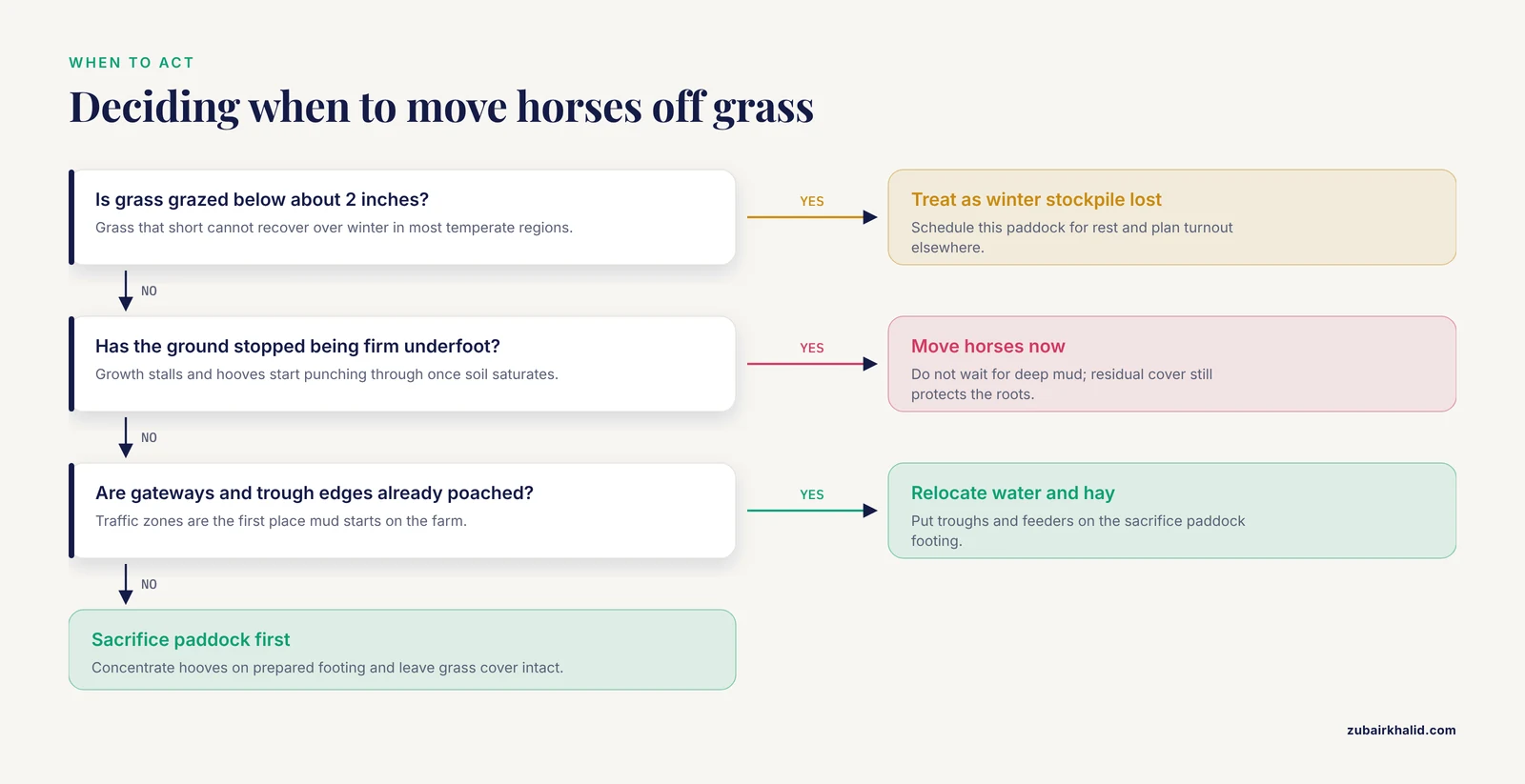
The most common timing error is waiting until the pasture is destroyed and the mud is already deep. The better trigger is the point when grass growth stalls and horses stop being able to maintain cover, which in much of the United States falls between late October and early December. Move horses to the sacrifice paddock while the main pastures still have residual cover. Those residual plants hold the soil, and the field goes into winter with its root system intact instead of stripped.
Step 4. Feed forage in every occupied paddock, all winter
Once horses are on restricted acreage, forage becomes the centerpiece of both nutrition and behavior. The Icelandic gastric disease study showed why the quantity matters. Horses on short winter grass without supplementary forage had dramatically higher odds of significant squamous gastric disease, while horses on low grass with forage provided did not show that risk [3]. Spread hay points out around the paddock or use multiple feeders to reduce crowding at a single spot, since a single hay pile in a small paddock creates a churned crater you will be fighting all season.
For pregnant mares, winter nutrition has specific stakes. A study of Mongolian broodmares in late gestation, kept through harsh winters on limited pasture, found that supplementing with a medium-energy concentrate improved final body weight, tended to improve average daily gain, enhanced nutrient digestibility, and was associated with lower aspartate aminotransferase activity, suggesting reduced hepatic or muscular stress [5]. Broodmares and other horses with elevated requirements deserve a planned winter ration rather than ad lib access to a hay ring and hope.
Step 5. Relocate and maintain water away from traffic zones
Water troughs in winter become magnets for hoof traffic, and the ground around them is where mud starts. Place troughs in the sacrifice paddock on your best footing, not at a gateway into the good pasture. Check them daily in freezing weather, break ice promptly, and keep the surrounding gravel topped up as it migrates into the mud over the season.
Step 6. Manage manure deliberately
Manure management in winter is where pasture health and parasite control meet, and the evidence here is strong. In a Nordic-climate study of strongyle larvae on horse pasture, twice-weekly fecal removal significantly reduced larval yields on herbage, while harrowing a single time under dry summer conditions did not [6]. The same study mapped larval migration and found that strongyle larvae can travel up to 150 centimeters from a fecal pat, though most were found within 50 centimeters, and critically, both small strongyles (Cyathostominae) and S. vulgaris larvae survived the winter months, with larvae still recoverable up to 17 to 18 months after the feces were deposited [6].
There is an ecological wrinkle. Dung beetles and other coprophagous insects help break down and bury manure, but their activity is temperature dependent. In a yearlong Uruguayan study, dung beetle abundance and richness tracked warm seasons and essentially ceased during the winter period, with temperature a clear driver of the patterns [7]. In other words, the natural manure cleanup crew clocks out for winter in temperate climates, so piles that would partially decompose in July sit intact through February, shedding larvae onto your spring pasture if you leave them.
The winter plan follows directly. Pick up manure at least twice weekly in paddocks horses occupy through winter, compost or pile it well away from grazing areas, and compost it long enough and hot enough before spreading. Spread only on fields being rested.
Step 7. Time parasite control around the winter pasture cycle
Because larvae overwinter on pasture and inside the fecal pat, late fall is a logical checkpoint in a fecal egg count based program. Macrocyclic lactone resistance in cyathostomins is now documented internationally, and a Swedish study of 16 establishments using selective treatment found that fecal egg count reduction testing and monitoring of egg reappearance periods were needed to verify that ivermectin still worked on a given farm [8]. The owner-facing takeaway is that a deworming product should not be assumed effective. Work with your veterinarian on fecal egg count reduction testing and a targeted program rather than rotational deworming by calendar.
Tapeworm biology also has a pasture dimension. Anoplocepthala perfoliata, the most common equine tapeworm, uses oribatid mites on pasture as intermediate hosts, and a three-year UK surveillance study tracked mite numbers and tapeworm DNA in mites across seasons while monitoring horses with a saliva antibody test [9]. The infection risk lives in the pasture environment, which is one more reason manure removal and pasture rest carry value beyond grass agronomy.
Step 8. Rest paddocks and plan the spring rotation
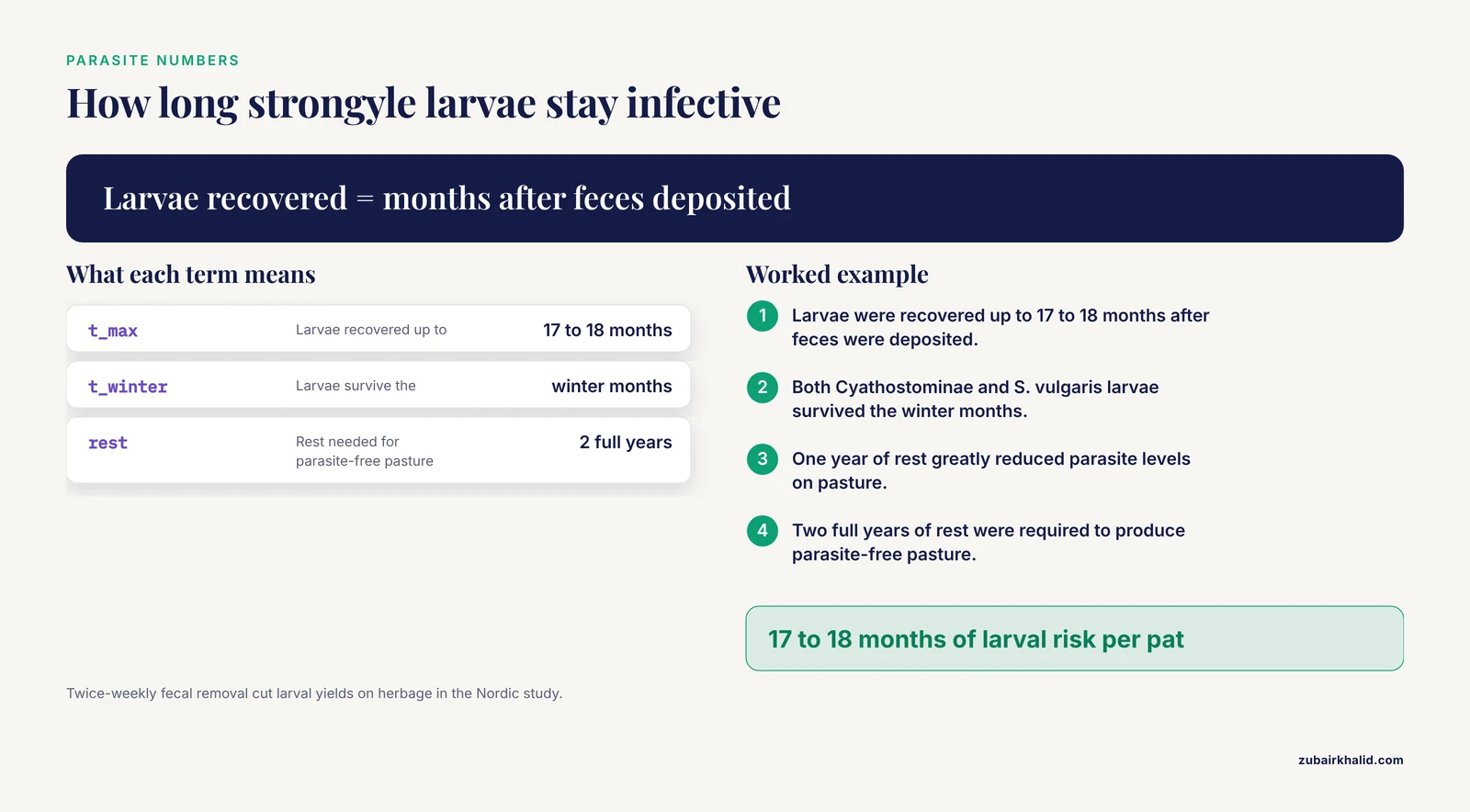
One year of rest greatly reduced parasite levels on pasture in the Nordic study, while two full years of rest were required to produce parasite-free pasture [6]. That finding gives you a rational basis for rotation planning. Paddocks you rest over winter come back in spring with lower larval burden and intact root systems, which is the payoff for the sacrifice paddock discipline. Do not spread manure on paddocks coming out of rest if you want the parasite benefit.
Step 9. Scout for toxic plants before and during winter
Cool-season weeds and toxic plants can persist or germinate in wet weather. Pimelea, a highly toxic plant in Australian pasture systems that contains the toxin simplexin, was reported by landholders to appear most in spring (65 percent of respondents) and winter (48 percent), with some seeing it year-round under favorable rainfall [10]. Cattle were most affected, but horses were among the species affected, and the lesson generalizes. Walk your winter paddocks and identify whatever is growing where grass used to be, because weeds and toxic plants colonize exactly the bare, disturbed ground that poor winter management creates.
Common Winter Pasture Management Mistakes
Harrowing in cool, wet weather. The research evidence shows harrowing under dry, warm conditions did not reduce larval yields, and harrowing in winter is worse, because it spreads manure and larvae across moist herbage where larvae thrive [6]. Save harrowing for hot, dry spells if you use it at all, and rely on physical removal the rest of the year.
Waiting too long to pull horses off pasture. By the time the mud is obvious, the root mat is gone and the sacrifice paddock should have been running for weeks. The transition is a fall decision.
Underfeeding forage as grass disappears. The single strongest management risk factor for significant squamous gastric disease in extensively kept horses was reduced grass availability with no additional forage, at roughly tenfold increased odds [3]. Free-choice or generous measured hay through winter is a gastric health intervention, not an expense to minimize.
Leaving manure in occupied paddocks all winter. With dung beetle activity essentially absent in winter [7] and strongyle larvae surviving on pasture for 17 to 18 months [6], winter manure accumulation is a direct investment in next year's parasite load.
Skipping the fecal egg count. Given documented macrocyclic lactone resistance in cyathostomins [8], deworming every horse on a calendar schedule wastes product and accelerates resistance. Test, treat the horses that need it, and retest.
Turning young horses out on rough, churned winter ground. Mixed winter housing and rough pasture ground were associated with deterioration of juvenile osteochondral condition scores in yearlings [4]. Growing horses need the best footing on the farm in winter, not the worst.
Letting gateways become the farm's mud epicenter. Gateways see concentrated traffic twice a day. Gravel, geotextile, and a slightly relocated gate line are cheap fixes compared to excavating a mud hole in March.
Winter Pasture Management Tips That Pay Off
- Spread hay points across the paddock to distribute traffic and reduce competition at any single feeder.
- Use a muzzle-style slow feeder or small-hole hay net to stretch forage and mimic more natural intake patterns, which supports hindgut stability through the diet transition from grass to hay [2].
- Walk the fence line after every freeze-thaw cycle, because frost heave lifts staples and posts, and a loose fence in deep mud is a serious injury risk.
- Keep one paddock in reserve if you have the acreage, so you can rest a paddock that turns bad mid-winter rather than doubling down.
- Photograph each paddock monthly. A photo record makes grass cover decline visible and doubles as documentation for your horse health records.
Your Winter Horse Care Checklist
A seasonal horse care checklist keeps the pasture plan from drifting once the weather turns miserable. This checklist pairs daily barn tasks with the pasture tasks above.
Daily
- Horses eating forage with normal appetite and behavior
- Water troughs free of ice and functioning
- Manure picked up in occupied paddocks
- Feet and lower legs checked for mud accumulation, scratches, or heat
Weekly
- Full body condition score check on every horse
- Fence, gate, and feeder inspection
- Footing assessment in the sacrifice paddock, with gravel or material topped up as needed
- Weed and toxic plant scan of all paddocks
Monthly
- Grass cover photos of every paddock
- Fecal egg counts per your veterinarian's schedule
- Weight tape measurement recorded in the health record
- Forage inventory check so you never run out mid-winter
Seasonally
- Fecal egg count reduction test after any deworming [8]
- Tapeworm screening discussion with your veterinarian, including saliva-based testing where available [9]
- Dental examination so horses can chew hay efficiently through winter
- Spring turnout plan for rested paddocks
A Simple Horse Health Record Template
Winter is when management changes stack up, and a written record keeps the picture clear. Copy this template for each horse and update it on the checklist schedule above.
| Field | What to record |
|---|---|
| Identification | Name, age, breed, sex, microchip number |
| Body weight and body condition score | Weight tape reading and BCS (1 to 9 scale) at each monthly check, with the date |
| Forage plan | Type and approximate daily amount of hay or haylage, pasture access hours, concentrates if any |
| Fecal egg counts | Date, eggs per gram result, any treatment given, follow-up reduction test date and result |
| Deworming history | Product, date, dose, effective or reduced efficacy on reduction testing |
| Parasite screening | Tapeworm test type and date, for example a saliva antibody test, and result [9] |
| Vaccinations | Product and date given |
| Dental care | Floating date and any findings |
| Hoof care | Trim or shoe date, farrier notes, winter observations such as thrush or abscesses |
| Gastric health notes | Appetite changes, attitude under saddle, any gastroscopy findings and dates |
| Body systems notes | Coughing, nasal discharge, diarrhea, skin conditions, lameness, with dates |
| Reproductive status | For broodmares, gestation stage and any late-gestation supplementation plan [5] |
| Pasture access log | Which paddock the horse occupied and for how long, weekly |
Keeping pasture access in the record has a specific purpose. Horses moving between paddocks, onto sacrifice areas, or onto freshly rested fields are changing their parasite exposure and their forage base, and those transitions are exactly the windows where gastric and gut health problems surface [2][3].
Welfare and Safety in the Winter Paddock
Winter turnout should meet the same welfare standard as summer turnout, just with different inputs. Horses need continuous access to appropriate forage, liquid water, shelter from wind and precipitation, firm-enough footing to walk and lie down comfortably, and social contact. The British survey data showing that 92 percent of horses had regular pasture access, with full stabling remaining uncommon even in winter, reflects a broadly sensible welfare norm for temperate climates [1]. Horses kept outdoors in winter with good forage and shelter generally do well, but mud changes the calculus. Standing in deep mud causes lost shoes, scratches, chapped heels, and strain injuries, and it discourages the movement that keeps gut and joint health on track.
Watch for the specific winter signs that a pasture plan is failing. Weight loss despite adequate hay suggests teeth, parasite burden, or gastric disease rather than simply cold. A horse reluctant to move through the paddock is telling you the footing is unsafe. Diarrhea or a dull coat after the grass-to-hay transition warrants a call to your veterinarian, particularly given the measurable shift in fecal microbiota during the late autumn to winter period seen in forage-fed horses [2].
Limitations and When to Contact a Veterinarian
Every property differs in soil type, drainage, rainfall, stocking density, and regional climate, so the transition timing and paddock math above are frameworks rather than formulas. Individual cases, especially those involving youngstock, pregnant mares, senior horses, or horses with existing gastric or metabolic disease, need a plan built with your veterinarian and, where available, an equine nutritionist.
Contact your veterinarian promptly for any of the following:
- Weight loss or failure to maintain condition on a winter forage program
- Colic signs of any degree, including pawing, flank watching, rolling, or reduced manure output
- Dull appetite, quidding hay, or dropping feed, which suggests dental pain at exactly the time horses need to chew hay well
- Diarrhea or a marked change in manure consistency lasting more than a day
- Fever, nasal discharge, or coughing in a group-turnout setting
- Lameness, heat in a hoof, or thrush that does not resolve with cleaning and dry footing
- Suspected tapeworm-associated disease, since A. perfoliata sits at the small and large intestinal junction and has been associated with colic [9]
- Any plan to deworm, given the need for efficacy testing where macrocyclic lactone resistance has been documented [8]
- Sudden behavior change in a horse that has just moved from pasture to sacrifice paddock or vice versa
Frequently Asked Questions
How do I stop my horse paddock from turning into mud every winter?
Move horses onto a prepared sacrifice paddock with good footing before the ground saturates, relocate water and hay feeding onto that footing, and stop winter traffic on your grass paddocks entirely. Mud forms where hooves churn saturated soil, so concentrating traffic on a built surface and keeping manure picked up are the two highest-impact fixes.
Can horses stay out on pasture all winter?
Yes, in most temperate climates horses can live outdoors through winter, provided they have adequate forage, liquid water, shelter, and safe footing. In the Great Britain survey, only 4 percent of horses were stabled 24 hours a day, and 92 percent had regular pasture access, with median turnout of 91 hours per week [1]. The catch is that winter pasture provides little nutrition, so forage must replace the grass the season takes away.
Should I harrow my pasture before winter?
No. Harrowing is a warm-season tool at best. In a Nordic-climate study, a single harrowing under dry summer conditions did not reduce strongyle larvae on herbage, and harrowing in cool, wet weather spreads larvae and intact manure across the pasture [6]. Pick up manure instead, and if you harrow, wait for hot, dry conditions.
How long do parasite larvae survive on winter pasture?
Much longer than most owners expect. Strongyle larvae, including both Cyathostominae and S. vulgaris, survived winter conditions and were recovered up to 17 to 18 months after the original fecal pats were placed [6]. This is why manure removal and pasture rest, rather than timing dewormers to the calendar, form the backbone of winter parasite control.
How long should I rest a pasture to reduce parasites?
One year of rest greatly reduced parasite levels in a Nordic-climate study, but two full years of rest were required to produce a parasite-free pasture [6]. For most farms, rotating paddocks out for the full grazing season, with a multiyear rest for the worst paddocks, is the realistic approach.
Does losing winter grass affect my horse's stomach?
Yes. Among extensively managed Icelandic horses, reduced grass availability without additional forage provided carried roughly tenfold higher odds of gastroscopically significant squamous gastric disease compared with low grass plus forage [3]. When winter grass disappears, hay or haylage is not optional, it is the intervention that protects the stomach.
Why does picking up manure matter more in winter?
Because the insects that normally break down manure are inactive in winter, so piles sit intact through the cold months. Dung beetle activity in a yearlong study tracked the warm seasons and essentially stopped during winter, driven by temperature [7]. Meanwhile strongyle larvae in those piles survive the cold and seed your spring pasture [6]. Removing manure at least twice weekly in occupied paddocks cuts larval contamination directly.
What should go in a winter horse health record?
Record monthly weight tape readings and body condition scores, the forage plan, fecal egg count dates and results, any deworming with follow-up efficacy testing, tapeworm screening results, vaccinations, dental work, hoof care, pasture access, and any clinical observations with dates [9][8]. A consistent template turns scattered notes into a pattern your veterinarian can act on.
Sources
- Demographics and management practices of horses and ponies in Great Britain: a cross-sectional study.
- Seasonal Variation in the Faecal Microbiota of Mature Adult Horses Maintained on Pasture in New Zealand.
- Risk factors associated with gastric disease prevalence in extensively kept horses in Iceland evaluated four times in a calendar year.
- Effects of management practices as risk factors for juvenile osteochondral conditions in 259 French yearlings.
- Effects of supplementing concentrates with different energy levels on growth performance, blood indicators, and fecal microbiota of Mongolian horses in late gestation.
- Evaluation of Strategies to Reduce Equine Strongyle Infective Larvae on Pasture and Study of Larval Migration and Overwintering in a Nordic Climate.
- Seasonal and Daily Variations in Dung Beetle Assemblages (Coleoptera: Scarabaeidae) in Two Contrasting Habitats in a Livestock Ranch in Central Uruguay: Implications for Habitat Management and Species Conservation.
- Retained efficacy of ivermectin against cyathostomins in Swedish horse establishments practicing selective anthelmintic treatment.
- A study of the epidemiology of Anoplocephala perfoliata infection in horses and the oribatid mite vector in southern England.
- Pimelea and Its Toxicity: A Survey of Landholder Experiences and Management Practices.