When to Euthanize a Horse: Quality of Life Signs
By Dr. Zubair Khalid, DVM, MS, PhD ·
The clearest signal that it may be time to euthanize a horse is a sustained loss of quality of life that treatment can no longer reverse. That means your horse spends more days in pain, fear, or discomfort than in comfort, has lost interest in food, herd companions, and surroundings, and can no longer stand, move, eat, or rest normally despite good care. Research on aged horse populations shows that most owners reach this decision after a chronic illness, most often lameness, colic, or a long-term condition such as pituitary pars intermedia dysfunction, and that they rarely make it alone. In one UK cohort of geriatric horses, 94 percent of deaths were euthanasia, most frequently attributed to lameness and colic, and owners consistently identified veterinary advice as central to the decision [1].
This guide explains how to assess your horse's quality of life in a structured way, which clinical signs matter most, when treatment may still help, how to comfort a dying horse, and how to care for yourself while grieving the loss of a horse.
This article is educational and is not a substitute for veterinary diagnosis or treatment.
At a Glance: A Quality of Life Checklist
Review this list with your veterinarian during every end-of-life conversation. A single bad day means very little. A pattern that persists across weeks, or any item in the urgent column, deserves a same-day call to your veterinarian.
| Domain | Assess by asking | Pattern that suggests suffering |
|---|---|---|
| Eating and drinking | Does the horse finish meals, chew normally, maintain weight? | Repeated quidding, dropping feed, weight loss despite good feed, long periods not eating |
| Mobility and comfort | Can the horse stand, lie down, and rise without struggle? | Difficulty rising, constant weight shifting, reluctance to move, recumbency for long periods |
| Pain | Is pain controlled at the maximum tolerated dose of prescribed medication? | Pain that returns between doses, pain that no longer responds to treatment |
| Behavior and interest | Does the horse greet you, interact with herd mates, show curiosity? | Withdrawal from the herd, standing apart, dull response to surroundings, loss of normal routines |
| Breathing and body systems | Is breathing comfortable, are manure and urine output normal? | Labored breathing, repeated colic episodes, straining without manure |
| Bad days versus good days | Are good days still outnumbering bad ones? | A steady slide toward more bad days, or bad days that never fully recover |
If most rows describe your horse's recent weeks, schedule a quality of life conversation with your veterinarian. You do not need to wait for a crisis.
Why This Decision Feels So Hard
Owners of aged horses often describe them as family members. Duration of ownership strengthens the human-horse bond, and that bond directly shapes how owners weigh welfare, quality of life, and euthanasia [2]. Surveys of owners of geriatric horses confirm that attachment levels remain just as strong for a 25-year-old companion as for an active riding horse, even though geriatric horses are more often kept primarily as companions [3].
That attachment is a gift, but it complicates the decision. Owners may delay euthanasia because the horse still has bright moments, because they feel guilty, or because they cannot bear the loss. Research on owner decision-making found that the most frequent reasons for euthanasia were injury or illness with a low chance of survival, followed by poor quality of life and long-term injury, and that the overwhelming majority of these decisions were welfare driven [4]. In other words, most owners who choose euthanasia do so because they are protecting their horse from suffering, not giving up on it.
The same research offers a practical reassurance: most owners actively seek advice when making end-of-life decisions, and more than half had a euthanasia plan in place before they needed one [4]. Planning ahead is normal, responsible, and common among experienced horse people.
What Quality of Life Means for a Horse
Quality of life is broader than physical health. It covers nutrition, environment, health, behavior, and mental state, and it includes positive experiences as well as negative ones. This framing comes from the Five Domains Model, a widely used scientific framework for assessing animal welfare that modern equine welfare guidelines, including the Thoroughbred Welfare Assessment Guidelines developed in New Zealand, have adopted for practical use [5].
Applied to a horse, the model asks five questions:
- Nutrition. Is the horse able to eat enough, drink enough, and maintain body condition with minimal difficulty?
- Environment. Can the horse rest comfortably, shelter from heat and cold, and move around safely?
- Health. Is disease or injury present, and is it causing pain, breathlessness, nausea, or weakness that treatment cannot relieve?
- Behavior. Can the horse perform the behaviors that matter to horses, such as foraging, social contact, and movement? Studies using automated tracking show that healthy horses, geriatric horses, and horses with chronic orthopedic disease spend roughly 42 percent of the day eating, 39 percent resting, and 19 percent in movement, so a marked collapse in these time budgets is a meaningful warning sign [6].
- Mental state. Taken together, do the horse's physical and social circumstances produce mostly contentment, or mostly fear, pain, frustration, and boredom?
A focus group study of owners, veterinarians, farriers, and caregivers found strong agreement on two points relevant here. First, quality of life must be judged for the individual horse, not against a generic standard. Second, quality of life should drive decisions about veterinary interventions, including the choice to prioritize well-being over simply extending life [7]. Your quiet mare who has always hated confinement may suffer more in stall rest than an easygoing horse would, and that individuality belongs in the decision.
A Horse Quality of Life Scale You Can Use Today
Veterinarians use structured quality of life scales in companion animal practice, and the same logic works for horses. The scale below is built on the Five Domains framework [5]. Score each item from 0 (severely impaired) to 2 (normal for this horse). Reassess weekly and keep written notes. Trends matter more than any single score.
| Item | 0 points | 1 point | 2 points |
|---|---|---|---|
| Appetite | Refuses most meals | Eats slowly or partially | Eats normally |
| Hydration and gut function | No manure, repeated colic | Reduced or irregular output | Normal |
| Standing and rising | Cannot rise or stands continuously, unable to lie down | Struggles, shifts weight constantly | Moves and rests normally |
| Pain control | Pain uncontrolled despite treatment | Partial relief, frequent breakthrough pain | Comfortable on current plan |
| Interest and interaction | Withdrawn, unresponsive, separated from herd | Intermittent engagement | Normal engagement |
| Breathing | Labored at rest | Occasional effort | Easy |
| Good days out of the last seven | Fewer than 2 | 3 to 4 | 5 or more |
A practical rule many owners and veterinarians use in conversation is the "bad days" tally. Track good days and bad days on a calendar. When bad days outnumber good days for two to three consecutive weeks, or when the horse can no longer do the two or three things that define its personal happiness (rolling in the paddock, grazing with a friend, meeting you at the gate), it is time to discuss euthanasia rather than more treatment.
Two cautions on how horses express suffering. Hesitation to show pain is deeply wired into prey animals, and hospitalized horses in pain hide it from observers, shifting weight, feeding less, and resting less in ways that are easy to miss without structured observation [8]. Also, lying behavior and sleep are genuine welfare indicators. Horses need adequate recumbent rest, and research with overnight monitoring shows that older horses get less restorative sleep than younger horses and that housing conditions measurably change sleep quality [9]. A horse that never lies down is not being stoic. It is telling you something hurts.
Signs a Horse Is Dying
Signs a horse is dying vary with the underlying disease, but the following patterns, especially in combination and especially when they persist despite treatment, indicate that the end is near. Any of them justifies an urgent call to your veterinarian.
- Recurrent or unrelieved colic. Colic is one of the two most common reasons for euthanasia in geriatric horses and a leading contributor to euthanasia decisions across age groups [1][10].
- Inability to rise or prolonged recumbency. A horse that stays down, or that struggles painfully every time it tries to stand, is in a welfare crisis.
- Persistent anorexia and rapid weight loss. Refusing feed day after day, dropping grain, quidding hay, or balls of unchewed feed accumulating in the bucket.
- Labored breathing at rest. Flared nostrils, heaving flanks, or breathing that requires visible effort when the horse is not working.
- Loss of thermoregulation and circulation. Cold extremities, prolonged capillary refill, dark or purple gum color.
- Neurologic decline. Stumbling, head pressing, seizures, or the horse getting caught in a corner of the stall.
- Withdrawal and dullness. Standing apart from the herd, head low, unresponsive to surroundings and to people the horse knows well.
- Fractures, severe laminitis, or catastrophic injury. In the laminitis cohort study described above, laminitis-related consequences were the most frequently reported health reason contributing to euthanasia, ahead of colic and other chronic disease [10].
Some owners expect "old age" itself to look like a peaceful fading. The geriatric horse mortality study found that owner-attributed natural deaths were the small minority, and that identifiable disease, most often musculoskeletal disease and colic, underlay most losses [1]. If your aged horse is declining, assume there is a treatable or non-treatable disease behind it and have your veterinarian examine the horse rather than waiting.
The Most Common Reasons Horses Are Euthanized
Knowing the common pathways to this decision helps you recognize your own situation in them. Across studies of aged and chronically ill horses, the same conditions appear repeatedly.
- Lameness and musculoskeletal disease. The leading cause of euthanasia in geriatric horses in the UK cohort, accounting for roughly a quarter of deaths, all but a few by euthanasia [1].
- Colic. The second most common cause in the same cohort [1], and the second most common contributor in the prospective laminitis cohort, where it accounted for just over a fifth of euthanasias [10].
- Laminitis and its consequences. In a prospective study of more than 1,000 horses and ponies followed for nearly three years, the overall incidence of euthanasia was 7.3 per 100 horse-years at risk, and laminitis-related consequences were the most frequently reported health reason behind those decisions [10].
- Chronic endocrine disease, especially PPID. Pituitary pars intermedia dysfunction (equine Cushing's disease) is common in older horses. In a long-term follow-up study, half of diagnosed horses were still alive 4.6 years after diagnosis, most owners were satisfied with treatment, but among horses that died, the large majority were euthanized, and most of those euthanasias were for conditions associated with PPID, above all laminitis [11]. The lesson is nuanced: PPID itself is often manageable for years, but its complications, particularly severe laminitis, frequently become the welfare endpoint.
- Untreatable pain, including severe eye disease. Chronic ocular pain is a recognized welfare endpoint. In a case series of horses that underwent bilateral enucleation to relieve untreatable eye pain, owners reported improvement in every welfare parameter after surgery, and most horses returned to their previous activity levels [12]. That study illustrates an important point: some conditions that look like endpoints are actually treatable, which is exactly why a veterinary assessment should come before a final decision.
When Treatment Can Still Help
Choosing euthanasia should never feel like the only option before a veterinarian has evaluated the horse. Several conditions that owners fear are terminal can be managed well for meaningful periods.
For PPID, treatment satisfaction among owners is high, and clinical improvement within the first months of diagnosis is common [11]. For chronic orthopedic disease, management matters enormously. Geriatric horses and horses with chronic orthopedic disease can maintain normal activity time budgets, eating, resting, and moving like healthy controls, when their housing and turnout conditions support them, with open-air group housing showing more even, natural patterns of feeding and movement than restrictive systems [6]. Environmental change is treatment. So is preventive care. Surveys of aged horse management show that owners often reduce veterinary involvement as horses age, particularly once a horse is fully retired, which leaves painful, treatable conditions undiagnosed [13]. Your veterinarian plays an essential role not only in treating disease but in guiding the eventual end-of-life decision, and aged horses deserve the same standard of care as any other horse in your barn [13][2].
Pain management itself deserves attention. Research on hospitalized horses shows that painful horses change their behavior in measurable ways, and that these behaviors improve after analgesia is given [8]. If your horse is painful, ask your veterinarian directly whether the current pain plan is adequate and what a maximal, humane palliative plan would look like. If pain can be controlled, quality of life can often be extended. If it cannot, the scale above will tell you.
How to Comfort a Dying Horse
Once treatment goals shift from cure to comfort, or once you are in the final days with a horse whose death is expected, your job becomes reducing fear, pain, and isolation.
- Keep the horse with its companions when possible. Horses are herd animals, and separation is itself a stressor.
- Make food and water easy. Offer soft, palatable feed at ground level and within easy reach. Frequent small offerings matter more than balanced nutrition at this stage.
- Provide good footing and room to lie down. Deep, dry bedding in a large stall or a quiet, well-footed paddock lets the horse choose to lie down, which it needs for real rest [9].
- Reduce handling stress. Handle the horse the way it is used to being handled. Research on low-stress handling shows that aversive restraint and rushed procedures create fear that persists and compounds, so end-of-life care should be calm, unhurried, and familiar [14].
- Manage pain on a schedule, not on demand. Ask your veterinarian for a palliative plan with regular timing rather than as-needed dosing, so the horse does not cycle in and out of pain.
- Stay present. Most horses know their people. Your voice, your routine grooming, and simply sitting nearby are comforts.
Ask your veterinarian what specific signs to expect as death approaches so you are not deciding alone at 2 a.m. Many practices will help you set written comfort criteria in advance: if the horse cannot rise by morning, or if it shows unrelieved colic, you will call for euthanasia rather than re-litigating the decision in a moment of crisis.
Making the Decision: A Step-by-Step Approach
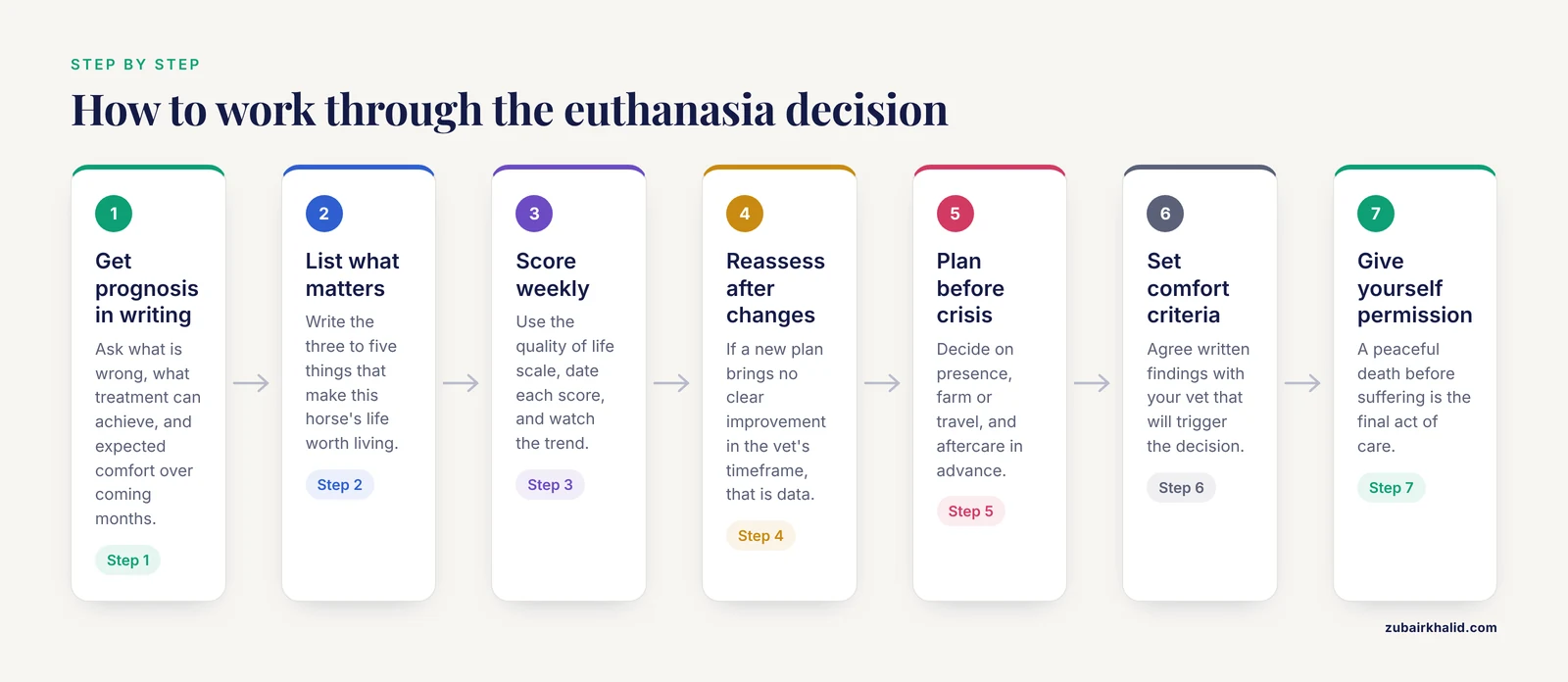
- Get a diagnosis and prognosis in writing. Ask your veterinarian what is wrong, what treatment can realistically achieve, and what the horse's expected comfort looks like over the coming months.
- Define your horse's personal quality of life list. Write down the three to five things that make this individual horse's life worth living. For one horse it may be rolling and grazing with a friend. For another it may be trail rides. When those things are gone permanently, you have your answer.
- Use the quality of life scale weekly. Score it, date it, and watch the trend.
- Reassess after each treatment change. If a new plan does not produce clear improvement within the timeframe your veterinarian gives you, that is data.
- Make the plan before the crisis. Decide in advance whether you will be present, whether your veterinarian will come to the farm or the horse will travel, and what aftercare you want. More than half of owners in the decision-making survey already had a euthanasia plan in place, and those plans made the eventual day easier [4].
- Set written comfort criteria. Agree with your veterinarian on the specific findings that will trigger the decision, so that a bad night does not become an argument with yourself.
- Give yourself permission. Choosing a peaceful death for a horse you love, before suffering becomes the only thing left, is the final act of care. Most owners who make this decision do so on welfare grounds [4], and most report afterward that they do not regret it.
What Happens During Euthanasia
In the United States, euthanasia of horses is performed by a licensed veterinarian, most commonly with an overdose of a barbiturate anesthetic given intravenously. The American Veterinary Medical Association publishes euthanasia guidelines that define acceptable methods, and your veterinarian follows those standards. In practical terms, the horse receives an injection, loses consciousness within seconds, and then the heart and breathing stop. Some veterinarians give a sedative first so the horse is relaxed. You may see the horse shift, sway, and fall, so plans for a safe location with room for the body to lie are part of the preparation.
Euthanasia can be performed at your farm, which most owners prefer because the horse stays in familiar surroundings with familiar people. Discuss with your veterinarian whether you and any family members wish to be present, and whether barn mates should be allowed to see the body afterward. Many owners find that the herd's brief inspection of the body, and the quiet minutes you spend with your horse afterward, help everyone, human and equine alike.
Aftercare arrangements, including burial, cremation, or rendering, depend on your location and local rules, so confirm them with your veterinarian or your municipal office before the day arrives.
Common Mistakes Owners Make
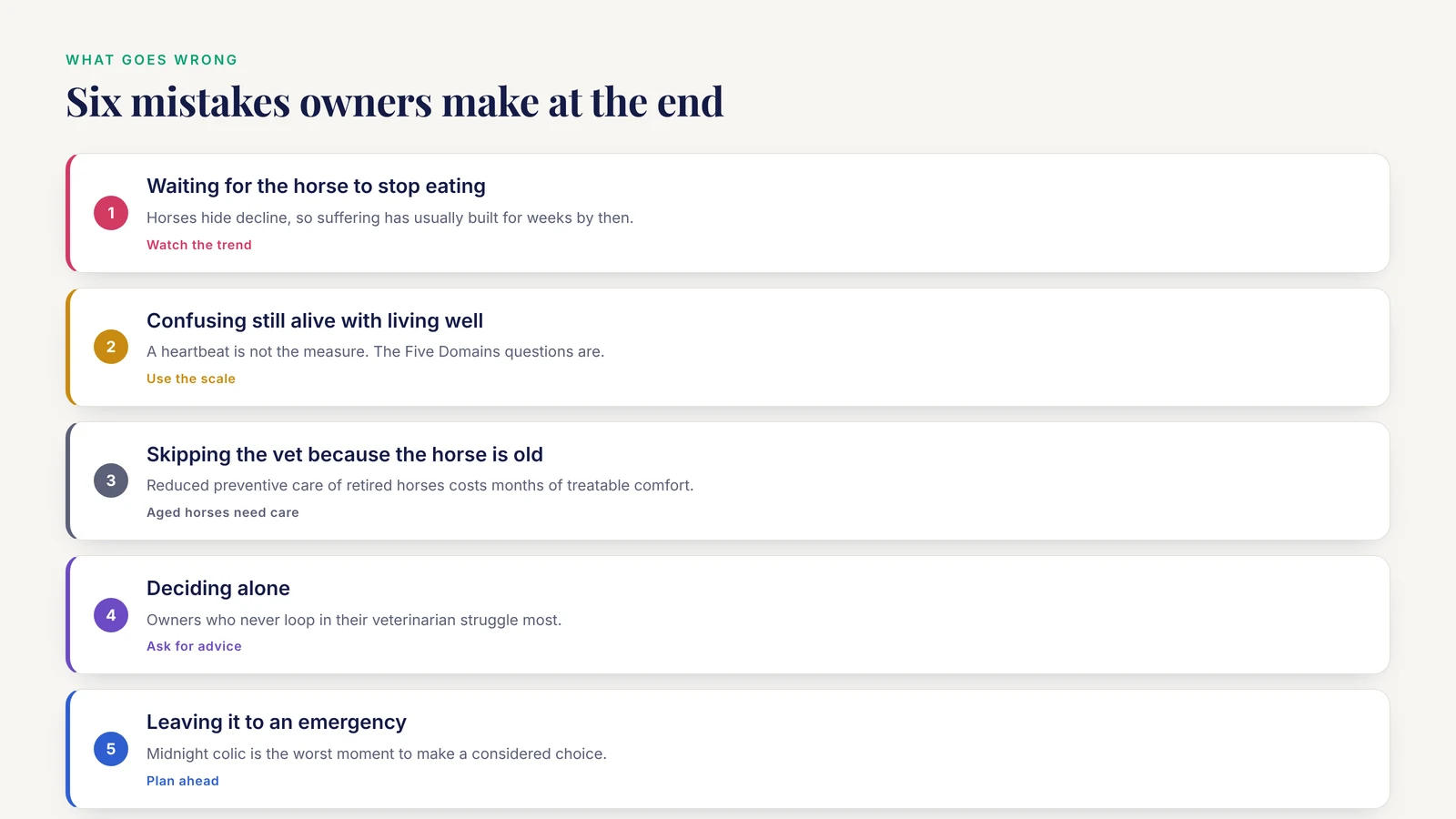
- Waiting for the horse to stop eating entirely. Horses hide decline. By the time a horse stops eating and withdraws, suffering has usually been building for weeks.
- Equining "still alive" with "still living well." A heartbeat is not the measure. The Five Domains questions are [5].
- Skipping veterinary assessment because the horse is old. Declining management and reduced preventive care of retired horses is a documented pattern, and it costs aged horses months of treatable comfort [13].
- Deciding alone. The owners who struggle most are those who never loop in their veterinarian. Advice-seeking is the norm for good reason [4].
- Leaving the decision to a medical emergency. Emergency colic at midnight is the worst possible moment to make a considered choice. Planning ahead converts a panic into a plan.
- Choosing more treatment with no realistic comfort goal. Interventions that extend life without restoring the ability to eat, rest, move, and interact extend suffering, not life. Stakeholder research on this exact question concluded that well-being and a good quality of life should take priority over simply prolonging it [7].
Grieving the Loss of a Horse
Grief after losing a horse is real, deep, and normal. Survey data on owners of geriatric horses found that attachment to aged horses is as strong as attachment to younger horses, and that euthanasia, while a compassionate choice, is associated with higher levels of bereavement than unassisted death [3]. Losing a horse you have owned for many years, or made an intentional end-of-life decision for, can hurt more, not less, because of the responsibility you carried.
Practical steps that help:
- Expect the grief to be significant. Research on the human-horse bond shows the bond strengthens with years of ownership, which means the loss is proportionally large [2].
- Give yourself rituals. Sitting with the body, keeping a shoe or a lock of tail, holding a small ceremony at the barn. These are not sentimental extras. They are how people process loss.
- Talk to people who understand. Fellow horse people, your veterinarian, and formal pet loss support lines all exist. Avoid dismissing your own grief because "it was just a horse."
- Watch the rest of the herd. Horses form bonds too, and barn mates often show searching behavior and herd disruption after a loss. Extra turnout, familiar routines, and time help them adjust.
- Delay major decisions. Do not rehome the empty stall or buy a replacement horse in the first raw weeks. Wait until the grief has settled enough for clear thinking.
- Consider when, not whether, to get another horse. For most owners, the answer eventually becomes yes, on a timeline that honors both the horse they lost and themselves.
If grief becomes overwhelming, persistent, or interferes with daily life for months, speaking with a counselor experienced in pet loss is a reasonable and respectable step.
Limitations and When to Contact a Veterinarian
Every horse and every situation is individual, and the thresholds described here are general patterns, not diagnoses. Your veterinarian, who knows your horse's history and can examine the animal, is the right partner for applying any framework to your specific case. Quality of life assessment is inherently individual, as stakeholders and veterinarians in formal studies have emphasized [7].
Contact your veterinarian promptly, the same day or sooner, if your horse shows any of the following:
- Inability to rise, or repeated struggling to stand
- Signs of colic that persist or recur, especially more than one episode in a few days
- Labored breathing at rest
- Refusal of food and water lasting more than a day
- Sudden severe lameness, a hot hoof with a strong digital pulse, or signs of laminitis
- Rapid weight loss, depression, or withdrawal from the herd
- Any injury you suspect involves a fracture or deep structural damage
Contact your veterinarian for a scheduled quality of life conversation if your horse has a chronic disease, if bad days are accumulating, or if you are starting to ask the euthanasia question. Veterinarians expect these conversations, they are part of the job, and asking early gives you time to think clearly rather than decide in crisis.
Frequently Asked Questions
How do I know when it is time to euthanize my horse?
It is time when your horse's bad days outnumber its good days and treatment can no longer reverse the trend. Track appetite, mobility, pain control, interaction, and comfort on a weekly scale, and discuss the pattern with your veterinarian. Persistent inability to rise, unrelieved pain, recurrent colic, and loss of interest in food and companions are the clearest signals.
What is a horse quality of life scale?
A horse quality of life scale is a structured checklist, usually based on the Five Domains Model, that scores nutrition, environment, health, behavior, and mental state over time. Scoring each domain regularly turns a subjective feeling into a documented trend you and your veterinarian can review together.
What are the signs a horse is dying?
Common signs include inability to rise or prolonged lying down, refusal of food and water, labored breathing at rest, repeated colic, cold extremities with dark gum color, stumbling or other neurologic changes, and withdrawal from the herd. These signs, especially in combination and despite treatment, mean you should call your veterinarian immediately.
How can I comfort a dying horse?
Keep the horse with familiar companions, provide soft bedding and safe footing so it can lie down, offer palatable feed and water within easy reach, manage pain on a regular schedule prescribed by your veterinarian, and handle the horse calmly using its normal routines. Ask your veterinarian for written comfort criteria so you know what to expect.
Should I stay with my horse during euthanasia?
You may stay if you wish, and many owners find presence comforting for themselves and their horse. Discuss it with your veterinarian in advance so the location, the people present, and the logistics are planned. There is no obligation either way, and both choices are respectable.
Does euthanasia hurt the horse?
No. Veterinarians perform euthanasia under American Veterinary Medical Association standards, typically using an intravenous barbiturate overdose that causes loss of consciousness within seconds before death. The horse does not experience pain from the procedure, though you may see it sway and fall as it becomes unconscious.
Why do owners say grieving the loss of a horse is so hard?
The human-horse bond strengthens with years of ownership, so losing a long-term companion is a major loss, and research shows euthanasia is associated with higher bereavement than other deaths. Give yourself time, use rituals that feel meaningful, talk with people who understand horses, and seek professional support if grief becomes overwhelming.
Is it wrong to euthanize an old horse that still has some good days?
No, if the trajectory is one of declining comfort that treatment cannot fix. Quality of life decisions weigh the overall pattern of suffering against remaining good moments, and prioritizing well-being over simply extending life is a recognized, responsible choice supported by equine veterinarians and welfare researchers. A veterinary assessment should always confirm the prognosis before the final decision.
Sources
- Factors associated with mortality of geriatric horses in the United Kingdom.
- Welfare, Quality of Life, and Euthanasia of Aged Horses.
- Survey of human-horse relationships and veterinary care for geriatric horses.
- Cross-sectional study of UK horse owner's purchase and euthanasia decision-making for their horse.
- Using the Five Domains Model to develop welfare assessment guidelines for Thoroughbred horses in New Zealand.
- Equine Activity Time Budgets: The Effect of Housing and Management Conditions on Geriatric Horses and Horses with Chronic Orthopaedic Disease.
- "How long is life worth living for the horse?" A focus group study on how Austrian equine stakeholders assess quality of life for chronically ill or old horses.
- Time budgets and weight shifting as indicators of pain in hospitalized horses.
- Sleep architecture and lying behavior in horses across age groups and two housing systems: an overnight non-invasive EEG study.
- Factors associated with euthanasia in horses and ponies enrolled in a laminitis cohort study in Great Britain.
- Diagnostic frequency, response to therapy, and long-term prognosis among horses and ponies with pituitary par intermedia dysfunction, 1993-2004.
- Owner satisfaction and animal welfare after bilateral enucleation in horses.
- Welfare of Aged Horses.
- Moving toward Fear-Free Husbandry and Veterinary Care for Horses.