Summer Pasture Management for Horses: Step-by-Step Guide
By Dr. Zubair Khalid, DVM, MS, PhD ·
Effective summer pasture management for horses comes down to five coordinated jobs: keep grass in its growth window through controlled grazing and rest, remove or spread manure so parasite larvae cannot build up, protect easy-keeping and insulin-dysregulated horses from high-sugar forage with tools like grazing muzzles, supply reliable water and shade through heat waves, and watch for summer-specific disease risks such as parasite peaks, endophyte toxicity, and pigeon fever. Horses on pasture carry the heaviest parasite burdens of any management system, with fecal egg counts rising through summer and autumn, so pasture hygiene and targeted deworming matter most in exactly this season [1]. This guide walks through each step in order, lists the mistakes that cause most summer pasture failures, and finishes with a horse care checklist and a health record template you can start using today.
This article is educational and is not a substitute for veterinary diagnosis or treatment.
At a Glance: Your Summer Pasture Checklist
| Step | Action | Frequency in summer |
|---|---|---|
| 1 | Walk and assess every paddock (grass height, weeds, bare patches, hazards) | Weekly |
| 2 | Rotate grazing and rest paddocks | Continuous plan |
| 3 | Pick up manure in irrigated or small paddocks | At least twice weekly |
| 4 | Check water troughs and clean them | Daily check, weekly clean |
| 5 | Confirm shade access for every horse | Daily |
| 6 | Fit and check grazing muzzles on at-risk horses | Every turnout |
| 7 | Body condition score and weigh tape each horse | Every 2 weeks |
| 8 | Fecal egg count testing per your veterinarian's schedule | Per plan, often summer-focused |
| 9 | Watch for endophyte grasses during drought | Ongoing in hot, dry spells |
| 10 | Update health records | After every event |
Why Summer Pasture Management Is Different
Summer concentrates several pressures on the same few acres. Grass growth slows or stops during heat and drought, so stocking pressure rises just as the nutritional profile of the sward changes. Cool-season grasses accumulate nonstructural carbohydrates (sugars and starch), and measured summer pasture NSC has been reported in a range from about 6 to 13.8 percent of dry matter over a single grazing day, which matters enormously for horses with insulin dysregulation [2].
Parasite dynamics also shift with temperature. In a year-long study of horses on pasture versus in stables, pasture-managed horses showed significant seasonal fluctuation in strongyle egg counts, peaking in summer and autumn, and the largest rise in reinfection occurred in summer [1]. A large 12-year survey of nearly 20,000 fecal samples in Brazil likewise found that summer carried a higher risk of strongyle and Parascaris egg shedding than any other season [3]. Summer is therefore the season when both grass management and parasite management are least forgiving.
There is also a positive side. Well-managed grazing improves pasture itself. In a three-year Swedish study, areas grazed year-round by horses diversified in chemical composition and increased in nutritive value, while nearby mown exclosures declined in energy and crude protein, showing that horse grazing, done properly, is a productive land use rather than a purely destructive one [4]. The difference between those outcomes is management.
Finally, pasture access itself has documented health benefits. Horses exercised on green pasture had lower risk of equine motor neuron disease than horses exercised only in dirt paddocks, a finding consistent with fresh forage supplying vitamin E and other antioxidants [5]. The goal of summer management is to keep those benefits while controlling the risks.
Step-by-Step: Managing Your Horse's Pasture Through Summer
Step 1: Walk Every Paddock and Set a Baseline
Before the heat of the season sets in, walk each paddock and record four things: average grass height, percentage of bare ground, weed presence, and hazards (holes, broken fence boards, wire, toxic plants). Photograph each paddock. This baseline lets you judge whether your rotation is keeping up with growth.
Pay attention to grass species while you walk. Endophyte-infected grasses, particularly tall fescue and perennial ryegrass, host fungi that produce alkaloids toxic to horses, and research indicates that concentrations of ergot alkaloids and indole diterpenes rise in horse pastures especially during hot and arid summer months, increasing the risk of endophyte toxicosis [6]. If your pasture contains significant fescue or ryegrass, drought stress is the trigger to watch. Discuss testing and renovation options with your local extension service or agronomist.
Step 2: Build a Rotation That Rests Paddocks
Divide available acreage into at least two or three sections and move horses when grass is grazed down, allowing rested sections to regrow. Resting is also your most powerful non-chemical parasite tool. In a Nordic-climate study of strongyle larvae on pasture, resting a pasture for one year greatly reduced parasite levels, though two full years were required to produce a parasite-free pasture [7]. Even if you cannot rest for a full year, rotating pressure off a paddock during peak growth protects both the sward and the parasite balance.
Realistic constraint: many hobby farms cannot rest paddocks for a year. Where resting is impossible, manure removal (Step 4) becomes the primary control, and you should plan for higher parasite exposure rather than pretending rotation alone will solve it.
Step 3: Match Stocking Density to Summer Growth
Overstocking is the fastest route to bare, weedy summer paddocks. If grass stops growing during a drought but horses keep grazing, you are mining the stand. Options in order of preference:
- Pull horses off the worst paddock entirely and feed hay.
- Reduce time on pasture (shorter turnout windows).
- Use a sacrifice area or dry lot for the hottest weeks, keeping the main paddocks in reserve.
On extensive properties, note that horses behave differently from cattle and sheep on range. Geolocation collar studies in mountainous grazing systems found horses traveled about 1.65 km per day and grazed more consistently throughout the day than cattle, which showed bimodal activity patterns [8]. Consistent all-day grazing means horses put steady, uninterrupted pressure on preferred areas, so small paddocks degrade faster under horses than under cattle.
Step 4: Manage Manure Deliberately
Manure is the engine of the summer parasite cycle. Survey data from Prince Edward Island illustrate the scale of the gap: 76 percent of owners never removed manure from pasture, and the mean fecal egg count in that population was 428 eggs per gram [9]. The evidence strongly favors removal.
- Pick up manure at least twice weekly in paddocks where horses are maintained at high density. Twice-weekly removal significantly reduced strongyle larval yields on herbage in a controlled pasture study [7].
- Harrowing is not a substitute under summer drought. A single harrowing pass under dry summer conditions did not reduce larval levels in that same study [7]. Harrowing works best when followed by adequate rest and favorable weather for larval desiccation, so discuss timing with your veterinarian based on your climate.
- Know the spread pattern. Strongyle larvae migrated up to 150 cm from fecal pats, though most larvae were found within 50 cm [7]. This is why dragged manure spreads contamination, and why harrowing a stocked, grazed-short paddock in a drought is counterproductive.
- Remember larvae are long-lived. Both small strongyles (Cyathostominae) and S. vulgaris survived winter conditions, with larvae recovered up to 17 to 18 months after manure was deposited [7]. Contamination decisions you make this summer affect next year's grazing.
Composting manure off-pasture, or spreading it on cropland or hay ground that horses will not graze within the parasite survival window, are the safest disposal routes.
Step 5: Build a Summer Parasite Program With Your Veterinarian
Modern equine parasite control is targeted, not calendar-driven, because indiscriminate anthelmintic use has produced resistance in cyathostomins to all currently available drug classes, including documented reduced efficacy of the macrocyclic lactones [10]. Fecal egg count testing identifies which horses actually shed eggs so treatment focuses where it matters.
Two summer-specific points deserve emphasis:
- Pasture-kept horses genuinely need more aggressive scheduling than stabled horses. In the year-long Korean comparison, stabled horses stayed near zero eggs per gram year-round regardless of deworming interval, while pasture horses reinfected fastest in summer, and the three-month interval was judged adequate for the pasture group [1]. Your deworming interval should reflect your horse's management system, not a universal calendar.
- Tapeworm risk is tied to pasture conditions. Anoplocephala perfoliata, the most common equine tapeworm, depends on oribatid mites on pasture as intermediate hosts, and infection has been associated with colic [11]. Saliva-based antibody tests (such as the EquiSal test used in epidemiological monitoring) allow treatment decisions based on actual exposure rather than guesswork [11]. Ask your veterinarian whether tapeworm testing fits your program.
Step 6: Protect Easy Keepers and Insulin-Dysregulated Horses

If any horse on your property has equine metabolic syndrome, PPID, or a laminitis history, summer grass is the season's biggest hazard. A controlled crossover study in insulin-dysregulated horses during 10-hour summer grazing periods found that grazing muzzles cut the peak insulin response to fresh forage roughly in half (24.31 versus 45.59 µIU/mL, a statistically significant difference), demonstrating that muzzles allow turnout with materially reduced metabolic risk [2].
Practical muzzle protocol:
- Introduce the muzzle gradually over several days so the horse learns to drink and eat through it.
- Check fit daily for rubs at the nose, cheekbones, and jaw.
- Verify the horse can still drink freely, and monitor for weight loss, since muzzles can restrict intake too much in some horses.
- Combine muzzling with turnout timing discussions with your veterinarian, because pasture NSC varies through the day and reached 13.8 percent dry matter in measured summer pasture [2].
Another summer option is forage diversification. In a controlled study, integrating warm-season grasses into cool-season grazing systems extended forage availability through summer, and horses grazing warm-season pasture developed distinct fecal microbiota profiles, with Akkermansia enriched and linked to forage crude protein and NSC levels [12]. Where climate allows, warm-season grazing strips can dilute cool-season sugar intake while keeping horses outdoors and moving.
Step 7: Water, Shade, and Heat Management
Every paddock must have working water and real shade. Horses graze consistently through the day rather than confining feeding to crepuscular periods [8], so they are exposed to midday heat on open pasture. Clean troughs weekly and check them daily, because summer evaporation, algae, and biofilm build up fast.
Respiratory considerations also apply. A survey of horses with chronic obstructive pulmonary disease in Louisiana found most affected horses were kept on pasture and developed clinical signs during summer [13]. If your horse coughs or shows increased respiratory effort in summer, discuss environmental triggers and management with your veterinarian rather than assuming pasture air is automatically cleaner than barn air.
Step 8: Consider Structural Alternatives: Tracks and Equicentral-Style Systems
If your layout allows, alternative grazing systems can solve several summer problems at once. A survey of 758 UK equid keepers found tracks were the most popular alternative system (56.5 percent), followed by Equicentral-style systems (19 percent), non-grass turnout (12.5 percent), rewilding (7.5 percent), and woodland turnout (2.5 percent) [14]. Keepers using these systems reported three shared goals: supporting diverse plant life by restricting access to certain areas, supporting wildlife, and managing droppings and helminths sustainably, with Equicentral users specifically targeting soil health [14].
A track system (a fenced corridor around the property) limits grazing area, forces movement, and concentrates manure collection in a small footprint, which is precisely the combination insulin-dysregulated horses and summer parasite control both need.
Step 9: Watch Body Condition Through the Season
Summer cuts both ways. Easy keepers gain dangerously, while horses on low-quality forage can lose condition surprisingly fast. In a study of mares grazing low-nutritive-value heathland in Spain, animals on the poorest vegetation types had to be removed from pasture in late August or early September because of apparent body condition loss [15]. Pasture is not automatically adequate feed. Body condition score every horse every two weeks with a weigh tape, and adjust hay or concentrate before condition slips.
Horses exercised only in dirt paddocks, without green forage access, carry a documented disadvantage in antioxidant intake relative to pasture-exercised horses [5]. If drought forces you off grass, ensure the replacement forage is quality hay and discuss vitamin E status with your veterinarian if pasture absence extends for weeks.
Step 10: Be Alert to Summer Disease Risks Tied to Pasture Life
Two conditions deserve specific summer vigilance:
- Pigeon fever (Corynebacterium pseudotuberculosis). In a California case-control study, horses on summer pasture had significantly increased odds of infection, as did young horses between 1 and 5 years of age and horses in contact with other horses, with insect control measures included in the risk model [16]. Reduce risk with diligent fly control, prompt wound care, and隔离 of any horse with abscesses until your veterinarian directs otherwise. (Note: isolate, discuss biosecurity steps with your veterinarian.)
- Endophyte toxicosis. As covered in Step 1, hot, dry conditions concentrate toxic alkaloids in endophyte-infected fescue and perennial ryegrass, with grazing risk rising through the summer [6]. Signs and management options should be reviewed with your veterinarian if your region grows these grasses and drought hits.
Common Mistakes in Summer Pasture Management
These are the errors that show up most often, and most of them are invisible until the damage is done.
- Assuming harrowing replaces manure pickup. A single dry-weather harrowing failed to reduce larvae, and dragging distributes larvae across the full paddock rather than concentrating them [7]. Pick up first. Harrow only when rest and weather can finish the job.
- Leaving manure because "everyone does it." With 76 percent of owners never removing manure in one regional survey, and a mean fecal egg count of 428 EPG in that population, the default is not a safe benchmark [9].
- Treating every horse on the same deworming calendar. Stabled horses near zero EPG year-round do not need the same interval as summer-grazed horses whose reinfection risk peaks in summer [1]. Resistance is already documented in cyathostomins across drug classes, so unnecessary treatments cost efficacy you will want later [10].
- Muzzling inconsistently. The metabolic benefit of grazing muzzles was demonstrated under consistent use during grazing [2]. A muzzle worn some days and forgotten others gives partial protection at best.
- Ignoring grass species until signs appear. Endophyte alkaloid concentrations rise exactly when drought makes horses graze stressed grass harder [6]. Identify fescue and ryegrass stands before the heat wave, not after.
- Overstocking through drought. Holding horses on dying sward destroys the stand and concentrates parasites and mud-edge weeds. Pull horses early and feed hay.
- Confusing turnout with adequate forage. Low-quality pasture caused measurable condition loss in mares by late summer in the Spanish heathland study [15]. Score body condition on a schedule.
- Skipping records. Owners in the Prince Edward Island survey were experienced, yet gaps remained in parasite control, dental care, and hoof care, with many horses showing long hooves or hoof wall defects [9]. Structured records close exactly this kind of gap.
Your Horse Care Checklist and Health Record Template
A written checklist turns intentions into routines. Adapt this one to your property and post it at the barn.
Daily
- Fresh water available and trough intact
- Shade accessible for every horse
- Visual health check: attitude, appetite, manure output, gait, eyes, legs
- Muzzle on (and fit checked) for horses on a muzzle protocol
- Fly control devices functioning
Twice weekly
- Manure removal from active paddocks
Weekly
- Paddock walk: grass height, bare patches, hazards, weeds
- Trough scrubbed
- Fence and gate inspection
Every two weeks
- Body condition score and weigh tape for each horse
- Hoof check for chips, heat, pulse, odor
Monthly or per veterinary plan
- Fecal egg counts where scheduled
- Dental, vaccination, and hoof-trimming schedule review
- Update health records for every horse
Summer event triggers
- Any heat-stress episode, colic sign, lameness, or limb swelling: record date, duration, and action taken, and call your veterinarian per the escalation criteria below.
Horse Health Record Template
Keep one record per horse, on paper or in a spreadsheet, with these fields:
| Field | What to log |
|---|---|
| Identification | Name, age, breed, sex, microchip, photos of markings |
| Baseline | Normal temperature, pulse, respiration, resting weight |
| Body condition | Score and weigh-tape reading with date |
| Parasite control | Fecal egg count results and dates, product used, dose, date given, egg reappearance notes |
| Vaccinations | Product, date, administering veterinarian, next due date |
| Dental | Exam date, findings, float date, next due |
| Hoof care | Trim or shoe date, farrier, findings, next due |
| Pasture notes | Paddock assignment, muzzle use, turnout hours, pasture NSC or quality notes if tested |
| Illness or injury | Date, signs observed, veterinarian contacted, diagnosis, treatment, follow-up date, outcome |
| Weight and diet | Forage and concentrate amounts, changes with dates and reason |
The parasite-control and illness fields matter most in summer because reinfection speed and disease exposure both peak in this season [1][16]. A record that shows which horse shed eggs last summer, and which product was used, is the single most useful document at your next veterinary visit.
Troubleshooting Common Summer Pasture Problems
Grass is gone but the horses are still turned out. Move to the sacrifice area and feed hay. Continuing to graze a dead sward harms the horses (low intake, dust, weed consumption) and the pasture (loss of crown and root reserves).
Egg counts climbed despite deworming. Recheck the product, the dose based on current weight, and the timing. Shortened egg reappearance periods after ivermectin treatment are an early signal of declining efficacy and were specifically monitored in Swedish establishments practicing selective treatment [10]. Bring your records to your veterinarian.
An insulin-dysregulated horse is inflamed or foot-sore on grass. Remove from pasture immediately, provide appropriate hay as directed by your veterinarian, and reframe turnout around a track or dry lot. The muzzle data show meaningful insulin reduction during grazing, but an active laminitic episode requires removal and veterinary care, not a muzzle [2].
Fly pressure is extreme. Insect control was part of the risk model for pigeon fever, a disease significantly associated with summer pasture [16]. Manure removal, drylot management of wet spots, and appropriate repellents and traps are the practical levers.
The drought will not end. Extend the sacrifice area timeline, source hay early, and keep the sward covered with residue rather than scalping it. Recovery is far faster from a grazed-high drought sward than from a scalped one.
Welfare and Safety Points
- Horses are trickle feeders that graze throughout the day [8]. Restricting forage too severely, for example with an overly tight muzzle schedule or bare dry lot with no hay, conflicts with this biology. Any intake restriction should be designed with your veterinarian.
- Pasteurella-type respiratory risk is not the only airway issue. Since summer onset of clinical signs occurred in pasture-kept COPD-affected horses in the Louisiana survey [13], any summer cough or nasal discharge warrants veterinary assessment, not just "dust" blame.
- Green forage access supports antioxidant nutrition, and pasture exercise was associated with lower EMND risk in a large case-control study [5]. Total removal from pasture for long periods deserves a nutritional review.
- Hoof health belongs on the summer list. In the Prince Edward Island survey, 26.8 percent of horses had excessively long hooves and 32 percent had hoof wall breaks [9]. Fast summer growth plus hard, dry ground makes the trim interval matter more, not less.
Limitations and When to Contact a Veterinarian
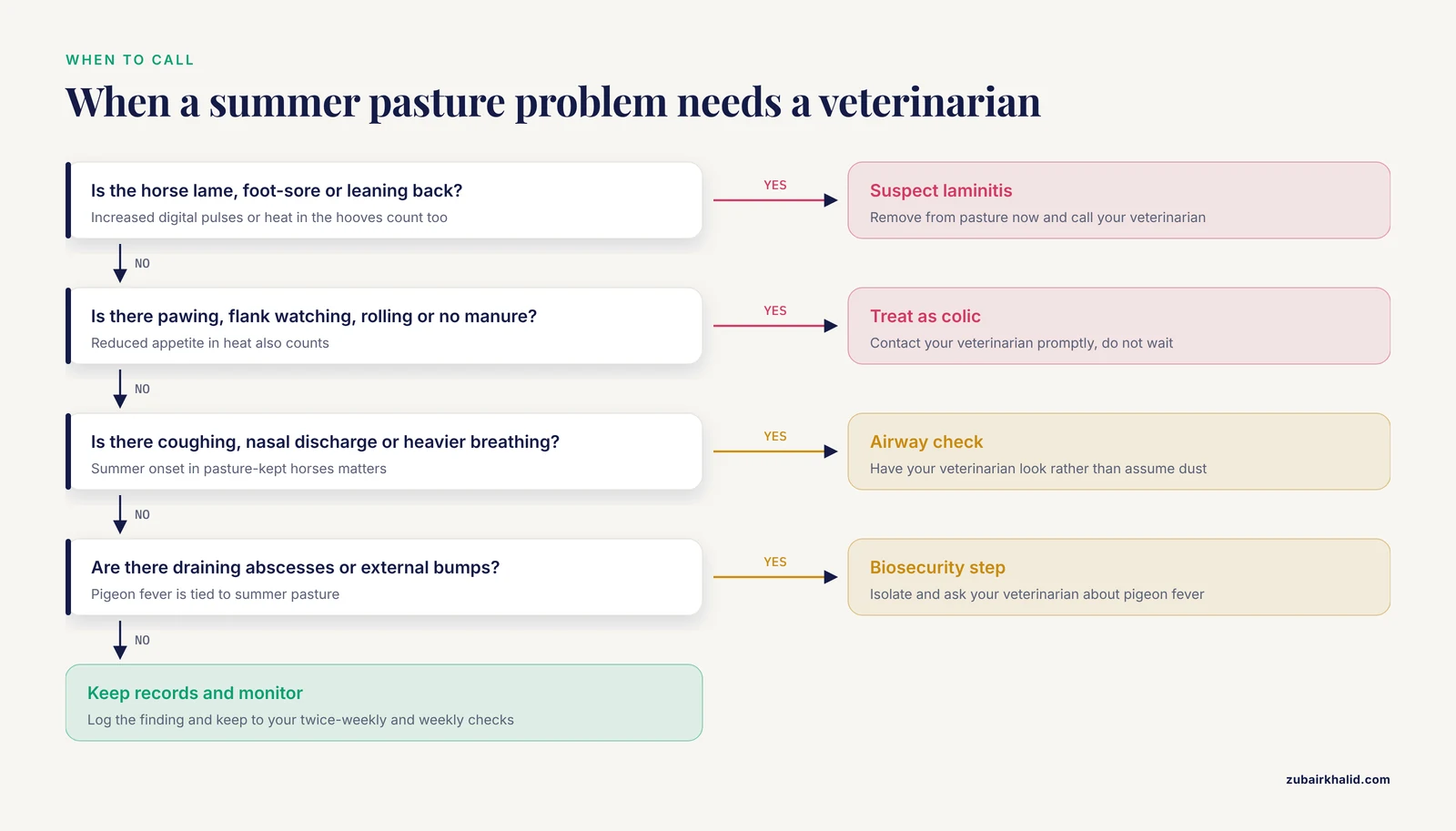
Every property, climate, and horse is different, and the findings summarized here come from specific study populations and conditions, so individual cases need a veterinarian who knows your horses and your ground. That said, contact your veterinarian promptly in any of these situations:
- Any sign of laminitis: increased digital pulses, heat in the hooves, lameness on turns, or a leaning-back stance
- Colic signs of any degree: pawing, flank watching, rolling, reduced or absent manure, off feed
- Fever, lethargy, or a horse off feed for more than a few hours in heat
- Coughing, nasal discharge, or increased breathing effort during summer
- Limb swelling, draining abscesses, or external bumps consistent with pigeon fever, which requires veterinary diagnosis and biosecurity planning
- Rapid weight loss or condition drop on pasture
- Suspected grass sickness of any kind on endophyte-infected fescue or ryegrass during drought, or any neurologic signs
- Fecal egg counts that fail to drop after treatment, which may indicate resistance and requires a fecal egg count reduction test and veterinary guidance
- Any emergency: severe pain, non-weight-bearing lameness, or profuse diarrhea
Frequently Asked Questions
How often should I remove manure from my horse's pasture in summer?
At least twice weekly is the evidence-supported standard. Research found twice-weekly manure removal significantly reduced strongyle larvae on pasture grass, while a single harrowing under dry summer conditions did not [7].
Do grazing muzzles really help metabolic horses on summer grass?
Yes. In insulin-dysregulated horses grazing for 10 summer hours, muzzled horses had roughly half the peak insulin response of unmuzzled controls [2]. Fit, gradual introduction, and daily monitoring for rubs and adequate drinking are essential.
Is harrowing a good substitute for picking up manure?
No, not in dry summer conditions. Harrowing on a single dry-weather occasion failed to reduce larval levels, and because larvae migrate up to 150 cm from pats, dragging spreads contamination across the paddock [7]. Harrow only when rest and weather can follow.
Why is summer the peak parasite season for pastured horses?
Heat and moisture accelerate the larval development cycle on grass. Pastured horses in a year-long study showed egg counts peaking in summer and autumn, with the largest reinfection rise in summer, while stabled horses stayed near zero year-round [1]. A separate large survey also identified summer as the highest-risk season for strongyle and roundworm egg shedding [3].
Should pasture horses and stabled horses be dewormed on the same schedule?
Generally no. Evidence indicates routine three-month deworming may be excessive for stabled horses but adequate for pasture-managed horses, whose reinfection risk is highest in summer [1]. Pair this with fecal egg count testing, because resistance in small strongyles is documented to all major drug classes [10].
What are the signs of endophyte grass toxicity in summer?
Endophyte-infected fescue and perennial ryegrass produce alkaloids that are neurotoxic to horses, and their concentrations rise during hot, arid summer months [6]. If your pasture contains these grasses, discuss testing, signs to monitor, and renovation with your veterinarian and a local agronomist before drought hits.
Can my horse lose weight on summer pasture?
Yes. Mares grazing low-quality heathland in one study had to be pulled off pasture in late summer because of apparent body condition loss [15]. Body condition score every two weeks and supplement with hay before condition slips.
What should go in a horse health record?
Log identification and baselines, body condition and weight over time, parasite control with fecal egg counts and treatments, vaccinations, dental exams, hoof care, pasture assignment and muzzle use, and every illness or injury with diagnosis, treatment, and follow-up dates. Summer makes the parasite and illness fields especially valuable, given the seasonal peaks in both [1].
Sources
- Comparison of prevalence and strongyle egg counts per gram of feces in horses at pasture and in stables following ivermectin/praziquantel treatment.
- Short-term effects of grazing muzzles on insulin in horses with insulin dysregulation out at pasture.
- Prevalence and risk factors of gastrointestinal helminths infection in Brazilian horses: A retrospective study of a 12-year (2008-2019) diagnostic data.
- Impact of Year-Round Grazing by Horses on Pasture Nutrient Dynamics and the Correlation with Pasture Nutrient Content and Fecal Nutrient Composition.
- Intrinsic, management, and nutritional factors associated with equine motor neuron disease.
- The Dark Side of Grasslands: Endophyte Toxicosis in Horses-Exposure Risks, Health Consequences, and Management.
- Evaluation of Strategies to Reduce Equine Strongyle Infective Larvae on Pasture and Study of Larval Migration and Overwintering in a Nordic Climate.
- Activity and behavior patterns of cattle, horses, and sheep grazing in mountainous areas using geolocation collars.
- Demographics, management, and welfare of nonracing horses in Prince Edward Island.
- Retained efficacy of ivermectin against cyathostomins in Swedish horse establishments practicing selective anthelmintic treatment.
- A study of the epidemiology of Anoplocephala perfoliata infection in horses and the oribatid mite vector in southern England.
- Fecal Microbiota, Forage Nutrients, and Metabolic Responses of Horses Grazing Warm- and Cool-Season Grass Pastures.
- Chronic obstructive pulmonary disease in horses in Louisiana.
- An Exploration of Environmentally Sustainable Practices Associated with Alternative Grazing Management System Use for Horses, Ponies, Donkeys and Mules in the UK.
- Diet selection and performance of horses grazing on different heathland types.
- Risk factors associated with Corynebacterium pseudotuberculosis infection in California horses.