Spring and Fall Horse Care: Transitioning Your Routine
By Dr. Zubair Khalid, DVM, MS, PhD ·
The best way to transition your horse's routine for spring or fall is to make gradual changes over two to four weeks in five areas: forage and feed, pasture access, parasite and dental care scheduling, stable air and housing, and your written health records. Spring asks a horse's body to shift from winter maintenance toward work, shedding, and breeding-season physiology. Fall asks the opposite, a move toward more stabled hours, drier forage, and indoor air that behaves very differently from open pasture. Horses tolerate both transitions well when the changes are slow, documented, and checked by your veterinarian at the right moments.
This guide walks through both seasons together, because spring and fall horse care share the same core skill: watching the animal, not just the calendar. You will find a step-by-step spring routine, a fall counterpart, a horse care checklist you can act on today, the mistakes owners make most often, and a simple horse health record template you can copy into a notebook or spreadsheet.
At a Glance: Seasonal Transition Checklist
| Task | Spring | Fall |
|---|---|---|
| Body condition scoring | Score every 2 weeks as work increases | Score every 2 weeks as grass dies back |
| Forage change | Introduce new pasture or fresh hay gradually over 1 to 2 weeks | Shift to hay-dominant ration gradually before full stabling |
| Water | Check for algae and refill habits as temperatures rise | Monitor intake as buckets freeze or horses drink less |
| Hooves | Reset shoeing or trimming schedule as turnout and work increase | Adjust for softer, wetter footing or frozen ground |
| Dental exam | Book before heavy spring work | Book before winter, when chewing hay is the main job |
| Parasite plan | Review your fecal egg count and deworming plan with your vet | Confirm the plan before winter stabling |
| Vaccination | Confirm spring boosters with your veterinarian | Confirm fall boosters with your veterinarian |
| Stable air | Deep-clean before humid spring months | Increase ventilation and cleaning before indoor season |
| Health records | Update weight, dental, and vaccination entries | Log winter weights, blanket use, and hay types |
| Mare management | Track the return of regular estrous cycles | Record cycle length as daylight shortens |
Print this table or copy it into a notes app. Each row is expanded in the sections below.
Why Seasonal Transitions Matter
Two body systems respond directly to the season change, and both shape your routine more than owners expect.
The first is the respiratory environment inside the barn. Airborne mold and yeast concentrations in stables change with the seasons. A two-year study of stable air at a Polish stud farm found that molds dominated the air during humid periods, specifically spring and autumn, while yeasts were more prominent in summer and winter [1]. The same study found that horses kept in individual box stables were exposed to lower concentrations of molds and yeasts than horses kept in open runner-style housing [1]. Spring and fall are therefore the two windows each year when the air your horse breathes indoors is most likely to carry a heavy fungal load, and they are also the two windows when you can do the most about it through cleaning and ventilation.
The second is the reproductive axis of the mare. Mares are seasonal breeders, and their ovarian activity tracks daylight. Research profiling the follicular fluid of mares across the year identified four distinct reproductive seasons: a spring anovulatory season when follicles grow but do not ovulate, a spring ovulatory season, a summer ovulatory season, and a fall ovulatory season, with the protein composition of the follicular fluid differing between them [2]. For a mare owner, this means behavior, cycle tracking, and breeding plans in spring and fall are not imagined. The mare's physiology genuinely shifts at both ends of the grazing year.
Beyond these two systems, every seasonal transition touches weight, hoof quality, hydration, and work load. The step-by-step sections below address each in the order you should tackle them.
Spring Horse Care Tips, Step by Step
These spring horse care tips are ordered so that each step sets up the next. Work through them over two to four weeks rather than in one weekend.
Step 1: Establish a Baseline Before Anything Changes
Before pasture grass arrives or work ramps up, record where your horse is starting from. Weigh your horse with a weight tape or scale, score body condition on a 1 to 9 scale, photograph the body from the side and rear, and write down current feed, hay, and supplements. A horse health record template for this appears later in this article. Without a baseline, you cannot tell whether the spring change is going well.
Step 2: Introduce Pasture Gradually
Lush spring grass is the single biggest digestive risk of the season. Horses turned out suddenly on rich pasture after a winter on hay face a sharp change in the carbohydrate load reaching the hindgut. Use this sequence:
- Start with 15 to 30 minutes of grazing per day on new grass.
- Increase turnout time by roughly 15 to 30 minutes every few days, depending on your horse's condition, breed tendency toward easy weight gain, and your veterinarian's guidance.
- Keep hay available before turnout so the horse does not bolt onto grass hungry.
- Use a grazing muzzle if your veterinarian recommends restricting intake for an easy keeper or a horse with a history of laminitis or metabolic disease.
Discuss the specific pace for your horse with your veterinarian, especially for ponies, donkeys, and horses previously diagnosed with equine metabolic syndrome or pituitary pars intermedia dysfunction, since these groups need the most conservative grass introduction.
Step 3: Rework the Parasite Control Plan in Spring
Spring is the standard time to review parasite control. Modern programs, as promoted by the AAEP and described in Merck Veterinary Manual owner resources, center on strategic deworming guided by fecal egg counts rather than rotation on a fixed calendar. Bring a fresh fecal sample to your spring veterinary visit and build the year's plan from the result. Do not deworm based on the calendar alone without discussing your horse's specific egg count history with your veterinarian.
Step 4: Schedule the Spring Dental Exam
Book a dental examination before riding work increases. A horse moving from light winter riding into harder spring work with sharp enamel points, hooks, or a loose tooth will express the problem as resistance, head tossing, or dropping feed, and you want that found and corrected beforehand. For many adult horses an annual exam is sufficient, while horses with known dental disease often need checks every six months. Your veterinarian will set the interval.
Step 5: Confirm Vaccinations and Coggins Requirements
Spring vaccination timing is typically set around the onset of insect season and the start of shows, travel, or new boarding situations. The AAEP publishes core and risk-based vaccination guidelines that your veterinarian uses to build an individual schedule. Call your veterinarian in late winter, before the spring rush, to reserve a slot and confirm which boosters your horse is due for and whether a current Coggins test or health certificate is needed for your planned travel.
Step 6: Address the Shedding Coat and Skin
As the winter coat drops, groom more frequently with a shedding blade or curry to speed the process and give you a daily chance to find early skin problems, old winter blanket rubs, rain rot, or bites. Spring moisture plus mud creates the conditions for fungal and bacterial skin disease. Keep the coat as clean and dry as practical, and wash shared grooming equipment between horses.
Step 7: Reset Hoof Care for Higher Mileage
Spring footing alternates between soft mud and hard, dry ground. Increased turnout and work change hoof wear rates, and thrush risk rises in wet paddocks. Pick out hooves daily, keep the horse standing on drier ground where possible, and confirm the trimming or shoeing interval with your farrier based on how fast the feet are growing and wearing now, not last winter's rate.
Step 8: Reassess Water and Electrolyte Needs
Rising temperatures and increasing work raise sweat losses. Check troughs and buckets daily for algae, which grows quickly once water warms. Horses in increasing work need free-choice salt and, depending on sweat volume and your veterinarian's advice, additional electrolyte support on hard work days.
Fall Horse Care: The Reverse Transition
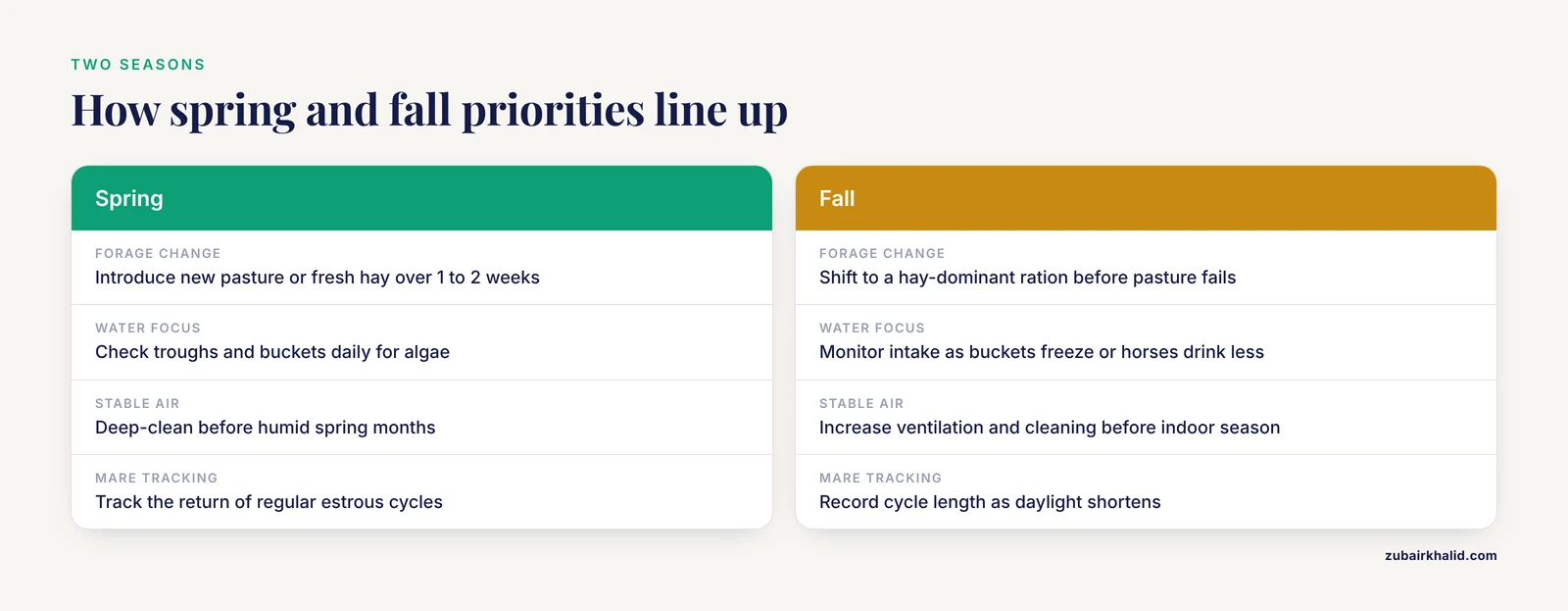
Fall horse care mirrors spring in structure but reverses the priorities. The central shift is from pasture toward the stable, and that shift changes the air the horse breathes as much as the feed it eats.
Step 1: Shift the Ration Toward Forage Before Pasture Fails
Do not wait for the grass to be gone. Begin increasing hay allocation as pasture quality declines, so the horse's hindgut adapts to a hay-dominant ration gradually. When changing to a new cutting or type of hay, mix old and new over one to two weeks. Score body condition every two weeks through the fall, because some horses lose weight rapidly as grass dies back, while easy keepers on reduced pasture need their intake managed in the other direction.
Step 2: Prepare the Stable Environment Before Full Stabling
This is where the seasonal research becomes directly practical. Because mold concentrations in stable air peak during the humid spring and autumn months [1], the weeks before your horse moves into longer stabled hours are the right time to act. Your goals, in order:
- Deep-clean the stable. Remove accumulated dust, cobwebs, old bedding, and feed residue from walls, corners, light fixtures, and storage areas. Cleaning reduces the fungal elements present in stable air [1].
- Maximize fresh air movement without creating a cold draft at horse level. Open ridge vents, doors, and windows where design allows. Stalls with good airflow help dilute airborne spores and particulates.
- Choose low-dust bedding and store hay away from the stall aisle, or wet or steam hay if your veterinarian has recommended it for a horse with respiratory sensitivity.
- Schedule stall cleaning for times when horses can be turned out, because cleaning reduces fungal elements in the air even though it temporarily raises airborne particulate matter [1]. Doing the mucking while horses are outside keeps them out of the dustiest moments of the day.
The same study also offers a housing comparison worth knowing. Horses in individual box stables were exposed to lower concentrations of molds and yeasts than horses in runner-style housing [1]. If your horse has respiratory sensitivity and your facility offers a choice of stabling style, raise this with your veterinarian when planning the indoor season.
Step 3: Book the Fall Dental and Health Check
A fall examination serves the winter ahead. Your veterinarian can perform the dental exam, score body condition before the cold increases energy demands, assess whether the current ration will meet those demands, and review whether fall boosters are due. Many owners combine this visit with pre-winter bloodwork if the horse is older or has a chronic condition, a decision to make with your veterinarian.
Step 4: Manage Water in Freezing Weather
Horses often drink less when water is icy, and reduced intake is a colic risk factor through winter. Offer tepid water where practical, break ice on troughs promptly, and use heated buckets designed for livestock with grounded, protected cords. Monitor intake by noting fill and refill amounts, which is far easier when your health records include a daily water line.
Step 5: Adjust Exercise as Turnout Shrinks
Reduced turnout means reduced free movement, and stiff, stale horses are more prone to strains when work resumes in spring. Maintain a consistent ridden or in-hand exercise schedule through the stable months, increase warm-up time on cold days, and use hand-grazing or longeing to add movement on days the horse cannot be turned out.
Step 6: Track the Mare's Cycle as Daylight Shortens
Fall is when many owners notice their mare's cycles becoming irregular as the ovulatory season winds down. This is normal seasonal physiology, not disease, in most cases. Keep recording cycle dates in your health record. If you are planning an early spring breeding, discuss with your veterinarian whether artificial lighting programs under veterinary guidance are appropriate for your mare, since manipulating day length is the standard way to shift her season earlier [2].
Equipment and Supplies for Both Transitions
You do not need a large budget, but you do need the right basics, selected on function rather than brand.
- Weight tape and condition score chart. Choose a tape marked for horses, and keep the printed 1 to 9 condition scale with it.
- Hay scale or kitchen scale. Weigh hay by weight, not by flake, so ration changes are real changes.
- Grazing muzzle. Select one that fits your horse's head shape, allows drinking, and has breakaway attachment.
- Thermometer and stethoscope. Learn your horse's normal temperature, heart rate, and respiratory rate at rest, and write those numbers in your health record.
- Ventilation hardware. Ridge vents, Dutch doors, and stall windows that open at horse level all improve stable air. Prioritize airflow design over gadgets.
- Low-dust bedding and hay storage. Choose bedding that produces minimal airborne dust when disturbed, and store hay in a separate building or at minimum a separate bay.
- Fecal egg count kit. Simple collection containers from your veterinary clinic make the spring parasite step easy.
- Blankets, if used. Select by fill weight and fit, check for rubs at the shoulders daily, and rewaterproof per manufacturer instructions.
A Simple Horse Health Record Template
A horse health record template turns scattered observations into a history your veterinarian can actually use. Copy this structure into a binder, spreadsheet, or stable whiteboard. One sheet per horse.
Horse profile section
- Name, age, breed, sex, and color or markings
- Microchip or registration numbers
- Current weight (date-stamped)
- Baseline vital signs (temperature, heart rate, respiratory rate at rest)
- Known conditions, allergies, and prior surgeries
- Insurance status if applicable
Recurring log section (one line per entry, dated)
| Field | Why it matters |
|---|---|
| Body condition score and weight | Detects gradual loss or gain before it is visible |
| Dental exam date and findings | Anchors the next appointment |
| Vaccinations given, by name and date | Prevents gaps and duplicate dosing |
| Fecal egg count results and deworming given | Builds the parasite history your vet needs |
| Hoof care dates and farrier notes | Tracks progress on cracks, abscesses, and thrush |
| Feed and hay type, amounts per day | Makes ration changes traceable |
| Water intake notes | Flags early reduced drinking |
| Mare cycle dates and length | Documents seasonal patterns [2] |
| Injuries, illnesses, and treatments | Gives any treating veterinarian the full picture |
| Behavior or performance changes | Early warning for pain and gastric or dental issues |
Update the log weekly in season and after every veterinary visit. Bring the record to each appointment. Owners who present a written history get faster, more accurate veterinary decisions, and the record becomes invaluable during an emergency or a purchase examination.
Common Mistakes in Spring and Fall Horse Care
These are the errors veterinarians and experienced barn managers see most often, phrased so you can check yourself against each one.
- Turning out onto lush grass all day on the first warm week. The hindgut needs weeks to adapt, and the horses most at risk are the easy keepers and pony breeds.
- Changing hay or feed in a single day. Any forage change should span one to two weeks of mixing.
- Deworming every horse on the same calendar regardless of egg count. Strategic deworming based on fecal results preserves drug effectiveness and treats the horses that need it.
- Skipping the fall dental exam because the horse is not being ridden hard. A horse eating hay all winter needs efficient chewing more than ever.
- Sealing the barn shut against cold. Stagnant winter air concentrates dust and spores. Ventilation at horse level, even in cold weather, protects the respiratory tract.
- Cleaning stalls while horses are inside. Cleaning helps reduce fungal elements in the air [1], but it also temporarily raises airborne particulates [1], so schedule it for turnout hours.
- Assuming a mare's irregular fall cycles or spring behavior are behavioral problems. Seasonal reproductive physiology is real and measurable [2]. Chart the dates first, then call your veterinarian if the pattern looks abnormal.
- Letting the water routine lapse. Frozen buckets and algae-coated troughs both reduce intake. The fall and spring transitions are when drinking habits change fastest.
- Restarting work at the previous level after the winter layoff. Fitness is lost over months of light work. Rebuild duration before intensity.
- Failing to write anything down. Weight, feed, and cycle changes are invisible across weeks without records.
Troubleshooting Common Seasonal Problems
Sudden loose manure after a pasture or hay change. Slow the transition, add hay, and call your veterinarian if diarrhea persists beyond a day, contains blood, or comes with fever, depression, or colic signs.
Steady weight gain on spring grass despite a muzzle. Reduce turnout hours further, increase controlled exercise, and have your veterinarian evaluate for metabolic disease rather than simply restricting feed further.
Coughing or nasal discharge after moving into full stabling. Improve ventilation, reduce dust sources, move the horse outside as much as possible, and have your veterinarian examine the airway. Persistent coughs in stabled horses deserve a diagnosis, not just a bedding change.
Unexplained irritability or resistance under saddle in spring. Rule out physical causes first, then consider cycle-related behavior in mares. Record cycle dates alongside training notes so patterns become visible over one to two seasons.
Slow shedding in spring. A horse that fails to shed normally warrants a veterinary conversation, particularly in older horses, because a long, delayed coat can accompany underlying endocrine disease.
Weight loss through fall despite adequate hay. Check teeth first, then have your veterinarian assess digestion, parasite status, and ration adequacy with a forage analysis if needed.
Welfare and Safety Points
- Every season, walk your turnout areas for hazards spring brings exposed holes, fence damage from winter frost heave, and toxic plants emerging, while fall brings buried objects under leaf litter and slippery wet slopes.
- Provide shelter from wind and rain in every paddock the horse uses through the shoulder seasons.
- Never restrict forage to zero in an attempt to control spring weight. Forage should be available continuously unless your veterinarian directs otherwise for a medical reason.
- Check blankets and their fit daily during fall and winter transitions.
- Keep a written emergency plan at the barn, including your veterinarian's number, an alternate hauler, and each horse's baseline vitals from your health record.
- Quarantine and biosecurity practices matter whenever new horses arrive in spring or horses return from fall shows. Ask your veterinarian what isolation period is appropriate for your facility.
Limitations and When to Contact a Veterinarian
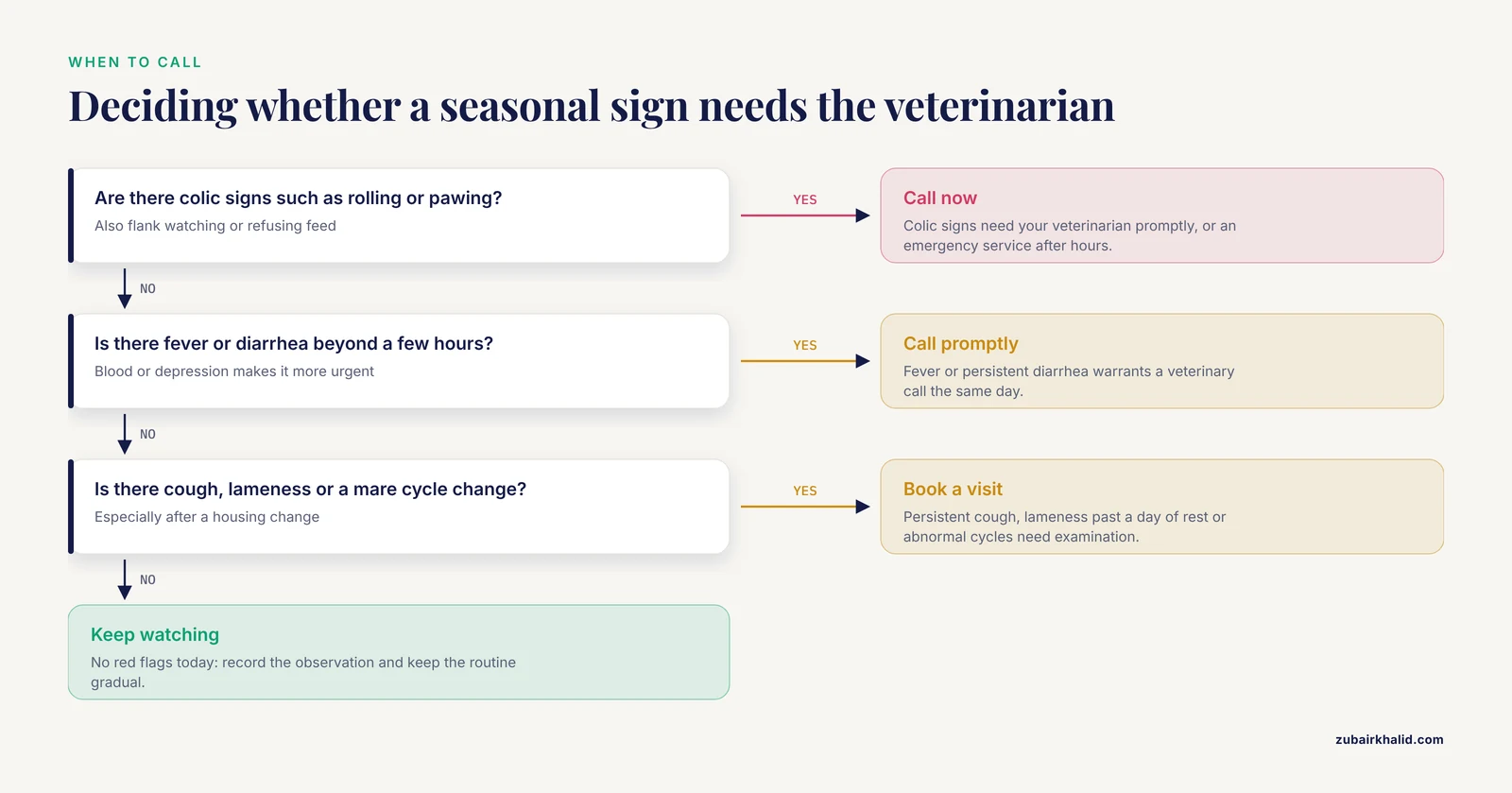
Every horse's transition needs should be confirmed with your own veterinarian, because age, breed, body condition, previous disease, housing, and geographic climate all alter the plan. The steps above are general practice, not prescriptions for a specific animal.
Contact your veterinarian promptly, or an emergency service after hours, for any of the following:
- Colic signs, including rolling, pawing, flank watching, or refusing feed
- Fever, defined as a temperature above your horse's recorded normal range, or any temperature you are unsure about
- Diarrhea that persists more than a few hours, contains blood, or comes with depression
- Lameness that does not resolve within a day of rest, or any non-weight-bearing limb
- Coughing, nasal discharge, or labored breathing, especially after a housing change
- A mare with prolonged absence of cycles during the ovulatory season, excessively frequent or painful cycles, or vulvar discharge
- Rapid weight loss or gain, or a horse that fails to shed in spring
- Any wound, eye injury, or sudden behavior change without an obvious cause
When in doubt, call. A short phone conversation with your veterinarian is the cheapest diagnostic step available to you.
This article is educational and is not a substitute for veterinary diagnosis or treatment.
Frequently Asked Questions
When should I start transitioning my horse's routine for spring?
Start two to four weeks before turnout grass is ready and work intensity increases. That window gives the hindgut time to adapt to new forage, lets you complete dental and vaccination visits before the season starts, and gives shedding and hoof adjustments time to happen gradually.
What is the single most common spring horse care mistake?
Turning a horse out full time on lush spring grass immediately after winter. Gradual turnout of 15 to 30 minutes per day, increasing over one to two weeks with hay available first, prevents most of the digestive problems owners face in April and May.
Do mares cycle year round?
No, mares are seasonal breeders. Most mares stop cycling during the winter and resume regular cycles as daylight increases in spring, with defined anovulatory and ovulatory seasons documented in equine research [2].
How can I improve the air quality in my barn for fall and winter?
Deep-clean the stable before full stabling begins, maximize ventilation without drafts at horse level, choose low-dust bedding, store hay separately, and clean stalls while horses are outside. These steps target the dust and fungal load that rise in stabled horses during humid seasons [1].
What should go in a basic horse health record?
Record the horse's profile, weight, and baseline vital signs once, then log dated entries for body condition, feed and hay, dental exams, vaccinations, fecal egg counts and deworming, farrier visits, water intake, mare cycle dates, and any illness or injury. The template table in this article lists every field.
How often should I score my horse's body condition?
Score every two weeks during spring and fall transitions and at least monthly the rest of the year. Gradual changes of half a condition point are easy to miss visually but show up clearly in a written record.
Should I change my horse's feed gradually at each season change?
Yes. Blend old and new forage or feed over one to two weeks so the hindgut microbes adapt. This applies to spring grass introduction, fall hay transitions, and any switch to a new hay cutting or batch.
When does a seasonal issue need a veterinarian instead of home management?
Call your veterinarian for colic signs, fever, diarrhea lasting more than a few hours, persistent coughing or nasal discharge, lameness beyond a day of rest, unexplained weight change, failed spring shedding, or abnormal cycle patterns in a mare. When you are unsure whether a sign qualifies, the phone call itself is the right next step.