Senior Pony Care: Aging Signs, Diet, and Comfort
By Dr. Zubair Khalid, DVM, MS, PhD ·
A pony is generally considered senior from around 15 years of age, which is the threshold veterinary researchers use when they study geriatric horses and ponies [1]. Good senior pony care at this stage comes down to three pillars: spotting the physical signs of aging early, adjusting the diet to match a changing metabolism and dentition, and managing daily comfort so that stiffness, pain, and weight loss do not quietly accumulate. Ponies are long-lived animals, and many remain healthy and useful well into their late twenties and beyond, so the decisions you make now shape a decade or more of your pony's life.
The stakes are higher than many owners realize. In one detailed veterinary survey of geriatric horses and ponies in the United Kingdom, more than three quarters of animals aged 30 and older were lame on at least one limb when trotted, yet only 16 percent of their owners had reported lameness in the previous year [2]. Dental abnormalities were found in every animal that received an oral examination, but fewer than half of the owners knew their pony had a dental problem [2]. Aging in ponies is often silent, and the owner who learns what to look for holds the greatest advantage.
This article explains how aging shows up in ponies, how to build a senior pony diet that fits your individual animal, and how to set up daily and seasonal routines that protect comfort and welfare. It closes with clear guidance on when to involve your veterinarian.
Senior Pony Care at a Glance
| Care area | What to do starting today | Why it matters |
|---|---|---|
| Body condition | Run your hands over the ribs and neck weekly and keep a simple written score | Underweight and overweight bodies are both common in senior equids, and owners often misjudge both [1][2] |
| Eating behavior | Watch your pony finish meals, chew hay, and drop feed | Dental abnormalities are nearly universal in very old ponies and frequently go unnoticed by owners [2] |
| Movement | Walk and trot your pony in hand regularly and watch for short, uneven strides | Subclinical lameness and reduced joint motion are extremely common in geriatric equids [2] |
| Coat and skin | Note coat length, shedding pattern, and any lumps, scabs, or infections | Most geriatric equids have at least one dermatological abnormality [1] |
| Eyes | Watch for cloudiness, discharge, bumping into objects, or hesitation in dim light | Cataracts and other ocular lesions are frequent findings in aged ponies [1][2] |
| Prevention | Maintain hoof trimming, vaccination, and a parasite control plan with your veterinarian | Regular preventive care is the norm for well-managed equids and underpins long-term health [3] |
| Grazing design | Arrange turnout so your pony walks and forages rather than standing at one patch | Grazing layout changes how much ponies move and how they behave [4] |
How Old Is a Senior Pony?
Researchers studying aging in equids define geriatric animals as those aged 15 years and older [1]. That is a practical working answer to the question of how old a senior pony is: by the mid-teens, the physiological changes of aging are already detectable in a meaningful share of the population, even in animals that look outwardly well.
Pony lifespan is generous compared with many pets. The surveys behind the veterinary geriatric research cited in this article included animals aged 30 years and older, examined and interviewed in detail [2], which tells you two things at once. First, ponies and horses routinely reach an age that would be remarkable in a smaller pet. Second, the prevalence of disease at that age is high, so lifespan and healthspan are not the same thing. A pony can live three decades, and the last several of those decades require active management to remain comfortable.
Breed and type matter as well. Ponies as a group tend toward easy weight gain, which shapes the senior pony diet conversation in a different direction than it would for a lean Thoroughbred. Surveys of general horse and pony populations in Great Britain found that around a third of owners described their animals as overweight or obese, and osteoarthritis was the most commonly reported long-term condition [3]. Those two facts together define the central tension of senior pony care for many native pony owners: keeping weight down while keeping joints, teeth, and gut functioning well.
Signs of Aging in Ponies
The signs of aging in ponies fall into predictable body systems. The geriatric survey of 200 horses and ponies aged 15 and older in the United Kingdom documented the pattern clearly [1]. Knowing which findings are common helps you judge what is normal wear and what needs action.
Weight and body condition
In that survey population, 26 percent of geriatric animals were overweight and 4.5 percent were underweight [1]. At the extreme old end of the spectrum, the picture shifts: among horses and ponies aged 30 and older, 16 percent were underweight with a body condition score below 2 out of 5, while 10 percent were overweight [2]. The lesson is that senior ponies drift in both directions, and neither direction is safe. Weight loss in an old pony often reflects dental disease, pain, or underlying illness rather than simple underfeeding.
A related pattern appeared in semi-feral pony populations assessed across seasons: body condition was lower in early spring than in summer [5]. Even for a well-fed domestic pony, late winter is the time of year when condition is most likely to slip, so weigh or condition-score more often through the cold months.
Teeth and chewing
Oral examinations in the oldest survey group found dental abnormalities in every animal examined [2]. Owners detected only a fraction of this. Common owner-visible clues include dropping partially chewed feed (quidding), slow chewing, hay balls accumulating in the cheeks, undigested long fiber in manure, and preference for softer feeds. Because the dental findings in aged equids are so consistent, routine dental examinations are a cornerstone of senior pony care rather than an optional extra.
Eyes
Ophthalmic changes are among the most striking aging findings. In the 15-and-older survey, vitreous degeneration was present in 66 percent of animals, cataracts in 58.5 percent, and senile retinopathy in 33.7 percent [1]. In the 30-and-older group, every single animal examined had at least one ophthalmic lesion, and 17 percent of owners reported their animal had experienced visual problems within the previous year [2]. Watch for a cloudy or bluish lens, reluctance in fading light, head tilting, spooking, or bumping into fence posts and feed tubs. Many aged ponies adapt well to reduced vision when their environment stays predictable.
Coat, skin, and hormones
Seventy-one percent of geriatric equids had a dermatological abnormality, and 22 percent showed hirsutism or abnormal moulting [1]. Hirsutism means a long, often curly coat that sheds late, incompletely, or not at all. Owner-reported coat changes aligned closely with what veterinarians found on examination [2]. A coat that fails to shed normally is a well-recognized indicator of pituitary pars intermedia dysfunction, an endocrine disease of older equids described in detail by the Merck Veterinary Manual. This finding should always prompt a veterinary conversation rather than being dismissed as a quirk of age. Skin infections, lumps, and slow-healing wounds also deserve attention, since they accounted for the large dermatological burden in this age group.
Movement, joints, and pain
Gait abnormalities and joint changes dominate the physical findings of advanced age. Among the oldest equids examined, 77 percent were lame on at least one limb at trot and 97 percent had a reduced range of motion in at least one joint [2]. Osteoarthritis was the most frequently reported long-term condition in the broader British survey population as well [3]. The practical translation is that some degree of joint stiffness is nearly universal in senior ponies, and your job is to notice it early. Watch for shortened strides, reluctance to turn tightly, difficulty lifting a foot, or a changed stance.
Heart and lungs
Cardiac murmurs were present in 20 percent of the geriatric population examined [1]. Respiratory findings were also common: 18.5 percent had some form of nasal discharge, 22 percent had abnormalities on thoracic auscultation at rest, and 13.6 percent developed marked abnormalities consistent with lower airway disease after a rebreathing examination [1]. Coughing during feeding or exercise, nasal discharge, and slow recovery after light work all warrant a veterinary visit.
Behavior and temperament
Aging changes behavior as well as bodies. Analysis of nearly two thousand owner-completed behavior questionnaires found that older horses were rated as bolder, meaning less reactive to novel situations, than younger horses [6]. Many owners experience this as their senior pony becoming calmer and more settled. The flip side is that a stoic, bold old pony may mask pain and illness particularly well, which is one more reason to rely on structured checks rather than general impressions.
Building a Senior Pony Diet
The senior pony diet has one job: meet nutrient and calorie needs through a mouth and gut that may no longer handle long-stem hay efficiently, while avoiding the obesity that ponies are prone to. Surveys show both failure modes are common, with underweight animals concentrated in the oldest age groups and overweight animals throughout the geriatric population [1][2].
Start with forage
Forage remains the foundation. A pony with healthy teeth can usually maintain condition on good hay fed to body condition. A pony with dental disease may need hay chopped, soaked, or partially replaced with shorter-chopped forage alternatives that are easier to chew. Because dental abnormalities are nearly universal in very old equids [2], have the teeth assessed before you assume a weight problem is a feed problem. Changing the feed when the real problem is a sharp enamel point or a loose tooth wastes money and delays relief.
Feeding the thin senior pony
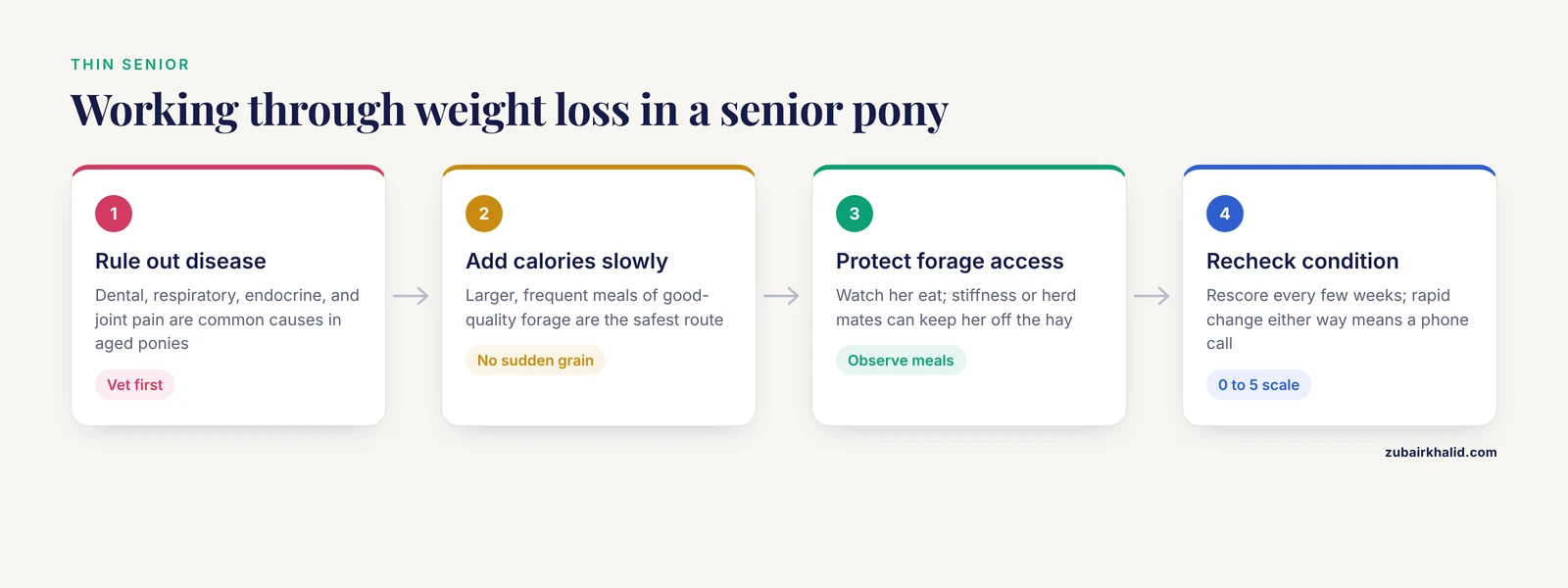
If your senior pony is losing weight, work through this sequence with your veterinarian:
- Rule out disease first. Weight loss in an aged pony can reflect dental disease, chronic respiratory disease, endocrine disease, or painful joints that discourage movement to feed. The high prevalence of these conditions in geriatric equids makes veterinary investigation the correct first step, not more feed [1][2].
- Increase calories gradually. Larger, frequent meals of good-quality forage are the safest way to add condition. Sudden large grain meals risk digestive upset.
- Protect forage access. Old ponies kept outdoors with companions should be observed eating. A stiff, painful pony that cannot walk to hay, or a low-ranking pony pushed off the pile by herd mates, will lose weight no matter what you buy.
- Recheck. Reassess body condition every few weeks. Visible change takes time, and rapid change in either direction deserves a phone call to your veterinarian.
Managing the overweight senior pony
Overweight carries its own risks and was more common than underweight in the general geriatric survey [1]. For easy-keeper pony breeds, controlling grazing is often the central challenge. Research on grazing systems offers a useful, welfare-aware tool here. In a study of pasture-kept ponies, animals managed on a track system, where forage is placed around the perimeter of a paddock, spent more time moving and traveled greater distances per day than ponies on strip grazing, and they showed less overt aggressive behavior toward each other [4]. For a senior pony, this matters twice over. Layout that encourages slow walking supports joint health and calorie expenditure, and layout that reduces confrontation protects the older, lower-ranking animal in the group.
Restricting feed without restricting movement and engagement is the common mistake. The grazing system study was designed around weight control, and its findings show that how you restrict matters as much as how much [4]. If your pony needs a diet, talk with your veterinarian about a plan that limits calories while preserving movement, foraging behavior, and social contact.
Salt, water, and seasonal adjustments
Semi-feral pony assessments found body condition dipping in early spring [5], and domestic seniors face the same seasonal squeeze of cold weather, poorer pasture, and sometimes reduced water intake in winter. Keep plain salt available, monitor water intake, and step up condition monitoring through late winter. If you use blankets or additional forage in cold snaps, adjust based on the individual pony's body condition rather than the calendar.
Comfort and Daily Management
Senior pony care succeeds or fails in the daily routine. The preventive care survey of British horses and ponies showed what well-managed animals typically receive: 95.6 percent had regular hoof care, 71.3 percent were vaccinated for both influenza and tetanus, and parasite control was administered on a median interval of about 8.7 weeks [3]. Those figures describe owner behavior at a population level, and they are a reasonable benchmark for your own program.
Hooves and legs
Regular farrier visits remain essential, and the interval may shorten as hoof quality and conformation change with age. Combine farrier visits with your own in-hand trot-ups so you detect lameness between appointments. Given how often owner reports underestimated lameness found on examination [2], a structured check beats watching from the barn door.
Movement and exercise
Joints stay healthier when they move. Reduced range of motion was found in 97 percent of the oldest equids examined [2], and gentle, consistent movement is the standard way to support joint comfort. Hand walking, light riding if the pony is comfortable and your veterinarian agrees, and turnout layouts that promote walking all count. The track system finding, where ponies on a perimeter layout traveled roughly 1,700 meters more per day than ponies on strip grazing, shows how much management design alone can change activity [4].
Shelter, herd, and environment
Comfort for a stiff, thinner-coated, or visually impaired pony means predictable footing, shelter from wind and rain, non-slip surfaces, and herd arrangements that prevent bullying at the feed pile. Welfare assessment work on ponies kept extensively on pasture [7] and on free-living pony populations [5] reinforces a broader principle from modern welfare science: assessment should cover nutrition, environment, health, and behavior together, not just whether the animal is fed. For a senior pony, that means asking four questions daily. Is she eating? Is she comfortable moving? Is her coat, skin, and weight stable? Is she interacting normally with her companions?
Monitoring and records
Keep a simple log. Body condition score on a 0-to-5 scale, the same scale used in the geriatric research [1], noted every one to two weeks, will reveal trends that daily observation hides. Add notes on eating speed, manure consistency, coat shedding, and any gait changes. Photographs of your pony from the side and front, taken monthly in consistent light, are surprisingly effective at catching gradual change.
Common Mistakes in Senior Pony Care
- Assuming weight loss is normal aging. The oldest equids had dental abnormalities in every animal examined [2]. Unexplained weight loss is a symptom, not a life stage.
- Trusting appearance over examination. Owners reported lameness in only 16 percent of animals in which 77 percent were objectively lame at trot [2]. A formal in-hand trot-up, ideally with a second set of eyes or video, catches what the eye at rest misses.
- Treating the coat change as cosmetic. Hirsutism and abnormal moulting in roughly a fifth of geriatric equids [1] point to endocrine disease that responds to veterinary management, not to grooming.
- Cranking feed up or down abruptly. Gradual changes protect the digestive tract, and rapid weight gain in a pony carries the same metabolic concerns as obesity in any breed.
- Restricting grazing to a bare, static paddock. The comparison of track and strip systems showed that restriction designs differ in how much they let ponies move and how they affect social behavior [4]. A diet plan that creates a frustrated, stationary pony solves one problem by creating others.
- Letting preventive care slide. The majority of well-kept equids receive regular hoof care and vaccination [3]. Senior status is a reason to tighten this schedule, not relax it.
- Working through problems. A study of working ponies on Gili Trawangan found that many drivers stated they would work ponies regardless of injury or illness, and the ponies showed widespread wounds, hoof lesions, and painful gaits [8]. The lesson for any owner is clear. A pony in pain does not get fitter by being pushed. Rest and treatment come first.
Limitations and When to Contact a Veterinarian
Every case is individual, and this article is educational and is not a substitute for veterinary diagnosis or treatment. The studies cited describe populations of horses and ponies in specific regions and settings, so their percentages describe patterns, not guarantees for your animal.
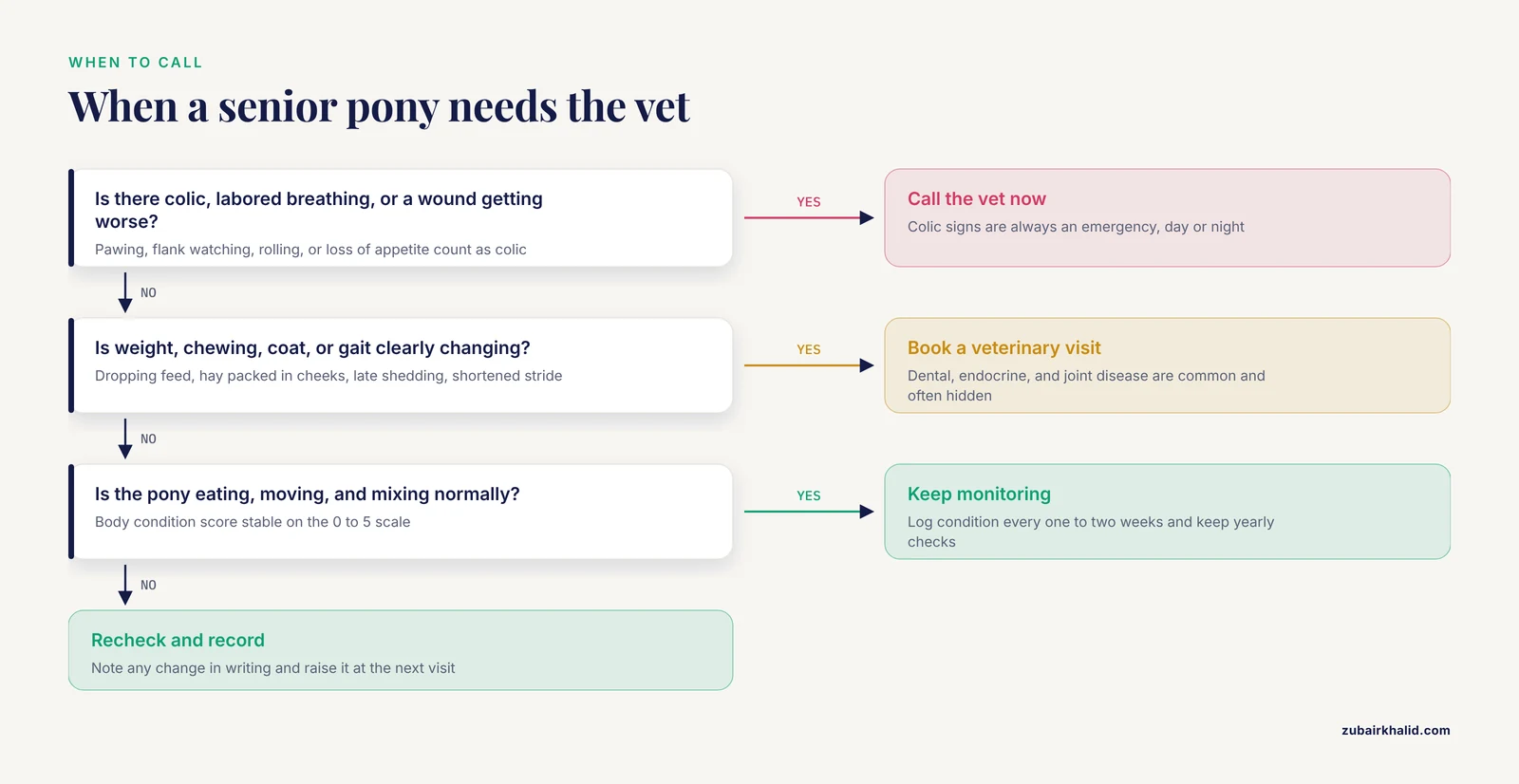
Contact your veterinarian promptly if your senior pony shows any of the following:
- Unexplained weight loss or a body condition score trending below 2 on the 5-point scale, or rapid weight gain you cannot explain by feed changes
- Quidding, dropping feed, slow chewing, hay packing in the cheeks, or undigested long fiber in manure
- A coat that sheds late, partially, or not at all, or any new thickening of the neck crest or fat deposits
- Visible lameness, reluctance to move, shortened stride, heat in a limb, or difficulty rising
- Coughing, nasal discharge, labored breathing, or slow recovery after light exertion
- Cloudy eyes, squinting, discharge from the eye, or new hesitancy in dim light or unfamiliar spaces
- Colic signs such as pawing, flank watching, rolling, or loss of appetite, which are always an emergency
- Any wound, swelling, or skin infection that is not clearly improving within a few days
Schedule, at minimum, a yearly veterinary examination for your senior pony, and ask your veterinarian whether twice-yearly visits suit your animal's age and condition. Annual dental examination is standard practice for older equids, given the near-universal dental findings in geriatric survey animals [2]. The American Association of Equine Practitioners (AAEP) publishes owner-facing senior horse care resources at aaep.org, and the Merck Veterinary Manual's horse owner materials at merckvetmanual.com cover the specific diseases of aged equids in detail. Use both alongside your own veterinarian, who knows your pony's history.
Frequently Asked Questions
How old is a senior pony?
Veterinary researchers classify equids aged 15 years and older as geriatric, so the mid-teens is a sensible starting point for senior-focused care [1]. Individual ponies age at different rates, so use your veterinarian's assessment of teeth, body condition, and soundness alongside the calendar.
What is the typical pony lifespan?
Ponies are long-lived, and the veterinary surveys of very old equids included animals aged 30 years and older [2], which reflects how routinely well-cared-for ponies reach their third decade. Long lifespan makes early attention to teeth, weight, and joints especially valuable, since small problems have years to grow.
What are the first signs of aging in ponies I should watch for?
The earliest practical signs are changes in chewing and shedding, gradual weight drift, and shortened strides. In the large geriatric survey, dermatological abnormalities and ocular changes such as cataracts were the most common findings, with hirsutism in about a fifth of animals [1]. Any of these deserves a veterinary conversation.
What should a senior pony diet include?
A senior pony diet is built on forage adjusted for dental ability, fed to body condition, with calories added or reduced gradually and salt and fresh water always available. Because dental abnormalities were found in every very old equid examined [2], have the teeth checked before changing feed, and ask your veterinarian to help you match the ration to your pony's condition score and workload.
Why is my senior pony losing weight even though he is eating?
The most common culprits in aged ponies are dental disease that prevents proper chewing, painful joints that limit movement to feed, and underlying disease such as respiratory or endocrine conditions, all of which are highly prevalent in geriatric equids [1][2]. Weight loss in a senior pony is a reason for a veterinary examination, not simply more grain.
How often should a senior pony have dental checkups?
At least annually, and your veterinarian may recommend more frequent visits as your pony ages. In the survey of the oldest equids, dental abnormalities were detected in all animals examined orally, yet only 42 percent of owners were aware of a dental disorder [2]. That gap between reality and owner perception is exactly why regular professional examinations matter.
Can senior ponies still be ridden or worked?
Many can, depending on soundness, body condition, and comfort, and there is no age at which riding automatically stops. Because reduced joint motion and lameness are common in older equids even when owners have not noticed them [2], have your pony assessed for comfort first, then scale work to what he can do without stiffness or soreness the next day.
How can I keep my senior pony comfortable in his field?
Design the space for easy movement and low conflict. A track-style layout, where forage is distributed around the edge of the paddock, doubled the distance ponies traveled compared with strip grazing in a controlled study [4], and it also reduced aggressive interactions. Add predictable footing, shelter from weather, feed stations that prevent bullying, and a stable routine that a visually impaired pony can learn by heart.
Sources
- Disease prevalence in geriatric horses in the United Kingdom: veterinary clinical assessment of 200 cases.
- A survey of health care and disease in geriatric horses aged 30 years or older.
- Preventive health care and owner-reported disease prevalence of horses and ponies in Great Britain.
- The impact of restricted grazing systems on the behaviour and welfare of ponies
- How Useful Are Existing Protocols in the Quick Assessment of the Welfare of Semi-Feral Horses? Pilot Study on Konik Polski Horses Living in the Forest Sanctuary
- Age-Related Changes in the Behaviour of Domestic Horses as Reported by Owners.
- Gotland ponies on extensive pastures - a welfare assessment
- A Pilot Welfare Assessment of Working Ponies on Gili Trawangan, Indonesia