Horse Fencing 101: How to Choose Safe and Durable Fencing
By Dr. Zubair Khalid, DVM, MS, PhD ·
A safe horse fence is one a healthy horse cannot push through, catch a hoof in, or injure itself on, while a durable fence is one that survives weather, ground movement, and daily contact for years. The best safe horse fencing options combine both qualities, and the rule of thumb is simple. Choose the fence that fails safely. Every fence eventually takes a hit. The right one bends, breaks away, or gives before it cuts, traps, or launches a thousand-pound animal.
This guide walks through the main fencing types, compares them side by side, works through real scenarios, and places fencing inside your broader horse care routine, including a horse care checklist and a simple health record template you can start using today.
This article is educational and is not a substitute for veterinary diagnosis or treatment.
Why Fencing Is a Welfare Issue, Not Just a Property Issue
Fencing shapes nearly every hour of a horse's day. Modern welfare thinking has moved past the old idea that animals simply need to be free from harm. David Mellor's widely cited update to the Five Freedoms framework argues that good welfare means more than neutralizing negative experiences. Animals need opportunities for positive experiences too, and their environment determines whether those opportunities exist [1].
A fence either enables or blocks that goal. A fence that injures a horse creates pain and fear. A fence that a horse has learned to barge through creates chronic tension between the animal's motivation to reach grass, companions, or feed and the barrier in its way. Mellor points out that animals carry internally generated urges to obtain life-sustaining resources and to avoid harm, and these urges drive real behavior [1]. A horse on the wrong side of a thin electric boundary with better grass beyond it is not being naughty. It is responding to motivation the fence was never designed to manage.
Good fencing also reduces the negative side of the welfare ledger. Lacerations from wire, hoof entrapment in mesh, collisions with rigid pipe, and cribbing or weaving along unsuitable boundaries are all preventable sources of discomfort and distress. When you evaluate fencing, evaluate it as welfare equipment, the same way you would evaluate a halter or a stall floor.
There is a useful parallel from human-centered design. Research on barrier-free environments for visually impaired people emphasizes unobstructed pathways, consistent and predictable spatial layouts, and sensory cues that let a person know where they are and what is coming next [2]. Horses are prey animals with a strong need for spatial predictability. A fence line that is visible, consistent, and free of gaps and surprises serves the same psychological function for a horse that a clear, obstacle-free pathway serves for a person with low vision. Fences that appear suddenly, sag into the pathway, or vanish into tall grass create the equine equivalent of a trip hazard in a dim hallway.
The Main Safe Horse Fencing Options
Horse fencing 101 starts with a short list. Nearly every fence you will encounter falls into one of these categories.
| Fencing Type | Visibility | Give Under Impact | Containment Strength | Maintenance Load | Relative Cost | Best Use |
|---|---|---|---|---|---|---|
| Wood board | Excellent | Moderate (breaks, splinters) | Good | High (painting, board replacement) | Moderate to high | High-visibility paddocks, breeding farms |
| Vinyl (PVC) board | Excellent | Moderate | Good | Low | High | Show properties, low-traffic boundary fencing |
| Pipe and steel panel | Excellent | Low (rigid) | Very good | Low to moderate | High | Dry lots, stall fronts, high-traffic areas |
| Woven wire with top rail | Moderate to good | Moderate | Very good | Moderate | Moderate | Large pastures, perimeter fencing |
| Diamond mesh (V-mesh) | Good | Moderate | Very good | Low | High | Foals, small paddocks, escape artists |
| Electric tape or rope | Good (when flagged) | High (breaks away) | Moderate | Moderate to high | Low to moderate | Interior divisions, temporary grazing |
| High-tensile smooth wire | Poor unless flagged | High | Good | Moderate | Low | Large acreage, budget perimeter |
| Flexible rail (polymer) | Good | High | Good | Low | Moderate | Replacement for wood, mixed systems |
No single product wins every column. The best safe horse fencing options for your property depend on your horses, your terrain, and how much maintenance you will actually perform. The sections below explain each option on its own terms, then the article compares them on the criteria that decide real choices.
Wood Board Fencing
Wood board fence is the traditional image of a horse property, and it earns that reputation. Horses see it clearly, respect it, and rarely challenge it. A well-built board fence with strong posts and nailed or screwed boards presents a solid visual wall.
The pros are real. Visibility is excellent. Horses that lean, paw, or push meet a barrier that feels substantial. Wood is forgiving in the sense that it can break rather than deform a limb, though broken boards create splinters and sharp edges.
The cons are equally real. Wood demands maintenance. Boards loosen, warp, crack, and rot, especially at ground level. Nails work loose and protrude. A horse that chews wood can destroy a rail line in a season. Paint and stain require periodic renewal. If you choose wood, commit to a walking inspection schedule and keep a hammer and spare boards on hand.
Wood fencing pros and cons at a glance
- Pros: maximum visibility, strong psychological barrier, forgiving breakage, widely available builders
- Cons: high maintenance, chewing damage, splinters and protruding fasteners, rot at post bases
Vinyl (PVC) Board Fencing
Vinyl board fencing looks like painted wood and behaves like a plastic composite. It never needs paint, does not rot, and horses generally do not chew it. Visibility matches wood.
The pros: very low maintenance, clean appearance, no splinters, no loose nails.
The cons: cost at installation, and some products can crack or shatter in extreme cold or under hard impact rather than flexing. Rail quality varies widely between manufacturers, so buy from a supplier with an equine track record rather than a general-purpose agricultural product.
Pipe and Steel Panel Fencing
Welded pipe fence is nearly indestructible and common on ranches, at show grounds, and around dry lots and gates. Horses cannot chew it and cannot push it over.
The pros: strength, longevity, minimal maintenance.
The cons: rigidity. Pipe does not give. A horse that runs into pipe fence at speed meets an unyielding surface, which is why pipe is best used where horses move slowly and predictably, such as alleys, pens, and stall fronts, rather than along open gallop routes. Welded panels also create narrow gaps at joins where a hoof or muzzle can catch if the panels are not aligned and secured properly. Inspect welds and connections periodically, because rust and movement create sharp points over time.
Woven Wire Fencing With a Top Rail
Woven wire, sometimes called field fence, is a grid of horizontal and vertical wires. It is one of the strongest containment options per dollar and works well for large perimeters. The critical rule is that horse-safe woven wire must have a stiff top rail and be installed with the correct orientation so hooves cannot ride up the mesh.
The pros: strong containment, good value over long distances, keeps horses in and many dogs and wildlife out.
The cons: horses do not see thin wire well, so woven wire without a visible top rail invites walking into it. Openings that are too large allow a curious hoof to slide through, and a trapped hoof in woven wire is a genuine emergency. Choose a horse-specific mesh pattern and always top it with a visible rail.
Diamond Mesh and V-Mesh Fencing
V-mesh, also called no-climb or diamond mesh horse fence, uses small, fixed-knot openings that a hoof cannot pass through. It is widely considered among the best safe horse fencing options for foals, minis, and horses with a history of getting into trouble.
The pros: excellent safety against entrapment, strong containment, good visibility when paired with a top rail, long service life.
The cons: higher material and installation cost than wire options, and it should still carry a visible top rail because mesh alone reads as a blur to a moving horse.
Electric Fencing: Polytape, Polyrope, and Coated Wire
Electric fencing works on psychology rather than physical strength. The horse touches the fence once, receives a memorable but brief shock, and thereafter respects a visually light boundary. Polytape and polyrope are the common horse-facing products because they are wide enough or flagged enough to be seen.
The pros: low material cost, easy installation, easy reconfiguration for rotational grazing, and high give. A horse that hits an electric fence meets a boundary that yields and releases, which dramatically reduces impact injury compared with rigid fencing.
The cons: it depends on power. A dead charger, a broken insulator, or grass shorting out the bottom strand turns psychological containment into no containment at all. Electric fence requires consistent testing with a voltmeter and clear visible markers. It also fails for a motivated horse. Mellor's framework reminds us that an animal's drive to reach resources such as grass is a genuine motivational state, not a training deficit [1]. A thin hot strand along a lush, ungrazed pasture asks a hungry horse to fight its own biology.
Electric fencing works best as an interior divider or as an added strand on a physical fence, not as the sole barrier between your horse and a road, a stallion, or a neighbor's dog pack.
High-Tensile Smooth Wire
High-tensile smooth wire is strong, inexpensive, and long-lived, with excellent give. Its weakness is visibility. Unflagged smooth wire is nearly invisible to horses in poor light and has caused serious injuries when horses ran into it at speed. If you use it, combine it with a visible top rail or frequent markers, and never use it as a single-strand boundary around a horse area.
Comparing Safe Horse Fencing Options on the Criteria That Matter
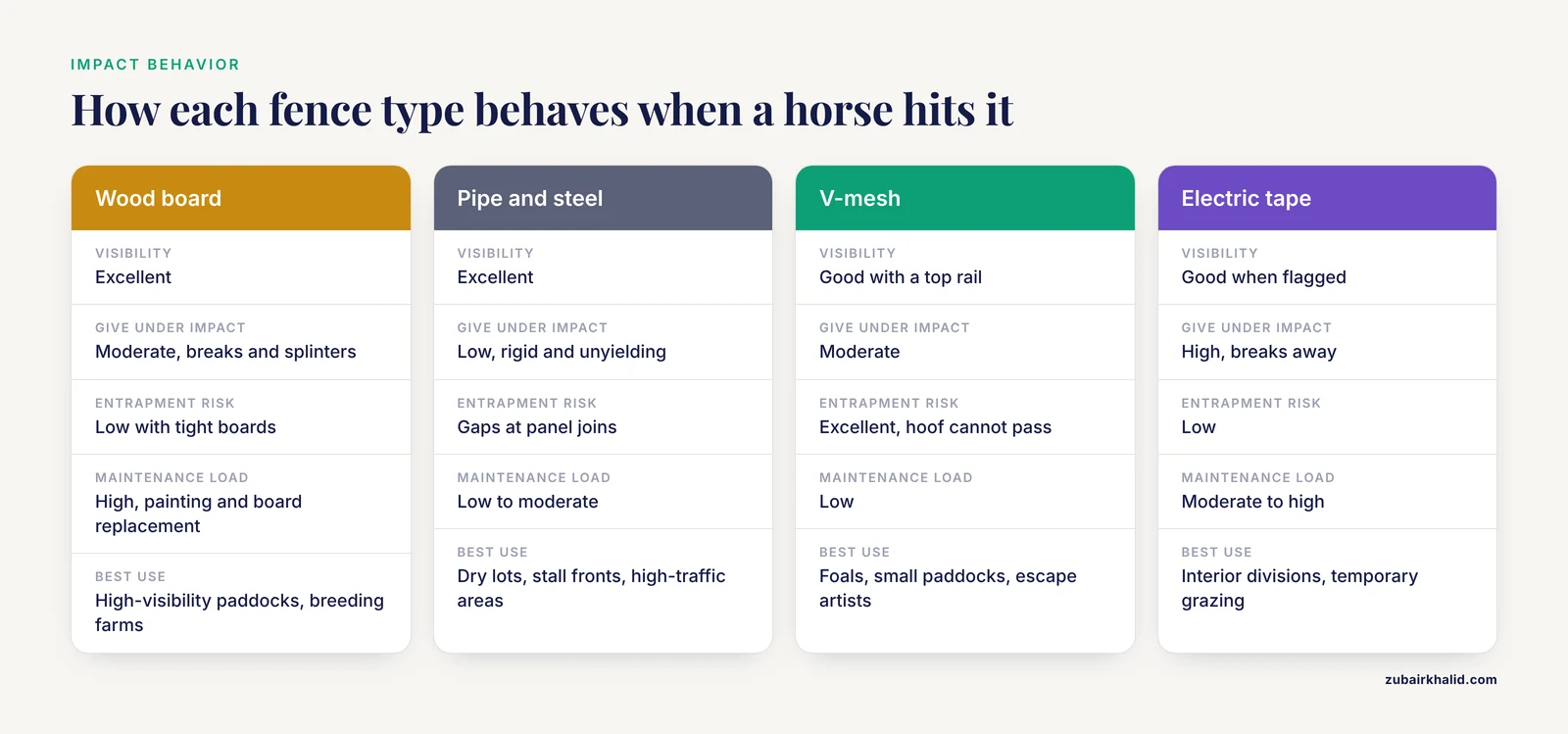
Product pages compare price and panel width. Horse owners should compare these five criteria.
1. Visibility
A fence a horse cannot see is a fence it will hit. Wood, vinyl, and pipe win here. Mesh and wire products need a top rail or high-visibility markers. Ethnographic research on how residents actually use planned environments found that people routinely adapt and repurpose built spaces in ways designers never intended, creating friction between the official design and daily life [3]. Fencing shows the same pattern. The fence as installed on the plan is not the fence as your horses experience it at dusk, in fog, or after a storm knocks a rail loose. Design for how horses actually use the space, including the corner where they always canter and the gate they always crowd.
2. Give Under Impact
Rigid fences injure. Flexible fences bruise. The safest designs either flex, break away, or present a surface that slows the horse without stopping it instantly. Evaluate every product by asking what happens at a full gallop collision.
3. Entrapment Risk
The deadliest fence failures involve entrapment rather than impact. Openings that admit a hoof but not its release, gaps under gates, and gaps between the fence and a corner post are the classic culprits. Mesh with small, fixed openings and tight construction at corners and gates reduces this risk.
4. Maintenance Reality
Every fence decays. The honest question is whether your maintenance plan matches the product. Wood needs annual attention. Electric needs voltage checks. Pipe needs rust watch. Vinyl needs occasional cleaning and hardware checks. The best fence is the one you will actually inspect.
5. Fit With Your Horses
A retired pony pair, a weanling, a boarded school horse string, and a stallion need different fencing. Match the fence to the animals, not to the catalog photo.
Worked Scenarios
Scenario 1: The boarding facility with mixed traffic
A facility takes boarders' horses of all ages and handling levels. Owner control over individual horses is limited, so the perimeter must be the strongest layer. A good configuration is woven wire or V-mesh on the perimeter with a visible top rail, wood or flexible rail on high-traffic interior paddocks, and electric tape only for temporary grazing divisions checked daily. The perimeter never depends on power.
Scenario 2: The homestead with two retired geldings and a foal on the way
Gentle older horses respect almost anything, but a foal changes the math. Foals are small enough to roll under rails, curious enough to investigate mesh, and fragile. Before the foal arrives, replace or reinforce fencing in the foal's paddock with small-opening mesh or closely spaced boards with no gaps a small hoof or head can enter. Leave the decorative four-rail wood for the grown horses' paddocks.
Scenario 3: The budget-conscious owner with twenty acres
Long perimeters strain any budget. A practical approach is high-tensile smooth wire or woven wire on the far perimeter with strong visible markers, paired with a high-quality physical fence, such as wood or mesh, on the areas where horses spend concentrated time near the barn, gates, and roads. Put the money where the risk is.
Common Mix-Ups Owners Make
These are the mistakes that show up in emergency calls and repair bills.
- Using single-strand electric as the only fence around a road or a stallion pen. Electric is a training tool, not a physical barrier.
- Installing woven wire without a top rail, then discovering the hard way that horses walk into what they cannot see.
- Leaving a gap between the gate and the fence line, or a space under a gate, that fits a muzzle or a hoof.
- Assuming pipe fence is automatically safe because it is strong. Rigid pipe along a gallop path is an impact hazard, and rusty welds become razors.
- Ignoring the fence after installation. Fence failures are usually gradual. A loose insulator in October is a loose wire dragging across the paddock in December.
- Placing a hot strand at a height that catches a grazing muzzle or a halter buckle rather than the horse's nose.
- Storing hay, feed, or equipment close enough to the fence line that horses lean, reach, and develop fence-testing habits.
Fencing as Part of Your Horse Care Checklist
Fencing does not stand alone. It is one layer in a system that keeps a horse healthy and content. Mellor's welfare framework emphasizes that welfare is maintained through continuous management, not one-time fixes [1]. A fence inspection belongs on your routine horse care checklist alongside feed, water, and hoof care.
A practical weekly horse care checklist looks like this:
- Walk or ride the full fence line, checking boards, wires, insulators, and gate hardware
- Test electric fence voltage with a meter, not by touch
- Check water troughs for cleanliness, function, and access from every paddock
- Confirm feed storage is secure and out of fence-reach
- Look for loose boards, protruding nails, broken insulators, and sagging wire
- Observe each horse moving at a walk and trot for early lameness signs
- Check body condition and coat, and note anything unusual in behavior or appetite
- Confirm shelter from sun, wind, and rain is accessible in every turnout area
A Simple Horse Health Record Template
Pair your fence inspections with a health record. A fence line walk often doubles as the moment you notice a scratch, a loose shoe, or a dull coat, so capture those observations in one place. A basic horse health record template can live in a binder or a spreadsheet.
| Field | Entry |
|---|---|
| Horse name and ID | |
| Date | |
| Weight or body condition score | |
| Vaccinations due or given | |
| Dental check or float date | |
| Farrier visit and notes | |
| Deworming or fecal egg count results | |
| Injuries or illness, with treatment and follow-up date | |
| Fence or facility hazards found and repaired | |
| Veterinarian contact and next scheduled visit |
The fence row matters more than owners expect. Recording that you fixed a broken insulator on a date creates a paper trail if a horse later injures itself at that spot, and it tells you which sections of fence fail repeatedly and need redesign rather than another patch.
Limitations and When to Contact a Veterinarian
This article describes general fencing principles and common configurations. Individual properties, individual horses, and individual injuries vary, and decisions about your specific horses should be made with your veterinarian and an experienced fence installer who can see your terrain.
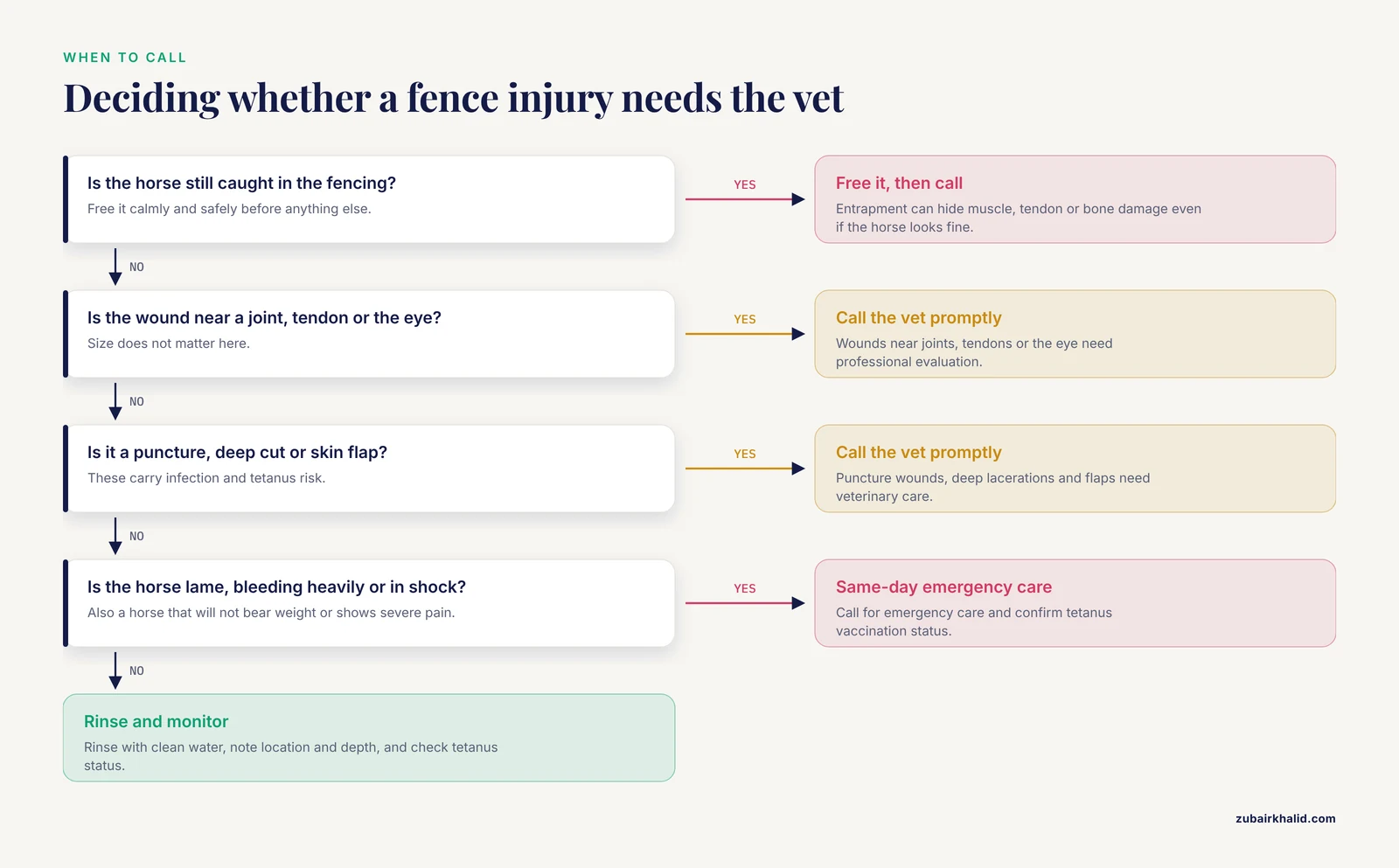
Contact your veterinarian promptly, or call for same-day emergency care, in these situations:
- Any wound near a joint, tendon, or the eye, regardless of size
- Any puncture wound, deep laceration, or wound with a flap of skin, because these carry infection and tetanus risk
- A horse caught in fencing, even if it appears unharmed afterward, since entrapment injuries can involve hidden muscle, tendon, or bone damage
- Obvious lameness, heat, or swelling after any fence contact
- A horse that will not bear weight, or that shows severe pain, bleeding that does not stop, or signs of shock
- Any suspected injury in a foal, which can deteriorate quickly
- Colic signs, such as rolling, pawing, flank watching, or refusing feed, which can occur after stress or injury even when the fence itself is not the cause
Tetanus vaccination status should be confirmed with your veterinarian whenever a horse suffers a wound.
Frequently Asked Questions
What is the safest fencing for horses?
The safest fencing is highly visible, has no openings that can trap a hoof or head, and either flexes or breaks away under impact. V-mesh with a top rail and well-maintained board fencing sit at the top of most lists, while rigid pipe and unflagged wire sit at the bottom for open paddocks.
Is electric fencing safe for horses?
Yes, when it is correctly installed, clearly visible with tape, rope, or flags, and tested regularly, and when it serves as a divider or supplement rather than the sole physical barrier. A dead charger turns an electric fence into a suggestion, so voltage testing is part of ownership.
How tall should a horse fence be?
A fence should be tall enough that your horses cannot casually lean over it or reach feed and grass on the other side, and many owners use the horse's wither height as a mental benchmark. Terrain, horse size, and horse behavior all affect the answer, so confirm specifics with your installer for your property.
How often should I inspect my horse fencing?
Walk the fence line at least weekly, plus after every major storm, and do a quick visual check of turnout areas daily when you bring horses in or turn them out. High-traffic corners and gates deserve closer attention because that is where most damage starts.
Can I use cattle fencing for horses?
Generally no, not without modification. Cattle fencing is built for animals that do not test boundaries the way horses do, and typical cattle wire configurations leave openings and visibility problems that create hoof and head entrapment risks for horses. Choose horse-specific products or add a visible top rail and horse-safe mesh.
What should I do if my horse cuts itself on the fence?
Rinse the wound with clean water, note its location and depth, and call your veterinarian if it is deep, near a joint or tendon, puncture-like, bleeding heavily, or if your horse is lame. Even minor-looking wounds near joints deserve professional evaluation, and tetanus status should be verified.