Questions to Ask Your Equine Vet: Template and Examples
By Dr. Zubair Khalid, DVM, MS, PhD ·
The most useful questions to ask your equine vet fall into six groups: what is wrong and how sure are we, what are the treatment options and their tradeoffs, what will this cost, what should I do at home, when do we recheck, and when should I call you back urgently. Write your questions down before the visit, lead with the two or three that matter most, and end every appointment by asking what change you should watch for at home and what should trigger a phone call.
This guide gives you a reusable question format, complete templates for wellness exams, sick visits, and new-horse evaluations, a filled-in example you can copy, and the horse care checklist and health record structure that make those conversations productive.
This article is educational and is not a substitute for veterinary diagnosis or treatment.
At a Glance: Your Pre-Visit Checklist
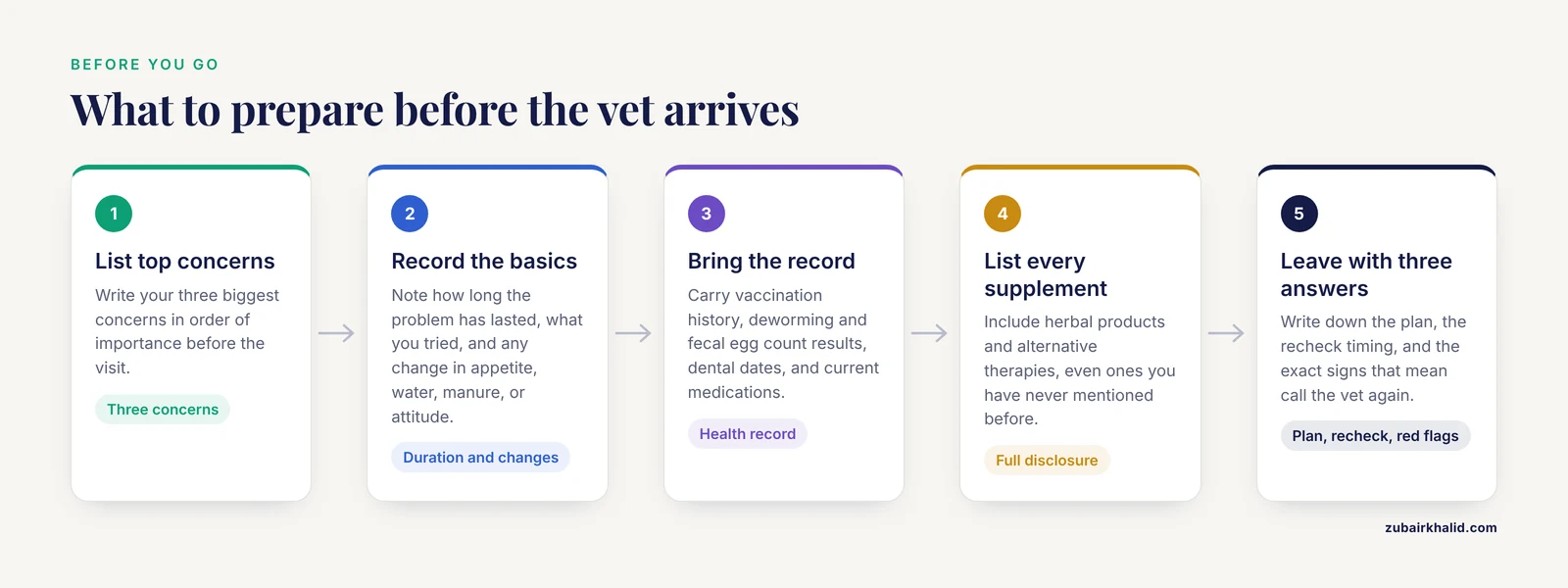
Before any scheduled appointment, do the following:
- Write down your top three concerns in order of importance.
- Record the basics: how long the problem has lasted, what you have already tried, and whether appetite, water intake, manure output, and attitude have changed.
- Bring your horse health record, including vaccination history, deworming and fecal egg count results, dental dates, and any medications currently given.
- List every supplement, herbal product, or alternative therapy your horse receives, including ones you have not mentioned before.
- Ask whether the visit should happen at your barn or at a clinic, and whether haul-in pricing differs.
- Prepare your budget question so it comes early, not at the door.
- Leave with three answers written down: the plan, the recheck timing, and the exact signs that mean call the vet again.
Why Prepared Questions Matter
Equine veterinary visits are short and often happen in a busy barn aisle with other clients waiting. Owners who arrive with written questions get more out of those minutes than owners who remember a concern halfway through the exam. Research on horse owner behavior shows that owners who actively involve their veterinarian get measurably better outcomes in specific areas. In a survey of more than 4,200 UK horse owners, those who sought veterinary advice were significantly more likely to deworm based on fecal egg count and tapeworm test results rather than on habit, and they ran fecal egg counts more often than owners who did not involve their vet [1]. The pattern is clear across equine care. Asking structured questions changes what actually gets done for your horse.
There is a second reason to prepare. Some topics are hard to raise in person, and owners skip them. Complementary therapies are the classic example. In surveys of Flemish equine veterinarians, 95 percent agreed that owners sometimes use complementary or alternative treatments without telling the vet, and roughly half of conversations on the topic were initiated by the owner rather than the clinician [2]. If you want your vet to have the full picture, you usually have to be the one who brings it up.
A Simple Format for Questions That Get Answers
A good question has three parts. Vague questions produce vague answers, so use this format for anything that matters.
- Context. One sentence of background. "My 12-year-old gelding has been refusing the right lead for three weeks."
- The actual question. Ask it directly. "What are the three most likely causes, and what would you do to tell them apart?"
- The follow-up. Tie the answer to action. "What should I change in his work schedule until we know, and when do we recheck?"
Keep each question to one topic. Ask about cost as its own question, not buried inside a medical one. If your vet uses a term you do not know, ask "What does that mean in plain language, and what would it change if the answer were yes instead of no?"
A pocket template you can reuse:
- Problem: (one sentence)
- How long: (days or weeks)
- What I have tried: (list)
- My top question:
- My second question:
- What change at home should I watch for:
- When do we recheck:
- When do I call urgently:
Preventive Care and Wellness Visit Questions
The annual or twice-yearly wellness exam is where most owners under-ask. Bring this list and adapt it to your horse.
Vaccination questions:
- Which vaccines does my horse need this year, and which are legally required in my state versus simply recommended?
- What is the difference between the core vaccines and the risk-based ones for how my horse is kept and where he travels?
- If my horse is overdue, how do we restart safely?
- Are there documentation requirements for shows, boarding, or interstate travel that I should keep in his record?
Vaccination decisions benefit from this conversation. A large survey of UK horse owners found an overall equine influenza vaccination rate of 80 percent, with significantly lower rates among owners keeping more than five horses and among horses that never left home premises, and welfare concerns plus competition requirements were leading motivators for those who did vaccinate [3]. Ask your vet directly how your horse's lifestyle maps onto those risk categories, because a horse that stays home and a horse that trailers to shows every weekend sit at different points on that curve.
Parasite control questions:
- Should we deworm based on fecal egg count results this year instead of a fixed calendar schedule?
- What did my horse's last egg count show, and does that change the product or the timing you recommend?
- Should all horses on my pasture be treated together, and how do we handle new arrivals?
- Can we check whether the products we are using still work on my farm?
These questions matter because deworming practices vary enormously between owners. In the Project WORMS owner survey, just over half of owners administered anthelmintics based on fecal egg count or tapeworm test results, while 30 percent treated at least annually regardless of any test, and moxidectin was the first-choice product for more than 80 percent of respondents [1]. On shared livery yards, managers made the deworming decision for roughly 40 percent of horses [1]. If you board, one of the best questions you can ask your vet is how to coordinate a test-based program with a yard manager who controls the calendar.
Other wellness topics to cover at least yearly:
- Dental: "When did he last have a full oral exam under sedation, and does anything in his chewing or dropping feed suggest we should look sooner?"
- Weight and diet: "Is his body condition where you want it, and what specifically should change, if anything?"
- Senior horse screening: "Given his age, what baseline tests or exams would you recommend this year that we did not do last year?"
- Biosecurity: "If a fever or cough appears at my barn, what do you want me to do first, and what is your protocol for potentially contagious horses?"
Sick-Visit and Emergency Questions
When something is wrong, your questions should sharpen the diagnosis and define the plan. Ask:
- What are the most likely explanations for what I am seeing, and which of them are time-critical?
- What tests do you recommend right now, which can wait, and what would each result change about treatment?
- What is the treatment plan, how long until I should see improvement, and what does improvement look like specifically?
- What should I do at home tonight: hand-walk, stall rest, remove feed, offer water?
- What exact signs mean call you back tonight rather than wait until morning?
- What signs mean this becomes an emergency clinic situation even if you are the one I usually call?
- What will this cost, and is there a meaningful difference between the plan you recommend and a less expensive alternative?
The last question deserves an early spot in the conversation. Ambulatory practices make deliberate decisions about which equipment and technology they carry to the barn, and those investment choices shape what can be done on your farm versus what requires hauling [4]. Asking "Can that be done here today, or does my horse need to go to the clinic?" early in a sick visit prevents surprise logistics later.
Diagnostics, Lab Work, and Technology Questions
Modern ambulatory practice carries a surprising amount of capability, but owners rarely ask what is actually available. Reasonable questions include:
- What diagnostic equipment do you bring to the farm, and what requires a clinic visit?
- When you send bloodwork or samples to a lab, which lab do you use and how long do results typically take?
- Will I get a copy of the lab report for my records?
- Do you use any digital records, images, or telemedicine follow-ups, and how do I access them?
Ambulatory equine practitioners weigh client expectations directly when deciding which technologies to invest in, so asking what your practice has on the truck is a fair and useful question rather than an awkward one [4]. If a test is delayed or a result seems unclear, a direct follow-up question is appropriate. Diagnostic laboratories themselves have emphasized that they can handle substantial testing volume and want veterinarians to use them, which means a slow result is worth a phone call to the practice, not a shrug [5].
Medications, Pain Control, and the Vet-Client Relationship
Two areas deserve explicit questions from every owner.
Prescription and controlled medication questions:
- Does my horse have an established veterinary-client-patient relationship with your practice, and what does that require before you can prescribe or treat?
- What pain medication are we using, what dose, how often, and for how long?
- What side effects should I watch for, especially with anything affecting the gut or kidneys?
- How should I store and dispose of leftover controlled or prescription medications?
- If I need a refill or a repeat dose, what is the process?
Research on veterinary "vet shopping," the practice of soliciting multiple clinics for prescription medications, has highlighted how heavily the profession relies on a valid veterinary-client-patient relationship to keep controlled drug use safe and legal [6]. On the owner side, that same relationship protects you. It means your horse's medication history lives with one practice that knows the whole picture, and it gives you a legitimate channel for refill questions. Ask your practice how they document it.
Practical medication questions for any prescription:
- Can this be given by mouth, and will he eat it in feed?
- Who gives the next dose if I cannot be there?
- Should we recheck bloodwork or physical exam findings while he is on this?
Complementary and Alternative Therapies
Many owners use acupuncture, chiropractic, osteopathy, massage, or herbal supplements, often alongside conventional care. Surveys suggest that up to 75 percent of horse owners have used some form of complementary or alternative veterinary medicine, and that non-disclosure of these treatments to the vet is common [7]. The veterinary profession expects this. In one survey, 98 percent of equine vets had discussed complementary therapies with clients and 81 percent described themselves as open to those conversations [2]. Silence, not the therapy itself, is the risk, because some products and treatments can interact with conventional care or delay a diagnosis that needed conventional workup.
Ask your vet:
- I am using (or considering) this specific therapy or product. Do you see any conflict with the current treatment plan?
- Is the person providing it appropriately qualified and, where required, working under veterinary direction?
- How will we know whether it is helping, and what timeframe should we use before we reassess?
- If we try this instead of, or alongside, conventional treatment, what worsening signs mean we switch back or add conventional therapy?
Research on how these conversations unfold found that vets most often bring up complementary options themselves as one of several treatment choices or as an addition to conventional treatment, and that whether they mention it depends heavily on the specific problem being treated. That means the door is usually open if you walk through it. Reporting everything your horse receives is one of the single most protective habits you can build, and the disclosure gap documented in practice, where treatments routinely happen without the vet knowing, exists largely because owners assume the conversation will go badly [2].
Referral and Specialist Questions
Some problems warrant a specialist. If your vet mentions a heart murmur, a suspicious mass, a complex lameness, or anything requiring advanced imaging, ask:
- Is this something you are comfortable managing here, or should we refer?
- What would a specialist add, and what would the referral involve logistically?
- What information or test results should go with my horse to that appointment?
- How will the specialist's findings get back to you so we keep one coordinated plan?
Specialist input can change the picture meaningfully. Expert discussions in veterinary cardiology, for example, illustrate how focused questions from referring vets and owners shape the workup of cardiac cases, from what the murmur grade means to when echocardiography changes management. You do not need to know the technical details in advance. You need to ask whether referral is on the table and, if it is, what question the specialist visit is meant to answer.
Question Templates by Visit Type
Template: Annual Wellness Exam
- Based on his age, use, and where he lives, what does this year's preventive plan look like?
- Which vaccines, and why those?
- What do his teeth look like, and is the next dental exam due before or after next winter?
- What did the last fecal egg count show, and what is the plan this season?
- Is his weight, topline, and coat where you expect it for his age and workload?
- Are there baseline diagnostics you would recommend this year?
- What is the single most important thing I can do for him between now and the next visit?
- What does his emergency plan look like, and do you have a current copy of his history on file?
Template: New Horse or New Vet First Visit
- Here is his full history. What would you prioritize in a first evaluation?
- Are his vaccination and deworming records complete, and do any gaps need fixing now?
- Does anything in this exam change how I should be feeding or working him?
- What are his baseline vital signs, and can I get those numbers for my records so I know what normal looks like for him?
- Do you see anything today that is not urgent but will probably need attention within a year?
- What is your emergency protocol for my barn, and who covers after hours?
Template: Lameness or Performance Problem
- Where exactly do you think the pain is coming from, and how confident are you?
- What blocks, imaging, or tests would confirm it, in what order, and what does each step cost?
- If we find the cause, what are the realistic treatment options and their expected outcomes?
- What should his work schedule look like while we work this up?
- When do we reassess, and what improvement would tell us we are on the right track?
Template: Senior Horse Check-In
- Given his age, what conditions are most likely to affect him in the next few years, and what early signs should I watch for?
- Does he need any screening this visit that we have not done before?
- Is his current diet still right for an older horse with his teeth and workload?
- At what point would you want to discuss quality of life or changing expectations, and how do those conversations usually go?
A Worked Example
Here is how one real-world scenario looks when the template is filled in.
Problem: My 9-year-old mare has been eating her grain slowly and dropping partly chewed hay for about six weeks.
How long: Six weeks, gradually worsening.
What I have tried: Switched to soaked hay, no change in the dropping.
Top question: Are her teeth the most likely cause, and does she need a full oral exam under sedation now or can we watch and recheck?
Second question: If it is her teeth, does she need any follow-up after the float, and how soon?
At home: Should I keep soaking hay, and should I add anything to make chewing easier in the meantime?
Recheck: If you do the exam today, when do we confirm the problem is resolving?
Call urgently if: What specific sign, such as not finishing any feed or dropping feed entirely, would make this urgent rather than scheduled?
Notice that the owner brings the timeline, the trials, and the observation in specific terms. That specificity is what lets the vet skip twenty minutes of history-taking and go straight to answering.
Horse Health Record Template
A health record turns every vet conversation into a shorter one. Keep one page or one document per horse with these sections:
- Identity: name, registration or microchip number, age, breed, sex, height, and a current photo.
- Vaccination log: product, date given, vet who administered it, and next due date.
- Parasite control log: date, fecal egg count result, product used, and next test date.
- Dental log: date of exam, findings, and work performed.
- Medical history: each illness or injury, diagnosis, treatment, duration, and outcome.
- Medication log: drug, dose, route, frequency, start and stop dates, and any reactions.
- Baseline data: normal temperature, pulse, respiratory rate, and weight for this specific horse, recorded when he is healthy.
- Farrier records: trim and shoeing dates, and any hoof-related comments.
- Insurance and ownership documents: policy numbers, Coggins or test results required for travel, and boarding agreements.
- Contact sheet: your vet, emergency clinic, backup vet, farrier, and barn manager.
Updating this record within a day of every vet visit is the habit that makes the rest of this article work. When the vet asks when the last egg count was or what dose he received last spring, the answer is one page away.
Horse Care Checklist
Pair the health record with a routine checklist. This list covers observation and logistics, not treatment:
Daily:
- Note appetite, water consumption, and manure output.
- Check for heat or swelling in the legs before and after work.
- Scan for wounds, discharge from eyes or nose, or changes in attitude.
Weekly:
- Check body weight or condition visually and by feel.
- Inspect fencing, waterers, and feed storage.
- Review whether any medication or supplement course needs a refill call to the vet.
Monthly:
- Update the health record with anything that changed.
- Confirm upcoming appointments: dental, farrier, vaccination due dates.
Seasonally:
- Review the parasite control plan with test results rather than habit.
- Reassess diet and workload as weather and turnout change.
- Refresh the emergency contact sheet and confirm after-hours coverage.
Each item on this list feeds the questions you bring to the next appointment. The checklist is also where you will notice the pattern that deserves a vet call, such as a horse who drinks less every day for three days, which is a question for your vet rather than a wait-and-see item.
Common Mistakes Owners Make
- Saving the cost question for last. Ask it early so the plan can be shaped to your budget while options still exist.
- Withholding information about supplements and alternative therapies. Surveys show this happens constantly and it works against your own horse [2].
- Accepting vague follow-up instructions. "Call if he gets worse" is not a plan. Ask what "worse" means in concrete terms.
- Treating the annual visit as a formality. The wellness exam is where risk factors specific to your horse get discussed. Arriving with questions changes what gets covered.
- Failing to write things down. Memory fades in the truck on the way home. Write the plan, the recheck date, and the red flags before you leave the barn aisle.
- Not asking who to call after hours. Emergency coverage varies by practice, and the answer should be on your contact sheet before you need it.
Troubleshooting a Conversation That Isn't Working
If your questions are getting short answers, try three moves. First, ask for the reasoning: "What makes you lean toward that diagnosis over the other options?" Second, ask for the decision point: "What result or finding would make you change this plan?" Third, if a topic keeps getting deflected, schedule a specific consultation for it rather than trying to handle it in the last two minutes of a vaccination appointment. Practices generally accommodate this, and it mirrors the way good diagnostic conversations are structured, with the expert given room to answer a defined question rather than a vague worry.
If you feel your vet is not open to discussing a therapy or approach you want to use, say so directly. The survey data show most equine vets describe themselves as open to these conversations and have them daily or weekly [2]. Naming the discomfort usually dissolves it.
Limitations and When to Contact a Veterinarian
Every horse is an individual, and the templates here are conversation tools, not medical advice. Your vet's recommendations for your specific horse, based on an actual examination and your local conditions, always take precedence over general guidance.
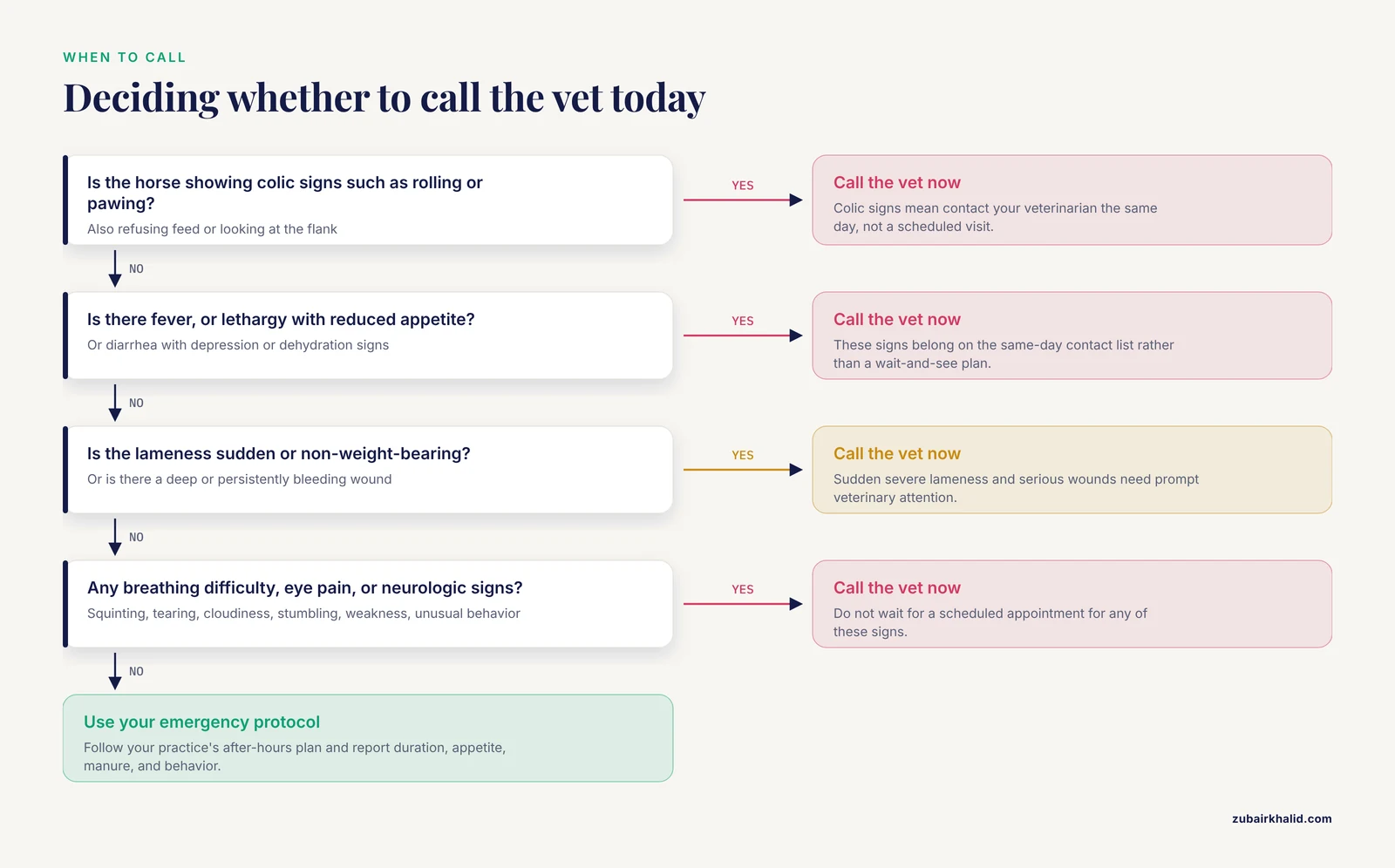
Contact your veterinarian promptly, the same day, if your horse shows any of the following, and treat this list as a floor rather than a ceiling:
- Signs of colic, including rolling, pawing, looking at the flank, or refusing feed
- Fever, or lethargy combined with reduced appetite
- Diarrhea, especially with depression or dehydration signs
- Nasal discharge with cough or fever in a horse that has recently traveled or mixed with new horses
- Sudden or non-weight-bearing lameness
- Wounds that are deep, bleeding persistently, or near a joint
- Eye pain, squinting, tearing, or cloudiness
- Difficulty breathing or distress at rest
- Any neurologic signs, including stumbling, weakness, or unusual behavior
For anything on this list, do not wait for a scheduled appointment. Follow your practice's emergency protocol, which is exactly why you asked about it in advance.
Frequently Asked Questions
How often should my horse see the vet?
At minimum once yearly for a wellness exam and core vaccinations, though many practices recommend twice-yearly visits for senior horses, breeding animals, or horses in heavy work. Ask your vet what interval fits your horse's age, use, and housing situation, and put the due dates in your health record.
What should I ask a vet at my first visit with a new horse?
Ask for a prioritized first evaluation, whether vaccination and parasite records have gaps, what the horse's baseline vital signs are, and what the practice's emergency protocol is for your barn. Also ask whether anything found on the exam is likely to need attention within the next year.
Should I tell my vet about herbal supplements or alternative therapies my horse uses?
Yes, always, including products you buy without a prescription. Vets report that treatments often happen without their knowledge, which prevents them from spotting interactions or delaying needed diagnostics. Most equine vets are open to these conversations and have them routinely.
What should I ask before deworming my horse?
Ask whether deworming this season should be based on a fecal egg count rather than a fixed calendar, what the last count showed, whether all horses on the pasture should be treated together, and whether product effectiveness should be checked. Owners who involve their vets in this decision are much more likely to use test-based programs.
What questions should I ask if my vet finds a heart murmur?
Ask what the murmur grade means, whether further testing such as echocardiography is recommended, whether it affects the horse's current use, and whether a referral to a cardiology specialist would add value. Ask what signs at home, if any, should prompt a recheck sooner.
What should I ask about sedation and pain medication?
Ask what drug is planned, the dose, how long the effect lasts, what side effects to watch for, and whether the visit requires an established veterinary-client-patient relationship before any prescription can be written. Also ask how refills and leftover medication disposal are handled.
How do I prepare for an emergency vet call?
Before an emergency happens, confirm who covers after hours, keep directions and a gate code available, and know your horse's baseline temperature, pulse, and respiratory rate from your health record. During the call, report what you see in specific terms: duration, appetite, manure, and behavior.
What should go in a horse health record?
Include identity details, a vaccination log with products and due dates, parasite control with egg count results, dental exam dates, a complete medical and medication history, baseline vital signs, farrier records, insurance and travel documents, and a contact sheet for the vet, emergency clinic, and farrier.
Sources
- Project WORMS (working to overcome resistance and make for a sustainable future): Horse owner survey of equine parasite control. Part 2. Anthelmintic use
- Flemish equine veterinarians' perceptions on the use of and client communication about complementary and alternative veterinary medicine.
- Equine Influenza Vaccination Uptake By Horse-Owners And Factors Influencing Their Decision To Vaccinate
- Technology and the ambulatory equine practitioner: implementing and affording the 21st century.
- ‘Let us help you with testing,’ say vet labs
- Veterinarians’ attitudes and practices regarding opioid-related vet shopping practices in tri-state Appalachian counties: an exploratory study
- Discussing complementary and alternative veterinary medicine: equine veterinarians’ perceptions