Pony Healthy Weight: Body Condition and Weight Charts
By Dr. Zubair Khalid, DVM, MS, PhD ·
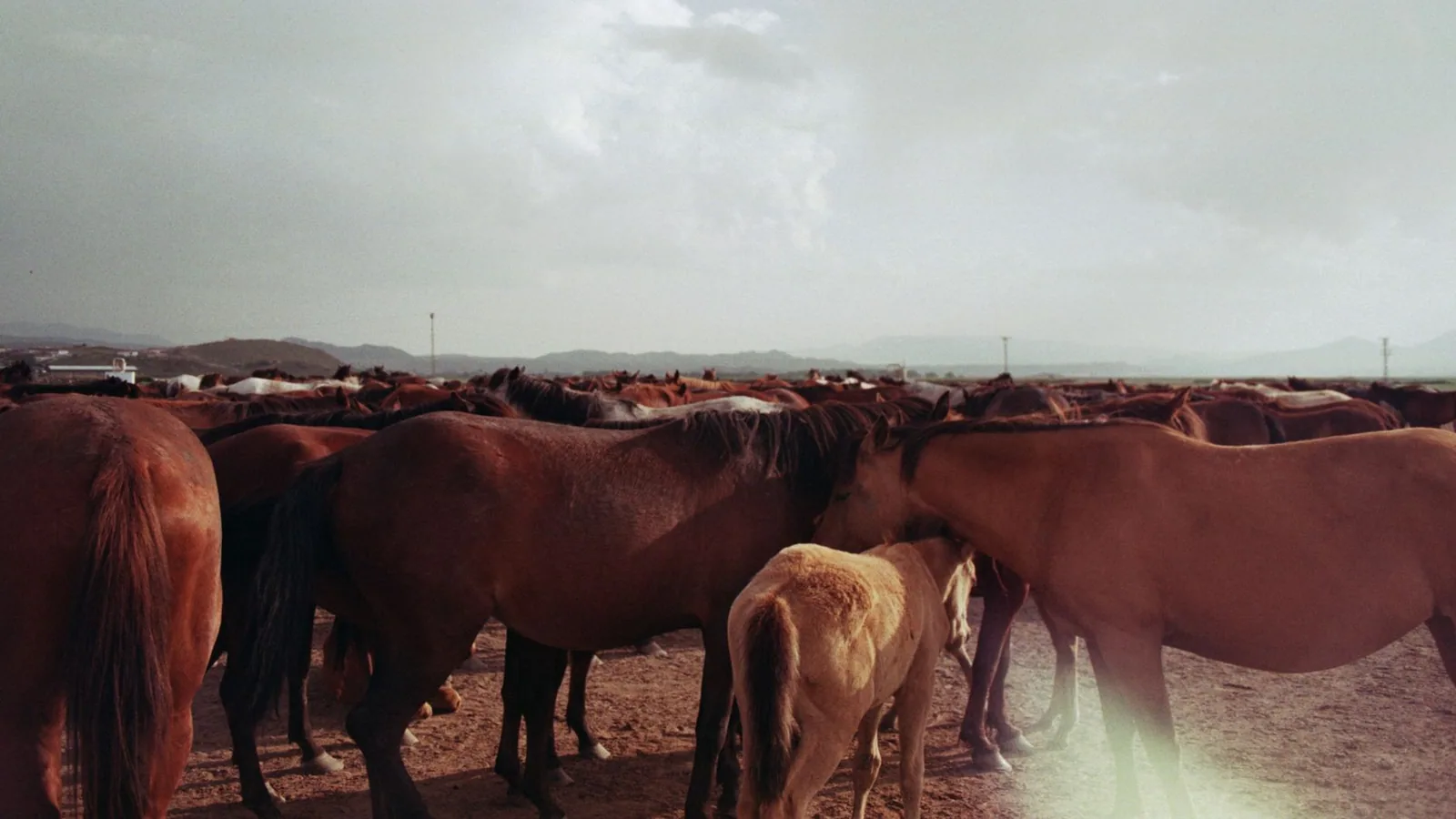
A healthy pony is not defined by a number on a chart. A healthy pony is defined by body condition, and for most adult ponies that means a body condition score of about 5 on the 9-point Henneke scale, a quiet crest on the neck, and ribs you can feel but not see. Ponies are among the most overweight animals in the leisure-horse world. In one Australian survey, researchers classified 71.5 percent of Shetland ponies and 32 percent of other pony types as obese, compared with 9.3 percent of horse breeds, and owners consistently judged their own animals as thinner than the researchers did [1]. In a British survey, native breeds and Welsh ponies were roughly three times more likely to be obese than Thoroughbreds [2]. Those numbers tell you the real question is not "how much should a pony weigh" in pounds, but "is my pony carrying too much fat," and that is a question you answer with your hands, a height stick, a weight tape, and your veterinarian.
This article walks you through what a pony healthy weight looks like, how to score body condition and cresty neck fat, why standard weight charts often mislead pony owners, and how to help a pony lose weight safely and without wrecking its welfare.
At a Glance: A Weekly Pony Weight Check
| Step | What to do | What "healthy" looks like |
|---|---|---|
| , - | , - | , - |
| 1 | Run your fingers over the ribs | Ribs easily felt with light pressure, not visible from a distance |
| 2 | Look at and palpate the neck crest | Symmetric, soft but not thickened or fallen to one side |
| 3 | Assess the hindquarters and tail head | No fat pads over the rump or croup, no dimpling |
| 4 | Photograph the pony from the side, front, and rear | Photos let you spot gradual fat gain you would otherwise miss |
| 5 | Record body condition score (BCS) and cresty neck score (CNS) | Target BCS around 5/9, CNS below 2/5 |
| 6 | Girth tape and height measurement monthly | Trend matters more than any single number |
| 7 | Contact your veterinarian | BCS of 7/9 or higher, CNS of 3/5 or higher, or any lameness or laminitis signs |
What a Healthy Pony Weight Actually Means
The body condition score system
The standard tool is the Henneke body condition score, which runs from 1 (poor) to 9 (extremely fat), with 5 described as moderate [3]. The score is assigned by palpating fat at six sites: the neck, withers, behind the shoulder, over the ribs, across the loin, and around the tail head. Fat is deposited in that order as a pony gains condition and mobilized in roughly the reverse order as condition drops.
For mature horses and ponies, a score of 5 is the ideal target and 6 is acceptable for some individuals. Scores of 7 and above are classified as overweight and obese in research and in veterinary practice. In one study of mature Icelandic horses, owners and an experienced assessor scored the animals on this scale, and 13.8 percent were overweight (BCS 7) and 10.2 percent were obese (BCS 8 to 9), while 70 percent sat in the optimal 5 to 6 band [3]. That distribution is a reasonable picture of what "healthy on a population level" looks like, and it shows how many animals sit just above the target.
The cresty neck score
Body condition scoring alone misses one of the most metabolically important fat depots in ponies, which is the neck crest. The cresty neck score runs from 0 to 5, and scores of 2.5 or higher were recorded in 29 percent of a large sample of Connemara ponies, while 67.5 percent of those ponies showed regionalized fat deposits such as a crest, shoulder patches, or tail head pads [4]. In a study of Shetland and Welsh ponies in Australia, a cresty neck score of 3 or higher was associated with higher insulin concentrations after an oral sugar test, an indicator of insulin dysregulation [5]. In practical terms, a hard, fat, or laterally displaced crest is a red flag even when the ribs still feel reasonable.
Why hands beat eyes
Fat over the ribs is easy to feel and hard to see, which is exactly why so many owners miss it. Photographs taken monthly from the side, front, and rear reveal changes the eye adapts to day by day. Palpation through a winter coat or a fluffy native-type coat requires firm finger pressure, not a light touch.
How Much Should a Pony Weigh?
The problem with fixed weight charts
Breed, height, frame, muscle, and fat all change what a pony should weigh. Two 13.2-hand ponies of the same breed can differ by a wide margin in healthy weight depending on conformation and workload. Research supports individual assessment over fixed targets. A body condition index derived from objective morphometric measurements, including girth, length, and neck measures, correlated well with measured percent body fat in ponies, but the relationship varied notably between breeds, particularly in Shetlands and miniature ponies, presumably because of differences in body shape [6]. If a formula built from measurements shifts in accuracy between breeds, a one-size-fits-all chart in pounds will mislead even more often.
That said, weight estimation has a place. Weight tapes and girth-to-height ratios provide a repeatable trend line. In the Icelandic horse study, both girth circumference to height ratio and neck circumference to height ratio increased as body condition score increased, and the authors suggested that a girth to height ratio above 1.21 may indicate overweight or obesity in that breed [3]. Ask your veterinarian whether a breed-specific ratio applies to your pony. For actual pounds, an electronic livestock scale at a clinic or weighbridge is the only accurate method, and the value of knowing it lies mostly in tracking change over time.
The "easy keeper" problem
Native pony breeds evolved to survive sparse forage, and that biology has not left them. In the British prevalence survey, native breeds were significantly more likely to be obese than Thoroughbreds, Welsh breeds were similarly overrepresented, and owners who described their animal as a "good doer" had nearly four times the odds of owning an obese animal compared with owners of animals that maintained weight easily [2]. Experimental work confirms how easily ponies gain. Seven native-breed ponies with normal insulin and a starting body condition around 5/9 were allowed to graze freely until they reached 7/9, which took only weeks of pasture access, and by mid-study their post-feeding insulin responses were several times higher than at the start [7]. In a separate two-year controlled study, Shetland ponies and warmblood horses fed 200 percent of their maintenance energy requirement gained weight steadily, and the ponies showed diet-associated changes in their fecal microbiota, including a loss of microbial richness [8].
The practical lesson for owners is that a pony's healthy weight is the leanest condition that still looks and feels well, and for most native-type ponies that will be at or below the middle of the condition scale, not at the top of it.
Is My Pony Overweight? A Step-by-Step Assessment
- Score the ribs. Place your fingers flat against the ribcage just behind and below the shoulder and sweep back. You should feel each rib with light pressure. If you must press firmly, or if you cannot feel ribs at all, the pony is carrying excess fat.
- Score the neck. Run your hand along the crest. A healthy crest is soft and symmetric. Fat deposition in the crest region is one of the fat sites scored in the Henneke system [3], and a cresty neck score of 2.5 or higher is common in overweight pony populations [4].
- Check the shoulder and withers. In an overweight pony, fat pads appear behind the shoulder blade and the withers lose their definition.
- Check the loin and tail head. A fat groove along the spine or symmetric fat pads either side of the tail head push the score upward.
- Look for regional fat. Patches of fat at the shoulders, rump, and prepuce or mammary area count as regionalized adiposity, which was present in two thirds of one Connemara population studied [4].
- Compare your assessment with a professional one. Owner perception is the weakest link. In the Australian survey, owners rated their animals significantly lower on a visual scale than researchers did, and the mismatch was statistically robust [1]. Icelandic horse owners did the same, underestimating their horses' condition relative to an experienced assessor [3]. Even experienced pony owners competing at elite hunter shows brought 35 percent obese ponies to a national competition, with a mean body condition score of 6.7 [9].
If your own assessment puts the pony at 7/9 or above, or the crest scores 3/5 or more, treat that as actionable rather than debatable and involve your veterinarian. If you are unsure, ask your veterinarian or an experienced instructor to score the pony alongside you and calibrate your eye and hands.
Why Pony Obesity Matters
Obesity in ponies is not a cosmetic issue. It is the main modifiable risk factor for equine metabolic syndrome and endocrinopathic laminitis, which is painful, recurrent, and sometimes career ending or life ending. The mechanisms documented in ponies include insulin dysregulation and low circulating adiponectin, a hormone produced by fat tissue that is associated with laminitis risk [7].
Several findings from pony research sharpen this picture. In the Australian epidemiological study of Shetland and Welsh ponies, 61 percent of tested ponies showed insulin dysregulation on dynamic testing, and higher insulin concentrations after an oral sugar test were associated with older age and higher cresty neck scores [5]. In the longitudinal grazing study, ponies that moved from body condition 5 to 7 showed significantly higher insulin responses to an oral sugar test and significantly lower adiponectin concentrations, even though some animals in that study did not become hyperinsulinemic, which shows that obesity and metabolic dysfunction are related but not identical [7]. Analysis of data from more than 700 native-breed ponies in England found that total adiponectin was only weakly correlated with body condition score and body weight, meaning some lean-looking ponies can still carry metabolic risk and some overweight ponies have not yet shown it on routine measures [10]. Obesity also alters stress hormone dynamics, since free cortisol concentrations were higher in overweight and obese horses than in lean controls in a study of endocrine status and body condition [11].
The clinical bottom line is that condition scoring identifies risk, but a pony with a normal-looking body can still have insulin dysregulation, so metabolic screening is a conversation worth having with your veterinarian, especially in native breeds and any pony with a crest.
How to Help a Pony Lose Weight
Weight loss in ponies must be deliberate, measured, and monitored, because severe restriction carries its own risks, including hyperlipemia in extreme cases and welfare problems from feed deprivation. The good news is that controlled trials give us real parameters.
Set the energy restriction with your veterinarian
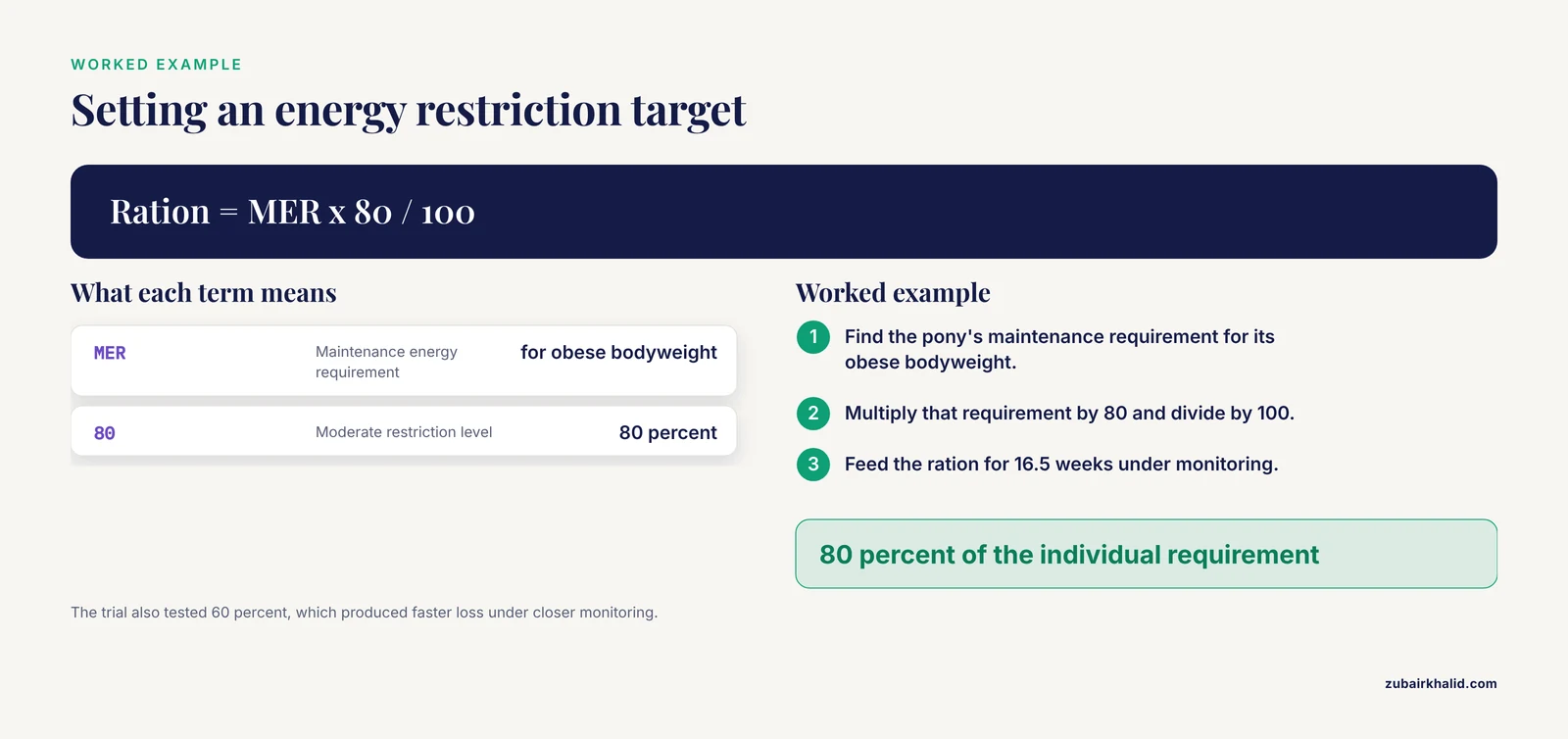
In a trial on 18 obese Shetland geldings, researchers first determined each pony's maintenance energy requirement for its obese bodyweight, then fed groups at 100, 80, and 60 percent of that requirement for 16.5 weeks. The moderately and severely restricted groups both lost weight, the more severe restriction produced faster declines in body condition score, tail head fat, and girth measurements, and no gastric ulceration was observed even in the severe group under that protocol's monitoring [12]. Do not copy those numbers at home. The key takeaways are that restriction must be calculated from an individual energy requirement, that faster restriction works faster but demands closer monitoring, and that a veterinarian should set the target and the timetable.
Choose a grazing system that fits the pony and its welfare
Dietary restriction is the backbone of weight loss, but how you restrict grazing affects behavior. In a crossover study comparing strip grazing with a track system in outdoor-living ponies, ponies on the track system moved more, traveled farther per day, and showed less agonistic (aggressive) behavior than ponies on strip grazing, suggesting track systems better balance weight control with natural movement and social behavior [13]. Strip grazing remains a legitimate tool for limiting grass intake, but pairing it with opportunities for movement and social contact matters.
Use low-intensity movement deliberately
Exercise alone is not a complete answer, but it helps. In a study using a dynamic feeding system that required ponies to walk between stations to obtain forage, daily travel distance increased nearly fourfold, and over three months the ponies' mean body condition score fell from about 6.5 to 5.4, cresty neck scores fell, and measured body fat dropped by roughly 5 percent [14]. Notably, insulin sensitivity did not improve in that window, which reinforces that exercise supports weight loss but does not by itself reverse metabolic dysfunction. Any ridden or in-hand exercise plan for an overweight pony should be approved by your veterinarian, especially if laminitis has ever occurred, because working an inflamed foot makes the disease worse.
Monitor with the same tools you used to diagnose
Track bodyweight or a weight tape reading, body condition score, cresty neck score, and girth measurements on a fixed schedule. The Shetland weight loss trial tracked exactly these morphometric parameters at set time points and found measurable differences between feeding groups within weeks [12]. Recheck photographs monthly. A sensible rhythm is a hands-on condition check weekly during active weight loss and a veterinary recheck at intervals your veterinarian sets, commonly every 4 to 8 weeks, with metabolic testing repeated as indicated.
Protect welfare while restricting feed
Welfare is a legitimate concern during restriction. Ponies on restricted diets can show frustration behaviors, and owners should provide adequate forage within the prescribed ration, continued social contact, and environmental enrichment. If your pony boxes, chews, or paces while on a weight loss plan, report that to your veterinarian so the plan can be adjusted rather than abandoned.
Underweight Is Also a Body Condition Problem
The conversation about pony healthy weight usually focuses on the fat end of the scale, but the thin end matters too, and the causes are not always obvious. Among working ponies on the Indonesian island of Gili Trawangan, more than 39 percent scored 2/5 or lower on a 5-point condition scale, and the researchers linked low condition to management factors, foot pathology, wounds, and limited access to veterinary services [15]. Among semi-feral Konik horses assessed with the Henneke system, body condition scores dropped significantly between summer and early spring, and low condition was associated with negative reactions to human approach, which shows how seasonal forage cycles and social experience shape condition in extensively managed equids [16]. A Swedish study of extensively managed Gotland ponies found that most animals dropped below a condition score of 3/5 at some point during the year and that some needed supplementary feed through winter [17].
Even in domestic herds, body condition is not purely a function of feed. In a study of 116 horses and ponies in 20 herds, lower body condition was associated with less efficient foraging, meaning individuals that spent more time interrupted while eating stayed thinner regardless of dominance rank [18]. In a herd situation, watch whether your pony actually gets its share of hay and grazing, and feed separately if it does not.
Common Mistakes
- Trusting the eye. Owners systematically underestimate their own animals' condition [1][3]. Use hands and photographs.
- Assuming a big belly means good condition. A rounded abdomen in a pony often reflects forage volume and posture, not fat, and can coexist with a topline that is losing muscle.
- Ignoring the crest. Crest fat is metabolically active tissue and a visible marker of metabolic risk [4][5].
- Slashing feed abruptly without veterinary guidance. Rapid restriction can be appropriate but only under a plan that includes forage sufficiency and monitoring, as in the supervised Shetland trial [12].
- Cutting exercise into a laminitic foot. Exercise is part of long-term management, but starting or continuing work in a pony with active foot pain worsens the problem. Have the pony examined first.
- Feeding by tradition. Hard feed, treats, and neighbors' handouts routinely undo a well-designed ration. Everyone who handles the pony, including boarders and children, needs to follow the plan.
- Comparing your pony to other ponies. In a population where a third or more of ponies are overweight [1][2][9], the average paddock neighbor is not a healthy benchmark.
Limitations and When to Contact a Veterinarian
Every individual pony is different, and only your veterinarian, who can examine your animal, can diagnose obesity, insulin dysregulation, or laminitis, and prescribe a specific ration and exercise plan. This article is educational and is not a substitute for veterinary diagnosis or treatment.
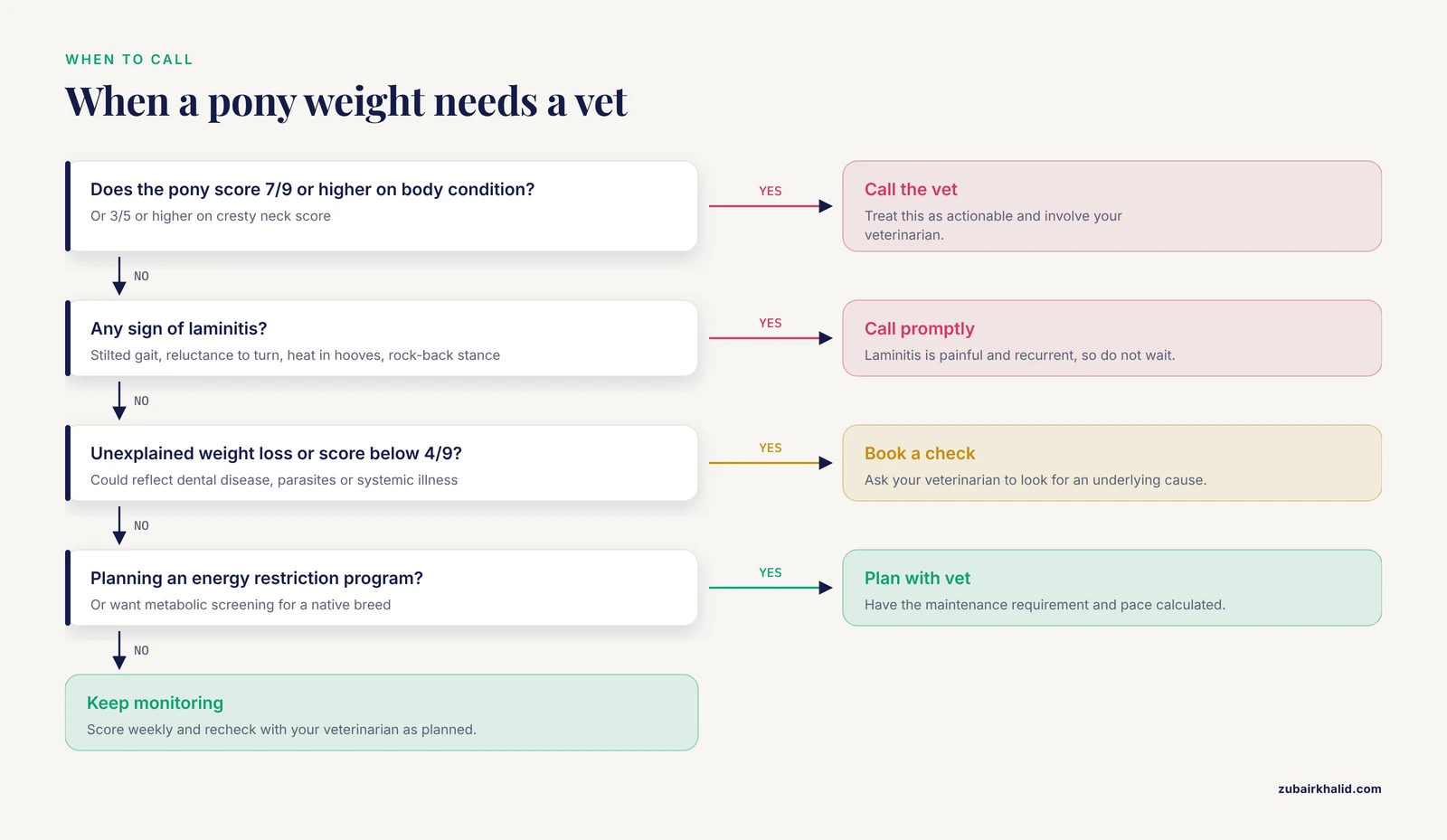
Contact your veterinarian promptly if any of the following apply:
- Your pony scores 7/9 or higher on body condition, or 3/5 or higher on cresty neck score.
- Your pony shows signs of laminitis, including a stilted gait, reluctance to turn, heat in the hooves, increased digital pulses, or a rock-back stance.
- Your pony is losing weight unexpectedly, or scores below 4/9, since weight loss can reflect dental disease, parasites, or systemic illness.
- You are planning an energy restriction program and want the maintenance requirement and rate of restriction calculated for your pony [12].
- You want metabolic screening, which may include basal insulin testing or an oral sugar test, particularly for native breeds or any pony with regional fat deposits [7][5].
- Behavioral changes appear during a weight loss plan, such as persistent agitation, wood chewing, or aggression around feed.
Frequently Asked Questions
How much should a pony weigh?
There is no single correct number for a breed or height, because healthy weight varies with frame, muscle, and fat distribution. Assess condition with the Henneke body condition score and cresty neck score instead, use a weight tape or morphometric ratio to track trends, and ask your veterinarian to help establish a target weight for your individual pony [6][3].
What body condition score should my pony be?
Aim for a body condition score of about 5 out of 9, where ribs are palpable with light pressure and the shape over the loin is smooth but not fat-padded. Scores of 7 and above are classified as overweight or obese in veterinary research [3].
How can I tell if my pony is overweight without a scale?
Palpate the ribs, neck crest, behind the shoulder, loin, and tail head, and look for regional fat pads at the shoulders and rump. Photograph the pony monthly from three angles. Owner visual assessment tends to underestimate condition, so hands-on scoring and occasional professional calibration matter [1][3].
Why are ponies so prone to gaining weight?
Native pony breeds evolved as efficient foragers and are described as good doers, which in modern management translates to rapid weight gain on pasture. In one survey, native and Welsh breeds had roughly three to three and a half times the odds of obesity compared with Thoroughbreds, and Shetland ponies had the highest obesity prevalence of any group studied [1][2].
How fast can a pony lose weight safely?
Restriction rate should be individualized. In a controlled Shetland pony trial, groups fed at 60 and 80 percent of their individual obese maintenance requirement both lost significant condition over 16.5 weeks, with faster loss at greater restriction and no gastric ulcers observed under that monitored protocol. Have your veterinarian calculate your pony's requirement and set the pace rather than guessing.
Does exercise alone fix an overweight pony?
No. Exercise helps. In one study, ponies encouraged to move several times farther each day lost measurable body fat and dropped about one condition score over three months, but their insulin sensitivity did not improve. Dietary management remains the foundation, and exercise should be added with veterinary approval [14].
Is restricting my pony's grazing bad for its welfare?
Restriction can be managed humanely. In a crossover study, ponies on a track system moved more, traveled farther, and showed fewer aggressive interactions than ponies on strip grazing, so the design of the restriction matters as much as the amount. Maintain forage within the prescribed ration, keep the pony in contact with companions, and adjust the plan if frustration behaviors appear.
When should I call the vet about my pony's weight?
Call for any body condition score of 7/9 or above, a cresty neck score of 3/5 or above, any sign of laminitis, unexplained weight loss, or before starting any weight loss program. A veterinarian can also screen for insulin dysregulation, which can occur even in ponies that do not look overtly obese [7][10][5].
Sources
- Prevalence of obesity and owners' perceptions of body condition in pleasure horses and ponies in south-eastern Australia.
- Prevalence of and risk factors for equine obesity in Great Britain based on owner-reported body condition scores.
- Body condition score, morphometric measurements and estimation of body weight in mature Icelandic horses in Denmark.
- Obesity and obesity-associated metabolic disease conditions in Connemara ponies in Ireland.
- Epidemiological investigation of insulin dysregulation in Shetland and Welsh ponies in Australia.
- Development of a body condition index to estimate adiposity in ponies and horses from morphometric measurements.
- Effects of pasture consumption and obesity on insulin dysregulation and adiponectin concentrations in UK native-breed ponies.
- Changes in the faecal microbiota of horses and ponies during a two-year body weight gain programme.
- Visual Assessment of Adiposity in Elite Hunter Ponies.
- Relationships between total adiponectin concentrations and obesity in native-breed ponies in England.
- Effect of Age, Season, Body Condition, and Endocrine Status on Serum Free Cortisol Fraction and Insulin Concentration in Horses.
- Level of energy restriction alters body condition score and morphometric profile in obese Shetland ponies.
- The impact of restricted grazing systems on the behaviour and welfare of ponies.
- Sustained, Low-Intensity Exercise Achieved by a Dynamic Feeding System Decreases Body Fat in Ponies.
- A Pilot Welfare Assessment of Working Ponies on Gili Trawangan, Indonesia.
- How Useful Are Existing Protocols in the Quick Assessment of the Welfare of Semi-Feral Horses? Pilot Study on Konik Polski Horses Living in the Forest Sanctuary.
- Welfare of extensively managed Swedish Gotland ponies.
- Foraging efficiency, social status and body condition in group-living horses and ponies.