Pony Enrichment Ideas That Match Natural Behavior
By Dr. Zubair Khalid, DVM, MS, PhD ·
The best pony enrichment ideas copy what a pony evolved to do all day: forage for many hours, move at will, and live with companions. A systematic review of horse and pony time budgets found that free-ranging equines spend about 56 percent of their day feeding, while stabled ones spend only about 38 percent, and that management promoting foraging, social contact, and locomotion improves welfare [1]. So the short answer is this. Feed your pony more slowly and for longer, give it reasons to walk, and give it a friend or consistent neighbor. Toys and puzzles help, but they work best as additions to a forage-first, social, movement-rich routine, not as replacements for it.
This article walks through the why, the how, the best toys for ponies by category, DIY pony enrichment projects, safety points, and when to involve your veterinarian.
At a Glance
| Goal | What to do today |
|---|---|
| Stretch feeding time | Split the daily forage into many small offerings or use a slow feeder |
| Encourage movement | Spread hay piles, water, and shade so the pony walks between resources |
| Add social contact | House with or fence-next-to a compatible companion where safe |
| Provide play and chewing | Offer one forage-based toy or treat ball with the pony's calorie budget in mind |
| Watch for boredom | Note reduced foraging, more standing, and any repetitive behavior change |
| Monitor the program | Do a brief weekly check of body condition, feet, skin, and attitude |
Every change to feeding, turnout, or exercise should be filtered through your pony's health status. A quick discussion with your veterinarian before starting is sensible for any pony with lameness, metabolic disease, dental problems, or breathing issues.
Why Enrichment Matters: The Science of Pony Behavior
Ponies are grazing, gregarious, slowly moving herbivores. Wild and free-living horses and ponies allocate most of their day to feeding, with free-ranging animals feeding about 56 percent of the time compared with 38 percent in stabled horses, and feeding time also rises in grouped animals versus isolated ones and in grazing animals versus those fed hay from a pile [1]. The same review found that resting and locomotion increase under free-ranging, grouped, grazing conditions, while standing increases in stabled and isolated animals [1]. A pony standing motionless in a stall for most of the day is not resting in a species-typical way. It is filling the empty hours with standing because nothing else is available.
The Five Domains Model, a framework widely used in equine welfare assessment, helps explain why this matters. A panel of welfare experts rated 116 common equine interventions and found that restrictions on behavior (Domain 4) had the strongest association with the integrated mental-state domain (Domain 5), while nutritional interventions had the weakest [2]. In plain terms, preventing a pony from behaving normally appears to weigh more heavily on its mental state than almost any other common management limitation. Enrichment that restores foraging, locomotion, and social behavior therefore targets the domain that matters most.
This principle also shows up in controlled research settings. A review of management practices for horses and ponies kept in research facilities highlights opportunities for exercise and environmental enrichment, along with bedding, food, and water provision, as key levers for improving welfare in stabled equids [3]. If researchers studying equine welfare treat enrichment as a core requirement rather than a luxury, private owners have good reason to do the same.
Signs of a Bored Pony
Behavior reflects environment. When stabling or isolation compresses feeding time and inflates standing time, the visible result is a pony that spends its day differently from a healthy, occupied one [1]. Owners should watch for these patterns.
- Reduced time spent eating forage relative to what the pony would choose, with meals finished quickly and long idle stretches afterward
- Increased standing, especially stationary standing near the door or wall rather than relaxed dozing
- Restless behavior in the stall, such as circling or pawing, or repetitive behaviors that develop when movement and forage are restricted
- Low responsiveness to the environment, or conversely, over-excitement when anything novel appears
- Loss of interest in handling or work that the pony previously tolerated well
Some of these changes overlap with medical problems, and that overlap is real. In a survey of geriatric horses and ponies, 71 percent had a dermatological abnormality and a substantial proportion had respiratory abnormalities on examination, meaning that an older pony who seems dull or disengaged may be uncomfortable rather than bored [4]. Persistent lethargy, weight change, coughing, or nasal discharge deserve a veterinary visit before you assume boredom is the cause. Discuss any new repetitive behavior with your veterinarian as well, because the right next step depends on the individual case.
Core Principles: Match Behavior, Not Just Time
Good enrichment answers four questions about the natural behavior of ponies.
- Foraging. Can the pony spend many hours a day eating small amounts of fibrous food? Ponies in free-ranging conditions feed roughly half the day [1], so the enrichment target is long, slow, variable foraging rather than two large grain meals.
- Locomotion. Does the environment invite walking? Free-ranging and grazing animals log more locomotion than stabled ones [1]. Resource placement can recreate this even in a small paddock.
- Social behavior. Can the pony see, touch, or interact with other equines? Grouped animals show more feeding and locomotion and more resting time as part of a normal social rhythm [1]. Behavior restrictions in this domain carry a heavy welfare cost [2].
- Choice. Can the pony opt in or out? Welfare assessments of semi-feral ponies suggest that positive welfare indicators and an animal's free choice of conditions deserve consideration in future protocols [5]. Offering choices, such as sun versus shade or company versus quiet, is enrichment in itself.
A practical program touches all four. A treat ball alone cannot compensate for a pony that eats two fast meals, stands alone, and never walks more than a few steps.
Best Toys for Ponies: Categories and Selection Criteria
The published equine literature describes enrichment broadly, covering opportunities for exercise, environmental enrichment, and thoughtful provision of food and bedding, rather than endorsing specific products [3]. That gives owners a clear selection framework. The best toys for ponies fall into these categories, and you can evaluate any product against them.
Forage-slowing equipment
Slow-feed hay nets, hay pillows, and small-hole feeders stretch eating time and mimic the piecemeal intake of grazing. Selection criteria:
- Openings sized for your pony's muzzle and hoof size, small enough to slow intake but not so small the pony becomes frustrated
- Sturdy material without loose straps that could catch a hoof
- Easy to clean, because damp hay residue grows mold
Treat and puzzle balls
Rolling balls that dispense a few hard pellets or forage pieces as the pony pushes them add nose-level movement, problem-solving, and brief play. Choose food-safe, smooth, unbreakable material sized so the pony cannot mouth the whole object. Keep the treat budget tiny, because ponies gain weight easily, a point covered below.
Lick and nibble items
Lick blocks and hanging chew items extend contact time with a single object. Use plain or mineral blocks appropriate for your pony's diet, and skip sugary molasses-heavy products unless your veterinarian approves.
Textures and novelty
Stable toys, safe hanging objects, and varied bedding depths encourage investigation. A review of management for equids in research settings treats environmental enrichment and appropriate bedding as part of standard humane housing [3], and that standard transfers to backyard settings.
What makes a toy good for a pony specifically
Ponies are small, clever, strong-jawed, and often food motivated to a degree that surprises horse owners. A toy that is safe for a horse may be destroyable by a Shetland. Reject anything with:
- Thin plastic that shatters into sharp pieces
- Loops, cords, or chains that can trap a foot, jaw, or halter
- Large hollow cavities that a muzzle can wedge into
- Feed components that blow up the calorie budget
Introduce any new object while you are watching. Some ponies play. Some ponies disassemble. Build your toy collection around what your individual animal does, not what the packaging promises.
DIY Pony Enrichment
DIY pony enrichment does not need to be elaborate, and the cheapest options are usually the most behavior-relevant because they manipulate forage and space rather than adding gadgets.
Scatter feeding
Instead of one hay pile, divide the ration into five or ten small piles spread around the paddock or stall. The pony walks between them, which reproduces the grazing-plus-walking pattern documented in free-ranging animals [1]. Scatter a double handful of forage into deep, clean bedding for indoor foraging sessions.
Slow-feed hay bag station set
Hang two or three small-hole hay nets at different heights and locations. The pony shifts position to eat, and multiple nets slow intake. Check that hanging hardware has no gaps where a strap or halter can catch.
Treat bottle roller
Use a sturdy, food-grade plastic container with smooth-cut openings slightly larger than the treat. Fill with a small portion of the pony's regular concentrate or forage pellets. Remove lids, rings, and labels. Start with a wide opening so success comes easily, then narrow it. Retire any bottle that cracks or develops sharp edges.
Cardboard forage boxes
Fill a double-thick cardboard box, no tape or staples, with hay and a few buried forage pieces. The pony paws, noses through, and shreds. Shredding is normal exploratory behavior, and many ponies find destruction itself rewarding. Skip this one for ponies who eat large amounts of cardboard.
Log and brush features
In larger paddocks, safe brush piles, logs, and varied terrain create investigate-and-navigate opportunities. Native ponies on conservation grazing land show good welfare when their environment offers varied conditions, and environmental hazard scoring is part of welfare monitoring in those systems [6]. Mirror that variety at home scale, after removing anything sharp, toxic, or hoof-trapping.
DIY ground scratching and rolling spots
A patch of soft sand or a well-drained rolling area is used by many ponies for rolling and self-maintenance. Keep it clean and free of stones.
Rotate items every few days. Novelty is part of the reward, and rotation also lets you inspect items for damage.
Pasture and Environmental Enrichment
For ponies kept outdoors, the environment itself is the biggest enrichment lever. Studies of free-ranging and extensively managed ponies show that these animals can do well when their environment supplies adequate feed, water, shelter, and safe footing, and that daily monitoring of such systems is a stated key factor for success [7]. In one year-long study of extensively managed Gotland ponies, welfare was acceptable during late spring and summer, but some horses needed supplementary feed in winter, and enclosures had to provide sufficient feed for the program to work [7].
Translate those findings into design choices:
- Vary the terrain. Gentle slopes, different footing surfaces, and open versus sheltered areas encourage movement and choice.
- Position resources apart. Water at one end, forage at another, shade at a third. Distance is the simplest locomotion enrichment there is.
- Provide shelter and dry ground. Skin and coat condition is a scored welfare indicator in free-ranging pony protocols [8], and prolonged wet conditions work against it. Give the pony a dry place to stand and roll.
- Remove hazards. Environmental hazards are explicitly assessed in observational welfare protocols for free-ranging ponies [6]. Walk your paddock regularly for wire, holes, toxic plants, and protruding hardware.
- Keep water clean and available. Water quality and availability is a distinct scored indicator in the free-ranging pony welfare protocol [6]. Check troughs daily in warm weather and break ice in cold weather.
Ponies managed extensively with appropriate monitoring can show acceptable welfare [7], which is reassuring for owners who prefer a naturalistic setup. The monitoring part is not optional. The same studies that show success also show that problems such as low body condition in winter emerge gradually and are caught by routine checks [7].
Social Enrichment
Ponies are herd animals, and the data support that structure. Grouped equines feed more, move more, and show different resting patterns than isolated ones [1], and the Five Domains expert panel ranked behavioral restrictions, which include isolation from social contact, as the interventions most tightly linked to poor mental state [2].
If your pony is currently alone:
- Explore boarding or shared fencing with a compatible equine, matched for size and temperament so play does not become injury
- If true companionship is impossible, arrange fence-line or stable-neighbor contact so the pony can at least see, smell, and touch noses across a barrier
- Introduce new companions gradually across a fence line first, and supervise initial full contact
Social housing is not risk-free. Quarantine rules, aggression between individuals, and resource guarding all need management, and your veterinarian or an experienced behavior professional can help you plan introductions for your specific situation.
Enrichment for Special Populations
Easy keepers and overweight ponies
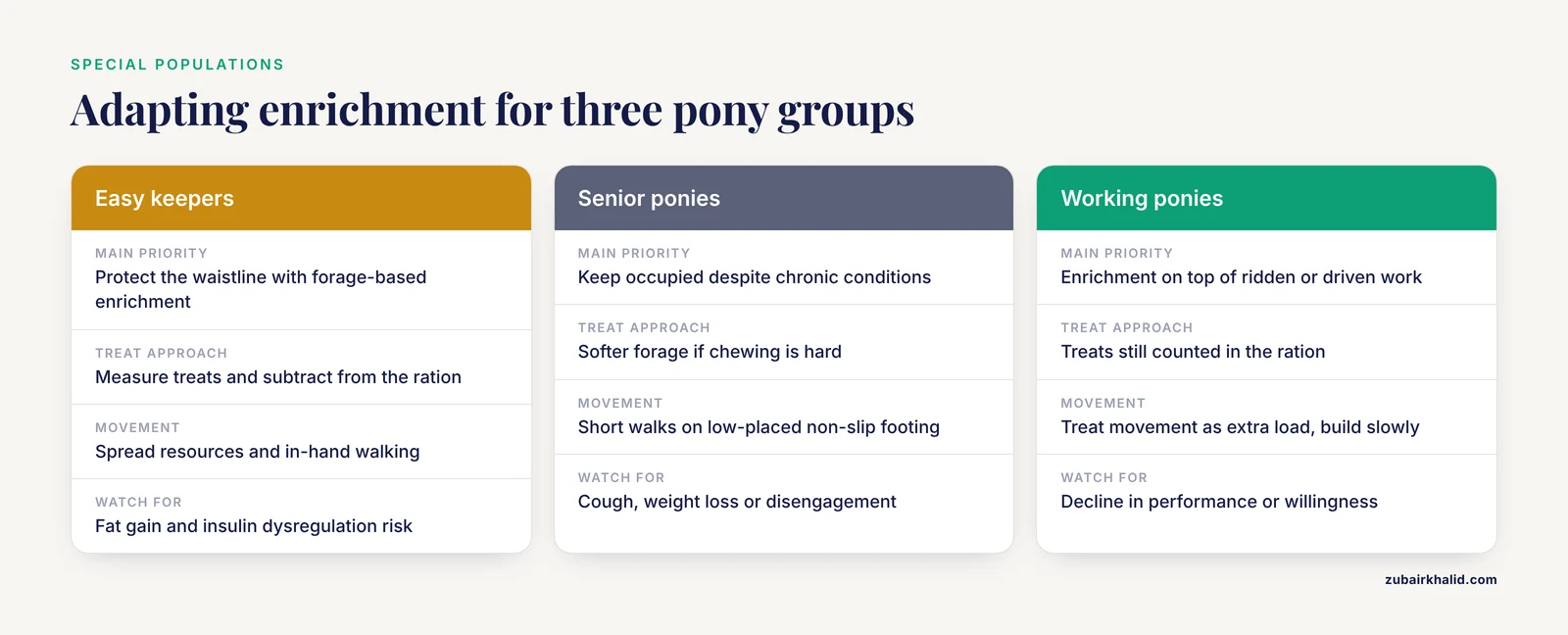
Ponies are famously efficient at storing fat, and accurate body fat assessment in ponies is an active area of research precisely because excess fat is associated with increased morbidity and mortality [9]. In a large laboratory dataset, non-sport horses and ponies were more likely to show insulin dysregulation than sport horses, and metabolic obesity was common in both groups [10]. The practical consequence for enrichment is simple. Every enrichment plan for a pony must protect the waistline.
- Use forage-based enrichment, not calorie-dense treats, as the default reward
- Measure the treat budget, and subtract it from the ration rather than adding it on top
- Ask your veterinarian before using any feed-based toy for a pony with a history of laminitis, obesity, or metabolic disease
- Use movement enrichment, such as spread resources and in-hand walking, which burns energy while occupying the mind
Senior ponies
Geriatric horses and ponies carry a high burden of chronic conditions, with frequent dermatological, respiratory, ocular, and cardiac findings on veterinary examination [4]. Enrichment still matters for seniors, but adapt it. Softer forage options may be needed if chewing is hard, low-placed non-slip footing matters for unsteady legs, and any new cough, weight loss, or disengagement warrants a checkup before you attribute it to boredom [4].
Working ponies
Ponies used for riding, driving, or therapy still need enrichment, and their work adds considerations. In the eventing context, locomotor injury was the most common reason ponies withdrew from championship preparation [11], and a study of working ponies on Gili Trawangan found lameness in 38 percent and foot pathology in 92 percent of those examined [12]. Before adding exercise-based enrichment to a working pony's routine, have the feet and legs assessed, and treat enrichment movement as additional load, not free load.
Adding Movement Safely
Movement is enrichment, and it also has measurable physiological effects. Blood analysis in exercising Shetland ponies shows that exercise shifts hematological and metabolic parameters, reflecting real energy expenditure and training adaptation [13]. That is the benefit and the risk in one sentence. Build movement-based enrichment gradually.
- Start with short in-hand walks over varied, safe footing
- Add duration before adding intensity
- Watch for uneven gait, shortened stride, or reluctance to turn, because subtle forelimb lameness can be detected with careful observation and pressure-based methods in ponies [14]
- Give rest days, and adjust for weather and footing
If your pony is scheduled for increased work, such as competition preparation, structured fitness testing with veterinary input is the established approach in pony sport programs [11]. For a backyard pony, the equivalent is simply increasing activity slowly and watching the legs.
Common Mistakes
- Toys instead of forage. A stall full of gadgets does not fix two fast meals a day. Time-budget data show foraging is the dominant natural behavior [1], so food delivery design comes first.
- Calorie creep. Treat balls and licks add up fast in animals prone to fat accumulation [9]. Budget treats into the ration.
- One-and-done novelty. Leaving the same item out for months defeats the purpose. Rotate.
- Ignoring the social hole. No toy substitutes for companionship, and behavioral restriction carries high welfare cost [2].
- Frustration by design. Puzzles that are too difficult cause some ponies to give up or become agitated. Start easy.
- Skipping the health filter. New enrichment for a pony with undiagnosed lameness, dental pain, or metabolic disease can make matters worse. Health check first, enrichment second.
- Unsafe hardware. Loops and straps near hanging toys are hoof and halter traps. Inspect weekly.
Welfare and Safety Checklist
Run through this weekly:
- Body condition and weight trend, using the same visual and palpation method each time, with veterinary input on any pony accumulating fat [9]
- Feet and legs, including heat, swelling, or gait change, and prompt veterinary assessment of any suspected lameness [14]
- Skin and coat, since these are standard scored indicators in pony welfare protocols [8]
- Enrichment item condition, discarding anything cracked, frayed, or sharp
- Behavior trend, comparing this week with last week rather than with an ideal
- Water and forage availability, including winter supplementation when pasture is short [7]
Year-round monitoring is explicitly emphasized in welfare studies of free-ranging native pony herds [6], and the same rhythm protects a backyard enrichment program. Brief, regular checks catch problems while they are small.
Limitations and When to Contact a Veterinarian
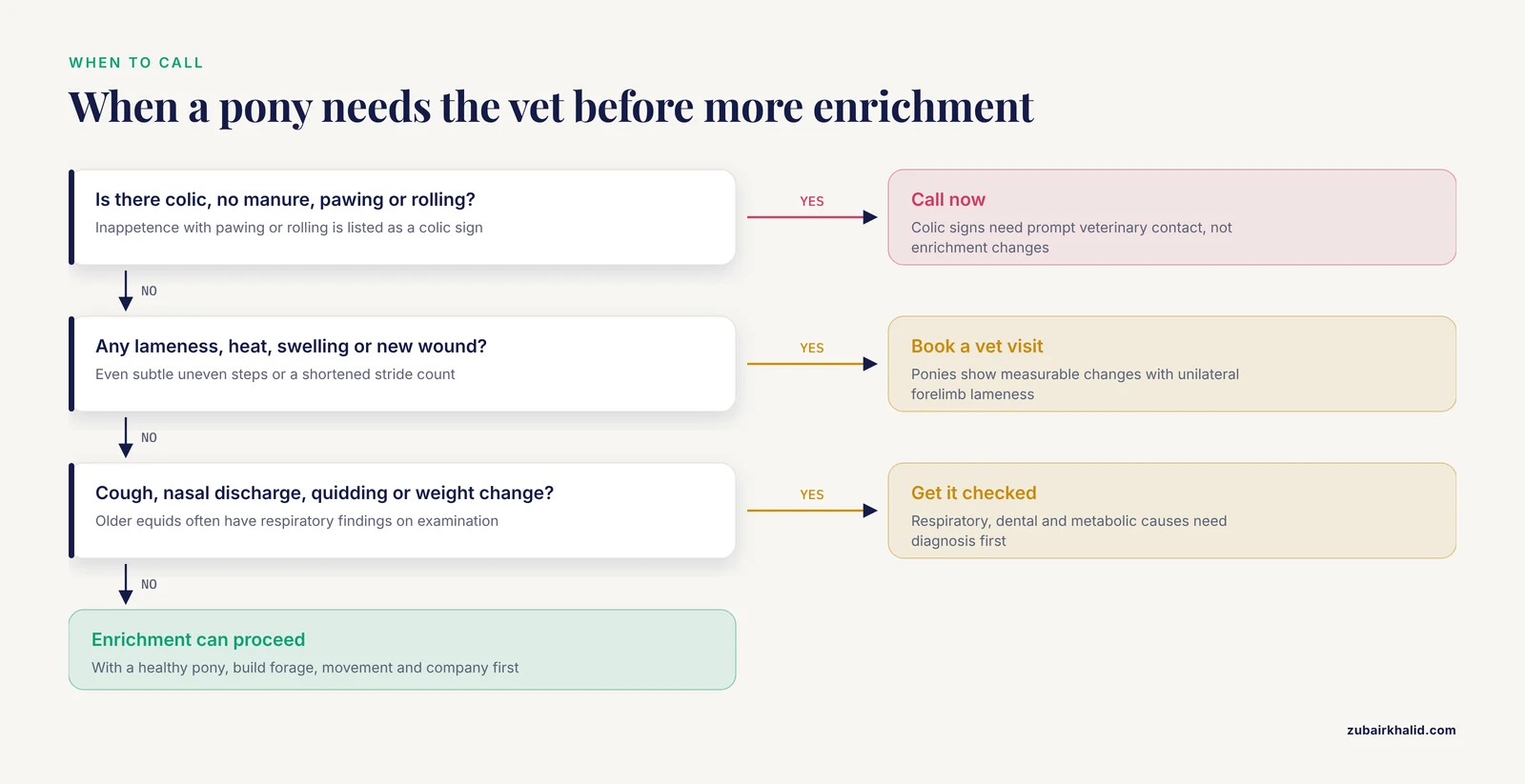
Enrichment improves welfare when the underlying animal is healthy, but it cannot diagnose or treat anything. Individual cases need a veterinarian, and this article is educational and is not a substitute for veterinary diagnosis or treatment.
Contact your veterinarian promptly if you see:
- Any lameness, even subtle, including uneven steps, shortened stride, or reluctance to move, since ponies show measurable postural and pressure changes with unilateral forelimb lameness [14]
- Heat or swelling in a limb, or a new wound
- Weight loss or unexpected weight gain, which in ponies may signal metabolic disease requiring blood testing such as insulin and ACTH screening [10]
- Coughing, nasal discharge, or labored breathing, given the frequency of respiratory findings in older equids [4]
- Chewing difficulty, quidding, or dropping feed
- New repetitive behavior, self-injury, or sudden aggression
- Colic signs, including inappetence, pawing, rolling, or absence of manure
- In working ponies, any decline in performance or willingness, since injury and foot pathology are common in working populations [12] [11]
Your veterinarian can also help you set a forage plan and treat budget for an overweight or insulin-dysregulated pony, and can advise on companions and turnout design for your specific property. Owners of working ponies in remote settings face real barriers to veterinary access [12], and if that describes you, establish a relationship with the nearest equine practitioner before an emergency.
Frequently Asked Questions
How much enrichment does a pony need each day?
Aim to occupy the pony across the whole day rather than in one session. Because free-ranging equines naturally spend most of the day feeding and moving [1], spread forage into multiple small offerings, keep the pony near or with companions, and add one or two toys or puzzles per day as variety.
What are the best toys for ponies on a budget?
Slow-feed hay nets, treat balls, and plain lick blocks are affordable and behavior-relevant. Many owners find that a few small-hole hay nets placed in different spots deliver more enrichment per dollar than any single gadget, because they extend foraging time and add walking at once.
Can enrichment help a pony that is alone?
It helps, but it does not replace companionship. Grouped equines feed and move more than isolated ones [1], and behavioral restrictions weigh heavily on equine mental state in expert welfare assessments [2]. Enrichment fills gaps while you work toward a safe companion or at least consistent fence-line contact.
Are treat balls safe for overweight ponies?
Only with a calorie budget. Ponies accumulate fat readily, and excess body fat is linked to increased disease risk [9], with insulin dysregulation more likely in non-sport ponies [10]. Use the pony's regular pellets or forage as the treat, count the portion within the ration, and ask your veterinarian first if laminitis or metabolic disease is in the history.
What enrichment works for a senior pony?
Gentle scatter feeding, soft or soaked forage options, low-effort puzzles, and short in-hand walks over good footing. Seniors have high rates of chronic conditions, including dental and respiratory disease [4], so have your veterinarian tailor texture, effort level, and any work program to your pony's findings.
How do I introduce a new enrichment item safely?
Introduce it while you are present, with plenty of space, and take it away if the pony paws it aggressively, mouths pieces of it, or panics. Start with easy versions, such as an open treat container, and inspect the item afterward for damage before the next use.
Can ponies have too much enrichment?
The failure mode is usually too much food or too much intensity, not too much occupation. Keep total calories within the ration, keep new physical activity gradual, and simplify any puzzle that frustrates rather than engages your pony.
How long before I see a change in my pony's behavior?
Many ponies settle visibly within days once forage is available for longer stretches and social contact improves, but weight, fitness, and chronic behavior patterns change over weeks to months. Track behavior weekly, and loop in your veterinarian if anything worsens rather than improves.
Sources
- Time-activity budget in horses and ponies: A systematic review and meta-analysis on feeding dynamics and management implications.
- Using the Five Domains Model to Assess the Adverse Impacts of Husbandry, Veterinary, and Equitation Interventions on Horse Welfare
- Management methods to improve the welfare of horses used in research.
- Disease prevalence in geriatric horses in the United Kingdom: veterinary clinical assessment of 200 cases.
- How Useful Are Existing Protocols in the Quick Assessment of the Welfare of Semi-Feral Horses? Pilot Study on Konik Polski Horses Living in the Forest Sanctuary.
- A comparison of the welfare of free-ranging native pony herds on common land with those used for conservation grazing in the UK.
- Welfare of extensively managed Swedish Gotland ponies.
- Evaluation of the Feasibility, Reliability, and Repeatability of Welfare Indicators in Free-Roaming Horses: A Pilot Study.
- Assessment of body fat in the pony: part II. Validation of the deuterium oxide dilution technique for the measurement of body fat.
- Prevalence and Progression of Resting ACTH, Insulin and Adiponectin Values as Indicators of Suspected Endocrine Diseases in Sport Horses and Ponies Compared to Non-Sport Horses, Ponies and Donkeys.
- A prospective study on a cohort of horses and ponies selected for participation in the European Eventing Championship: reasons for withdrawal and predictive value of fitness tests.
- A Pilot Welfare Assessment of Working Ponies on Gili Trawangan, Indonesia.
- Analysis of the season-dependent component in the evaluation of morphological and biochemical blood parameters in Shetland ponies of both sexes during exercise.
- Assessment of static posturography and pedobarography for the detection of unilateral forelimb lameness in ponies.