Bringing Home a New Pony: First Week Guide
By Dr. Zubair Khalid, DVM, MS, PhD ·
Bringing home a pony is exciting, and the first week decides how easily the transition goes. Most ponies relax noticeably within the first few days and settle into a predictable routine within one to two weeks, and the quiet, consistent pattern you set in those first seven days does most of the work. The plan is straightforward: prepare the environment before arrival, keep the diet familiar, handle lightly, book the first vet visit within a few days, and observe your pony at the same times every day.
This guide gives you a day-by-day plan for your new pony's first week, a preparation checklist, feeding and turnout guidance, and a clear list of warning signs. Every pony arrives with its own history and temperament, so treat this as a framework to adapt with your veterinarian.
This article is educational and is not a substitute for veterinary diagnosis or treatment.
New Pony First Week: The Day-by-Day Plan
| Timeframe | Goal | Key actions |
|---|---|---|
| Before arrival | Safe, quiet setup | Buy the forage the pony eats now, fill water, check fencing and shelter, gather records, book the vet |
| Day 1 | Calm arrival | Lead around the space, hand graze, offer forage and water, light grooming check, no riding |
| Days 2 to 3 | Health baseline | First vet visit, body condition and cresty neck scores, start your observation log |
| Days 4 to 7 | Routine and friends | Fence-line introductions, short in-hand walks, consistent feed and handling times |
| End of week | Review | Check appetite, manure, weight trend, and attitude, list questions for a follow-up call |
The first week is about lowering stress, not adding goals. Transport, new sights, new smells, new neighbors, and a changed diet all land at once, so keep each day simple and predictable. Two outcomes matter more than any other in week one: a stable gut and a calm mind.
The New Pony Checklist: Prepare Before Arrival
A little preparation removes most first-week problems. Work through this new pony checklist before the trailer arrives.
- Forage. Buy the hay the pony eats now, ideally a week or more ahead of what you need. Ask the seller for the exact type and the amount fed at each meal. Any change you plan comes later, gradually.
- Water. Scrub troughs and buckets and fill them before arrival. Note the level daily so you learn your pony's normal intake.
- Shelter. Provide a run-in shed or stable with dry footing and bedding, and check it for protruding nails, wire, and sharp edges.
- Fencing. Walk every fence line. Fix gaps, loose boards, and sagging wire, and remove hazards such as broken posts and discarded machinery.
- Feed and health records. Ask the seller for the feed type and amount, the feeding schedule, vaccination and deworming history, dental history, and any past illness or injury. Put copies in a folder.
- Paperwork. Ask your veterinarian which health certificates or tests your state requires when equines change ownership or travel, and confirm what the seller should provide.
- Equipment. A well-fitting halter and lead rope, a grooming kit, a hoof pick, a digital thermometer, and a weight tape. Ask your veterinarian to show you how to use the thermometer and weight tape during the first visit.
- Identification. Discuss microchipping and backup identification with your veterinarian.
- Veterinary appointment. Book it before arrival so the visit lands on day two or three.
- Isolation plan. Ask your veterinarian whether to house the new pony away from resident horses for a period, a step many practices recommend for any new arrival while its health status becomes clear.
Once the setup is ready, the focus shifts from facilities to the pony itself.
Bringing Home a Pony: Arrival Day, Step by Step
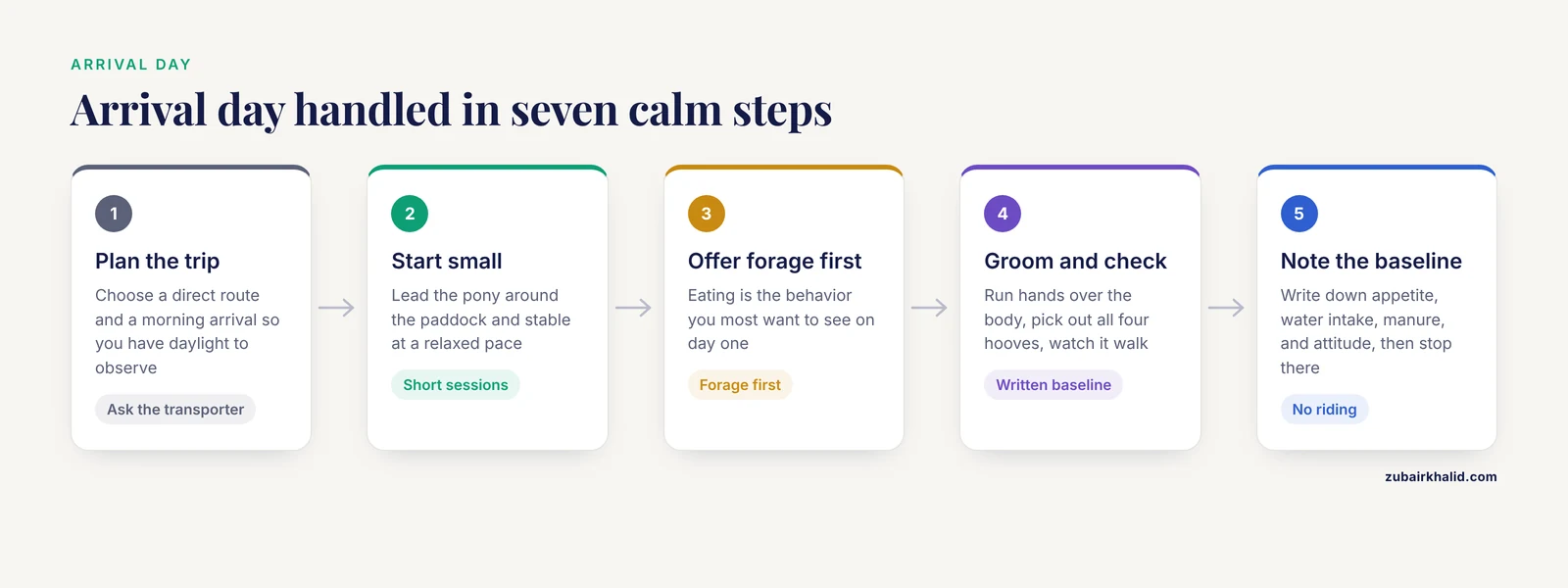
Arrival day sets the tone. The goal is a calm first impression of the new place, not progress toward any training goal.
- Plan the trip. Choose a direct route and a morning arrival so you have daylight to observe. Ask the transporter how the pony behaved en route.
- Start small. Lead the pony around its new paddock and stable at a relaxed pace. Let it look, sniff, and pause. Short sessions work better than long ones.
- Offer forage and water. Forage comes first, always. Eating is the behavior you most want to see on day one.
- Groom, and check while you groom. Run your hands over the entire body, part the coat to look at the skin, pick out all four hooves, and watch the pony walk and turn. Hands-on checks find what eyes miss. You do not need to diagnose anything on day one, you need a written baseline.
- Keep the circle small. One or two calm handlers, no crowd, no loose dogs, no machinery running nearby.
- Log the baseline. Note appetite, water intake, manure amount and consistency, and attitude. Take clear photos of body condition, face, legs, and hooves for your records.
- Stop there. No riding, no longing, no training sessions. Light handling and quiet observation are enough.
If the pony seems tense, end the session and try again later. A pony that spends arrival day grazing, drinking, and passing normal manure is off to a good start.
How Long for a Pony to Settle In
Most ponies show clear signs of relaxing within the first few days and settle into a routine within one to two weeks. Some settle over a weekend, and some, especially ponies that left a semi-feral herd or traveled a long distance, need several weeks. There is no fixed timeline, so plan around a two-week adaptation window and let the pony's behavior tell you where it stands. Livestock research supports that window: in one study of transported beef cattle, skin lesions and lameness increased significantly between day 2 and day 15 after arrival, alongside blood changes consistent with a difficult adaptation response [1].
Signs of settling include grazing for long stretches, drinking normally, passing well-formed manure, lying down to rest, approaching you willingly, and responding to a predictable routine.
Signs of strain include refusing feed, pacing the fence line, calling constantly, loose manure, or refusing to drink. One unsettled day is normal. Call your veterinarian if these signs persist beyond a day or two or if appetite or water intake drops sharply.
Background matters. Welfare researchers who study semi-feral and extensively kept ponies, such as free-living Konik horses and Gotland ponies on open range, note that these animals can respond very differently to handling and confinement than stabled horses, and purpose-built assessment protocols exist for them [2], [3]. A pony from a herd-living background often needs a slower, quieter introduction to handling, stabling, and new neighbors.
Feeding and Grazing During the First Week
Feed for continuity in week one. The safest first-week diet is the one the pony already eats, so match the forage and concentrates to the seller's records and keep meal times consistent.
Keep the diet forage-led. Ponies are efficient weight gainers, and equine obesity is a growing concern, with much current management advice centered on limiting or removing grazing [4]. Restriction has trade-offs, though, because the way you limit grass changes how the pony moves and behaves. In a crossover study of pasture-kept ponies, a track system, a fenced lane that circles the pasture, kept ponies moving for 3.23 percent of the day compared with 2.02 percent on strip grazing, moved them over roughly 7,013 meters per 24 hours versus 5,332 meters, and produced less agonistic behavior between ponies [4]. If your veterinarian advises restricting grass for weight, ask which setup fits your land and your pony.
Learn your pony's starting shape during the first week. Ask your veterinarian to demonstrate body condition scoring and cresty neck scoring, the same measures used in pony grazing research [4], then repeat them monthly. Body condition is a core welfare indicator in equids, and simple scoring systems are standard tools in equid welfare surveys [5]. Season matters too: in semi-feral horses, body condition measured lower in early spring than in summer [3], so track the trend rather than a single reading.
Practical feeding rules for week one:
- Forage available on the schedule your veterinarian sets, with any grass restriction planned deliberately.
- Fresh, clean water, checked and refilled daily.
- No sudden increases in grain or concentrates.
- Treats in small amounts, if at all.
- Any diet change made gradually over a week or more, mapped with your veterinarian. Kentucky Equine Research and similar equine nutrition resources publish practical guidance on forage-based diets and safe transitions if you want to read further.
The First Vet Visit for a Pony
Book the first vet visit for a pony within the first two to three days, before riding, before group turnout, and before any training goals. The visit has three jobs: establish a physical baseline, review the history you inherited, and set a preventive care plan.
Expect a nose-to-tail examination. Your veterinarian will check heart and lung sounds, gut sounds, temperature, mucous membranes, eyes, teeth and mouth, skin, and hooves, and will watch the pony walk and turn. The exam targets exactly the problems that pony health surveys surface most often. In one survey of 38 working ponies, almost half were underweight, most had wounds and hoof lesions, and many moved with possibly painful gaits [6]. Weight taken with a tape or scale, a body condition score, and a cresty neck score give you numbers to compare against later.
Bring to the visit:
- The seller's vaccination, deworming, and dental records.
- The current feed list with amounts and meal times.
- Your arrival-day notes and photos.
- Your written questions.
Discuss and decide with your veterinarian:
- A vaccination plan suited to your region and the pony's age and use. The American Association of Equine Practitioners publishes the vaccination guidance many equine veterinarians follow, and your veterinarian will tailor it.
- A parasite control strategy, and whether testing should guide it.
- Whether an isolation period is still needed, and for how long.
- A dental exam schedule.
- Identification, such as microchipping.
- A target body condition and weight for your pony, and when light work can begin.
- Which signs should trigger an emergency call, and the clinic's after-hours process.
Ask your veterinarian to show you two skills before you leave: body condition scoring and taking a temperature. Both turn you into a better early-warning system. Veterinary-reviewed resources such as The Horse and the Merck Veterinary Manual horse owner library are reliable places to read up afterward on any condition your veterinarian names.
A Daily Observation Routine That Catches Problems Early
Five to ten minutes at the same times each day will teach you your pony's normal faster than anything else. Structure the routine around the same domains welfare scientists use, feeding, environment, health, and behavior [7], and keep it consistent, because welfare assessments only detect real change when they are reliable and repeatable [8].
Morning check:
- Feeding. Did the pony finish its forage? How does it chew? How much water went overnight?
- Manure. Amount, consistency, and normal shape. Manure is one of the most informative daily signals you have.
- Movement. Watch the pony walk a few steps. Note any stiffness, short stride, or reluctance.
- Attitude. Does the pony approach, lift its head, and engage? Flatness or unusual quietness counts as a finding.
Evening check:
- Body scan. Hands over the whole body for new wounds, heat, swelling, or sensitivity, plus a quick hoof pick.
- Environment. Water clean and full, fencing intact, shelter dry, no new hazards.
- Behavior. Grazing posture, interaction with neighbors over the fence, resting behavior.
Modern welfare assessment leans on animal-based indicators, measures taken on the animal itself, alongside resource checks [9]. Your log works the same way. Write down anything unusual with the date, and photograph it. A simple notebook or notes app is enough.
Turnout, Exercise, and Meeting the Neighbors
Ponies need daily turnout with room to move and, ideally, company. Outdoor group living supports that: in a study of 171 horses kept in outdoor group systems on semi-natural pasture, a trained veterinarian found no major welfare issues, few abnormal behaviors, and good nutrition and good relationships with humans [10]. Free movement, grazing, and social contact are the behaviors that system protects, and they are the ones to protect in your own setup.
Plan the first week like this:
- Days 1 to 2. Turnout alone, or with a calm neighbor across a fence line, in a small, secure paddock.
- Days 3 to 5. Continue fence-line contact. Look for mutual grazing along the fence, relaxed posture, and interest without constant squealing or striking.
- Days 4 to 7 and beyond. If fence contact stays peaceful, try short, supervised turnout with one calm companion, then build time before any larger group.
Keep exercise to in-hand walking, hand grazing, and light groundwork during week one. Riding waits until the settling period is over and your veterinarian has completed the first exam, then starts short and easy. If introductions turn aggressive, with charging, biting, or pinned ears that do not settle, separate the animals and ask your veterinarian or an experienced trainer for a plan.
Common First-Week Mistakes
- Riding too soon. The pony is processing a new world. Work comes after settling and a clean vet check.
- Changing the feed suddenly. Abrupt diet changes upset the digestive system. Match the old diet first, transition later.
- Turning out with the herd on day one. Unmanaged introductions injure both the new pony and residents. Use fence lines first.
- Skipping the vet exam because the pony looks fine. Looking fine is not a diagnosis, and a hands-on exam exists precisely because coats hide problems.
- Overfeeding treats and concentrates. Ponies gain weight easily, and extra calories in week one create problems that last.
- Too much handling and too many visitors. Novelty is stressful in small doses. Keep the circle small.
- No baseline records. Without notes on appetite, manure, water, and weight, you cannot spot change early.
Troubleshooting: When Something Looks Off
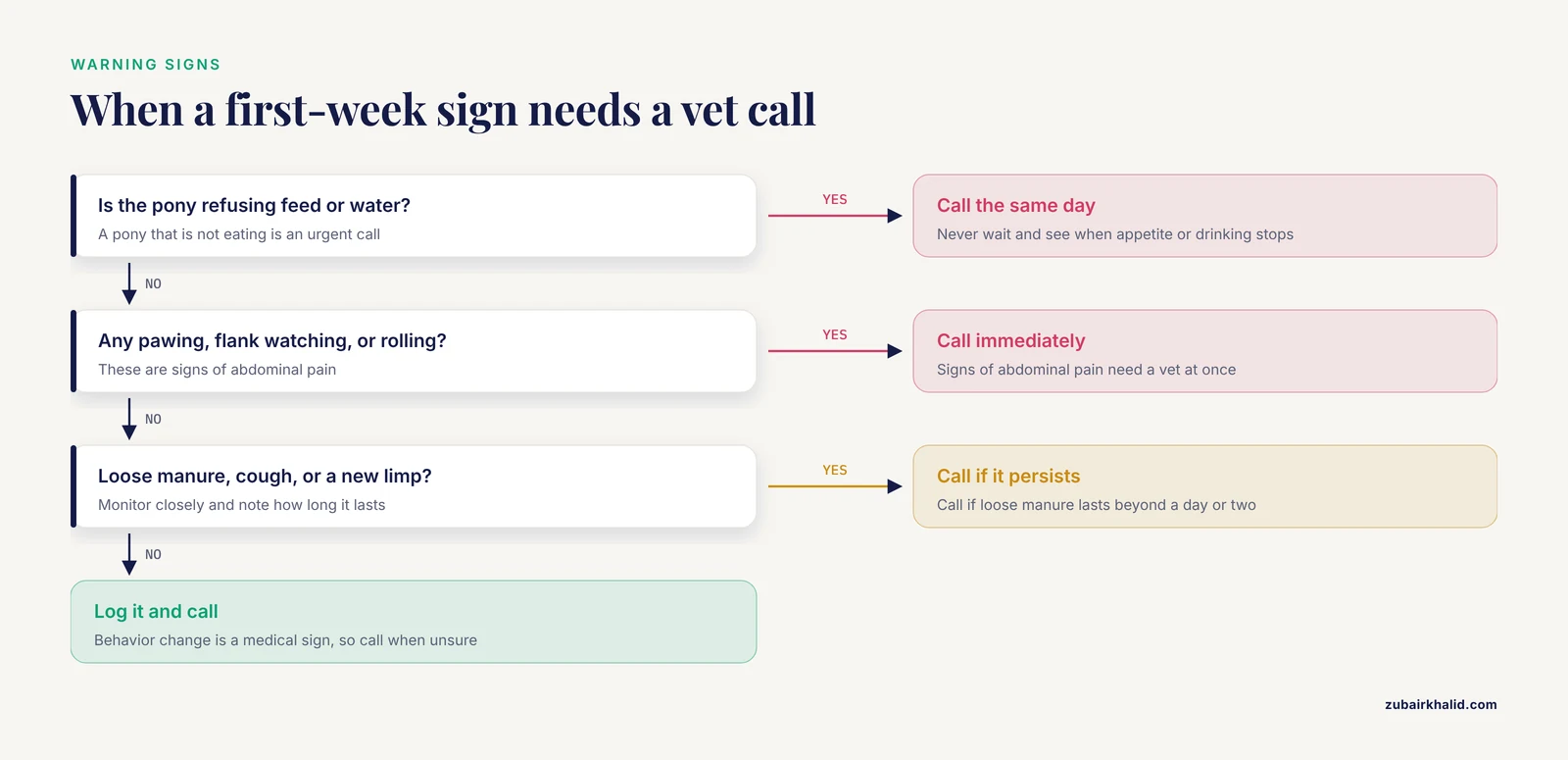
- Refusing feed or water. Call your veterinarian the same day. A pony that is not eating is an urgent call, never a wait-and-see.
- Signs of abdominal pain. Pawing, looking at the flank, repeated lying down or rolling, stretching as if to urinate, or no manure alongside other signs of discomfort. Call immediately.
- Loose manure. Transport and feed changes can loosen manure. Monitor closely and call if it persists beyond a day or two, contains blood, or the pony seems dull.
- Cough, nasal discharge, or fever. Call your veterinarian. Respiratory disease is a recognized risk of the arrival and adaptation period in transported livestock [1], so mention the recent move when you call.
- Heat in a hoof or a new limp. Call your veterinarian and restrict movement until the pony is seen.
- A cut or wound. Call for anything deep, gaping, near a joint, or persistently bleeding. Ask during the first visit which minor wounds you can clean and monitor yourself.
- Unusual flatness. A pony that stands apart, stops responding to you, or loses interest in its surroundings needs a call. Structured welfare assessments in companion animals show that chronic pain reaches behavior, engagement, and social interaction alongside physical signs [11], so behavior change is a medical sign, not a mood.
Limitations and When to Contact a Veterinarian
This article is educational and is not a substitute for veterinary diagnosis or treatment. Every pony arrives with its own age, history, body condition, and temperament, and only a veterinarian who examines your pony can tailor vaccination, parasite control, diet, and exercise plans to the individual.
Contact your veterinarian promptly during the first week if you see any of the following:
- Refusal to eat or drink, or a sharp drop in either.
- No manure, diarrhea, or manure with blood.
- Signs of abdominal pain, including pawing, flank watching, or rolling.
- Labored breathing, coughing, or nasal discharge with fever.
- Lameness, heat in a limb or hoof, or reluctance to move.
- Eye pain, squinting, discharge, or injury.
- A deep or gaping wound, or bleeding that does not stop.
- A pony that seems dull, unresponsive, or unusually quiet.
Call for questions too, not only emergencies. If you are unsure about feed transitions, introductions, isolation length, or when to start work, a short call in week one prevents most week-two problems.
Frequently Asked Questions
How long does it take a pony to settle into a new home?
Most ponies relax noticeably within the first few days and settle into a predictable routine within one to two weeks. Some take longer, especially ponies that traveled far or left a herd they knew well. Judge settling by appetite, manure, resting behavior, and interest in you rather than by the calendar.
What should be on a new pony checklist?
Cover five basics before arrival: forage the pony is already eating, clean water, safe shelter and fencing, the seller's feed and health records, and a booked veterinary appointment. Add a well-fitting halter and lead, grooming kit, hoof pick, thermometer, weight tape, and a notebook for daily observations.
When should the first vet visit for a pony happen?
Book it within the first two to three days, before riding or group turnout. The visit establishes a physical baseline, reviews the seller's records, and sets a plan for vaccination, parasite control, dental care, and any isolation period your veterinarian recommends.
Can I ride my new pony during the first week?
No. Keep the first week to light handling, in-hand walking, and hand grazing. Riding adds physical and mental load before the pony knows the environment, and your veterinarian should complete the first exam before work begins. Plan the first rides for after the settling period, short and easy.
What should I feed my pony during the first week?
Feed exactly what the previous owner fed, including the same forage, for the first several days. If you plan to change hay or concentrate, transition gradually over a week or more with your veterinarian's guidance. Keep the diet forage-led, because ponies gain weight easily.
How do I introduce my new pony to other horses?
Start with fence-line contact in adjacent paddocks for a few days, then move to short, supervised turnout with one calm companion before joining any larger group. Separate the animals if you see charging, biting, or pinned ears that do not settle, and ask for help from your veterinarian or an experienced handler.
Should I keep a new pony separated from resident horses at first?
Ask your veterinarian about an isolation plan for the new arrival, which many practices recommend so contagious disease cannot spread while the pony's health status becomes clear. Separation also makes introductions calmer. Your veterinarian can advise how long to wait based on your property and the pony's history.
What warning signs mean I should call the veterinarian?
Call promptly for refusal to eat or drink, no manure or diarrhea, signs of abdominal pain such as pawing, flank watching, or rolling, labored breathing, nasal discharge with fever, non-weight-bearing lameness, eye pain, a deep wound, or a pony that seems dull or unresponsive. When in doubt, call, because early calls are rarely wasted.
Sources
- Health and welfare assessment of beef cattle during the adaptation period in a specialized commercial fattening unit.
- Gotland ponies on extensive pastures - a welfare assessment
- How Useful Are Existing Protocols in the Quick Assessment of the Welfare of Semi-Feral Horses? Pilot Study on Konik Polski Horses Living in the Forest Sanctuary
- The impact of restricted grazing systems on the behaviour and welfare of ponies
- Working donkey welfare assessment and owner survey in Meru County, Kenya
- A Pilot Welfare Assessment of Working Ponies on Gili Trawangan, Indonesia
- Development of a welfare assessment protocol for migratory goats in the North-Western Himalayan region
- Animal welfare definitions, frameworks, and assessment tools: Advancing the measurement and laying the foundation for improved animal welfare through a three-step approach
- A review of existing scientific literature on welfare assessment of farmed species applied in commercial practice: identification of strengths, weaknesses, and areas for further development
- Does housing system affect horse welfare? The AWIN welfare assessment protocol applied to horses kept in an outdoor group-housing system: The ‘parcours’
- How does chronic pain impact the lives of dogs: an investigation of factors that are associated with pain using the Animal Welfare Assessment Grid