Bringing Home a New Horse: First Week Guide
By Dr. Zubair Khalid, DVM, MS, PhD ·
Most horses need several days to a few weeks to settle into a new home, and the first week is about three things: forage, calm routine, and a baseline veterinary exam. Ride nothing new, change nothing fast, and watch your horse closely. Bringing home a horse is less about training in week one and more about lowering stress while you learn what normal looks like for this individual.
Research on relocated and re-homed horses consistently shows that adaptation is a process measured in days and weeks, not hours. Foals undergoing a major life change show measurable stress hormones and altered behavior for roughly three weeks afterward [1], and horses moved between housing systems show sleep and lying patterns that keep shifting over consecutive nights as they adapt [2]. Plan your first week with that timeline in mind.
At a Glance: Your First Week Plan
| Day | Main focus | Key actions |
|---|---|---|
| Before arrival | Preparation | Complete the new horse checklist, book the first vet visit, arrange same forage the seller used |
| Day 1 | Arrival and calm | Unload quietly, hand-walk, offer forage and water, no riding, observe manure and appetite |
| Day 2 to 3 | Routine and observation | Keep feeding times consistent, short hand-grazing, begin baseline notes on behavior and vital signs |
| Day 3 to 5 | Veterinary baseline | First vet visit for a horse, baseline exam, discuss vaccination, parasite control, and dental status |
| Day 5 to 7 | Gentle expansion | Introduce turnout per your veterinarian's guidance, brief groundwork if the horse is settled, continue observation |
Every step should flex to the individual horse. A quiet, confident trail horse may settle in three days. A young or anxious horse may need the full three weeks before anything new is added.
How Long for a Horse to Settle In
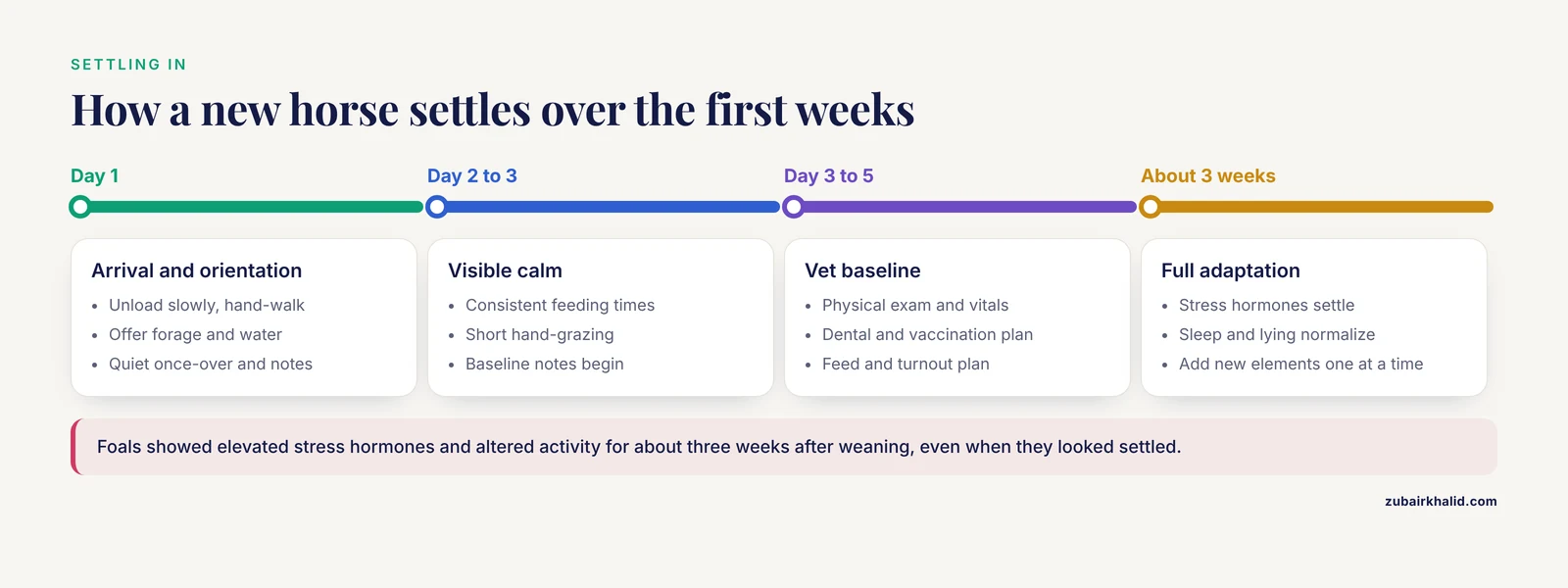
There is no single answer, but the honest range is a few days for visible calm and several weeks for full physiological and behavioral adaptation. Horses are prey animals that respond to novelty with vigilance and increased movement, and even well-handled horses show measurable behavioral shifts when their environment or routine changes [3].
Three findings from equine research help set realistic expectations:
- Stress hormones lag behind visible calm. In foals, fecal cortisol metabolites stayed elevated and activity shifted from movement to standing for about three weeks after weaning, even though the animals appeared outwardly settled [1]. Adult horses relocated to a new home go through a comparable, if milder, adjustment.
- Sleep adapts gradually. Horses moved between a large communal barn and individual stalls showed changes in REM sleep, lying frequency, and lying duration over consecutive nights, which the researchers interpreted as an adaptation effect [2]. A new horse that seems restless at night in week one is often still adjusting, not misbehaving.
- Routine is the medicine. Horses on consistent, near-continuous forage access show stable hormonal patterns, while meal-fed horses show repeated spikes and dips in insulin, glucose, and leptin [4]. Predictable feeding and turnout times do more to calm a new horse than extra handling sessions.
A practical rule for the new horse first week is to add one new element at a time and give the horse a full day between additions. New environment, new herd mates, new feed, and new work should never all arrive in the same 48 hours.
New Horse Checklist: What to Have Ready Before Arrival
A useful way to build a new horse checklist is the Five Domains Model, the framework used in modern equine welfare assessment, which evaluates nutrition, environment, health, behavior, and mental state as separate but connected areas [5]. Stocking each domain before the trailer arrives prevents most first-week problems.
Nutrition
- Forage. Source the same hay the horse was eating, ideally several bales from the seller. If you cannot match it, ask your veterinarian for a transition plan rather than switching overnight.
- Water. Fresh, clean water in two containers so a spill or fouling never leaves the horse without a drink. Note that some horses drink less when water tastes unfamiliar.
- Feed, if any. Only the concentrate the horse already receives, in the amount the seller reports. New grain is a week-three decision, not a week-one decision.
- Salt. A plain salt block or loose salt appropriate for horses.
Environment
- Safe containment. Stalls checked for loose boards, protruding hardware, and gaps. Fencing walked on foot before the horse ever sees it.
- Shelter and shade appropriate to your climate.
- Bedding the horse can lie down in comfortably. Recumbency matters, because horses in box stalls spend a meaningful portion of their day lying and resting, and sleep quality depends on it [6].
- Slow feeder or hay net if you plan to use one. Small-mesh hay nets have been shown to significantly lengthen chewing time per kilogram of hay compared with loose hay, which supports steadier forage intake [7].
Health
- A veterinary appointment booked before arrival, ideally within the first few days.
- Records request. Ask the seller for vaccination history, deworming history, dental records, and any prior lameness or colic notes, and send them to your veterinarian ahead of the visit.
- A digital thermometer, a stethoscope if you can use one, and a notebook or phone note for daily observations.
- A biosecurity plan. Isolation from resident horses for a period is a common recommendation, but the appropriate length depends on your property and the horse's origin, so confirm the specifics with your veterinarian rather than guessing.
Behavior and Mental State
- A quiet arrival window with no barn chaos, dogs loose, or machinery running.
- A certified-safe halter and long lead rope, a well-fitting grooming kit, and a first-aid kit for basic wound care.
- Time budgeted. Plan short, calm visits several times a day rather than one long session.
Day One: Bringing Home a Horse the Right Way
Day one sets the tone for the whole relationship. The goal is a horse that learns your property is a predictable, safe place.
- Unload slowly. Let the horse look around before leading to its stall or paddock. Horses respond to novel objects and environments with heightened alertness and movement, and rushing unloading invites an accident [3].
- Hand-walk for ten to fifteen minutes. Let the horse sniff its surroundings. This is orientation, not exercise.
- Offer forage immediately. Forage is the anchor. Healthy horses spend roughly 42 percent of their day eating, 39 percent resting, and 19 percent moving [8], so a horse with nothing to eat is a horse with a disrupted time budget and rising stress.
- Check water access. Show the horse where the water is and confirm it drinks.
- Do a quiet once-over. Note manure consistency, breathing rate at rest, attitude, appetite, and any cough, nasal discharge, swelling, or heat in the legs. Write it down. Your week-one notes become the baseline your veterinarian interprets.
- End on a good note and leave. Novelty is tiring. A short first day beats a marathon of introductions.
Do not ride on day one, even if the horse seems fine. If the horse is stiff from transport, unbalanced on new footing, or quietly anxious, riding converts a manageable adjustment into a risk.
Feeding Through the First Week
Feeding is where new owners most often cause harm, usually with good intentions. Two principles govern the first week.
First, forage before everything else. Horses evolved as near-continuous foragers, and research comparing feeding regimens shows that horses with ad libitum forage access have far more stable metabolic and hormonal patterns than horses fed discrete meals [4]. Free-choice or frequently renewed hay is the default for a new horse unless your veterinarian advises otherwise for a specific medical reason.
Second, change slowly and deliberately. Any grain, supplement, or hay change should be introduced gradually over days with your veterinarian's input. Rapid dietary change is a recognized discussion point in laminitis prevention, and veterinary researchers have built risk-scoring systems for laminitis that incorporate clinical findings such as digital pulse quality, hoof tester response, lameness examination results, rectal temperature, and age [9]. If your new horse is overweight, has a cresty neck, or has any history of metabolic disease, raise laminitis risk explicitly at the first vet visit before changing anything.
Practical feeding notes for week one:
- Feed the same forage and the same amounts the seller reported for the first several days.
- Weigh feed rather than scooping by volume, and record what you offer so intake changes are visible.
- If you use a slow feeder, expect an adjustment period. Small-mesh nets lengthen chewing time per unit of hay [7], but some horses eat less at first while they learn the device, so monitor intake and body condition rather than assuming the net is working as intended.
- Watch for leftover hay two meals in a row. Reduced feeding is one of the behaviors that most reliably separates painful hospitalized horses from pain-free ones in video-based studies, along with altered standing-rest patterns [10]. A new horse that leaves hay is telling you something.
Turnout, Housing, and Rest
Turnout decisions in week one depend on the horse's history, your fencing, and your resident herd, which is why turnout is a veterinarian and barn-management conversation rather than a fixed rule. What the evidence does support is what good housing looks like once the horse is turned out.
Objective tracking of daily activity shows that healthy horses distribute their time across eating, resting, and movement in fairly consistent proportions, and that horses in open-air group housing on paddocks show more uniform feeding and movement patterns with fewer intense peaks than horses in more restricted systems [8]. In plain terms, turnout with room to move and forage available supports a more natural daily rhythm than stall confinement.
Rest deserves specific attention. Horses need recumbent sleep for REM sleep, and a study using non-invasive EEG monitoring found that housing system measurably changed how much REM sleep and lying behavior horses achieved, with patterns shifting over repeated nights as horses adapted [2]. A new horse may be too vigilant to lie down well in its first nights, which is one more reason to keep week one quiet and predictable.
Behavioral signals in the paddock are mostly reassuring:
- Rolling after exercise or a bath is a normal, frequently observed self-care behavior in horses, expressed with sniffing, pawing, and rubbing movements, and it varies by individual [11]. A single good roll and shake is not an emergency.
- Vigilant standing at the fence line watching the resident horses is normal early adjustment.
- Persistent fence-walking, not eating, or not drinking is not normal and should trigger the escalation criteria below.
The First Vet Visit for a Horse
Schedule the first vet visit for a horse within the first three to five days, once the horse has had a night to rest but before you have made feeding or turnout decisions you might need to revise. The purpose of this visit is baseline data and a plan, not treatment.
What the Visit Should Cover
Discuss the following with your veterinarian and record the answers:
- A complete physical examination with baseline vital parameters, including rectal temperature, heart rate, respiratory rate, and gut sounds. Rectal temperature remains the conventional reference measurement for core body temperature in horses, even as infrared methods are studied for quick screening [12].
- Body condition scoring and a weight estimate to anchor your feeding plan.
- Dental assessment and a float schedule.
- Vaccination status and a catch-up plan tailored to your region.
- Parasite control strategy, ideally guided by testing rather than routine dosing.
- A biosecurity and isolation plan for the new arrival, including how long to keep the horse separate from residents and what to watch for during that period.
- Hoof and limb evaluation, with farrier recommendations. Hoof care is a frequent gap in equine management generally, and studies of welfare practices repeatedly identify hoof care lapses as a common problem [13].
- Laminitis risk review if the horse is overweight or has metabolic history, using findings such as digital pulses and hoof tester response [9].
- A written plan for feed transitions, turnout introduction, and when riding may resume.
Making the Visit Low-Stress
How the examination is performed matters as much as what is examined. Equine veterinary researchers have documented that traditional approaches built on physical restraint, punishment, or the threat of aversives are less than ideal from a welfare standpoint and can create more dangerous responses in future similar situations [14]. The shift toward fear-free husbandry and veterinary care aims to reduce fear and stress during procedures, which protects the horse and the people handling it [14].
You can support this before the vet arrives:
- Handle the horse calmly for several days so the vet is meeting a settled animal, not a cornered one.
- Practice simple husbandry handling, such as lifting a lip or touching the legs, in short reward-based sessions.
- Ask the clinic whether they use low-stress handling approaches and tell them about anything the horse already fears.
- Stay present and calm. Horses read the emotional state of the humans around them.
Reading Your Horse: Normal Behavior vs Warning Signs
Week one is a monitoring exercise. Compare what you see against two benchmarks.
Benchmark one is the equine time budget. Healthy horses in different husbandry systems spend on the order of 42 percent of the day eating, 39 percent resting, and 19 percent moving [8]. A horse eating far less than expected, or pacing instead of resting, is off its budget in a way that deserves attention.
Benchmark two is the pain behavior literature. Because horses instinctively hide discomfort from potential threats, including humans, researchers use time budgets and posture to detect pain. In a 24-hour video study of hospitalized horses, weight shifting reliably distinguished painful from pain-free horses, and severely painful horses showed lower rates of feeding and standing rest than pain-free horses [10]. For a new horse at home, that translates into a short daily checklist:
- Eating with normal enthusiasm at every forage offering
- Drinking, with urine output that looks normal
- Manure production in normal volume and consistency
- Standing square or resting a hind leg briefly, not repeatedly shifting weight or pointing a front foot
- Bright, responsive eye and normal interaction with you
- Normal respiratory rate and effort at rest
- No pawing, repeated looking at the flank, or lying down and getting up repeatedly
Rolling deserves a nuance. A horse that rolls, gets up, shakes, and settles is performing normal self-care, and rolling after work or bathing is common and expected [11]. Rolling that comes with colic-type signs, such as repeated lying and rising, flank watching, or refusing food, is an emergency call to your veterinarian.
Common First Week Mistakes
- Riding too soon. A settled-looking horse on day two is not a saddle-safe horse. Transport, diet change, and a new environment each carry their own stress load.
- Changing feed immediately. Sudden changes disrupt the stable metabolic patterns seen in consistently fed horses [4] and are a discussion point in laminitis risk [9].
- Skipping the baseline vet exam. Without early baseline vitals and a documented exam, you cannot judge whether a day-four change is significant.
- Over-handling. Every session feels like novelty to a new horse. Several short, calm visits beat one exhausting one.
- Introducing the whole herd at once. Herd integration has real injury risk and should be planned with experienced barn management, ideally in stages across adjacent fencing.
- Ignoring quiet water intake. Reduced drinking in a new environment is common and can be missed until it becomes a problem. Track buckets.
- Treating boredom as a training problem. A horse pacing the stall often needs more forage access and turnout, not more lessons.
Limitations and When to Contact a Veterinarian
This article is educational and is not a substitute for veterinary diagnosis or treatment. Individual horses vary widely in background, fitness, temperament, and health status, and every recommendation here should be adapted by an equine veterinarian who has examined your horse.
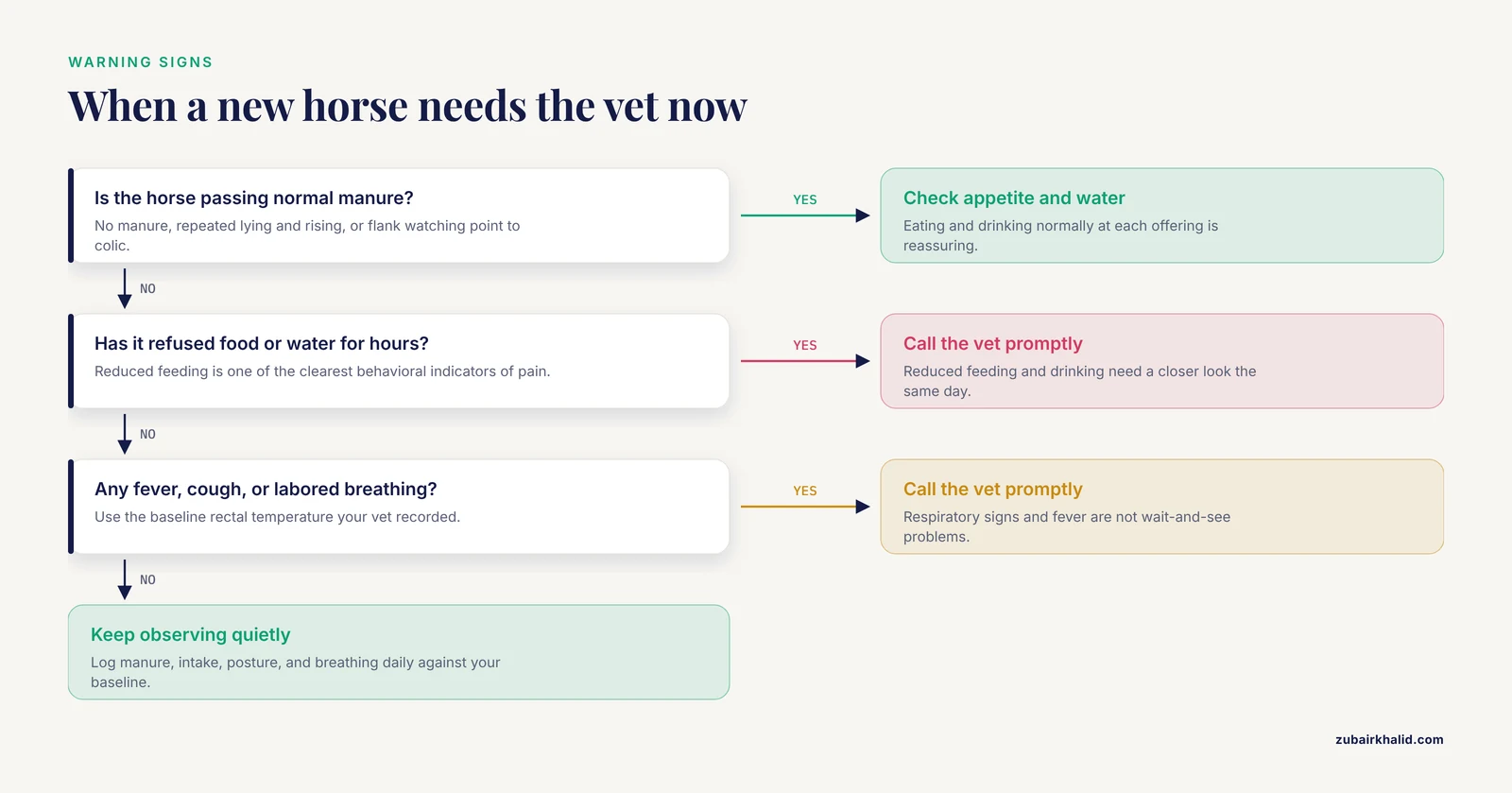
Contact your veterinarian promptly, or follow your clinic's emergency protocol, if your new horse shows any of the following:
- No manure production, repeated lying and rising, flank watching, or other signs consistent with colic
- Not eating or drinking for more than a few hours
- Fever, meaning a rectal temperature outside the range your veterinarian defines for your horse at the baseline visit
- Nasal discharge, cough, or labored breathing
- Lameness, heat in a hoof or limb, strong digital pulses, or persistent weight shifting [10] [9]
- Diarrhea or a sudden change in manure consistency
- Any swelling of the head, sheath, or legs that does not resolve with hand-walking
- Aggression or panic that makes routine care unsafe
For questions that can wait a day, such as feed brand choices, farrier scheduling, or introduction timing, write the question down and bring the list to the first vet visit rather than guessing.
Frequently Asked Questions
How long does it take a horse to settle in?
Visible settling often takes a few days, but full adaptation takes longer. Related research shows behavioral and hormonal changes lasting about three weeks after a major life change such as weaning [1], and sleep patterns shifting over multiple nights after a housing change [2]. Treat two to three weeks as a realistic adjustment window.
Should I ride my new horse during the first week?
No, not in the first several days. Use week one for observation, handling, the baseline veterinary exam, and groundwork only if the horse is clearly settled. Ask your veterinarian and, where relevant, the seller about the horse's prior work level before adding riding.
What should I feed my horse on the first day?
Feed the same forage the horse was eating before transport, offered freely or in generous amounts, with fresh water. Horses show more stable metabolic patterns with near-continuous forage access than with discrete meals [4]. Confirm any grain or supplement with your veterinarian at the first visit.
Do I need to quarantine a new horse?
Isolation from resident horses during an adjustment and observation period is a common biosecurity recommendation, but the right duration depends on the horse's origin and your property. Ask your veterinarian to specify the isolation plan at or before the first vet visit.
When should the first vet visit for a horse happen?
Within the first three to five days of arrival, once the horse has rested from transport. The visit establishes baseline vital signs, body condition, dental status, and a written plan for vaccinations, parasite control, feed transitions, and turnout.
What paperwork should come with a new horse?
Request vaccination records, deworming and dental history, and any notes on prior illness, injury, or lameness from the seller, and forward them to your veterinarian before the appointment. If you are transporting the horse across state lines or boarding off-site, ask your veterinarian which health documentation your state requires.
Is it normal for a new horse to eat less at first?
Mild hesitation while a horse orients to a new environment is common, but reduced feeding is also one of the clearest behavioral indicators of pain in horses [10]. A new horse that leaves hay for more than a meal or two needs a closer look and a call to your veterinarian.
Can I turn my new horse out with other horses right away?
Not immediately. Plan staged introduction, first across a safe shared fence line and then in a small group under supervision, coordinated with barn management. Your veterinarian can also advise on turnout timing based on the horse's exam findings and any isolation requirements.
Sources
- Behavioral and hormonal assessment of stress in foals (Equus caballus) throughout the weaning process.
- Sleep architecture and lying behavior in horses across age groups and two housing systems: an overnight non-invasive EEG study.
- Behavioral changes in thoroughbred horses following pre-training: insights from novel object tests and activity monitoring under field conditions.
- Hormonal patterns in normal and hyperleptinemic mares in response to three common feeding-housing regimens.
- Using the Five Domains Model to develop welfare assessment guidelines for Thoroughbred horses in New Zealand.
- Measuring Activity-Rest Condition by Using Two Different Accelerometer Devices in Trained and Retired Horses.
- Chewing analysis of horses consuming bermudagrass hay in different styles of slow feeders as compared to loose hay.
- Equine Activity Time Budgets: The Effect of Housing and Management Conditions on Geriatric Horses and Horses with Chronic Orthopaedic Disease.
- A point-based laminitis risk scoring system and machine learning framework for prediction of laminitis in horses.
- Time budgets and weight shifting as indicators of pain in hospitalized horses.
- Influence of workload and weather conditions on rolling behaviour of horses and mules.
- Thermographic assessment of surface temperature distribution and agreement between a thermographic camera, infrared thermometer, and rectal temperature in exercising horses under tropical climate conditions.
- Working equines: Assessment of welfare and management practices in and around Debre Markos District, Northwest Ethiopia.
- Moving toward Fear-Free Husbandry and Veterinary Care for Horses.