How to Clean Your Horse's Hooves Daily: A Step-by-Step Routine
By Dr. Zubair Khalid, DVM, MS, PhD ·
To clean your horse's hooves daily, safely position yourself beside the horse, run your hand down the leg to ask for the foot, support the hoof, and use a hoof pick to remove packed material from the heel toward the toe. Clear the grooves beside the frog and the central cleft, brush away remaining debris, inspect the sole, frog, wall, and heel for odor, discharge, heat, cracks, or embedded stones, then set the foot down gently. Repeat on all four feet, most often before and after riding and at least once every day.
This routine takes five to ten minutes once you and your horse are practiced. Professional yards treat hoof care as a core task. One thoroughbred stud documented hoof care performed every two to three days, with each session covering inspection of hoof condition, cleaning, and shoe management, and horseshoe replacement about once per month [1]. Daily picking between those sessions is the habit that keeps small problems, such as a wedged stone or early odor in the frog, from becoming lameness.
This article gives you the complete step-by-step routine, the equipment you need, practical tips, the mistakes that cause injury, and clear signs that it is time to call your veterinarian or farrier.
This article is educational and is not a substitute for veterinary diagnosis or treatment.
At a Glance: The Daily Hoof Cleaning Routine
| Step | Action | What you are checking for |
|---|---|---|
| 1 | Halter and tie or hold the horse in a quiet, well-lit area | Calm demeanor, safe footing |
| 2 | Run your hand down the leg and ask for the foot | Flinching, heat, swelling |
| 3 | Support the hoof and face the toe away from you | Comfortable stance for you and the horse |
| 4 | Pick from heel toward toe, clearing the commissures beside the frog | Packed dirt, stones, manure |
| 5 | Clean the central cleft of the frog and the heel bulbs | Odor, black discharge, tenderness |
| 6 | Brush the sole, wall, and sole-frog junction | Cracks, holes, bruising, loose shoes |
| 7 | Inspect the hoof wall, coronary band, and pastern | Heat, swelling, cuts, cracks |
| 8 | Set the foot down gently and repeat on all four feet | Even weight bearing when the horse walks away |
| 9 | Log anything abnormal in your horse health record | Trends over days and weeks |
Why Daily Hoof Cleaning Matters
The hoof is a sealed structure that bears the full weight of the horse on each limb. Debris that packs into the sole and the grooves beside the frog holds moisture against the horn, conceals punctures, and presses on sensitive tissue. Removing it daily is the single most effective owner-level habit for hoof health.
Daily cleaning also creates a daily inspection. When you pick the feet every day, you notice changes within twenty-four hours: a new odor, a shift in gait, swelling along the pastern, or a loosening nail. Because the lower limb has little protective muscling and sits close to tendons, joint surfaces, and other sensitive structures, injuries in this region can become serious quickly and are a known challenge for equine practitioners [2]. Finding a problem early, while it is small, changes the outcome.
There is a broader management point as well. Research on stable management has linked the amount of daily free time horses spend outside in a paddock with behavioral disturbances and health outcomes [3]. Horses living out on varied footing often wear their feet more naturally, but they also pick up more mud, stones, and manure, which makes the daily pick-out routine even more valuable.
Finally, cleaning is training. Every calm, predictable hoof-picking session reinforces the handling your farrier and veterinarian will need later.
Equipment You Need
You do not need much, and none of it is expensive. Choose equipment for safety and function rather than appearance.
- Hoof pick. A sturdy metal pick with a comfortable grip. Some models combine a pick with a stiff brush on the opposite end, which is convenient for the final sweep.
- Stiff-bristled brush. For clearing dust and fine material from the sole, wall, and hoof surface so you can see what you are inspecting.
- Hoof knife (optional, for experienced handlers). Used to trim away flaky, dead sole and frog tissue. If you have not been taught to use one, skip it. Overzealous use removes healthy horn and causes soreness. Ask your farrier to demonstrate on a routine visit.
- Hoof dressing (only if recommended). Apply products only on the advice of your farrier or veterinarian, because the need depends on climate, hoof quality, and the individual horse.
- Gloves and safe footwear. Boots with steel toes or firm soles protect your feet if the horse steps down before you move clear.
- A well-lit, clean workspace. Lighting matters more than any tool. You cannot see a hidden stone or an early crack in a dim barn aisle.
Avoid picks with dull or bent tips, which slip, and avoid any tool with a cracked handle that could fail mid-use.
How to Clean Horse Hooves Daily, Step by Step
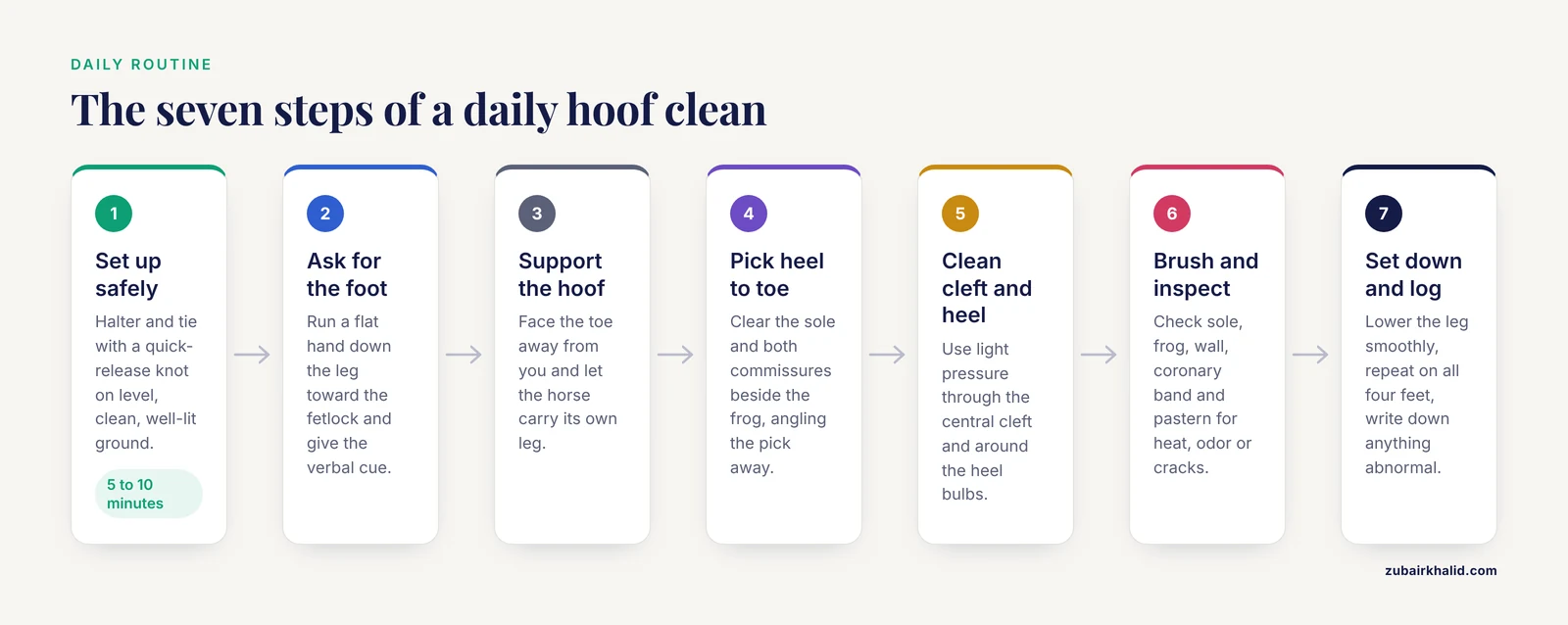
Step 1: Set Up Safely
Halter the horse and tie it with a quick-release knot to a solid post, or have a helper hold the lead rope. Choose a level, clean, well-lit surface. A horse standing on mud, gravel, or slippery ground cannot balance comfortably on three legs and is more likely to pull away.
Stand beside the horse, never directly in front of or behind the hind limbs. Run your flat hand firmly down the back of the leg from knee or hock toward the fetlock. Most horses learn the cue and lift the foot. If the horse does not respond, lean lightly against the shoulder or hip while squeezing the leg. Give a clear verbal cue such as "foot" each time so the response becomes automatic.
Step 2: Support the Hoof Correctly
When the horse lifts, catch and support the hoof. For front feet, many handlers hold the toe with one hand and rest the other under the fetlock or knee. For hind feet, guide the leg forward and support it, keeping the horse's leg lower rather than cranked up high, which strains the joint and unbalances the horse.
Your own posture matters here too. Ergonomic analysis of daily cleaning tasks in horse stables has identified awkward body postures as a real risk for handlers, who perform these bending and lifting motions many times every day [4]. Face the toe away from your body, keep your back as straight as practical, let the horse carry the weight of its own leg, and avoid crouching fully under the hoof. If a horse leans on you, gently push back into the lean rather than trying to hold the leg up with muscle alone.
Step 3: Pick From Heel to Toe
Position the pick so it angles away from you and away from the frog, then draw packed material out of the sole, working from the heel toward the toe. Working in this direction follows the natural shape of the hoof and keeps the pick from digging into the frog or stabbing into your own hand if it slips.
Clear the two grooves, called the commissures, that run along either side of the frog. This is where stones, manure, and wet organic material pack most tightly. A stone driven into the commissure and left there can bruise the foot within hours, so this is the part of the routine you should never skip.
Step 4: Clean the Central Cleft and Heel
Run the pick gently through the central cleft of the frog and around the heel bulbs. Use light pressure. The frog and the heel bulbs are sensitive structures. You are cleaning, not scraping tissue.
As you work, note the smell. A healthy hoof smells like clean horn and dirt. A strong foul odor, especially with dark crumbly material in the frog or commissures, is a finding to report to your veterinarian or farrier. Do not apply over-the-counter treatments on your own until someone has examined the foot, because different causes of odor need different management.
Step 5: Brush and Inspect
Brush the sole, the hoof wall, and the junction where the sole meets the frog so you can see the entire surface. Now inspect methodically:
- Sole. Look for punctures, bruising (dark discoloration), flaky areas, or anything embedded. If you find a nail or other object in the sole, do not pull it out before calling your veterinarian unless it is loose and about to fall out on its own. Knowing exactly where and how deep the object entered helps the veterinarian assess the injury.
- Frog. Look for tenderness when you press gently with your thumb, foul odor, or tissue that looks devitalized.
- Hoof wall. Look for cracks, especially ones that run vertically from the ground surface up toward the coronary band, and for loose or missing nails if the horse is shod.
- Coronary band and pastern. Run your hand along the coronary band comparing front feet to hind feet and left to right. Heat, swelling, or a painful response deserves follow-up. Check the pastern for cuts, scabs, and swelling.
Heat comparisons are useful. A foot that is clearly warmer than its three neighbors is telling you something, even before lameness appears.
Step 6: Set the Foot Down and Repeat
Lower the leg smoothly rather than dropping it. Move to the other front foot, then the hind feet. Many horses are fussier about their hind feet, so give them extra time and stay patient.
Step 7: Log Your Findings
Write down anything abnormal, along with the date, in your horse health record. A simple template works well: one line per day with columns for each hoof, any odor or discharge, any heat or swelling, any behavior change during picking, and the date of the last farrier visit. Over weeks, this log reveals trends, such as an odor that keeps returning after rain, or a foot that is consistently warmer on the day after hard work. Bring this record to veterinary and farrier appointments.
How to Clean Horse Hooves Daily: Tips for Reluctant Horses
Some horses snatch their feet away, lean, kick, or threaten to kick during hoof handling. Fear is a common driver. Research on handling injuries notes that handlers are most frequently hurt by horse kicks induced by the horse's fear, which makes safe working conditions during hoof care a priority.
A published trial offers a useful approach. In a study of six Lipizzan horses, handlers applied the Tellington TTouch method, a system of circular hand movements over various parts of the horse's body intended to build trust, during hoof care. The horses received customary handling in the first week and the TTouch method in the second. Researchers measured the time needed for hoof care, the number of leg withdrawal attempts, the number of actual withdrawals, heart rate, and cooperation scores. The TTouch period produced statistically significant improvements in withdrawal attempts and in the horses' assessed cooperation. A follow-up case study applied the same approach over eight weeks with a young, problematic horse.
Practical takeaways you can apply, whether or not you use that specific method:
- Touch the leg with slow, deliberate contact before you ask for the foot, rather than grabbing.
- Ask for the foot, hold it briefly, and set it down before the horse decides to snatch it away. End each early attempt on a success.
- Work in short sessions. Several calm two-minute sessions beat one long battle.
- Stay out of the kick arc on hind legs until the horse has proven reliable, and consider having a trainer or your veterinarian involved if the horse has a history of striking or kicking.
- Do not punish the horse for pulling. Punishment adds fear, and fear is the underlying problem.
If a horse refuses to give a foot, that refusal itself can be a physical finding. Painful hocks, stifles, back, or feet make lifting uncomfortable, so persistent refusal deserves a veterinary conversation rather than more force.
How to Clean Horse Hooves Daily: Common Mistakes
Skipping days. The habit only protects the horse if it happens daily. Material left packed in the commissures for a weekend can bruise the sole or soften the frog. Professionals at a documented thoroughbred stud performed hoof care every two to three days at minimum, and the practical standard for most owners is daily picking [1].
Working in poor light or mud. You cannot see what you are cleaning in dim conditions, and a horse on uneven or slippery footing cannot stand safely on three legs. Fix the environment before blaming the horse.
Rushing the hind feet. Handlers get hurt most often at the hind end. Support the leg low, stay positioned to the side, and never kneel directly behind the horse.
Digging hard into the frog. Aggressive scraping causes soreness and teaches the horse that hoof handling hurts. Use light pressure and let the pick do the work in the commissures.
Pulling an embedded nail without a plan. If you remove a penetrating object, save it and mark the entry point, but call your veterinarian first. The depth and direction of penetration determine how urgently the injury must be treated.
Ignoring heat and pulse. Owners sometimes look only for stones. Heat in the hoof wall, a bounding digital pulse, or reluctance to bear weight are escalation signs covered below.
Failing to communicate with the farrier. A preliminary review of hoof management and the client-farrier relationship in the United Kingdom found that the owner-farrier relationship is central to good hoof care outcomes [6]. Your farrier only knows what you observe if you tell them. The daily log you keep while picking feet is exactly the information a farrier wants.
Repeating the same posture for hours. Barn work is physically repetitive, and ergonomic studies of daily stable cleaning tasks document musculoskeletal strain from habitual awkward postures [4]. Alternate which side you stand on, use tables or stands when available, and pace yourself.
Troubleshooting Problems You Find While Cleaning
A wedged stone. Stop, remove the stone with the pick, and check the sole for bruising. If the horse is lame after removal, rest the horse and call your veterinarian.
Foul odor or dark material in the frog. Stop picking aggressively, keep the foot as dry and clean as possible, and ask your veterinarian or farrier to examine the horse. Do not begin chemical treatments on your own.
A loose or missing shoe. Call your farrier. In the interim, pick the foot gently, keep the horse in soft footing if a nail is protruding, and prevent the horse from tearing at the shoe in the fence or stall.
Heat, a strong digital pulse, or lameness. These can signal inflammation within the foot. Laminitis, the inflammation of the laminar structures inside the hoof, is described in the veterinary literature as a common condition and a medical emergency with the potential to end a horse's athletic career [7]. A documented treatment case involved extensive clinical care, including cleaning of the affected sole with hydrogen peroxide and 10% iodine, protective boots, and therapeutic shoeing under veterinary direction [7]. You should not attempt any of that at home. If your horse shows a stilted stance, heat in multiple feet, or a strong pulse, contact your veterinarian immediately.
Cracks or deformities. Photograph the crack, note whether it is widening or climbing toward the coronary band, and discuss it at your next farrier visit. Some cracks need corrective trimming and shoeing, and case reports show that corrective approaches are individualized to each horse's conformation and diagnosis.
Cuts on the pastern or coronet. Clean gently with clean water and note the location. Because the lower limb lacks protective muscle over tendons and joint structures, wounds here warrant a veterinary assessment sooner rather than later [2].
Supporting Hoof Health Through Stable and Pasture Management
Hoof cleaning works best inside a clean overall environment.
Stall hygiene. Wet, manure-soaked bedding softens the hoof horn and keeps the frog in contact with waste. Bedding choice also affects general cleanliness, with studies showing that the bedding material itself, whether wheat straw, wood shavings, or pelleted newspaper, and whether it is clean or used, affects the cleanliness of the horse's hair coat and environment. Clean stalls and dry bedding make your morning pick-out more effective because there is less moisture and waste pressed into the feet overnight.
Ammonia and flies. Research in a horse barn environment found that applying sodium bisulfate to stall bedding daily reduced ammonia concentration, manure pH, and fly numbers compared with untreated periods, and the ponies in the study showed fewer fly-evasive behaviors such as tail swishes, head tosses, and kicks [8]. Discuss such products with your veterinarian or extension advisor before use, but the underlying principle is sound: reducing ammonia and flies improves the environment the horse stands in all day.
Water. Foot health connects to water hygiene more than owners expect, because horses stand near tanks and troughs, and muddy ground around them packs into hooves. In a study of stock tank water quality, adding goldfish reduced dissolved solids but did not affect turbidity or algae measures, and regular tank cleaning remained part of the protocol throughout the study period [9]. Scrub tanks on a schedule rather than relying on additives.
Parasite and pasture management. Management style influences parasite exposure, as shown in a survey of helminth control practices on horse farms that assessed risks linked to different kinds of management [10]. Picking the feet daily also removes manure-contaminated material from the hoof, and good manure and pasture management complements the parasite control plan you build with your veterinarian.
A Simple Daily Horse Care Checklist
Hoof cleaning fits naturally into a broader daily routine. A practical horse care checklist for one horse looks like this:
- Morning feed and fresh water check, scrubbing or refreshing the tank as needed
- Turnout, or supervised exercise appropriate to the horse's schedule
- Full pick-out and inspection of all four hooves
- Visual health check, including appetite, manure output, attitude, eyes, and any swelling
- Stall cleaning and bedding refresh
- Grooming and tack check before riding
- Hoof pick-out after riding, especially if the horse worked in sand, gravel, or mud
- Evening feed, water check, and a final look at the horse before leaving the barn
- Log entries in the horse health record, including anything abnormal and upcoming farrier dates
The observation habit matters as much as the tasks. Surveys of livestock keepers show that daily observation for signs of illness is a recognized health care practice that not everyone adopts consistently, and making it explicit on a checklist helps [10-adjacent practices]. Build the checklist once and use it every day, because consistency is what catches problems early.
Your Farrier Partnership and the Daily Routine
Daily cleaning supports, and never replaces, professional hoof trimming and shoeing. Hoof trimming and shoeing measurably change hoof conformation. In a study of fifteen horses, routine trimming and shoeing produced significant changes in coronary band measurements, dorsal hoof wall length, heel length, heel overhang, and hoof angle, with differences in heel length correlating with changes in gait [11]. This is why keeping a consistent farrier interval matters, and why your daily observations help: when you report that the horse's gait changed after the last trim, or that the heels are growing long again, your farrier can adjust the plan.
The owner-farrier relationship itself is recognized in the literature as central to hoof management [6]. Schedule farrier visits at the interval your farrier recommends for your horse, keep the feet clean and dry before the appointment, and share your daily log.
Limitations and When to Contact a Veterinarian
Every horse is an individual, and this article describes a general routine, not a diagnosis. Individual cases need a veterinarian, especially anything involving pain, lameness, or penetration injuries.
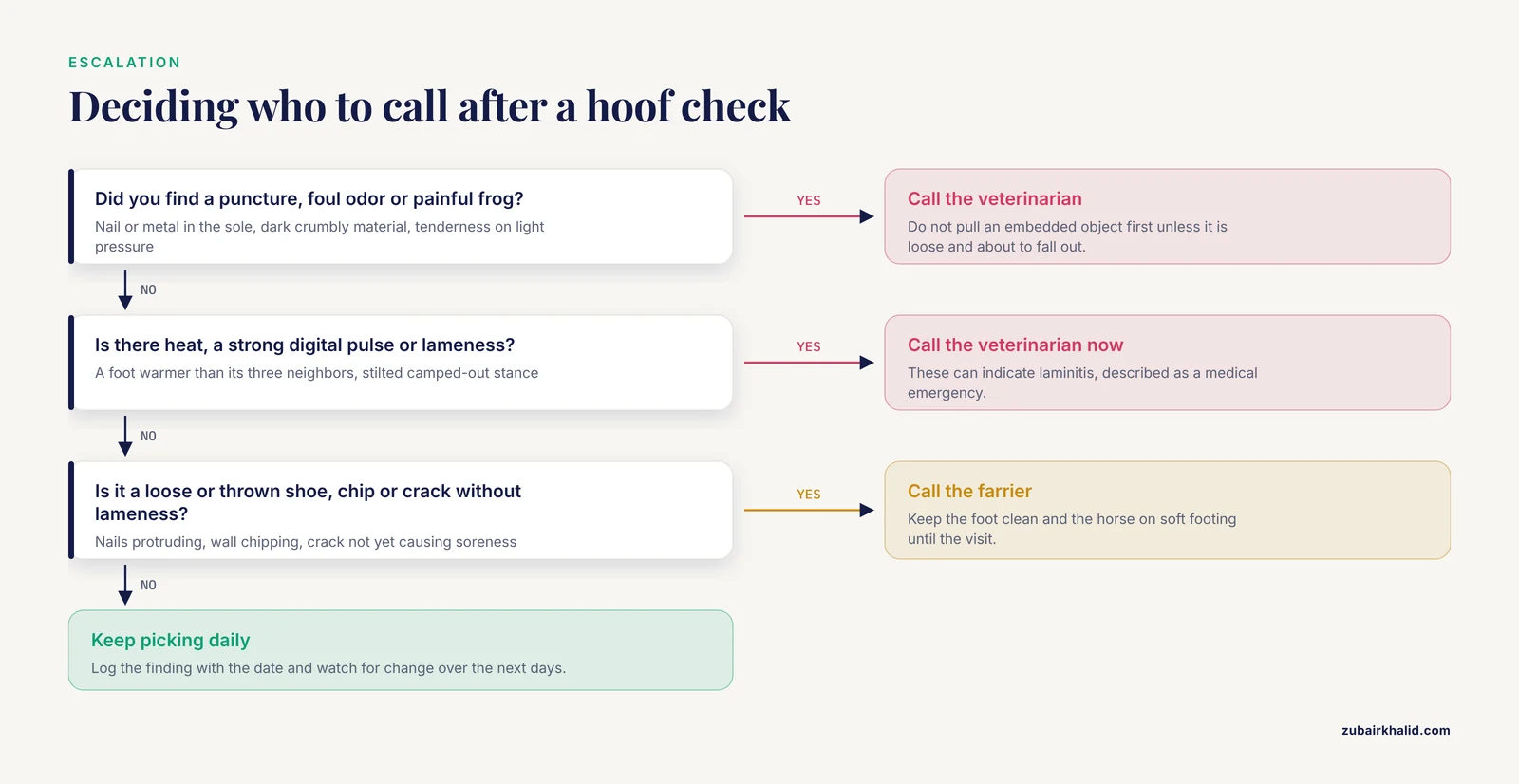
Contact your veterinarian promptly for:
- Any puncture to the sole or frog, especially from a nail or metal object, before or immediately after removing the object
- Heat in one or more feet, a strong digital pulse, or a stilted, camped-out stance, which can indicate laminitis, a medical emergency [7]
- Lameness that persists after you remove a stone or debris
- Foul odor, discharge, or painful tissue in the frog or sole
- Swelling, heat, or pain along the pastern, fetlock, or coronary band
- Cracks that are widening, bleeding, or causing lameness
- A horse that suddenly refuses to lift its feet, which may reflect pain rather than behavior
- Any wound on the lower limb, given how little protective tissue covers the tendons and joint structures there [2]
Contact your farrier for loose or thrown shoes, overgrown feet, chipping, cracks without lameness, and changes in hoof angle or heel growth between regular visits [11].
Contact a trainer or behavior professional, in coordination with your veterinarian, for a horse that kicks, strikes, or panics during hoof handling, since fear-driven kicking is a documented handler safety risk [5].
Frequently Asked Questions
How often should I clean my horse's hooves?
Pick out all four hooves at least once every day, and ideally before and after every ride. Professional facilities often perform structured hoof care, including cleaning and inspection, every two to three days, with horseshoe replacement about once monthly [1], and daily owner-level picking fills the gap between those sessions.
What tools do I need to clean my horse's hooves?
You need a hoof pick, a stiff-bristled brush, gloves, and safe footwear, plus a well-lit workspace. A hoof knife is optional and only for handlers trained to use it. Hoof dressings should wait until your farrier or veterinarian recommends one for your specific horse.
How do I get my horse to pick up its foot?
Run your hand firmly down the back of the leg toward the fetlock, squeeze, and give a consistent verbal cue. Stay calm, keep early sessions short, and set the foot down on a success. For fearful horses, slow, deliberate touch techniques have been shown to reduce leg withdrawal attempts and improve cooperation during hoof care in a published trial.
Should I pick hooves before or after riding?
Both, whenever possible. Picking before riding removes stones that could bruise the sole under saddle, and picking afterward clears anything the ride packed in, which matters most after work in sand, gravel, or mud.
Is it safe to clean the hooves of a horse I just met?
Be cautious. Handlers are most often injured by kicks driven by the horse's fear, and safety during hoof care is an established concern in daily practice [5]. Until you know the horse, ask about its history, use a helper, and stay out of the kick arc of the hind legs.
What does a healthy hoof look and smell like?
A healthy hoof has a solid wall without widening cracks, a firm sole, a frog with normal texture, and no heat, swelling, or discharge. It smells of clean horn and dirt. A strong foul odor, dark crumbly material, heat, or a strong digital pulse are findings to report to your veterinarian or farrier.
How often does my horse need a farrier?
Follow the interval your farrier sets for your individual horse, since trimming and shoeing measurably change hoof measurements and can influence gait [11]. One documented thoroughbred stud replaced horseshoes approximately once per month as part of a broader hoof care cycle [1].
Can I use hoof dressings or other products every day?
Use them only when your farrier or veterinarian recommends them for your horse's climate, hoof quality, and work level. Products applied to a foot with an unidentified problem can mask the signs your veterinarian needs in order to diagnose correctly.
Sources
- Thoroughbred Racehorse Hoof Care at ECLIPSE STUD AND STABLE
- Topical Chinese Herbal Medicine Treatment of a Non-healing Leg Wound in a Horse: A Case Report
- Influence of daily free time spent outside in a paddock and stable management on behavioural disturbances and health in the horse
- An analytical ergonomic risk evaluation of body postures during daily cleaning tasks in horse stables
- Effect of the Tellington Ttouch® Method on Horse Behaviour in Daily Practices
- A Preliminary Review of Equine Hoof Management and the Client-Farrier Relationship in the United Kingdom
- Chronic Laminitis in a Horse - Treatment with Use of Horseshoe with Horizontal Cross and Epoxy Putty
- Effect of sodium bisulfate on ammonia concentration, fly population, and manure pH in a horse barn.
- The Effect of Goldfish (Carassius auratus) on Water Quality in Horse Stock Tanks.
- A questionnaire survey on helminth control on horse farms in Brandenburg, Germany and the assessment of risks caused by different kinds of management
- The Immediate Effect of Routine Hoof Trimming and Shoeing on Horses' Gait.