How Often Should Your Horse See the Farrier?
By Dr. Zubair Khalid, DVM, MS, PhD ·
The difference between a horse that stays sound and one that develops cracks, flares, and lameness often comes down to weeks, not years, between farrier visits. A simple rule of thumb works for most owners: schedule a farrier appointment every 6 to 8 weeks, and shorten that window to every 4 to 6 weeks if your horse wears shoes, works hard on hard ground, or has a hoof condition your veterinarian is managing.
That rule is a starting point, not a prescription. Hoof growth rate, shoe type, footing, age, and health status all shift the interval. This guide explains why the schedule exists, compares your main options side by side, walks through real-world scenarios, and shows you how to fold farrier visits into a practical horse care checklist so nothing slips through the cracks.
This article is educational and is not a substitute for veterinary diagnosis or treatment.
Why a Regular Farrier Schedule Matters
A horse's hoof is a growing structure. The wall grows downward from the coronary band at a rate commonly described in farriery and veterinary references as roughly a quarter to three-eighths of an inch per month, with faster growth during periods of increased blood flow to the foot such as spring and summer. Because growth is continuous but natural wear is uneven, the hoof gradually loses its balanced shape between appointments.
When the interval stretches too long, several problems build quietly:
- Overgrowth and flaring. Untrimmed wall length puts leverage on the hoof wall and white line, increasing the risk of cracks and separation.
- Lost shoeing balance. A shod foot grows past the shoe, the shoe migrates forward, and the breakover point changes, altering limb mechanics with every stride.
- Hoof wall cracks. Long walls chip and crack, and a cracked wall can climb toward sensitive tissue.
- Uneven wear. Barefoot horses wear their feet unevenly on arena surfaces and turnout, which distorts hoof-pastern angles over time.
- Thrush and sole problems. Overgrown frogs and contracted heels trap moisture and debris, creating conditions where thrush and bacterial invasion thrive.
The American Association of Equine Practitioners emphasizes that consistent, professional hoof care is one of the most important components of preventive horse health, and its owner education materials recommend that horses receive routine farrier care on a regular schedule rather than on an as-needed basis. The Merck Veterinary Manual similarly identifies routine trimming and shoeing as core elements of equine preventive care, alongside dental exams and vaccination.
Quick Answer: The Standard Intervals at a Glance
| Situation | Typical interval | What happens at the visit | Key advantage | Main tradeoff |
|---|---|---|---|---|
| Barefoot horse, light work, healthy feet | Every 6 to 8 weeks | Full trim, rasping, balance check | Lowest cost, natural hoof function | Intervals can stretch too long unnoticed |
| Barefoot horse, heavy riding or abrasive footing | Every 4 to 6 weeks | Trim plus wear assessment | Prevents uneven wear from masking problems | More frequent expense and scheduling |
| Horse in full shoes | Every 4 to 6 weeks | Reset or replace shoes, trim, balance | Protects feet under work, consistent breakover | Highest frequency and cost, nail holes stress wall |
| Front shoes only, barefoot hind | Every 5 to 7 weeks | Combined trim and shoeing | Compromise protection for front-end work | Two slightly different intervals to track |
| Therapeutic or corrective shoeing | Every 3 to 6 weeks, veterinarian-directed | Specialized shoe application, radiograph-guided balance | Treats laminitis, navicular syndrome, cracks | Requires vet and farrier to work as a team |
| Foals and young horses | Every 4 to 6 weeks during rapid growth | Trimming for limb alignment | Corrects conformational deviations early | Over-trimming can harm developing feet |
These intervals reflect widely published farriery and veterinary guidance. Your own horse's schedule should be set with your farrier, and your veterinarian should be involved whenever there is lameness, disease, or therapeutic shoeing involved.
How Often Should Your Horse See the Farrier? Comparing Your Options
Option 1: Barefoot Trimming Every 6 to 8 Weeks
A barefoot trim removes excess wall length, balances the foot, trims the frog and sole conservatively, and rounds (rasps) the wall edge to prevent chipping. For a healthy barefoot horse in light to moderate work with good hoof quality, a 6 to 8 week cycle is the most commonly recommended interval.
Pros
- Lower cost per visit than shoeing, and no risk of lost shoes.
- The hoof's natural mechanism of expansion and contraction is fully functional, which many owners report improves frog health and traction on certain surfaces.
- No nail holes, so the wall is never perforated.
- Fewer complications from unsuitable shoeing.
Cons
- Bare feet wear down with riding, and abrasive footing can outpace hoof growth, leaving some horses footsore between trims.
- Transitioning a horse out of shoes takes months, sometimes close to a year, and requires careful management during that period.
- Without shoes, horses with thin soles, long toes, or under-run heels may need hoof boots for riding.
- A stretched interval shows up as flares and chipping, which some owners mistake for a trimming quality problem rather than a timing problem.
The 8-week end of the range suits horses with slow growth, light work, and dry climates. The 6-week end suits faster-growing feet, wet climates, and horses in regular work. Ask your farrier to measure wall length and note wear patterns at each visit so the interval can be tuned to your horse rather than to the calendar alone.
Option 2: Shoeing Every 4 to 6 Weeks
A shod horse grows past the steel or aluminum shoe in roughly 4 to 6 weeks. As the wall lengthens, the shoe migrates toward the toe, the heels lose support, and the nail clinches loosen. Most farriers recommend resetting or replacing shoes within that window to maintain the balance they built at the previous visit.
Pros
- Shoes protect the sole and wall from wear on abrasive surfaces and provide traction for arena, trail, and competition work.
- A properly fitted shoe maintains consistent breakover, which reduces strain on the flexor structures of the limb.
- Horses with thin soles, flat feet, or certain conformational faults often stay comfortable only with shoe support.
- Therapeutic shoe designs are the mainstay of managing many causes of foot lameness.
Cons
- Highest recurring cost of any hoof care option.
- Lost shoes happen, often at the worst time, and each loss damages the wall and can shorten the interval to the next visit.
- Repeated nail holes can weaken the wall over years of continuous shoeing.
- Shoes reduce the hoof's natural traction on some surfaces, which matters for certain sports.
If a shoe pulls off between appointments, call your farrier promptly rather than waiting for the scheduled date. A horse standing on an unbalanced foot with one shoe missing can develop strain in the opposite limb within days.
Option 3: Front Shoes Only
Many trail and arena horses go barefoot behind and shod in front, because the front limbs carry 55 to 60 percent of the horse's weight and take the brunt of concussion under saddle. The interval for this setup usually lands between the barefoot and full-shoe schedules, at roughly 5 to 7 weeks.
Pros
- Protects the feet that take the most load under riding.
- Keeps the hind feet, which often have excellent natural wear and strong walls, unshod.
Cons
- Scheduling is marginally more complex because the farrier does two different jobs in one visit.
- Some farriers charge a partial-shoeing rate that is not proportional to the work, so confirm pricing in advance.
Option 4: Therapeutic and Corrective Shoeing
Horses under veterinary treatment for laminitis, navicular syndrome or podotrochlosis, deep hoof wall cracks, abscess recovery, or angular limb deformities in young horses follow a different and tighter schedule. The Merck Veterinary Manual describes farriery as a central component of managing foot-related lameness, with shoeing decisions made jointly by the veterinarian and farrier, often guided by hoof radiographs.
Therapeutic cases commonly need visits every 3 to 6 weeks, because the shoeing strategy itself is part of the treatment and must be adjusted as the condition changes. In laminitis, for example, reducing leverage on the hoof wall and supporting the sole may require frequent fine-tuning in the early phase of recovery.
Pros
- Directed treatment for a diagnosed problem rather than routine maintenance.
- Close monitoring catches deterioration early.
Cons
- Highest cost and most demanding coordination, since your veterinarian and farrier must communicate directly.
- Requires disciplined scheduling. A missed visit in a laminitic horse can undo weeks of progress.
Option 5: Foals, Yearlings, and Young Horses
Young horses grow hoof wall faster than mature horses and can develop conformational deviations in the limb that become permanent if the feet stay unbalanced through rapid growth phases. Equine practitioners generally recommend that foals receive their first handling and light trimming in the first weeks to months of life, with trimming every 4 to 6 weeks through the growth phase so that minor angular deviations can be corrected early.
Pros
- Early correction of toe-in, toe-out, and flexural deviations during growth windows when change is still possible.
- The foal learns to handle farrier visits calmly before adult shoeing begins.
Cons
- Foal feet are soft and small, and over-trimming is a real risk, so the farrier must be experienced with young stock.
- Genetics, nutrition, and exercise management all interact with trimming, so your veterinarian should be part of the plan whenever a limb deviation is noticed.
Option 6: Seniors and Pasture-Only Horses
Retired and pasture-only horses still need farrier care. Their hooves keep growing, and untrimmed feet in an older horse lead to long toes and broken-back hoof-pastern angles that strain the deep flexor tendon and joints. Many seniors do well on an 8-week schedule, while seniors with cushingoid changes, chronic laminitis risk, or arthritis may need shorter intervals and closer veterinary oversight.
Pros
- Maintains comfort and mobility in retirement, which directly affects an older horse's quality of life.
- Regular visits give your farrier a chance to flag early changes such as abnormal rings on the wall or sinking of the coronary band, both of which warrant a veterinary call.
Cons
- Arthritic seniors may need sedation or extra time to stand comfortably for the visit, which should be arranged in advance with your veterinarian.
How to Decide: The Criteria That Actually Matter
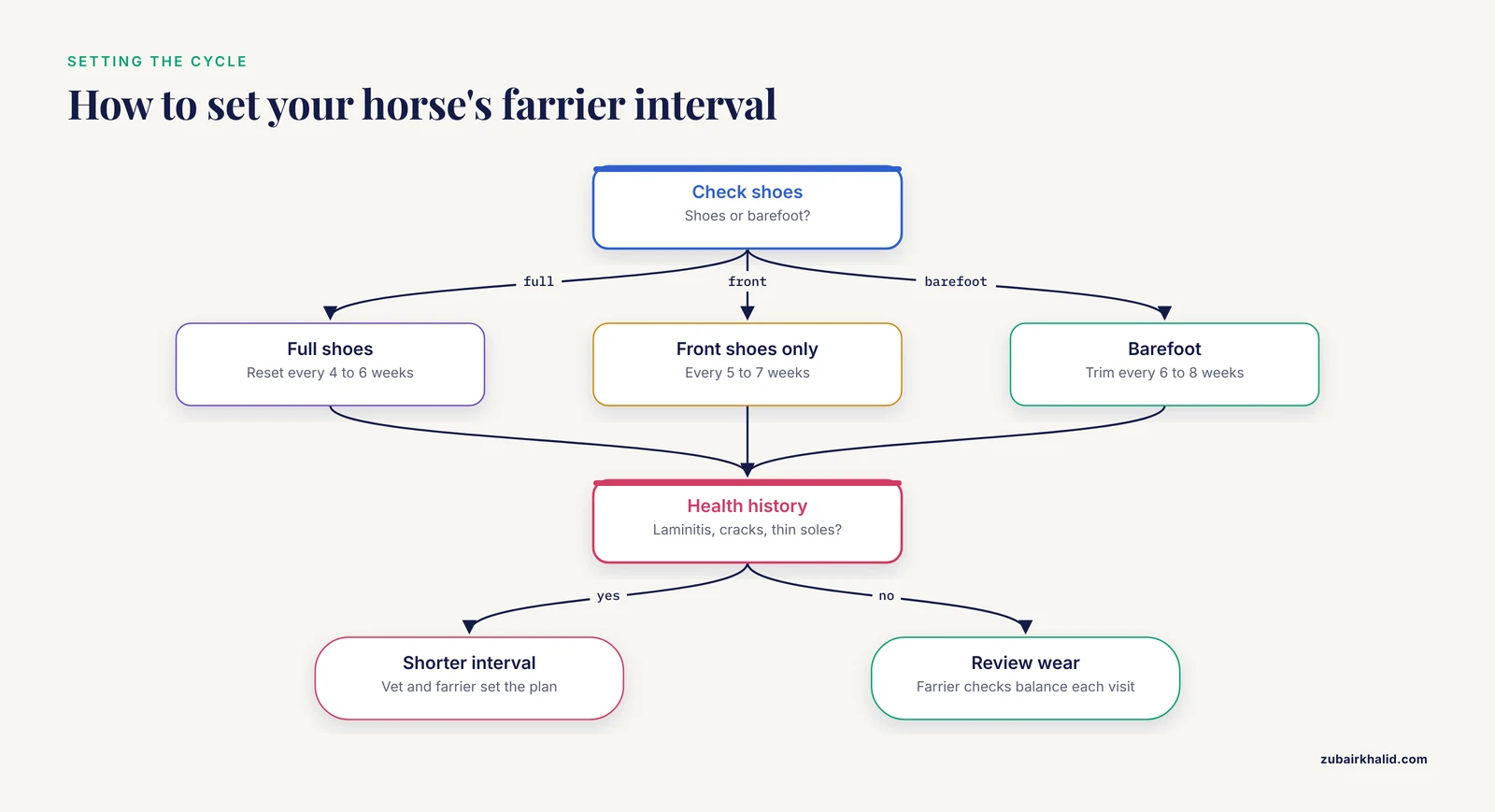
Four factors determine where your horse falls within these ranges. Work through them in order.
1. Shoes or no shoes. This is the biggest single divider. Shoes need resetting before the foot grows past them, which pulls the typical interval to 4 to 6 weeks. Barefoot trims tolerate longer gaps, typically 6 to 8 weeks, because the trim restores balance rather than maintaining a fixed appliance.
2. Rate of wear versus rate of growth. A horse in daily arena work on sand wears its feet faster than a pasture companion. A horse on rocky terrain may need boots or shoes simply to keep wear from outpacing growth. Your farrier can read wear patterns at each visit and tell you whether the interval is right.
3. Hoof quality and health history. Horses with a history of laminitis, chronic abscesses, white line disease, or thin soles belong on shorter intervals with veterinary involvement. The Merck Veterinary Manual notes that horses with a prior laminitis episode benefit from ongoing monitoring of hoof balance and comfort, because recurrence is common and farriery is part of long-term management.
4. Season. Hoof growth accelerates in warm months with good nutrition and slows in cold months. Many horses need trims closer together in summer and can stretch slightly longer in winter, though wet winter footing introduces its own problems with thrush and softened walls.
Worked Scenarios
Scenario A. A 9-year-old quarter horse mare, barefoot, ridden twice a week on soft trails. Her feet are hard and grow slowly. Her farrier starts at 7 weeks, finds the feet still balanced at that point, and stretches her to 8 weeks. Her owner logs each visit on a health record and the mare stays sound.
Scenario B. A 6-year-old warmblood gelding in full shoes, jumped three times a week. He is on a 5-week reset schedule. At one visit his farrier notices the left front shoe had been loose for a week and the wall under it is chipped. The farrier removes the shoe, lets the wall rest, and fits the next set a week early. The owner adjusts the schedule to 4 weeks for that horse.
Scenario C. A pony with a previous laminitis episode. Under veterinary guidance, the pony wears supportive therapeutic shoes and is seen every 4 weeks. Her owner keeps radiographs from each check in a health record file so the farrier and veterinarian can compare sole thickness over time.
Scenario D. A weanling colt with a mild toe-out conformation on the left fore. His veterinarian and farrier plan trims every 4 weeks through his yearling year, using medial and lateral adjustments rather than aggressive corrections, and reassess at each visit.
Common Mix-Ups Owners Make
- Waiting for the horse to look lame. Overgrown feet distort balance long before lameness appears. By the time a horse is visibly sore, structural changes are already underway.
- Treating a chipped, cracked foot as a farrier problem alone. Cracks can reflect an over-long interval, but they can also signal white line disease, abscess tracts, or chronic imbalance that needs a veterinary diagnosis before the farrier repairs the wall.
- Assuming barefoot means no farrier. Barefoot horses need trims on a schedule just as shod horses do, and untrimmed bare feet can develop the same flares and long toes as shod ones.
- Stretching the interval to save money. A skipped visit often produces a lost shoe, a pulled wall, or a footsore horse, and the corrective visit costs more than the routine one would have.
- Scheduling without the farrier's input. Some owners set rigid calendar dates without asking the farrier to assess wear at each visit. The interval should be reviewed at least a couple of times per year.
- Forgetting that diet affects the hoof. Hoof wall quality depends on nutritional factors such as adequate protein, biotin, methionine, zinc, and copper, and Kentucky Equine Research notes that correcting nutritional deficiencies improves hoof growth and quality over a period of many months because the wall must grow out from the coronary band. A horse with poor hoof quality may need shorter intervals until the wall improves.
Building Farrier Visits Into Your Horse Care Checklist
A horse care checklist keeps hoof care from depending on memory. Your checklist should include, at minimum:
- Vaccinations on the schedule your veterinarian recommends.
- Dental examination at least annually, more often for some horses.
- Deworming based on fecal egg count results rather than a fixed calendar.
- Farrier visits at your established interval, whether 4, 6, or 8 weeks.
- Daily or near-daily foot picking, which is your first line of defense against thrush and trapped foreign bodies.
- Annual or biannual body condition scoring and weight tape measurement.
- Coat, skin, and limb inspection during grooming, including running a hand down each leg to feel for heat, swelling, or digital pulse changes.
Farrier visits belong on the same list as vaccinations and dentistry because they are preventive care, not cosmetic maintenance.
Using a Horse Health Record Template to Track Hoof Care
A horse health record template turns farrier visits into data you can use. Whether you keep records in a binder, a spreadsheet, or a stable management app, each farrier entry should capture:
- Date of visit and date of the next scheduled visit.
- Trim, reset, or full new shoeing, and which feet were shod.
- Notes on balance, wall length, flares, cracks, or thrush treatment applied.
- Any shoes pulled or lost since the last visit, and the reason.
- Lameness observations, pulse strength in the feet, or owner-notified changes since the last visit.
- For therapeutic cases, radiograph dates and the shoeing plan agreed on by your veterinarian and farrier.
Over a year, this record reveals your horse's true interval. If the notes show flares appearing at week 7 every time, your interval is too long. If shoes are consistently loose at week 5, shorten the cycle. The record also protects you in boarding situations, supports your farrier when another professional takes over, and gives your veterinarian a documented timeline if lameness ever develops.
Digital templates and printable checklists are widely available through cooperative extension services and equine practice websites. Choose one that includes farrier fields specifically, because many generic pet records omit hoof care details.
Scheduling Tips That Keep the Cycle on Track
- Book the next appointment before you leave the barn. Good farriers book out weeks in advance, and scheduling at the visit prevents gaps.
- Cluster appointments. If you own multiple horses, ask for consecutive bookings so a single delay does not cascade across the whole string.
- Set reminders at the halfway point. A reminder at week 3 of a 6-week cycle gives you time to notice a loose shoe or a thrown one and adjust.
- Keep the environment consistent. Have your horse caught, feet picked, and standing on level ground when the farrier arrives. A calm, prepared horse makes each visit more thorough.
- Plan around weather and footing. Icy barn aisles, muddy paddocks, and extreme heat all complicate farrier work. Seasonal planning keeps visits safe for everyone.
Limitations and When to Contact a Veterinarian
Every horse is an individual, and the intervals in this article are general guidelines drawn from published farriery and veterinary education materials. Your farrier's hands-on assessment of your horse's feet, combined with your veterinarian's input where health problems exist, should always take precedence over any generic schedule.
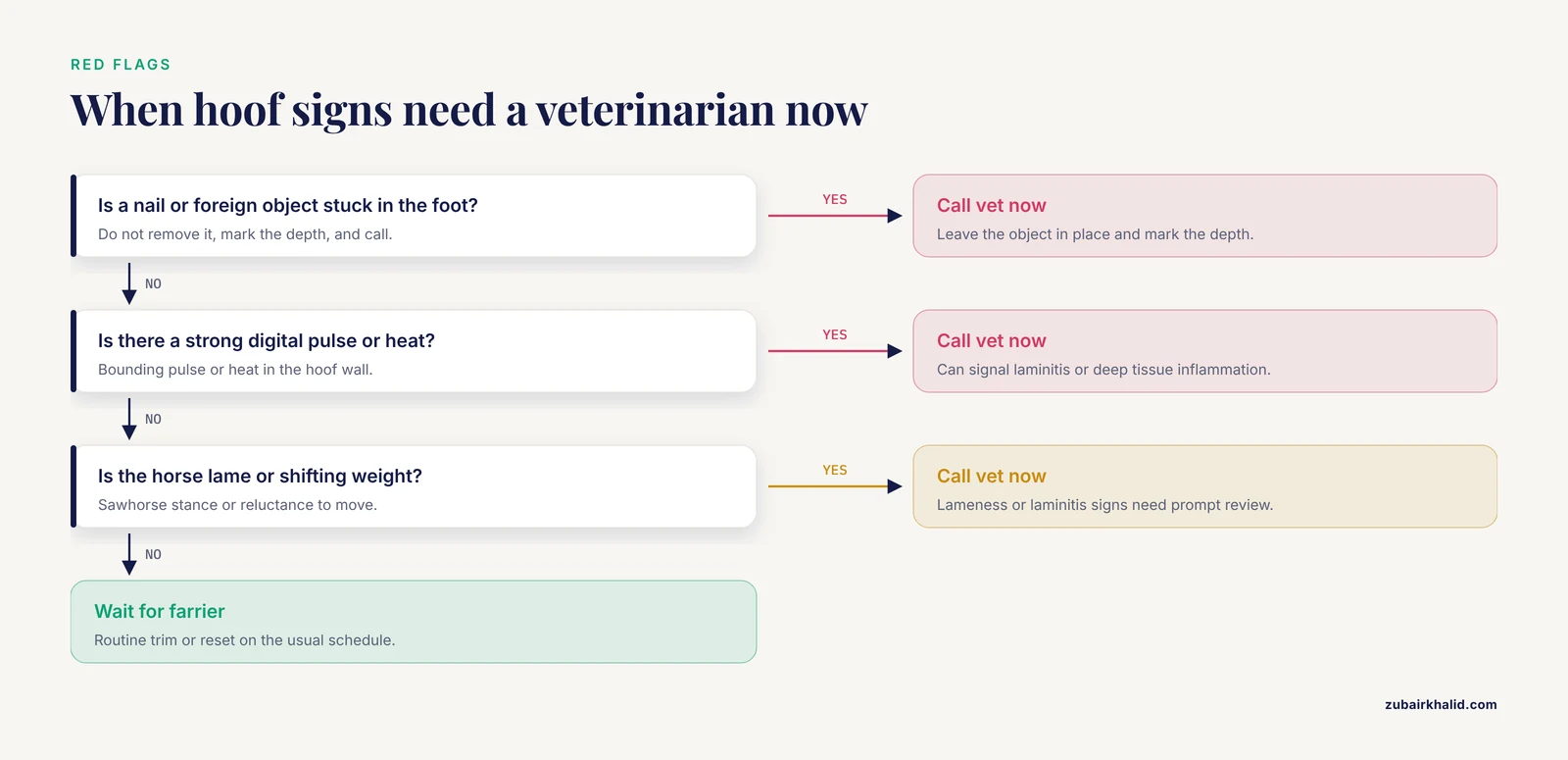
Contact your veterinarian promptly, rather than waiting for the next farrier appointment, if you observe any of the following:
- Obvious lameness at the walk, or reluctance to move that persists more than a few minutes.
- A strong or bounding digital pulse in one or more feet, which can signal laminitis or deep tissue inflammation.
- Heat in the hoof wall or swelling above the hoof that does not resolve within a day.
- A nail or foreign object deeply embedded in the foot. Do not remove it. Leave it in place, mark the depth, and call your veterinarian.
- An abscess, indicated by sudden severe foot pain, often with drainage at the coronary band or sole.
- A hoof wall crack that is bleeding, discharging, associated with lameness, or extending up toward the coronary band.
- Signs of laminitis, including shifting weight between front feet, a sawhorse stance, or increased breathing rate after a dietary change or illness.
- Rapid worsening of a known hoof condition, or a therapeutic shoeing plan that seems to be losing effectiveness between visits.
- A foal with an apparent limb deviation or an unwillingness to move normally.
Routine farrier work itself falls within the scope of a professional farrier, and in the United States farriery is generally not subject to veterinary licensure requirements. Where diagnostic work, lameness evaluation, medication, or treatment of disease is involved, veterinary oversight applies, and the veterinarian-farrier partnership is the accepted standard of care for complex hoof problems.
Frequently Asked Questions
How often should a horse see the farrier if it is barefoot?
Most healthy barefoot horses need a trim every 6 to 8 weeks. Horses in heavier work, on abrasive footing, or with faster-growing feet may need trims every 4 to 6 weeks. Ask your farrier to assess wear and balance at each visit and adjust from there.
How often should a shod horse see the farrier?
A shod horse generally needs resetting or new shoes every 4 to 6 weeks, because the foot grows past the shoe and the balance shifts within that window. If a shoe pulls off between visits, schedule an earlier appointment rather than waiting for the next scheduled date.
What happens if I skip a farrier visit?
The hoof keeps growing, the balance deteriorates, and flares, cracks, long toes, and lost shoes follow. Shod horses can develop loose, shifted shoes that alter limb mechanics. One missed visit is usually recoverable with an earlier reschedule, but repeated delays cause progressive hoof distortion and lameness risk.
Can I trim my own horse's feet?
Basic maintenance between professional visits is sometimes done by experienced owners, but full trimming and shoeing should be performed by a trained farrier. Hoof balance affects the entire limb, and incorrect trimming can cause lameness that takes months to resolve. Many practitioners recommend that owners focus on daily foot picking and leave trimming to professionals.
Does diet affect how often my horse needs the farrier?
Yes. Hoof wall grows from the coronary band, and its quality depends on adequate protein and nutrients including biotin, methionine, zinc, and copper. Improving nutrition strengthens the wall over many months, which can reduce chipping and cracking between trims, though the visit interval itself is set mainly by growth rate and wear.
How often do foals need the farrier?
Foals benefit from early, gentle trimming and handling, with visits roughly every 4 to 6 weeks through the rapid growth phase. Regular foal trims allow mild limb deviations to be corrected while growth is still underway. Involve your veterinarian whenever a young horse shows an angular or flexural deformity.