Horse Turnout Checklist: Step-by-Step Guide
By Dr. Zubair Khalid, DVM, MS, PhD ·
A horse turnout checklist is a short daily routine that confirms five things before you open the gate: your horse is sound and comfortable, the weather and blanketing plan fit the day, the paddock is free of hazards, water and shelter are in place, and the group your horse is joining is set up to stay calm. Run the same sequence every morning and turnout becomes safer, longer, and calmer for both of you.
Time outside is also where horses meet the three core behavioral needs researchers summarize as friends, forage, and freedom, meaning social contact with other horses, near-constant access to fibrous forage, and freedom of movement [1]. Restricting any of those needs keeps a horse below its welfare potential, which is exactly why a checklist beats improvising at the gate.
This article is educational and is not a substitute for veterinary diagnosis or treatment.
Below is the full routine, the paddock and pasture setup behind it, seasonal adjustments, the errors behind most turnout problems, and the record keeping that ties everything together.
At a Glance: The Daily Turnout Checklist
| Step | What to Do | What Should Stop You |
|---|---|---|
| 1 | Morning health check: attitude, appetite, manure, urine, legs, eyes | Heat or filling in a limb, no manure overnight, colic signs, fever |
| 2 | Weather check and blanketing decision | A soaked, torn, or poorly fitting blanket |
| 3 | Walk the fence line, gate, and footing | Loose boards or wire, open holes, debris, toxic plants |
| 4 | Confirm water, shade, and shelter | Empty, dirty, or frozen water, no shelter in severe weather |
| 5 | Set the group plan | A new horse without a gradual introduction |
| 6 | Release safely, then watch the first 15 minutes | Chasing that does not settle, a horse that will not leave your side |
| 7 | Midday visual check | A horse isolated at the fence, a tangled or missing blanket |
| 8 | Bring in, check over, and log the day | New cuts, heat, swelling, or a horse that will not settle |
Why Daily Turnout Matters for Welfare
Horses are built to eat and move for most of the day. When researchers fitted horses with automated tracking devices, the animals spent 42% of their day eating, 39% resting, and 19% in movement, and those time budgets shifted with turnout conditions and housing system. Horses in open-air group housing on a paddock showed more even feeding and movement patterns, with fewer sharp peaks, than horses kept in more restricted systems [2].
Management style shows up clearly in owner surveys. In a study of 1,501 recreational horse owners in the UK and Ireland, the largest differences between management styles were hours of turnout, individual stabling, and access to forage. The largest group of owners provided 24-hour turnout with a forage source and contact with two or more horses, while the most restrictive group offered 0 to 6 hours of turnout, often with no equine company and forage access limited to 0 to 10 hours [3].
Small management differences matter more than most owners expect. Three riding schools housing 59 horses in total, run under nearly identical conventional management and differing slightly in turnout frequency and riding techniques, produced clearly different facility-level welfare profiles when horses were assessed with behavioral, health, and physiological measures [4].
Daily routine even reaches the gut. In a study of 57 horses, diet and management factors, including turnout and stalling, were associated with differences in the glandular gastric mucosal microbiome [5].
Owners generally understand all of this. In interviews, owners wanted behavioral needs prioritized, yet fear of injury in group turnout and livery yard rules that controlled forage and freedom of movement often overrode those intentions [1]. A checklist exists to close that gap, turning good intentions into a repeatable routine.
Step-by-Step Horse Turnout Checklist
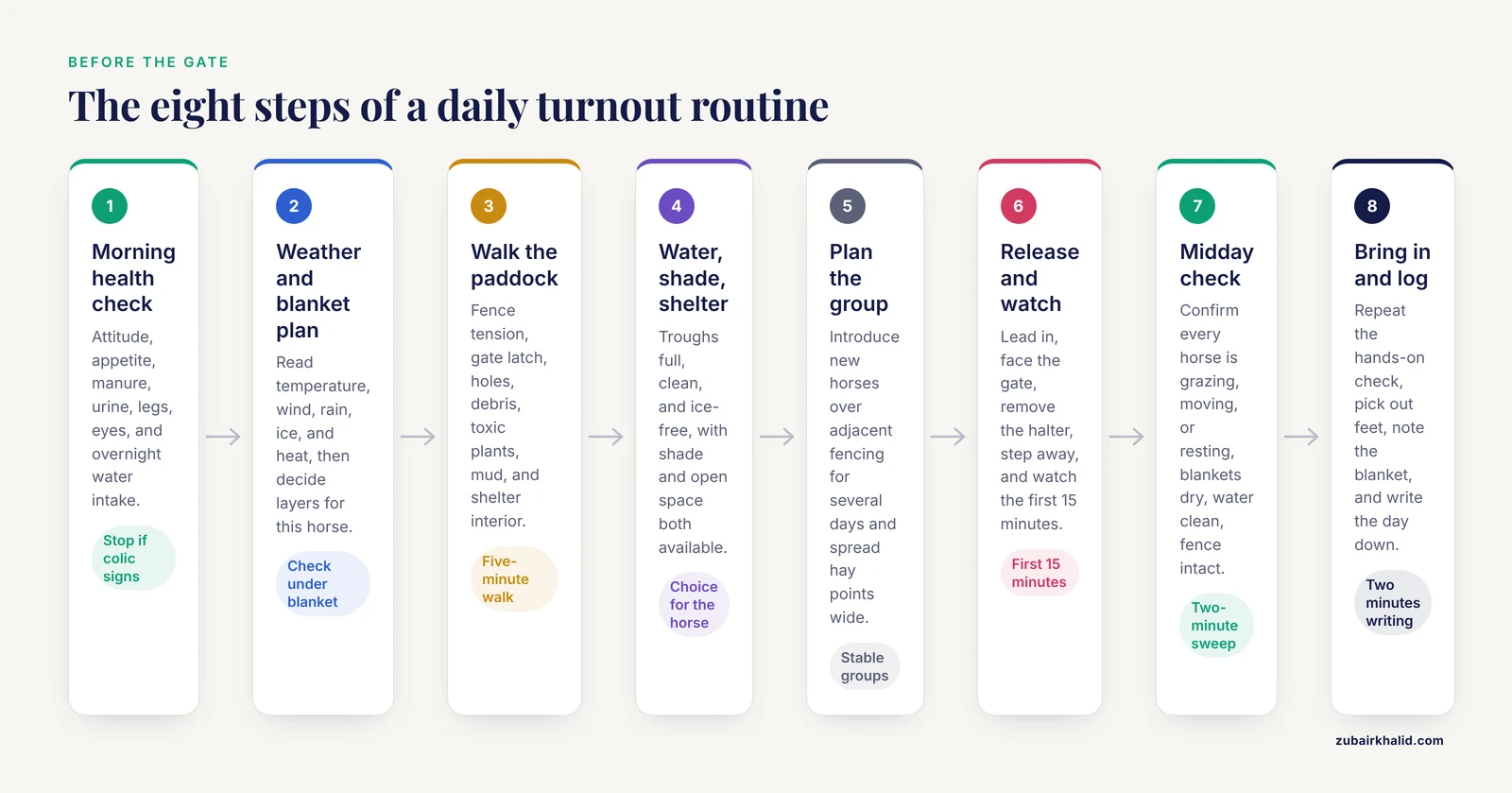
Work through the steps in order. Steps 1 through 5 happen before any horse leaves the barn, and the whole routine becomes quick once it is habit.
Step 1: Run a Morning Health Check
Your horse care checklist starts at the stall door. Look before you enter: is your horse standing comfortably, interested in breakfast, and passing normal manure? Then run through the basics:
- Attitude at the door and interest in last night's hay
- Manure amount and consistency in the stall, plus urine output
- Legs and feet for heat, filling, or fresh marks, checked before a blanket goes on
- Eyes and nostrils for discharge, and the body for blanket rubs or new bumps
- Water buckets, to estimate overnight intake
If anything is off, take a temperature if your horse tolerates it, keep turnout supervised or skip it, and call your veterinarian when the picture is unclear. A horse showing colic signs, such as pawing, looking at its flank, or lying down repeatedly, needs veterinary attention, not the paddock.
Step 2: Check the Weather and Set the Blanket Plan
Read the day before you read the horse: temperature, wind, rain or snow, ice, and heat. Blanketing should fit the individual horse, including coat type, body condition, whether the horse is clipped, shelter access, and age.
Blanketing during turnout is common in cold climates. In surveys of 4,122 Swedish and 2,075 Norwegian horse owners, 91% and 84% respectively reported blanketing horses during turnout, most often in rainy, cold, or windy conditions and at around 50°F (10°C) and below. Warmblood owners blanketed almost universally, while owners of Icelandic and coldblood horses blanketed far less often, and clipping was common as well, reported by 67% of Swedish and 35% of Norwegian respondents [6]. The same research notes that blanketing and clipping can interfere with a horse's natural thermoregulation, so the decision deserves a fresh look each day rather than habit.
Practical rules: check under the blanket daily for rubs, moisture, or sweating, adjust layers as the weather changes, and never turn out a horse in a soaked or torn blanket.
Step 3: Walk the Paddock Before the Horse Does
Walk the space your horse is about to enter while the horses are still inside:
- Fence and tape tension, post stability, gate latch function, and a tester check on electric fencing
- Holes, erosion channels, rocks, machinery, and discarded twine or wire
- Toxic plants common in your region, especially along fence lines and after mowing
- Mud depth and standing water that make footing risky
- The interior of any run-in shelter, for wasp nests, sharp edges, and dirty bedding
Fix or fence off hazards before turnout, not after an injury. A five-minute walk is the cheapest insurance in this entire routine.
Step 4: Confirm Water, Shade, and Shelter
Water comes first: troughs full, clean, and ice-free in winter, with no leaks and no exposed pipes. Then check shade and shelter from the horse's perspective.
In a paddock study under heat between 84 and 90°F (29 to 32°C) with moderate humidity, 12 adult horses moving freely among sunny, shaded, and mist-cooled areas showed no single group-level preference, because individual horses chose differently. Horses were more relaxed in the sun and under the mist curtain than in shade, and they showed no signs of thermal discomfort while in the sun, which led the researchers to conclude that providing shade and mist curtain options in paddocks is reasonable [7].
The takeaway is choice. Provide a run-in shelter or a shade source, keep open space available, and let each horse manage its own comfort rather than forcing one answer on the whole group.
Step 5: Plan the Group
Decide who goes out with whom before halter time. Group living is the norm in well-managed populations. In a Nordic survey covering 17,248 horses, 47% were grouped around the clock, 45% were stabled singly but turned out in groups, and only 8% were never grouped. Most owners, 86%, strongly agreed that group housing benefits horse welfare, and 92% agreed that company of other horses matters [8].
Good groups are built, not thrown together:
- Introduce a new horse over adjacent fencing for several days before shared turnout
- Match by size, age, and energy level, and keep established groups stable rather than reshuffling daily
- Spread hay points wide so no single pile becomes a battleground
- Watch the group at feeding time, when tension is easiest to spot
Step 6: Release Safely and Watch the First 15 Minutes
Lead through the gate, turn the horse to face the gate, remove the halter, and step away promptly. Lingering in the gateway invites a parting kick or a horse that will not leave your side.
Then watch. Brief squealing and movement are normal in established groups. Chasing should settle within minutes, and the horses should drift into grazing, moving, or resting. Separate a horse that cannot settle, a horse being relentlessly pursued, or a group that keeps escalating. New introductions deserve a longer supervised window, ideally on a day when you are not racing to work.
Step 7: Do a Midday Check
A two-minute visual sweep at midday catches most problems early. Confirm every horse is grazing, moving, or resting with the group, blankets are straight and dry, water is still full and clean, and the fence line is intact. A horse parked alone at the gate for hours, or standing in the same spot all day, is telling you something.
Step 8: Bring In and Close the Loop
On bring-in, run the same hands-on check you ran in the morning: legs for heat and filling, body for new nicks, feet picked out, blanket condition noted. Then log the day in your record (more on that below). Two minutes of writing catches weight trends, intermittent stiffness, and group conflicts far earlier than memory does.
How Much Space Does Group Turnout Need?
Space per horse is a stress variable you control. In a crossover study, groups of four stalled horses received one hour of daily turnout in pens providing 342, 263, or 184 square meters per horse, roughly 3,700, 2,800, and 2,000 square feet. In the largest pens, plasma cortisol dropped by 15 minutes into turnout and remained lower an hour after the horses returned to their stalls. In the smallest pens, horses showed more chasing, contact biting, kicking, and low-level threats such as pinned ears and tail swishing [9].
Three lessons follow. First, undersized lots make group turnout more stressful and more dangerous, so expand space before you expand group size. Second, horses that are stalled most of the day and get short turnout need generous space the most, because that single hour carries their stored energy. Third, if your only option is a small paddock, stagger turnout into smaller subgroups rather than crowding a large group together.
Pasture and Forage Management for Turnout
Turnout quality depends on what is growing in the paddock. In a survey of 80 Florida horse operations, 57% housed horses on pasture full time, 48% used rotational stocking, and 57.5% relied on a combination of hay and pasture as the primary forage, while 32.5% used pasture alone and 10% used hay alone. Operations that leaned on hay as the primary forage tended to have shorter pasture access and less pasture management, and the primary forage fed was statistically linked to both pasture management type and turnout practices. Although 82% of respondents performed some pasture maintenance, few had their hay or pasture analyzed [10].
Rotation is the core skill. Moving horses off a paddock before it is grazed down, letting it rest and regrow, and returning later keeps grass ahead of the horses and reduces the mud and weed pressure that shorten the turnout season. Pair rotation with manure management and, where practical, forage or soil analysis, a step very few operations currently take.
Alternative systems are gaining ground among owners thinking about sustainability. In a UK survey of 758 equid keepers exploring alternative grazing systems, track systems were the most used (56.5%), followed by Equicentral-style systems (19%), non-grass turnout (12.5%), rewilding approaches (7.5%), and woodland turnout (2.5%). Across systems, keepers aimed to support diverse plant life, wildlife, and sustainable manure and parasite management, with soil health an added goal for Equicentral followers [11]. Whenever you change grazing management, review your parasite control plan with your veterinarian, because manure distribution and exposure change with the system.
Turnout Plans for Special Horses
Seniors and Horses With Chronic Orthopedic Disease
Age and arthritis are reasons to design turnout, not cancel it. In the tracking study described earlier, geriatric horses 20 years and older and horses with chronic orthopedic disease showed daily activity time budgets equivalent to healthy controls, and open-air group housing produced the most even patterns of feeding and movement [2]. Ask your veterinarian about footing, group mates, shelter access, and the right level of daily movement for your horse's specific joints.
Horses With Muscle Conditions Such as PSSM
Polysaccharide storage myopathy (PSSM), well described in Quarter Horses, typically first shows signs between young adulthood and midlife, with a mean onset age of 4.9 years in one population of 40 affected horses and a range from 1 day to 14 years. Signs include muscle stiffness, muscle fasciculations, sweating, exercise intolerance, weakness, reluctance to move, and colic-like episodes [12].
Management rests on diet plus regular exercise, and consistency decides the outcome. In that study, 63% of owners fed the recommended diet, 55% provided regular exercise, and only 40% did both. Decreases in the severity or frequency of signs were seen in horses whose owners followed both the dietary and exercise recommendations, while horses without improvement came from owners who did not follow them [12]. Daily turnout is one of the easiest ways to deliver consistent low-intensity movement, so build it into the plan your veterinarian sets, and know the warning signs before your horse ever sets foot in the paddock.
Stallions and Competition Horses
Some horses get the least social time. In the Nordic survey, stallions were often kept alone (38%), and competition horses were twice as likely to never be grouped (51%) as horses used for breeding (20%) or leisure (15%), while yearlings were the most often permanently grouped (75%) [8]. If your horse falls into one of these categories, plan social contact deliberately: compatible companions where possible, adjacent paddocks with safe fence-line contact, or at minimum visual contact with neighbors, alongside the largest and safest turnout you can provide.
Common Turnout Mistakes
- Turning out on autopilot. Skipping the morning check sends a filling leg, a mild colic, or a fever to the paddock instead of getting treated.
- Blanketing by the calendar. The date tells you nothing. Coat, clip, body condition, shelter, wind, and rain tell you everything.
- Crowding a small paddock. Tight space raises aggression and stress, so grow your space or shrink your group.
- Tossing a new horse into an established group. Fence-line introductions over several days prevent most launch-day chaos.
- Canceling turnout out of fear of injury. Injuries are a real risk, but the fix is better groups, more space, and gradual introductions, not confinement that removes movement, forage, and company.
- Ignoring the land. Overgrazed, weed-filled, muddy lots shorten the grass season and concentrate manure, so rotation and manure management belong on the checklist, not on the someday list.
- Keeping no records. Without written daily notes, weight loss, intermittent stiffness, and recurring group conflicts stay invisible until they are advanced.
Turnout Tips From Research and Practice
- Make choice the default. Owners in interviews repeatedly described choice for the horse as paramount, so build options into every step: shade and open sun, company and quiet corners, hay points spread across the paddock [1].
- Pair internet research with your veterinarian. In a survey of 1,011 Ohio horse owners, the internet (15%), veterinarians (14%), and personal contacts (12%) were the top sources of management information, and the survey identified knowledge gaps in everyday management practices [13]. Use online resources for background and your veterinarian for decisions.
- Favor space over fancy. A plain, large, safe paddock beats a small, elaborate one for group turnout.
- Match the forage plan to the turnout hours. Horses with short turnout need forage available in the barn, while horses on full-time pasture still need hay when grass is short or snow-covered.
- Give hot-weather options. Shade, open space, and cooling choices let each horse manage heat its own way.
- Write it down. The checklist only pays off long term if the results land in a record.
Keep a Horse Care Checklist and Health Record
A horse health record template does not need to be fancy. It needs to be filled in. A one-page daily sheet works:
- Date, weather, and temperature
- Blanket on or off, and its condition
- Turnout hours and turnout group
- Appetite, water intake, manure, and urine
- Attitude and gait notes, plus any injuries or treatments
- Medications or supplements given
Add a weekly weight tape or body condition score, and keep a running log of vaccines, deworming per your veterinarian's plan, dental work, and farrier visits. For owner-level background reading, the American Association of Equine Practitioners (AAEP) and the Merck Veterinary Manual publish horse-owner resources that pair well with advice from your own veterinarian.
The payoff is pattern recognition. Written notes turn a vague sense that your horse seems off into a concrete timeline your veterinarian can act on, and they catch seasonal patterns in weight, stiffness, or group conflict that memory loses.
Limitations and When to Contact a Veterinarian
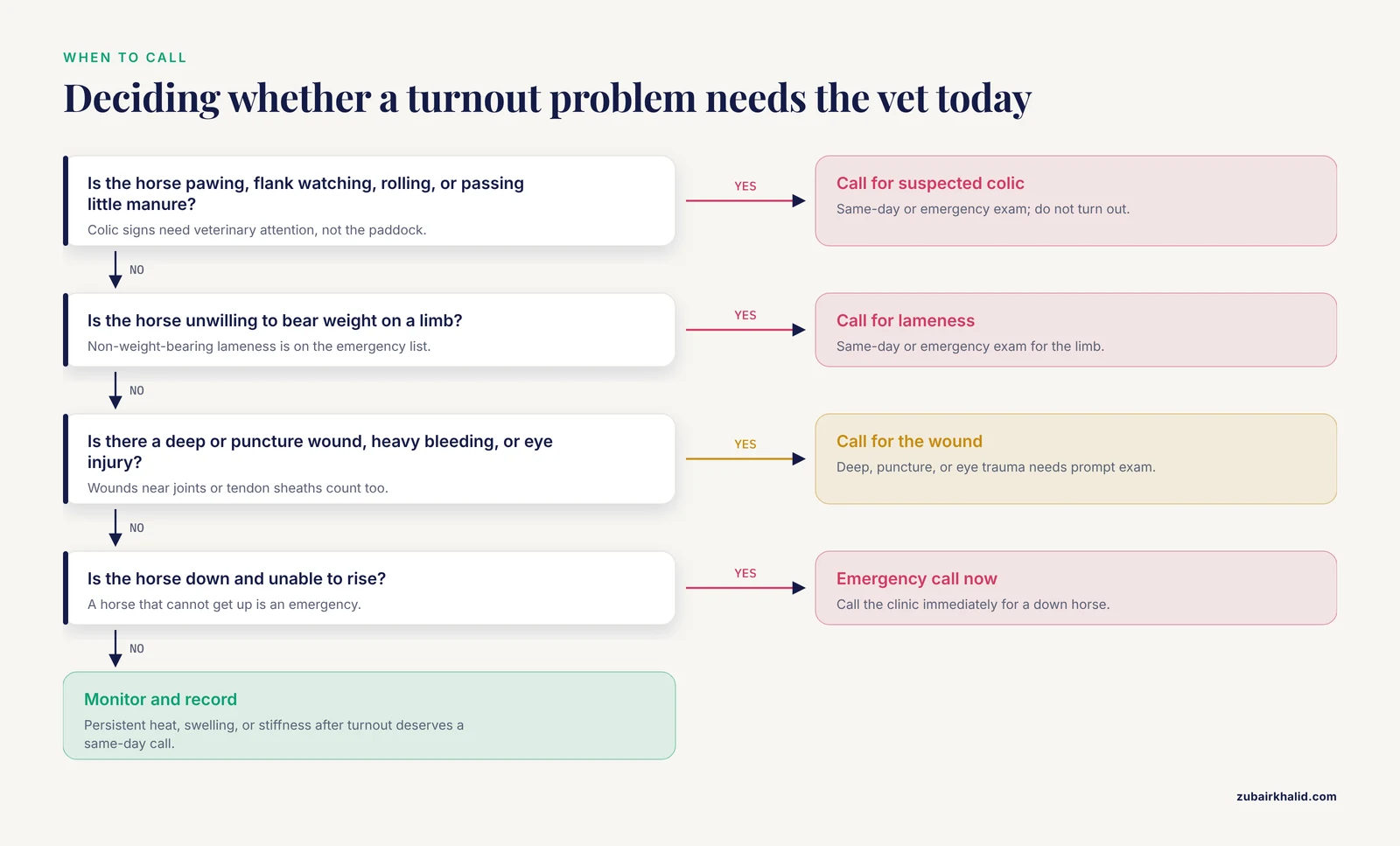
Every horse is an individual, and your veterinarian should help you tailor turnout hours, group composition, blanketing, and exercise to your horse's health status, breed, and workload.
Contact your veterinarian promptly when you see any of the following:
- Lameness, heat, or filling in a limb, or a horse that will not bear weight
- Wounds near joints or tendon sheaths, puncture wounds, or heavy bleeding
- Colic signs such as pawing, flank watching, rolling, or little or no manure
- Muscle stiffness, trembling, excessive sweating, or reluctance to move after turnout, which can signal a muscle condition such as PSSM [12]
- Not eating, not drinking, or a sudden change in manure output
- A horse isolated from its group or behaving unlike itself
- Eye injuries, nosebleeds, or a blanket that has rubbed or overheated your horse
Call for a same-day or emergency exam for suspected colic, non-weight-bearing lameness, deep wounds, eye trauma, or a horse that is down and cannot rise. When in doubt, a phone call to your veterinary clinic settles the question.
Frequently Asked Questions
How many hours of turnout does a horse need?
Aim for the longest safe turnout your horse's health, your facilities, and your land can support. Research on management styles links longer turnout with better welfare, while very restrictive turnout, especially without companions or forage, carries real costs. Treat the number of hours as a deliberate choice you make with your veterinarian, not an accident of the schedule.
Is it safe to turn my horse out with other horses?
For most horses, yes, and social contact is a core need. Safety comes from gradual fence-line introductions, compatible groupings by size and temperament, generous space, and supervision of early turnout sessions. Horses that cannot share a paddock can still get adjacent-paddock or visual contact.
What size paddock do I need for group turnout?
More space per horse is consistently better for group turnout. If space is limited, split the group into smaller subgroups on rotation instead of crowding everyone together, and expand the area whenever you can.
Should I blanket my horse for winter turnout?
Blanket for the horse in front of you, not the calendar. Coat type, body condition, clipping, shelter access, wind, and rain matter more than the date, and blanketing can interfere with natural thermoregulation. Check under the blanket daily for rubs, moisture, or sweating.
Can a senior horse with arthritis still have daily turnout?
In most cases, yes, and movement usually helps. Ask your veterinarian about footing, group mates, shelter, and pain management, because seniors with chronic orthopedic disease often do well with well-designed daily turnout.
What should I write in my horse's daily health record?
Log the date, weather, blanket status, turnout hours, turnout group, appetite, water intake, manure and urine, attitude, gait, and any injuries or treatments, then add a weekly weight or body condition note. A short daily entry beats an occasional essay, because patterns are what your veterinarian needs.
Do horses need shade in the paddock?
Yes, shade should be available in hot weather. Offering shade alongside open space, and cooling options such as misting where practical, lets each horse manage its own comfort instead of forcing one answer on the whole group.
When is a turnout injury a veterinary emergency?
Call your veterinarian immediately for a non-weight-bearing horse, deep or puncture wounds, heavy bleeding, eye injuries, suspected colic, or a horse that is down and cannot rise. Persistent heat and swelling, or stiffness and reluctance to move after turnout, also deserve a same-day call.
Sources
- Choice for the horse is paramount: Owners' experiences in facilitating friends, forage, and freedom in their management practices.
- Equine Activity Time Budgets: The Effect of Housing and Management Conditions on Geriatric Horses and Horses with Chronic Orthopaedic Disease.
- Friends, forage, freedom: A cluster analysis investigating horse management styles and welfare in the UK and Ireland.
- Differences between facilities in horse welfare profiles: slight differences in management/working conditions may be enough.
- Dietary and management factors influence the equine gastric microbiome.
- Management of horses with focus on blanketing and clipping practices reported by members of the Swedish and Norwegian equestrian community.
- Horse Preferences for Insolation, Shade or Mist Curtain in the Paddock under Heat Conditions: Cardiac and Behavioural Response Analysis.
- A Nordic survey of management practices and owners' attitudes towards keeping horses in groups.
- Effect of Pen Size on Stress Responses of Stall-Housed Horses Receiving One Hour of Daily Turnout.
- Characterization of Forage Utilization and Pasture Management Practices on Florida Horse Operations.
- An Exploration of Environmentally Sustainable Practices Associated with Alternative Grazing Management System Use for Horses, Ponies, Donkeys and Mules in the UK.
- Epidemiologic characteristics and management of polysaccharide storage myopathy in Quarter Horses.
- Ohio horse industry survey: feeding and housing management practices.