Supplements for Horses: What Actually Works
By Dr. Zubair Khalid, DVM, MS, PhD ·

The one-sentence difference between a useful supplement and a useless one is this: a useful supplement corrects a documented gap or supports a diagnosed problem, while a useless one adds cost, scoop complexity, and risk to a horse whose base diet already covers the need. The rule of thumb for choosing is simple. Feed a forage-first diet, identify what that forage and your horse's actual workload are missing, and buy only what closes a specific, verified gap. Everything else in the aisle is marketing.
This horse supplements guide walks through the major supplement categories sold to horse owners, explains the honest case for and against each one, compares them side by side, and then shows you how to turn all of it into a short checklist and a health record you actually maintain. Nutrition research across animal species consistently shows two things that apply directly here. Requirements change across life stages, and nutrient adequacy depends on the whole diet rather than any single additive. Getting the base ration right matters more than any bucket on the shelf.
This article is educational and is not a substitute for veterinary diagnosis or treatment.
Why the Equine Supplement Market Is So Confusing
Supplements for horses are sold in a regulatory environment very different from pharmaceuticals. Products intended to affect the structure or function of the body are generally marketed without the pre-market approval process required for drugs, which means a supplement can carry strong claims on the label with far less evidence behind it than the wording implies. The practical consequence for owners is that the loudest claim on a tub is the least reliable piece of information on it.
The American Association of Equine Practitioners has repeatedly emphasized that a forage-based diet, matched to the horse's workload and life stage, meets the needs of most horses, and that supplementation should follow an assessment rather than precede it. Kentucky Equine Research and the Merck Veterinary Manual make the same point in their owner-facing nutrition resources. Forage and a fortified concentrate, where needed, deliver the majority of nutritional requirements. Supplements occupy the narrow space left over after that foundation is in place.
There is also a herd-level pattern worth knowing. Nutritional research across domesticated species shows that problems at one life stage often trace back to nutrition at an earlier stage, and that a diet suited to one phase of life can be actively unsuitable for another. In horses, this shows up as the difference between the growing youngster, the broodmare, the performance horse, and the senior. A supplement plan built for one of those horses frequently gets passed along to another, which is where over-supplementation injuries tend to begin.
The Core Comparison: Supplement Categories Side by Side
This table is the heart of the article. Evidence strength here reflects the general level of veterinary and nutritional consensus, described qualitatively rather than with invented figures.
| Supplement category | Marketed for | Strength of evidence | When it is genuinely useful | Main drawbacks |
|---|---|---|---|---|
| Salt and electrolytes | Replacing minerals lost in sweat, encouraging drinking | Strong for the concept of salt provision, situational for commercial electrolyte products | All horses need a plain salt source. Added electrolytes matter for horses in sustained sweat-producing work or hot climates | Unnecessary flavored products, sugar-heavy formulas, horses that do not drink enough even when offered |
| Vitamin E and selenium | Muscle health, antioxidant support, ties up | Strong when correcting a verified deficiency, weak when added indiscriminately | Horses on poor selenium soils, horses with no access to fresh pasture, horses under veterinary care for muscle disorders | Selenium has a narrow safety margin. Fat-soluble vitamins accumulate. Stacking products causes overdose |
| Joint supplements (glucosamine, chondroitin, MSM) | Cartilage support, arthritis comfort | Weak to moderate. Oral absorption and clinical benefit remain debated | Reasonable to try in working or senior horses with mild stiffness, only alongside veterinary management of the underlying problem | Cost, variable product quality, owners substituting them for diagnosis and real treatment |
| Omega-3 fatty acids | Coat shine, inflammatory response, joint and respiratory support | Moderate for coat and palatability effects, weaker for disease-modifying claims | Horses on all-dry diets with no pasture, horses needing calorie-dense fat sources such as oil | Spoiled oil tastes bad and loses value, added calories can tip an easy keeper over |
| Biotin and hoof supplements | Hoof wall strength, growth rate | Moderate in horses with documented poor hoof quality, minimal in horses with already healthy feet | Horses with weak, cracking hoof walls confirmed by farrier and veterinarian input | Months of dosing before any visible change, slow hoof growth makes cause and effect hard to judge |
| Probiotics and digestive support | Gut stability, colic prevention, weight gain | Weak to moderate and strain-dependent. Colic prevention is not supported | Horses during dietary transitions or antibiotic courses, on a veterinarian's advice | Probiotic products vary enormously in the organisms they actually contain, claims about colic prevention are not supported |
| Gastric support products | Ulcer prevention, buffering stomach acid | Weak for commercial supplements compared with prescribed medication | Only as an adjunct after a veterinarian has diagnosed and is managing the ulcer problem | Owners use them in place of veterinary treatment, which allows disease to progress |
| Herbal and calming products | Anxiety, focus, behavior | Weak. Most have no controlled equine trials, some contain controlled substances | Rarely justified. Behavioral problems deserve a workup first | Undisclosed ingredients, positive drug tests in competition, unpredictable herb-drug interactions |
| Weight and condition additives (oil, rice bran) | Calories for hard keepers | Strong as calorie sources, conditional as supplements | Adding safe, non-grain calories to underweight or hard-working horses | Easy weight gain is a hazard in easy keepers, excess fat can cause digestive upset |
Read this table as a triage tool. The top two rows deserve money almost universally in some form. The middle rows deserve money only in specific, identifiable situations. The bottom rows deserve skepticism regardless of how convincing the marketing is.
Salt and Electrolytes: The One Almost Everyone Needs
Plain white salt is the closest thing the equine supplement world has to a consensus product. Horses have a natural sodium appetite, and free-choice access to a salt block or loose salt is standard advice across every major equine nutrition resource, including the Merck Veterinary Manual and Kentucky Equine Research owner materials.
Electrolyte supplementation beyond plain salt becomes genuinely useful in a narrower situation. A horse that sweats heavily and repeatedly, through intense training, hot humid weather, or long competitive days, loses substantial minerals in sweat and benefits from targeted replacement. This is one of the few supplement decisions where workload alone can justify the purchase.
Pros: Cheap, well supported, directly addresses a real physiological need, can encourage water intake when appropriately used.
Cons: Commercial electrolyte products are often overpriced sugar and flavoring. A horse that sweats a little on weekends does not need a performance electrolyte. And no electrolyte product fixes the underlying problem of a horse that is not drinking enough, which always warrants a veterinary conversation.
Vitamin E and Selenium: High Value, Low Safety Margin
This category illustrates both the best and worst of the supplement market. Vitamin E and selenium work together as antioxidants in muscle tissue, and horses without access to green pasture can fall short on vitamin E because the vitamin degrades quickly once forage is cut and stored. Horses living in regions with selenium-poor soils can fall short on selenium through their forage.
Used correctly, supplementation in these situations is legitimate and sometimes essential. Used incorrectly, it is dangerous. Selenium sits in a narrow window between too little and too much, and stacked products, a joint supplement that contains selenium plus a hoof supplement that contains selenium plus a multivitamin that contains selenium, can push a horse over the line. Fat-soluble vitamins accumulate in the body in a way water-soluble ones do not, so the overdose risk with vitamin products is real rather than theoretical.
Pros: Corrects real deficiencies in specific geographic and management situations, supported by veterinary consensus for diagnosed cases.
Cons: Requires testing and calculation rather than guesswork. Blood work can establish selenium status, and forage analysis can establish what the hay actually provides. A veterinarian or equine nutritionist should do that math, not the label.
Joint Supplements: The Most Sold and Least Proven
Glucosamine, chondroitin, and MSM products are the volume leaders in the supplement market, and they are also the category where the gap between marketing and evidence is widest. Oral joint supplements in horses face two scientific problems. First, absorption of the active ingredients through the digestive tract is variable and debated. Second, even where absorption occurs, demonstrating a meaningful clinical effect in a controlled setting has proven difficult.
That does not make every joint supplement a scam. It makes them an unproven, moderately priced bet that some owners consider reasonable for a working horse showing mild stiffness, provided the owner understands what they are buying. The critical mistake is substitution. A joint supplement is not a diagnosis, and it is not a treatment plan. Lameness has causes that range from hoof imbalance to soft tissue injury, and managing those causes requires a veterinarian, not a scoop of powder. The American Association of Equine Practitioners resources on lameness and senior horse care consistently frame supplements as adjuncts at most.
Pros: Low risk of direct harm, some horses appear more comfortable, sensible owners often view the cost as an acceptable experiment alongside proper care.
Cons: Expensive over months, quality varies between manufacturers, no substitute for veterinary diagnosis, and stiff horses can worsen while an owner waits for a powder to work.
Omega-3 Fatty Acids: Modest and Defensible
Horses evolved eating varied fresh forage, which delivers a fatty acid profile quite different from a diet of dry hay and grain. Omega-3 supplementation, commonly through flaxseed or fish oil, has a moderate evidence base for visible coat quality and general dietary balance, and weaker support for the more dramatic claims about joints, airway inflammation, and metabolic disease.
Where omega-3s fit best in practice is with horses that have no pasture access at all and with hard keepers that need extra calories in a safe form. Oil is a dense calorie source, and for an underweight performance horse it can serve double duty.
Pros: Reasonable evidence for coat and general nutritional value, useful calorie source, low risk at sensible amounts.
Cons: Oils go rancid and rancid fat is unpalatable and nutritionally degraded, calories are not free, and easy keepers or horses with metabolic concerns may not tolerate added fat calories well.
Biotin and Hoof Products: Patience Required, Expectations Managed
Hoof supplements, usually built around biotin with methionine, zinc, and other nutrients, occupy a middle tier. The hoof wall grows slowly, so any real effect takes months, and improvements show up mainly in horses whose hoof quality was poor to begin with. Horses with strong feet gain little from biotin at any dose.
The correct workflow here is farrier first, veterinarian second, supplement third. Hoof cracks and weak walls can reflect trimming intervals, environmental cycling between wet and dry, underlying disease, or simple genetics. A supplement addresses only the last portion of that list where a nutritional shortfall actually exists.
Pros: Legitimate for confirmed poor hoof quality, low risk, well-tolerated.
Cons: Slow, expensive waiting period, easy to confuse farriery improvements with supplement effects, and repeated purchases of hoof products are a common hidden cost in the horse care budget.
Digestive Supplements and Gastric Support: Handle With Care
The digestive category includes probiotics, prebiotics, yeast products, and buffering agents. The honest assessment is that quality varies more in this category than in any other. Probiotic effectiveness depends entirely on the specific organisms, their count, and their survival through storage and stomach acid, and independent verification of what is actually in the tub is limited.
There are reasonable, narrow uses. A veterinarian may recommend digestive support during a major feed transition or alongside antibiotic treatment. What the evidence does not support is the routine use of these products as colic insurance. Colic has many causes, most of them unrelated to the probiotic content of the gut, and owners who buy digestive supplements as colic prevention are buying comfort for themselves rather than protection for the horse.
Gastric support products deserve their own warning. Equine gastric ulcer syndrome is a real and common disease in performance horses, but it is diagnosed and treated with veterinary tools. Over-the-counter gastric supplements are not equivalent to prescription treatment, and using them in place of a proper workup allows a painful, treatable condition to continue.
Herbal and Calming Products: The Category to Skip
Herbal calmers are the category where owners should apply the most skepticism, for three reasons. The evidence base in horses is thin. Ingredient disclosure is often incomplete. And some herbal ingredients, or contaminants within them, can produce positive results on drug tests at competitions governed by strict medication rules, creating a career problem out of a calming problem.
A horse that is anxious, spooky, or difficult deserves a systematic look first. Pain, gastric ulcers, husbandry that leaves the horse stabled too long, inconsistent handling, and eyesight problems all present as behavior. Masking the symptom with an unlabeled powder delays the real answer.
Building the Plan: Life Stage, Workload, and Forage
Three variables decide almost every legitimate supplement decision.
Life stage. Growing horses, broodmares, performance horses, and seniors have genuinely different requirements. This principle is consistent across animal nutrition research, and equine practice reflects it. What matters is not the specific product but the discipline of matching the plan to the stage the horse is actually in rather than the one it was in last year.
Workload. A horse in light paddock exercise and a horse in active competition are nutritionally different animals, mainly in calorie need, sweat losses, and antioxidant demand.
Forage. Hay and pasture are the diet, and everything else is adjustment. A forage analysis tells you what your hay provides and what it lacks. Without that information, supplement decisions are guesses. With it, they become arithmetic.
Worked Scenarios
Scenario one. An easy keeper on good pasture, ridden twice a week. This horse needs a salt source, and likely nothing else. Adding a joint supplement, a coat supplement, and a multivitamin to this horse adds calories, cost, and stacking risk with no identified need. This is the scenario where the best horse supplements guide advice is to buy less.
Scenario two. A hard-keeping event horse in full work, stabled with no pasture. Legitimate needs stack up here. Salt and electrolytes for sweat losses, vitamin E because there is no fresh grass, omega-3 or oil for calories and fatty acid balance, and possibly a joint supplement as an owner-chosen adjunct to a veterinary lameness and conditioning program. Every one of these should follow forage analysis and veterinary input.
Scenario three. A senior horse with mild stiffness and weight loss. Seniors often need easier-to-chew forage and more calorie density, which can make senior feeds or oil more important than any pill. A joint supplement is a fair trial alongside proper veterinary management. Full senior blood work first is the smarter order of operations, because weight loss and stiffness can both signal diseases that no supplement touches.
The Horse Care Checklist for Supplement Decisions
Run this horse care checklist before buying anything new.
- Have a current forage analysis for the hay actually being fed.
- Have the horse's body condition assessed honestly, by weight tape or scale, not by memory.
- List every product currently fed, including ingredients, and check for overlapping nutrients, especially selenium and fat-soluble vitamins.
- Ask whether the target problem is diagnosed or assumed.
- Confirm with a veterinarian that any horse in competition can take the product under applicable medication rules.
- Set a review date. Reassess at 60 to 90 days and drop anything that produced nothing.
- Confirm the horse is fully vaccinated, dewormed per veterinary guidance, and seen by the farrier on schedule, because these basic health measures outweigh any supplement in the bucket.
The Horse Health Record Template for Supplements
A horse health record template turns supplement decisions from memory into data. At minimum, log the following for each product.
- Product name, manufacturer, and batch or lot number
- Amount fed per day and the scoop actually used, measured once in grams rather than guessed
- Start date and reason for starting
- Observed changes, recorded monthly, in plain notes
- Any blood work or forage analysis results with dates
- Stop date and the reason for stopping
- Baseline photographs for claims involving coat, hooves, or body condition, taken under identical lighting and stance
This record does two jobs. It prevents stacking errors when products change, and it gives your veterinarian an accurate picture instead of an approximate one at every visit.
Common Mix-Ups Owners Make
Stacking overlapping products. The most common and the most preventable error. Three products each containing selenium is not three times the support. It is a toxicity risk.
Supplementing instead of diagnosing. A stiff horse, a thin horse, and a dull coat are signals, not conditions. The supplement aisle cannot tell you why any of them is happening.
Feeding by the scoop, not the label. Scoops vary, densities vary, and portion confusion is routine. Weigh the scoop once for each product.
Believing that natural means safe. Plants concentrate compounds, some of which are pharmacologically active, and herbals interact with medications in documented ways across species.
Ignoring the diet entirely. No supplement compensates for insufficient forage, bad teeth, or a parasite burden. Fix those first.
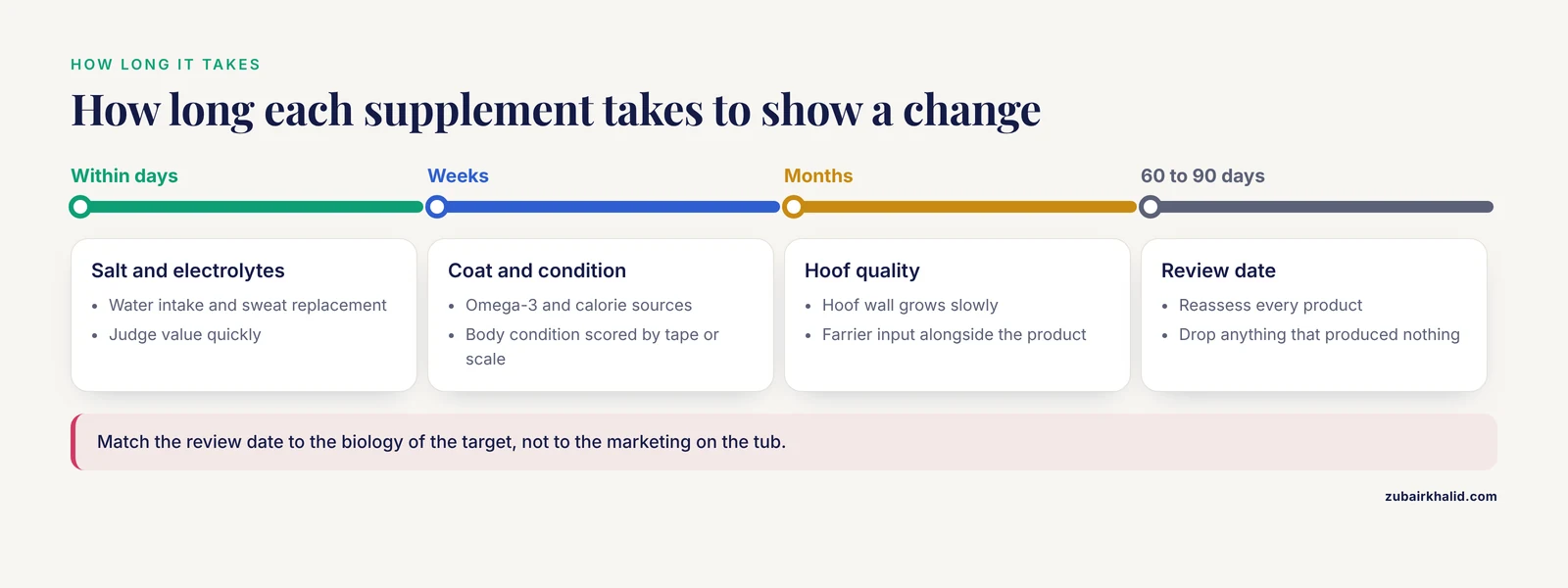
Judging too fast or too slow. Hoof products need months. Electrolytes show their value within days. Expecting coat change from a joint supplement, or hoof change from an omega-3, is a mismatch between product and promise.
Limitations and When to Contact a Veterinarian
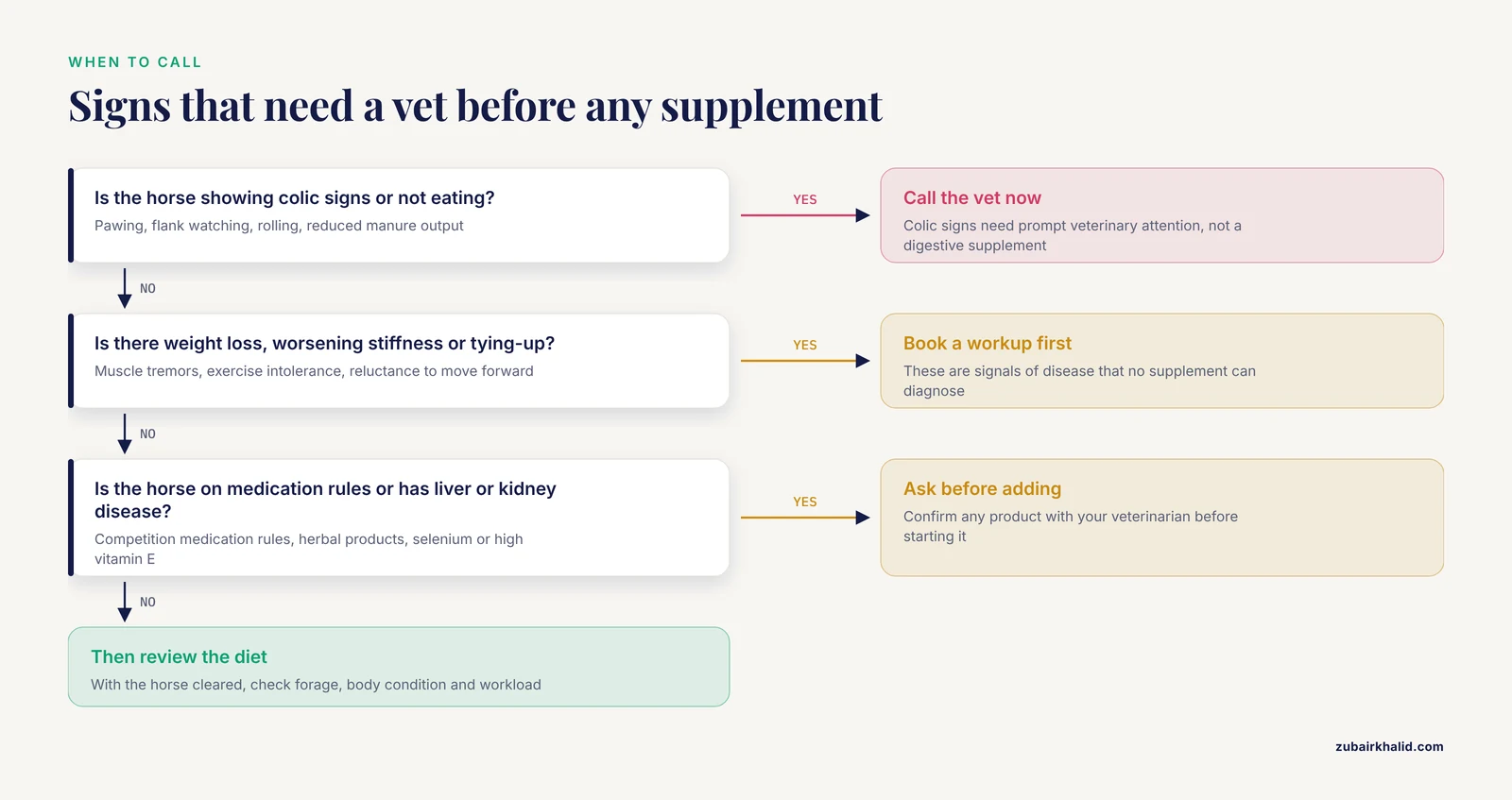
Every individual case needs a veterinarian. Supplement decisions interact with the horse's age, workload, forage, geography, medical history, and competition status, and this article can frame those decisions but cannot make them for a specific animal.
Contact your veterinarian promptly rather than adjusting supplements on your own in any of the following situations.
- Sudden weight loss, weight gain difficulty, or a change in appetite
- Signs of colic, including pawing, flank watching, rolling, or reduced manure output
- Lameness, stiffness that worsens, or reluctance to move forward
- Muscle tremors, tying-up episodes, or exercise intolerance
- Neurologic signs, including incoordination or abnormal behavior
- Suspected gastric ulcers, especially in a performance horse with poor appetite or attitude under saddle
- Any horse competing under medication rules, before adding any product, herbal or otherwise
- Before starting selenium, vitamin E at higher amounts, or any product for a horse with kidney or liver disease
Frequently Asked Questions
Do all horses need supplements?
No. Many horses on good forage with a plain salt source and a fortified balancer or concentrate need nothing beyond that. Supplementation should follow an identified gap, not a marketing claim.
What is the best horse supplement to start with?
Plain salt, available free choice, is the best starting point for nearly every horse. After that, decisions depend on forage analysis, workload, and life stage, discussed with your veterinarian.
Are joint supplements for horses worth the money?
The evidence for oral joint supplements is weak to moderate, and they are best viewed as an optional adjunct, never a substitute for veterinary diagnosis and management of lameness. Their value is a personal cost-benefit judgment made with full knowledge of that evidence gap.
Can I give my horse too many supplements?
Yes. Stacking products is the most common over-supplementation error, and nutrients like selenium and the fat-soluble vitamins carry genuine toxicity risk at excessive amounts. Audit every product you feed for overlapping ingredients.
How long before I see results from a supplement?
It depends on the target. Electrolyte and salt effects appear within days. Coat and condition changes take weeks. Hoof quality changes take months because the hoof wall grows slowly, so set review dates that match the biology.
Are herbal or natural supplements safer than synthetic ones?
No. Natural origin says nothing about safety, dose control, or purity. Some herbal products carry competition drug-test risks and undisclosed ingredients, so discuss any herbal product with your veterinarian before use.
Further Reading
- Trophic Requirements of the Sea Urchin Paracentrotus lividus Varies at Different Life Stages: Comprehension of Species Ecology and Implications for Effective Feeding Formulations
- Effects of Diet on the Gut Microbial Communities of Nile Tilapia (Oreochromis niloticus) Across Their Different Life Stages
- Impact of feed ration on the growth and body weight variation in pikeperch (Sander lucioperca L.) at different life stages in a recirculating aquaculture system
- Symposium on nutrition and cognition: towards research and application for different life stages.
- Feeding the mind: Nutritional strategies across different stages of Alzheimer's disease and their significance.
- Navigating nutrition through the decades: Tailoring dietary strategies to women's life stages.